

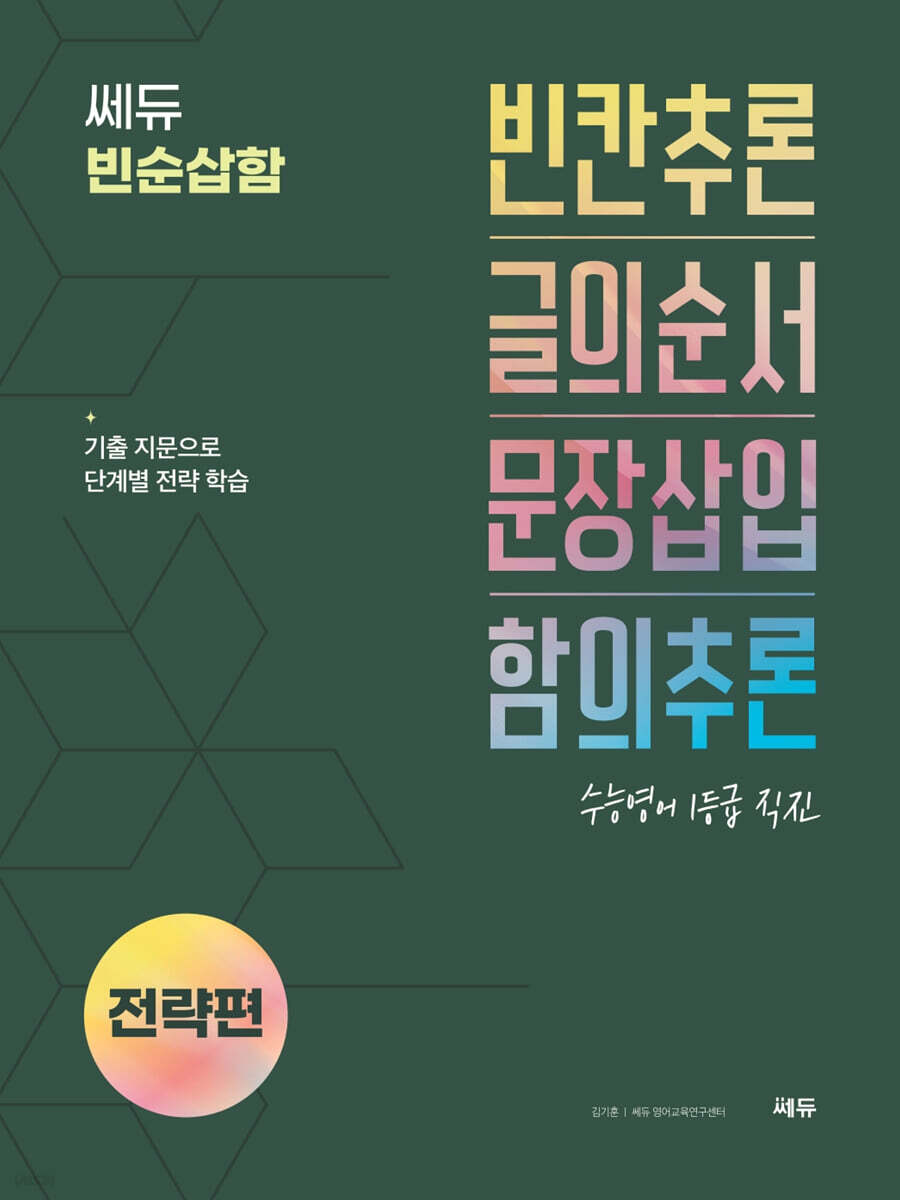
Sedu Binsun Insertion Strategy
 |
Description
Book Introduction
Inference in the blank is a representative type of question with the highest error rate in the English section of the CSAT. Since the introduction of absolute evaluation, the order of writing and the type of sentence insertion have shown as high an error rate as the blank inference. In addition, the implication inference type has been tested once a year since it first appeared in the mock exam in June 2018, and is considered a very difficult type with an average correct answer rate of about 50%. This textbook is designed to enable systematic strategic learning and application training. |
- You can preview some of the book's contents.
Preview
index
Preparation Part 1: Preparing for new exam trends after the 24th academic year
Preparation 2: Clues to Understanding Logical Flow: Connecting Words
01 Fill in the blank
Strategy Point 1: Finding the correct answer when there is a blank space at the beginning
Strategy Point 2: Finding the correct answer when the blank is in the middle
Strategy Point 3: Finding the correct answer when there is a blank space in the latter half
Strategy Point 4: Finding the Answer When the Blank Space is at the End
Actual Test 1
Actual Test 2
02 Order of text
Strategy Point 1: Finding the Answer Using Grammatical Clues
Strategy Point 2: Find the answer using the connecting word clue
Strategy Point 3: Finding the Answer Through Content Flow
Actual Test 1
Actual Test 2
03 Insert sentence
Strategy Point 1: Finding the Answer Using Grammatical Clues
Strategy Point 2: Find the answer using the connecting word clue
Strategy Point 3: Finding the Answer Through the Content Flow
Actual Test 1
Actual Test 2
04 Inference of implications
Strategy Point 1: Find clues from the underlined sentence and its context.
Strategy Point 2: Find the correct answer based on the topic of the article
Actual Test 1
Actual Test 2
Final Check 1
Final Check 2
Final Check 3
Answer and explanation
Preparation 2: Clues to Understanding Logical Flow: Connecting Words
01 Fill in the blank
Strategy Point 1: Finding the correct answer when there is a blank space at the beginning
Strategy Point 2: Finding the correct answer when the blank is in the middle
Strategy Point 3: Finding the correct answer when there is a blank space in the latter half
Strategy Point 4: Finding the Answer When the Blank Space is at the End
Actual Test 1
Actual Test 2
02 Order of text
Strategy Point 1: Finding the Answer Using Grammatical Clues
Strategy Point 2: Find the answer using the connecting word clue
Strategy Point 3: Finding the Answer Through Content Flow
Actual Test 1
Actual Test 2
03 Insert sentence
Strategy Point 1: Finding the Answer Using Grammatical Clues
Strategy Point 2: Find the answer using the connecting word clue
Strategy Point 3: Finding the Answer Through the Content Flow
Actual Test 1
Actual Test 2
04 Inference of implications
Strategy Point 1: Find clues from the underlined sentence and its context.
Strategy Point 2: Find the correct answer based on the topic of the article
Actual Test 1
Actual Test 2
Final Check 1
Final Check 2
Final Check 3
Answer and explanation
Detailed image

Publisher's Review
Learning strategic points through past exam questions by type
Extract past exam questions including each strategy point to check and study actual exam trends.
In the 'Beware of Pitfalls' section, learn about areas that require special attention through simple solutions to past exam questions and examples.
After learning how to apply effective strategies to the selected key parts, you can learn step-by-step by solving problems in the entire previous exam passage.
Training to develop a sense of real-world exams with two tests consisting of five practice questions per chapter.
After completing the entire learning process, do a final check by solving one question of each type, for a total of four questions.
Customized commentary by type, providing detailed clues to understanding the basis for reasoning and the flow of content
Direct reading, syntactic analysis, and vocabulary organization to help analyze and understand the text
Inference in the blank is the most common type of question with the highest error rate in the English section of the CSAT.
Since the introduction of absolute evaluation, the order of writing and the type of sentence insertion have shown as high an error rate as the blank inference.
In addition, the implication inference type has been tested once a year since it first appeared in the mock exam in June 2018, and is considered a very difficult type with an average correct answer rate of approximately 50%.
Among the 28 English reading comprehension questions in the CSAT, the difficult types mentioned above account for a total of 9 questions, and most of them are worth 3 points, so the total score is 22-25 points.
So if you get all of these wrong, you will get a grade lower than 3.
These high-difficulty questions require advanced logical reasoning skills to differentiate top students, so the error rate is bound to be high.
Simply interpreting a few sentences accurately is not enough; it is important to clearly infer the basis for the right and wrong answers based on logic.
This logical reasoning ability is not automatically developed simply by solving many problems.
After deeply understanding the strategies for finding clues to the correct answer intended by the examiner and avoiding incorrect answers, it is necessary to internalize these strategies so that they can be naturally applied in real-life situations.
Accordingly, this textbook is structured to enable systematic strategic learning and application training by focusing on these four main types.
1. Type-specific past exam points and strategies
We review key points of problem solving by type through the latest exam questions and present solution strategies to avoid traps intended by the examiner.
Step 2: Apply and Troubleshoot
After learning key strategic points from past exam questions, you can apply those contents to the entire past exam passage, and then apply the strategies to actual exam questions to develop a sense of the actual exam.
Absolute evaluation is an exam that shows your performance in proportion to how much you have studied.
We hope that you will be able to reach your target grade through systematic study and training in this textbook.
We hope you will do your best until the end and achieve your goals!
· Step-by-step strategy learning with past exam questions
· Practical test questions for strategy application
· Type-specific, customized commentary to help you find clues
Extract past exam questions including each strategy point to check and study actual exam trends.
In the 'Beware of Pitfalls' section, learn about areas that require special attention through simple solutions to past exam questions and examples.
After learning how to apply effective strategies to the selected key parts, you can learn step-by-step by solving problems in the entire previous exam passage.
Training to develop a sense of real-world exams with two tests consisting of five practice questions per chapter.
After completing the entire learning process, do a final check by solving one question of each type, for a total of four questions.
Customized commentary by type, providing detailed clues to understanding the basis for reasoning and the flow of content
Direct reading, syntactic analysis, and vocabulary organization to help analyze and understand the text
Inference in the blank is the most common type of question with the highest error rate in the English section of the CSAT.
Since the introduction of absolute evaluation, the order of writing and the type of sentence insertion have shown as high an error rate as the blank inference.
In addition, the implication inference type has been tested once a year since it first appeared in the mock exam in June 2018, and is considered a very difficult type with an average correct answer rate of approximately 50%.
Among the 28 English reading comprehension questions in the CSAT, the difficult types mentioned above account for a total of 9 questions, and most of them are worth 3 points, so the total score is 22-25 points.
So if you get all of these wrong, you will get a grade lower than 3.
These high-difficulty questions require advanced logical reasoning skills to differentiate top students, so the error rate is bound to be high.
Simply interpreting a few sentences accurately is not enough; it is important to clearly infer the basis for the right and wrong answers based on logic.
This logical reasoning ability is not automatically developed simply by solving many problems.
After deeply understanding the strategies for finding clues to the correct answer intended by the examiner and avoiding incorrect answers, it is necessary to internalize these strategies so that they can be naturally applied in real-life situations.
Accordingly, this textbook is structured to enable systematic strategic learning and application training by focusing on these four main types.
1. Type-specific past exam points and strategies
We review key points of problem solving by type through the latest exam questions and present solution strategies to avoid traps intended by the examiner.
Step 2: Apply and Troubleshoot
After learning key strategic points from past exam questions, you can apply those contents to the entire past exam passage, and then apply the strategies to actual exam questions to develop a sense of the actual exam.
Absolute evaluation is an exam that shows your performance in proportion to how much you have studied.
We hope that you will be able to reach your target grade through systematic study and training in this textbook.
We hope you will do your best until the end and achieve your goals!
· Step-by-step strategy learning with past exam questions
· Practical test questions for strategy application
· Type-specific, customized commentary to help you find clues
GOODS SPECIFICS
- Date of issue: October 4, 2024
- Page count, weight, size: 256 pages | 210*280*20mm
- ISBN13: 9788968064364
- ISBN10: 8968064369
You may also like
카테고리
korean


korean

![GQ KOREA Mark (Monthly): December [2025]](http://librairie.coreenne.fr/cdn/shop/files/8ef265dbbfbf186523ed75ba7319009d.jpg?v=1765340328&width=3840)


