

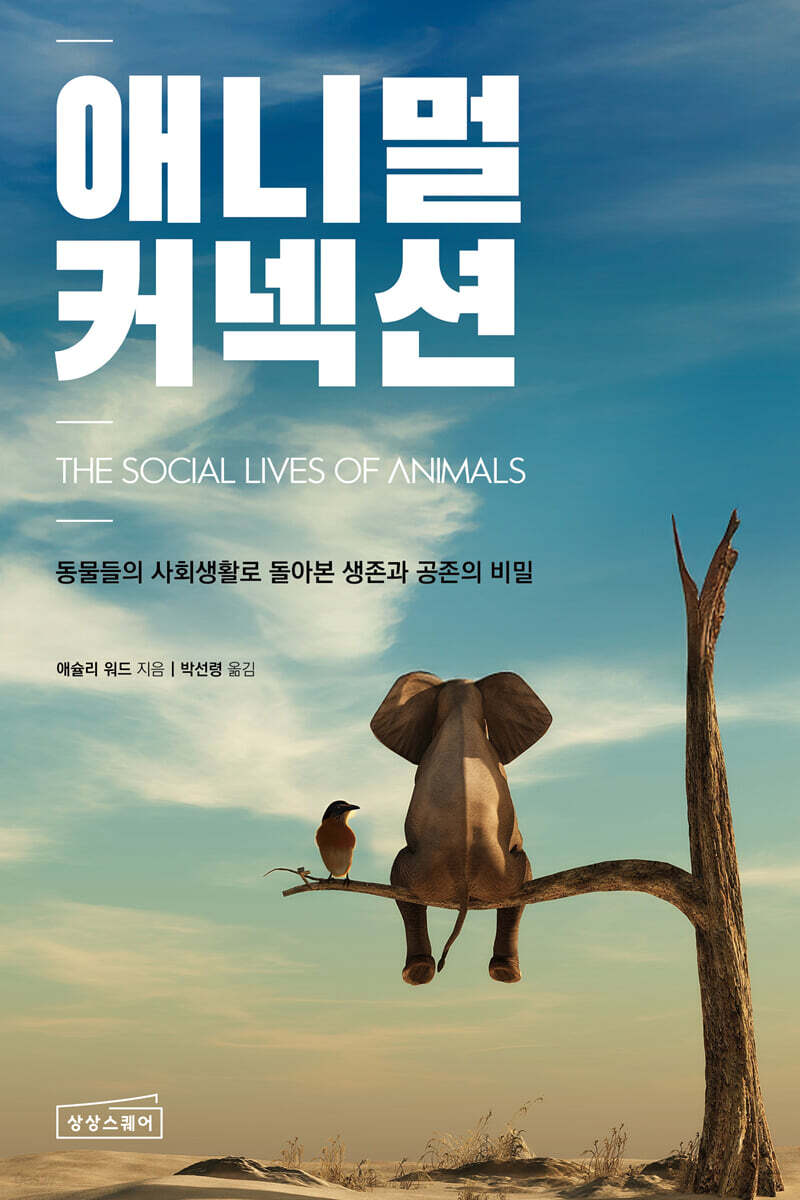
Animal Connection
 |
Description
Book Introduction
The amazing and affectionate social lives of animals,
The secret of desperate survival and coexistence
The rat selflessly helps a stranger in trouble.
Lions surprisingly adopt the cubs of their prey, and ants form communities to farm and build homes.
So why do we still believe that the wild, the animal world, is sustained by competition and the survival of the fittest? How can we define animal savagery and human sociality?
In "Animal Connection," biologist Ashley Ward travels the world in search of a more accurate picture of how animals create societies.
You'll visit a termite mating ritual, witness guides snacking on the termites, meet freelance goat herders, and swim with a special family of whales and dolphins.
The social life of animals, including the power of cooperation and the importance of sociality, herd behavior and information sharing, the evolution and development of social structures, decision-making and collective intelligence, conflict, war, and peace.
The author unfolds the story with affection, taking us on a journey that is both awe-inspiring and exhilarating, yet never loses sight of the scientific lens.
He emphasizes that social instincts, long believed to be uniquely human, may actually be the common thread that most powerfully connects humans and animals.
"Animal Connection" delivers a humorous and profound message: "The true principles that drive nature, including both humans and animals, are not the survival of the fittest or competition, but cooperation and evolution."
The secret of desperate survival and coexistence
The rat selflessly helps a stranger in trouble.
Lions surprisingly adopt the cubs of their prey, and ants form communities to farm and build homes.
So why do we still believe that the wild, the animal world, is sustained by competition and the survival of the fittest? How can we define animal savagery and human sociality?
In "Animal Connection," biologist Ashley Ward travels the world in search of a more accurate picture of how animals create societies.
You'll visit a termite mating ritual, witness guides snacking on the termites, meet freelance goat herders, and swim with a special family of whales and dolphins.
The social life of animals, including the power of cooperation and the importance of sociality, herd behavior and information sharing, the evolution and development of social structures, decision-making and collective intelligence, conflict, war, and peace.
The author unfolds the story with affection, taking us on a journey that is both awe-inspiring and exhilarating, yet never loses sight of the scientific lens.
He emphasizes that social instincts, long believed to be uniquely human, may actually be the common thread that most powerfully connects humans and animals.
"Animal Connection" delivers a humorous and profound message: "The true principles that drive nature, including both humans and animals, are not the survival of the fittest or competition, but cooperation and evolution."
- You can preview some of the book's contents.
Preview
index
introduction
Chapter 1 | Brown Ale and Conspecific Predation
Chapter 2 | The Parenting War Between Bees and Ants
Chapter 3 | From the Ditch to the Decision
Chapter 4 | Giant Swarm Flight
Chapter 5 | The Wrong Mouse
Chapter 6 | Follow the Crowd
Chapter 7 | Blood is Thicker than Water
Chapter 8 | Whale Tail Sounds and Culture
Chapter 9 | War and Peace
Epilogue
Acknowledgements
References
Chapter 1 | Brown Ale and Conspecific Predation
Chapter 2 | The Parenting War Between Bees and Ants
Chapter 3 | From the Ditch to the Decision
Chapter 4 | Giant Swarm Flight
Chapter 5 | The Wrong Mouse
Chapter 6 | Follow the Crowd
Chapter 7 | Blood is Thicker than Water
Chapter 8 | Whale Tail Sounds and Culture
Chapter 9 | War and Peace
Epilogue
Acknowledgements
References
Detailed image

Into the book
Because krill's bodies are largely transparent, you can even see their tiny hearts beating, and when they are separated from the group, their heartbeat increases.
They react similarly when they sense that a whale is nearby.
An elevated heart rate is a primary sign of stress.
Certainly, they prefer to be with colleagues rather than alone.
--- p.25, from “Brown Ale and Predation of Species”
Krill can shed their shells abruptly when confronted by fast-moving predators such as fish or penguins.
The predator bites the krill, seemingly on the verge of victory, only to find that its mouth is empty, leaving the intended victim behind, who has fled to safety.
Another unusual feature is that krill can light up the bioluminescent cells in their shells.
It is not yet clear whether this light is a means of communication between members of the same species, a flash to confuse predators, or a silhouette that blurs the darkness of the seafloor when attacked from below.
--- p.27, from “Brown Ale and Predation of Species”
A cockroach that is isolated at a young age is truly a tragic existence.
They grow slower than others and live on the periphery of society even after becoming adults.
They have difficulty socializing or interacting properly, find it difficult to join a cockroach colony, and are excluded from mating.
If they could write, these cockroaches would write poignant poems about existential loneliness and loss.
Perhaps a surprisingly beautiful and sad poem could have been born.
--- p.55, from “The Parenting War Between Bees and Ants”
The amount of honey that can be produced from a beehive is about 40 kilograms a year, which is surprising considering that a single bee produces only a fraction of a teaspoon of honey in its lifetime.
--- p.72, from “The Parenting War Between Bees and Ants”
Horribly, the queen Amazon ant brutally murders the queen Formica to get the scent.
It chemically disguises itself by licking the victim's body while biting, stabbing, and beating them until they die.
Some colonies of Formica ants have multiple queens, so the queen Amazon ant hunts down and mercilessly kills all the Formica queens.
Now the perception system of the Formica ants has compromised with reality and accepts the queen Amazon ant as their queen.
The newly crowned queen Amazon ant settles down and lays eggs, and the enslaved Formica ants carefully raise the offspring for the new queen.
--- p.119, from “The Parenting War Between Bees and Ants”
The guppy population is divided into two distinct living environments by natural barriers.
One side is a fish paradise, the other is a predator-infested hell.
Fortunately, guppies are highly adaptable and can cope well with these environments.
A combination of individual flexibility and natural selection results in distinct differences between these two populations.
The guppies that live above the waterfall are big, colorful, and stylish, and don't tend to swim in groups, while the guppies that live below the waterfall are drab and vagrant, and they swim in groups to avoid predators.
--- p.158~159, from “From the Ditch to the Decision”
The cries that bats make when they start to wake up from their long sleep attract the attention of the birds, who fly straight to the sound.
These bats, still asleep and unable to wake up from hibernation, are easy prey for birds.
The birds peck at the bat's thin skull and eat the succulent brain inside.
Like the magpies opening milk bottles (a petty crime that doesn't seem so heinous anymore), it's claimed that this behavior is passed down between birds and through generations.
--- p.199, from “Giant Swarm Flight”
If I have to choose between a familiar cow and an unfamiliar cow, I always choose the former.
So it is difficult for new animals to join a group where adults have established themselves firmly.
As cows get older, they become more attached to their old ways.
It is also a common trait in many animals, including humans.
The flexible approach of youth gradually gives way to an aversion to change.
--- p.290, from “Follow the Crowd”
The elephants, who appeared to be silent, were actually secretly whispering.
Infrasound is a great way to communicate remotely.
Deep sounds have long wavelengths and can travel over wide ranges, making them a fantastic way to communicate over long distances when family is scattered.
When conditions are right, elephants can sense each other from up to 10 kilometers apart, and exchange more detailed information when within 2 to 3 kilometers.
--- p.302, from “Follow the Crowd”
As dawn broke, the family of the headman, eerily silent and somber, gathered around the remains, caressing them and performing a ritual that seemed to be widespread among the elephants.
After several hours of silent reflection, they began covering the remains with branches, leaves, and dirt.
As the shadows lengthened and another night approached, they remained in the same place.
--- p.315, from “Follow the Crowd”
It's gloomy.
It may seem strange to us that an adult lioness would mate with the very same lion that killed her cubs, but that is the reality of lion society.
A lioness enters estrus shortly after losing her offspring and soon begins raising another generation of cubs.
--- p.333, from “Blood is thicker than water”
The most friendly of these wolves benefited from cooperating with humans.
And our human ancestors acquired capable guards and useful hunting companions.
Over time, the bond between the two species strengthened, and the wolves became increasingly distant from their wild cousins.
You might think that humans domesticated wolves, but it would be more accurate to say that they domesticated themselves.
--- p.379, from “Blood is thicker than water”
An interesting thing about the sperm whale clans is that each clan has its own dialect, which creates its own tail sounds.
Just as regional accents can develop within human language groups, the clan dialects of whales appear to be linked to geographic range.
When sperm whales encounter each other, they can identify not only who they are talking to, but also their family group and clan.
Being able to communicate is clearly important for the cohesion of animal societies, and may be particularly important for whales to locate each other when diving to the depths and then returning.
--- p.395~396, from “The Whale’s Tail Sound and Culture”
Female killer whales rarely give birth after age 40, but they can live for decades after that.
We don't question it because it's so familiar and natural to us, but biology isn't that emotional.
Why do these old orcas continue to live despite being unable to reproduce? The answer is that promoting the success of those who share their genes is a brilliant evolutionary strategy.
--- p.415, from “The Whale’s Tail Sound and Culture”
While identifying oneself when meeting others is certainly an important use of identification whistles, dolphins take it even further.
It is to imitate the identification whistle of other dolphins it has encountered.
Dolphins are not the only animals that can identify individuals by their vocalizations, but they are the only ones that call other individuals in the wild using specific tags that we call names.
--- p.421, from “The Whale’s Tail Sound and Culture”
Although humpback whales are widely distributed throughout the world's oceans, males in each ocean basin tend to sing nearly identical songs.
Their songs are not always the same.
It changes over time as males in a particular area adjust their songs to the songs they hear and the latest songs sung by other males.
Sometimes a song can be completely different.
--- p.428, from “The Whale’s Tail Sound and Culture”
When given a choice, their favorite mate is an older, heavier female who has previously had many offspring.
Although a bit surprising, this is also a valid choice.
Such females are better able to find food, are better mothers, and are more likely to rise in the dominance hierarchy.
--- p.494, from "War and Peace"
The chimpanzee looked at the other chimpanzee's entire face in the photo, while the bonobo kept its gaze on the photo's eyes.
When presented with another full-body photograph, the chimpanzees mostly looked at the buttocks, while the bonobos' attention was divided between the face and the buttocks.
In the third photo, where another ape was holding an object in its hand, the chimpanzee looked at the object the ape was holding, while the bonobo looked at both the face and the object.
Essentially, the bonobos' gaze patterns were similar to those seen in similar experiments in humans, and particularly to those seen in highly social individuals.
They react similarly when they sense that a whale is nearby.
An elevated heart rate is a primary sign of stress.
Certainly, they prefer to be with colleagues rather than alone.
--- p.25, from “Brown Ale and Predation of Species”
Krill can shed their shells abruptly when confronted by fast-moving predators such as fish or penguins.
The predator bites the krill, seemingly on the verge of victory, only to find that its mouth is empty, leaving the intended victim behind, who has fled to safety.
Another unusual feature is that krill can light up the bioluminescent cells in their shells.
It is not yet clear whether this light is a means of communication between members of the same species, a flash to confuse predators, or a silhouette that blurs the darkness of the seafloor when attacked from below.
--- p.27, from “Brown Ale and Predation of Species”
A cockroach that is isolated at a young age is truly a tragic existence.
They grow slower than others and live on the periphery of society even after becoming adults.
They have difficulty socializing or interacting properly, find it difficult to join a cockroach colony, and are excluded from mating.
If they could write, these cockroaches would write poignant poems about existential loneliness and loss.
Perhaps a surprisingly beautiful and sad poem could have been born.
--- p.55, from “The Parenting War Between Bees and Ants”
The amount of honey that can be produced from a beehive is about 40 kilograms a year, which is surprising considering that a single bee produces only a fraction of a teaspoon of honey in its lifetime.
--- p.72, from “The Parenting War Between Bees and Ants”
Horribly, the queen Amazon ant brutally murders the queen Formica to get the scent.
It chemically disguises itself by licking the victim's body while biting, stabbing, and beating them until they die.
Some colonies of Formica ants have multiple queens, so the queen Amazon ant hunts down and mercilessly kills all the Formica queens.
Now the perception system of the Formica ants has compromised with reality and accepts the queen Amazon ant as their queen.
The newly crowned queen Amazon ant settles down and lays eggs, and the enslaved Formica ants carefully raise the offspring for the new queen.
--- p.119, from “The Parenting War Between Bees and Ants”
The guppy population is divided into two distinct living environments by natural barriers.
One side is a fish paradise, the other is a predator-infested hell.
Fortunately, guppies are highly adaptable and can cope well with these environments.
A combination of individual flexibility and natural selection results in distinct differences between these two populations.
The guppies that live above the waterfall are big, colorful, and stylish, and don't tend to swim in groups, while the guppies that live below the waterfall are drab and vagrant, and they swim in groups to avoid predators.
--- p.158~159, from “From the Ditch to the Decision”
The cries that bats make when they start to wake up from their long sleep attract the attention of the birds, who fly straight to the sound.
These bats, still asleep and unable to wake up from hibernation, are easy prey for birds.
The birds peck at the bat's thin skull and eat the succulent brain inside.
Like the magpies opening milk bottles (a petty crime that doesn't seem so heinous anymore), it's claimed that this behavior is passed down between birds and through generations.
--- p.199, from “Giant Swarm Flight”
If I have to choose between a familiar cow and an unfamiliar cow, I always choose the former.
So it is difficult for new animals to join a group where adults have established themselves firmly.
As cows get older, they become more attached to their old ways.
It is also a common trait in many animals, including humans.
The flexible approach of youth gradually gives way to an aversion to change.
--- p.290, from “Follow the Crowd”
The elephants, who appeared to be silent, were actually secretly whispering.
Infrasound is a great way to communicate remotely.
Deep sounds have long wavelengths and can travel over wide ranges, making them a fantastic way to communicate over long distances when family is scattered.
When conditions are right, elephants can sense each other from up to 10 kilometers apart, and exchange more detailed information when within 2 to 3 kilometers.
--- p.302, from “Follow the Crowd”
As dawn broke, the family of the headman, eerily silent and somber, gathered around the remains, caressing them and performing a ritual that seemed to be widespread among the elephants.
After several hours of silent reflection, they began covering the remains with branches, leaves, and dirt.
As the shadows lengthened and another night approached, they remained in the same place.
--- p.315, from “Follow the Crowd”
It's gloomy.
It may seem strange to us that an adult lioness would mate with the very same lion that killed her cubs, but that is the reality of lion society.
A lioness enters estrus shortly after losing her offspring and soon begins raising another generation of cubs.
--- p.333, from “Blood is thicker than water”
The most friendly of these wolves benefited from cooperating with humans.
And our human ancestors acquired capable guards and useful hunting companions.
Over time, the bond between the two species strengthened, and the wolves became increasingly distant from their wild cousins.
You might think that humans domesticated wolves, but it would be more accurate to say that they domesticated themselves.
--- p.379, from “Blood is thicker than water”
An interesting thing about the sperm whale clans is that each clan has its own dialect, which creates its own tail sounds.
Just as regional accents can develop within human language groups, the clan dialects of whales appear to be linked to geographic range.
When sperm whales encounter each other, they can identify not only who they are talking to, but also their family group and clan.
Being able to communicate is clearly important for the cohesion of animal societies, and may be particularly important for whales to locate each other when diving to the depths and then returning.
--- p.395~396, from “The Whale’s Tail Sound and Culture”
Female killer whales rarely give birth after age 40, but they can live for decades after that.
We don't question it because it's so familiar and natural to us, but biology isn't that emotional.
Why do these old orcas continue to live despite being unable to reproduce? The answer is that promoting the success of those who share their genes is a brilliant evolutionary strategy.
--- p.415, from “The Whale’s Tail Sound and Culture”
While identifying oneself when meeting others is certainly an important use of identification whistles, dolphins take it even further.
It is to imitate the identification whistle of other dolphins it has encountered.
Dolphins are not the only animals that can identify individuals by their vocalizations, but they are the only ones that call other individuals in the wild using specific tags that we call names.
--- p.421, from “The Whale’s Tail Sound and Culture”
Although humpback whales are widely distributed throughout the world's oceans, males in each ocean basin tend to sing nearly identical songs.
Their songs are not always the same.
It changes over time as males in a particular area adjust their songs to the songs they hear and the latest songs sung by other males.
Sometimes a song can be completely different.
--- p.428, from “The Whale’s Tail Sound and Culture”
When given a choice, their favorite mate is an older, heavier female who has previously had many offspring.
Although a bit surprising, this is also a valid choice.
Such females are better able to find food, are better mothers, and are more likely to rise in the dominance hierarchy.
--- p.494, from "War and Peace"
The chimpanzee looked at the other chimpanzee's entire face in the photo, while the bonobo kept its gaze on the photo's eyes.
When presented with another full-body photograph, the chimpanzees mostly looked at the buttocks, while the bonobos' attention was divided between the face and the buttocks.
In the third photo, where another ape was holding an object in its hand, the chimpanzee looked at the object the ape was holding, while the bonobo looked at both the face and the object.
Essentially, the bonobos' gaze patterns were similar to those seen in similar experiments in humans, and particularly to those seen in highly social individuals.
--- p.514, from “War and Peace”
Publisher's Review
The Truth About the Social Bonds That Connect Humans and Animals
The wise and poignant ways of animals, who alternate between cooperation and competition.
A story of animal cooperation and survival from the most entertaining zoologist of our time.
If you still believe humans are the "kings of creation," and that the ability to enhance the quality of life through sociality and cooperation is a uniquely human characteristic, this book, which challenges that belief and presents a series of twists and turns, will be even more captivating.
Biologist Ashley Ward, who opened a new world to readers with "Sensational," a new scientific approach to all the senses in nature, now delves into the "social lives of animals."
In "Animal Connection," he highlights the evolutionary logic and profound values hidden in the social lives of animals, emphasizing that this can help us better understand human society.
It helps us interpret the social behavior of diverse animals across continents and homes, insects and mammals, and reexamine the value of social relationships.
Furthermore, it suggests the reason why humans cannot but live as social beings, as part of evolution and animals, rather than as humans.
By looking into the social lives of animals, which are sometimes pitiful, sometimes strong, sometimes wise, and always wonderful, we ultimately come to understand the essence of humans coexisting with nature.
Studying the social behavior of animals not only provides valuable insights in itself, but also provides clues to understanding the evolutionary basis of human sociality.
From Antarctic krill to our closest living relatives, chimpanzees and bonobos, what all these animals have in common is that they are social creatures.
A social animal is a being that lives and interacts in groups.
Herring succumb to stress if left alone for a while.
So basically, what I'm saying is that people die because of loneliness.
We might feel sorry for this dying fish, but as humans we might think otherwise, but solitary confinement in prison remains one of the most feared punishments in the justice system.
Prolonged isolation can cause depression and even hallucinations.
When we lose contact with other people, the human spirit begins to break down on its own.
Social relationships also have a significant impact on mental health and longevity.
It's not a uniquely human characteristic.
Similar patterns can be seen in baboons, rats, and crows.
The support individuals receive through secure social bonds and the buffering social groups provide when facing life's ups and downs are significantly beneficial to their health and well-being, and the same holds true for animals.
Cooperation is a characteristic of social animals.
All social animals benefit simply from being close to and interacting with their own kind.
Gain strength from the presence of other colleagues and the support of the group.
It is a value that is more important to us humans now than ever before.
While the rewards we receive from the people around us in our daily lives are important, a deeper dive into evolutionary history reveals how sociality has shaped us and other animals in fundamental ways.
The transition from individual existence to group living was one of the most important evolutionary developments in the history of life on Earth.
Groups provide refuge from predators and information about where to find the next meal.
In such an environment, the individual's chances of survival are higher and they can raise many offspring.
In groups that raise their young cooperatively, infants and adolescents interact together.
In the process, each person develops the necessary skills and becomes socialized.
As animals began to live in groups, they underwent various changes, interacted in more sophisticated ways, and accomplished more by cooperating with fellow group members than they could on their own.
That's how social behavior developed and culture evolved.
Sociality is a fundamental part of human existence.
Our lives are intertwined with the lives of our friends and family.
Our society is structured around relationships that provide the foundation for our economy and government.
That relationship is the foundation for the development of our culture, human civilization, and ultimately, humanity's success.
Ultimately, our instinct for cooperation is what provided the foundation of human civilization.
However, this did not originate with the first humans, but is an ancient legacy inherited from our common ancestors with the animals we live with.
We are not the only socially inclined animals on Earth.
Throughout the animal kingdom, countless animals use social skills to solve various problems that arise in their lives.
Living in groups provides the foundation for success for such a diverse range of species.
Moreover, we can trace direct and important parallels between human society and the animal societies with which we coexist on Earth.
These similarities, which echo the human evolutionary journey, help us understand how sociality fundamentally shapes our lives.
Understanding animals in their own way can help us understand ourselves and our society much better.
It is important for social animals to have the intelligence to navigate the interactions and intrigues that occur within a group.
As the swarm size grows, the number of interactions that need to be tracked increases exponentially.
All of this requires significant cognitive ability, and for many species, larger groups require larger brains.
Bees and other insects have small brains but enjoy highly organized social lives and possess remarkable spatial memories, enabling them to accomplish impressive feats of learning and build complex nests.
Bees can even be pessimists.
It is frustrating when the honey gland is half empty.
Human language and culture are not identical to those found among other group-living animals, but that doesn't make us unique.
It's just a little different.
Scientific research over the past half-century has forced us to rethink our understanding of animal sociality and cooperation.
Recent technological advances have provided remarkable insights into the behavior of swarming insects, fish, birds, mammals, and even humans.
This insight revealed a surprising similarity between us and our animal cousins.
And by re-presenting our sociality as a fundamental animal drive, we have come to understand the complexity of animals.
As Darwin said, the difference between humans and the animal kingdom is not one of kind, but of degree.
Filled with insight and humor, Animal Connection captivatingly explores the importance of cooperation, not competition, to truly understanding animals, nature, and humans and society.
This popular science book will appeal to readers who love and are interested in nature and animals, those with a strong scientific curiosity, those interested in social issues and human relationships, those seeking insight and new perspectives, and general readers who enjoy humorous and engaging writing.
A writer who can express the existential sadness of a lonely cockroach, capture the excitement of krill, and vividly describe a fellow researcher being engulfed in a "magnificent fart" from a massive whale while snorkeling is a true gift to the scientific community and the public.
Ashley Ward is an author with just such superpowers.
Extraordinary stories in this wonderfully engaging book connect science and humanity.
_〈Guardian〉
Ashley Ward explores a fascinating world of creatures that crawl, crawl, climb, swim, jump, run, and fly.
The fun instantly captivates readers.
From the baboon to the African elephant, all living things are objects of his interest.
Reading his book is like entering a maze.
Unpredictable surprises await you every time.
What ties all these stories together is the author's exceptional storytelling skills and his engaging and witty writing style.
_〈The Wall Street Journal〉
Ashley Ward's vivid and surprising observations and quirky and witty writing style captivate readers.
His writings, which contrast human and animal behavior, linger in the mind long after the book is closed.
_〈Booklist〉
The story is a smooth read thanks to Ward's passion.
A book with irresistible charm for animal lovers.
_〈Publisher's Weekly〉
It's interesting and fun.
This is a must-read for anyone interested in the social behavior of animals (including humans).
_〈Library Journal〉
It's very impressive.
Ward excels at detail and writes with a vivid, immersive quality.
_〈Sunday Times〉
The wise and poignant ways of animals, who alternate between cooperation and competition.
A story of animal cooperation and survival from the most entertaining zoologist of our time.
If you still believe humans are the "kings of creation," and that the ability to enhance the quality of life through sociality and cooperation is a uniquely human characteristic, this book, which challenges that belief and presents a series of twists and turns, will be even more captivating.
Biologist Ashley Ward, who opened a new world to readers with "Sensational," a new scientific approach to all the senses in nature, now delves into the "social lives of animals."
In "Animal Connection," he highlights the evolutionary logic and profound values hidden in the social lives of animals, emphasizing that this can help us better understand human society.
It helps us interpret the social behavior of diverse animals across continents and homes, insects and mammals, and reexamine the value of social relationships.
Furthermore, it suggests the reason why humans cannot but live as social beings, as part of evolution and animals, rather than as humans.
By looking into the social lives of animals, which are sometimes pitiful, sometimes strong, sometimes wise, and always wonderful, we ultimately come to understand the essence of humans coexisting with nature.
Studying the social behavior of animals not only provides valuable insights in itself, but also provides clues to understanding the evolutionary basis of human sociality.
From Antarctic krill to our closest living relatives, chimpanzees and bonobos, what all these animals have in common is that they are social creatures.
A social animal is a being that lives and interacts in groups.
Herring succumb to stress if left alone for a while.
So basically, what I'm saying is that people die because of loneliness.
We might feel sorry for this dying fish, but as humans we might think otherwise, but solitary confinement in prison remains one of the most feared punishments in the justice system.
Prolonged isolation can cause depression and even hallucinations.
When we lose contact with other people, the human spirit begins to break down on its own.
Social relationships also have a significant impact on mental health and longevity.
It's not a uniquely human characteristic.
Similar patterns can be seen in baboons, rats, and crows.
The support individuals receive through secure social bonds and the buffering social groups provide when facing life's ups and downs are significantly beneficial to their health and well-being, and the same holds true for animals.
Cooperation is a characteristic of social animals.
All social animals benefit simply from being close to and interacting with their own kind.
Gain strength from the presence of other colleagues and the support of the group.
It is a value that is more important to us humans now than ever before.
While the rewards we receive from the people around us in our daily lives are important, a deeper dive into evolutionary history reveals how sociality has shaped us and other animals in fundamental ways.
The transition from individual existence to group living was one of the most important evolutionary developments in the history of life on Earth.
Groups provide refuge from predators and information about where to find the next meal.
In such an environment, the individual's chances of survival are higher and they can raise many offspring.
In groups that raise their young cooperatively, infants and adolescents interact together.
In the process, each person develops the necessary skills and becomes socialized.
As animals began to live in groups, they underwent various changes, interacted in more sophisticated ways, and accomplished more by cooperating with fellow group members than they could on their own.
That's how social behavior developed and culture evolved.
Sociality is a fundamental part of human existence.
Our lives are intertwined with the lives of our friends and family.
Our society is structured around relationships that provide the foundation for our economy and government.
That relationship is the foundation for the development of our culture, human civilization, and ultimately, humanity's success.
Ultimately, our instinct for cooperation is what provided the foundation of human civilization.
However, this did not originate with the first humans, but is an ancient legacy inherited from our common ancestors with the animals we live with.
We are not the only socially inclined animals on Earth.
Throughout the animal kingdom, countless animals use social skills to solve various problems that arise in their lives.
Living in groups provides the foundation for success for such a diverse range of species.
Moreover, we can trace direct and important parallels between human society and the animal societies with which we coexist on Earth.
These similarities, which echo the human evolutionary journey, help us understand how sociality fundamentally shapes our lives.
Understanding animals in their own way can help us understand ourselves and our society much better.
It is important for social animals to have the intelligence to navigate the interactions and intrigues that occur within a group.
As the swarm size grows, the number of interactions that need to be tracked increases exponentially.
All of this requires significant cognitive ability, and for many species, larger groups require larger brains.
Bees and other insects have small brains but enjoy highly organized social lives and possess remarkable spatial memories, enabling them to accomplish impressive feats of learning and build complex nests.
Bees can even be pessimists.
It is frustrating when the honey gland is half empty.
Human language and culture are not identical to those found among other group-living animals, but that doesn't make us unique.
It's just a little different.
Scientific research over the past half-century has forced us to rethink our understanding of animal sociality and cooperation.
Recent technological advances have provided remarkable insights into the behavior of swarming insects, fish, birds, mammals, and even humans.
This insight revealed a surprising similarity between us and our animal cousins.
And by re-presenting our sociality as a fundamental animal drive, we have come to understand the complexity of animals.
As Darwin said, the difference between humans and the animal kingdom is not one of kind, but of degree.
Filled with insight and humor, Animal Connection captivatingly explores the importance of cooperation, not competition, to truly understanding animals, nature, and humans and society.
This popular science book will appeal to readers who love and are interested in nature and animals, those with a strong scientific curiosity, those interested in social issues and human relationships, those seeking insight and new perspectives, and general readers who enjoy humorous and engaging writing.
A writer who can express the existential sadness of a lonely cockroach, capture the excitement of krill, and vividly describe a fellow researcher being engulfed in a "magnificent fart" from a massive whale while snorkeling is a true gift to the scientific community and the public.
Ashley Ward is an author with just such superpowers.
Extraordinary stories in this wonderfully engaging book connect science and humanity.
_〈Guardian〉
Ashley Ward explores a fascinating world of creatures that crawl, crawl, climb, swim, jump, run, and fly.
The fun instantly captivates readers.
From the baboon to the African elephant, all living things are objects of his interest.
Reading his book is like entering a maze.
Unpredictable surprises await you every time.
What ties all these stories together is the author's exceptional storytelling skills and his engaging and witty writing style.
_〈The Wall Street Journal〉
Ashley Ward's vivid and surprising observations and quirky and witty writing style captivate readers.
His writings, which contrast human and animal behavior, linger in the mind long after the book is closed.
_〈Booklist〉
The story is a smooth read thanks to Ward's passion.
A book with irresistible charm for animal lovers.
_〈Publisher's Weekly〉
It's interesting and fun.
This is a must-read for anyone interested in the social behavior of animals (including humans).
_〈Library Journal〉
It's very impressive.
Ward excels at detail and writes with a vivid, immersive quality.
_〈Sunday Times〉
GOODS SPECIFICS
- Date of issue: June 11, 2025
- Page count, weight, size: 588 pages | 734g | 140*210*28mm
- ISBN13: 9791194368359
- ISBN10: 1194368352
You may also like
카테고리
korean


korean

![ELLE 엘르 스페셜 에디션 A형 : 12월 [2025]](http://librairie.coreenne.fr/cdn/shop/files/b8e27a3de6c9538896439686c6b0e8fb.jpg?v=1766436872&width=3840)


