

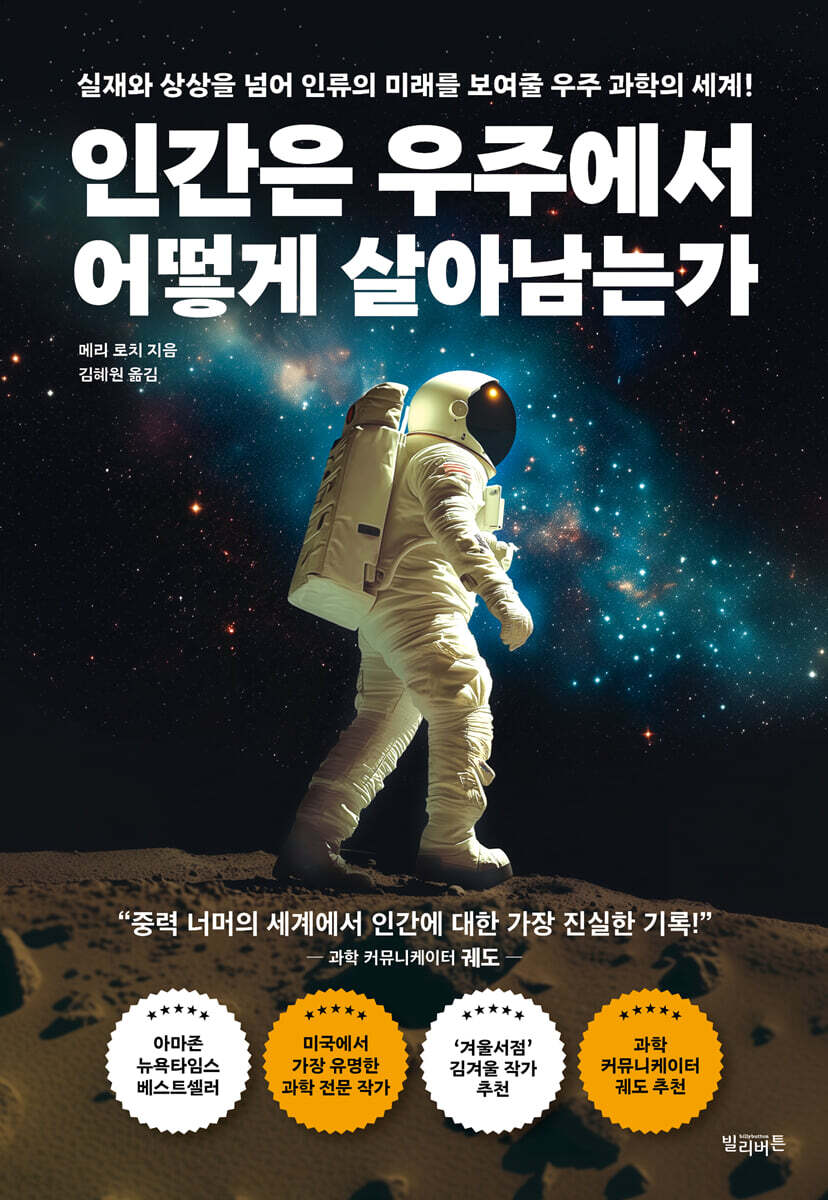
How do humans survive in space?
 |
Description
Book Introduction
The one and only book that will reveal the true face of space science.
How do humans exist in the endless abyss of space?
Amazon and New York Times bestseller
Author Kim Gyul-wool, Science Communicator Orbit Recommended
In an era where humanity's first exploration of Mars is no longer just a dream, the question of whether humans can exist in space has become a realistic challenge.
"How do humans survive in space?" seeks to answer this enormous question based on scientific facts.
Mary Roach, a science nonfiction author who received rave reviews from the Washington Post, visited major space agencies, including NASA (National Aeronautics and Space Administration), JAXA (Japan Aerospace Exploration Agency), and Russia's Star City, to experience training and interview actual astronauts and scientists.
The journey demonstrates the physical and mental rigor of space flight, vividly conveying the fragility and strength of human nature often overshadowed by heroic tales in the news.
Readers follow the daily lives of astronauts and experience the failures and adaptations hidden behind the glamorous landscape of space exploration.
"How Humans Survive in Space" deeply examines how humans endure, adapt, and survive in the extreme environment of zero gravity, from a scientific yet human perspective.
This book, which honestly records space science from past to present, is the one and only must-read space science humanities book for the coming era of space exploration.
How do humans exist in the endless abyss of space?
Amazon and New York Times bestseller
Author Kim Gyul-wool, Science Communicator Orbit Recommended
In an era where humanity's first exploration of Mars is no longer just a dream, the question of whether humans can exist in space has become a realistic challenge.
"How do humans survive in space?" seeks to answer this enormous question based on scientific facts.
Mary Roach, a science nonfiction author who received rave reviews from the Washington Post, visited major space agencies, including NASA (National Aeronautics and Space Administration), JAXA (Japan Aerospace Exploration Agency), and Russia's Star City, to experience training and interview actual astronauts and scientists.
The journey demonstrates the physical and mental rigor of space flight, vividly conveying the fragility and strength of human nature often overshadowed by heroic tales in the news.
Readers follow the daily lives of astronauts and experience the failures and adaptations hidden behind the glamorous landscape of space exploration.
"How Humans Survive in Space" deeply examines how humans endure, adapt, and survive in the extreme environment of zero gravity, from a scientific yet human perspective.
This book, which honestly records space science from past to present, is the one and only must-read space science humanities book for the coming era of space exploration.
- You can preview some of the book's contents.
Preview
index
Countdown
CHAPTER 1.
Secrets of the Astronaut Selection Process
Japan selects astronauts
CHAPTER 2.
Life in a Box
The Dangerous Psychological Changes of Isolation and Confinement
CHAPTER 3.
People who went crazy looking at the stars
Can the universe capture your heart?
CHAPTER 4.
A world without gravity
How do humans survive?
CHAPTER 5.
Preparing for space travel
Zero gravity survival experiment
CHAPTER 6.
The Hidden Pain of Astronauts
space sickness
CHAPTER 7.
Corpse in space capsule
Crash test for safe return
CHAPTER 8.
Who will go into space first for humanity?
Ham and Enos: The Bizarre Journey of the First Space Travelers
CHAPTER 9.
A lunar exploration journey unfolding from Earth
A mock expedition that is more difficult and longer than an actual expedition
CHAPTER 10.
The War on Odor
People who gave up bathing for space hygiene and science
CHAPTER 11.
Astronaut Bone Protection Project
What if you just lay in bed your whole life?
CHAPTER 12.
A challenge to instinct
Reflections on Sex in Zero Gravity
CHAPTER 13.
Space Escape, the Moment of Final Choice
At the crossroads of free fall
CHAPTER 14.
Dreaming of the perfect space toilet
The never-ending struggle in a zero-gravity bathroom
CHAPTER 15.
Space Banquet
Episodes surrounding space food
CHAPTER 16.
Ready to fire!
Extreme Survival: Why We Should Go to Mars
Timeline
CHAPTER 1.
Secrets of the Astronaut Selection Process
Japan selects astronauts
CHAPTER 2.
Life in a Box
The Dangerous Psychological Changes of Isolation and Confinement
CHAPTER 3.
People who went crazy looking at the stars
Can the universe capture your heart?
CHAPTER 4.
A world without gravity
How do humans survive?
CHAPTER 5.
Preparing for space travel
Zero gravity survival experiment
CHAPTER 6.
The Hidden Pain of Astronauts
space sickness
CHAPTER 7.
Corpse in space capsule
Crash test for safe return
CHAPTER 8.
Who will go into space first for humanity?
Ham and Enos: The Bizarre Journey of the First Space Travelers
CHAPTER 9.
A lunar exploration journey unfolding from Earth
A mock expedition that is more difficult and longer than an actual expedition
CHAPTER 10.
The War on Odor
People who gave up bathing for space hygiene and science
CHAPTER 11.
Astronaut Bone Protection Project
What if you just lay in bed your whole life?
CHAPTER 12.
A challenge to instinct
Reflections on Sex in Zero Gravity
CHAPTER 13.
Space Escape, the Moment of Final Choice
At the crossroads of free fall
CHAPTER 14.
Dreaming of the perfect space toilet
The never-ending struggle in a zero-gravity bathroom
CHAPTER 15.
Space Banquet
Episodes surrounding space food
CHAPTER 16.
Ready to fire!
Extreme Survival: Why We Should Go to Mars
Timeline
Detailed image

Into the book
The universe you will encounter in this book is not the great feats or tragic misfortunes you have seen on television.
The little comedies that happen in the gaps, made up of everyday challenges and successes.
--- p.11
The essence of the Thousand-Hand Origami judging process is that each applicant's work is recorded by time zone.
After completing the thousand cranes, the applicants are hung on a long rope.
After the quarantine period, all applicants' paper cranes will be collected and analyzed.
It could be called the scientific investigation of origami.
As the deadline approaches, does the pressure cause the folds of the paper cranes to become crooked? How different will the first ten folds be from the last ten? Inoue explains, "A drop in accuracy is evidence of an inability to withstand the pressure."
--- p.20
What would it be like to be trapped in a sterile, artificial structure for two years, unable to escape work or colleagues, without flowers, trees, or sex, and with nothing but empty space or, at best, red dust outside the window? --- p.41
Gemini 4 astronaut Edward White suddenly said he felt "like a millionaire" about four minutes into NASA's first spacewalk.
He struggled to find the right words to describe his feelings.
“I… am just amazed…” --- p.85
Schweickart earned the dubious title of "the only American astronaut to vomit in space," as he put it (motion sickness was rare during the Mercury and Gemini space programs).
(Perhaps because those space capsules were so cramped that you couldn't move around enough to cause motion sickness).
Much later, Bowman confessed, as Cernan wrote in his memoir, that he too was "as seasick as a dog the entire flight to the moon."
--- p.162
The first female cosmonaut, Valentina Tereshkova, said in a 2007 interview that going to Mars was a dream of early Russian cosmonauts, and that even now, at age 72, she wants to make that dream come true.
“Even if I can’t return, I’m ready to fly.” --- p.232
Conventional shower methods are ineffective in a zero-gravity environment.
The water sprays only a few inches from the shower head and then clumps into large droplets.
It's cool, but it doesn't really help with body washing.
If you hold the shower head close enough that it doesn't create large droplets, the water will bounce off your skin, creating droplets that float around the spacecraft and you'll have to chase them away to remove them.
Astronaut Alan Bean said of Skylab's retractable shower, "It's easier to just forget about showering."
--- p.285
The ridiculous story doesn't end there.
What made things even more tedious for the astronauts was having to knead the feces by hand before rolling them up and sealing them, adding a disinfectant to prevent any unpleasant excrement from leaking out.
But if you don't, the fecal bacteria will do their job, digesting the feces and releasing gas.
The gas that would have been a fart if it had been in the intestines.
Sealed stool bags containing feces cannot pass gas and may burst if not disinfected.
--- p.386
Despite the milkshake's bad reputation, researchers evaluated no fewer than twenty different commercial liquid food recipes.
I once read an Air Force technical report that listed desirable characteristics of edible paper: "tasteless, flexible, and sticky."
I thought this might be the hallmark of space food developers.
--- p.417
The first foods tested were all infamous dice-shaped foods.
Mini sandwiches, bite-sized meats, tiny desserts—they were food that looked like something straight out of a doll's kitchen.
Dice-shaped foods were the main culprit causing indigestion.
--- p.429
The approximate cost of sending a spacecraft to Mars is estimated to be $500 billion, the same as the cost of the Iraq War so far.
Is the enormous cost justifiable? What benefits are there to sending humans to Mars, especially given the existence of robotic landers capable of scientifically proficient, if not as fast, human missions?
The little comedies that happen in the gaps, made up of everyday challenges and successes.
--- p.11
The essence of the Thousand-Hand Origami judging process is that each applicant's work is recorded by time zone.
After completing the thousand cranes, the applicants are hung on a long rope.
After the quarantine period, all applicants' paper cranes will be collected and analyzed.
It could be called the scientific investigation of origami.
As the deadline approaches, does the pressure cause the folds of the paper cranes to become crooked? How different will the first ten folds be from the last ten? Inoue explains, "A drop in accuracy is evidence of an inability to withstand the pressure."
--- p.20
What would it be like to be trapped in a sterile, artificial structure for two years, unable to escape work or colleagues, without flowers, trees, or sex, and with nothing but empty space or, at best, red dust outside the window? --- p.41
Gemini 4 astronaut Edward White suddenly said he felt "like a millionaire" about four minutes into NASA's first spacewalk.
He struggled to find the right words to describe his feelings.
“I… am just amazed…” --- p.85
Schweickart earned the dubious title of "the only American astronaut to vomit in space," as he put it (motion sickness was rare during the Mercury and Gemini space programs).
(Perhaps because those space capsules were so cramped that you couldn't move around enough to cause motion sickness).
Much later, Bowman confessed, as Cernan wrote in his memoir, that he too was "as seasick as a dog the entire flight to the moon."
--- p.162
The first female cosmonaut, Valentina Tereshkova, said in a 2007 interview that going to Mars was a dream of early Russian cosmonauts, and that even now, at age 72, she wants to make that dream come true.
“Even if I can’t return, I’m ready to fly.” --- p.232
Conventional shower methods are ineffective in a zero-gravity environment.
The water sprays only a few inches from the shower head and then clumps into large droplets.
It's cool, but it doesn't really help with body washing.
If you hold the shower head close enough that it doesn't create large droplets, the water will bounce off your skin, creating droplets that float around the spacecraft and you'll have to chase them away to remove them.
Astronaut Alan Bean said of Skylab's retractable shower, "It's easier to just forget about showering."
--- p.285
The ridiculous story doesn't end there.
What made things even more tedious for the astronauts was having to knead the feces by hand before rolling them up and sealing them, adding a disinfectant to prevent any unpleasant excrement from leaking out.
But if you don't, the fecal bacteria will do their job, digesting the feces and releasing gas.
The gas that would have been a fart if it had been in the intestines.
Sealed stool bags containing feces cannot pass gas and may burst if not disinfected.
--- p.386
Despite the milkshake's bad reputation, researchers evaluated no fewer than twenty different commercial liquid food recipes.
I once read an Air Force technical report that listed desirable characteristics of edible paper: "tasteless, flexible, and sticky."
I thought this might be the hallmark of space food developers.
--- p.417
The first foods tested were all infamous dice-shaped foods.
Mini sandwiches, bite-sized meats, tiny desserts—they were food that looked like something straight out of a doll's kitchen.
Dice-shaped foods were the main culprit causing indigestion.
--- p.429
The approximate cost of sending a spacecraft to Mars is estimated to be $500 billion, the same as the cost of the Iraq War so far.
Is the enormous cost justifiable? What benefits are there to sending humans to Mars, especially given the existence of robotic landers capable of scientifically proficient, if not as fast, human missions?
--- p.453
Publisher's Review
We don't know the universe yet
Why we can't stop challenging ourselves even in weightlessness and uncertainty
"How to Survive in Space" realistically depicts the intense journey of astronauts as they endure isolation, pressure, physical adaptation and physiological changes, psychological anxiety, and loneliness.
The selection process, which includes unexpected elements like origami cranes, eating scenes, and talent shows, conveys humanity even in the harsh realities of the universe.
Simultaneously, training continues, including cadaver impact experiments, long-term bed studies, and motion sickness resistance tests.
Based on the vivid experiences of those trained at the world's leading space agencies and who have participated in actual space flights, it provides a detailed portrayal of how the human body and mind react and change in the space environment.
Nevertheless, the stories of those who dream of flying, prepared to face the end of their lives, prove human courage and aspiration.
Astronaut Bonnie Dunbar said, “Even if my life ends on a Mars mission, it’s not a bad choice,” and Valentina Tereshkova, the first female spaceflight attendant, said, “I’m ready to fly even if I don’t come back,” still harboring that dream now that she’s over 70.
This book, which delves deeply into the past, present, and future of space science, will serve as a practical guide not only for scientists and astronauts who dream of space exploration, but also for all readers interested in space.
The image of a human flying away from gravity
Brilliantly dazzling and tear-jerkingly distant
When humans escape the shackles of Earth's gravity and soar into space, the sight is splendid and wondrous.
But behind it all lies unimaginable pain and challenges.
Even the trivial things we experience on Earth—limited food and sleep, uncomfortable bowel movements, and conflicts with others in confined spaces—become variables for survival in space.
Additionally, in a zero-gravity environment, various physical changes occur, such as muscles and bones becoming weaker, body fluids flowing to the head, and facial swelling.
This leads to mental fatigue and insomnia, which sometimes leads to anger being expressed towards colleagues or ground control.
"How Humans Survive in Space" contains such dazzling yet arduous challenges for humanity.
Through the process of human adaptation to weightlessness and the science behind it, it tells the story of how the journey into space is not simply a technological achievement, but a story of expanding the limits of existence.
Cheerful but not light
Human but without losing scientific essence
Space stories are often presented as grand and mysterious narratives, but this book challenges that notion.
Science nonfiction author Mary Roach tackles difficult and unfamiliar topics with a humorous style and tenacious inquiry, transporting readers to worlds beyond Earth.
It vividly portrays everything from never-before-seen stories about space ecstasy, space sickness, sleep disorders, and personal hygiene to the human struggle to survive in the midst of unexpected failures and the chaos of accidents.
"How Humans Survive in Space" strikes a balance between scientific rigor and human perspective.
This is the most realistic space survival report that provides interesting and reflective answers to humanity's instinctive questions about space.
Why we can't stop challenging ourselves even in weightlessness and uncertainty
"How to Survive in Space" realistically depicts the intense journey of astronauts as they endure isolation, pressure, physical adaptation and physiological changes, psychological anxiety, and loneliness.
The selection process, which includes unexpected elements like origami cranes, eating scenes, and talent shows, conveys humanity even in the harsh realities of the universe.
Simultaneously, training continues, including cadaver impact experiments, long-term bed studies, and motion sickness resistance tests.
Based on the vivid experiences of those trained at the world's leading space agencies and who have participated in actual space flights, it provides a detailed portrayal of how the human body and mind react and change in the space environment.
Nevertheless, the stories of those who dream of flying, prepared to face the end of their lives, prove human courage and aspiration.
Astronaut Bonnie Dunbar said, “Even if my life ends on a Mars mission, it’s not a bad choice,” and Valentina Tereshkova, the first female spaceflight attendant, said, “I’m ready to fly even if I don’t come back,” still harboring that dream now that she’s over 70.
This book, which delves deeply into the past, present, and future of space science, will serve as a practical guide not only for scientists and astronauts who dream of space exploration, but also for all readers interested in space.
The image of a human flying away from gravity
Brilliantly dazzling and tear-jerkingly distant
When humans escape the shackles of Earth's gravity and soar into space, the sight is splendid and wondrous.
But behind it all lies unimaginable pain and challenges.
Even the trivial things we experience on Earth—limited food and sleep, uncomfortable bowel movements, and conflicts with others in confined spaces—become variables for survival in space.
Additionally, in a zero-gravity environment, various physical changes occur, such as muscles and bones becoming weaker, body fluids flowing to the head, and facial swelling.
This leads to mental fatigue and insomnia, which sometimes leads to anger being expressed towards colleagues or ground control.
"How Humans Survive in Space" contains such dazzling yet arduous challenges for humanity.
Through the process of human adaptation to weightlessness and the science behind it, it tells the story of how the journey into space is not simply a technological achievement, but a story of expanding the limits of existence.
Cheerful but not light
Human but without losing scientific essence
Space stories are often presented as grand and mysterious narratives, but this book challenges that notion.
Science nonfiction author Mary Roach tackles difficult and unfamiliar topics with a humorous style and tenacious inquiry, transporting readers to worlds beyond Earth.
It vividly portrays everything from never-before-seen stories about space ecstasy, space sickness, sleep disorders, and personal hygiene to the human struggle to survive in the midst of unexpected failures and the chaos of accidents.
"How Humans Survive in Space" strikes a balance between scientific rigor and human perspective.
This is the most realistic space survival report that provides interesting and reflective answers to humanity's instinctive questions about space.
GOODS SPECIFICS
- Date of issue: June 24, 2025
- Page count, weight, size: 459 pages | 594g | 145*210*22mm
- ISBN13: 9791192999876
- ISBN10: 1192999878
You may also like
카테고리
korean


korean

![ELLE 엘르 스페셜 에디션 A형 : 12월 [2025]](http://librairie.coreenne.fr/cdn/shop/files/b8e27a3de6c9538896439686c6b0e8fb.jpg?v=1766436872&width=3840)


