

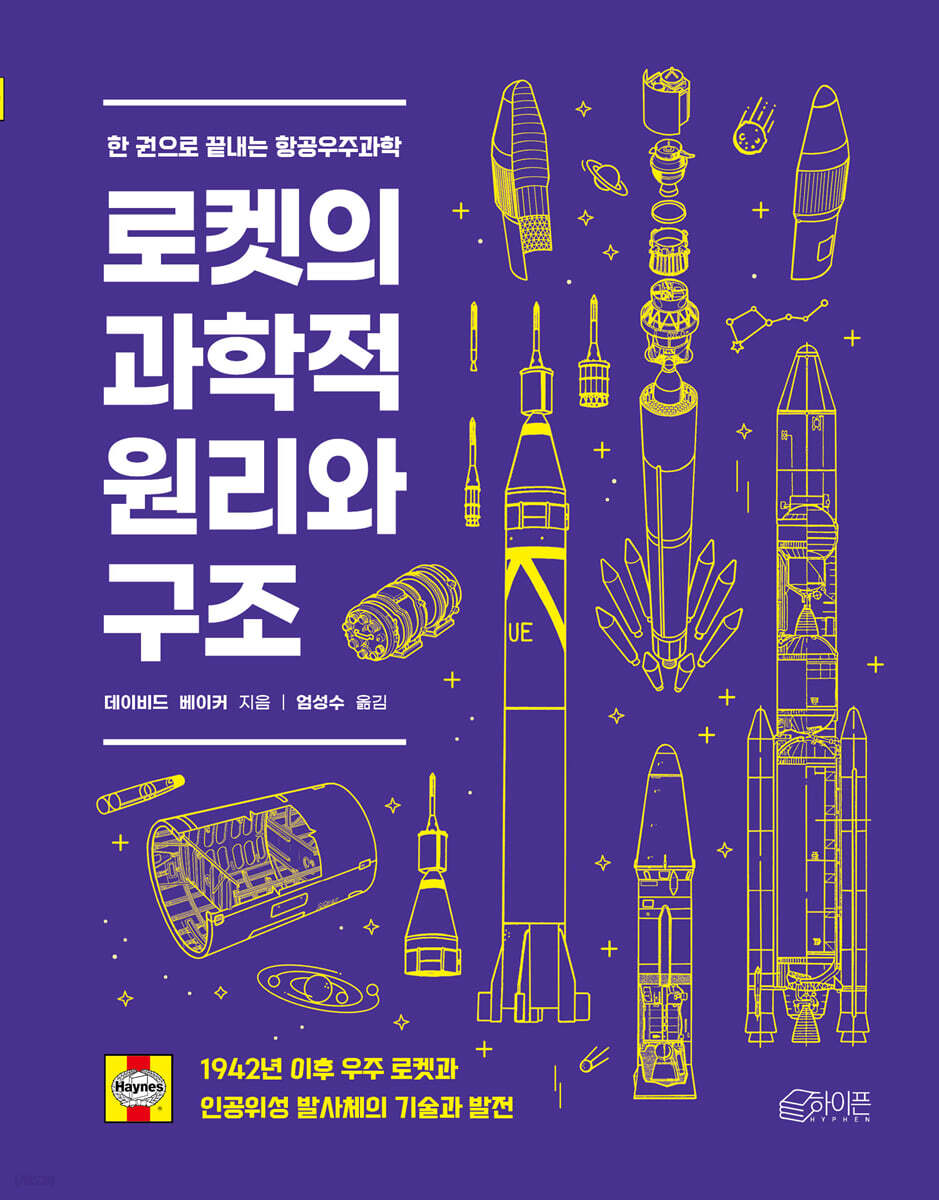
Scientific principles and structure of rockets
 |
Description
Book Introduction
Satellites and spacecraft that orbit the Earth and explore distant space beyond the solar system.
The technology and history of the rocket launchers that launch them!
"The Scientific Principles and Structure of Rockets" details the basic technical principles and structures that operate rockets, as well as the history of the development and advancement of early rockets since 1942.
You can see various rockets and launch vehicles that have led the history of rockets, such as the V2, the world's first ballistic missile developed by Germany's Wernher von Braun; the Redstone, which was developed as a tactical missile and used for ballistic flight, but flew while carrying America's first astronaut, Alan Shepard; the R-7, which was designed as Russia's first intercontinental ballistic missile and launched Sputnik 1 into Earth's orbit in October 1957 and was developed into the manned spacecraft Vostok, Voskhod, and Soyuz; the Atlas, America's first intercontinental ballistic missile; the Delta, a launch vehicle that has launched satellites for NASA and US government agencies for over 50 years; and the Ariane 5 developed by the European Space Agency (ESA).
Although it contains technical terms and descriptions unfamiliar to the general public, the over 300 illustrations, cross-sections showing the interior, and a wealth of photographs and illustrations provide a glimpse into the history and performance of rockets that have underpinned humanity's history of space exploration, as well as the different technologies and diverse designs applied to each rocket.
You can also easily understand the features, design, and overall key points of each rocket.
The technology and history of the rocket launchers that launch them!
"The Scientific Principles and Structure of Rockets" details the basic technical principles and structures that operate rockets, as well as the history of the development and advancement of early rockets since 1942.
You can see various rockets and launch vehicles that have led the history of rockets, such as the V2, the world's first ballistic missile developed by Germany's Wernher von Braun; the Redstone, which was developed as a tactical missile and used for ballistic flight, but flew while carrying America's first astronaut, Alan Shepard; the R-7, which was designed as Russia's first intercontinental ballistic missile and launched Sputnik 1 into Earth's orbit in October 1957 and was developed into the manned spacecraft Vostok, Voskhod, and Soyuz; the Atlas, America's first intercontinental ballistic missile; the Delta, a launch vehicle that has launched satellites for NASA and US government agencies for over 50 years; and the Ariane 5 developed by the European Space Agency (ESA).
Although it contains technical terms and descriptions unfamiliar to the general public, the over 300 illustrations, cross-sections showing the interior, and a wealth of photographs and illustrations provide a glimpse into the history and performance of rockets that have underpinned humanity's history of space exploration, as well as the different technologies and diverse designs applied to each rocket.
You can also easily understand the features, design, and overall key points of each rocket.
- You can preview some of the book's contents.
Preview
index
Introduction 008
Chapter 1 Principles
Rocket Science 010
Various types of power 012
Liquid Propellant 017
Rocket Motor 019
Cryogenic Propellant 025
Solid propellant 026
Multistage Rocket 029
Chapter 2 Rockets and Launch Vehicles
V-2 (Germany) 032
V-2 (USA) 035
V-2 (Russia) 038
Viking 040
Redstone 043
Reengineering 045
Mercury-Redstone 046
Jupiter-C (Juno I) 049
Test Flight 050
Thor 052
The first intermediate-range ballistic missile, the 052
Variants 055
Flight Test 058
Thor Able 061
Thor Able-Star 065
Thor Agena 067
TAT-Agena B and D 073
Thor Burner 074
Thorad Agena D 075
Peter 077
Juno II 080
R-7 Semyorka/Soyuz 083
Atlas 088
Development Process 093
Test Flight 097
Atlas Space Launch Vehicle 100
Atlas-Able 101
Atlas-Agena A, B, and D 103
Atlas-Century 107
Atlas OV-1 113
Atlas Burner II 114
Atlas I 115
Atlas II 117
Atlas III 118
Atlas V 121
Vanguard 127
Titan 132
Better Rocket 135
Gemini-Titan 140
Titan III 143
Titan III and IV 145
Titan II Space Launch Vehicle 150
Delta 152
Important Upgrade 158
Improved Performance 161
Delta II, III, IV 164
Scout 175
Scout 178 Soars into the Sky
Saturn I/IB 183
Blue Streak/Europa 190
Test Flight 193
Proton 195
Diamant 197
Saturn V 199
Black Arrow 202
Arian 204
Arian 1/2/3/4 205
Arian 5 210
List of abbreviations 214
Chapter 1 Principles
Rocket Science 010
Various types of power 012
Liquid Propellant 017
Rocket Motor 019
Cryogenic Propellant 025
Solid propellant 026
Multistage Rocket 029
Chapter 2 Rockets and Launch Vehicles
V-2 (Germany) 032
V-2 (USA) 035
V-2 (Russia) 038
Viking 040
Redstone 043
Reengineering 045
Mercury-Redstone 046
Jupiter-C (Juno I) 049
Test Flight 050
Thor 052
The first intermediate-range ballistic missile, the 052
Variants 055
Flight Test 058
Thor Able 061
Thor Able-Star 065
Thor Agena 067
TAT-Agena B and D 073
Thor Burner 074
Thorad Agena D 075
Peter 077
Juno II 080
R-7 Semyorka/Soyuz 083
Atlas 088
Development Process 093
Test Flight 097
Atlas Space Launch Vehicle 100
Atlas-Able 101
Atlas-Agena A, B, and D 103
Atlas-Century 107
Atlas OV-1 113
Atlas Burner II 114
Atlas I 115
Atlas II 117
Atlas III 118
Atlas V 121
Vanguard 127
Titan 132
Better Rocket 135
Gemini-Titan 140
Titan III 143
Titan III and IV 145
Titan II Space Launch Vehicle 150
Delta 152
Important Upgrade 158
Improved Performance 161
Delta II, III, IV 164
Scout 175
Scout 178 Soars into the Sky
Saturn I/IB 183
Blue Streak/Europa 190
Test Flight 193
Proton 195
Diamant 197
Saturn V 199
Black Arrow 202
Arian 204
Arian 1/2/3/4 205
Arian 5 210
List of abbreviations 214
Into the book
Since the beginning of human history, humans have always looked up at the night sky with awe, and have wondered about the lights twinkling across the sky.
As Galileo and Copernicus spread their wings of free thought toward other worlds in space, those lights became the ultimate destination of human imagination, igniting the desire to leave Earth and visit the moon and other planets.
--- p.10
Space rocketry began as scientists sought a means to study outer space, the universe, and the celestial bodies of our solar system.
Then, as the Cold War began, many weapons were created in the heat of war, and the desire to explore knowledge led to the path of disarmament, and finally, with the International Geophysical Year (the period from 1957 to 1958 when some 70 countries participated and surveyed the geophysical environment), international surveys were conducted to better understand the Earth, and the weapons of the Cold War were transformed into tools for peace.
As Galileo and Copernicus spread their wings of free thought toward other worlds in space, those lights became the ultimate destination of human imagination, igniting the desire to leave Earth and visit the moon and other planets.
--- p.10
Space rocketry began as scientists sought a means to study outer space, the universe, and the celestial bodies of our solar system.
Then, as the Cold War began, many weapons were created in the heat of war, and the desire to explore knowledge led to the path of disarmament, and finally, with the International Geophysical Year (the period from 1957 to 1958 when some 70 countries participated and surveyed the geophysical environment), international surveys were conducted to better understand the Earth, and the weapons of the Cold War were transformed into tools for peace.
--- p.31
Publisher's Review
Nuriho, a Korean launch vehicle independently developed with our own technology
The launch of the Korean launch vehicle 'Nuriho' is just around the corner.
Nuri, scheduled to be launched on October 21 from the Naro Space Center in Goheung, South Jeolla Province, is Korea's first independently developed launch vehicle and is a 300-ton thrust space launch vehicle capable of launching a 1.5-ton practical satellite into low Earth orbit (600-800 km).
The first launch in October will carry a 1.5-ton satellite replica with only communication functions, and the second launch scheduled for May 2022 will carry a 1.3-ton satellite replica and a performance verification satellite weighing approximately 0.2 tons.
If the launch of our independently developed Nuri is successful, our country will become the seventh country in the world to possess a rocket.
Furthermore, it will be a tremendous achievement that will mark a turning point in the history of domestic space development, as it will enable not only the launch of artificial satellites but also future exploration of Mars.
Meanwhile, following British billionaire Richard Branson's Virgin Galactic, Amazon founder Jeff Bezos recently succeeded in space travel using the rocket 'New Shepard' of his private space company Blue Origin, and the spacecraft Crew Dragon of SpaceX, founded by Tesla CEO Elon Musk, also succeeded in space travel carrying civilians.
Now, space exploration and space travel are no longer just movies, but a reality.
Humanity's desire to advance into a new world, space
Looking up at the countless stars twinkling in the dark night sky, mankind has dreamed of a distant and new world since time immemorial.
Although scientific knowledge about the Earth, the solar system, and the universe on which we live has steadily increased, the vast universe remains an unknown world, awaiting humanity's curiosity and challenges.
To explore space, we need to launch a spacecraft outside the Earth's atmosphere.
What is absolutely necessary at this time is a rocket.
In order to place into Earth's orbit the various satellites that make our lives more convenient, such as those that provide weather information, communications, and GPS, we need rockets, which are launch vehicles or propulsion devices that carry and launch satellites.
Rockets are the most basic tool for mankind to travel into space and are devices that contain the best technology.
Modern rocketry began in the arms race of the Cold War.
Guided missiles and ballistic missiles were developed to strike enemies from farther away and more accurately, and Hitler's Nazi army even bombed several European cities with V-2 rockets.
However, it was also thanks to rockets that peaceful exploration of Earth and other worlds in space became more active.
Rockets are the only means by which humans can escape gravity and travel from planet Earth to new worlds.
Rockets, which have been with mankind for a long time, began to fly into space only about 60 years ago. However, over the past 60 years, scientists from various countries have been sending orbital spacecraft to each planet in the solar system and exploring them using various robots and machines.
And thanks to that, we now know a lot about the planets and their moons in our solar system.
It was only thanks to rockets that we were able to get there, and this was possible because of the advancement of science and technology.
In other words, rocket technology developed first in the form of an arms race, then in the race for space exploration, and now in modern times in the form of a commercial competition for information provided by numerous satellites.
Various rocket technologies and designs
This book, "The Scientific Principles and Structure of Rockets," details the basic technical principles and structures that operate rockets, as well as the history of the development and advancement of early rockets since 1942.
You can see various rockets and launch vehicles that have led the history of rockets, such as the V2, the world's first ballistic missile developed by Germany's Wernher von Braun; the Redstone, which was developed as a tactical missile and used for ballistic flight, but flew while carrying America's first astronaut, Alan Shepard; the R-7, which was designed as Russia's first intercontinental ballistic missile and launched Sputnik 1 into Earth's orbit in October 1957 and was developed into the manned spacecraft Vostok, Voskhod, and Soyuz; the Atlas, America's first intercontinental ballistic missile; the Delta, a launch vehicle that has launched satellites for NASA and US government agencies for over 50 years; and the Ariane 5 developed by the European Space Agency (ESA).
Although it contains technical terms and descriptions unfamiliar to the general public, the over 300 illustrations, cross-sections showing the interior, and a wealth of photographs and illustrations provide a glimpse into the history and performance of rockets that have underpinned humanity's history of space exploration, as well as the different technologies and diverse designs applied to each rocket.
You can also easily understand the features, design, and overall key points of each rocket.
Space travel is fast approaching, and the era of space development is coming.
Although the private space industry has recently become more active, space development is still in its infancy, and thus, the opportunities for development are limitless.
The space industry and development will accelerate further in the future, and competition will intensify. Rockets and space exploration, once considered the stuff of science fiction movies or a distant future, are now a reality.
Knowledge of rockets and their core technologies is essential not only to ensure we don't miss out on leadership and opportunities in the space industry, but also to better understand the future of our planet, which is struggling with environmental issues, and the solar system surrounding us.
Through this book, readers will gain a deep understanding of the scientific principles and structure of rockets, as well as the history of their development and advancement.
The launch of the Korean launch vehicle 'Nuriho' is just around the corner.
Nuri, scheduled to be launched on October 21 from the Naro Space Center in Goheung, South Jeolla Province, is Korea's first independently developed launch vehicle and is a 300-ton thrust space launch vehicle capable of launching a 1.5-ton practical satellite into low Earth orbit (600-800 km).
The first launch in October will carry a 1.5-ton satellite replica with only communication functions, and the second launch scheduled for May 2022 will carry a 1.3-ton satellite replica and a performance verification satellite weighing approximately 0.2 tons.
If the launch of our independently developed Nuri is successful, our country will become the seventh country in the world to possess a rocket.
Furthermore, it will be a tremendous achievement that will mark a turning point in the history of domestic space development, as it will enable not only the launch of artificial satellites but also future exploration of Mars.
Meanwhile, following British billionaire Richard Branson's Virgin Galactic, Amazon founder Jeff Bezos recently succeeded in space travel using the rocket 'New Shepard' of his private space company Blue Origin, and the spacecraft Crew Dragon of SpaceX, founded by Tesla CEO Elon Musk, also succeeded in space travel carrying civilians.
Now, space exploration and space travel are no longer just movies, but a reality.
Humanity's desire to advance into a new world, space
Looking up at the countless stars twinkling in the dark night sky, mankind has dreamed of a distant and new world since time immemorial.
Although scientific knowledge about the Earth, the solar system, and the universe on which we live has steadily increased, the vast universe remains an unknown world, awaiting humanity's curiosity and challenges.
To explore space, we need to launch a spacecraft outside the Earth's atmosphere.
What is absolutely necessary at this time is a rocket.
In order to place into Earth's orbit the various satellites that make our lives more convenient, such as those that provide weather information, communications, and GPS, we need rockets, which are launch vehicles or propulsion devices that carry and launch satellites.
Rockets are the most basic tool for mankind to travel into space and are devices that contain the best technology.
Modern rocketry began in the arms race of the Cold War.
Guided missiles and ballistic missiles were developed to strike enemies from farther away and more accurately, and Hitler's Nazi army even bombed several European cities with V-2 rockets.
However, it was also thanks to rockets that peaceful exploration of Earth and other worlds in space became more active.
Rockets are the only means by which humans can escape gravity and travel from planet Earth to new worlds.
Rockets, which have been with mankind for a long time, began to fly into space only about 60 years ago. However, over the past 60 years, scientists from various countries have been sending orbital spacecraft to each planet in the solar system and exploring them using various robots and machines.
And thanks to that, we now know a lot about the planets and their moons in our solar system.
It was only thanks to rockets that we were able to get there, and this was possible because of the advancement of science and technology.
In other words, rocket technology developed first in the form of an arms race, then in the race for space exploration, and now in modern times in the form of a commercial competition for information provided by numerous satellites.
Various rocket technologies and designs
This book, "The Scientific Principles and Structure of Rockets," details the basic technical principles and structures that operate rockets, as well as the history of the development and advancement of early rockets since 1942.
You can see various rockets and launch vehicles that have led the history of rockets, such as the V2, the world's first ballistic missile developed by Germany's Wernher von Braun; the Redstone, which was developed as a tactical missile and used for ballistic flight, but flew while carrying America's first astronaut, Alan Shepard; the R-7, which was designed as Russia's first intercontinental ballistic missile and launched Sputnik 1 into Earth's orbit in October 1957 and was developed into the manned spacecraft Vostok, Voskhod, and Soyuz; the Atlas, America's first intercontinental ballistic missile; the Delta, a launch vehicle that has launched satellites for NASA and US government agencies for over 50 years; and the Ariane 5 developed by the European Space Agency (ESA).
Although it contains technical terms and descriptions unfamiliar to the general public, the over 300 illustrations, cross-sections showing the interior, and a wealth of photographs and illustrations provide a glimpse into the history and performance of rockets that have underpinned humanity's history of space exploration, as well as the different technologies and diverse designs applied to each rocket.
You can also easily understand the features, design, and overall key points of each rocket.
Space travel is fast approaching, and the era of space development is coming.
Although the private space industry has recently become more active, space development is still in its infancy, and thus, the opportunities for development are limitless.
The space industry and development will accelerate further in the future, and competition will intensify. Rockets and space exploration, once considered the stuff of science fiction movies or a distant future, are now a reality.
Knowledge of rockets and their core technologies is essential not only to ensure we don't miss out on leadership and opportunities in the space industry, but also to better understand the future of our planet, which is struggling with environmental issues, and the solar system surrounding us.
Through this book, readers will gain a deep understanding of the scientific principles and structure of rockets, as well as the history of their development and advancement.
GOODS SPECIFICS
- Date of issue: May 30, 2025
- Page count, weight, size: 224 pages | 210*270*20mm
- ISBN13: 9791193035672
- ISBN10: 1193035678
You may also like
카테고리
korean


korean

![GQ KOREA Mark (Monthly): December [2025]](http://librairie.coreenne.fr/cdn/shop/files/8ef265dbbfbf186523ed75ba7319009d.jpg?v=1765340328&width=3840)


