

Children's spelling that can be used right away while reading
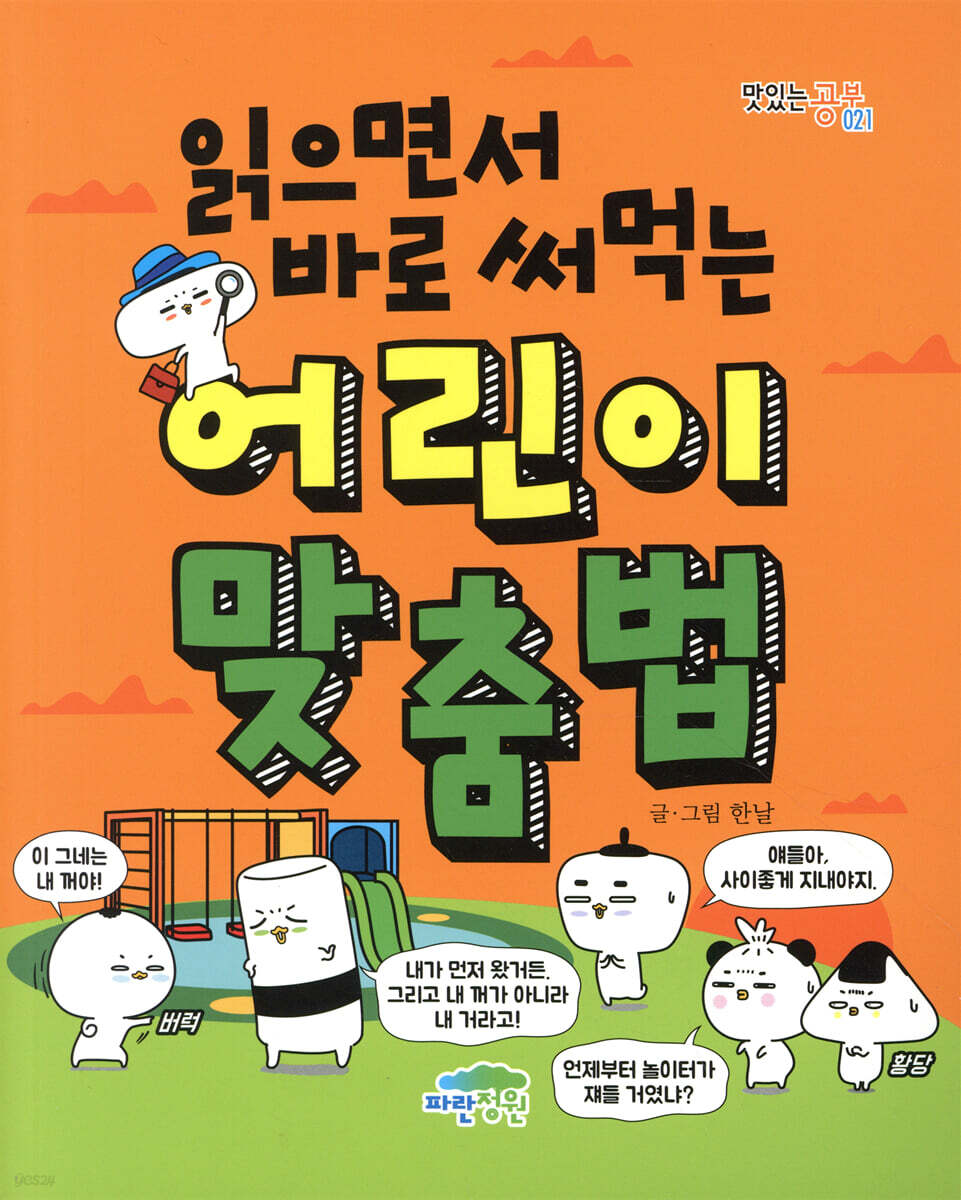 |
Description
Book Introduction
I'm confused, I'm confused about Korean spelling
Teach, instruct, point out.
What the heck is the difference? They all sound the same, but the meanings are different and the spelling is wrong… .
Korean spelling is really difficult.
Korean spelling was full of question marks.
Find the answer in 『Children's Spelling that You Can Use While Reading』 and change it to an exclamation mark.
Teach, instruct, point out.
What the heck is the difference? They all sound the same, but the meanings are different and the spelling is wrong… .
Korean spelling is really difficult.
Korean spelling was full of question marks.
Find the answer in 『Children's Spelling that You Can Use While Reading』 and change it to an exclamation mark.
- You can preview some of the book's contents.
Preview
index
<go>
Point out vs. teach / Point out vs. point / Lightly vs. Lightly
Tickle VS Tickling / Mischievous VS Mischievous / Hand over VS Hand over
Touch vs. Touch / Thinking vs. Thinking / Guji, Gnae-i vs. Gye-geul-dae
Mumbling VS Mumbling / Whispering VS Whispering / Either way VS Either way
Quickly vs. Quickly / Kkaktugi vs. Kkakdugi / Cleanly vs. Cleanly
Disgusting VS Disgusting / Turn it off VS It's a thing / Tricky VS Pretty
<me too>
Flat VS Flat / Cliff VS Cliff / Mine VS Mine
Naenorahada VS Naerorahada / Nalleum VS Nalleum / Nolleurijida VS Nolleurijida
Broad VS Spacious / Broad VS Flat / Frown VS Frown
Slow VS Slow / Increase VS Increase / Big VS Big
Usually VS Usually / Price VS Price / What the heck VS What the heck
Be vs. Become / Betrayal vs. Inheritance / Cleaning up vs. Cleaning up
Hear VS Stop by / Come out VS Be revealed / Digge VS Become real
〈ㄹ, ㅁ, ㅂ, ㅅ〉
As VS As / Match VS Match / How many days VS How many days
Greetings vs. okay / Crazy vs. not yet / Wish vs. Wish
Footsteps vs. Footprints / Reflect vs. Reflected / Penniless vs. Penniless
Borrow, borrower vs. borrowing / fraud charging vs. fraud charging / three vs. life
Hesitation VS Hesitation / Washing dishes VS Washing dishes / Excitement VS Excitement
Noisy VS Noisy / Evidence VS Disgusting
<blanket>
Know VS Not / Baby VS Infant / Where did you say VS Get you say
How can I do it VS What can I do / It's ridiculous VS It's absurd / Role VS Role
Lover VS Celebrity / Enthusiastic VS Hardworking / Expectation VS Story
Pretty VS Pretty / For a long time VS For a long time / Long time VS Long time
Why VS Why / Yose VS Fortress / Push in VS Push in
Shrink VS Shrink / Hunch VS Hunch / Courtesy VS Utterance
Human rights expenses vs. labor expenses / partly vs. deliberately / daily vs. daily
Early VS Earlier / Lose VS Forget / Have VS Later
〈ㅈ, ㅊ, ㅌ, ㅍ, ㅎ〉
Lock VS Lock / Fighter VS Jang / Red-faced VS Not a little
Last year vs. the year before last / Take action vs. take action / Give vs. pick up
Cheeky VS Cheeky / Jjigae VS Jjigae / Shameful VS Embarrassing
To smash vs. to smash / to hit vs. to hit / to hit vs. to be hit
Whole VS Whole / Wrong VS Different / Explosion VS Explosion
Almost VS Almost / Pale VS Pale / Confusing VS Confused
Recover VS Number of Times / Strange VS Strange
Point out vs. teach / Point out vs. point / Lightly vs. Lightly
Tickle VS Tickling / Mischievous VS Mischievous / Hand over VS Hand over
Touch vs. Touch / Thinking vs. Thinking / Guji, Gnae-i vs. Gye-geul-dae
Mumbling VS Mumbling / Whispering VS Whispering / Either way VS Either way
Quickly vs. Quickly / Kkaktugi vs. Kkakdugi / Cleanly vs. Cleanly
Disgusting VS Disgusting / Turn it off VS It's a thing / Tricky VS Pretty
<me too>
Flat VS Flat / Cliff VS Cliff / Mine VS Mine
Naenorahada VS Naerorahada / Nalleum VS Nalleum / Nolleurijida VS Nolleurijida
Broad VS Spacious / Broad VS Flat / Frown VS Frown
Slow VS Slow / Increase VS Increase / Big VS Big
Usually VS Usually / Price VS Price / What the heck VS What the heck
Be vs. Become / Betrayal vs. Inheritance / Cleaning up vs. Cleaning up
Hear VS Stop by / Come out VS Be revealed / Digge VS Become real
〈ㄹ, ㅁ, ㅂ, ㅅ〉
As VS As / Match VS Match / How many days VS How many days
Greetings vs. okay / Crazy vs. not yet / Wish vs. Wish
Footsteps vs. Footprints / Reflect vs. Reflected / Penniless vs. Penniless
Borrow, borrower vs. borrowing / fraud charging vs. fraud charging / three vs. life
Hesitation VS Hesitation / Washing dishes VS Washing dishes / Excitement VS Excitement
Noisy VS Noisy / Evidence VS Disgusting
<blanket>
Know VS Not / Baby VS Infant / Where did you say VS Get you say
How can I do it VS What can I do / It's ridiculous VS It's absurd / Role VS Role
Lover VS Celebrity / Enthusiastic VS Hardworking / Expectation VS Story
Pretty VS Pretty / For a long time VS For a long time / Long time VS Long time
Why VS Why / Yose VS Fortress / Push in VS Push in
Shrink VS Shrink / Hunch VS Hunch / Courtesy VS Utterance
Human rights expenses vs. labor expenses / partly vs. deliberately / daily vs. daily
Early VS Earlier / Lose VS Forget / Have VS Later
〈ㅈ, ㅊ, ㅌ, ㅍ, ㅎ〉
Lock VS Lock / Fighter VS Jang / Red-faced VS Not a little
Last year vs. the year before last / Take action vs. take action / Give vs. pick up
Cheeky VS Cheeky / Jjigae VS Jjigae / Shameful VS Embarrassing
To smash vs. to smash / to hit vs. to hit / to hit vs. to be hit
Whole VS Whole / Wrong VS Different / Explosion VS Explosion
Almost VS Almost / Pale VS Pale / Confusing VS Confused
Recover VS Number of Times / Strange VS Strange
Detailed image

Publisher's Review
Korean spelling was full of question marks,
Let's change it to an exclamation mark!
Spelling refers to the rules for writing Korean.
You might wonder why such a thing is necessary, but unified rules are necessary for communication.
If we both see and write the same flower, but some people write it as 'flower' and others write it as 'flower' according to its sound, there will be no communication at all.
In this way, spelling is a rule that all of us who use Korean must know.
Korean spelling rules
〈Article 1〉 The standard language is written phonetically, but the principle is to follow grammar rules.
You need to know the sounds accurately to be able to spell them correctly.
When you come across a new or confusing word, be sure to check the pronunciation as well as the meaning in the Korean dictionary.
〈Article 2〉 In principle, each word in a sentence should be spaced.
If you write a sentence without spaces, each reader can interpret the meaning differently.
Also, it's hard to read because I don't know where to stop.
Spacing is also for accurate communication.
Our beautiful language, if we learn it correctly and use it correctly, its beauty will continue.
Korean spelling is full of question marks. Find the answer in "Children's Spelling: Use It While Reading" and change them to exclamation marks.
This is how to read children's spelling
· Step 1: Find out which of the two is the standard language.
· Read the step 2 explanation carefully,
· Learn accurate standard Korean by reading 3-step webtoons.
· Step 4: Read out loud and write the confusing standard words.
Let's change it to an exclamation mark!
Spelling refers to the rules for writing Korean.
You might wonder why such a thing is necessary, but unified rules are necessary for communication.
If we both see and write the same flower, but some people write it as 'flower' and others write it as 'flower' according to its sound, there will be no communication at all.
In this way, spelling is a rule that all of us who use Korean must know.
Korean spelling rules
〈Article 1〉 The standard language is written phonetically, but the principle is to follow grammar rules.
You need to know the sounds accurately to be able to spell them correctly.
When you come across a new or confusing word, be sure to check the pronunciation as well as the meaning in the Korean dictionary.
〈Article 2〉 In principle, each word in a sentence should be spaced.
If you write a sentence without spaces, each reader can interpret the meaning differently.
Also, it's hard to read because I don't know where to stop.
Spacing is also for accurate communication.
Our beautiful language, if we learn it correctly and use it correctly, its beauty will continue.
Korean spelling is full of question marks. Find the answer in "Children's Spelling: Use It While Reading" and change them to exclamation marks.
This is how to read children's spelling
· Step 1: Find out which of the two is the standard language.
· Read the step 2 explanation carefully,
· Learn accurate standard Korean by reading 3-step webtoons.
· Step 4: Read out loud and write the confusing standard words.
GOODS SPECIFICS
- Date of publication: August 20, 2019
- Page count, weight, size: 224 pages | 350g | 152*190*13mm
- ISBN13: 9791158681647
- ISBN10: 115868164X
- KC Certification: Certification Type: Conformity Confirmation
You may also like
카테고리
korean


korean

![GQ KOREA Mark (Monthly): December [2025]](http://librairie.coreenne.fr/cdn/shop/files/8ef265dbbfbf186523ed75ba7319009d.jpg?v=1765340328&width=3840)


