

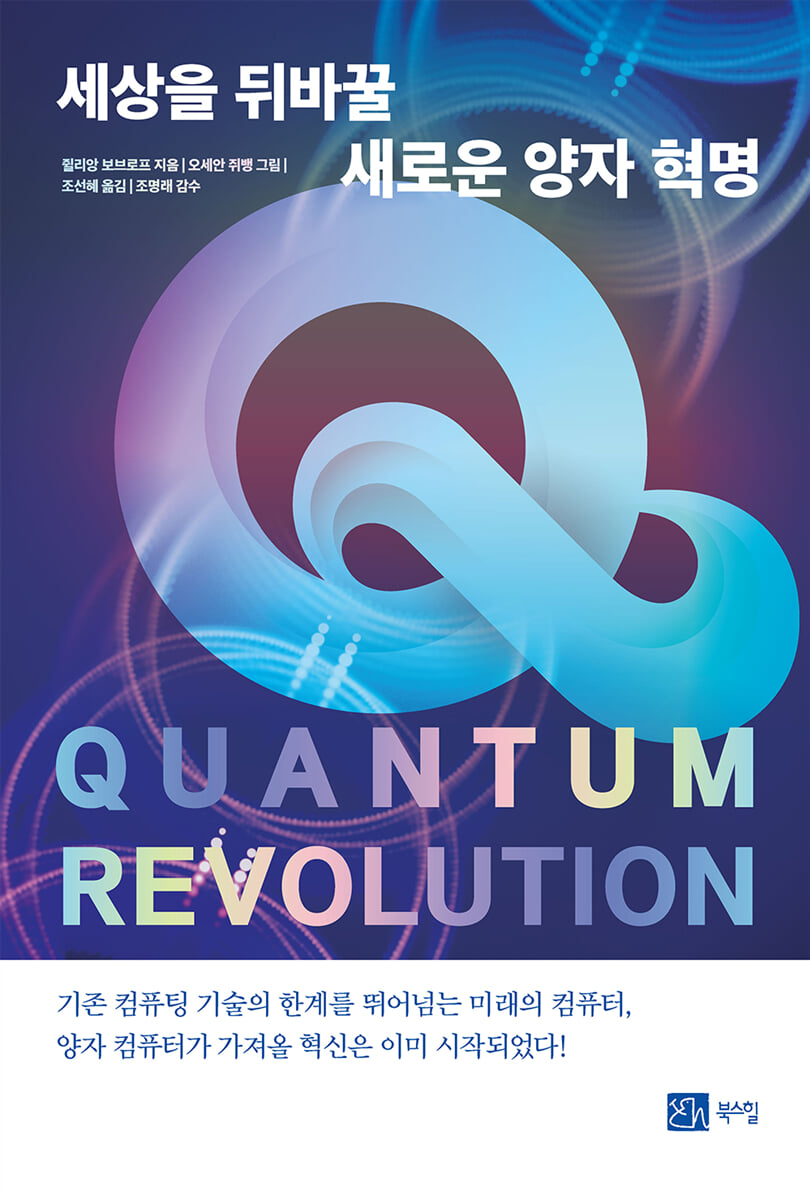
A new quantum revolution that will change the world
 |
Description
Book Introduction
The computer of the future that overcomes the limitations of existing computing technology.
The revolutionary changes brought about by quantum computers have already begun!
A quantum computer is a new, innovative computing system that processes information using the principles of quantum mechanics. It uses qubits instead of the 0 and 1 bits of conventional computers, and is based on superposition and entanglement, which allow qubits to exist in both 0 and 1 states simultaneously.
Quantum computers can use superposition states to calculate multiple cases simultaneously, and entangled states can dramatically increase computational speed.
This book explores what quantum computers are, how they work, and how they will change our lives.
Furthermore, it shows that quantum computers have the potential to bring about revolutionary changes in cryptography, drug development (e.g., Google's Sycamore), and artificial intelligence.
The revolutionary changes brought about by quantum computers have already begun!
A quantum computer is a new, innovative computing system that processes information using the principles of quantum mechanics. It uses qubits instead of the 0 and 1 bits of conventional computers, and is based on superposition and entanglement, which allow qubits to exist in both 0 and 1 states simultaneously.
Quantum computers can use superposition states to calculate multiple cases simultaneously, and entangled states can dramatically increase computational speed.
This book explores what quantum computers are, how they work, and how they will change our lives.
Furthermore, it shows that quantum computers have the potential to bring about revolutionary changes in cryptography, drug development (e.g., Google's Sycamore), and artificial intelligence.
- You can preview some of the book's contents.
Preview
index
Prologue: The Second Revolution?
1.
See the atom
2.
What time is it now?
3.
Atoms at the top of Mount Etna
4.
Diamonds are forever
5.
Draw a quantum computer
6.
universal machine
7.
Quantum superiority
8.
Quantum music score
9.
Quantum Spy
10.
Bugs
11.
Let there be light!
12.
Outsiders
13.
Mona Lisa sculpted from atoms
14.
A real simulator, not a game
15.
Entanglement, a new frontier
16.
Quantum Internet
Epilogue: Key Questions
Acknowledgements
annotation
References
Search
1.
See the atom
2.
What time is it now?
3.
Atoms at the top of Mount Etna
4.
Diamonds are forever
5.
Draw a quantum computer
6.
universal machine
7.
Quantum superiority
8.
Quantum music score
9.
Quantum Spy
10.
Bugs
11.
Let there be light!
12.
Outsiders
13.
Mona Lisa sculpted from atoms
14.
A real simulator, not a game
15.
Entanglement, a new frontier
16.
Quantum Internet
Epilogue: Key Questions
Acknowledgements
annotation
References
Search
Detailed image

Into the book
In this book, we will explore these future technologies together.
I'm not going to teach you quantum theory.
You won't even learn how to solve the Schrödinger equation.
...
I'll tell you about the latest, most exciting, and most unexpected discoveries—things already in use, things that may never see the light of day, and, most importantly, the ones I think will truly transform our daily lives tomorrow.
--- p.9-10 "Prologue: The Second Revolution?"
Without us even realizing it, the quantum revolution has already shaken up our understanding of time and space.
Not only do our smartphones adjust their time to Coordinated Universal Time, measured by atomic clocks in laboratories, but GPS also measures our location based on quantum experiments conducted inside satellites.
Beyond these applications, these watches could also find use in an even more unexpected field: geophysics.
To understand this, we need to go through general relativity! --- p.34 "What time is it now?"
Until now, experiments have been nothing more than technical devices for observing nature.
Experiments are no longer content to simply measure phenomena; they are now creating unprecedented phenomena.
This is the essence of the second quantum revolution.
In the first step, physicists create a phenomenon in the laboratory and observe it closely.
Then use it for other purposes.
They create interference and use it to invent accelerometers.
We create an entanglement and use it to encrypt messages.
We create superpositions and use them to design computers.
--- p.53 "Atoms on the Top of Mount Etna"
Quantum computers are a challenge to the mass adoption of quantum technology, perhaps the ultimate challenge.
It is based on the most abstract theories and the most cutting-edge technologies.
What's worse is that it carries all the illusions with it.
It attracts and captivates the most adventurous and daring investors in the high-tech world.
But it also gives me fear.
--- p.71 "Draw a Quantum Computer"
Any discussion of the future of quantum computing requires a serious consideration of the error problem.
There are so many errors, such as 'gate errors', 'phase errors', and 'bit errors'.
Where do these errors come from? Which errors are the most serious? How can we fix them? Let's start by explaining what these errors are specifically.
--- p.144 "Bugs"
Of all the qubits studied to date, there is no guarantee that any type will be successfully scaled in the future.
Each has serious problems, and those who invest time and resources in them are taking a real risk.
But nothing is as dangerous as topological qubits.
Topological qubits are perhaps the most adventurous challenge of this second quantum revolution.
--- p.180 "Outsiders"
Quantum computers could spark small revolutions in unexpected places.
It is the agricultural sector.
Currently, nitrogen fertilizer is one of the major energy costs our society pays to support our population.
To produce this fertilizer, nitrogen must be converted into ammonia.
This chemical reaction requires a reactor at temperatures exceeding 400°C, consumes 1-2% of the world's energy, and emits an equivalent amount of CO2 into the atmosphere.
This is a disaster.
Fortunately, a simple protein, nitrogenase, can perform the same task without the need to heat the nitrogen.
If quantum computers could decipher how it works, and factories could replicate it, polluting reactors would be no longer needed!
I'm not going to teach you quantum theory.
You won't even learn how to solve the Schrödinger equation.
...
I'll tell you about the latest, most exciting, and most unexpected discoveries—things already in use, things that may never see the light of day, and, most importantly, the ones I think will truly transform our daily lives tomorrow.
--- p.9-10 "Prologue: The Second Revolution?"
Without us even realizing it, the quantum revolution has already shaken up our understanding of time and space.
Not only do our smartphones adjust their time to Coordinated Universal Time, measured by atomic clocks in laboratories, but GPS also measures our location based on quantum experiments conducted inside satellites.
Beyond these applications, these watches could also find use in an even more unexpected field: geophysics.
To understand this, we need to go through general relativity! --- p.34 "What time is it now?"
Until now, experiments have been nothing more than technical devices for observing nature.
Experiments are no longer content to simply measure phenomena; they are now creating unprecedented phenomena.
This is the essence of the second quantum revolution.
In the first step, physicists create a phenomenon in the laboratory and observe it closely.
Then use it for other purposes.
They create interference and use it to invent accelerometers.
We create an entanglement and use it to encrypt messages.
We create superpositions and use them to design computers.
--- p.53 "Atoms on the Top of Mount Etna"
Quantum computers are a challenge to the mass adoption of quantum technology, perhaps the ultimate challenge.
It is based on the most abstract theories and the most cutting-edge technologies.
What's worse is that it carries all the illusions with it.
It attracts and captivates the most adventurous and daring investors in the high-tech world.
But it also gives me fear.
--- p.71 "Draw a Quantum Computer"
Any discussion of the future of quantum computing requires a serious consideration of the error problem.
There are so many errors, such as 'gate errors', 'phase errors', and 'bit errors'.
Where do these errors come from? Which errors are the most serious? How can we fix them? Let's start by explaining what these errors are specifically.
--- p.144 "Bugs"
Of all the qubits studied to date, there is no guarantee that any type will be successfully scaled in the future.
Each has serious problems, and those who invest time and resources in them are taking a real risk.
But nothing is as dangerous as topological qubits.
Topological qubits are perhaps the most adventurous challenge of this second quantum revolution.
--- p.180 "Outsiders"
Quantum computers could spark small revolutions in unexpected places.
It is the agricultural sector.
Currently, nitrogen fertilizer is one of the major energy costs our society pays to support our population.
To produce this fertilizer, nitrogen must be converted into ammonia.
This chemical reaction requires a reactor at temperatures exceeding 400°C, consumes 1-2% of the world's energy, and emits an equivalent amount of CO2 into the atmosphere.
This is a disaster.
Fortunately, a simple protein, nitrogenase, can perform the same task without the need to heat the nitrogen.
If quantum computers could decipher how it works, and factories could replicate it, polluting reactors would be no longer needed!
--- p.207 "A real simulator, not a game"
Publisher's Review
How quantum computers work
Superposition, one of the core principles of quantum mechanics, is the concept that particles can exist in multiple states simultaneously, similar to the phenomenon of a coin spinning in the air and showing both heads and tails at the same time.
This superposition state allows quantum computers to compute multiple cases simultaneously.
Another principle is 'entanglement', where if two particles are entangled, simply measuring the state of one particle can instantly reveal the state of the other particle.
These entangled states can dramatically speed up computations.
The Amazing Power and Transformative Potential of Quantum Computers
The computers we use today perform calculations using a unit of information processing called a 'bit' that can only have the value 0 or 1, but quantum computers use a special unit of information called a 'qubit' that can have both 0 and 1 simultaneously through the phenomenon of superposition.
Therefore, it can store much more information than conventional computers and perform multiple calculations at once.
Entanglement is also a phenomenon where two particles behave as if they are connected even though they are far apart, and this could be used to make quantum computers that are far apart operate as a single computer, allowing them to influence each other, instantly share information, and even perform calculations collaboratively.
These properties of quantum computers could lead to tremendous innovations in a variety of fields.
For example, we can quickly develop drugs that are more effective and have fewer side effects than existing drugs, develop stronger and lighter materials to build new spaceships and buildings, and create smarter artificial intelligence to make our lives more convenient.
The Present and Future of Quantum Computers
Quantum computers are a revolutionary technology that surpasses the limits of current computing technology.
This is because it can perform calculations that are impossible with existing computers by utilizing the principles of superposition and entanglement.
However, quantum computers are still in their infancy and it will take some time before they are commercialized as a practical technology.
Quantum computing technology is advancing rapidly, and governments around the world and global corporations like IBM, Google, and Microsoft are investing massive amounts of capital in the development of this revolutionary technology.
Quantum computers will dramatically transform our lives by spurring new technologies and innovations.
Superposition, one of the core principles of quantum mechanics, is the concept that particles can exist in multiple states simultaneously, similar to the phenomenon of a coin spinning in the air and showing both heads and tails at the same time.
This superposition state allows quantum computers to compute multiple cases simultaneously.
Another principle is 'entanglement', where if two particles are entangled, simply measuring the state of one particle can instantly reveal the state of the other particle.
These entangled states can dramatically speed up computations.
The Amazing Power and Transformative Potential of Quantum Computers
The computers we use today perform calculations using a unit of information processing called a 'bit' that can only have the value 0 or 1, but quantum computers use a special unit of information called a 'qubit' that can have both 0 and 1 simultaneously through the phenomenon of superposition.
Therefore, it can store much more information than conventional computers and perform multiple calculations at once.
Entanglement is also a phenomenon where two particles behave as if they are connected even though they are far apart, and this could be used to make quantum computers that are far apart operate as a single computer, allowing them to influence each other, instantly share information, and even perform calculations collaboratively.
These properties of quantum computers could lead to tremendous innovations in a variety of fields.
For example, we can quickly develop drugs that are more effective and have fewer side effects than existing drugs, develop stronger and lighter materials to build new spaceships and buildings, and create smarter artificial intelligence to make our lives more convenient.
The Present and Future of Quantum Computers
Quantum computers are a revolutionary technology that surpasses the limits of current computing technology.
This is because it can perform calculations that are impossible with existing computers by utilizing the principles of superposition and entanglement.
However, quantum computers are still in their infancy and it will take some time before they are commercialized as a practical technology.
Quantum computing technology is advancing rapidly, and governments around the world and global corporations like IBM, Google, and Microsoft are investing massive amounts of capital in the development of this revolutionary technology.
Quantum computers will dramatically transform our lives by spurring new technologies and innovations.
GOODS SPECIFICS
- Date of issue: May 15, 2025
- Page count, weight, size: 288 pages | 152*225*17mm
- ISBN13: 9791159715426
You may also like
카테고리
korean


korean

![GQ KOREA Mark (Monthly): December [2025]](http://librairie.coreenne.fr/cdn/shop/files/8ef265dbbfbf186523ed75ba7319009d.jpg?v=1765340328&width=3840)


