

The Future of Quantum Computers: Uncertainty
 |
Description
Book Introduction
The uncertainty principle, one of the core concepts of quantum mechanics, is a natural law of the microscopic world. It is not an uncertain theory, but a definite theory whose correctness has been proven through numerous experiments.
The author depicts the background and process of uncertainty's emergence in a serious yet interesting way.
From the dawn of the 19th century, when the uncertainty principle was bound to emerge, to the 20th century's clash over this new physical principle, it explains step by step.
Unlike other scientific theories, quantum mechanics was dramatically perfected over a period of 20 years by several brilliant scientists.
This book explains the development of the revolutionary principles of quantum mechanics in an easy-to-understand manner for readers weak in science and mathematics, while also beautifully capturing the lives and thoughts of the people surrounding this revolution.
The author depicts the background and process of uncertainty's emergence in a serious yet interesting way.
From the dawn of the 19th century, when the uncertainty principle was bound to emerge, to the 20th century's clash over this new physical principle, it explains step by step.
Unlike other scientific theories, quantum mechanics was dramatically perfected over a period of 20 years by several brilliant scientists.
This book explains the development of the revolutionary principles of quantum mechanics in an easy-to-understand manner for readers weak in science and mathematics, while also beautifully capturing the lives and thoughts of the people surrounding this revolution.
- You can preview some of the book's contents.
Preview
index
★ Preface
1 excited particles
2 Entropy increases infinitely toward its maximum value.
3. A wonder and an object of astonishment
4 How do electrons make decisions?
5 Unprecedented Shamelessness
6 Ignorance does not guarantee success.
7 How can one be happy?
8 I'd rather be a shoe repairman
9 Something amazing happened
10 The spirit of the classical system
11 I am on the side of giving up determinism.
12 There are no appropriate words
13 Terms like Bohr's order
Game 14 ended in victory
15 Life experience, not scientific experience
16 Possibility of unambiguous interpretation
17 In the middle area between logic and physics
18 In the end, it was a state of confusion
★ Author's Note
★ Words of gratitude
★ Notes
★ References
★ Translator's Note
1 excited particles
2 Entropy increases infinitely toward its maximum value.
3. A wonder and an object of astonishment
4 How do electrons make decisions?
5 Unprecedented Shamelessness
6 Ignorance does not guarantee success.
7 How can one be happy?
8 I'd rather be a shoe repairman
9 Something amazing happened
10 The spirit of the classical system
11 I am on the side of giving up determinism.
12 There are no appropriate words
13 Terms like Bohr's order
Game 14 ended in victory
15 Life experience, not scientific experience
16 Possibility of unambiguous interpretation
17 In the middle area between logic and physics
18 In the end, it was a state of confusion
★ Author's Note
★ Words of gratitude
★ Notes
★ References
★ Translator's Note
Detailed image
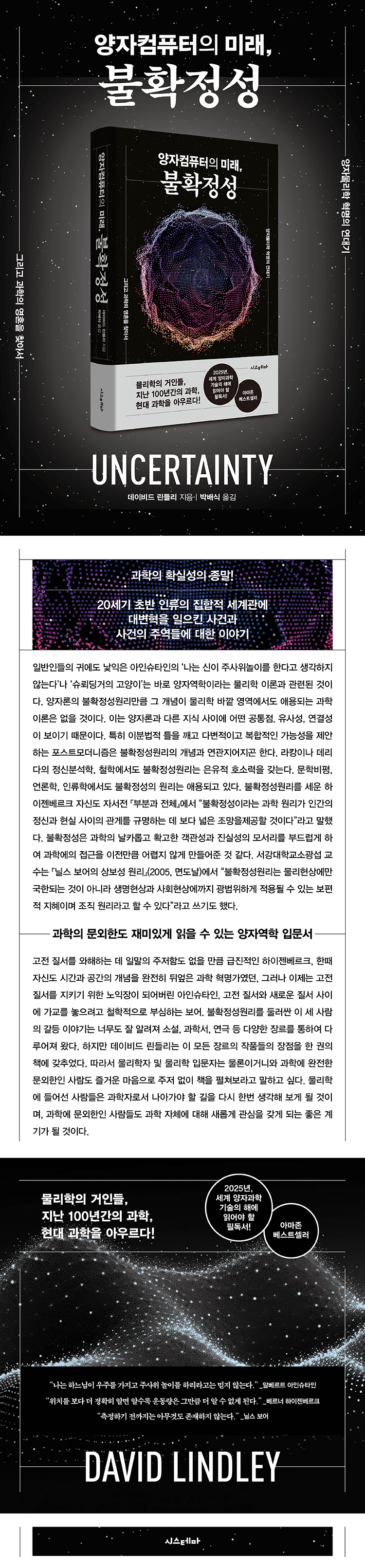
Publisher's Review
Explains in an easy-to-understand way how understanding of atoms led to quantum mechanics, special relativity, matrix algebra, and matrix mechanics, which gave birth to nuclear physics.
-The New York Times
The End of Scientific Certainty
A story about the events and their protagonists that brought about a great transformation in humanity's collective worldview in the early 20th century.
Einstein's "I don't think God plays dice" and "Schrödinger's cat," which are familiar to the general public, are related to the physics theory called quantum mechanics.
There is probably no scientific theory whose concept is used as much outside of physics as the uncertainty principle of quantum theory.
This is because there are some commonalities, similarities, and connections between quantum theory and other knowledge.
In particular, postmodernism, which breaks the dichotomous framework and proposes multifaceted and complex possibilities, is often associated with the concept of the uncertainty principle.
The uncertainty principle also has metaphorical appeal in the psychoanalysis and philosophy of Lacan and Derrida.
The uncertainty principle is also widely used in literary criticism, journalism, and anthropology.
Heisenberg, who established the uncertainty principle, said in his autobiography, “The Part and the Whole,” “The scientific principle of uncertainty will provide a broader perspective in elucidating the relationship between the human mind and reality.”
Uncertainty seems to have softened the sharp edges of science's rigid objectivity and truthfulness, making it less difficult to approach.
Professor Sogang University's So Gwang-seop wrote in "Niels Bohr's Complementarity Principle" (2005, Razor Blade) that "the uncertainty principle is not limited to physical phenomena, but is a universal wisdom that can be widely applied to life and social phenomena, and it can be said to be an organizing principle."
The uncertainty principle is a rigorously derived formula.
The uncertainty principle, one of the core concepts of quantum mechanics, is a natural law of the microscopic world. It is not an uncertain theory, but a definite theory whose correctness has been proven through numerous experiments.
Lasers, electron microscopes, transistors, and nuclear power are all useful technologies made possible by quantum theory.
The uncertainty principle is not an abstract idea, but a rigorously derived formula.
According to this formula, measuring the speed of an electron means that its position cannot be determined, and determining its position means that its speed becomes uncertain.
It is not because our measurement technology is lacking, but because it is inherently the nature or properties of particles.
If velocity and position are not definite, electrons can only be thought of as spread out over some spatial region.
Therefore, we cannot say with certainty, 'This is here, and it will go to where and at what speed in the future,' but can only speak of statistical probabilities.
Quantum systems, which seem to move freely without following precise causality, were a source of perplexity for Einstein and other scientists of the time because they broke the ironclad concept of deterministic classical science.
(Modern physicists have neither the time nor the reason to worry about the metaphysical and philosophical implications of quantum mechanics, because the formulas of quantum mechanics are so precisely consistent with experimental results and there are infinitely many useful things they can do with them.)
A clash of scientific geniuses over the revolutionary physics principles of the 20th century!
Unlike other scientific theories, quantum mechanics was dramatically perfected over a period of 20 years by many brilliant scientists.
This book explains the development of the revolutionary principles of quantum mechanics in an easy-to-understand manner for readers weak in science and mathematics, while also beautifully capturing the lives and thoughts of the people surrounding this revolution.
For readers interested in the philosophy and history of science, or those seeking to learn about quantum mechanics, this is perhaps the most appropriate introductory book ever written in this field.
Heisenberg, shaking the foundations of classical physics!
In 1927, Heisenberg, a young student with no interest in classical physics, caused a sensation with a revolutionary scientific principle.
It completely overturned science, which humanity had believed to be beyond doubt until the 19th century.
That is, all moving objects have position and speed; all physical world moves by clear cause and effect; nature is fundamentally a precise machine that can be known and will inevitably be known someday; and this can be described precisely using numbers; if you understand everything, you can predict everything; science is ultimately deterministic and unchanging, which completely overturns the existing understanding.
The more precisely we know position, the less we know momentum. Atoms move spontaneously, without a preexisting cause. Nature can only be predicted by what is observable, expressed in probability and statistics! This has completely uprooted the belief that science can accurately reveal the physical world around us.
Heisenberg's beliefs deeply irritated Einstein.
Einstein frequently referred to God as not playing dice and opposed Heisenberg's radical new principles of physics until his death.
Furthermore, Heisenberg's teacher, Bohr, struggled to explain this principle in classical physics terms, which is precisely why his conflict with Heisenberg was at its peak.
Heisenberg could not bear to have his new principles, which he was convinced owed no debt to any generation, explained in terms of classical physics.
The conflict between these three people surrounding the uncertainty principle is the main theme.
A heated debate erupted among scientists, and it has not yet been resolved.
I'd rather be a shoe repairman or a casino worker!
David Lindley depicts the background and process of uncertainty's emergence in a serious yet fascinating way.
From the dawn of the 19th century, when the uncertainty principle was bound to emerge, to the 20th century's clash over this new physical principle, it explains step by step.
One of the greatest charms of this work is the episodes that allow us to glimpse the human side of these genius scientists and the vividly conveyed words they left behind.
This, combined with the conflict among scientists surrounding the uncertainty principle, makes it impossible for even those unfamiliar with science to put the book down until the very end.
For example, Einstein even said that if the new theory was going in this direction, “I would rather be a cobbler or a casino worker.” One cannot help but wonder what this new theory was that caused such a great man like Einstein such trouble.
An introductory book on quantum mechanics that even non-scientists can enjoy.
Heisenberg, who was so radical that he had no hesitation in destroying the classical order; Einstein, who was once a scientific revolutionary who completely overturned the concepts of time and space, but is now a veteran defender of the classical order; Bohr, who struggled philosophically to build a bridge between the classical order and the new order.
The story of the conflict between these three people surrounding the uncertainty principle is so well known that it has been covered in various genres such as novels, science books, and plays.
But David Lindley has combined the best of all these genres into one book.
Therefore, I would like to encourage physicists, physics beginners, and even complete science laymen to open this book with joy and without hesitation.
Those entering the field of physics will be able to reconsider the path they should take as a scientist, and it will also be a good opportunity for those who are not familiar with science to develop a new interest in science itself.
-The New York Times
The End of Scientific Certainty
A story about the events and their protagonists that brought about a great transformation in humanity's collective worldview in the early 20th century.
Einstein's "I don't think God plays dice" and "Schrödinger's cat," which are familiar to the general public, are related to the physics theory called quantum mechanics.
There is probably no scientific theory whose concept is used as much outside of physics as the uncertainty principle of quantum theory.
This is because there are some commonalities, similarities, and connections between quantum theory and other knowledge.
In particular, postmodernism, which breaks the dichotomous framework and proposes multifaceted and complex possibilities, is often associated with the concept of the uncertainty principle.
The uncertainty principle also has metaphorical appeal in the psychoanalysis and philosophy of Lacan and Derrida.
The uncertainty principle is also widely used in literary criticism, journalism, and anthropology.
Heisenberg, who established the uncertainty principle, said in his autobiography, “The Part and the Whole,” “The scientific principle of uncertainty will provide a broader perspective in elucidating the relationship between the human mind and reality.”
Uncertainty seems to have softened the sharp edges of science's rigid objectivity and truthfulness, making it less difficult to approach.
Professor Sogang University's So Gwang-seop wrote in "Niels Bohr's Complementarity Principle" (2005, Razor Blade) that "the uncertainty principle is not limited to physical phenomena, but is a universal wisdom that can be widely applied to life and social phenomena, and it can be said to be an organizing principle."
The uncertainty principle is a rigorously derived formula.
The uncertainty principle, one of the core concepts of quantum mechanics, is a natural law of the microscopic world. It is not an uncertain theory, but a definite theory whose correctness has been proven through numerous experiments.
Lasers, electron microscopes, transistors, and nuclear power are all useful technologies made possible by quantum theory.
The uncertainty principle is not an abstract idea, but a rigorously derived formula.
According to this formula, measuring the speed of an electron means that its position cannot be determined, and determining its position means that its speed becomes uncertain.
It is not because our measurement technology is lacking, but because it is inherently the nature or properties of particles.
If velocity and position are not definite, electrons can only be thought of as spread out over some spatial region.
Therefore, we cannot say with certainty, 'This is here, and it will go to where and at what speed in the future,' but can only speak of statistical probabilities.
Quantum systems, which seem to move freely without following precise causality, were a source of perplexity for Einstein and other scientists of the time because they broke the ironclad concept of deterministic classical science.
(Modern physicists have neither the time nor the reason to worry about the metaphysical and philosophical implications of quantum mechanics, because the formulas of quantum mechanics are so precisely consistent with experimental results and there are infinitely many useful things they can do with them.)
A clash of scientific geniuses over the revolutionary physics principles of the 20th century!
Unlike other scientific theories, quantum mechanics was dramatically perfected over a period of 20 years by many brilliant scientists.
This book explains the development of the revolutionary principles of quantum mechanics in an easy-to-understand manner for readers weak in science and mathematics, while also beautifully capturing the lives and thoughts of the people surrounding this revolution.
For readers interested in the philosophy and history of science, or those seeking to learn about quantum mechanics, this is perhaps the most appropriate introductory book ever written in this field.
Heisenberg, shaking the foundations of classical physics!
In 1927, Heisenberg, a young student with no interest in classical physics, caused a sensation with a revolutionary scientific principle.
It completely overturned science, which humanity had believed to be beyond doubt until the 19th century.
That is, all moving objects have position and speed; all physical world moves by clear cause and effect; nature is fundamentally a precise machine that can be known and will inevitably be known someday; and this can be described precisely using numbers; if you understand everything, you can predict everything; science is ultimately deterministic and unchanging, which completely overturns the existing understanding.
The more precisely we know position, the less we know momentum. Atoms move spontaneously, without a preexisting cause. Nature can only be predicted by what is observable, expressed in probability and statistics! This has completely uprooted the belief that science can accurately reveal the physical world around us.
Heisenberg's beliefs deeply irritated Einstein.
Einstein frequently referred to God as not playing dice and opposed Heisenberg's radical new principles of physics until his death.
Furthermore, Heisenberg's teacher, Bohr, struggled to explain this principle in classical physics terms, which is precisely why his conflict with Heisenberg was at its peak.
Heisenberg could not bear to have his new principles, which he was convinced owed no debt to any generation, explained in terms of classical physics.
The conflict between these three people surrounding the uncertainty principle is the main theme.
A heated debate erupted among scientists, and it has not yet been resolved.
I'd rather be a shoe repairman or a casino worker!
David Lindley depicts the background and process of uncertainty's emergence in a serious yet fascinating way.
From the dawn of the 19th century, when the uncertainty principle was bound to emerge, to the 20th century's clash over this new physical principle, it explains step by step.
One of the greatest charms of this work is the episodes that allow us to glimpse the human side of these genius scientists and the vividly conveyed words they left behind.
This, combined with the conflict among scientists surrounding the uncertainty principle, makes it impossible for even those unfamiliar with science to put the book down until the very end.
For example, Einstein even said that if the new theory was going in this direction, “I would rather be a cobbler or a casino worker.” One cannot help but wonder what this new theory was that caused such a great man like Einstein such trouble.
An introductory book on quantum mechanics that even non-scientists can enjoy.
Heisenberg, who was so radical that he had no hesitation in destroying the classical order; Einstein, who was once a scientific revolutionary who completely overturned the concepts of time and space, but is now a veteran defender of the classical order; Bohr, who struggled philosophically to build a bridge between the classical order and the new order.
The story of the conflict between these three people surrounding the uncertainty principle is so well known that it has been covered in various genres such as novels, science books, and plays.
But David Lindley has combined the best of all these genres into one book.
Therefore, I would like to encourage physicists, physics beginners, and even complete science laymen to open this book with joy and without hesitation.
Those entering the field of physics will be able to reconsider the path they should take as a scientist, and it will also be a good opportunity for those who are not familiar with science to develop a new interest in science itself.
GOODS SPECIFICS
- Date of issue: April 30, 2025
- Format: Hardcover book binding method guide
- Page count, weight, size: 352 pages | 626g | 148*216*25mm
- ISBN13: 9791194090298
- ISBN10: 119409029X
You may also like
카테고리
korean


korean

![GQ KOREA Mark (Monthly): December [2025]](http://librairie.coreenne.fr/cdn/shop/files/8ef265dbbfbf186523ed75ba7319009d.jpg?v=1765340328&width=3840)


