

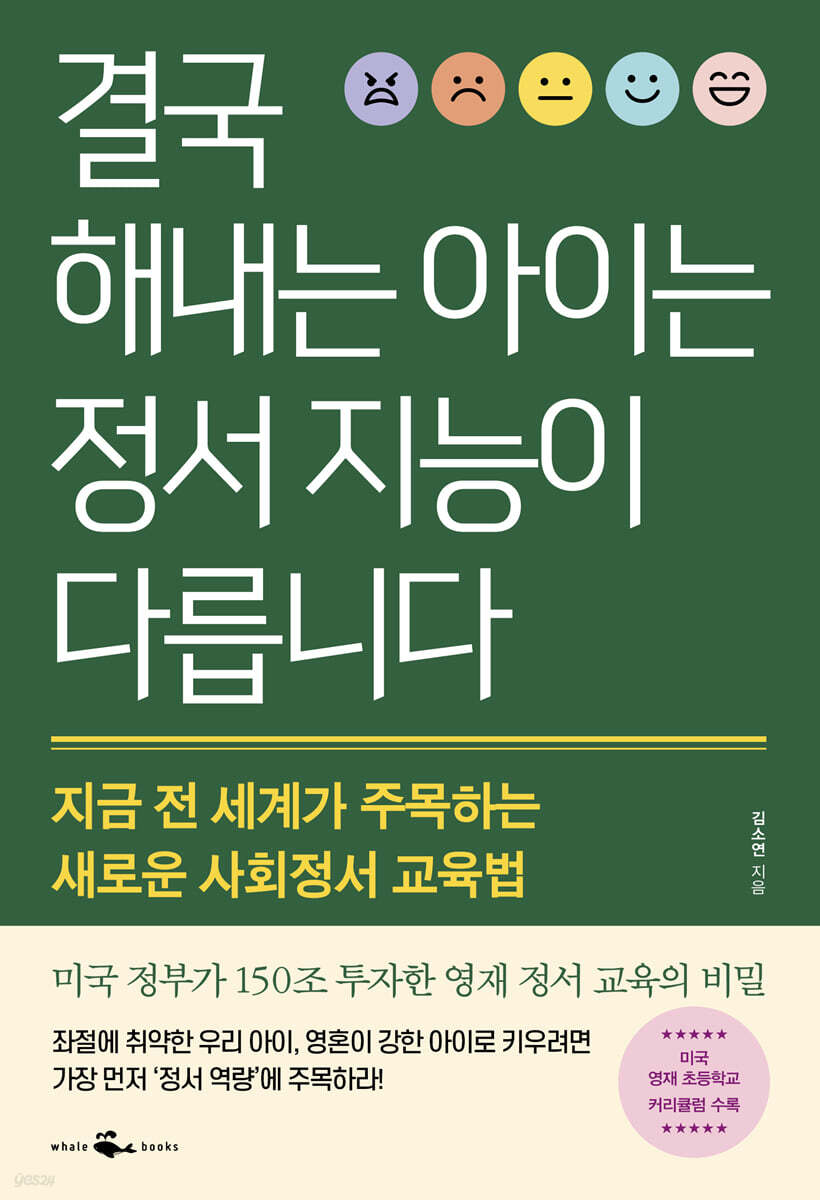
In the end, children who succeed have different emotional intelligence.
 |
Description
Book Introduction
★ Included in the American Gifted Elementary School Curriculum ★ The Secret to Gifted Emotional Education, a $150 Billion Investment by the U.S. Government To raise our children, who are vulnerable to frustration, into children with strong souls, First of all, focus on ‘emotional competence’! In American gifted elementary schools, Specializing in the study of emotions, feelings, and relationships The U.S. Department of Education's SEL Education Bible: Developing 21st Century Core Competencies ★ Self-advocacy skills that value oneself ★ Mood Meter to Raise a Child Who Holds the Reins of His Own Heart ★ A classroom strategy that strengthens peer relationships and creates a world for children. ★ An educational method that fosters the ability to make responsible choices. ★ A 'Growth Mindset' Coaching Method That Increases Resilience Is college a must? Are English and math more important, or is literacy more important? Will my current job still be in demand 10 years from now? Every parent in Korea is on edge right now. It's been a long time since studying hard for a dozen years to get into a prestigious university and then getting a job at a successful large company and receiving a high salary is no longer considered a successful life. If you're feeling lost amidst the overwhelming information about what kind of education your child needs, consider the emerging educational trends gaining global attention. Countries known as advanced educational institutions, such as the United States, Canada, the United Kingdom, and Singapore, have long been preparing educational methods to adapt to the rapidly changing times. In particular, the U.S. government invested 150 trillion dollars in this education law, which is called 'social emotional learning (SEL)'. Author Kim So-yeon, a mind education expert who has taught numerous gifted students in American elementary schools, advises that the foundation of future competitiveness lies in “helping children find the strength to move forward on their own without giving in to difficult situations, rather than fulfilling their parents’ dreams.” I need to help my child develop his emotional capabilities. This is because only children with high emotional capacity grow up to be children who not only achieve academic success but also 'overcome' any setback or failure. Even when under academic stress, children with high emotional regulation skills maintain better mental health than those without, and have the strength to persevere when faced with unexpected problems and conflicts. In this book, the author argues that the skills that are difficult to replace with artificial intelligence and machines are communication and collaboration skills, critical thinking skills, and creativity, and recommends increasing emotional intelligence. The ability of children to effectively express their knowledge and collaborate through communication with others is the 'weapon' our children will use in future society. Based on theoretical foundations in education, psychology, and brain science, this book discusses how children can feel secure and grow at school and at home. In this book, which will become the new parenting bible, we will find clues to happiness that we can pass on to our children. |
- You can preview some of the book's contents.
Preview
index
Prologue: Children with high emotional intelligence proactively design their own happiness.
CHAPTER 1 America's Gifted Children Receive Emotional Education
The only education that guarantees proactive happiness
What exactly is social emotional education?
Explicit, implicit, and integrated teaching methods
Why the U.S. government invested $150 billion
Children with strong SEL will become future talents of the 21st century.
Hot SEL Curriculum in the US
Mental Education for Children Growing Up in Korea
CHAPTER 2 Emotional Education: Raising Children with a Strong Ego
A child who laughs at school but cries when he gets home
The way we look at ourselves, the ego
How much are you investing in building relationships?
The power to know myself, metacognition
A growth-oriented classroom where ignorance is the norm
Extrinsic and Intrinsic Motivation: How to Optimize Your Use
The courage to ask for help
At the heart of a responsible child is choice.
Make good use of the safe zone
CHAPTER 3 Emotional Education: Raising Children Who Know Their Own Feelings
A child who holds the reins of his heart
Mood meter to help you understand your feelings
There are no bad feelings in the world.
Learn the emotional signals your body sends
Complex emotions and ambivalence, unraveling the emotional tangle
Why Emotional Control Is Still Difficult
Common mistakes parents make when teaching emotional intelligence
Our child, on an emotional roller coaster, often loses his temper
How to Deal with Anxious and Sensitive Children
An emotional conversation that begins with a picture book and ends with role-playing.
* List of recommended picture books related to social and emotional learning
CHAPTER 4: Relationship Education: Raising Socially Well-Being Children in a World We Live In Together
Social skills that change my child's life
The Beginning of Everything: Developing Empathy
Teaching Manners and Rules: The Subtle Differences
Social distancing must be maintained even after the pandemic is over.
To be patient in an 'instant' world
An attitude of understanding mistakes and differences
Opportunity for choice with responsibility
Self-advocacy skills that value oneself
Children's World, Peer Relationships
How to Deal with Peer Pressure
Fighting well is also a skill
A child who knows the size of the problem well
The Key to Success: Developing Flexibility
Too Much Talker
A good lead comes from reading your opponent.
References
CHAPTER 1 America's Gifted Children Receive Emotional Education
The only education that guarantees proactive happiness
What exactly is social emotional education?
Explicit, implicit, and integrated teaching methods
Why the U.S. government invested $150 billion
Children with strong SEL will become future talents of the 21st century.
Hot SEL Curriculum in the US
Mental Education for Children Growing Up in Korea
CHAPTER 2 Emotional Education: Raising Children with a Strong Ego
A child who laughs at school but cries when he gets home
The way we look at ourselves, the ego
How much are you investing in building relationships?
The power to know myself, metacognition
A growth-oriented classroom where ignorance is the norm
Extrinsic and Intrinsic Motivation: How to Optimize Your Use
The courage to ask for help
At the heart of a responsible child is choice.
Make good use of the safe zone
CHAPTER 3 Emotional Education: Raising Children Who Know Their Own Feelings
A child who holds the reins of his heart
Mood meter to help you understand your feelings
There are no bad feelings in the world.
Learn the emotional signals your body sends
Complex emotions and ambivalence, unraveling the emotional tangle
Why Emotional Control Is Still Difficult
Common mistakes parents make when teaching emotional intelligence
Our child, on an emotional roller coaster, often loses his temper
How to Deal with Anxious and Sensitive Children
An emotional conversation that begins with a picture book and ends with role-playing.
* List of recommended picture books related to social and emotional learning
CHAPTER 4: Relationship Education: Raising Socially Well-Being Children in a World We Live In Together
Social skills that change my child's life
The Beginning of Everything: Developing Empathy
Teaching Manners and Rules: The Subtle Differences
Social distancing must be maintained even after the pandemic is over.
To be patient in an 'instant' world
An attitude of understanding mistakes and differences
Opportunity for choice with responsibility
Self-advocacy skills that value oneself
Children's World, Peer Relationships
How to Deal with Peer Pressure
Fighting well is also a skill
A child who knows the size of the problem well
The Key to Success: Developing Flexibility
Too Much Talker
A good lead comes from reading your opponent.
References
Detailed image

Into the book
For Korean students, who are prone to experiencing negative emotions due to excessive study load and study time, it is increasingly important to foster the ability to find happiness beyond grades through social-emotional learning.
Even with similar grades and academic stress, children with high emotional regulation skills do not lose their mental health.
Because building mental muscle plays a key role in the relationship between academic stress and mental health.
---p.55 From “Mind Education for Children Growing Up in Korea”
Responsibility is not something that comes naturally with age, but rather an ability that is developed through experiences that we choose for ourselves.
As children are repeatedly made to take full responsibility for the consequences of their own choices, they accumulate the strength to make their own decisions when faced with other choices.
This builds up within us as a strong sense of responsibility, independence, and confidence.
On the other hand, children who lack self-determination become increasingly distant from the life they choose for themselves.
From which college to attend and which major to choose to where to invest, the fact that people today seek and follow the opinions of others rather than thinking for themselves may stem from a desire to avoid responsibility.
However, we must realize that if we simply run away from choices, we will not only be unable to live our own lives independently, but we will also become increasingly distant from responsibility for our own lives.
---p.143 "At the heart of a responsible child lies the power of choice."
Knowing alternatives to controlling your fiery temper will help you better manage your anger.
Expressions like “You shouldn’t throw things when you’re angry!” and “Who’s yelling!” that we often use to calm down a child who is experiencing strong emotions only criticize and try to control the problematic behavior, but do not teach them how to deal with it.
Rather than simply suppressing a child's desire to break or throw things out of anger, this is a mind control strategy that helps them release their emotional pressure through activities such as drumming, jumping in place, or kicking a ball.
---p.223 From "My Child, Frequently Angry, on an Emotional Roller Coaster"
Children make friends from a very young age, but it is usually not until much later that they begin to understand the true meaning of those relationships.
That is understandable, as the expression ‘friend’ is often used in a complex sense in our daily lives.
Because of the social environment where children call all peers they meet on the street or classmates as friends, it is easy for children to feel awkward about this.
However, there is a strict difference between friends and acquaintances, and they are as diverse as the forms of friendship.
Therefore, we need to teach children that there are healthy relationships in the world that bring emotional stability to each other, as well as toxic relationships.
Even with similar grades and academic stress, children with high emotional regulation skills do not lose their mental health.
Because building mental muscle plays a key role in the relationship between academic stress and mental health.
---p.55 From “Mind Education for Children Growing Up in Korea”
Responsibility is not something that comes naturally with age, but rather an ability that is developed through experiences that we choose for ourselves.
As children are repeatedly made to take full responsibility for the consequences of their own choices, they accumulate the strength to make their own decisions when faced with other choices.
This builds up within us as a strong sense of responsibility, independence, and confidence.
On the other hand, children who lack self-determination become increasingly distant from the life they choose for themselves.
From which college to attend and which major to choose to where to invest, the fact that people today seek and follow the opinions of others rather than thinking for themselves may stem from a desire to avoid responsibility.
However, we must realize that if we simply run away from choices, we will not only be unable to live our own lives independently, but we will also become increasingly distant from responsibility for our own lives.
---p.143 "At the heart of a responsible child lies the power of choice."
Knowing alternatives to controlling your fiery temper will help you better manage your anger.
Expressions like “You shouldn’t throw things when you’re angry!” and “Who’s yelling!” that we often use to calm down a child who is experiencing strong emotions only criticize and try to control the problematic behavior, but do not teach them how to deal with it.
Rather than simply suppressing a child's desire to break or throw things out of anger, this is a mind control strategy that helps them release their emotional pressure through activities such as drumming, jumping in place, or kicking a ball.
---p.223 From "My Child, Frequently Angry, on an Emotional Roller Coaster"
Children make friends from a very young age, but it is usually not until much later that they begin to understand the true meaning of those relationships.
That is understandable, as the expression ‘friend’ is often used in a complex sense in our daily lives.
Because of the social environment where children call all peers they meet on the street or classmates as friends, it is easy for children to feel awkward about this.
However, there is a strict difference between friends and acquaintances, and they are as diverse as the forms of friendship.
Therefore, we need to teach children that there are healthy relationships in the world that bring emotional stability to each other, as well as toxic relationships.
---p.335 From “How to Deal with Peer Pressure”
Publisher's Review
"Proactive parents prioritize social and emotional education over pre-school learning."
Five core competencies suggested by CASEL (American Society for Social and Emotional Development)
“He says he can’t study because he’s worried about the test questions being difficult,” “He keeps hitting his friends,” “He says he’s sociable at school, but he doesn’t say a word at home.” Many parents are so scared that their children will get hurt that they put up a fence and neglect their children, not knowing what to do.
In Korea's educational climate, which is known for its high levels of stress and anxiety, it's no wonder that children struggle with academics and relationship building.
Author Kim So-yeon, who helped American gifted students develop strong mental muscles and a strong study mindset, argues that "non-cognitive abilities"—such as patience, self-control, self-esteem, and sociality, which are often addressed in social-emotional learning—are more important for success.
When a child is in a comfortable state of mind, he or she is not only less susceptible to external influences, but is also more likely to proactively find a study method that suits him or her.
The secret to a child who sets the next goal, overcomes it, and ultimately succeeds, even if he or she doesn't achieve satisfactory results right away, lies in emotional intelligence.
This book introduces the five core competencies suggested by CASEL, the American Association for Social and Emotional Learning, as ways to develop children's hidden emotional capacities: self-awareness, self-management, social awareness, relationship formation and maintenance, and responsible decision-making.
It also presents a comprehensive set of strategies for parents to easily implement the social-emotional learning curriculum implemented in American elementary schools at home.
“A child’s future competitiveness lies in ‘sociality’!”
The best strategies to reduce your child's mental pressure and develop proactive leadership.
For a child who has difficulty making new friends or is always angry and in conflict with peers, minimizing the child's concerns by saying things like, "Just try talking to your friends first," or "Everyone grows up fighting." This can be a major obstacle to social development.
It is very important to guide your child's school life well because good relationships with friends have a positive impact not only on the child's mental health but also on his or her future social life.
In other words, we need to lower the child's mental pressure and increase his or her social skills.
In a rapidly changing educational environment, what do children need most to thrive in the future? Education experts point to communication and collaboration skills, critical thinking, and creativity.
Future leaders must not only be proactive but also have excellent communication skills.
Social skills are essential for children as they grow up and have to interact with people of various personalities.
A child doesn't need to get along with everyone.
It is also the role of parents to help their children grow up to be understanding and get along well with others.
In this book, the author has compiled methods to foster social skills, a core competency for future talent.
This book provides all the know-how you need for a child's overall life, from developing self-advocacy and empathy, to fighting well with friends, to understanding the scale of a problem.
An emotionally stable child will never be shaken even when exposed to stressful situations.
Also, even when you go through difficult times, you find a way to overcome them wisely.
The social-emotional learning methods discovered in this book will help your child advance into a deeper and wider world.
Five core competencies suggested by CASEL (American Society for Social and Emotional Development)
“He says he can’t study because he’s worried about the test questions being difficult,” “He keeps hitting his friends,” “He says he’s sociable at school, but he doesn’t say a word at home.” Many parents are so scared that their children will get hurt that they put up a fence and neglect their children, not knowing what to do.
In Korea's educational climate, which is known for its high levels of stress and anxiety, it's no wonder that children struggle with academics and relationship building.
Author Kim So-yeon, who helped American gifted students develop strong mental muscles and a strong study mindset, argues that "non-cognitive abilities"—such as patience, self-control, self-esteem, and sociality, which are often addressed in social-emotional learning—are more important for success.
When a child is in a comfortable state of mind, he or she is not only less susceptible to external influences, but is also more likely to proactively find a study method that suits him or her.
The secret to a child who sets the next goal, overcomes it, and ultimately succeeds, even if he or she doesn't achieve satisfactory results right away, lies in emotional intelligence.
This book introduces the five core competencies suggested by CASEL, the American Association for Social and Emotional Learning, as ways to develop children's hidden emotional capacities: self-awareness, self-management, social awareness, relationship formation and maintenance, and responsible decision-making.
It also presents a comprehensive set of strategies for parents to easily implement the social-emotional learning curriculum implemented in American elementary schools at home.
“A child’s future competitiveness lies in ‘sociality’!”
The best strategies to reduce your child's mental pressure and develop proactive leadership.
For a child who has difficulty making new friends or is always angry and in conflict with peers, minimizing the child's concerns by saying things like, "Just try talking to your friends first," or "Everyone grows up fighting." This can be a major obstacle to social development.
It is very important to guide your child's school life well because good relationships with friends have a positive impact not only on the child's mental health but also on his or her future social life.
In other words, we need to lower the child's mental pressure and increase his or her social skills.
In a rapidly changing educational environment, what do children need most to thrive in the future? Education experts point to communication and collaboration skills, critical thinking, and creativity.
Future leaders must not only be proactive but also have excellent communication skills.
Social skills are essential for children as they grow up and have to interact with people of various personalities.
A child doesn't need to get along with everyone.
It is also the role of parents to help their children grow up to be understanding and get along well with others.
In this book, the author has compiled methods to foster social skills, a core competency for future talent.
This book provides all the know-how you need for a child's overall life, from developing self-advocacy and empathy, to fighting well with friends, to understanding the scale of a problem.
An emotionally stable child will never be shaken even when exposed to stressful situations.
Also, even when you go through difficult times, you find a way to overcome them wisely.
The social-emotional learning methods discovered in this book will help your child advance into a deeper and wider world.
GOODS SPECIFICS
- Date of issue: August 31, 2023
- Page count, weight, size: 392 pages | 604g | 150*220*25mm
- ISBN13: 9791192097596
- ISBN10: 1192097599
You may also like
카테고리
korean


korean

![GQ KOREA Mark (Monthly): December [2025]](http://librairie.coreenne.fr/cdn/shop/files/8ef265dbbfbf186523ed75ba7319009d.jpg?v=1765340328&width=3840)


