

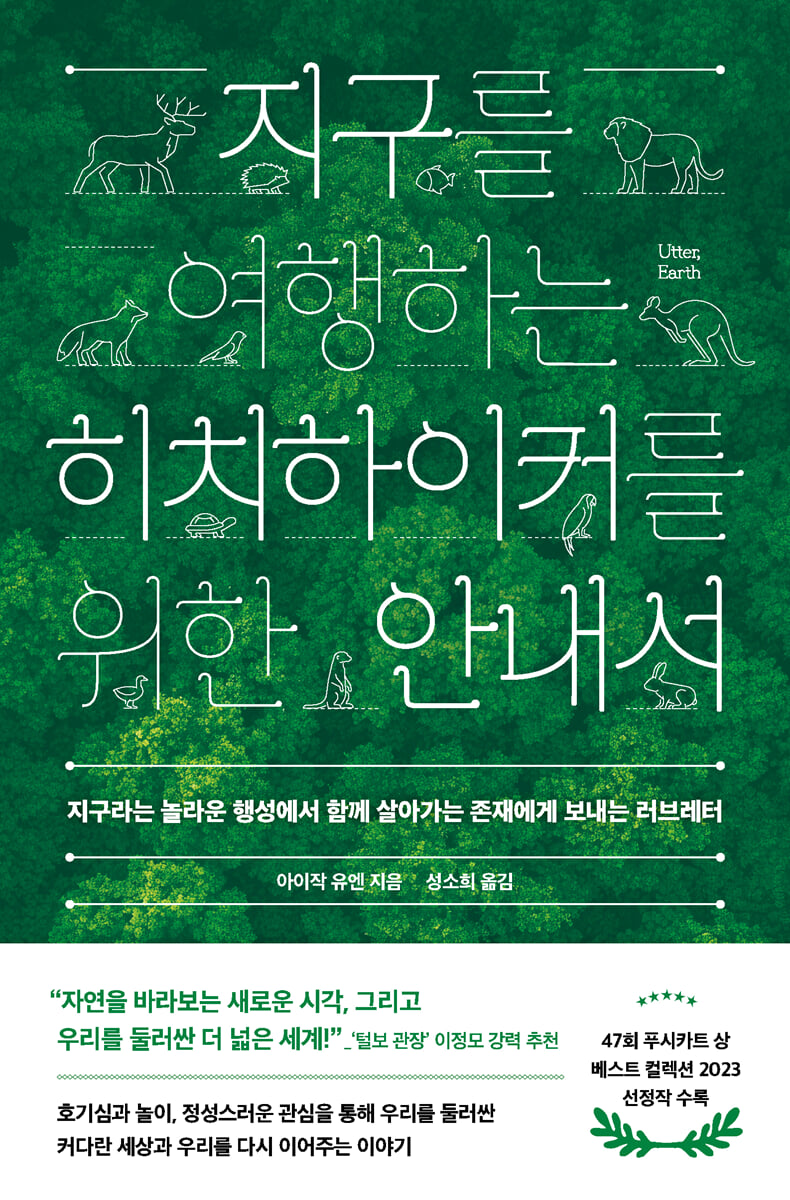
The Hitchhiker's Guide to the World
 |
Description
Book Introduction
“A new perspective on nature,
And the wider world surrounding us!” _Highly recommended by Lee Jeong-mo, the "Hairy Manager"
A love letter to all beings living on the border between nature and the unnatural.
Included in the 47th Pushcart Award Best Collection 2023 selections
The Hitchhiker's Guide to the World is a story of the non-human world, told by nature writer Isaac Yuen, where science, literature, empathy, and humor intersect.
Breaking away from the traditional nature essay format, the author explores biological and geological topics such as insects, mammals, amphibians, ancient creatures, and fossils in a literary manner, offering readers a "new sense of reading nature."
From coelacanths to capybaras to lichens, the unique survival strategies and senses of various creatures are exquisitely interwoven with human emotions, behaviors, and social structures. These 40 short essays reveal the depth and expansiveness of nature in humorous yet thoughtful language.
This book is particularly noteworthy for its expansion of the modern ecological imagination, approaching nature not as a mere object of observation, but as an object to relate to, empathize with, and imagine.
This book includes the eponymous collection, "Utter, Earth," which was selected for inclusion in the 47th Pushcart Prize Best of the Small Presses 2023, as well as works that have received favorable reviews from leading literary magazines such as [Orion], [Agni], and [Tin House], and shows the possibility of a new nature narrative that encompasses essays, science, lyricism, and ecological sensibility.
And the wider world surrounding us!” _Highly recommended by Lee Jeong-mo, the "Hairy Manager"
A love letter to all beings living on the border between nature and the unnatural.
Included in the 47th Pushcart Award Best Collection 2023 selections
The Hitchhiker's Guide to the World is a story of the non-human world, told by nature writer Isaac Yuen, where science, literature, empathy, and humor intersect.
Breaking away from the traditional nature essay format, the author explores biological and geological topics such as insects, mammals, amphibians, ancient creatures, and fossils in a literary manner, offering readers a "new sense of reading nature."
From coelacanths to capybaras to lichens, the unique survival strategies and senses of various creatures are exquisitely interwoven with human emotions, behaviors, and social structures. These 40 short essays reveal the depth and expansiveness of nature in humorous yet thoughtful language.
This book is particularly noteworthy for its expansion of the modern ecological imagination, approaching nature not as a mere object of observation, but as an object to relate to, empathize with, and imagine.
This book includes the eponymous collection, "Utter, Earth," which was selected for inclusion in the 47th Pushcart Prize Best of the Small Presses 2023, as well as works that have received favorable reviews from leading literary magazines such as [Orion], [Agni], and [Tin House], and shows the possibility of a new nature narrative that encompasses essays, science, lyricism, and ecological sensibility.
- You can preview some of the book's contents.
Preview
index
List of illustrations
1.
sound
Yes, it's okay to be discharged without naming your baby.
Second best is best
2.
scene
invisible sight
The 102 things briefly mentioned above, most of them living things
The perfect party guest
3.
contact
If we unite, we live; if we divide, we die.
A home is one where there is warmth.
5.
pressure
How to argue like a fish
Give up on your dreams
Going down into the ground
6.
recovery
career counseling
Transformation is inevitable
7.
Survival
Create any animal you like
Want to write an animal essay?
Appendix_A brief thought on the previously mentioned and mostly living objects (in alphabetical order)
Acknowledgements
1.
sound
Yes, it's okay to be discharged without naming your baby.
Second best is best
2.
scene
invisible sight
The 102 things briefly mentioned above, most of them living things
The perfect party guest
3.
contact
If we unite, we live; if we divide, we die.
A home is one where there is warmth.
5.
pressure
How to argue like a fish
Give up on your dreams
Going down into the ground
6.
recovery
career counseling
Transformation is inevitable
7.
Survival
Create any animal you like
Want to write an animal essay?
Appendix_A brief thought on the previously mentioned and mostly living objects (in alphabetical order)
Acknowledgements
Detailed image
.jpg)
Into the book
If you are not careful when naming something, you can make the big mistake of assigning value too lightly.
Can the lesser kudu, with its horns spiraling like Parmesan cheese sticks, be considered less attractive than its cousin, the greater kudu? Should the lesser frigatebird, which soars on updrafts alongside its red-necked cousins, the greater frigatebird and the magnificent frigatebird, be classified as inferior, second-rate, or even inferior? Sure, they'd argue that their smaller size is the reason for their name, but such claims are often just excuses for laziness.
The least weasel, though it weighs as little as a handful of coins, deserves praise for its ability to tackle prey ten times its size and for its ability to precisely bite and sever the vertebrae of a baby rabbit.
--- From "Yes, it's okay to be discharged without naming the baby"
Let's go back to the question of adding the words "greater," "lesser," and "list" to the name.
You might ask why I am picking on people with names.
You might be wondering why it's called something like this.
But names are sacred, and naming is a sacred act, this reviewer's opinion.
So how annoying it must be to those who, at best, carelessly, at worst, maliciously, name things without distinguishing between size and defects, and thus give them names like lesser earless lizard, lesser sooty owl, or lesser mouse-deer.
--- From "Yes, it's okay to be discharged without naming the baby"
The sloth in front of you appears to have nothing more to do.
He seems comfortable in his new, quieter role on Earth.
The smile on his face and the long story he tells are as genuine as the impression you received.
You might find yourself wanting to spend some time alone with a sloth for the next few days.
I really hope we can stay together.
Being with such beings helps us acquire the necessary skills for our minds.
Through the sloth, you will learn how to secure space to live in the present with peace, and the importance of occasionally turning your perspective upside down and looking at the world with eyes that are old but not frail.
--- From "The Perfect Party Guest"
The falcon is a master of aerodynamics, but he's also a student of quantum mechanics, so he knows full well that physical contact is actually an illusion created by our senses to reveal the repulsive force between our electronic arrangements and those of others.
Perhaps the scorpion has accepted that what we touch and contact is not really the other person, but the resistance of the shell that surrounds and protects our innermost core.
--- From "If we unite, we live; if we divide, we die"
Even if you're more oyster than scallop, and tied to the company that pays your salary, I hope you find solace in the fact that there are others who have a much harder time leaving home than you.
There was a man who lived to be 168 years old and never left his home for a single moment.
A Pacific geoduck was truly homebound until someone violently dragged it out.
Firmly nestled beneath the fine sand of the sea floor, this giant clam probably never seriously considered whether to leave its dull shell (or even to think about it in the first place).
The tree's trunk, nearly a meter long, had grown longer than the 20-centimeter house decades ago, yet it remained motionless inside the house.
--- From "A home is one where there is warmth"
Those who are skilled in home construction and have good dexterity, and do not shy away from even the most dilapidated houses that require a lot of maintenance, should take a second look at the world of crustaceans.
You will get lots of tips on remodeling.
The graceful decorator crab has a strawberry anemone (not a true strawberry, nor a true anemone) on its shell.
(The level of deception is this great)
The furred sponge crab covers its back with pieces of living sponge.
Decorating a sponge house is similar to installing a regular roof.
However, the sponge roof prevents curious eyes from being drawn to the crab, and gives the unpleasant surprise of the curious teeth rushing in.
--- From "A home is one where there is warmth"
But some people don't realize how great a privilege it is to live on such a planet.
Helium is like that.
Helium shows no interest in the various planetary events or neighborly events posted on the bulletin board.
Except for the occasional appearance at children's birthday parties.
Helium that escapes from a balloon or the back of the throat always floats alone without a friend and eventually goes out into space.
Only the sun can provide a home for helium.
Only the sun can give purpose to helium.
But it will take so long for Helium to realize that, by then the Sun will no longer look like the Sun and horses will no longer look like horses (though the Tuatara will likely still look like the Tuatara).
--- From "A home is one where there is warmth"
A coelacanth might be surprised to be asked for advice after 400 million years, but it would be willing to impart its wisdom to a disciple who knows how to take it readily.
It may reveal the secrets of how countless species survived the fickle changes of the world, transforming their protrusions into hooves and their fins into wings, while remaining alone to navigate the seas.
After much deliberation, the coelacanth will conclude that all other animals' adventures have led to speciation and premature destruction.
This fish, imbued with the dignity of age, will not convey its wisdom in words.
Because my brain is too dazed to think of words, and my mouth, which is only good for opening wide, cannot speak for long.
But the coelacanth, with its chainmail-like scales, stands firm against change and sadness.
Dig deep.
Be strong and hold on.
Even if the world has abandoned you, do not lose yourself.
--- From "The Wisdom of Ancient Strange Creatures"
Even in the Permian Period of the Paleozoic Era, the confident young ginkgo tree responded by unfurling its dazzling golden mane for the first time.
Older relatives who still didn't know about the colorful outerwear that could be taken off according to the season or the melancholy of autumn were startled.
Since then, nothing has been able to match the daring feat first accomplished by the Ginkgo tree.
Even the waves of flowers that later covered the entire earth could not compare to the ginkgo.
Flowering plants do not dare to challenge the banks.
Although flowers cooperate with animals to produce fruit and delight the eye, we know that even flowers are dulled by the intense and vivid colors that permeate the sculptural, fan-shaped leaves of ginkgo trees.
--- From "The Wisdom of Ancient Strange Creatures"
A close look at shark teeth can teach us some essential life philosophy.
The dense, flat teeth of the zebra shark advise persistence.
By moving your muscles and grit your teeth, you can break down the barriers that keep you from reaching your dreams.
On the other hand, the shortfin mako shark's needle-like teeth teach it to latch on to its shiny, slippery, and easily missed target with pinpoint accuracy and never let go.
The great white shark's teeth are triangular with jagged edges, and their secret lies in taking on life's big goals and chopping them into smaller chunks.
Then you can digest it without chewing.
--- From "The Wisdom of Ancient Strange Creatures"
In the realm of the home, there will be those who will try to corner you and force you into a trap.
It will cast a net of controversy over you, immobilizing you and demoralizing you.
Look, you're clearly not a fish.
Fish are cold-blooded animals with streamlined bodies and scales, but you are not like that at all.
So it must be a different animal.
Okay, let's stop talking nonsense.
In this case, you should react like a fish, depending on your discussion skills and willingness to participate.
If you want to be as resilient as the puffer fish (Mola mola), you must accept any insult and overcome any nuisance, even parasites.
--- From "How to Argue Like a Fish"
Learn the viral marketing power of the platypus.
They use their chimera-like personas to create heated debates, flaunt their loveliness, and leave a strong impression.
We must also accept the attitude of not crossing the line like a mountain beaver.
The mountain beaver, trying to create an image different from its famous cousin with a tail that resembles a rowing paddle, veered into unusual territory and became a fern-eating hermit.
Even if your unique brand isn't properly recognized—like the pronghorn, which is still misclassified as simply a goat or antelope—don't be discouraged, keep working hard and build a strong vision.
--- From "Career Counseling"
Even 500 million years ago, during the peaceful Cambrian period of the Paleozoic Era, when radical awakenings and actions were commonplace and the oceans were roiling with revolutions of body and mind, failure was not the exception but the norm.
The experiment with Opabinia, which boasted five eyes and a proboscis like a vacuum cleaner hose, has so far left no descendants.
Anomalocaris, with its eyes on the ends of its stalks and its mouth moving like a camera shutter, lasted longer into the Ordovician, but ultimately failed to survive and was pushed out by the jawless.
No matter how many hallucinogens you take, you can't imagine a successor to Hallucigenia.
This creature is so bizarrely shaped that scholars have mistaken its head for its tail, its spines for its legs, and reconstructed it upside down and upside down.
Can the lesser kudu, with its horns spiraling like Parmesan cheese sticks, be considered less attractive than its cousin, the greater kudu? Should the lesser frigatebird, which soars on updrafts alongside its red-necked cousins, the greater frigatebird and the magnificent frigatebird, be classified as inferior, second-rate, or even inferior? Sure, they'd argue that their smaller size is the reason for their name, but such claims are often just excuses for laziness.
The least weasel, though it weighs as little as a handful of coins, deserves praise for its ability to tackle prey ten times its size and for its ability to precisely bite and sever the vertebrae of a baby rabbit.
--- From "Yes, it's okay to be discharged without naming the baby"
Let's go back to the question of adding the words "greater," "lesser," and "list" to the name.
You might ask why I am picking on people with names.
You might be wondering why it's called something like this.
But names are sacred, and naming is a sacred act, this reviewer's opinion.
So how annoying it must be to those who, at best, carelessly, at worst, maliciously, name things without distinguishing between size and defects, and thus give them names like lesser earless lizard, lesser sooty owl, or lesser mouse-deer.
--- From "Yes, it's okay to be discharged without naming the baby"
The sloth in front of you appears to have nothing more to do.
He seems comfortable in his new, quieter role on Earth.
The smile on his face and the long story he tells are as genuine as the impression you received.
You might find yourself wanting to spend some time alone with a sloth for the next few days.
I really hope we can stay together.
Being with such beings helps us acquire the necessary skills for our minds.
Through the sloth, you will learn how to secure space to live in the present with peace, and the importance of occasionally turning your perspective upside down and looking at the world with eyes that are old but not frail.
--- From "The Perfect Party Guest"
The falcon is a master of aerodynamics, but he's also a student of quantum mechanics, so he knows full well that physical contact is actually an illusion created by our senses to reveal the repulsive force between our electronic arrangements and those of others.
Perhaps the scorpion has accepted that what we touch and contact is not really the other person, but the resistance of the shell that surrounds and protects our innermost core.
--- From "If we unite, we live; if we divide, we die"
Even if you're more oyster than scallop, and tied to the company that pays your salary, I hope you find solace in the fact that there are others who have a much harder time leaving home than you.
There was a man who lived to be 168 years old and never left his home for a single moment.
A Pacific geoduck was truly homebound until someone violently dragged it out.
Firmly nestled beneath the fine sand of the sea floor, this giant clam probably never seriously considered whether to leave its dull shell (or even to think about it in the first place).
The tree's trunk, nearly a meter long, had grown longer than the 20-centimeter house decades ago, yet it remained motionless inside the house.
--- From "A home is one where there is warmth"
Those who are skilled in home construction and have good dexterity, and do not shy away from even the most dilapidated houses that require a lot of maintenance, should take a second look at the world of crustaceans.
You will get lots of tips on remodeling.
The graceful decorator crab has a strawberry anemone (not a true strawberry, nor a true anemone) on its shell.
(The level of deception is this great)
The furred sponge crab covers its back with pieces of living sponge.
Decorating a sponge house is similar to installing a regular roof.
However, the sponge roof prevents curious eyes from being drawn to the crab, and gives the unpleasant surprise of the curious teeth rushing in.
--- From "A home is one where there is warmth"
But some people don't realize how great a privilege it is to live on such a planet.
Helium is like that.
Helium shows no interest in the various planetary events or neighborly events posted on the bulletin board.
Except for the occasional appearance at children's birthday parties.
Helium that escapes from a balloon or the back of the throat always floats alone without a friend and eventually goes out into space.
Only the sun can provide a home for helium.
Only the sun can give purpose to helium.
But it will take so long for Helium to realize that, by then the Sun will no longer look like the Sun and horses will no longer look like horses (though the Tuatara will likely still look like the Tuatara).
--- From "A home is one where there is warmth"
A coelacanth might be surprised to be asked for advice after 400 million years, but it would be willing to impart its wisdom to a disciple who knows how to take it readily.
It may reveal the secrets of how countless species survived the fickle changes of the world, transforming their protrusions into hooves and their fins into wings, while remaining alone to navigate the seas.
After much deliberation, the coelacanth will conclude that all other animals' adventures have led to speciation and premature destruction.
This fish, imbued with the dignity of age, will not convey its wisdom in words.
Because my brain is too dazed to think of words, and my mouth, which is only good for opening wide, cannot speak for long.
But the coelacanth, with its chainmail-like scales, stands firm against change and sadness.
Dig deep.
Be strong and hold on.
Even if the world has abandoned you, do not lose yourself.
--- From "The Wisdom of Ancient Strange Creatures"
Even in the Permian Period of the Paleozoic Era, the confident young ginkgo tree responded by unfurling its dazzling golden mane for the first time.
Older relatives who still didn't know about the colorful outerwear that could be taken off according to the season or the melancholy of autumn were startled.
Since then, nothing has been able to match the daring feat first accomplished by the Ginkgo tree.
Even the waves of flowers that later covered the entire earth could not compare to the ginkgo.
Flowering plants do not dare to challenge the banks.
Although flowers cooperate with animals to produce fruit and delight the eye, we know that even flowers are dulled by the intense and vivid colors that permeate the sculptural, fan-shaped leaves of ginkgo trees.
--- From "The Wisdom of Ancient Strange Creatures"
A close look at shark teeth can teach us some essential life philosophy.
The dense, flat teeth of the zebra shark advise persistence.
By moving your muscles and grit your teeth, you can break down the barriers that keep you from reaching your dreams.
On the other hand, the shortfin mako shark's needle-like teeth teach it to latch on to its shiny, slippery, and easily missed target with pinpoint accuracy and never let go.
The great white shark's teeth are triangular with jagged edges, and their secret lies in taking on life's big goals and chopping them into smaller chunks.
Then you can digest it without chewing.
--- From "The Wisdom of Ancient Strange Creatures"
In the realm of the home, there will be those who will try to corner you and force you into a trap.
It will cast a net of controversy over you, immobilizing you and demoralizing you.
Look, you're clearly not a fish.
Fish are cold-blooded animals with streamlined bodies and scales, but you are not like that at all.
So it must be a different animal.
Okay, let's stop talking nonsense.
In this case, you should react like a fish, depending on your discussion skills and willingness to participate.
If you want to be as resilient as the puffer fish (Mola mola), you must accept any insult and overcome any nuisance, even parasites.
--- From "How to Argue Like a Fish"
Learn the viral marketing power of the platypus.
They use their chimera-like personas to create heated debates, flaunt their loveliness, and leave a strong impression.
We must also accept the attitude of not crossing the line like a mountain beaver.
The mountain beaver, trying to create an image different from its famous cousin with a tail that resembles a rowing paddle, veered into unusual territory and became a fern-eating hermit.
Even if your unique brand isn't properly recognized—like the pronghorn, which is still misclassified as simply a goat or antelope—don't be discouraged, keep working hard and build a strong vision.
--- From "Career Counseling"
Even 500 million years ago, during the peaceful Cambrian period of the Paleozoic Era, when radical awakenings and actions were commonplace and the oceans were roiling with revolutions of body and mind, failure was not the exception but the norm.
The experiment with Opabinia, which boasted five eyes and a proboscis like a vacuum cleaner hose, has so far left no descendants.
Anomalocaris, with its eyes on the ends of its stalks and its mouth moving like a camera shutter, lasted longer into the Ordovician, but ultimately failed to survive and was pushed out by the jawless.
No matter how many hallucinogens you take, you can't imagine a successor to Hallucigenia.
This creature is so bizarrely shaped that scholars have mistaken its head for its tail, its spines for its legs, and reconstructed it upside down and upside down.
--- From "Transformation is inevitable"
Publisher's Review
Where animals and language live and breathe,
Full of stories of familiar yet unfamiliar beings
A journey to the planet called Earth!
The Hitchhiker's Guide to the World is a book that delightfully pushes the boundaries of nature essays and makes us reconsider the relationship between humans and nature.
Author Isaac Yuen combines lyrical language and whimsical imagination with scientific foundations in evolutionary biology, taxonomy, and ecology to lead readers into a world of creatures we've previously overlooked.
This book is not simply a biological record.
Each piece is like a poem, like a fable, and contains humorous yet profound insights.
The creatures that appear in the book are diverse.
The categories are vast and the treatment is unexpected: sloths, trilobites, lichens, coelacanths, planarians, capybaras, turtles, bees, flies, corals, elephants, etc.
The author does not treat them as mere objects of observation.
Rather, through their lives, we shed new light on the existence of humans, their relationships, emotions, civilization, and worldview.
This is possible at the point where ecological thinking and literary thinking intersect.
This book asks again what it means to ‘live on Earth.’
And that question connects to the images of ‘slowness’ and ‘reversal’ that appear frequently in this book.
The perspective of looking at the world upside down like a sloth, the sense of the world seen from the perspective of an invisible microorganism or insect, makes the Earth we thought so familiar feel unfamiliar.
The author says:
Sometimes, that unfamiliarity is the most honest way we can face the real world.
What do X-Ash A Twelve and Lesser Kudu have in common?
Naming constitutes identity and determines the location of existence.
In particular, the chapter titled “Yes, It’s Okay to Leave the Hospital Without Naming Your Baby” explores the fact that the act of naming a living thing has a meaning beyond simple naming.
Here, he humorously explores the issues of identity, relationships, memory and records that arise from naming, using the example of Elon Musk and singer Grimes' sixth son, X Æ A-12 (the child who was seen picking his nose next to Trump in the Oval Office).
It explores how names go beyond mere symbols to influence identity and social perception.
And this topic leads to biological taxonomy.
The term "lesser"—given to animals because they appear smaller and less important—names like lesser kudu, lesser frigatebird, liston, and weasel have a subtle devaluing effect, revealing how deeply bias and hierarchy permeate our view of nature.
This is not just a question of names; it extends to ethical questions about how we remember and treat someone's existence.
Earth, the planet with the loudest and most affectionate tenants
Home is not just a place to stay, it's a way of living!
The chapter titled “A Home Must Have Warmth” shows that the concept of “home” is actually connected to the survival, emotions, and dignity of living things.
From floating creatures like jellyfish to those that line up and change shells like Caribbean hermit crabs, all life makes its home in a way that suits it.
A home is not just a physical structure, but a vessel that contains the ‘rhythm of existence.’
Hardworking creatures like plankton and ferns spread vitality everywhere, while noisy inhabitants like vegetable vendors and howler monkeys brighten up the planet's celebrations.
The Earth is rich because it has allowed all life to 'move in', and those that cannot settle down, like helium, drift into space and end up performing their late missions in a place no one remembers.
Helium eventually gives off new light and is transformed into carbon by the sun, but his name is forgotten in the world where he stayed.
This book asks us to revisit the meaning of occupying space and living within it.
The author's message is deeply connected to the housing issues of human society today.
Unlike many living creatures who instinctively build and maintain safe and sustainable shelters, humans live in an age where securing a home is the most difficult task.
In a society where even the instinct to build a nest suited to each individual's size and habits is threatened, this book makes us reconsider space as the "minimum condition for life."
It quietly reminds us that home should ultimately be a place that contains the rhythm and warmth that allows us to breathe.
Through curiosity, play and caring attention, we are surrounded by
A story that reconnects us with the larger world.
The essays in the book are independent yet organically connected.
Sometimes it starts like a science column and ends like a fairy tale, and sometimes it follows the narrative of an encyclopedia and takes a literary twist.
Some of the writing reads like science fiction, while others read like philosophical essays.
This is the essence of the nature narrative technique that the author has been experimenting with for many years through the blog 'Ekostories'.
In this short but dense text, readers experience how science and literature, knowledge and senses intertwine and work together.
His writing always returns to the same question.
What kind of beings do we make up this world with, and how can we relate to them?
This book is one that helps us regain a sense of the world we live in today.
In an age where everything is rapidly consumed and meaning evaporates, this book tells us to focus on 'how we look' rather than 'what we look at.'
It reminds us that nature is still there and that we are a part of it too.
This tender and whimsical love letter to the inhuman world will resonate deeply and lastingly with readers who straddle the boundaries of literature and science.
At the end of the book, there is an appendix called 'Mini Encyclopedia of Creatures' where you can meet the colorful creatures that appear in the text again.
Witty commentary and concise explanations will help readers turn the pages again and again to connect more deeply with each living thing, so don't miss it!
Full of stories of familiar yet unfamiliar beings
A journey to the planet called Earth!
The Hitchhiker's Guide to the World is a book that delightfully pushes the boundaries of nature essays and makes us reconsider the relationship between humans and nature.
Author Isaac Yuen combines lyrical language and whimsical imagination with scientific foundations in evolutionary biology, taxonomy, and ecology to lead readers into a world of creatures we've previously overlooked.
This book is not simply a biological record.
Each piece is like a poem, like a fable, and contains humorous yet profound insights.
The creatures that appear in the book are diverse.
The categories are vast and the treatment is unexpected: sloths, trilobites, lichens, coelacanths, planarians, capybaras, turtles, bees, flies, corals, elephants, etc.
The author does not treat them as mere objects of observation.
Rather, through their lives, we shed new light on the existence of humans, their relationships, emotions, civilization, and worldview.
This is possible at the point where ecological thinking and literary thinking intersect.
This book asks again what it means to ‘live on Earth.’
And that question connects to the images of ‘slowness’ and ‘reversal’ that appear frequently in this book.
The perspective of looking at the world upside down like a sloth, the sense of the world seen from the perspective of an invisible microorganism or insect, makes the Earth we thought so familiar feel unfamiliar.
The author says:
Sometimes, that unfamiliarity is the most honest way we can face the real world.
What do X-Ash A Twelve and Lesser Kudu have in common?
Naming constitutes identity and determines the location of existence.
In particular, the chapter titled “Yes, It’s Okay to Leave the Hospital Without Naming Your Baby” explores the fact that the act of naming a living thing has a meaning beyond simple naming.
Here, he humorously explores the issues of identity, relationships, memory and records that arise from naming, using the example of Elon Musk and singer Grimes' sixth son, X Æ A-12 (the child who was seen picking his nose next to Trump in the Oval Office).
It explores how names go beyond mere symbols to influence identity and social perception.
And this topic leads to biological taxonomy.
The term "lesser"—given to animals because they appear smaller and less important—names like lesser kudu, lesser frigatebird, liston, and weasel have a subtle devaluing effect, revealing how deeply bias and hierarchy permeate our view of nature.
This is not just a question of names; it extends to ethical questions about how we remember and treat someone's existence.
Earth, the planet with the loudest and most affectionate tenants
Home is not just a place to stay, it's a way of living!
The chapter titled “A Home Must Have Warmth” shows that the concept of “home” is actually connected to the survival, emotions, and dignity of living things.
From floating creatures like jellyfish to those that line up and change shells like Caribbean hermit crabs, all life makes its home in a way that suits it.
A home is not just a physical structure, but a vessel that contains the ‘rhythm of existence.’
Hardworking creatures like plankton and ferns spread vitality everywhere, while noisy inhabitants like vegetable vendors and howler monkeys brighten up the planet's celebrations.
The Earth is rich because it has allowed all life to 'move in', and those that cannot settle down, like helium, drift into space and end up performing their late missions in a place no one remembers.
Helium eventually gives off new light and is transformed into carbon by the sun, but his name is forgotten in the world where he stayed.
This book asks us to revisit the meaning of occupying space and living within it.
The author's message is deeply connected to the housing issues of human society today.
Unlike many living creatures who instinctively build and maintain safe and sustainable shelters, humans live in an age where securing a home is the most difficult task.
In a society where even the instinct to build a nest suited to each individual's size and habits is threatened, this book makes us reconsider space as the "minimum condition for life."
It quietly reminds us that home should ultimately be a place that contains the rhythm and warmth that allows us to breathe.
Through curiosity, play and caring attention, we are surrounded by
A story that reconnects us with the larger world.
The essays in the book are independent yet organically connected.
Sometimes it starts like a science column and ends like a fairy tale, and sometimes it follows the narrative of an encyclopedia and takes a literary twist.
Some of the writing reads like science fiction, while others read like philosophical essays.
This is the essence of the nature narrative technique that the author has been experimenting with for many years through the blog 'Ekostories'.
In this short but dense text, readers experience how science and literature, knowledge and senses intertwine and work together.
His writing always returns to the same question.
What kind of beings do we make up this world with, and how can we relate to them?
This book is one that helps us regain a sense of the world we live in today.
In an age where everything is rapidly consumed and meaning evaporates, this book tells us to focus on 'how we look' rather than 'what we look at.'
It reminds us that nature is still there and that we are a part of it too.
This tender and whimsical love letter to the inhuman world will resonate deeply and lastingly with readers who straddle the boundaries of literature and science.
At the end of the book, there is an appendix called 'Mini Encyclopedia of Creatures' where you can meet the colorful creatures that appear in the text again.
Witty commentary and concise explanations will help readers turn the pages again and again to connect more deeply with each living thing, so don't miss it!
GOODS SPECIFICS
- Date of issue: May 20, 2025
- Page count, weight, size: 336 pages | 426g | 135*205*22mm
- ISBN13: 9791141162504
- ISBN10: 1141162504
You may also like
카테고리
korean


korean

![ELLE 엘르 스페셜 에디션 A형 : 12월 [2025]](http://librairie.coreenne.fr/cdn/shop/files/b8e27a3de6c9538896439686c6b0e8fb.jpg?v=1766436872&width=3840)


