

The Secret of What We Call Wisdom
 |
Description
Book Introduction
A textbook of wisdom and well-being.
“It teaches us the social and neuroscientific roots of wisdom and how to become wiser.”
- Jong-ho Na (Professor of Psychiatry, Yale University School of Medicine)
"The most hopeful book of all time, as humanity faces problems that can only be solved by becoming wiser."
- Tara Brach, clinical psychologist and author of Acceptance
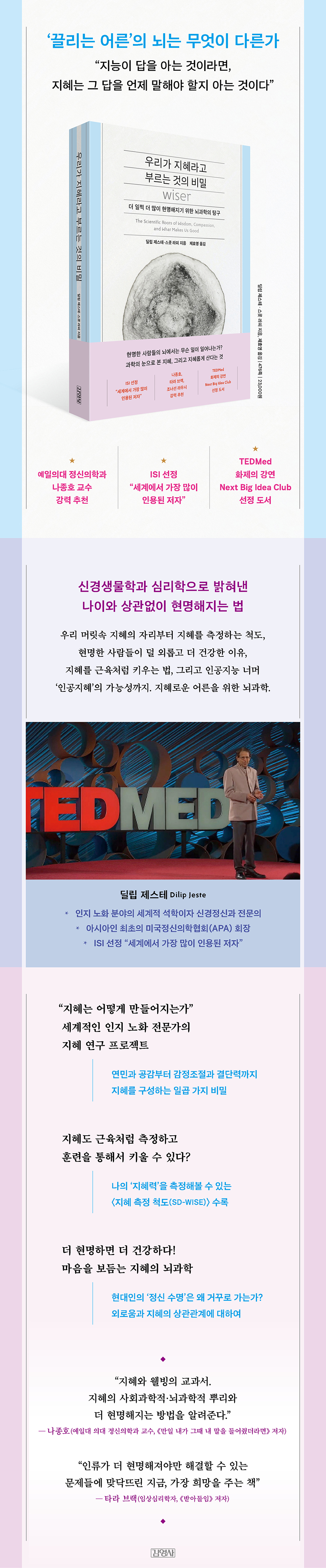
“If intelligence is knowing the answer,
Wisdom is knowing when to say the answer.”
What Happens in the Brains of "Attractive Adults"?
How to cultivate wisdom from the world's most cited cognitive aging expert
There are many smart people, but few wise people.
Age does not guarantee wisdom.
What is wisdom, and how can we become wise? From the seat of wisdom in our heads, to the scale of wisdom measurement, to why wise people are less lonely and healthier, to how to develop wisdom like a muscle, and even beyond artificial intelligence, the potential for "artificial wisdom"—the secrets of wisdom as seen from the perspectives of neurobiology and psychology.
The author, a world-renowned expert in the field of cognitive aging and a neuropsychiatrist who has been researching both “healthy aging” and “wisdom” for over 20 years and has been selected as “the world’s most cited author” (ISI), brings wisdom, which was mainly discussed in mythology and religion, to the realm of science.
This book is essential for our bodies, minds, individuals, and society, as it offers new insights into various mental health issues in modern society, such as aging, loneliness, and happiness.
“It teaches us the social and neuroscientific roots of wisdom and how to become wiser.”
- Jong-ho Na (Professor of Psychiatry, Yale University School of Medicine)
"The most hopeful book of all time, as humanity faces problems that can only be solved by becoming wiser."
- Tara Brach, clinical psychologist and author of Acceptance
“If intelligence is knowing the answer,
Wisdom is knowing when to say the answer.”
What Happens in the Brains of "Attractive Adults"?
How to cultivate wisdom from the world's most cited cognitive aging expert
There are many smart people, but few wise people.
Age does not guarantee wisdom.
What is wisdom, and how can we become wise? From the seat of wisdom in our heads, to the scale of wisdom measurement, to why wise people are less lonely and healthier, to how to develop wisdom like a muscle, and even beyond artificial intelligence, the potential for "artificial wisdom"—the secrets of wisdom as seen from the perspectives of neurobiology and psychology.
The author, a world-renowned expert in the field of cognitive aging and a neuropsychiatrist who has been researching both “healthy aging” and “wisdom” for over 20 years and has been selected as “the world’s most cited author” (ISI), brings wisdom, which was mainly discussed in mythology and religion, to the realm of science.
This book is essential for our bodies, minds, individuals, and society, as it offers new insights into various mental health issues in modern society, such as aging, loneliness, and happiness.
- You can preview some of the book's contents.
Preview
index
To Korean Readers: The Name Value of Homo Sapiens
Getting Started: How to Enjoy Ultimate Wisdom, Regardless of Age
Part 1: What is Wisdom?
1 Scientific Facts About Wisdom
The Berlin Wisdom Project | John Nash's Schizophrenia | How Far Have Scientists Uncovered?
2 The relationship between the brain and wisdom
Where Wisdom Dwells│Exploring the City of the Spirit│What the Swindlers and Pioneers Left Behind│The Tragedy of Phineas Gage│The Disease That Loses Wisdom│Can We Become Wise Sooner?
3 Every family needs a grandmother and a grandfather.
Aging and Society│Why Genes Protect the Elderly│If We Go Back 22 Years│Ask a Person Facing Death│Ability in Tragedy│What the Brain and Muscles Have in Common│Less Bad Things, More Good Things
4 How to Measure Wisdom
Focusing on What Matters│How Smart Is Your IQ Score│Quantifying Wisdom│Sunless Daylight│Cognition, Reflection, and Emotion│In the Noise and Bustle of Everyday Life│The San Diego Wisdom Scale│The 24 Questions of SD-WISE│There Is No Such Thing as Too Much Wisdom
Part 2: The Components of Wisdom
5 Compassion is also a muscle
The Altruistic Brain│The Thoughtful Psychopath│The Kindness of Strangers│The Difference Between Self-Pity and Narcissism│Gender and Genetics│Cultivating Compassion│More Active Gratitude│Reading More Novels│Directing Emotions
6 Where Emotions Stay
Within the spectrum│Feeling and controlling│Pink glasses│The unstoppable optimist│Can't resist marshmallows│The meaning of a smile│Riley's control room│The genetics of emotions│Opening the brain's black box│A precarious brake│People with excessive emotional control│The art of regulation│Knowledge for an uncertain life
7 What Happens When You Make a Decision
Dilemma Exercises│Where Shortcuts Lead│Hot Choices, Cold Choices│Bad Things and Good Things│Foresight Wisdom?│Signing the Informed Consent Form│The Gentle Skeptic│Finding in Differences│From Coin Flips to Balance Sheets
8 Thoughts are not trivial
The author of one's own life│The brain that looks into itself│People who avoid thinking│The benefits of self-affirmation│The usefulness of laziness│The pervasiveness of curiosity│The desire to know│The winning joke│What makes us laugh│The power of humor│Everyone wants to understand a joke│The realm of the gods
9 A sense of something greater
The Difference Between Religiosity and Spirituality | Scientific Measurement | Experiences with Nature | Wisdom and Spirituality | Health Strategies | A Bus Driver's Story | "There Are No Atheists in the Trenches"
Part 3: Practical: How to Strengthen Social Wisdom
10 Can it get better sooner?
The intervention of science│How to make good decisions│Time to reflect on myself│Trained compassion│The more I practice, the better│The heart to care for the younger generation│When I feel like driving recklessly│Moments I inadvertently missed│Elderly creative masters│Time alone│Inner strength│There is no panacea│Exercise, food, sleep
11 Latest Technologies to Develop Wisdom
Smarter Drugs│Technology that Enhances Brain Function│Artificial Intelligence and Artificial Wisdom
12 The wiser you are, the less lonely you are.
If a Wisdom World Cup were held, would herd immunity be effective? The debate surrounding whether the world is becoming wiser, no matter how many trophies we win. Wisdom in a crisis.
Acknowledgements
References
Search
Getting Started: How to Enjoy Ultimate Wisdom, Regardless of Age
Part 1: What is Wisdom?
1 Scientific Facts About Wisdom
The Berlin Wisdom Project | John Nash's Schizophrenia | How Far Have Scientists Uncovered?
2 The relationship between the brain and wisdom
Where Wisdom Dwells│Exploring the City of the Spirit│What the Swindlers and Pioneers Left Behind│The Tragedy of Phineas Gage│The Disease That Loses Wisdom│Can We Become Wise Sooner?
3 Every family needs a grandmother and a grandfather.
Aging and Society│Why Genes Protect the Elderly│If We Go Back 22 Years│Ask a Person Facing Death│Ability in Tragedy│What the Brain and Muscles Have in Common│Less Bad Things, More Good Things
4 How to Measure Wisdom
Focusing on What Matters│How Smart Is Your IQ Score│Quantifying Wisdom│Sunless Daylight│Cognition, Reflection, and Emotion│In the Noise and Bustle of Everyday Life│The San Diego Wisdom Scale│The 24 Questions of SD-WISE│There Is No Such Thing as Too Much Wisdom
Part 2: The Components of Wisdom
5 Compassion is also a muscle
The Altruistic Brain│The Thoughtful Psychopath│The Kindness of Strangers│The Difference Between Self-Pity and Narcissism│Gender and Genetics│Cultivating Compassion│More Active Gratitude│Reading More Novels│Directing Emotions
6 Where Emotions Stay
Within the spectrum│Feeling and controlling│Pink glasses│The unstoppable optimist│Can't resist marshmallows│The meaning of a smile│Riley's control room│The genetics of emotions│Opening the brain's black box│A precarious brake│People with excessive emotional control│The art of regulation│Knowledge for an uncertain life
7 What Happens When You Make a Decision
Dilemma Exercises│Where Shortcuts Lead│Hot Choices, Cold Choices│Bad Things and Good Things│Foresight Wisdom?│Signing the Informed Consent Form│The Gentle Skeptic│Finding in Differences│From Coin Flips to Balance Sheets
8 Thoughts are not trivial
The author of one's own life│The brain that looks into itself│People who avoid thinking│The benefits of self-affirmation│The usefulness of laziness│The pervasiveness of curiosity│The desire to know│The winning joke│What makes us laugh│The power of humor│Everyone wants to understand a joke│The realm of the gods
9 A sense of something greater
The Difference Between Religiosity and Spirituality | Scientific Measurement | Experiences with Nature | Wisdom and Spirituality | Health Strategies | A Bus Driver's Story | "There Are No Atheists in the Trenches"
Part 3: Practical: How to Strengthen Social Wisdom
10 Can it get better sooner?
The intervention of science│How to make good decisions│Time to reflect on myself│Trained compassion│The more I practice, the better│The heart to care for the younger generation│When I feel like driving recklessly│Moments I inadvertently missed│Elderly creative masters│Time alone│Inner strength│There is no panacea│Exercise, food, sleep
11 Latest Technologies to Develop Wisdom
Smarter Drugs│Technology that Enhances Brain Function│Artificial Intelligence and Artificial Wisdom
12 The wiser you are, the less lonely you are.
If a Wisdom World Cup were held, would herd immunity be effective? The debate surrounding whether the world is becoming wiser, no matter how many trophies we win. Wisdom in a crisis.
Acknowledgements
References
Search
Detailed image
Into the book
The human brain has developed a bias to pay more attention to negative things, so we focus more on threatening and dangerous things, even if it makes us feel stressed and unhappy.
This is why we remember bad news better than good news, and why political attacks work.
As we age and become wiser, this negativity bias dissipates.
When we are young, negative emotional experiences and bad memories stick to our minds as easily as glue, but as we get older, they don't stick for long and quickly fall off, as if our minds had a Teflon coating.
--- p.108
Wisdom without emotion is not wisdom.
Just as night and day are different, wisdom is something entirely different.
Consider antisocial personality disorder, for example.
Although this personality disorder is characterized by a lack of compassion, not all psychopaths become murderous criminals.
In fact, most psychopaths are perfectly adapted to society and live quite ordinary lives.
Among them, there are some who are very intelligent, and some who are even examples of success.
Can we really call these people wise?
--- p.120
One of the key findings of this study is that the desire to help others doesn't just develop with age, and that the development of this desire is influenced more by significant life events than by current stress levels or emotional functioning.
The desire to help others is a price that comes with suffering.
In fact, after we have personally experienced great pain and loss, we find it easier to understand the feelings of others.
Because I have experienced it firsthand.
There is a saying that goes, “Before you judge someone hastily, walk a mile in their shoes.”
--- p.143
Traces of time remain all over the body.
The brain is no exception.
Brain cells die and the speed at which information is processed slows down.
However, it has been discovered relatively recently that the brain retains some degree of plasticity even in old age.
Our brains find ways to function with the resources available at the time, and as we age and become less able to handle challenging mental tasks as easily as before, we find alternatives.
In some ways, and sometimes, the alternative is better than the original method.
This is the essence of wisdom.
--- p.214
Reflection allows us to make decisions by considering both the good and bad situations of ourselves and our surroundings.
This does not mean that you have to have all the components of wisdom to be wise.
Even a good thing can become poisonous if overused.
Excessive introspection makes you pay little attention to anyone but yourself.
Excessive empathy and a reluctance to accept uncertainty also create a sense of helplessness, leaving us stuck in despair when we need to take action.
As with most things, finding moderation and balance is key.
--- p.345
No one would argue that a society becomes wise when the proportion of wise members reaches the same level as herd immunity.
That's not only impossible, but in my opinion unnecessary.
However, wisdom has aspects that are consistent with the biology of infectious diseases.
It can be transmitted in countless ways, knowingly or unknowingly, piecemeal, from one person to another, and then to new people again; it evolves and adapts along the way; it can be cultivated, nurtured, and grown by anyone, anywhere; and what may seem insignificant at first quickly surpasses all expectations.
This is why we remember bad news better than good news, and why political attacks work.
As we age and become wiser, this negativity bias dissipates.
When we are young, negative emotional experiences and bad memories stick to our minds as easily as glue, but as we get older, they don't stick for long and quickly fall off, as if our minds had a Teflon coating.
--- p.108
Wisdom without emotion is not wisdom.
Just as night and day are different, wisdom is something entirely different.
Consider antisocial personality disorder, for example.
Although this personality disorder is characterized by a lack of compassion, not all psychopaths become murderous criminals.
In fact, most psychopaths are perfectly adapted to society and live quite ordinary lives.
Among them, there are some who are very intelligent, and some who are even examples of success.
Can we really call these people wise?
--- p.120
One of the key findings of this study is that the desire to help others doesn't just develop with age, and that the development of this desire is influenced more by significant life events than by current stress levels or emotional functioning.
The desire to help others is a price that comes with suffering.
In fact, after we have personally experienced great pain and loss, we find it easier to understand the feelings of others.
Because I have experienced it firsthand.
There is a saying that goes, “Before you judge someone hastily, walk a mile in their shoes.”
--- p.143
Traces of time remain all over the body.
The brain is no exception.
Brain cells die and the speed at which information is processed slows down.
However, it has been discovered relatively recently that the brain retains some degree of plasticity even in old age.
Our brains find ways to function with the resources available at the time, and as we age and become less able to handle challenging mental tasks as easily as before, we find alternatives.
In some ways, and sometimes, the alternative is better than the original method.
This is the essence of wisdom.
--- p.214
Reflection allows us to make decisions by considering both the good and bad situations of ourselves and our surroundings.
This does not mean that you have to have all the components of wisdom to be wise.
Even a good thing can become poisonous if overused.
Excessive introspection makes you pay little attention to anyone but yourself.
Excessive empathy and a reluctance to accept uncertainty also create a sense of helplessness, leaving us stuck in despair when we need to take action.
As with most things, finding moderation and balance is key.
--- p.345
No one would argue that a society becomes wise when the proportion of wise members reaches the same level as herd immunity.
That's not only impossible, but in my opinion unnecessary.
However, wisdom has aspects that are consistent with the biology of infectious diseases.
It can be transmitted in countless ways, knowingly or unknowingly, piecemeal, from one person to another, and then to new people again; it evolves and adapts along the way; it can be cultivated, nurtured, and grown by anyone, anywhere; and what may seem insignificant at first quickly surpasses all expectations.
--- p.419
Publisher's Review
A Wisdom Research Project by World-Class Neuropsychiatrists
The Components of Wisdom Discovered Through Neurobiology and Psychology
"The Secret of What We Call Wisdom (Original Title: Wiser)" is a scientific study of "wisdom" that everyone desires but cannot obtain. It is the first popular book to compile the results of wisdom research by the author, a neuropsychiatrist who has dedicated his life to studying brain function and cognitive function in old age.
There have been many books discussing 'wisdom', but in philosophy and religion it has been regarded as something mysterious that follows age and experience, and in health and self-help books it has been regarded as a thread of hope that offsets the fear of cognitive aging.
This book covers everything from the definition and components of wisdom from the perspectives of neurobiology and psychology to how individuals and societies can strengthen their wisdom. It also offers a fresh perspective on various mental health issues in modern society, such as aging, loneliness, empathy and compassion, choice, reflection, and happiness, through the lens of wisdom.
Specifically, wisdom is made up of seven elements.
These include 'prosocial behavior' that comes from compassion, empathy, and altruism; 'emotional regulation' that can manage not only fear and anger but also joy; 'decisiveness' in the midst of sudden changes and dilemmas; 'reflection' that can turn even dark moments into humor; 'spirituality' that is the ability to sense bigger things without being absorbed in oneself; and the ability to accept various perspectives and provide social advice.
Of these, the most essential, in the author's view, is prosocial behavior.
In fact, this connects to the essence of wisdom in that “the most impressive achievements of human cognitive function, such as the technologies, languages, and social institutions that have enabled human survival, were not created by individuals alone, but emerged from the interactions of many people.”
“The concept of wisdom and moral wisdom, once speculated in the realm of mythology and philosophy, has been brought into the bright and radiant realm of modern psychology and neuroscience.
“It defines wisdom as an aspect of the human mind and brain, explains the psychological components of wisdom, and shows how to become wiser.”
- Howard C.
Nussbaum (Professor of Psychology, University of Chicago)
What if wisdom could be measured and trained like a muscle?
How to Get Wiser Earlier, No Matter Your Age
This book overturns the traditional notion that wisdom is something sublime and incomprehensible, the fruit of a lifetime of enlightenment and aging.
Like human consciousness, stress, and resilience, wisdom also has a biological basis and can therefore be measured and changed.
According to various brain science experiments and observations, the components of wisdom are created through complex interactions between various parts of the brain, centered around the prefrontal cortex and the amygdala.
So if this part is damaged, wisdom may be lost.
A representative example is the case of Phineas Gage, a worker who suffered frontal lobe damage in an accident at a railroad construction site in Vermont, USA in 1848 and became “capricious, insolent, and impatient.”
Like other faculties, wisdom is a mixture of innate and developed.
Several brain science and psychology studies, such as the 'altruistic brain theory', which posits that the neurocognitive mechanisms that operate in the human brain at the stage of processing altruism have evolved to reinforce prosocial behavior; 'mirror neurons' cells that make us flinch when we see someone else get hit by a ball as if we were hit ourselves; and 'theory of mind', which is the ability of six-month-old babies to instinctively distinguish and understand their own and others' mental states, show that humans are born with some of the components of wisdom.
According to the author, “35 to 55 percent is determined by innate factors, and the remainder is determined by external influences and individual behavior.”
Therefore, we can transform and strengthen our wisdom in the direction we want.
To do this, we first need to measure the level of wisdom.
This book contains a 'wisdom measurement scale' that the author personally participated in developing.
This allows you to score each component of wisdom and identify areas where you are lacking.
If you lack 'compassion', you can practice it.
The methods suggested by the author include writing gratitude journals, reading novels, and meditating. In the brains of people who did this 'compassion training', activity was actually shown in the medial orbitofrontal cortex and the putamen, brain areas associated with positive emotions and a sense of belonging.
If you are concerned about 'emotional regulation', we recommend training to divert attention and training to name emotions.
From this perspective, it is possible to create wisdom externally in the form of drugs, electronic devices, artificial intelligence, etc.
In fact, research has proven that games that activate self-control to treat gambling disorders and other disorders are effective.
“This book, which explains the components of wisdom, uncovered through cutting-edge neuroscience and a lifetime of research, shows us that wisdom is something we can develop and strengthen, and shows us how to do it.
“The scientific nature of wisdom changes our thinking about human potential.”
- Jonathan Rausch (Senior Fellow at the Brookings Institution, author of "Why Life Starts to Bounce Back at 50")
Why Smarter People Are Healthier
The Brain Science of Wisdom that Heals Aching Hearts
Human lifespan is longer than ever before.
However, problems such as stress, internet addiction, drugs, and suicide, which are getting worse day by day, show that the 'mental lifespan' of modern people is going in the opposite direction.
Wisdom is the key to turning this around.
Above all, it can be an antidote to loneliness, which is “a problem that has spread like an epidemic in modern society and has spread almost everywhere on the planet.”
Loneliness has been linked to a wide range of health problems, from heart attacks to dementia.
The author conducted a 'loneliness study' targeting three groups living in different regions, including San Diego, USA and Cilento, Southern Italy, and found that loneliness and wisdom showed a strong inverse correlation.
This means that the wiser a person is, the less likely he or she is to suffer from the negative effects of loneliness.
The wiser you are, the more connected you are with others, and the more connected you are, the wiser you become.
This is also revealed in the ‘generativity’ of the middle-aged and older generation trying to take care of the younger generation.
According to a study conducted in the United States, elderly people who participated in an "experience volunteer group" that helped elementary school students with their academic, social, and behavioral development experienced increased generativity and improved mental health.
We pursue wisdom not simply to become smarter.
To “understand the meaning of life, broaden your perspective on where you fit in and how to get there, and become a better person for yourself and others.”
This wisdom can only be created when we are connected to each other.
Homo sapiens, the 'wise man', is the human race that survived in that way.
“It details the scientific basis for the human tendency to be concerned about the well-being of others and the environments that reinforce that tendency.
“Once we know this clear truth about wisdom, we will become wiser.”
- Laura L.
Carstensen (Professor of Psychology and Public Policy, Stanford University)
“When you become wise, happiness naturally follows.”
Nine Strategies for an Age of Wisdom
Everywhere in the world, without exception, faces similar crises: the climate crisis and natural disasters that worsen every year, political polarization that repeats a vicious cycle of anger and distrust, and even deeper-rooted income polarization.
Will humanity be able to overcome this crisis and turn it into an opportunity for a better life and society?
The wisdom strategies this book recommends for use in times of crisis are as follows:
① Emotional control is important: Don’t panic.
Accept reality, but don't lose your optimistic outlook.
② The more difficult it is, the more you should not avoid reflection: Think about the experiences you overcame and how you dealt with them.
Develop a strategy similar to the one used back then.
③ Prosocial behavior helps me too: Studies show that people who help others feel stronger, happier, and less lonely.
The best antidote to stress like loneliness is wisdom.
Compassion is particularly effective.
④ Accepting uncertainty and diversity: You can learn from other people's actions and strategies.
There is no such thing as a one-size-fits-all solution to a crisis.
⑤ Make a decision: Sudden changes inevitably bring with them various moral dilemmas.
You have to make decisions by mobilizing all the information at that time.
Not being able to make any decisions doesn't help.
⑥ Become a person who knows how to give social advice: To give advice to someone, you need general knowledge about life.
Let's always listen to what the experts say.
You can give better advice when you need it.
⑦ Cultivating spirituality: We must care for all life, including all of humanity, animals, and plants.
⑧ Don't lose your sense of humor: Humor is an element that creates wisdom and a way for wisdom to be revealed.
It helps even in desperate moments.
⑨ Openness to new experiences: Maintaining an open attitude can help you turn crises into opportunities and growth.
“It takes us on a journey from the neurobiological basis of practical wisdom to its psychological components and social factors.
“This book will be an incredibly valuable basic guide for all readers.”
Dan Blazer, Professor Emeritus of Psychiatry and Behavioral Sciences, Duke University School of Medicine
The Components of Wisdom Discovered Through Neurobiology and Psychology
"The Secret of What We Call Wisdom (Original Title: Wiser)" is a scientific study of "wisdom" that everyone desires but cannot obtain. It is the first popular book to compile the results of wisdom research by the author, a neuropsychiatrist who has dedicated his life to studying brain function and cognitive function in old age.
There have been many books discussing 'wisdom', but in philosophy and religion it has been regarded as something mysterious that follows age and experience, and in health and self-help books it has been regarded as a thread of hope that offsets the fear of cognitive aging.
This book covers everything from the definition and components of wisdom from the perspectives of neurobiology and psychology to how individuals and societies can strengthen their wisdom. It also offers a fresh perspective on various mental health issues in modern society, such as aging, loneliness, empathy and compassion, choice, reflection, and happiness, through the lens of wisdom.
Specifically, wisdom is made up of seven elements.
These include 'prosocial behavior' that comes from compassion, empathy, and altruism; 'emotional regulation' that can manage not only fear and anger but also joy; 'decisiveness' in the midst of sudden changes and dilemmas; 'reflection' that can turn even dark moments into humor; 'spirituality' that is the ability to sense bigger things without being absorbed in oneself; and the ability to accept various perspectives and provide social advice.
Of these, the most essential, in the author's view, is prosocial behavior.
In fact, this connects to the essence of wisdom in that “the most impressive achievements of human cognitive function, such as the technologies, languages, and social institutions that have enabled human survival, were not created by individuals alone, but emerged from the interactions of many people.”
“The concept of wisdom and moral wisdom, once speculated in the realm of mythology and philosophy, has been brought into the bright and radiant realm of modern psychology and neuroscience.
“It defines wisdom as an aspect of the human mind and brain, explains the psychological components of wisdom, and shows how to become wiser.”
- Howard C.
Nussbaum (Professor of Psychology, University of Chicago)
What if wisdom could be measured and trained like a muscle?
How to Get Wiser Earlier, No Matter Your Age
This book overturns the traditional notion that wisdom is something sublime and incomprehensible, the fruit of a lifetime of enlightenment and aging.
Like human consciousness, stress, and resilience, wisdom also has a biological basis and can therefore be measured and changed.
According to various brain science experiments and observations, the components of wisdom are created through complex interactions between various parts of the brain, centered around the prefrontal cortex and the amygdala.
So if this part is damaged, wisdom may be lost.
A representative example is the case of Phineas Gage, a worker who suffered frontal lobe damage in an accident at a railroad construction site in Vermont, USA in 1848 and became “capricious, insolent, and impatient.”
Like other faculties, wisdom is a mixture of innate and developed.
Several brain science and psychology studies, such as the 'altruistic brain theory', which posits that the neurocognitive mechanisms that operate in the human brain at the stage of processing altruism have evolved to reinforce prosocial behavior; 'mirror neurons' cells that make us flinch when we see someone else get hit by a ball as if we were hit ourselves; and 'theory of mind', which is the ability of six-month-old babies to instinctively distinguish and understand their own and others' mental states, show that humans are born with some of the components of wisdom.
According to the author, “35 to 55 percent is determined by innate factors, and the remainder is determined by external influences and individual behavior.”
Therefore, we can transform and strengthen our wisdom in the direction we want.
To do this, we first need to measure the level of wisdom.
This book contains a 'wisdom measurement scale' that the author personally participated in developing.
This allows you to score each component of wisdom and identify areas where you are lacking.
If you lack 'compassion', you can practice it.
The methods suggested by the author include writing gratitude journals, reading novels, and meditating. In the brains of people who did this 'compassion training', activity was actually shown in the medial orbitofrontal cortex and the putamen, brain areas associated with positive emotions and a sense of belonging.
If you are concerned about 'emotional regulation', we recommend training to divert attention and training to name emotions.
From this perspective, it is possible to create wisdom externally in the form of drugs, electronic devices, artificial intelligence, etc.
In fact, research has proven that games that activate self-control to treat gambling disorders and other disorders are effective.
“This book, which explains the components of wisdom, uncovered through cutting-edge neuroscience and a lifetime of research, shows us that wisdom is something we can develop and strengthen, and shows us how to do it.
“The scientific nature of wisdom changes our thinking about human potential.”
- Jonathan Rausch (Senior Fellow at the Brookings Institution, author of "Why Life Starts to Bounce Back at 50")
Why Smarter People Are Healthier
The Brain Science of Wisdom that Heals Aching Hearts
Human lifespan is longer than ever before.
However, problems such as stress, internet addiction, drugs, and suicide, which are getting worse day by day, show that the 'mental lifespan' of modern people is going in the opposite direction.
Wisdom is the key to turning this around.
Above all, it can be an antidote to loneliness, which is “a problem that has spread like an epidemic in modern society and has spread almost everywhere on the planet.”
Loneliness has been linked to a wide range of health problems, from heart attacks to dementia.
The author conducted a 'loneliness study' targeting three groups living in different regions, including San Diego, USA and Cilento, Southern Italy, and found that loneliness and wisdom showed a strong inverse correlation.
This means that the wiser a person is, the less likely he or she is to suffer from the negative effects of loneliness.
The wiser you are, the more connected you are with others, and the more connected you are, the wiser you become.
This is also revealed in the ‘generativity’ of the middle-aged and older generation trying to take care of the younger generation.
According to a study conducted in the United States, elderly people who participated in an "experience volunteer group" that helped elementary school students with their academic, social, and behavioral development experienced increased generativity and improved mental health.
We pursue wisdom not simply to become smarter.
To “understand the meaning of life, broaden your perspective on where you fit in and how to get there, and become a better person for yourself and others.”
This wisdom can only be created when we are connected to each other.
Homo sapiens, the 'wise man', is the human race that survived in that way.
“It details the scientific basis for the human tendency to be concerned about the well-being of others and the environments that reinforce that tendency.
“Once we know this clear truth about wisdom, we will become wiser.”
- Laura L.
Carstensen (Professor of Psychology and Public Policy, Stanford University)
“When you become wise, happiness naturally follows.”
Nine Strategies for an Age of Wisdom
Everywhere in the world, without exception, faces similar crises: the climate crisis and natural disasters that worsen every year, political polarization that repeats a vicious cycle of anger and distrust, and even deeper-rooted income polarization.
Will humanity be able to overcome this crisis and turn it into an opportunity for a better life and society?
The wisdom strategies this book recommends for use in times of crisis are as follows:
① Emotional control is important: Don’t panic.
Accept reality, but don't lose your optimistic outlook.
② The more difficult it is, the more you should not avoid reflection: Think about the experiences you overcame and how you dealt with them.
Develop a strategy similar to the one used back then.
③ Prosocial behavior helps me too: Studies show that people who help others feel stronger, happier, and less lonely.
The best antidote to stress like loneliness is wisdom.
Compassion is particularly effective.
④ Accepting uncertainty and diversity: You can learn from other people's actions and strategies.
There is no such thing as a one-size-fits-all solution to a crisis.
⑤ Make a decision: Sudden changes inevitably bring with them various moral dilemmas.
You have to make decisions by mobilizing all the information at that time.
Not being able to make any decisions doesn't help.
⑥ Become a person who knows how to give social advice: To give advice to someone, you need general knowledge about life.
Let's always listen to what the experts say.
You can give better advice when you need it.
⑦ Cultivating spirituality: We must care for all life, including all of humanity, animals, and plants.
⑧ Don't lose your sense of humor: Humor is an element that creates wisdom and a way for wisdom to be revealed.
It helps even in desperate moments.
⑨ Openness to new experiences: Maintaining an open attitude can help you turn crises into opportunities and growth.
“It takes us on a journey from the neurobiological basis of practical wisdom to its psychological components and social factors.
“This book will be an incredibly valuable basic guide for all readers.”
Dan Blazer, Professor Emeritus of Psychiatry and Behavioral Sciences, Duke University School of Medicine
GOODS SPECIFICS
- Date of issue: April 25, 2025
- Page count, weight, size: 476 pages | 148*210mm
- ISBN13: 9791173321511
You may also like
카테고리
korean


korean

![ELLE 엘르 스페셜 에디션 A형 : 12월 [2025]](http://librairie.coreenne.fr/cdn/shop/files/b8e27a3de6c9538896439686c6b0e8fb.jpg?v=1766436872&width=3840)


