

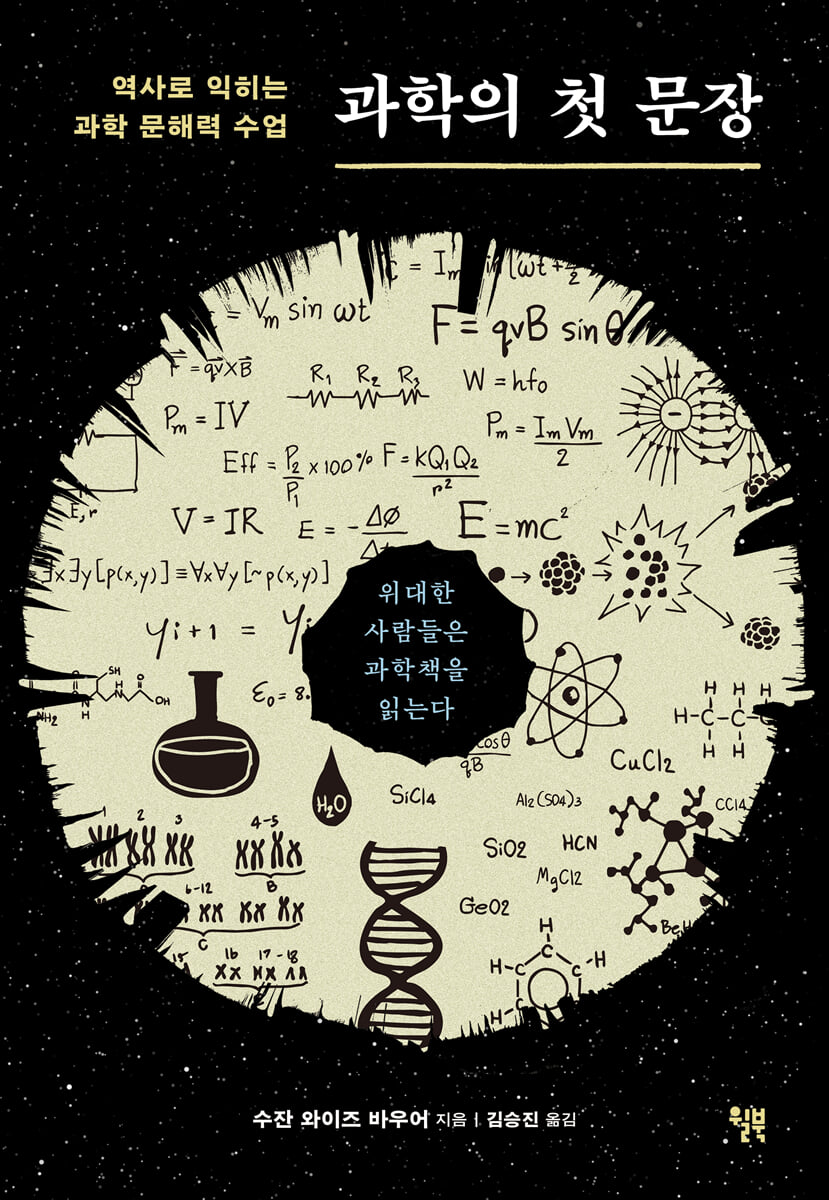
The first sentence of science
 |
Description
Book Introduction
★ A 'Science + History' book containing 36 scientific classics that changed the world and the great sentences written within them.
★ “It vividly shows not only the achievements of science, but also the human face contained within them.”
★ Highly recommended by physicist Kim Beom-jun, chemist Lee Gwang-ryeol, and astronomer Lee Myeong-hyeon!
From Darwin's "On the Origin of Species" to Einstein's "The Theory of Relativity" and Richard Dawkins' "The Selfish Gene," isn't it possible to make science books too thick and complex to fully digest in a light and easy read? "The First Sentence of Science" contains 36 volumes of the most influential scientific texts in human history.
Susan Wise Bauer, author of the best-selling book "The Story of a World History," which explains the flow of world history in an easy-to-understand way, provides a friendly account of the history of scientific development from the perspective of a humanist.
“What this vastness of the sky reveals to us are countless other stars twinkling like the Earth.” Knowing the history of science makes every sentence in a science book read differently.
Only then can you truly appreciate the intellectual brilliance and beauty contained in that sentence.
Archimedes, the philosopher who shouted "Eureka!" when he made an unexpected discovery, delivered the message in his book "The Sandman" that "there is nothing in the universe that humans cannot understand."
Newton extended the law of gravitation he discovered under an apple tree to the entire universe through Principia.
Let's take a closer look at the struggles scientists faced to make new discoveries and how those discoveries changed the world.
Along the way, you'll discover your own captivating first sentence from a science book.
How does this book differ from ordinary science or history books? "To interpret science, you must understand the past.
We must constantly ask ourselves not only, ‘What have we discovered?’ but also, ‘Why are we trying to find out?’” The author covers all areas of science, from chemistry to astronomy, physics, geology, biology, medicine, and cosmology, but does not dryly list only the knowledge in a specific field.
It reveals what science is and what it means to us, and reveals the deeply personal and human (yet generally excellent) side of scientists and science books that were once seen as cold.
Immerse yourself in an exciting story that unfolds in a twist and turn.
★ “It vividly shows not only the achievements of science, but also the human face contained within them.”
★ Highly recommended by physicist Kim Beom-jun, chemist Lee Gwang-ryeol, and astronomer Lee Myeong-hyeon!
From Darwin's "On the Origin of Species" to Einstein's "The Theory of Relativity" and Richard Dawkins' "The Selfish Gene," isn't it possible to make science books too thick and complex to fully digest in a light and easy read? "The First Sentence of Science" contains 36 volumes of the most influential scientific texts in human history.
Susan Wise Bauer, author of the best-selling book "The Story of a World History," which explains the flow of world history in an easy-to-understand way, provides a friendly account of the history of scientific development from the perspective of a humanist.
“What this vastness of the sky reveals to us are countless other stars twinkling like the Earth.” Knowing the history of science makes every sentence in a science book read differently.
Only then can you truly appreciate the intellectual brilliance and beauty contained in that sentence.
Archimedes, the philosopher who shouted "Eureka!" when he made an unexpected discovery, delivered the message in his book "The Sandman" that "there is nothing in the universe that humans cannot understand."
Newton extended the law of gravitation he discovered under an apple tree to the entire universe through Principia.
Let's take a closer look at the struggles scientists faced to make new discoveries and how those discoveries changed the world.
Along the way, you'll discover your own captivating first sentence from a science book.
How does this book differ from ordinary science or history books? "To interpret science, you must understand the past.
We must constantly ask ourselves not only, ‘What have we discovered?’ but also, ‘Why are we trying to find out?’” The author covers all areas of science, from chemistry to astronomy, physics, geology, biology, medicine, and cosmology, but does not dryly list only the knowledge in a specific field.
It reveals what science is and what it means to us, and reveals the deeply personal and human (yet generally excellent) side of scientists and science books that were once seen as cold.
Immerse yourself in an exciting story that unfolds in a twist and turn.
- You can preview some of the book's contents.
Preview
index
36 Great Science Books That Changed the World
Preface or How to Use This Book ─ Susan Wisebauer
Part 1: Opening the Beginning of the World
01 Hippocrates | The first scientific text | The first to describe the natural world in natural terms
02 Plato | Beyond the Human Body | Drawing the First Big Picture of the Universe
03 Aristotle | Change | First to Propose a Theory of Evolution
04 Archimedes | A Grain of Sand | Measuring the Universe Using Mathematics
05 Lucretius | Empty Space | Explaining the Natural World Without Divinity
06 Ptolemy | The Geocentric Universe | The Most Influential Book in History
07 Copernicus | The Last Ancient Astronomer | Presenting an Alternative Cosmology Using More Sophisticated Mathematics
Part 2: The Birth of Scientific Methodology
08 Francis Bacon | A New Proposal | Challenging Aristotle's Deductive Method
09 William Harvey | Proof | Refuting the Great Ancient Authority with Observation and Experiment
10 Galileo Galilei | The Death of Aristotle | Undermining Aristotle's Authority Through Observation and Proof
11 Robert Boyle and Robert Hooke | The Aid of Tools | Distorting Nature and Expanding the Senses to Improve Experimental Methods
12 Isaac Newton | The Rules of Argument | Extending Experimental Methodology to the Entire Universe
Part 3: Reading the Earth
13 Georges-Louis Leclerc | The Origins of Geology | The Birth of Earth Science
14 James Hutton and Georges Cuvier | The New Laws of Science | Two Major Theories Explaining the Formation of the Earth
15 Charles Lyell | A Long and Gradual History | Uniformitarianism Becomes the Standard
16 Arthur Holmes | The Unanswered Question | Calculating the Age of the Earth
17 Alfred Wegener | The Return of the Grand Theory | The Continental Drift Theory Proposed
Walter Alvarez | The Return of Catastrophe | The Reemergence of 'Catastrophic External Events' as a Factor Explaining Earth's History
Part 4: Explaining Life
19 Jean-Baptiste Lamarck | Biology | The first attempt to systematically explain the history of life
20 Charles Darwin | Natural Selection | First to Present a Naturalistic Explanation of the Origin of Species
21 Gregor Mendel | Heredity | The Laws and Mechanisms of Inheritance Revealed
22 Julian Huxley | Comprehensive | Combining cellular research with macroscopic evolutionary theory
23 James D.
Watson | The Secret of Life | Efforts to Unravel the Mysteries of Genetics through Biochemistry
24 Richard Dawkins, EO
Wilson and Stephen Jay Gould | Biology and Fate | Neo-Darwinian Reductionism and Its Counterarguments
Part 5: Heading into Space
25 Albert Einstein | Relativity | The Limits of Newtonian Physics Are Raised
26 Max Planck and Erwin Schrödinger | "The Damned Quantum Leap" | Discovering the Existence of Discontinuous Paths
27 Edwin Hubble, Fred Hoyle, Steven Weinberg | The Triumph of the Big Bang | Returning to the Question of the Beginning and Thinking About the End
28 James Gleick | The Butterfly Effect | Complexity: A Reminder of the Limits of Knowledge
Reading the 36 Great Science Books in their Original Texts
annotation
References
Acknowledgements
Preface or How to Use This Book ─ Susan Wisebauer
Part 1: Opening the Beginning of the World
01 Hippocrates | The first scientific text | The first to describe the natural world in natural terms
02 Plato | Beyond the Human Body | Drawing the First Big Picture of the Universe
03 Aristotle | Change | First to Propose a Theory of Evolution
04 Archimedes | A Grain of Sand | Measuring the Universe Using Mathematics
05 Lucretius | Empty Space | Explaining the Natural World Without Divinity
06 Ptolemy | The Geocentric Universe | The Most Influential Book in History
07 Copernicus | The Last Ancient Astronomer | Presenting an Alternative Cosmology Using More Sophisticated Mathematics
Part 2: The Birth of Scientific Methodology
08 Francis Bacon | A New Proposal | Challenging Aristotle's Deductive Method
09 William Harvey | Proof | Refuting the Great Ancient Authority with Observation and Experiment
10 Galileo Galilei | The Death of Aristotle | Undermining Aristotle's Authority Through Observation and Proof
11 Robert Boyle and Robert Hooke | The Aid of Tools | Distorting Nature and Expanding the Senses to Improve Experimental Methods
12 Isaac Newton | The Rules of Argument | Extending Experimental Methodology to the Entire Universe
Part 3: Reading the Earth
13 Georges-Louis Leclerc | The Origins of Geology | The Birth of Earth Science
14 James Hutton and Georges Cuvier | The New Laws of Science | Two Major Theories Explaining the Formation of the Earth
15 Charles Lyell | A Long and Gradual History | Uniformitarianism Becomes the Standard
16 Arthur Holmes | The Unanswered Question | Calculating the Age of the Earth
17 Alfred Wegener | The Return of the Grand Theory | The Continental Drift Theory Proposed
Walter Alvarez | The Return of Catastrophe | The Reemergence of 'Catastrophic External Events' as a Factor Explaining Earth's History
Part 4: Explaining Life
19 Jean-Baptiste Lamarck | Biology | The first attempt to systematically explain the history of life
20 Charles Darwin | Natural Selection | First to Present a Naturalistic Explanation of the Origin of Species
21 Gregor Mendel | Heredity | The Laws and Mechanisms of Inheritance Revealed
22 Julian Huxley | Comprehensive | Combining cellular research with macroscopic evolutionary theory
23 James D.
Watson | The Secret of Life | Efforts to Unravel the Mysteries of Genetics through Biochemistry
24 Richard Dawkins, EO
Wilson and Stephen Jay Gould | Biology and Fate | Neo-Darwinian Reductionism and Its Counterarguments
Part 5: Heading into Space
25 Albert Einstein | Relativity | The Limits of Newtonian Physics Are Raised
26 Max Planck and Erwin Schrödinger | "The Damned Quantum Leap" | Discovering the Existence of Discontinuous Paths
27 Edwin Hubble, Fred Hoyle, Steven Weinberg | The Triumph of the Big Bang | Returning to the Question of the Beginning and Thinking About the End
28 James Gleick | The Butterfly Effect | Complexity: A Reminder of the Limits of Knowledge
Reading the 36 Great Science Books in their Original Texts
annotation
References
Acknowledgements
Detailed image

Into the book
To interpret science, you must know its past.
We must constantly ask not only 'What have we discovered?' but also 'Why did we try to find out?'
Otherwise, we would not know why scientific knowledge is accepted or rejected in the way it is today, nor would we be able to distinguish between the promises science can fulfill and the claims that should be questioned.
Only by asking questions like these can we begin to understand science.
--- From "Preface or How to Use This Book"
Hippocrates's Collected Works are significant not only as the earliest extant scientific work, but also as the first recorded example of a naturalistic methodology supplanting explanatory approaches that relied on spirits and divinity.
--- From "01 Hippocrates | The First Scientific Literature"
The question of "The Sandman" was very clear.
How many grains of sand would it take to fill the universe? It seems like a simple thought experiment, but it's worth remembering that the Greeks were accustomed to measuring everything in proportions.
Archimedes' question was not 'How big is the universe?'
His question was 'Is it possible to measure the universe using mathematical tools?' and the tool he had in mind was proportions.
So his question was whether it was possible to draw a meaningful relationship between two very different things, a grain of sand and the entirety of natural reality, the universe.
--- From "04 Archimedes | Grains of Sand"
Ancient people measured nature, weighed it, calculated it, and used their senses to understand the physical world.
But telescopes, microscopes, and furnaces fundamentally changed the relationship between senses and their objects.
These tools distorted the natural world.
By unnaturally amplifying, mixing, blending, and distilling nature, or, in Boyle's words, 'torturing' it, he made it 'confess its constituent principles.
--- From "11 Robert Boyle and Robert Hooke | The Help of Tools"
The Earth is a very complex object of study.
Unlike the laws of physics or the principles of chemistry, the Earth is a place and has a history.
Traces of a long past remain on the surface of the Earth.
The Earth is home to species that have lived throughout time.
We must constantly ask not only 'What have we discovered?' but also 'Why did we try to find out?'
Otherwise, we would not know why scientific knowledge is accepted or rejected in the way it is today, nor would we be able to distinguish between the promises science can fulfill and the claims that should be questioned.
Only by asking questions like these can we begin to understand science.
--- From "Preface or How to Use This Book"
Hippocrates's Collected Works are significant not only as the earliest extant scientific work, but also as the first recorded example of a naturalistic methodology supplanting explanatory approaches that relied on spirits and divinity.
--- From "01 Hippocrates | The First Scientific Literature"
The question of "The Sandman" was very clear.
How many grains of sand would it take to fill the universe? It seems like a simple thought experiment, but it's worth remembering that the Greeks were accustomed to measuring everything in proportions.
Archimedes' question was not 'How big is the universe?'
His question was 'Is it possible to measure the universe using mathematical tools?' and the tool he had in mind was proportions.
So his question was whether it was possible to draw a meaningful relationship between two very different things, a grain of sand and the entirety of natural reality, the universe.
--- From "04 Archimedes | Grains of Sand"
Ancient people measured nature, weighed it, calculated it, and used their senses to understand the physical world.
But telescopes, microscopes, and furnaces fundamentally changed the relationship between senses and their objects.
These tools distorted the natural world.
By unnaturally amplifying, mixing, blending, and distilling nature, or, in Boyle's words, 'torturing' it, he made it 'confess its constituent principles.
--- From "11 Robert Boyle and Robert Hooke | The Help of Tools"
The Earth is a very complex object of study.
Unlike the laws of physics or the principles of chemistry, the Earth is a place and has a history.
Traces of a long past remain on the surface of the Earth.
The Earth is home to species that have lived throughout time.
--- From "16 Arthur Holmes | The Unanswered Question"
Publisher's Review
Sparkling sentences from great science books and the essence of science contained within them.
What was the limitation that the brilliant physicist Newton unhesitatingly acknowledged? Newton discovered the existence of gravity by observing an apple falling on his head, yet he couldn't explain why gravity exists.
In fact, he didn't think it was a disadvantage at all.
Rather, he disdained the task of finding out such causes as 'making up hypotheses' like the ancient philosophers, and wrote in his first book, Principia (Mathematical Principles of Natural Philosophy),
“And I don’t make up hypotheses.”
This sentence, which may sound like an excuse, is read differently once you understand science.
Newton was satisfied that his theory was "sufficient to explain the motions of the earth's oceans and all the heavenly bodies."
It is a near-perfect explanation of how the universe works, even though we don't know the cause.
He established the methodology of science, or 'experimental philosophy', which discovers universal laws applicable to all things from the properties of experimental objects and special phenomena.
"The First Sentence of Science" is a book that introduces outstanding scientific sources that changed the world and tells the history of science.
But it is different from the science history books we are familiar with.
This book reveals how intellectually beautiful the sentences in science books, which often seemed to lack sensitivity or were merely dry statements of facts, can be.
Because it doesn't just list scientific discoveries, it shows what those discoveries mean to us.
This book goes beyond knowledge to provide 'context' so that you can fully understand science.
Conquering 36 science books in a week—one that's hard to read even once a year.
“Life is short, art is long.” This famous sentence was actually mistranslated.
This is because it is a quote from the ancient physician Hippocrates, who is famous for the 'Hippocratic Oath', a code of ethics that doctors are said to declare with their hand on their heart.
A more accurate meaning of this sentence, which he wrote in his book “On Air, Water, and Place” around 420 BC, is: “Life is short, and the journey of medicine is long.” He chose the difficult path of trying to explain disease in terms of the visible world and the order of the universe, breaking away from the simple belief of the time that disease was caused by the wrath of the gods.
Thus, Hippocrates' book became the first surviving example of a scientific explanation of the world, free from divinity.
"The First Sentence of Science" discusses 36 science books that we should not miss, starting with Hippocrates, through Galileo's "Dialogues," Darwin's "On the Origin of Species," Einstein's "Theory of Relativity," and ending with James Gleick's "Chaos."
The author is a voracious reader, fluent in Latin, Hebrew, Greek, Arabic, French, and Korean, and has delved into a wide range of literature. He has delved into some of the most difficult scientific texts, even for professional researchers, and has lovingly unpacked the wisdom contained within.
Let's embark on a journey that encompasses history and science, from the birth of science in BC to the final paradigm shift of the 20th century brought about by quantum mechanics and complexity theory.
A deeply human story of scientists trying to uncover the secrets of Earth, life, and the universe.
“The more we seem to understand the universe, the more meaningless it seems.” Scientists were baffled when they discovered that the universe is steadily expanding and that at some point in the distant past, a Big Bang occurred to create all matter.
Because there is no way to explain the 'zero' point where everything came together before the explosion and expansion occurred in reverse.
Steven Weinberg, winner of the 1979 Nobel Prize in Physics, expressed his bewilderment in one sentence in his book, The First Three Minutes.
However, that does not mean that the astronomers' research itself was meaningless.
Weinberg found a purpose in physics to honor science and to pursue that honor forever, writing:
“The effort to understand the universe is the life of man.
It's a little bit more elevated than a farce.
“It gives it a bit of tragic elegance.”
"The First Sentence of Science" vividly shows that the scientific knowledge and tools we take for granted today were in fact born from the agony, conflict, frustration, and hope of countless scholars.
The author says that science is not a guide that leads to truth without error, but rather a natural way for humans to understand the world.
Sometimes deeply personal, sometimes fallible, and often quite brilliant.
Through this book, you will realize that science, which once seemed cold and distant, is actually a very human pursuit, and you will be able to become closer to it.
What was the limitation that the brilliant physicist Newton unhesitatingly acknowledged? Newton discovered the existence of gravity by observing an apple falling on his head, yet he couldn't explain why gravity exists.
In fact, he didn't think it was a disadvantage at all.
Rather, he disdained the task of finding out such causes as 'making up hypotheses' like the ancient philosophers, and wrote in his first book, Principia (Mathematical Principles of Natural Philosophy),
“And I don’t make up hypotheses.”
This sentence, which may sound like an excuse, is read differently once you understand science.
Newton was satisfied that his theory was "sufficient to explain the motions of the earth's oceans and all the heavenly bodies."
It is a near-perfect explanation of how the universe works, even though we don't know the cause.
He established the methodology of science, or 'experimental philosophy', which discovers universal laws applicable to all things from the properties of experimental objects and special phenomena.
"The First Sentence of Science" is a book that introduces outstanding scientific sources that changed the world and tells the history of science.
But it is different from the science history books we are familiar with.
This book reveals how intellectually beautiful the sentences in science books, which often seemed to lack sensitivity or were merely dry statements of facts, can be.
Because it doesn't just list scientific discoveries, it shows what those discoveries mean to us.
This book goes beyond knowledge to provide 'context' so that you can fully understand science.
Conquering 36 science books in a week—one that's hard to read even once a year.
“Life is short, art is long.” This famous sentence was actually mistranslated.
This is because it is a quote from the ancient physician Hippocrates, who is famous for the 'Hippocratic Oath', a code of ethics that doctors are said to declare with their hand on their heart.
A more accurate meaning of this sentence, which he wrote in his book “On Air, Water, and Place” around 420 BC, is: “Life is short, and the journey of medicine is long.” He chose the difficult path of trying to explain disease in terms of the visible world and the order of the universe, breaking away from the simple belief of the time that disease was caused by the wrath of the gods.
Thus, Hippocrates' book became the first surviving example of a scientific explanation of the world, free from divinity.
"The First Sentence of Science" discusses 36 science books that we should not miss, starting with Hippocrates, through Galileo's "Dialogues," Darwin's "On the Origin of Species," Einstein's "Theory of Relativity," and ending with James Gleick's "Chaos."
The author is a voracious reader, fluent in Latin, Hebrew, Greek, Arabic, French, and Korean, and has delved into a wide range of literature. He has delved into some of the most difficult scientific texts, even for professional researchers, and has lovingly unpacked the wisdom contained within.
Let's embark on a journey that encompasses history and science, from the birth of science in BC to the final paradigm shift of the 20th century brought about by quantum mechanics and complexity theory.
A deeply human story of scientists trying to uncover the secrets of Earth, life, and the universe.
“The more we seem to understand the universe, the more meaningless it seems.” Scientists were baffled when they discovered that the universe is steadily expanding and that at some point in the distant past, a Big Bang occurred to create all matter.
Because there is no way to explain the 'zero' point where everything came together before the explosion and expansion occurred in reverse.
Steven Weinberg, winner of the 1979 Nobel Prize in Physics, expressed his bewilderment in one sentence in his book, The First Three Minutes.
However, that does not mean that the astronomers' research itself was meaningless.
Weinberg found a purpose in physics to honor science and to pursue that honor forever, writing:
“The effort to understand the universe is the life of man.
It's a little bit more elevated than a farce.
“It gives it a bit of tragic elegance.”
"The First Sentence of Science" vividly shows that the scientific knowledge and tools we take for granted today were in fact born from the agony, conflict, frustration, and hope of countless scholars.
The author says that science is not a guide that leads to truth without error, but rather a natural way for humans to understand the world.
Sometimes deeply personal, sometimes fallible, and often quite brilliant.
Through this book, you will realize that science, which once seemed cold and distant, is actually a very human pursuit, and you will be able to become closer to it.
GOODS SPECIFICS
- Date of issue: May 14, 2025
- Page count, weight, size: 344 pages | 512g | 152*220*23mm
- ISBN13: 9791155818206
- ISBN10: 1155818202
You may also like
카테고리
korean


korean

![GQ KOREA Mark (Monthly): December [2025]](http://librairie.coreenne.fr/cdn/shop/files/8ef265dbbfbf186523ed75ba7319009d.jpg?v=1765340328&width=3840)


