

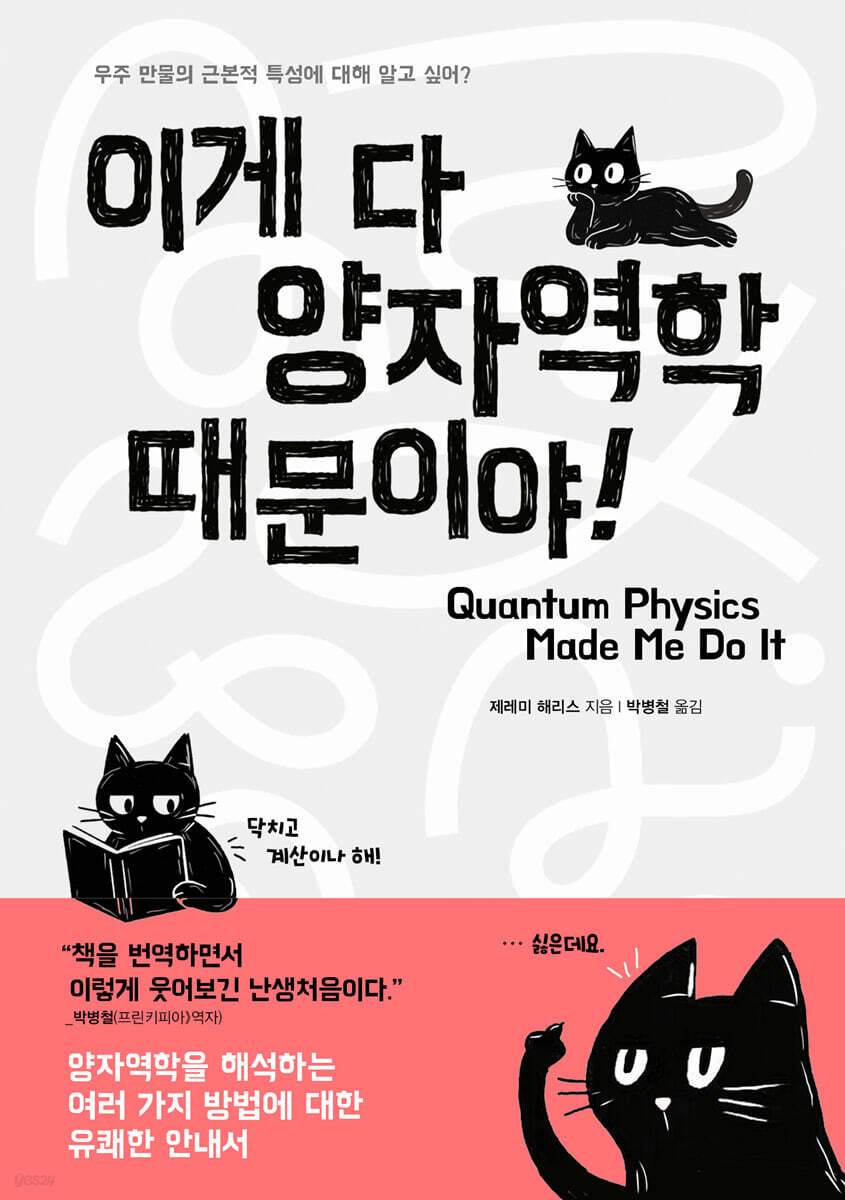
It's all because of quantum mechanics
 |
Description
Book Introduction
Looking at the most successful scientific theory in human history with irreverent(?) eyes!
"This is the first time in my life I've laughed this hard while translating a book." (Translator Park Byeong-cheol)
This year marks the 100th anniversary of the birth of quantum mechanics. The book, "It's All Because of Quantum Mechanics!" (original title: Quantum Physics Made Me Do It), was published by Munhak Su-cheop. It challenges the "Copenhagen interpretation," which has been firmly established as the standard interpretation of quantum mechanics, and introduces various ways to understand quantum mechanics.
In 1925, a mathematical system for interpreting the motion of quantum was published, and over a long period of time, Bohr's collapse theory, which states that "the wave function collapses at the moment of observation," became the established interpretation of quantum mechanics, and all other new interpretations were rejected.
If anyone raised a question, the only response would be, “Shut up and calculate!”
However, quantum mechanics, a scientific theory that explains how the world at the atomic level works, can be a lens through which we can look into the essence of all things in the universe, which are made up of atoms, including humans, and that essence appears in very different ways depending on the type of lens.
Author Jeremy Harris introduces various interpretations outside the rigid walls built by Bohr's theory.
Rather than dealing with the mathematical formulas or principles of quantum mechanics themselves, this book explores the various perspectives and philosophical implications of interpreting quantum mechanics. It is a refreshing rebellion against the pressure to "Just shut up and do the math!" and a delightful guidebook that takes you on a tour of the beautiful and complex quantum world discovered by modern physics.
"This is the first time in my life I've laughed this hard while translating a book." (Translator Park Byeong-cheol)
This year marks the 100th anniversary of the birth of quantum mechanics. The book, "It's All Because of Quantum Mechanics!" (original title: Quantum Physics Made Me Do It), was published by Munhak Su-cheop. It challenges the "Copenhagen interpretation," which has been firmly established as the standard interpretation of quantum mechanics, and introduces various ways to understand quantum mechanics.
In 1925, a mathematical system for interpreting the motion of quantum was published, and over a long period of time, Bohr's collapse theory, which states that "the wave function collapses at the moment of observation," became the established interpretation of quantum mechanics, and all other new interpretations were rejected.
If anyone raised a question, the only response would be, “Shut up and calculate!”
However, quantum mechanics, a scientific theory that explains how the world at the atomic level works, can be a lens through which we can look into the essence of all things in the universe, which are made up of atoms, including humans, and that essence appears in very different ways depending on the type of lens.
Author Jeremy Harris introduces various interpretations outside the rigid walls built by Bohr's theory.
Rather than dealing with the mathematical formulas or principles of quantum mechanics themselves, this book explores the various perspectives and philosophical implications of interpreting quantum mechanics. It is a refreshing rebellion against the pressure to "Just shut up and do the math!" and a delightful guidebook that takes you on a tour of the beautiful and complex quantum world discovered by modern physics.
index
introduction
Chapter 1.
Down the rabbit hole
Chapter 2.
The Physics of Collapsing Consciousness and the Soul
Chapter 3.
Become one with the universe
Chapter 4.
Creation of consciousness
Chapter 5.
Collapse that occurs without conscious intervention
Chapter 6.
Quantum Multiverse
Chapter 7.
A Brief History of Time
Chapter 8.
Quantum mechanics that breaks the rules
Chapter 9.
Hidden Variable Theory and the Problems of Physics
Chapter 10.
Freewheeling dynamics
Chapter 11.
The Future of Consciousness
Acknowledgements
Translator's Note
Search
Chapter 1.
Down the rabbit hole
Chapter 2.
The Physics of Collapsing Consciousness and the Soul
Chapter 3.
Become one with the universe
Chapter 4.
Creation of consciousness
Chapter 5.
Collapse that occurs without conscious intervention
Chapter 6.
Quantum Multiverse
Chapter 7.
A Brief History of Time
Chapter 8.
Quantum mechanics that breaks the rules
Chapter 9.
Hidden Variable Theory and the Problems of Physics
Chapter 10.
Freewheeling dynamics
Chapter 11.
The Future of Consciousness
Acknowledgements
Translator's Note
Search
Into the book
If someone were to ask, "Turning left and turning right at the same time? How can that happen?" I would have to give this answer.
“The quantum world is a world where such absurd things happen all the time.
And it's not my fault that the quantum world is out of touch with common sense.”
--- p.46
Bohr's followers, who held his collapse theory almost religiously, condemned Everett's theory as heresy and staunchly blocked it from taking center stage in physics.
The reason Bohr's theory is accepted today as the 'orthodox interpretation' of quantum mechanics is because it went through a similar process whenever disagreements arose.
Fortunately, no one was burned at the stake for opposing Bohr's theory, but this may also have been due to the fact that theoretical physicists were so inept that they did not know how to make fire.
--- p.181
"You've got the wrong person! Yes, it's true that I snuck into the zoo last night and rode a llama.
But that person is no longer me.
Since then, countless quantum events have occurred within my body, each time splitting into a different version, so I can't possibly be the same person. If you understand, would you excuse me for a moment? Last night, that 'not me' guy caused such a ruckus that I can smell the llama all over me."
--- p.222
If you were to stop someone on the street and ask them, “What do you think is the most bizarre feature of quantum mechanics?” they would probably say something like this.
“What? Who are you? (To the children) Kids, get in the car and stay there.
(Back to you) Can't you just get out of here? Let me drag you out in handcuffs?"
--- p.255
Today's physics provides the foundation for the ideologies that will govern the future.
The problem, however, is that today's physics is uncertain.
Physicists have been playing with vague equations for so long that they have spawned a multitude of interpretations, each time forcing us to rethink our place in the universe.
“The quantum world is a world where such absurd things happen all the time.
And it's not my fault that the quantum world is out of touch with common sense.”
--- p.46
Bohr's followers, who held his collapse theory almost religiously, condemned Everett's theory as heresy and staunchly blocked it from taking center stage in physics.
The reason Bohr's theory is accepted today as the 'orthodox interpretation' of quantum mechanics is because it went through a similar process whenever disagreements arose.
Fortunately, no one was burned at the stake for opposing Bohr's theory, but this may also have been due to the fact that theoretical physicists were so inept that they did not know how to make fire.
--- p.181
"You've got the wrong person! Yes, it's true that I snuck into the zoo last night and rode a llama.
But that person is no longer me.
Since then, countless quantum events have occurred within my body, each time splitting into a different version, so I can't possibly be the same person. If you understand, would you excuse me for a moment? Last night, that 'not me' guy caused such a ruckus that I can smell the llama all over me."
--- p.222
If you were to stop someone on the street and ask them, “What do you think is the most bizarre feature of quantum mechanics?” they would probably say something like this.
“What? Who are you? (To the children) Kids, get in the car and stay there.
(Back to you) Can't you just get out of here? Let me drag you out in handcuffs?"
--- p.255
Today's physics provides the foundation for the ideologies that will govern the future.
The problem, however, is that today's physics is uncertain.
Physicists have been playing with vague equations for so long that they have spawned a multitude of interpretations, each time forcing us to rethink our place in the universe.
--- p.270
Publisher's Review
Why does quantum mechanics insist that there are cats that are both dead and alive?
A refreshing punch to the solid wall built over 100 years of quantum mechanics.
When the electron spins clockwise, the rotation sensor turns on, the gun fires, and the cat dies.
If you turn counterclockwise, the sensor will be silent and the gun will not fire, so the cat will survive.
However, according to quantum mechanics, electrons can rotate both clockwise and counterclockwise at the same time.
So the cat is dead and yet alive… … .
No one has ever seen a cat that's both dead and alive, so why does quantum mechanics insist that such zombie cats exist? To understand quantum mechanics, we need to understand why such strange things happen.
Niels Bohr argued that 'the moment an observer observes a physical system, the various states that existed in the system instantly collapse, and only one state is selected as the final result.'
However, without giving a clear answer to the questions about the standard and subject of 'observation', the universe was divided into 'a small world where objects can exist in multiple places at the same time' and 'a large world where such a phenomenon cannot be observed'.
And this theory will become the mainstream interpretation of quantum mechanics in the future.
In the early days of quantum mechanics, the "mainstream" physicists brushed aside the thorny issue by saying, "Don't ask about collapse anymore" or "Just shut up and do the math."
Although they themselves were very uncomfortable, they could not give up on a theory that was riddled with problems and only provided correct answers.
It is a very human thing to look toward a distant mountain, hoping that a problem that has fallen on one's feet will one day be solved. (p. 163) The reason physicists have not been particularly interested in a realistic interpretation of quantum mechanics is because, as the quote suggests, quantum mechanics "produces only the right answers."
In other words, the values calculated theoretically exactly matched the data obtained experimentally.
Because they could not abandon such a precise theory as incomplete, and because they could not yet determine which of the theories interpreting quantum mechanics was true, physicists accepted Bohr's vague explanation as a last resort.
Author Jeremy Harris, who transitioned from a PhD in physics to an AI entrepreneur, is in a position where he can challenge the authority of the physics community without much to lose.
Accordingly, it presents various alternative interpretations of quantum mechanics, ranging from Hugh Everett III's 'multiverse hypothesis' that states that collapse does not occur and all possibilities split off into separate universes, to the 'collapse theory' that states that wave functions simply collapse for no reason, David Bohm's 'guided waves', and Amit Goswami's 'cosmic consciousness', which is a bit questionable as science.
And it reexamines human consciousness and free will from a quantum mechanical perspective, asking the question, "If each alternative were true, how would the world's moral values and legal system change?"
For example, according to Einstein's 'hidden variable theory', which states that all observations are influenced by unseen variables, the future is not random but is determined by hidden variables.
So, can we truly say that humans, composed of atoms whose movements are predictable, possess free will? The author humorously offers an answer to this question.
To hold someone legally or morally responsible for his actions, he must have freely chosen to do so.
(…) If free will does not exist, then all criminals are merely innocent people who are ‘forced’ to commit crimes by some external factor.
(…) “My client set fire to the peanut factory because the atoms that make up his body were arranged in a way that ‘could not do anything else.’
It was never his choice.
“Therefore, my client is not an arsonist, but another victim who, by the laws of the universe, had no choice but to set the fire!” (p. 129)
There are also amusing and humorous intellectual games, such as examining how animism, the belief that all things possess a soul (consciousness), was revived in the early 20th century thanks to quantum mechanics, and proving quantumly the probability of the Big Bang and the emergence of the first cell, as well as the slim possibility of Archduke Ferdinand's chauffeur taking a wrong turn and causing World War I.
Reading this book will tell you why inter-universe travel is impossible when “your roommate pretends to ‘jump from a universe where he’s been cleaning the room all week’ and then puts the dishes on you” (p. 234).
Understanding quantum mechanics is understanding the world.
It presents various methods for understanding quantum mechanics, the origin of all things in the universe.
The quantum revolution has completely changed our perspective on the world.
Not only Newton's deterministic universe, but all philosophical trends that humanity has experienced were put on the chopping block, and from this, new cosmological views such as parallel universes, cosmic consciousness, and mind-body dualism were born one after another.
Quantum mechanics is the most accurate theory developed by mankind to date, as the values obtained through calculations are exactly in line with experimental results, but just as you cannot see a dead cat while it is alive, nothing has been definitely proven yet.
But trying to interpret quantum mechanics is also an exploration of human nature and, furthermore, the origin of the universe.
Quantum mechanics can provide a lot of information when considering the place of humans in the universe.
In the final chapter, the author discusses the role quantum mechanics can play in considering human responsibility as "creators" in the face of the advent of artificial intelligence on a par with humans.
In this age where 'technology has surpassed philosophy,' quantum mechanics offers important ideas when it comes to combining ambiguous fields like ethics and morality with science and technology.
As you follow the author's characteristically playful intellectual playfulness from beginning to end of the book, you will naturally come to realize that 'everything in the world is the result of events that occurred at the quantum level.'
The process of pointing out the pros and cons of various methods of interpreting quantum mechanics, one by one, while saying, “It is not my responsibility that the quantum world deviates from common sense” (p. 46), is exhilarating.
No matter how you interpret it, the ironclad foundation of quantum mechanics will never be broken.
So don't worry about anything and just spread your wings of imagination.
If that's too much trouble, you can just climb on the wings the author has spread out.
I guarantee you that it will be difficult to find another book that explains quantum mechanics in such an engaging way for a while. (From the Translator's Note, p. 303)
A refreshing punch to the solid wall built over 100 years of quantum mechanics.
When the electron spins clockwise, the rotation sensor turns on, the gun fires, and the cat dies.
If you turn counterclockwise, the sensor will be silent and the gun will not fire, so the cat will survive.
However, according to quantum mechanics, electrons can rotate both clockwise and counterclockwise at the same time.
So the cat is dead and yet alive… … .
No one has ever seen a cat that's both dead and alive, so why does quantum mechanics insist that such zombie cats exist? To understand quantum mechanics, we need to understand why such strange things happen.
Niels Bohr argued that 'the moment an observer observes a physical system, the various states that existed in the system instantly collapse, and only one state is selected as the final result.'
However, without giving a clear answer to the questions about the standard and subject of 'observation', the universe was divided into 'a small world where objects can exist in multiple places at the same time' and 'a large world where such a phenomenon cannot be observed'.
And this theory will become the mainstream interpretation of quantum mechanics in the future.
In the early days of quantum mechanics, the "mainstream" physicists brushed aside the thorny issue by saying, "Don't ask about collapse anymore" or "Just shut up and do the math."
Although they themselves were very uncomfortable, they could not give up on a theory that was riddled with problems and only provided correct answers.
It is a very human thing to look toward a distant mountain, hoping that a problem that has fallen on one's feet will one day be solved. (p. 163) The reason physicists have not been particularly interested in a realistic interpretation of quantum mechanics is because, as the quote suggests, quantum mechanics "produces only the right answers."
In other words, the values calculated theoretically exactly matched the data obtained experimentally.
Because they could not abandon such a precise theory as incomplete, and because they could not yet determine which of the theories interpreting quantum mechanics was true, physicists accepted Bohr's vague explanation as a last resort.
Author Jeremy Harris, who transitioned from a PhD in physics to an AI entrepreneur, is in a position where he can challenge the authority of the physics community without much to lose.
Accordingly, it presents various alternative interpretations of quantum mechanics, ranging from Hugh Everett III's 'multiverse hypothesis' that states that collapse does not occur and all possibilities split off into separate universes, to the 'collapse theory' that states that wave functions simply collapse for no reason, David Bohm's 'guided waves', and Amit Goswami's 'cosmic consciousness', which is a bit questionable as science.
And it reexamines human consciousness and free will from a quantum mechanical perspective, asking the question, "If each alternative were true, how would the world's moral values and legal system change?"
For example, according to Einstein's 'hidden variable theory', which states that all observations are influenced by unseen variables, the future is not random but is determined by hidden variables.
So, can we truly say that humans, composed of atoms whose movements are predictable, possess free will? The author humorously offers an answer to this question.
To hold someone legally or morally responsible for his actions, he must have freely chosen to do so.
(…) If free will does not exist, then all criminals are merely innocent people who are ‘forced’ to commit crimes by some external factor.
(…) “My client set fire to the peanut factory because the atoms that make up his body were arranged in a way that ‘could not do anything else.’
It was never his choice.
“Therefore, my client is not an arsonist, but another victim who, by the laws of the universe, had no choice but to set the fire!” (p. 129)
There are also amusing and humorous intellectual games, such as examining how animism, the belief that all things possess a soul (consciousness), was revived in the early 20th century thanks to quantum mechanics, and proving quantumly the probability of the Big Bang and the emergence of the first cell, as well as the slim possibility of Archduke Ferdinand's chauffeur taking a wrong turn and causing World War I.
Reading this book will tell you why inter-universe travel is impossible when “your roommate pretends to ‘jump from a universe where he’s been cleaning the room all week’ and then puts the dishes on you” (p. 234).
Understanding quantum mechanics is understanding the world.
It presents various methods for understanding quantum mechanics, the origin of all things in the universe.
The quantum revolution has completely changed our perspective on the world.
Not only Newton's deterministic universe, but all philosophical trends that humanity has experienced were put on the chopping block, and from this, new cosmological views such as parallel universes, cosmic consciousness, and mind-body dualism were born one after another.
Quantum mechanics is the most accurate theory developed by mankind to date, as the values obtained through calculations are exactly in line with experimental results, but just as you cannot see a dead cat while it is alive, nothing has been definitely proven yet.
But trying to interpret quantum mechanics is also an exploration of human nature and, furthermore, the origin of the universe.
Quantum mechanics can provide a lot of information when considering the place of humans in the universe.
In the final chapter, the author discusses the role quantum mechanics can play in considering human responsibility as "creators" in the face of the advent of artificial intelligence on a par with humans.
In this age where 'technology has surpassed philosophy,' quantum mechanics offers important ideas when it comes to combining ambiguous fields like ethics and morality with science and technology.
As you follow the author's characteristically playful intellectual playfulness from beginning to end of the book, you will naturally come to realize that 'everything in the world is the result of events that occurred at the quantum level.'
The process of pointing out the pros and cons of various methods of interpreting quantum mechanics, one by one, while saying, “It is not my responsibility that the quantum world deviates from common sense” (p. 46), is exhilarating.
No matter how you interpret it, the ironclad foundation of quantum mechanics will never be broken.
So don't worry about anything and just spread your wings of imagination.
If that's too much trouble, you can just climb on the wings the author has spread out.
I guarantee you that it will be difficult to find another book that explains quantum mechanics in such an engaging way for a while. (From the Translator's Note, p. 303)
GOODS SPECIFICS
- Date of issue: April 30, 2025
- Page count, weight, size: 312 pages | 148*210*30mm
- ISBN13: 9791173830037
- ISBN10: 1173830030
You may also like
카테고리
korean


korean

![GQ KOREA Mark (Monthly): December [2025]](http://librairie.coreenne.fr/cdn/shop/files/8ef265dbbfbf186523ed75ba7319009d.jpg?v=1765340328&width=3840)


