

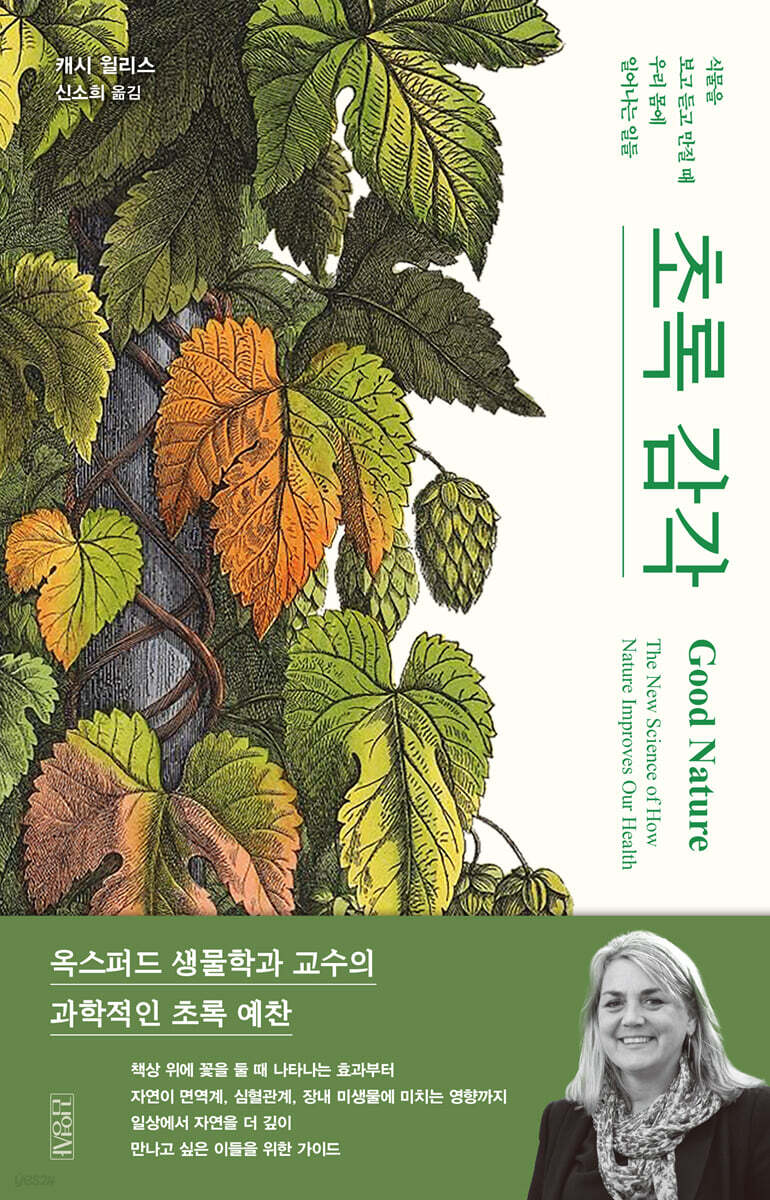
Green sense
 |
Description
Book Introduction
Why are we drawn to nature?
From the effect that appears when you place flowers on a desk
The impact of nature on the immune system, cardiovascular system, and gut microbiome
Oxford University Biodiversity Professor Cathy Willis's Scientific Praise for Green
Doing gardening with your bare hands can help your gut health.
New sounds can help reduce post-surgical pain.
Touching wood has a calming effect, and the more grain and knots there are in the wood, the greater the effect.
Surgery patients recovering in hospital rooms with a view of trees outside the window recover three times faster than those who face a wall.
The scent of roses calms the driver's mind, allowing for safer driving, and even placing a small flowerpot on the desk can increase work efficiency.
Why is that?
Since encountering a study about 15 years ago that fundamentally changed his perspective on the relationship between humans and nature, Professor Willis has been exploring the link between green space in our lives and our health, mood, and longevity.
This book is the result, bringing together the latest scientific research to present compelling scientific evidence proving that nature truly does benefit us.
To maximize these benefits, it also offers practical guidance for individuals and society, from choosing a commute or walking route to considering when decorating classrooms and offices, to planning public green spaces in cities.
From the effect that appears when you place flowers on a desk
The impact of nature on the immune system, cardiovascular system, and gut microbiome
Oxford University Biodiversity Professor Cathy Willis's Scientific Praise for Green
Doing gardening with your bare hands can help your gut health.
New sounds can help reduce post-surgical pain.
Touching wood has a calming effect, and the more grain and knots there are in the wood, the greater the effect.
Surgery patients recovering in hospital rooms with a view of trees outside the window recover three times faster than those who face a wall.
The scent of roses calms the driver's mind, allowing for safer driving, and even placing a small flowerpot on the desk can increase work efficiency.
Why is that?
Since encountering a study about 15 years ago that fundamentally changed his perspective on the relationship between humans and nature, Professor Willis has been exploring the link between green space in our lives and our health, mood, and longevity.
This book is the result, bringing together the latest scientific research to present compelling scientific evidence proving that nature truly does benefit us.
To maximize these benefits, it also offers practical guidance for individuals and society, from choosing a commute or walking route to considering when decorating classrooms and offices, to planning public green spaces in cities.
- You can preview some of the book's contents.
Preview
index
Preface: Forest Bathing and Tree Hugs
1.
Blue Horizon: The Importance of Perspective
2.
Vegetables for the eyes: Green leaves are good for you.
3.
The Allure of Flowers: How They Captivate Us
4.
The Sweet Scent of Success: The Scents of Plants That Enhance Your Quality of Life
5.
Healing Through the Ears: From Birdsong to the Whisper of Leaves
6.
The Feel of Wood Grain: Staying Healthy at Home
7.
Nature's Hidden Senses
8.
Indoor Sensory Landscape: Life-Friendly Design
9.
Outdoor Sensory Landscapes: The Power of a Short Walk
10.
Finding Happiness in Gardens and Vegetable Gardens
Conclusion: Natural Prescriptions for Individuals and Society
Acknowledgements
Additional explanation of the graph
Image source
main
Search
1.
Blue Horizon: The Importance of Perspective
2.
Vegetables for the eyes: Green leaves are good for you.
3.
The Allure of Flowers: How They Captivate Us
4.
The Sweet Scent of Success: The Scents of Plants That Enhance Your Quality of Life
5.
Healing Through the Ears: From Birdsong to the Whisper of Leaves
6.
The Feel of Wood Grain: Staying Healthy at Home
7.
Nature's Hidden Senses
8.
Indoor Sensory Landscape: Life-Friendly Design
9.
Outdoor Sensory Landscapes: The Power of a Short Walk
10.
Finding Happiness in Gardens and Vegetable Gardens
Conclusion: Natural Prescriptions for Individuals and Society
Acknowledgements
Additional explanation of the graph
Image source
main
Search
Detailed image

Into the book
The results were surprising.
Participants who walked through the forest for 15 minutes showed a 16 percent decrease in the level of cortisol, a stress hormone, in their saliva, and a significant drop in heart rate and blood pressure compared to participants who walked through the city for 15 minutes.
Participants who walked or sat in the forest also had significantly more parasympathetic nervous system activity (which is known to increase when we are relaxed) than those who did the same thing in the city.
Participants also reported feeling more at peace and overall happier when they were in the forest.
This new scientific evidence proves the real benefits of forest bathing.
--- p.13
The study results showed that, regardless of socioeconomic factors or home environment, the wider the natural green space that children encountered on a daily basis, the faster the development of working memory and attention.
Perhaps more importantly, the finding suggests that green space around school buildings, rather than along school routes, has the greatest impact on improving children's cognitive performance.
The researchers said that since children spend most of their day indoors, the natural scenery outside the window was likely the biggest influence.
These facts have important policy implications for the design and location of schools.
--- p.30~31
Finally, we may need to listen to our inner voices (and folklore) that tell us not to look into the dark, dense forest.
Forest scenes can actually increase stress rather than lower it.
Little Red Riding Hood's mother was wise, after all.
--- p.47
There is another interesting conclusion.
Red leaves were found to have the opposite, negative effect.
There were reactions that said that seeing red leaves made them feel 'depressed' and tense.
I think I need to move the red poinsettia from my desk.
The researchers concluded that placing plants with yellow-green and light-green leaves in one's living environment can make one feel calmer, more cheerful, and more focused.
This is a discovery that anyone can refer to in their daily life.
--- p.64~65
In other words, fragrances have been used for a long time not only for the enjoyment of smells but also for medicinal purposes, and in such cases, they may not have a particularly pleasant smell.
For example, many romance novels from the 18th and 19th centuries feature a scene where the heroine, who has fainted from a fit of depression, is awakened with smelling salt.
This salt was used to wake up unconscious people because it releases ammonia gas, which is foul-smelling and irritates the mucous membranes of the nose and lungs, triggering the inhalation reflex.
The inhalation reflex can change breathing patterns to improve respiratory flow and produce arousal effects.
It's surprising that even today you can buy a wide variety of smelling salts online.
--- p.101
There are not many scientifically clear cases where the effects of volatile organic compounds on the odors of specific plant groups have been clearly established.
In this chapter, we will summarize the results of ongoing research focusing on common scents encountered in everyday life, such as various coniferous trees, citrus fruits, herbs (lavender, rosemary, mint), and rose.
These four are the scents with the most scientific evidence and results showing that inhaling them can produce significant health-promoting effects.
After reading this chapter, you will notice that certain plants smell completely different than before.
--- p.107~108
Interestingly, water sounds had the greatest effect on improving mood and cognitive performance, while birdsong had the greatest effect on alleviating physiological symptoms of stress and discomfort (blood pressure, pain, heart rate).
The complexity of natural sounds also turned out to be an important variable.
The more varied and complex the sounds of nature, the greater the improvement in health and the reduction in stress and discomfort.
--- p.149
Of course, voluntary effort is also necessary.
Be mindful of the sounds around you and spend time listening to good sounds.
Let's go to work through a park where you can hear birds chirping or along a quiet street.
It doesn't matter if my commute time increases by a few minutes.
Because those few minutes will be the most productive part of your day.
--- p.157
The hobby of displaying exotic plants in homes and greenhouses was popular through the Georgian and Victorian eras and into the 20th century (Figure 9-1).
The 'parlor palm' has emerged as a key decorative element in many homes and has become a general term for a variety of palms, ferns, and other hardy plants native to South America, Asia, and Africa.
People's enthusiasm wasn't limited to the plant itself.
Still lifes adorned the walls, and natural forms began to appear on wallpaper, furniture, and fabrics, influenced by Art Nouveau architecture and designers such as William Morris.
It was similar to the carved wooden wall panels or window lattices that were popular in the Middle Ages.
But starting in the late 1950s, all this began to change.
--- p.212
For example, one study measured children's attention and emotional well-being over four months in two Dutch schools.
Children who studied in classrooms with green walls had significantly better selective attention than children who studied in classrooms without green walls.
This is a very important research finding, as selective attention is known to be essential to the learning process.
If this trend continues in the long term, children who study in classrooms with green walls will perform better academically.
Greenwall has also been shown to improve children's overall happiness and mental well-being in relation to learning and school, which is also noteworthy given recent mental health and youth issues.
--- p.219~220
This time again, a subtle but clear difference emerged.
Participants reported improved cognitive ability to perform multiple tasks when working indoors while listening to nature sounds, but cognitive performance was impaired when there were too many natural elements indoors.
The researchers reaffirmed that various natural designs indoors can actually be distracting.
These preliminary results clearly suggest that indoor natural elements are important for psychological well-being, but careful consideration should be given to the type of work being done indoors and whether it is creative work (e.g., a designer creating this book cover) or work requiring attention (e.g., a dedicated editor carefully reading the text of this book to avoid missing typos).
--- p.228
There is another important question.
How long should you spend walking in a city park? Is a ten-minute walk once a week enough, or is that not enough? If so, how long and how often should you walk? Recent studies offer surprisingly clear recommendations.
To maximize health and well-being benefits, you should walk in nature for at least 20 minutes at a time and enjoy nature for at least 120 minutes a week.
--- p.250
The results of the survey were beyond my expectations.
I thought that a dull garden far from home and devoid of colorful flowers would be less beneficial to mental health, and that participants who cultivated their own gardens would respond much more positively.
In reality, it was quite the opposite.
Even after controlling for socioeconomic variables such as age, gender, employment status, and job title, people who tended their gardens felt less stressed and more focused.
Why? The second surprising fact was that the vegetable garden had a wider variety of plants than the garden.
--- p.282
When people were asked why they gardened, they answered that it was fun, not that it was good for their health.
For children, gardening should remain a relaxing and enjoyable pastime, not an activity that requires end-of-year tests and grades.
Furthermore, for young people, working and spending time in nature should be considered 'cool'.
This is why I love and actively support the guerrilla gardening movement in cities around the world, including London.
Participants who walked through the forest for 15 minutes showed a 16 percent decrease in the level of cortisol, a stress hormone, in their saliva, and a significant drop in heart rate and blood pressure compared to participants who walked through the city for 15 minutes.
Participants who walked or sat in the forest also had significantly more parasympathetic nervous system activity (which is known to increase when we are relaxed) than those who did the same thing in the city.
Participants also reported feeling more at peace and overall happier when they were in the forest.
This new scientific evidence proves the real benefits of forest bathing.
--- p.13
The study results showed that, regardless of socioeconomic factors or home environment, the wider the natural green space that children encountered on a daily basis, the faster the development of working memory and attention.
Perhaps more importantly, the finding suggests that green space around school buildings, rather than along school routes, has the greatest impact on improving children's cognitive performance.
The researchers said that since children spend most of their day indoors, the natural scenery outside the window was likely the biggest influence.
These facts have important policy implications for the design and location of schools.
--- p.30~31
Finally, we may need to listen to our inner voices (and folklore) that tell us not to look into the dark, dense forest.
Forest scenes can actually increase stress rather than lower it.
Little Red Riding Hood's mother was wise, after all.
--- p.47
There is another interesting conclusion.
Red leaves were found to have the opposite, negative effect.
There were reactions that said that seeing red leaves made them feel 'depressed' and tense.
I think I need to move the red poinsettia from my desk.
The researchers concluded that placing plants with yellow-green and light-green leaves in one's living environment can make one feel calmer, more cheerful, and more focused.
This is a discovery that anyone can refer to in their daily life.
--- p.64~65
In other words, fragrances have been used for a long time not only for the enjoyment of smells but also for medicinal purposes, and in such cases, they may not have a particularly pleasant smell.
For example, many romance novels from the 18th and 19th centuries feature a scene where the heroine, who has fainted from a fit of depression, is awakened with smelling salt.
This salt was used to wake up unconscious people because it releases ammonia gas, which is foul-smelling and irritates the mucous membranes of the nose and lungs, triggering the inhalation reflex.
The inhalation reflex can change breathing patterns to improve respiratory flow and produce arousal effects.
It's surprising that even today you can buy a wide variety of smelling salts online.
--- p.101
There are not many scientifically clear cases where the effects of volatile organic compounds on the odors of specific plant groups have been clearly established.
In this chapter, we will summarize the results of ongoing research focusing on common scents encountered in everyday life, such as various coniferous trees, citrus fruits, herbs (lavender, rosemary, mint), and rose.
These four are the scents with the most scientific evidence and results showing that inhaling them can produce significant health-promoting effects.
After reading this chapter, you will notice that certain plants smell completely different than before.
--- p.107~108
Interestingly, water sounds had the greatest effect on improving mood and cognitive performance, while birdsong had the greatest effect on alleviating physiological symptoms of stress and discomfort (blood pressure, pain, heart rate).
The complexity of natural sounds also turned out to be an important variable.
The more varied and complex the sounds of nature, the greater the improvement in health and the reduction in stress and discomfort.
--- p.149
Of course, voluntary effort is also necessary.
Be mindful of the sounds around you and spend time listening to good sounds.
Let's go to work through a park where you can hear birds chirping or along a quiet street.
It doesn't matter if my commute time increases by a few minutes.
Because those few minutes will be the most productive part of your day.
--- p.157
The hobby of displaying exotic plants in homes and greenhouses was popular through the Georgian and Victorian eras and into the 20th century (Figure 9-1).
The 'parlor palm' has emerged as a key decorative element in many homes and has become a general term for a variety of palms, ferns, and other hardy plants native to South America, Asia, and Africa.
People's enthusiasm wasn't limited to the plant itself.
Still lifes adorned the walls, and natural forms began to appear on wallpaper, furniture, and fabrics, influenced by Art Nouveau architecture and designers such as William Morris.
It was similar to the carved wooden wall panels or window lattices that were popular in the Middle Ages.
But starting in the late 1950s, all this began to change.
--- p.212
For example, one study measured children's attention and emotional well-being over four months in two Dutch schools.
Children who studied in classrooms with green walls had significantly better selective attention than children who studied in classrooms without green walls.
This is a very important research finding, as selective attention is known to be essential to the learning process.
If this trend continues in the long term, children who study in classrooms with green walls will perform better academically.
Greenwall has also been shown to improve children's overall happiness and mental well-being in relation to learning and school, which is also noteworthy given recent mental health and youth issues.
--- p.219~220
This time again, a subtle but clear difference emerged.
Participants reported improved cognitive ability to perform multiple tasks when working indoors while listening to nature sounds, but cognitive performance was impaired when there were too many natural elements indoors.
The researchers reaffirmed that various natural designs indoors can actually be distracting.
These preliminary results clearly suggest that indoor natural elements are important for psychological well-being, but careful consideration should be given to the type of work being done indoors and whether it is creative work (e.g., a designer creating this book cover) or work requiring attention (e.g., a dedicated editor carefully reading the text of this book to avoid missing typos).
--- p.228
There is another important question.
How long should you spend walking in a city park? Is a ten-minute walk once a week enough, or is that not enough? If so, how long and how often should you walk? Recent studies offer surprisingly clear recommendations.
To maximize health and well-being benefits, you should walk in nature for at least 20 minutes at a time and enjoy nature for at least 120 minutes a week.
--- p.250
The results of the survey were beyond my expectations.
I thought that a dull garden far from home and devoid of colorful flowers would be less beneficial to mental health, and that participants who cultivated their own gardens would respond much more positively.
In reality, it was quite the opposite.
Even after controlling for socioeconomic variables such as age, gender, employment status, and job title, people who tended their gardens felt less stressed and more focused.
Why? The second surprising fact was that the vegetable garden had a wider variety of plants than the garden.
--- p.282
When people were asked why they gardened, they answered that it was fun, not that it was good for their health.
For children, gardening should remain a relaxing and enjoyable pastime, not an activity that requires end-of-year tests and grades.
Furthermore, for young people, working and spending time in nature should be considered 'cool'.
This is why I love and actively support the guerrilla gardening movement in cities around the world, including London.
--- p.291
Publisher's Review
Why are we drawn to nature?
Oxford University Biodiversity Professor Cathy Willis's Scientific Praise for Green
From the effect that appears when you place flowers on a desk
The impact of nature on the immune system, cardiovascular system, and gut microbiome
A guide for those who want to connect more deeply and effectively with nature in their daily lives.
Doing gardening with your bare hands can help your gut health.
New sounds can help reduce post-surgical pain.
Touching wood has a calming effect, and the more grain and knots there are in the wood, the greater the effect.
Surgery patients recovering in hospital rooms with a view of trees outside the window recover three times faster than those who face a wall.
The scent of roses calms the driver's mind, allowing for safer driving, and even placing a small flowerpot on the desk can increase work efficiency.
Why is that? Since encountering a study that fundamentally changed his perspective on the relationship between humans and nature about 15 years ago, Professor Willis has been exploring the link between green space in our lives and health, mood, and longevity.
The resulting book brings together cutting-edge scientific research from various fields to present compelling scientific evidence proving that nature truly benefits us.
To maximize these benefits, it also offers practical guidance for individuals and society, from choosing a commute or walking route to considering when decorating classrooms and offices, to planning public green spaces in cities.
How Nature Resonates with Our Senses
We all know that nature is good for our bodies.
Looking at a green forest when your eyes are tired, keeping even a small flower pot indoors, and trying to grow plants or vegetables with your own hands on even a scrap of land are all probably because we instinctively know that nature calms the mind and body and promotes health.
But is there any scientific basis for this? How and how is nature good for our bodies? "Green Sense" is a book that answers these very questions.
The author presents a comprehensive overview of pioneering and important research conducted around the world, as well as preliminary studies and meta-studies that analyze vast amounts of data.
Through this, we learn about the positive effects nature has on our bodies through our senses of sight, smell, hearing, and touch, from the effects of green landscapes on us, to the soothing and healing effects of the scent of plants and the sounds of birdsong, to the effects of stroking wood or tending a garden or vegetable patch.
Compared to other books that introduce the health benefits of nature, this book is unique in that it specifically explains the effects of nature on our bodies through the human 'five senses'.
The book satisfies the intellectual thirst for knowledge about plants by explaining the biological structure and color of plants, the shape and fragrance of flowers, and the patterns and textures of trees. Few books have focused on the specific physical properties of plants and their beneficial effects at the same time in this way.
Through this, readers can understand how important it is to live by directly experiencing nature with all five senses.
The scientific reason why nature affects the body
The book explores various aspects of the relationship between our five senses and plants, both indoors and outdoors, starting with stories about our preferred natural landscapes (Chapter 1), how we perceive the colors of plants and how we react to plants of different colors (Chapter 2), the effects of looking at flowers and how they work (Chapter 3), the effects of the scents of plants such as conifers, citrus fruits, and various herbs and roses (Chapter 4), the calming effects of natural sounds such as birdsong and the sound of water (Chapter 5), the benefits of hugging or touching trees (Chapter 6), the relationship between environmental microbiomes and gut microbiomes (Chapter 7), the usefulness of indoor plants (Chapter 8), how to enhance the effects of outdoor walks (Chapter 9), and even the effects of gardening on health (Chapter 10).
Through this, readers will learn interesting facts about what happens in our bodies when we sense trees and flowers, what types of natural scenery humans instinctively prefer, what color plants are best for improving concentration, how using artificial flowers or diffusers can have a similar effect to placing fresh flowers, and why playgrounds with dirt are better for children.
You will also gain insight into practical ways to properly structure urban green spaces, which have a real and significant impact on the environment of daily life, homes, streets and workplaces, and ultimately, the health of residents.
This journey brings together plant scientists, biologists, medical professionals, psychologists, urban planners, government officials and health authorities, and their discoveries have important implications for both individuals and society.
From the gardens of Chatsworth House in England to the indoor green wall of Seoul City Hall, you can also enjoy learning about the science of plants and the cultural history of plant landscapes by visiting meaningful places around the world.
Hearing new sounds reduces pain
How do our bodies and minds change when our senses of sight, hearing, smell, and touch interact with nature? Let's look at just a few of the health-boosting benefits of nature, as outlined in the book.
Hearing the sounds of birds can reduce post-operative pain, and walls finished with wood panels are less tiring on the eyes than plaster or concrete.
Just looking at a plant on your desk can help you relax mentally, and smelling the scent of coniferous wood indoors can have a similar effect.
The scent of rosemary and mint can help you stay alert and focused when doing difficult tasks.
Limonene scent reduces respiratory inflammation.
The book is packed with surprising facts about the impact natural landscapes, colors, sounds, touches, and scents have on our bodies.
While introducing pioneering and groundbreaking research, the book poses provocative questions, offering a credible account of how far the research can be trusted, how follow-up research has been conducted, whether it can be quantified, what overall conclusions can be drawn, and what challenges remain.
The writing stands out by maintaining an appropriate level of detail so as not to feel difficult or complicated.
There's a constant stream of tempting examples that I want to put to use right away, and I'm curious to see what will be introduced in the next chapter.
The amazing healing power of nature
Let's look at the sense of smell, which the author seems to consider particularly important.
There is a tendency to focus only on the visual aspects of nature, but the author points out that if the data he has examined are correct, “the natural senses and pathways that are beneficial to health should be discussed in reverse order: olfactory, auditory, and visual” (p. 294).
The sense of smell, unlike sight or hearing, has the unique characteristic that the substance detected causes a direct physical effect in our bloodstream.
For example, blood analysis of participants who walked through a cypress forest for 60 minutes revealed that blood concentrations of alpha-pinene, a volatile organic compound responsible for the characteristic pine odor of conifers, were significantly higher after the walk.
That is, the scent molecules of the forest air were transmitted through the lungs into the participants' bloodstream (pp. 103-104).
An experiment conducted by researchers at Konkuk University in 2019 is also introduced.
When smelling air containing pine-scented substances such as alpha-pinene, beta-pinene, and d-limonene in various concentrations similar to a forest, the results showed that as the concentration of these substances increased, alpha waves became stronger, the mind and body became more relaxed, and stress levels decreased.
Even more surprisingly, a study showed that the scent of cypress and juniper trees, in addition to these effects, significantly increased the number of natural killer cells in the blood (page 115), suggesting that the scent of these trees can be effectively utilized to strengthen the body's systems that fight cancer and viruses.
The healing, soothing, and concentration-enhancing effects of nature are so evident that readers who learn of these facts will never again be the same.
“I will cut lemons more often,” and I will try to take 20 minutes to walk along a tree-lined path every day.
No, you might change your monitor's background to a green landscape photo right away.
The author himself went through just such a change.
“When I started researching this book, I had no idea it would have such a profound impact on me.
Never before have my habits changed so much while writing a book or paper.
We now have four diffusers in our home, each emitting a different scent.
The bedroom has lavender, the study has rosemary, and the other two rooms have cedar.
The indoor potted plants have tripled in number, and vases of yellow and green cut flowers are placed in every corner.
Green-petalled Christmas roses proudly bloom in the garden alongside a variety of other plants.
Rather than keeping my garden neat and tidy, I try to create as many varied shapes, shades and colors as possible.
After planting such a variety of plants, the number of birds chirping has increased, and I take time every morning to listen to their songs.
Now, I view the lawn as a byproduct rather than the centerpiece of the garden, and neither my husband nor I try to pay attention to its unkempt appearance. (p. 288)
Natural Prescriptions for Individuals and Society
This book goes beyond the personal aspect, but also raises important points that policymakers in health, education, urban planning, and public facilities should pay attention to.
For example, interaction with nature is beneficial for children's health and cognitive performance.
Outdoor classrooms and forest schools should not be dismissed as mere alternative education.
We must heed new evidence and actively green the walls, playgrounds, and classrooms of all schools.
Meanwhile, it is important to note that “not all green spaces are created equal.”
“The right kind of green space must be placed in the right location, and moving green space from an inappropriate location to another place will not solve the problem” (p. 289).
Green spaces should be within “at most 15 minutes’ walk from home,” as people will not go there if they are further away.
If urban green spaces do not provide a natural environment suitable for the health of residents, they should be improved and new species added to create the ecological processes necessary for wildlife to thrive.
We cannot simply cover existing green spaces with concrete and hope to achieve the same natural effect elsewhere.
That's impossible.
“We must consider nature as an infrastructure that supports human well-being in cities around the world” (p. 290).
Going a step further, the author argues that contact with nature needs to be seriously considered in health care policymaking.
Could we prescribe natural remedies instead of conventional drugs and treatments? There's still much scientific research to be done.
Large-scale clinical trials are also required.
However, if sufficient research is conducted on the disease prevention and treatment effects of various natural remedies, it could dramatically reduce the burden of medical costs worldwide.
This is welcome news for individuals and policymakers who are already grappling with the surge in public health infectious diseases, cardiovascular and respiratory diseases, anxiety, depression, and suicide.
Of course, nature does more than just improve our health.
“Nature is an essential part of us,” and we cannot live without it.
Especially considering that “by 2050, more than 70 percent of humanity will live in urban environments,” it goes without saying that we must cherish and nurture nature.
“I am convinced that the right to enjoy nature and its many benefits, just as the right to fresh air, clean water, education, transportation and health care, is also a universal human right.
Everyone should have the right to access biodiverse nature.
Whether poor or rich, old or young, sick or healthy.
We must stop relegating nature to the lowest priority on urban infrastructure, a mere "nice-to-have."
Nature must be recognized as an essential element for the health and well-being of those who live, work, and be educated in newly developed areas. (p. 298)
Oxford University Biodiversity Professor Cathy Willis's Scientific Praise for Green
From the effect that appears when you place flowers on a desk
The impact of nature on the immune system, cardiovascular system, and gut microbiome
A guide for those who want to connect more deeply and effectively with nature in their daily lives.
Doing gardening with your bare hands can help your gut health.
New sounds can help reduce post-surgical pain.
Touching wood has a calming effect, and the more grain and knots there are in the wood, the greater the effect.
Surgery patients recovering in hospital rooms with a view of trees outside the window recover three times faster than those who face a wall.
The scent of roses calms the driver's mind, allowing for safer driving, and even placing a small flowerpot on the desk can increase work efficiency.
Why is that? Since encountering a study that fundamentally changed his perspective on the relationship between humans and nature about 15 years ago, Professor Willis has been exploring the link between green space in our lives and health, mood, and longevity.
The resulting book brings together cutting-edge scientific research from various fields to present compelling scientific evidence proving that nature truly benefits us.
To maximize these benefits, it also offers practical guidance for individuals and society, from choosing a commute or walking route to considering when decorating classrooms and offices, to planning public green spaces in cities.
How Nature Resonates with Our Senses
We all know that nature is good for our bodies.
Looking at a green forest when your eyes are tired, keeping even a small flower pot indoors, and trying to grow plants or vegetables with your own hands on even a scrap of land are all probably because we instinctively know that nature calms the mind and body and promotes health.
But is there any scientific basis for this? How and how is nature good for our bodies? "Green Sense" is a book that answers these very questions.
The author presents a comprehensive overview of pioneering and important research conducted around the world, as well as preliminary studies and meta-studies that analyze vast amounts of data.
Through this, we learn about the positive effects nature has on our bodies through our senses of sight, smell, hearing, and touch, from the effects of green landscapes on us, to the soothing and healing effects of the scent of plants and the sounds of birdsong, to the effects of stroking wood or tending a garden or vegetable patch.
Compared to other books that introduce the health benefits of nature, this book is unique in that it specifically explains the effects of nature on our bodies through the human 'five senses'.
The book satisfies the intellectual thirst for knowledge about plants by explaining the biological structure and color of plants, the shape and fragrance of flowers, and the patterns and textures of trees. Few books have focused on the specific physical properties of plants and their beneficial effects at the same time in this way.
Through this, readers can understand how important it is to live by directly experiencing nature with all five senses.
The scientific reason why nature affects the body
The book explores various aspects of the relationship between our five senses and plants, both indoors and outdoors, starting with stories about our preferred natural landscapes (Chapter 1), how we perceive the colors of plants and how we react to plants of different colors (Chapter 2), the effects of looking at flowers and how they work (Chapter 3), the effects of the scents of plants such as conifers, citrus fruits, and various herbs and roses (Chapter 4), the calming effects of natural sounds such as birdsong and the sound of water (Chapter 5), the benefits of hugging or touching trees (Chapter 6), the relationship between environmental microbiomes and gut microbiomes (Chapter 7), the usefulness of indoor plants (Chapter 8), how to enhance the effects of outdoor walks (Chapter 9), and even the effects of gardening on health (Chapter 10).
Through this, readers will learn interesting facts about what happens in our bodies when we sense trees and flowers, what types of natural scenery humans instinctively prefer, what color plants are best for improving concentration, how using artificial flowers or diffusers can have a similar effect to placing fresh flowers, and why playgrounds with dirt are better for children.
You will also gain insight into practical ways to properly structure urban green spaces, which have a real and significant impact on the environment of daily life, homes, streets and workplaces, and ultimately, the health of residents.
This journey brings together plant scientists, biologists, medical professionals, psychologists, urban planners, government officials and health authorities, and their discoveries have important implications for both individuals and society.
From the gardens of Chatsworth House in England to the indoor green wall of Seoul City Hall, you can also enjoy learning about the science of plants and the cultural history of plant landscapes by visiting meaningful places around the world.
Hearing new sounds reduces pain
How do our bodies and minds change when our senses of sight, hearing, smell, and touch interact with nature? Let's look at just a few of the health-boosting benefits of nature, as outlined in the book.
Hearing the sounds of birds can reduce post-operative pain, and walls finished with wood panels are less tiring on the eyes than plaster or concrete.
Just looking at a plant on your desk can help you relax mentally, and smelling the scent of coniferous wood indoors can have a similar effect.
The scent of rosemary and mint can help you stay alert and focused when doing difficult tasks.
Limonene scent reduces respiratory inflammation.
The book is packed with surprising facts about the impact natural landscapes, colors, sounds, touches, and scents have on our bodies.
While introducing pioneering and groundbreaking research, the book poses provocative questions, offering a credible account of how far the research can be trusted, how follow-up research has been conducted, whether it can be quantified, what overall conclusions can be drawn, and what challenges remain.
The writing stands out by maintaining an appropriate level of detail so as not to feel difficult or complicated.
There's a constant stream of tempting examples that I want to put to use right away, and I'm curious to see what will be introduced in the next chapter.
The amazing healing power of nature
Let's look at the sense of smell, which the author seems to consider particularly important.
There is a tendency to focus only on the visual aspects of nature, but the author points out that if the data he has examined are correct, “the natural senses and pathways that are beneficial to health should be discussed in reverse order: olfactory, auditory, and visual” (p. 294).
The sense of smell, unlike sight or hearing, has the unique characteristic that the substance detected causes a direct physical effect in our bloodstream.
For example, blood analysis of participants who walked through a cypress forest for 60 minutes revealed that blood concentrations of alpha-pinene, a volatile organic compound responsible for the characteristic pine odor of conifers, were significantly higher after the walk.
That is, the scent molecules of the forest air were transmitted through the lungs into the participants' bloodstream (pp. 103-104).
An experiment conducted by researchers at Konkuk University in 2019 is also introduced.
When smelling air containing pine-scented substances such as alpha-pinene, beta-pinene, and d-limonene in various concentrations similar to a forest, the results showed that as the concentration of these substances increased, alpha waves became stronger, the mind and body became more relaxed, and stress levels decreased.
Even more surprisingly, a study showed that the scent of cypress and juniper trees, in addition to these effects, significantly increased the number of natural killer cells in the blood (page 115), suggesting that the scent of these trees can be effectively utilized to strengthen the body's systems that fight cancer and viruses.
The healing, soothing, and concentration-enhancing effects of nature are so evident that readers who learn of these facts will never again be the same.
“I will cut lemons more often,” and I will try to take 20 minutes to walk along a tree-lined path every day.
No, you might change your monitor's background to a green landscape photo right away.
The author himself went through just such a change.
“When I started researching this book, I had no idea it would have such a profound impact on me.
Never before have my habits changed so much while writing a book or paper.
We now have four diffusers in our home, each emitting a different scent.
The bedroom has lavender, the study has rosemary, and the other two rooms have cedar.
The indoor potted plants have tripled in number, and vases of yellow and green cut flowers are placed in every corner.
Green-petalled Christmas roses proudly bloom in the garden alongside a variety of other plants.
Rather than keeping my garden neat and tidy, I try to create as many varied shapes, shades and colors as possible.
After planting such a variety of plants, the number of birds chirping has increased, and I take time every morning to listen to their songs.
Now, I view the lawn as a byproduct rather than the centerpiece of the garden, and neither my husband nor I try to pay attention to its unkempt appearance. (p. 288)
Natural Prescriptions for Individuals and Society
This book goes beyond the personal aspect, but also raises important points that policymakers in health, education, urban planning, and public facilities should pay attention to.
For example, interaction with nature is beneficial for children's health and cognitive performance.
Outdoor classrooms and forest schools should not be dismissed as mere alternative education.
We must heed new evidence and actively green the walls, playgrounds, and classrooms of all schools.
Meanwhile, it is important to note that “not all green spaces are created equal.”
“The right kind of green space must be placed in the right location, and moving green space from an inappropriate location to another place will not solve the problem” (p. 289).
Green spaces should be within “at most 15 minutes’ walk from home,” as people will not go there if they are further away.
If urban green spaces do not provide a natural environment suitable for the health of residents, they should be improved and new species added to create the ecological processes necessary for wildlife to thrive.
We cannot simply cover existing green spaces with concrete and hope to achieve the same natural effect elsewhere.
That's impossible.
“We must consider nature as an infrastructure that supports human well-being in cities around the world” (p. 290).
Going a step further, the author argues that contact with nature needs to be seriously considered in health care policymaking.
Could we prescribe natural remedies instead of conventional drugs and treatments? There's still much scientific research to be done.
Large-scale clinical trials are also required.
However, if sufficient research is conducted on the disease prevention and treatment effects of various natural remedies, it could dramatically reduce the burden of medical costs worldwide.
This is welcome news for individuals and policymakers who are already grappling with the surge in public health infectious diseases, cardiovascular and respiratory diseases, anxiety, depression, and suicide.
Of course, nature does more than just improve our health.
“Nature is an essential part of us,” and we cannot live without it.
Especially considering that “by 2050, more than 70 percent of humanity will live in urban environments,” it goes without saying that we must cherish and nurture nature.
“I am convinced that the right to enjoy nature and its many benefits, just as the right to fresh air, clean water, education, transportation and health care, is also a universal human right.
Everyone should have the right to access biodiverse nature.
Whether poor or rich, old or young, sick or healthy.
We must stop relegating nature to the lowest priority on urban infrastructure, a mere "nice-to-have."
Nature must be recognized as an essential element for the health and well-being of those who live, work, and be educated in newly developed areas. (p. 298)
GOODS SPECIFICS
- Date of issue: April 10, 2025
- Page count, weight, size: 364 pages | 418g | 135*210*23mm
- ISBN13: 9791173321238
- ISBN10: 1173321233
You may also like
카테고리
korean


korean

![GQ KOREA Mark (Monthly): December [2025]](http://librairie.coreenne.fr/cdn/shop/files/8ef265dbbfbf186523ed75ba7319009d.jpg?v=1765340328&width=3840)


