

Japanese Cuisine by Recipe
 |
Description
Book Introduction
Created by Tsuji Culinary Institute, a prestigious Japanese culinary school
The most systematic and professional introductory textbook on Japanese cuisine
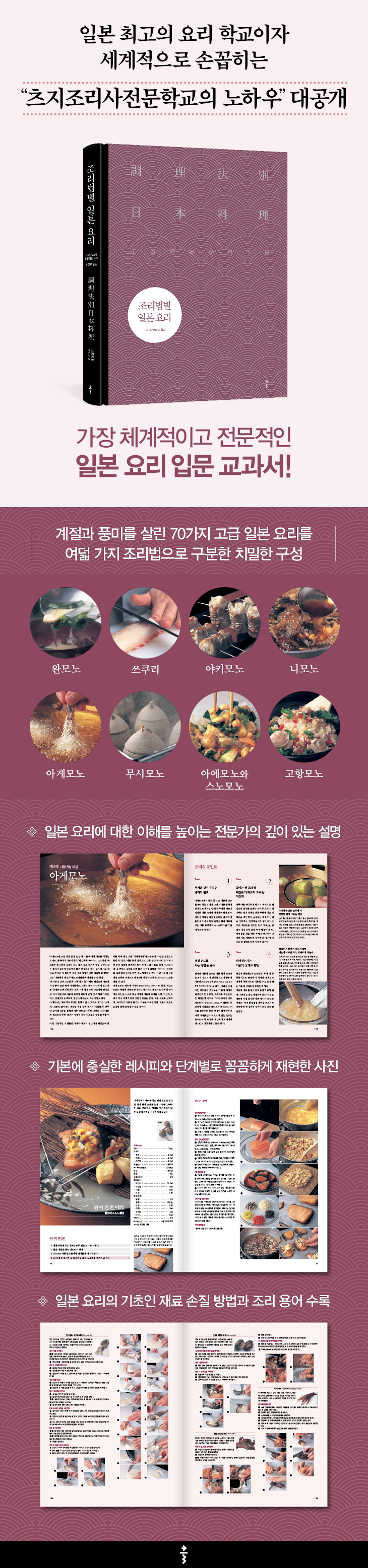
"Japanese Cuisine by Recipe" contains the know-how of Tsuji Culinary Institute, Japan's best culinary school and one of the world's best.
This book features 70 high-quality Japanese dishes that take advantage of seasonal flavors based on a basic understanding of Japanese cuisine, and is divided into eight cooking methods (wanmono, tsukuri, yakimono, nimono, agemono, mushimono, aemono and sunomono, and gohanmono) based on the order of kaiseki cuisine.
The background and characteristics of each recipe, as well as detailed classifications, are explained in a friendly manner to enhance understanding of the recipe, and the key points of the recipe are neatly organized.
Moreover, the in-depth recipes that are faithful to the basics and the meticulously reproduced step-by-step photos help anyone to master Japanese cuisine with delicacy and elegance.
Lastly, the book includes the basics of Japanese cooking, including how to prepare ingredients and how to re-draw them, to ensure a solid foundation from the beginning, and provides an explanation of cooking terms to add to the expertise.
For those who want to learn authentic Japanese cuisine, this will be an excellent introductory textbook for Japanese cuisine.
Tsuji Culinary Institute is considered one of the world's top three culinary schools, along with Le Cordon Bleu in France and the CIA in the United States. It is known for not only imparting advanced cooking techniques, but also cultivating a broad perspective and rich imagination regarding cooking and ingredients.
The most systematic and professional introductory textbook on Japanese cuisine
"Japanese Cuisine by Recipe" contains the know-how of Tsuji Culinary Institute, Japan's best culinary school and one of the world's best.
This book features 70 high-quality Japanese dishes that take advantage of seasonal flavors based on a basic understanding of Japanese cuisine, and is divided into eight cooking methods (wanmono, tsukuri, yakimono, nimono, agemono, mushimono, aemono and sunomono, and gohanmono) based on the order of kaiseki cuisine.
The background and characteristics of each recipe, as well as detailed classifications, are explained in a friendly manner to enhance understanding of the recipe, and the key points of the recipe are neatly organized.
Moreover, the in-depth recipes that are faithful to the basics and the meticulously reproduced step-by-step photos help anyone to master Japanese cuisine with delicacy and elegance.
Lastly, the book includes the basics of Japanese cooking, including how to prepare ingredients and how to re-draw them, to ensure a solid foundation from the beginning, and provides an explanation of cooking terms to add to the expertise.
For those who want to learn authentic Japanese cuisine, this will be an excellent introductory textbook for Japanese cuisine.
Tsuji Culinary Institute is considered one of the world's top three culinary schools, along with Le Cordon Bleu in France and the CIA in the United States. It is known for not only imparting advanced cooking techniques, but also cultivating a broad perspective and rich imagination regarding cooking and ingredients.
- You can preview some of the book's contents.
Preview
index
Preface to the Korean edition
Chapter 1: Wanmono
Cooking Points
Spring vegetable soup with suimono sumashijitate / yosehamo sumashijirujitate / sardine tsumirejiru awase misojitate / soft-shelled turtle manju sumponjitate / tilefish mizorewan usukuzujitate / clam shinjo usiojitate / edamame surinagashi surinagashijitate / aoyose
Chapter 2 Tsukuri
Cooking Points
Tsukuri 3 kinds Mori, wasabi, tosajoyu / sea bream sanmai oroshi / flounder usutsukuri / sea bass arai / octopus yuarai / flounder kawashimotsukuri / conger eel yakichiri / horse mackerel konbujime / saury konbujime / smoked shimesaba kirikaketsukuri / sea bream, bonito, and tiger shrimp sashimi salad / beef tataki
Chapter 3: Yakimono
Cooking Points
Hairtail shioyaki / Cabbage and sweetfish shioyaki / Green croaker shioyaki / Mackerel yuanyaki / Black rockfish misotsukeyaki / Tuna steak / Eggplant dengaku / Salmon kenchin yaki / Beef and dried magnolia leaf misoyaki / Abalone ishiyaki / Duck breast kaori yaki / Skewered meat ichiyaboshi
Chapter 4: Nimono
Cooking Points
Flounder nitsuke / cold noppei / sea bream kabura / Ise lobster kimini / round eggplant ageni / yellowtail oroshini / abalone musini / donga hakatani / pork misoni / young chicken itameni / Yanagawa-style conger eel / squid and taro tomowatani
Chapter 5 Agemono
Cooking Points
Eggplant suage with chicken miso / Shrimp suage / 3 kinds of koromage / Kakiage / Ssugimi karaage / Young chicken tatsutaage / 3 kinds of kawariage / Pollack kawariage / Crab kawariage / Japanese croquette
Chapter 6: Mushimono
Cooking Points
Daegu Iri Jawanmushi / Daegu Jirimushi / Golden eye sea bream Nanbamushi / Freshwater eel Hasumushi / Tile sea bream Yuzu-flavored Mushi / Oyster Nanzenjimushi
Chapter 7: Aemono and Sunomono
Cooking Points
Noodles, steamed sea urchin, and shrimp sanbaizu / oyster mizorezukake / turnip and salmon kimizukake / clam nutae / five-colored namasu sesame cream salad / spring vegetable yakibitashi
Chapter 8: Gohangmono
Cooking Points
Night port / clam port / nanban port / shiragayu shiromisoangake / large seaweed josui / chirashizushi
Chapter 9: Re-drawing and Preparing Ingredients
Re-draw / Prepare ingredients
Glossary of Cooking Terms
Chapter 1: Wanmono
Cooking Points
Spring vegetable soup with suimono sumashijitate / yosehamo sumashijirujitate / sardine tsumirejiru awase misojitate / soft-shelled turtle manju sumponjitate / tilefish mizorewan usukuzujitate / clam shinjo usiojitate / edamame surinagashi surinagashijitate / aoyose
Chapter 2 Tsukuri
Cooking Points
Tsukuri 3 kinds Mori, wasabi, tosajoyu / sea bream sanmai oroshi / flounder usutsukuri / sea bass arai / octopus yuarai / flounder kawashimotsukuri / conger eel yakichiri / horse mackerel konbujime / saury konbujime / smoked shimesaba kirikaketsukuri / sea bream, bonito, and tiger shrimp sashimi salad / beef tataki
Chapter 3: Yakimono
Cooking Points
Hairtail shioyaki / Cabbage and sweetfish shioyaki / Green croaker shioyaki / Mackerel yuanyaki / Black rockfish misotsukeyaki / Tuna steak / Eggplant dengaku / Salmon kenchin yaki / Beef and dried magnolia leaf misoyaki / Abalone ishiyaki / Duck breast kaori yaki / Skewered meat ichiyaboshi
Chapter 4: Nimono
Cooking Points
Flounder nitsuke / cold noppei / sea bream kabura / Ise lobster kimini / round eggplant ageni / yellowtail oroshini / abalone musini / donga hakatani / pork misoni / young chicken itameni / Yanagawa-style conger eel / squid and taro tomowatani
Chapter 5 Agemono
Cooking Points
Eggplant suage with chicken miso / Shrimp suage / 3 kinds of koromage / Kakiage / Ssugimi karaage / Young chicken tatsutaage / 3 kinds of kawariage / Pollack kawariage / Crab kawariage / Japanese croquette
Chapter 6: Mushimono
Cooking Points
Daegu Iri Jawanmushi / Daegu Jirimushi / Golden eye sea bream Nanbamushi / Freshwater eel Hasumushi / Tile sea bream Yuzu-flavored Mushi / Oyster Nanzenjimushi
Chapter 7: Aemono and Sunomono
Cooking Points
Noodles, steamed sea urchin, and shrimp sanbaizu / oyster mizorezukake / turnip and salmon kimizukake / clam nutae / five-colored namasu sesame cream salad / spring vegetable yakibitashi
Chapter 8: Gohangmono
Cooking Points
Night port / clam port / nanban port / shiragayu shiromisoangake / large seaweed josui / chirashizushi
Chapter 9: Re-drawing and Preparing Ingredients
Re-draw / Prepare ingredients
Glossary of Cooking Terms
Detailed image
GOODS SPECIFICS
- Date of publication: March 12, 2018
- Format: Hardcover book binding method guide
- Page count, weight, size: 208 pages | 842g | 205*265*17mm
- ISBN13: 9791188907045
- ISBN10: 1188907042
You may also like
카테고리
korean


korean

![GQ KOREA Mark (Monthly): December [2025]](http://librairie.coreenne.fr/cdn/shop/files/8ef265dbbfbf186523ed75ba7319009d.jpg?v=1765340328&width=3840)


