

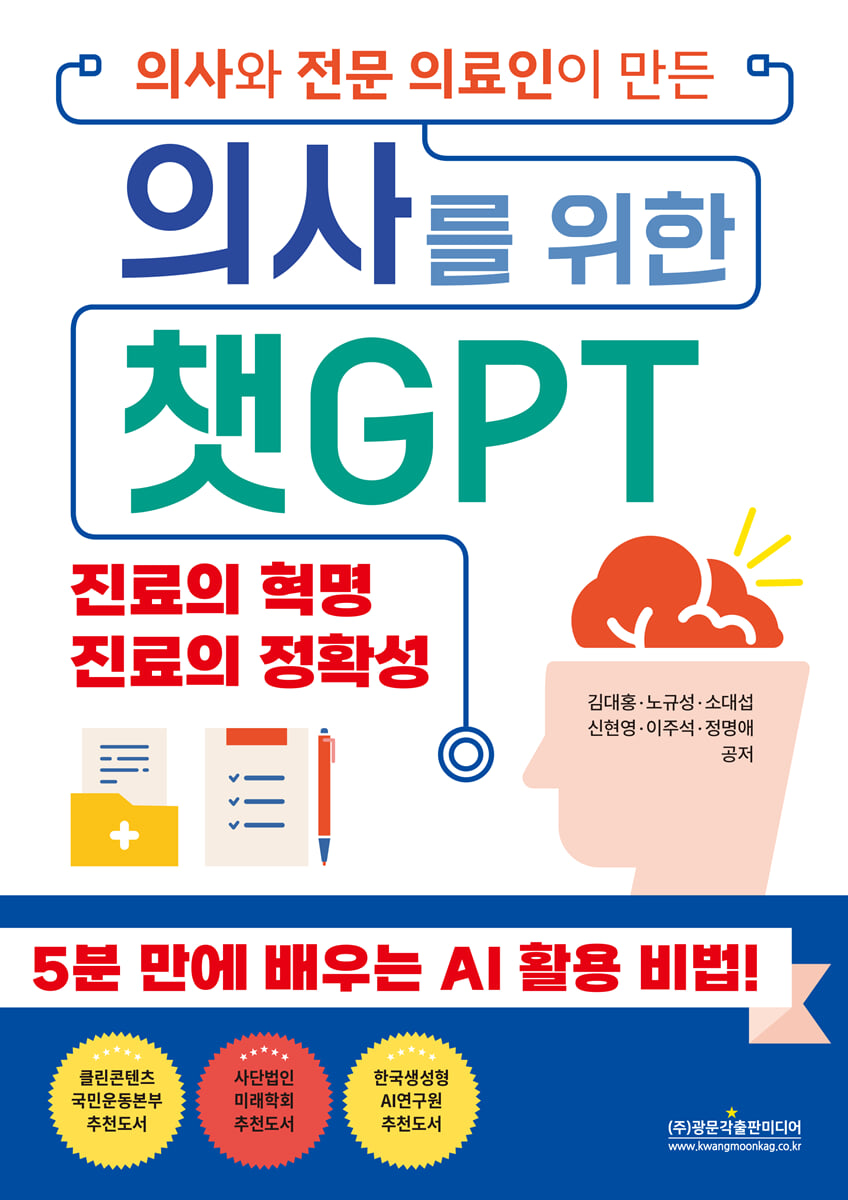
ChatGPT for Doctors, Created by Doctors and Medical Professionals
 |
Description
Book Introduction
I know you're making time for your patients outside of the clinic these days.
Reading papers, researching the latest guidelines, organizing medical records, and responding to various administrative tasks can make the day feel short.
Meanwhile, talk of AI, especially ‘generative AI’, is heard here and there.
Outside of hospitals, tools like ChatGPT are already being used routinely in countless areas, including document writing, summarizing, searching, consulting, planning, and education.
And this tool is now rapidly entering our medical field.
So how should we, as doctors, nurses, and medical professionals, respond to this trend?
The answer is simple.
It's about "learning, mastering, and trying things out first." We won't have to worry about AI replacing us.
Nevertheless, it has become important to treat and care for patients more intelligently, more freely, and more safely with AI at our side.
This book is just the starting point.
ChatGPT is not just a chatbot.
It is an 'intelligent assistant' that can quickly support various tasks such as summarizing, organizing, translating, consulting, and creating educational materials based on vast amounts of medical information.
But there is a big difference between using it blindly and using it with proper knowledge.
Because of the nature of medicine, we must always consider the reliability, ethics, and accuracy of information.
This book consists of four chapters.
Chapter 1 explains the principles and features of generative AI and ChatGPT, and Chapter 2 provides specific examples of how ChatGPT can be utilized in actual medical settings, such as treatment, document writing, patient counseling, and research.
Chapter 3 teaches you how to "use AI well" through effective prompt writing techniques and practical tips, and Chapter 4 covers ethics, security, copyright, and verification methods that are essential to know when utilizing AI.
You'll easily gain the knowledge and information needed to utilize AI in the medical field. AI is our tool, not our competitor.
He also revealed that AI was a significant help in writing this book. He is confident that the medical professionals who best utilize AI will become the most advanced in the future.
Let's take the first step with this book now.
Reading papers, researching the latest guidelines, organizing medical records, and responding to various administrative tasks can make the day feel short.
Meanwhile, talk of AI, especially ‘generative AI’, is heard here and there.
Outside of hospitals, tools like ChatGPT are already being used routinely in countless areas, including document writing, summarizing, searching, consulting, planning, and education.
And this tool is now rapidly entering our medical field.
So how should we, as doctors, nurses, and medical professionals, respond to this trend?
The answer is simple.
It's about "learning, mastering, and trying things out first." We won't have to worry about AI replacing us.
Nevertheless, it has become important to treat and care for patients more intelligently, more freely, and more safely with AI at our side.
This book is just the starting point.
ChatGPT is not just a chatbot.
It is an 'intelligent assistant' that can quickly support various tasks such as summarizing, organizing, translating, consulting, and creating educational materials based on vast amounts of medical information.
But there is a big difference between using it blindly and using it with proper knowledge.
Because of the nature of medicine, we must always consider the reliability, ethics, and accuracy of information.
This book consists of four chapters.
Chapter 1 explains the principles and features of generative AI and ChatGPT, and Chapter 2 provides specific examples of how ChatGPT can be utilized in actual medical settings, such as treatment, document writing, patient counseling, and research.
Chapter 3 teaches you how to "use AI well" through effective prompt writing techniques and practical tips, and Chapter 4 covers ethics, security, copyright, and verification methods that are essential to know when utilizing AI.
You'll easily gain the knowledge and information needed to utilize AI in the medical field. AI is our tool, not our competitor.
He also revealed that AI was a significant help in writing this book. He is confident that the medical professionals who best utilize AI will become the most advanced in the future.
Let's take the first step with this book now.
- You can preview some of the book's contents.
Preview
index
01 Understanding Generative AI and ChatGPT? Getting Started Right Away
1.
What is ChatGPT?
1.1 Overview of ChatGPT
1.2 Differences from existing medical IT systems
1.3 Core Features of ChatGPT
1.4 The Potential and Limitations of AI in Healthcare
2.
Getting Started with ChatGPT
2.1 How to sign up and set up ChatGPT
2.2 Differences between Free and Paid Versions
2.3 Recommended Settings for Medical Staff
3.
How to Write Effective Prompts
3.1 Prompts and Prompt Design
3.2 Good vs. Bad Prompt Examples
3.3 Core Principles of Prompt Design
02 Using ChatGPT in Medical Staff's Key Tasks
1.
Patient care and patient management
1.1 Organizing and summarizing patient records
1.2 Diagnostic Support and Treatment Option Recommendations
1.3 Patient Interview
2.
Research?·?Education and Administration
2.1 Medical Research and Education
2.2 Administrative and other tasks
03 How to Use Generative AI to Increase Its Effectiveness? What's the Guide?
1.
Save frequently used prompts
1.1 Shortcut Input Overview
1.2 Shortcut input example
1.3 Application using a combination of abbreviations and keywords of interest
1.4 Creating a patient's initial consultation chart using abbreviations
2.
Understanding and leveraging ChatGPT's limitations
2.1 When using AI for clinical assistance, use it in conjunction with clinical judgment.
2.2 Cases of using AI to assist in clinical practice and clinical judgment in parallel
2.3 Source Verification and Fact Checking
2.4 Understanding and Being Aware of the Limitations of Medical AI
3.
Methods that can be used in practice
3.1 Support for organizing medical documents and records
3.2 Medical Education and Patient Communication
4.
Tips for using ChatGPT more effectively
4.1 Professional plugins and database integration
4.2 Use for collaboration between medical staff
4.3 Simplifying repetitive administrative tasks
5.
Keywords that can be used in different medical situations and examples of prompts using them
5.1 Diagnostic Aid
5.2 Comparing Treatment Options
5.3 Creating patient consultation materials
5.4 Inspection Interpretation and Additional Suggestions
5.5 Summary of Medical Literature and Guidelines
5.6 Emergency Response
5.7 Prevention and Health Management
5.8 Use AI as a 'tool', but prioritize the expertise of doctors.
6.
How to check the reliability of an answer
6.1 Cross-Checking Sources
6.2 Check for Recent Updates
6.3 Verify with Experts or Official Documents
6.4 Check for Logical Consistency
6.5 Understanding AI's Limitations
6.6 Ask AI to Review Its Own Response
6.7 Don't blindly trust AI answers; you need to develop the habit of verifying them!
04 Generative AI Ethics, Copyright, and Verification
1.
Key Ethical Issues and Copyright Infringement Associated with the Use of Generative AI
1.1 Disinformation and Deepfakes
1.2 Copyright Infringement
2.
Data Bias and Discrimination
2.1 Bias in Medical Data
2.2 Biased Results of Generative AI
2.3 The severity of bias and discrimination
2.4 Guidelines for Acquiring High-Quality Data for Generative AI in Healthcare
3.
Exploitation and misuse
3.1 Cases and Problems of Generative AI Abuse and Misuse
3.2 Lack of transparency
4.
Data privacy breach
4.1 Cases of Personal Information Breach
5.
Solution
5.1 Solutions to AI Model-Related Issues
5.2 How to address issues related to responsibility and ethics
5.3 Other Troubleshooting Solutions
6.
How to Validate Generative AI: Using Prompts and Cross-Checking
6.1 Prompt Utilization Verification
6.2 Cross-check
6.3 Comparative Analysis of Results
6.4 Expert Review
1.
What is ChatGPT?
1.1 Overview of ChatGPT
1.2 Differences from existing medical IT systems
1.3 Core Features of ChatGPT
1.4 The Potential and Limitations of AI in Healthcare
2.
Getting Started with ChatGPT
2.1 How to sign up and set up ChatGPT
2.2 Differences between Free and Paid Versions
2.3 Recommended Settings for Medical Staff
3.
How to Write Effective Prompts
3.1 Prompts and Prompt Design
3.2 Good vs. Bad Prompt Examples
3.3 Core Principles of Prompt Design
02 Using ChatGPT in Medical Staff's Key Tasks
1.
Patient care and patient management
1.1 Organizing and summarizing patient records
1.2 Diagnostic Support and Treatment Option Recommendations
1.3 Patient Interview
2.
Research?·?Education and Administration
2.1 Medical Research and Education
2.2 Administrative and other tasks
03 How to Use Generative AI to Increase Its Effectiveness? What's the Guide?
1.
Save frequently used prompts
1.1 Shortcut Input Overview
1.2 Shortcut input example
1.3 Application using a combination of abbreviations and keywords of interest
1.4 Creating a patient's initial consultation chart using abbreviations
2.
Understanding and leveraging ChatGPT's limitations
2.1 When using AI for clinical assistance, use it in conjunction with clinical judgment.
2.2 Cases of using AI to assist in clinical practice and clinical judgment in parallel
2.3 Source Verification and Fact Checking
2.4 Understanding and Being Aware of the Limitations of Medical AI
3.
Methods that can be used in practice
3.1 Support for organizing medical documents and records
3.2 Medical Education and Patient Communication
4.
Tips for using ChatGPT more effectively
4.1 Professional plugins and database integration
4.2 Use for collaboration between medical staff
4.3 Simplifying repetitive administrative tasks
5.
Keywords that can be used in different medical situations and examples of prompts using them
5.1 Diagnostic Aid
5.2 Comparing Treatment Options
5.3 Creating patient consultation materials
5.4 Inspection Interpretation and Additional Suggestions
5.5 Summary of Medical Literature and Guidelines
5.6 Emergency Response
5.7 Prevention and Health Management
5.8 Use AI as a 'tool', but prioritize the expertise of doctors.
6.
How to check the reliability of an answer
6.1 Cross-Checking Sources
6.2 Check for Recent Updates
6.3 Verify with Experts or Official Documents
6.4 Check for Logical Consistency
6.5 Understanding AI's Limitations
6.6 Ask AI to Review Its Own Response
6.7 Don't blindly trust AI answers; you need to develop the habit of verifying them!
04 Generative AI Ethics, Copyright, and Verification
1.
Key Ethical Issues and Copyright Infringement Associated with the Use of Generative AI
1.1 Disinformation and Deepfakes
1.2 Copyright Infringement
2.
Data Bias and Discrimination
2.1 Bias in Medical Data
2.2 Biased Results of Generative AI
2.3 The severity of bias and discrimination
2.4 Guidelines for Acquiring High-Quality Data for Generative AI in Healthcare
3.
Exploitation and misuse
3.1 Cases and Problems of Generative AI Abuse and Misuse
3.2 Lack of transparency
4.
Data privacy breach
4.1 Cases of Personal Information Breach
5.
Solution
5.1 Solutions to AI Model-Related Issues
5.2 How to address issues related to responsibility and ethics
5.3 Other Troubleshooting Solutions
6.
How to Validate Generative AI: Using Prompts and Cross-Checking
6.1 Prompt Utilization Verification
6.2 Cross-check
6.3 Comparative Analysis of Results
6.4 Expert Review
Publisher's Review
This book consists of four chapters.
Chapter 1 explains the principles and features of generative AI and ChatGPT, and Chapter 2 provides specific examples of how ChatGPT can be utilized in actual medical settings, such as for treatment, document writing, patient counseling, and research.
Chapter 3 will teach you how to "use AI well" through effective prompt writing techniques and practical tips. Chapter 4 will cover the ethics, security, copyright, and verification methods that are essential to understanding when utilizing AI.
You will be able to easily grasp the knowledge and information needed to utilize AI in the medical field.
AI is our tool, not our competitor.
I also reveal that AI was a significant help in writing this book. I am confident that the medical professionals who best utilize AI will become the most advanced medical professionals of the future.
Let's take the first step with this book now.
Chapter 1 explains the principles and features of generative AI and ChatGPT, and Chapter 2 provides specific examples of how ChatGPT can be utilized in actual medical settings, such as for treatment, document writing, patient counseling, and research.
Chapter 3 will teach you how to "use AI well" through effective prompt writing techniques and practical tips. Chapter 4 will cover the ethics, security, copyright, and verification methods that are essential to understanding when utilizing AI.
You will be able to easily grasp the knowledge and information needed to utilize AI in the medical field.
AI is our tool, not our competitor.
I also reveal that AI was a significant help in writing this book. I am confident that the medical professionals who best utilize AI will become the most advanced medical professionals of the future.
Let's take the first step with this book now.
GOODS SPECIFICS
- Date of issue: April 1, 2025
- Page count, weight, size: 192 pages | 458g | 174*246*10mm
- ISBN13: 9791193205556
- ISBN10: 1193205557
You may also like
카테고리
korean


korean

![ELLE 엘르 스페셜 에디션 A형 : 12월 [2025]](http://librairie.coreenne.fr/cdn/shop/files/b8e27a3de6c9538896439686c6b0e8fb.jpg?v=1766436872&width=3840)


