

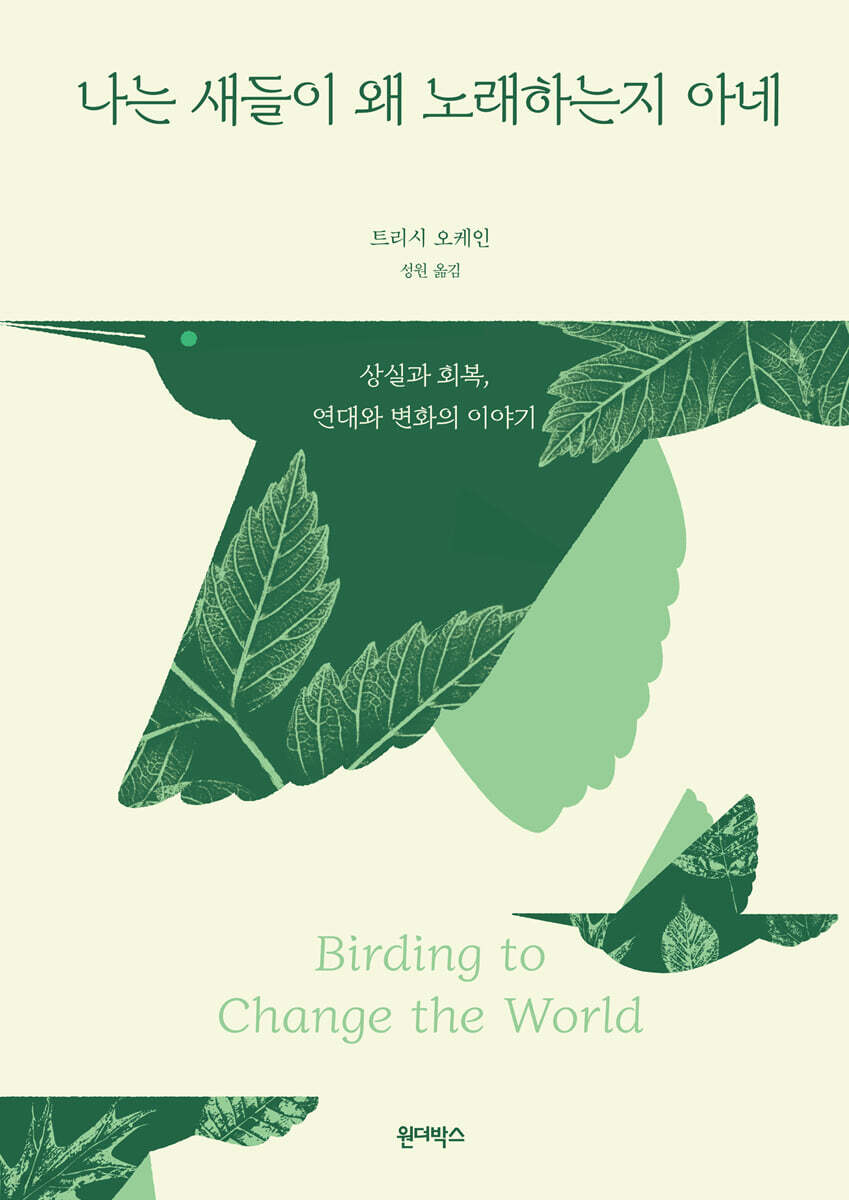
I know why birds sing
 |
Description
Book Introduction
In a world in ruins
What Birds Teach Us
“What about birds?” The author of this book, Trish O’Kane, would scoff at the idea of going birdwatching until she was 45.
But now he teaches ornithology classes at a university, and he says we humans can learn a lot from birds, and that birds can help change the world.
It was Hurricane Katrina that changed the author.
Katrina devours his home in New Orleans less than a month after he moved there, shattering his life.
Deeply shocked and devastated, he stumbles upon a bird, which leads him down a completely unexpected path in life.
Loss and recovery from disaster, reconciliation with parents who have deeply hurt us, forming new relationships with neighbors, awakening to and changing everyday discrimination, and solidarity to protect what is precious.
This book, which weaves together seemingly disparate stories under the code of "bird," dramatically tells the story of how a bird changes a person's life and becomes a precious gift to the world.
A wondrous book that connects birds, nature, people, and society, and goes beyond that.
What Birds Teach Us
“What about birds?” The author of this book, Trish O’Kane, would scoff at the idea of going birdwatching until she was 45.
But now he teaches ornithology classes at a university, and he says we humans can learn a lot from birds, and that birds can help change the world.
It was Hurricane Katrina that changed the author.
Katrina devours his home in New Orleans less than a month after he moved there, shattering his life.
Deeply shocked and devastated, he stumbles upon a bird, which leads him down a completely unexpected path in life.
Loss and recovery from disaster, reconciliation with parents who have deeply hurt us, forming new relationships with neighbors, awakening to and changing everyday discrimination, and solidarity to protect what is precious.
This book, which weaves together seemingly disparate stories under the code of "bird," dramatically tells the story of how a bird changes a person's life and becomes a precious gift to the world.
A wondrous book that connects birds, nature, people, and society, and goes beyond that.
- You can preview some of the book's contents.
Preview
index
prolog
CHAPTER 1: Strange Teachers
CHAPTER 2 Life is like that, and so are the embankments.
CHAPTER 3 The Song of the House Sparrow
CHAPTER 4 Our Applesauce Lady
CHAPTER 5: Those Broken and Silent
CHAPTER 6 Planning for a Category 5 Hurricane
CHAPTER 7 Long Live the Thunderbolt
CHAPTER 8 Let's Roll That Teacher Down the Hill
CHAPTER 9 The Goose Wars
CHAPTER 10 Seeing Discrimination Through the Eyes of Birdwatchers
CHAPTER 11 In the Kingdom of Dumetella
CHAPTER 12 Dance in the Sky Instead of Fireworks
Epilogue
Acknowledgements
main
Birds featured in this book
CHAPTER 1: Strange Teachers
CHAPTER 2 Life is like that, and so are the embankments.
CHAPTER 3 The Song of the House Sparrow
CHAPTER 4 Our Applesauce Lady
CHAPTER 5: Those Broken and Silent
CHAPTER 6 Planning for a Category 5 Hurricane
CHAPTER 7 Long Live the Thunderbolt
CHAPTER 8 Let's Roll That Teacher Down the Hill
CHAPTER 9 The Goose Wars
CHAPTER 10 Seeing Discrimination Through the Eyes of Birdwatchers
CHAPTER 11 In the Kingdom of Dumetella
CHAPTER 12 Dance in the Sky Instead of Fireworks
Epilogue
Acknowledgements
main
Birds featured in this book
Detailed image
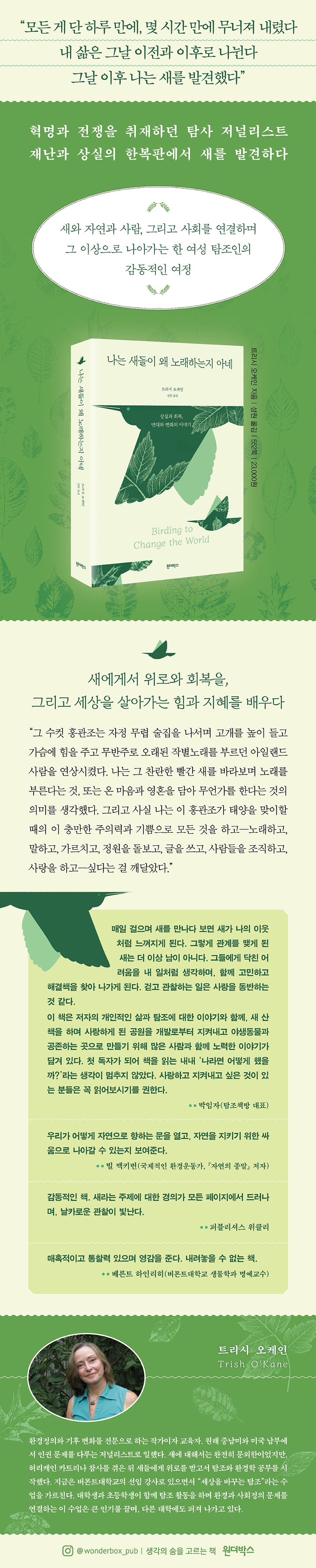
Into the book
How to stop war, how to end economic inequality, how to defeat racism and white supremacy—these global issues have been central to my life and work.
I had no interest in environmental issues.
I had no idea how to see the connection.
But then life suddenly took a violent turn.
Everything came crashing down in just one day, in just a few hours.
My life is divided into before and after that day.
After that day I discovered the bird.
--- p.22
There was still a place to stop and one more bouquet to deliver.
We drove to Lake Pontchartrain, just a few blocks away.
I sat down by the lake for a while and burst into tears.
I asked the lake for forgiveness.
As I threw each flower into the water, I swore to the lake, to all life in it, and to all the water on Earth that I would never again live in a way that would pollute the water.
I had no idea how to do that, but I promised myself that I would learn how to live on this Earth without trampling on life.
--- p.66
Now I think of this moment as a great teacher.
It was at this time that I learned how much can be taught through presence and practice alone, rather than through lectures and sermons.
There are times when I feel the students' eyes on me.
Especially when it seems like the world is falling apart, they watch how I navigate it, how I face reality, how I find joy in everyday life.
And I realize that during my father's final years, he was preparing to leave his children with the most important lesson of all.
How to live when you know you are dying.
Maybe there was some secret to exploration.
--- pp.100-101
The next question followed.
“What was the most interesting thing you saw in Iraq?”
My friend paused for a moment and stared outside the classroom.
“I once saw a huge flock of black birds flying.
I timed it and it took an hour for the birds to fly over me.
It was the most peaceful moment.
“It was so nice to see something so beautiful in the middle of this cesspool.”
To all of us sitting in that classroom in the ruined city, this young soldier, completely captivated by beauty amidst ugliness, was no longer a stranger.
--- p.128
Looking back, most of the joy I enjoy in my daily life today comes from the gifts I received from Katrina.
Thanks to Katrina, I ride my bike instead of my car.
Whenever I have worries, big or small, I knit to solve them.
Those days taught me how important it is for a teacher to balance the ugly truth with the joys of everyday life.
And most importantly, New Orleans is where I first met my new “little friends.”
That's what I called my house sparrows, my welcome birds, in my diary.
The introduction to my last diary entry from New Orleans begins like this:
“The birds are watching me.
The birds are still not sure if they can trust me.
“I hope my roommate loves these birds as much as I do.”
I lost everything in New Orleans and found everything I needed to build a new, better life.
I just didn't know that.
--- p.138
The male cardinal reminded me of an Irishman leaving a pub around midnight, head held high, chest pressed together, singing an old farewell song unaccompanied.
I looked at that brilliant red bird and thought about what it meant to sing, or to do something with all my heart and soul.
And in fact, I realized that I wanted to do everything with the same full attention and joy that this rhododendron does when it greets the sun—sing, talk, teach, garden, write, organize people, love.
--- p.170
The researchers concluded that “when human-nature interactions disappear, health is at risk.”
They are important for urban planners to understand that green space has a significant impact on public health when designing urban environments, especially schools.
It was recommended that the thread be taken into consideration.
Reading this study years after leaving Warner Park, I was reminded of how I had tried to spend as much time outside as possible after Katrina, how I had been drawn to Audubon Park in New Orleans, and then to Warner Park in Madison.
--- p.193
But their house was scheduled to be demolished.
I looked up the plan online and pictured the birds returning from Latin America in the spring, exhausted after flying thousands of kilometers.
I pictured them hovering over Warner Park, looking down on their unrecognizable neighborhood and wondering where their shrubs, trees, and swamps had gone.
I knew exactly what it felt like, because I still vividly remember the first time I saw those horrific aerial photos online of my home in New Orleans submerged in water.
--- p.216
We didn't know it that afternoon, but this apple pie gathering would become the genesis of Wild Warner, the residents' group that protects Warner Park.
Although it took another year to officially launch, the group began the way most organizations and movements do.
A handful of people gather in someone's kitchen or living room, fueled by love, anger, and pie.
Humans have been doing this for a very long time.
You go to a gathering of people, listen, share your thoughts, eat pie, and through one meeting after another, one struggle after another, you become part of a mighty, squawking flock of birds.
--- p.241
After publishing the article, “A Tale of Silk and Perfume from Warner’s Wild Fields,” I received a phone call from a woman.
The woman asked me if I was the one who wrote the silkworm story.
He said he looked through the phone book and found my number.
Cindyra
The woman, named , was a Medicare nurse visiting seniors in the neighborhood and said she had just read the moth story.
Cindy said she loved the article and wanted me to know that her patients loved it too.
The patients loved the park and the animals.
And they were glad that someone was speaking up for them.
“People don’t want more development.
“Please continue what you are doing, teacher.”
--- p.286
Later that afternoon, the children followed the geese foraging in the freshly mowed park grass, counting over 200 before finally sending the irritated birds flying into the air in a wild, swarming cloud of angry flapping, angry cries, and joyful shrieks.
I watched the human flock follow the winged flock, feeling the air vibrate with the force of their wings, each a meter and a half wide, and I reflected that the only reason these birds were there was because we fought for them.
--- p.310
“Have you ever experienced racism in this park?” I asked.
“Have you ever walked in this park? Yes, I have.
“I experienced this a few minutes ago.”
I stood there frozen in place.
I couldn't understand what Mr. M was saying.
It was a very nice day.
Mr. M and I spent over an hour enjoying the beauty around us, stopping several times to listen to the serenade of Mr. M's favorite song sparrow, and even rescuing a small toad from the bike path and releasing it into the grass.
“When? What happened?” I asked.
"You know that guy who just passed us? He seemed uncomfortable when we got close, so he turned off the sidewalk and cut across the grass? Oh, I could see him right in front of me.
The guy thought, "A black guy and a white girl."
“I can detect that by looking at body language.”
--- p.379
Experiences like the racial hostility Mr. M senses, and what we might call subtle discrimination today, may not stop someone like Mr. M from taking a walk in Warner Park.
Especially for someone who has experienced the horrific, everyday racism in the South.
But I realized that these incidents could be a barrier for other people of color in my neighborhood.
If I'm worried that white people will react negatively or even harass and harm me, can I even imagine wanting to go to a beautiful place to "decompress"? Bell hooks, a favorite author and scholar of race and feminism, calls this "the hostile and racist white gaze."
In a 1989 study of Detroit's parks, sociologist Patrick West wrote that African Americans use Detroit's parks less often because of fears of a hostile environment.
--- p.384
We joined citizens in petitioning for the fish, birds, fishermen, and people living around Lake Monona, and sounded the alarm like a ferocious catbird for the entire Yahara River basin.
Those who criticized Wild Warner as “a bunch of NIMBYs” were wrong.
We were not NIMBYs.
We were NIABY.
Not In Anyone's Backyard.
No, it won't work on anyone's water.
We shouldn't be dumping tons of trash into a 60-acre wetland, a 3,359-acre lake, or the Gulf of Mexico.
All water is sacred.
This was a painful awakening for Jim and I in New Orleans.
--- p.500
Love is a powerful force.
When I lived in New Orleans 17 years ago, I could never have imagined that my interest in a single cardinal would blossom into Wild Warner, a grassroots conservation group now in its 13th year, a model for nature education that has trained more than 500 birding mentors who work with more than 1,000 children through environmental education programs at three universities and elementary and middle schools in Wisconsin, Vermont, and Rhode Island. (In 2019, Brown University began a similar program in Providence.)
These days, I teach my students using many of the movement strategies I learned from the birds at Warner Park.
Then, the undergraduates in my environmental classes use their newly acquired civic spirit to drive change across the United States.
I had no interest in environmental issues.
I had no idea how to see the connection.
But then life suddenly took a violent turn.
Everything came crashing down in just one day, in just a few hours.
My life is divided into before and after that day.
After that day I discovered the bird.
--- p.22
There was still a place to stop and one more bouquet to deliver.
We drove to Lake Pontchartrain, just a few blocks away.
I sat down by the lake for a while and burst into tears.
I asked the lake for forgiveness.
As I threw each flower into the water, I swore to the lake, to all life in it, and to all the water on Earth that I would never again live in a way that would pollute the water.
I had no idea how to do that, but I promised myself that I would learn how to live on this Earth without trampling on life.
--- p.66
Now I think of this moment as a great teacher.
It was at this time that I learned how much can be taught through presence and practice alone, rather than through lectures and sermons.
There are times when I feel the students' eyes on me.
Especially when it seems like the world is falling apart, they watch how I navigate it, how I face reality, how I find joy in everyday life.
And I realize that during my father's final years, he was preparing to leave his children with the most important lesson of all.
How to live when you know you are dying.
Maybe there was some secret to exploration.
--- pp.100-101
The next question followed.
“What was the most interesting thing you saw in Iraq?”
My friend paused for a moment and stared outside the classroom.
“I once saw a huge flock of black birds flying.
I timed it and it took an hour for the birds to fly over me.
It was the most peaceful moment.
“It was so nice to see something so beautiful in the middle of this cesspool.”
To all of us sitting in that classroom in the ruined city, this young soldier, completely captivated by beauty amidst ugliness, was no longer a stranger.
--- p.128
Looking back, most of the joy I enjoy in my daily life today comes from the gifts I received from Katrina.
Thanks to Katrina, I ride my bike instead of my car.
Whenever I have worries, big or small, I knit to solve them.
Those days taught me how important it is for a teacher to balance the ugly truth with the joys of everyday life.
And most importantly, New Orleans is where I first met my new “little friends.”
That's what I called my house sparrows, my welcome birds, in my diary.
The introduction to my last diary entry from New Orleans begins like this:
“The birds are watching me.
The birds are still not sure if they can trust me.
“I hope my roommate loves these birds as much as I do.”
I lost everything in New Orleans and found everything I needed to build a new, better life.
I just didn't know that.
--- p.138
The male cardinal reminded me of an Irishman leaving a pub around midnight, head held high, chest pressed together, singing an old farewell song unaccompanied.
I looked at that brilliant red bird and thought about what it meant to sing, or to do something with all my heart and soul.
And in fact, I realized that I wanted to do everything with the same full attention and joy that this rhododendron does when it greets the sun—sing, talk, teach, garden, write, organize people, love.
--- p.170
The researchers concluded that “when human-nature interactions disappear, health is at risk.”
They are important for urban planners to understand that green space has a significant impact on public health when designing urban environments, especially schools.
It was recommended that the thread be taken into consideration.
Reading this study years after leaving Warner Park, I was reminded of how I had tried to spend as much time outside as possible after Katrina, how I had been drawn to Audubon Park in New Orleans, and then to Warner Park in Madison.
--- p.193
But their house was scheduled to be demolished.
I looked up the plan online and pictured the birds returning from Latin America in the spring, exhausted after flying thousands of kilometers.
I pictured them hovering over Warner Park, looking down on their unrecognizable neighborhood and wondering where their shrubs, trees, and swamps had gone.
I knew exactly what it felt like, because I still vividly remember the first time I saw those horrific aerial photos online of my home in New Orleans submerged in water.
--- p.216
We didn't know it that afternoon, but this apple pie gathering would become the genesis of Wild Warner, the residents' group that protects Warner Park.
Although it took another year to officially launch, the group began the way most organizations and movements do.
A handful of people gather in someone's kitchen or living room, fueled by love, anger, and pie.
Humans have been doing this for a very long time.
You go to a gathering of people, listen, share your thoughts, eat pie, and through one meeting after another, one struggle after another, you become part of a mighty, squawking flock of birds.
--- p.241
After publishing the article, “A Tale of Silk and Perfume from Warner’s Wild Fields,” I received a phone call from a woman.
The woman asked me if I was the one who wrote the silkworm story.
He said he looked through the phone book and found my number.
Cindyra
The woman, named , was a Medicare nurse visiting seniors in the neighborhood and said she had just read the moth story.
Cindy said she loved the article and wanted me to know that her patients loved it too.
The patients loved the park and the animals.
And they were glad that someone was speaking up for them.
“People don’t want more development.
“Please continue what you are doing, teacher.”
--- p.286
Later that afternoon, the children followed the geese foraging in the freshly mowed park grass, counting over 200 before finally sending the irritated birds flying into the air in a wild, swarming cloud of angry flapping, angry cries, and joyful shrieks.
I watched the human flock follow the winged flock, feeling the air vibrate with the force of their wings, each a meter and a half wide, and I reflected that the only reason these birds were there was because we fought for them.
--- p.310
“Have you ever experienced racism in this park?” I asked.
“Have you ever walked in this park? Yes, I have.
“I experienced this a few minutes ago.”
I stood there frozen in place.
I couldn't understand what Mr. M was saying.
It was a very nice day.
Mr. M and I spent over an hour enjoying the beauty around us, stopping several times to listen to the serenade of Mr. M's favorite song sparrow, and even rescuing a small toad from the bike path and releasing it into the grass.
“When? What happened?” I asked.
"You know that guy who just passed us? He seemed uncomfortable when we got close, so he turned off the sidewalk and cut across the grass? Oh, I could see him right in front of me.
The guy thought, "A black guy and a white girl."
“I can detect that by looking at body language.”
--- p.379
Experiences like the racial hostility Mr. M senses, and what we might call subtle discrimination today, may not stop someone like Mr. M from taking a walk in Warner Park.
Especially for someone who has experienced the horrific, everyday racism in the South.
But I realized that these incidents could be a barrier for other people of color in my neighborhood.
If I'm worried that white people will react negatively or even harass and harm me, can I even imagine wanting to go to a beautiful place to "decompress"? Bell hooks, a favorite author and scholar of race and feminism, calls this "the hostile and racist white gaze."
In a 1989 study of Detroit's parks, sociologist Patrick West wrote that African Americans use Detroit's parks less often because of fears of a hostile environment.
--- p.384
We joined citizens in petitioning for the fish, birds, fishermen, and people living around Lake Monona, and sounded the alarm like a ferocious catbird for the entire Yahara River basin.
Those who criticized Wild Warner as “a bunch of NIMBYs” were wrong.
We were not NIMBYs.
We were NIABY.
Not In Anyone's Backyard.
No, it won't work on anyone's water.
We shouldn't be dumping tons of trash into a 60-acre wetland, a 3,359-acre lake, or the Gulf of Mexico.
All water is sacred.
This was a painful awakening for Jim and I in New Orleans.
--- p.500
Love is a powerful force.
When I lived in New Orleans 17 years ago, I could never have imagined that my interest in a single cardinal would blossom into Wild Warner, a grassroots conservation group now in its 13th year, a model for nature education that has trained more than 500 birding mentors who work with more than 1,000 children through environmental education programs at three universities and elementary and middle schools in Wisconsin, Vermont, and Rhode Island. (In 2019, Brown University began a similar program in Providence.)
These days, I teach my students using many of the movement strategies I learned from the birds at Warner Park.
Then, the undergraduates in my environmental classes use their newly acquired civic spirit to drive change across the United States.
--- p.514
Publisher's Review
A chance encounter with a bird changes everything
The author was an investigative journalist active in international politics and human rights.
He has worked passionately for social justice, collaborating with revolutionary forces in Central and South America, investigating the massacre of civilians by dictators, and studying hate crimes in the American South.
But because I had no interest in the natural environment, I didn't understand the people who came to explore the jungles of Central and South America.
“In a country where people still count the number of bodies, you are a bunch of well-fed foreigners driving around in jeeps with binoculars, counting birds and monkeys.
I thought, “I will never be that kind of person.”
Now, more than a dozen years later, the author has a PhD in environmental studies and teaches birdwatching classes at a university.
This class, titled “Exploration that Changes the World,” pairs university students with local middle school students to engage in exploration activities and learn about the surrounding natural environment and local community.
Through this course, the author demonstrates that exploration can be a tool to help oneself and change the world.
What changed him like this?
The hurricane and the birdsong my father taught me
This book dramatically depicts the author's journey of recovering from loss and moving toward new changes and solidarity after a chance encounter with a bird.
The author's smooth life was turned upside down by Hurricane Katrina.
Hurricane Katrina struck New Orleans a month after he was offered a journalism lecturer position at Loyola University in New Orleans in 2005 and moved into a house in the area.
Everything there, including the author's house, was swept away and thrown into the lake and river.
It was a bird that saved him from the great loss and deep despair caused by the great disaster called Katrina.
One day, a sharp, metallic cry of a bird echoed through the ruins.
It meant that “even in a hurricane-ravaged field, there is something beautiful, something wild, something alive.”
The author feels such affection for the bird that he wants to run outside and hold it in his arms.
The author's father's long-term battle with cancer also brought him into contact with birds.
The father, a conservative Irish Catholic, had lost contact with the author, who was progressive and free-spirited, but they reconnected when he met his daughter, who was nearing the end of her life due to cancer.
It's nothing more than a story about the birds and plants you care for.
The author thinks as he watches his father fill the bird feeder and observe the birds even as his condition worsens.
Maybe there is a secret to living a life of exploration.
And he too begins to explore, feeding the sparrows.
The author has not lost his smile since then.
From loss and recovery to change and solidarity
The author's personal journey of recovery and healing through birds is followed by social action for birds.
It all started with the news that Warner Park, near his home and a place of exploration, was going to be developed.
The author had previously been uninterested in local politics, having only covered the president and members of the National Assembly and worked with international organizations. However, this shocking news prompted him to engage in local politics for the first time in his life.
Attend neighborhood meetings, walk around the park and ask people for their opinions, and invite people you meet at the park to your home for homemade apple pie and to discuss plans to protect the park together.
In doing so, he feels himself becoming “not just a citizen of the world, but a citizen of a place.”
I used to believe that the New York Times was the most powerful media outlet in the world, but I'm learning that "local newspapers and neighborhood newspapers" are more powerful in protecting the places I love, the places where I live.
The author and his colleagues successfully mobilize public opinion to preserve the park and attend public meetings to block plans to build a parking lot and commercial facilities in the park.
And they officially formed a group called Wild Warner and began activities to continuously protect the park.
Wild Warner prevented the cutting down of old thorn oak trees, stopped the cutting down of maples to widen roads, and persuaded the city to restore concrete canals to natural streams.
One of the group's greatest accomplishments was finally shutting down the region's largest fireworks festival after it was discovered that it was dumping heavy metal waste into the lake.
We also focused on ecological education, training over 500 birdwatching mentors who worked with over 1,000 children through environmental education programs at three universities and elementary and middle schools.
The latter part of the book, true to its original title, "Birding to Change the World," shows how birding can lead to social change and solidarity activities.
Looking at humans and society through the eyes of a bird
Exploration can also lead to awareness of larger social justice issues beyond environmental ones.
The person who made the author realize this point was an old black man named Mr. M whom he met at Warner Park.
Mr. M, who came to Wisconsin to escape racism in Arkansas in the South, reports that he often receives racist looks when walking in the park here.
Even when they were with the author, a white man passing by avoided them with a frown as if to say, "A black man and a white woman."
This encounter led the author to realize that people of color may be reluctant to engage in outdoor activities like birdwatching due to fear of racism.
It was also found that the people walking or jogging in Warner Park were mostly white.
“If I were worried that white people would react negatively or even harass and harm me, would I ever consider going to a beautiful place to ‘decompress’?”
So the author begins to address social justice issues in the exploration classes he teaches.
Through this, we hoped that middle-class college students who mentor low-income children of color would be able to understand the lives of these children.
College student mentors learn that “some kids get scolded when they roll down a hill at the park and get their clothes dirty,” and they think about “why they feel safe outdoors and why their parents have the resources to take their kids camping, skiing, rafting, and so on in national parks.”
Through the eyes of birdwatchers, I came to see issues of discrimination and social justice.
In this way, this book connects a surprisingly diverse range of topics—disaster, trauma, recovery, reconciliation, the environment, education, grassroots democracy, social justice, and more—through the theme of “birds.”
With masterful storytelling, the author moves beyond birds, compellingly showing how birdwatching can go beyond a mere hobby and become a tool for social change.
In particular, the process by which the author's world centered around birds gradually expands and gains the power to change society, just as birds that were once alone gradually form flocks and become powerful groups, is impressive and noteworthy.
The author's journey, utilizing lessons learned from nature to advance and transform local communities, will provide sparkling inspiration not only to readers interested in birds and nature, but also to those concerned with education, environmental activism, and community engagement.
The author was an investigative journalist active in international politics and human rights.
He has worked passionately for social justice, collaborating with revolutionary forces in Central and South America, investigating the massacre of civilians by dictators, and studying hate crimes in the American South.
But because I had no interest in the natural environment, I didn't understand the people who came to explore the jungles of Central and South America.
“In a country where people still count the number of bodies, you are a bunch of well-fed foreigners driving around in jeeps with binoculars, counting birds and monkeys.
I thought, “I will never be that kind of person.”
Now, more than a dozen years later, the author has a PhD in environmental studies and teaches birdwatching classes at a university.
This class, titled “Exploration that Changes the World,” pairs university students with local middle school students to engage in exploration activities and learn about the surrounding natural environment and local community.
Through this course, the author demonstrates that exploration can be a tool to help oneself and change the world.
What changed him like this?
The hurricane and the birdsong my father taught me
This book dramatically depicts the author's journey of recovering from loss and moving toward new changes and solidarity after a chance encounter with a bird.
The author's smooth life was turned upside down by Hurricane Katrina.
Hurricane Katrina struck New Orleans a month after he was offered a journalism lecturer position at Loyola University in New Orleans in 2005 and moved into a house in the area.
Everything there, including the author's house, was swept away and thrown into the lake and river.
It was a bird that saved him from the great loss and deep despair caused by the great disaster called Katrina.
One day, a sharp, metallic cry of a bird echoed through the ruins.
It meant that “even in a hurricane-ravaged field, there is something beautiful, something wild, something alive.”
The author feels such affection for the bird that he wants to run outside and hold it in his arms.
The author's father's long-term battle with cancer also brought him into contact with birds.
The father, a conservative Irish Catholic, had lost contact with the author, who was progressive and free-spirited, but they reconnected when he met his daughter, who was nearing the end of her life due to cancer.
It's nothing more than a story about the birds and plants you care for.
The author thinks as he watches his father fill the bird feeder and observe the birds even as his condition worsens.
Maybe there is a secret to living a life of exploration.
And he too begins to explore, feeding the sparrows.
The author has not lost his smile since then.
From loss and recovery to change and solidarity
The author's personal journey of recovery and healing through birds is followed by social action for birds.
It all started with the news that Warner Park, near his home and a place of exploration, was going to be developed.
The author had previously been uninterested in local politics, having only covered the president and members of the National Assembly and worked with international organizations. However, this shocking news prompted him to engage in local politics for the first time in his life.
Attend neighborhood meetings, walk around the park and ask people for their opinions, and invite people you meet at the park to your home for homemade apple pie and to discuss plans to protect the park together.
In doing so, he feels himself becoming “not just a citizen of the world, but a citizen of a place.”
I used to believe that the New York Times was the most powerful media outlet in the world, but I'm learning that "local newspapers and neighborhood newspapers" are more powerful in protecting the places I love, the places where I live.
The author and his colleagues successfully mobilize public opinion to preserve the park and attend public meetings to block plans to build a parking lot and commercial facilities in the park.
And they officially formed a group called Wild Warner and began activities to continuously protect the park.
Wild Warner prevented the cutting down of old thorn oak trees, stopped the cutting down of maples to widen roads, and persuaded the city to restore concrete canals to natural streams.
One of the group's greatest accomplishments was finally shutting down the region's largest fireworks festival after it was discovered that it was dumping heavy metal waste into the lake.
We also focused on ecological education, training over 500 birdwatching mentors who worked with over 1,000 children through environmental education programs at three universities and elementary and middle schools.
The latter part of the book, true to its original title, "Birding to Change the World," shows how birding can lead to social change and solidarity activities.
Looking at humans and society through the eyes of a bird
Exploration can also lead to awareness of larger social justice issues beyond environmental ones.
The person who made the author realize this point was an old black man named Mr. M whom he met at Warner Park.
Mr. M, who came to Wisconsin to escape racism in Arkansas in the South, reports that he often receives racist looks when walking in the park here.
Even when they were with the author, a white man passing by avoided them with a frown as if to say, "A black man and a white woman."
This encounter led the author to realize that people of color may be reluctant to engage in outdoor activities like birdwatching due to fear of racism.
It was also found that the people walking or jogging in Warner Park were mostly white.
“If I were worried that white people would react negatively or even harass and harm me, would I ever consider going to a beautiful place to ‘decompress’?”
So the author begins to address social justice issues in the exploration classes he teaches.
Through this, we hoped that middle-class college students who mentor low-income children of color would be able to understand the lives of these children.
College student mentors learn that “some kids get scolded when they roll down a hill at the park and get their clothes dirty,” and they think about “why they feel safe outdoors and why their parents have the resources to take their kids camping, skiing, rafting, and so on in national parks.”
Through the eyes of birdwatchers, I came to see issues of discrimination and social justice.
In this way, this book connects a surprisingly diverse range of topics—disaster, trauma, recovery, reconciliation, the environment, education, grassroots democracy, social justice, and more—through the theme of “birds.”
With masterful storytelling, the author moves beyond birds, compellingly showing how birdwatching can go beyond a mere hobby and become a tool for social change.
In particular, the process by which the author's world centered around birds gradually expands and gains the power to change society, just as birds that were once alone gradually form flocks and become powerful groups, is impressive and noteworthy.
The author's journey, utilizing lessons learned from nature to advance and transform local communities, will provide sparkling inspiration not only to readers interested in birds and nature, but also to those concerned with education, environmental activism, and community engagement.
GOODS SPECIFICS
- Date of issue: March 28, 2025
- Page count, weight, size: 552 pages | 726g | 150*212*28mm
- ISBN13: 9791192953489
- ISBN10: 1192953487
You may also like
카테고리
korean


korean

![GQ KOREA Mark (Monthly): December [2025]](http://librairie.coreenne.fr/cdn/shop/files/8ef265dbbfbf186523ed75ba7319009d.jpg?v=1765340328&width=3840)


