

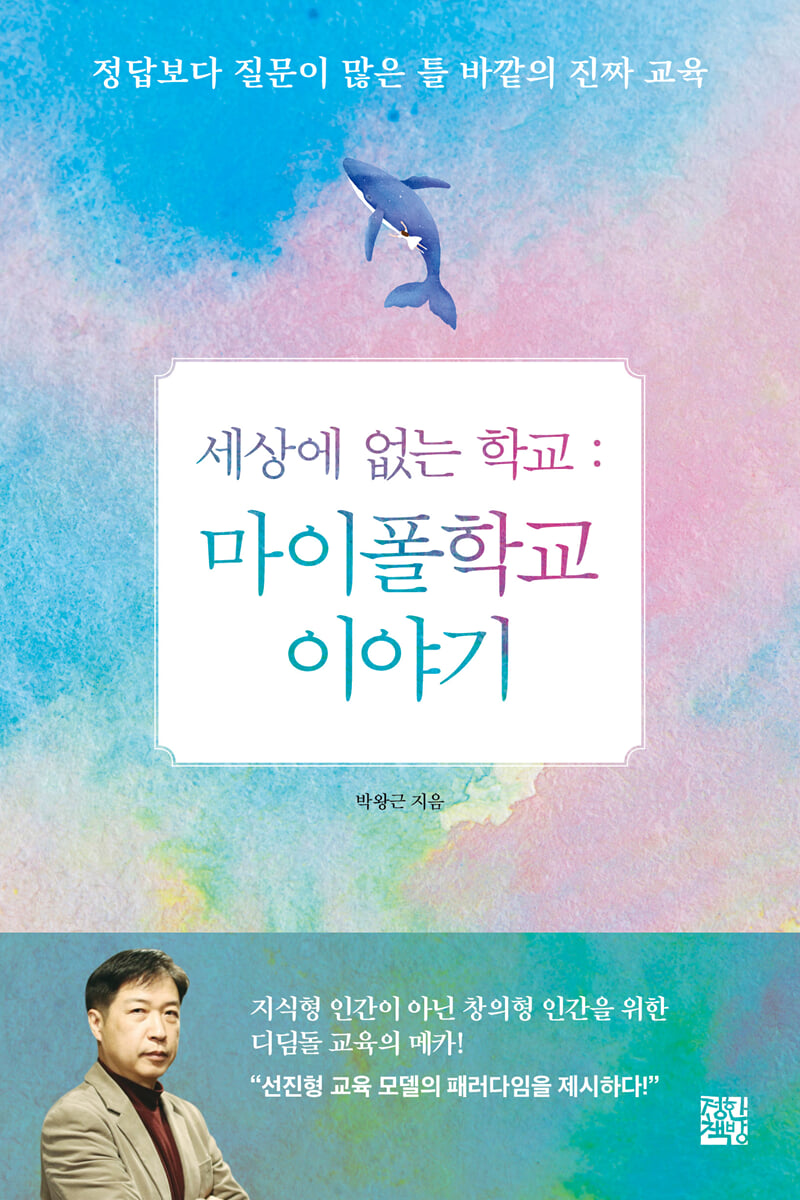
A School That Doesn't Exist: The Story of My Pole School
 |
Description
Book Introduction
“A school that stops giving answers and starts asking questions!”
The story of Mypol School, which shook up the Korean education landscape.
In a classroom where questions are not even allowed due to being caught up in tests and grades, where children are obsessed with who can guess the answer faster, children are gradually losing the joy and curiosity of learning.
However, Mypol School in Goesan, North Chungcheong Province, went against this trend head-on, declaring in 2014 that it would be a “school without lectures, a school without exams, and a school without competition.”
Here, learning begins with questions and projects, not textbooks.
Students analyze global data on the climate crisis, interview local farmers directly, and research sustainable agriculture.
It is true that they explore life-related issues on their own, from coding and writing to philosophy and video production, and sometimes achieve results that go beyond the university curriculum.
《A School That Doesn't Exist: The Story of My Pole School》 vividly shows how children design their own learning paths through depth rather than speed, and questions rather than answers, covering a 10-year journey including the days at Pole Math School.
You can witness firsthand how the simple philosophy of “a school that treats children special, not makes them special” is reviving the essence of education.
If you feel that education today has lost its way, this book will offer new answers to parents, teachers, and anyone concerned about future generations.
The story of Mypol School, which shook up the Korean education landscape.
In a classroom where questions are not even allowed due to being caught up in tests and grades, where children are obsessed with who can guess the answer faster, children are gradually losing the joy and curiosity of learning.
However, Mypol School in Goesan, North Chungcheong Province, went against this trend head-on, declaring in 2014 that it would be a “school without lectures, a school without exams, and a school without competition.”
Here, learning begins with questions and projects, not textbooks.
Students analyze global data on the climate crisis, interview local farmers directly, and research sustainable agriculture.
It is true that they explore life-related issues on their own, from coding and writing to philosophy and video production, and sometimes achieve results that go beyond the university curriculum.
《A School That Doesn't Exist: The Story of My Pole School》 vividly shows how children design their own learning paths through depth rather than speed, and questions rather than answers, covering a 10-year journey including the days at Pole Math School.
You can witness firsthand how the simple philosophy of “a school that treats children special, not makes them special” is reviving the essence of education.
If you feel that education today has lost its way, this book will offer new answers to parents, teachers, and anyone concerned about future generations.
- You can preview some of the book's contents.
Preview
index
Prologue: A school that stopped giving answers and started asking questions
PART Ⅰ.
The Land of Exams, the Lost Questions
1.
The true face of competition: what is it for?
- The reality of being forced through the narrow gate called 'score'
2.
A classroom with only empty subjects and exams left
- If the purpose of the test is different, the direction of thinking will also be different.
3.
The End of Growth: What Education Misses
- We need someone who thinks deeply.
4.
The slow kid goes further
- The first step to a classroom that allows questions
PART II. What is Real Study in the AI Era?
5.
Growing beyond the frame
- Immersion is created by the environment.
6.
What should learning be?
The purpose of education is to create beings who transcend knowledge.
7.
Non-cognitive competencies and character education
The future of character education as shown by Mypol School
8.
In search of the greatest joy in the world
- It's not just the name that has changed.
PART Ⅲ.
A school for self-discovery
9.
Dreaming of learning that changes your life
- The meaning of learning through questioning and connection
10.
A school that designs the direction of life
- The power of concentration in teenagers, with the potential to change the world.
11.
You're saying you're learning like in graduate school?
- Children who grow slowly but deeply
12.
A day that starts with a question, Mypol's classroom
- The structure of learning connected to life
13.
Dreaming of a "Classroom Where Questions Grow": My Pole School's Journey and Today
When Schools Change, Children Change: The Diverse Landscapes of Mypol
PART IV.
Reimagining the Classroom
14.
A growth roadmap from self-exploration to career planning
- The first moment that moves me
15.
A word that opens your heart rather than turning off your smartphone
In the digital age, schools that understand children's minds first
16.
Mind comes first, growth comes later.
- Studying starts from relationships, and relationships are restored through studying.
17.
Who is education waiting for now?
- The core of education discovered by Mypol: 'Relationships' and 'Recovery'
Epilogue: There are no right answers in life.
Appendix 1 My Pole School Lifestyle
Appendix 2: The Story of the Mypol People
PART Ⅰ.
The Land of Exams, the Lost Questions
1.
The true face of competition: what is it for?
- The reality of being forced through the narrow gate called 'score'
2.
A classroom with only empty subjects and exams left
- If the purpose of the test is different, the direction of thinking will also be different.
3.
The End of Growth: What Education Misses
- We need someone who thinks deeply.
4.
The slow kid goes further
- The first step to a classroom that allows questions
PART II. What is Real Study in the AI Era?
5.
Growing beyond the frame
- Immersion is created by the environment.
6.
What should learning be?
The purpose of education is to create beings who transcend knowledge.
7.
Non-cognitive competencies and character education
The future of character education as shown by Mypol School
8.
In search of the greatest joy in the world
- It's not just the name that has changed.
PART Ⅲ.
A school for self-discovery
9.
Dreaming of learning that changes your life
- The meaning of learning through questioning and connection
10.
A school that designs the direction of life
- The power of concentration in teenagers, with the potential to change the world.
11.
You're saying you're learning like in graduate school?
- Children who grow slowly but deeply
12.
A day that starts with a question, Mypol's classroom
- The structure of learning connected to life
13.
Dreaming of a "Classroom Where Questions Grow": My Pole School's Journey and Today
When Schools Change, Children Change: The Diverse Landscapes of Mypol
PART IV.
Reimagining the Classroom
14.
A growth roadmap from self-exploration to career planning
- The first moment that moves me
15.
A word that opens your heart rather than turning off your smartphone
In the digital age, schools that understand children's minds first
16.
Mind comes first, growth comes later.
- Studying starts from relationships, and relationships are restored through studying.
17.
Who is education waiting for now?
- The core of education discovered by Mypol: 'Relationships' and 'Recovery'
Epilogue: There are no right answers in life.
Appendix 1 My Pole School Lifestyle
Appendix 2: The Story of the Mypol People
Into the book
It is clear that this is the critical problem in Korean education today.
We focus only on the 'skill of quickly deriving the right answer', and do not teach why that skill is necessary or what it means.
They chose speed over meaning and prioritized results over process.
Since some point in time, children who asked, "Why are we learning this?" were considered difficult students, and children who followed the established rules well were recognized as "excellent students."
--- p.35
In Goesan, North Chungcheong Province, South Korea, in this quiet rural village surrounded by mountains and fields, there is a special school.
It is called My Paul School.
This experimental school, which first set foot on the world stage under the name of 'Paul Math School' in 2014, has caused quite a stir in the Korean education world since its opening.
The declaration that children would be immersed in real learning without entrance exam competition, grade rankings, or textbook-centered classes sounded like reckless idealism.
But now, Mypol School is proving new possibilities that are not just ideals but real.
--- p.75
Eventually, he organized his research results and submitted a paper to an international academic society, and achieved the result of having it accepted.
This is a prime example of how students who were previously excluded from traditional education can achieve profound immersion and growth when given an environment where they can take charge.
It was a surprising change brought about by Mypol School's educational method, which prioritizes the "power to ask questions" and "persistence in inquiry" over grades or rankings.
--- p.110
According to a survey conducted by the Korea Information Society Agency and the Ministry of Science and ICT in 2024, the percentage of adolescents (aged 10-19) at risk of smartphone over-reliance is 42.6%.
This is the highest figure among all age groups.
In particular, adolescence is a period in which not only the frequency of digital device use but also emotional dependence is high, with male students tending to be more immersed in online games, while female students tend to be more immersed in SNS and web novel content.
--- p.149
This is the essence of the ‘graduate school-style output education’ that Mypol School aims for.
The experience of not passively receiving knowledge, but rather formulating hypotheses, exploring data, developing one's own logic, and completing it into a single result.
In this process, children go beyond simply acquiring knowledge, and develop an attitude toward handling knowledge and their own learning method, that is, the power to study.
Even if the outcome is failure, the experience of failure is, in fact, the greatest asset in fostering "academic resilience," rather than frustration.
Because in Mypol's classroom, failure is not the end, but the beginning of another question.
We focus only on the 'skill of quickly deriving the right answer', and do not teach why that skill is necessary or what it means.
They chose speed over meaning and prioritized results over process.
Since some point in time, children who asked, "Why are we learning this?" were considered difficult students, and children who followed the established rules well were recognized as "excellent students."
--- p.35
In Goesan, North Chungcheong Province, South Korea, in this quiet rural village surrounded by mountains and fields, there is a special school.
It is called My Paul School.
This experimental school, which first set foot on the world stage under the name of 'Paul Math School' in 2014, has caused quite a stir in the Korean education world since its opening.
The declaration that children would be immersed in real learning without entrance exam competition, grade rankings, or textbook-centered classes sounded like reckless idealism.
But now, Mypol School is proving new possibilities that are not just ideals but real.
--- p.75
Eventually, he organized his research results and submitted a paper to an international academic society, and achieved the result of having it accepted.
This is a prime example of how students who were previously excluded from traditional education can achieve profound immersion and growth when given an environment where they can take charge.
It was a surprising change brought about by Mypol School's educational method, which prioritizes the "power to ask questions" and "persistence in inquiry" over grades or rankings.
--- p.110
According to a survey conducted by the Korea Information Society Agency and the Ministry of Science and ICT in 2024, the percentage of adolescents (aged 10-19) at risk of smartphone over-reliance is 42.6%.
This is the highest figure among all age groups.
In particular, adolescence is a period in which not only the frequency of digital device use but also emotional dependence is high, with male students tending to be more immersed in online games, while female students tend to be more immersed in SNS and web novel content.
--- p.149
This is the essence of the ‘graduate school-style output education’ that Mypol School aims for.
The experience of not passively receiving knowledge, but rather formulating hypotheses, exploring data, developing one's own logic, and completing it into a single result.
In this process, children go beyond simply acquiring knowledge, and develop an attitude toward handling knowledge and their own learning method, that is, the power to study.
Even if the outcome is failure, the experience of failure is, in fact, the greatest asset in fostering "academic resilience," rather than frustration.
Because in Mypol's classroom, failure is not the end, but the beginning of another question.
--- p.174
Publisher's Review
A strange school with no tests, no lectures, and no competition!
A school that is often misunderstood as a school for geniuses(?) who advance to graduate school in their teens!
In the AI era, a school that puts the true meaning of learning into practice!
“A new educational revolution taking place without a set curriculum!”
Any parent raising a child has asked this question at least once.
“The grades are good, but is my child really developing the ability to think and live independently?” They fear that in an educational environment that focuses on fast-paced learning and high scores, their children will lose the power to ask questions and the curiosity to learn on their own.
Mypol School, located in Goesan, North Chungcheong Province, has faced these parents' anxieties head-on and taken a completely different path.
A remarkable school that declared itself a "school without lectures, exams, or competition" in 2014, placing questions and projects at the center of classes instead of textbooks.
Children analyze data on the climate crisis, freely moving between philosophy, literature, coding, and art, sometimes producing research that goes deeper than university lectures.
A mecca of stepping stone education for creative people, not intellectual people!
“Presenting a paradigm for a new education model!”
《A School That Doesn't Exist: The Story of My Pole School》 is a record of the journey over the past 10 years.
This book does not simply introduce the experimental story of an alternative school.
It vividly demonstrates that learning is possible beyond the classroom confined to grades and entrance exams, starting with questions rather than answers and with depth rather than speed.
In particular, it clearly reminds us that the essence of education is not to 'make children special' but to 'treat them specially'.
This book will help parents understand how to protect their children's potential and what kind of environment will allow them to truly thrive.
Teachers and educators can gain practical clues for designing future education from the case of Mypol School.
Ultimately, this book is a must-read for parents on childcare and education, and a textbook on a new educational paradigm for educators.
When it feels like Korean education has lost its way, the story of Mypol School will surely serve as a compass.
This book serves as a guide for parents to help them grow, a model for classroom innovation for teachers, and a declaration for all of our society that opens new horizons in education.
A school that is often misunderstood as a school for geniuses(?) who advance to graduate school in their teens!
In the AI era, a school that puts the true meaning of learning into practice!
“A new educational revolution taking place without a set curriculum!”
Any parent raising a child has asked this question at least once.
“The grades are good, but is my child really developing the ability to think and live independently?” They fear that in an educational environment that focuses on fast-paced learning and high scores, their children will lose the power to ask questions and the curiosity to learn on their own.
Mypol School, located in Goesan, North Chungcheong Province, has faced these parents' anxieties head-on and taken a completely different path.
A remarkable school that declared itself a "school without lectures, exams, or competition" in 2014, placing questions and projects at the center of classes instead of textbooks.
Children analyze data on the climate crisis, freely moving between philosophy, literature, coding, and art, sometimes producing research that goes deeper than university lectures.
A mecca of stepping stone education for creative people, not intellectual people!
“Presenting a paradigm for a new education model!”
《A School That Doesn't Exist: The Story of My Pole School》 is a record of the journey over the past 10 years.
This book does not simply introduce the experimental story of an alternative school.
It vividly demonstrates that learning is possible beyond the classroom confined to grades and entrance exams, starting with questions rather than answers and with depth rather than speed.
In particular, it clearly reminds us that the essence of education is not to 'make children special' but to 'treat them specially'.
This book will help parents understand how to protect their children's potential and what kind of environment will allow them to truly thrive.
Teachers and educators can gain practical clues for designing future education from the case of Mypol School.
Ultimately, this book is a must-read for parents on childcare and education, and a textbook on a new educational paradigm for educators.
When it feels like Korean education has lost its way, the story of Mypol School will surely serve as a compass.
This book serves as a guide for parents to help them grow, a model for classroom innovation for teachers, and a declaration for all of our society that opens new horizons in education.
GOODS SPECIFICS
- Date of issue: September 25, 2025
- Page count, weight, size: 220 pages | 140*200*20mm
- ISBN13: 9791199162730
- ISBN10: 1199162736
You may also like
카테고리
korean


korean

![GQ KOREA Mark (Monthly): December [2025]](http://librairie.coreenne.fr/cdn/shop/files/8ef265dbbfbf186523ed75ba7319009d.jpg?v=1765340328&width=3840)


