

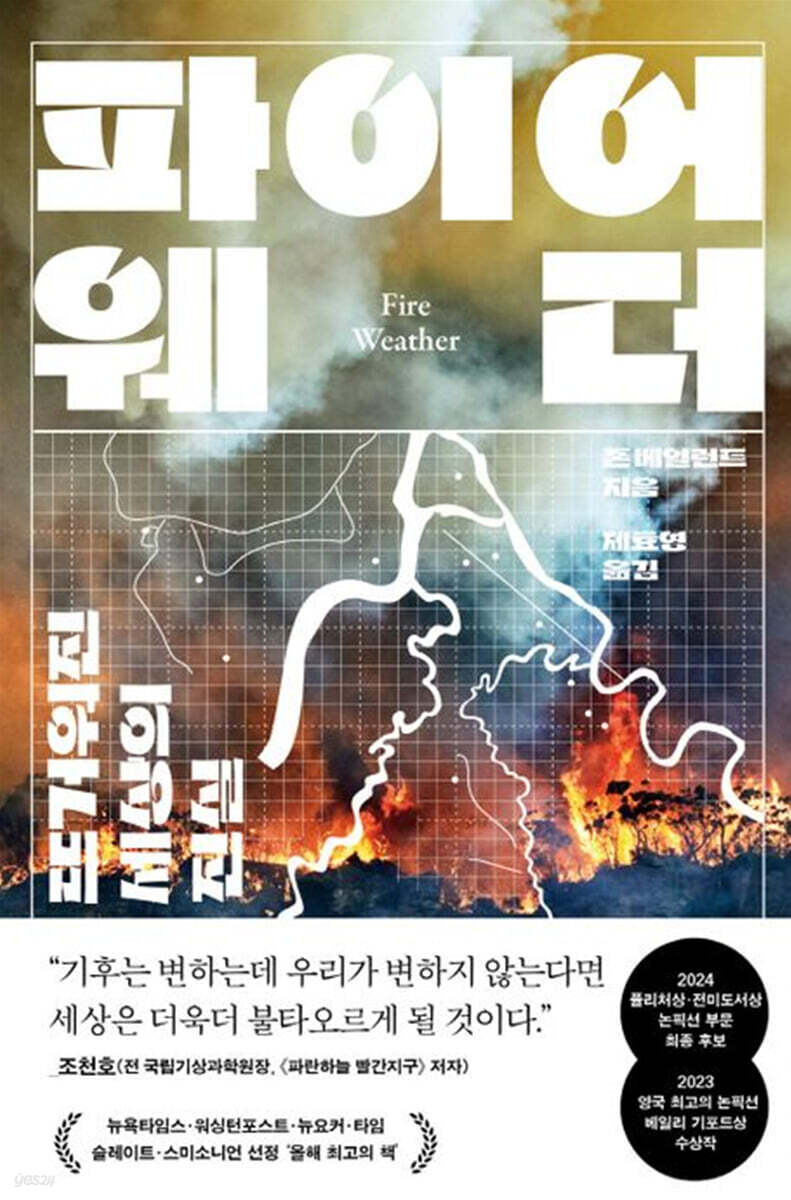
Fire Weather
 |
Description
Book Introduction
- A word from MD
-
Fire hasn't changed, humanity has just fallen.The 2016 Fort McMurray fire took 15 months to completely contain.
The duration of the fire and the extent of the damage are shocking.
The fact that the fire occurred in a city with a major oil industry is significant.
There have always been forest fires.
Why are recent wildfires so difficult to control? It's because humanity refuses to give up fossil fuels.
April 1, 2025. Social and Political PD Son Min-gyu
Finalist for the 2024 Pulitzer Prize and National Book Award in Nonfiction
★2023 Baillie Gifford Award Winner for Best British Nonfiction★
Named a "Best Book of the Year" by The Washington Post, The New York Times, National Public Radio (NPR), Time, Slate, The New Yorker, and Smithsonian
Fire Weather, winner of the 2023 Bailey Gifford Award for Best British Nonfiction
A shocking book about fire, the greatest threat to humanity today!
Fire Weather, winner of the 2023 Baillie Gifford Medal, the highest authority in British non-fiction, is a 2024 Pulitzer Prize and National Book Award non-fiction finalist and a bestseller that has received numerous accolades, including being selected as a "Best Book of the Year" by several media outlets.
In May 2016, a fire in Fort McMurray, the heart of Canada's oil industry and home to the largest crude oil supplier in the United States, forced the evacuation of over 100,000 people in just one day and caused $10 billion in property damage.
The author doggedly follows the fire of that day, as if filming a disaster movie minute by minute.
What makes this book so shocking is that the Fort McMurray fire was not an isolated incident in a specific region, but is connected to recent large-scale fires occurring around the world.
In this world that is becoming increasingly hotter and more vulnerable to fire, we are faced with fire without warning.
This book serves as a wake-up call to humanity about what we need to do and how we need to prepare for a fire that could be a cataclysmic event.
★2023 Baillie Gifford Award Winner for Best British Nonfiction★
Named a "Best Book of the Year" by The Washington Post, The New York Times, National Public Radio (NPR), Time, Slate, The New Yorker, and Smithsonian
Fire Weather, winner of the 2023 Bailey Gifford Award for Best British Nonfiction
A shocking book about fire, the greatest threat to humanity today!
Fire Weather, winner of the 2023 Baillie Gifford Medal, the highest authority in British non-fiction, is a 2024 Pulitzer Prize and National Book Award non-fiction finalist and a bestseller that has received numerous accolades, including being selected as a "Best Book of the Year" by several media outlets.
In May 2016, a fire in Fort McMurray, the heart of Canada's oil industry and home to the largest crude oil supplier in the United States, forced the evacuation of over 100,000 people in just one day and caused $10 billion in property damage.
The author doggedly follows the fire of that day, as if filming a disaster movie minute by minute.
What makes this book so shocking is that the Fort McMurray fire was not an isolated incident in a specific region, but is connected to recent large-scale fires occurring around the world.
In this world that is becoming increasingly hotter and more vulnerable to fire, we are faced with fire without warning.
This book serves as a wake-up call to humanity about what we need to do and how we need to prepare for a fire that could be a cataclysmic event.
- You can preview some of the book's contents.
Preview
index
preface
Part 1: The Beginning of Everything
Part 2 Fire Weather
3rd Division Judgement
Conclusion
Acknowledgements
main
References
Search
Part 1: The Beginning of Everything
Part 2 Fire Weather
3rd Division Judgement
Conclusion
Acknowledgements
main
References
Search
Detailed image

Into the book
Many people agree that there has never been a better time for humans to live.
Of course, there are those who disagree, but one thing is clear.
Throughout human history, there has never been a time when fire was as good as it is now.
Looking at the relationship between fire and humanity today, and the impact that the oil industry, the embodiment of fire, has on human nature and culture, a new name is needed.
Energy historian Vaclav Smil proposed 'hydrocarbon man', and I propose 'Homo flagrans'.
"How do you convey something frightening to people without causing them to fear it? Is it possible to tell citizens to prepare for a dire possibility and then immediately encourage them to go about their day as usual? How do you tell people to be prepared to evacuate at any moment without causing widespread confusion?" Everyone knew this dilemma, but they tried to ignore it.
--- From "Part 1: The Beginning of Everything"
Any community leader has a responsibility to acknowledge when chaos is expected.
But in places like Fort McMurray, where life and death hang in the hands of global crude oil prices and fickle investors, many of whom are overseas, turmoil is a sensitive issue.
(…) If we just consider the economic impact that would occur if an evacuation order were issued, there are hundreds of reasons why it would be better to just maintain the status quo and continue with business as usual.
There is so much to handle.
This incomprehensible failure is not unique to the Emergency Operations Center, which was formed during the Fort McMurray fire, but is a long-standing problem that has plagued humans since the dawn of human judgment.
(…) Because of this Lucretius problem of humans not trying to interpret the data even when it is obvious, the Fort McMurray fire was able to gain an unbeatable advantage for those who were responsible for preventing such a crisis.
What turns a common fire into a disaster? I realized that in Fort McMurray, unlike Hamburg, there was no need to transport incendiary bombs by air.
Thousands, tens of thousands of incendiary bombs were already there, throughout the forest surrounding the city.
Although it was not called a fire bomb, it was as explosive as that bomb, but its shape was so familiar to us (a house and a tree), that we never thought to connect it to the bombings of World War II, and we never thought that it could create a synergy as destructive as those bombings.
--- From "Part 2 Fire Weather"
Since humans have lived on Earth, no one has ever considered that the atmosphere could be changed by humans.
But that began to change just over a century ago, when humanity began to take a serious interest in automobiles.
As carbon dioxide increases, more heat remains trapped in the atmosphere.
As we all know, the more heat stagnates in the atmosphere, the more frequent fires and the more numerous the cumulonimbus clouds become.
We are currently witnessing the early stages of this vicious cycle, which is self-perpetuating, amplifying, and with countless cascading effects.
Christie Proistosecu, a professor of climate dynamics at the University of Illinois, says a future-focused perspective should be incorporated when conceptualizing warming trends.
He posted this on Twitter along with a graph showing the rising trend of the Earth's average temperature.
“What everyone should keep in mind is that this is not the hottest August of the last century, but the coolest August of the coming century.”
For those whose homes have burned down, it is not only what is lost that is deeply shocking, but also what remains.
(…) Since a house is a palace of memory, the complete disappearance of that palace is inherently cruel.
All the places and palaces of memory that we have taken refuge in the human and natural world are facing a new crisis.
The dangers of 21st-century fires are well summarized in a May 2021 Twitter post by Kent Porter, a veteran photojournalist from California.
“Now, everywhere is a forest city area.”
--- From "Part 3 Judgment"
Humanity planted flowers without knowing what would happen in the future.
Pour the energy and creativity of humankind into regeneration and renewal, not combustion and consumption. This is the right goal for humanity, as determined by nature, and the path we must follow, guided by nature.
Homo sapiens ushered in the age of oil, and we are now Homo flagrans.
Now, the human being who can lead the future of humanity, or lead humanity back to its original place, is 'Homo viriditas'.
Of course, there are those who disagree, but one thing is clear.
Throughout human history, there has never been a time when fire was as good as it is now.
Looking at the relationship between fire and humanity today, and the impact that the oil industry, the embodiment of fire, has on human nature and culture, a new name is needed.
Energy historian Vaclav Smil proposed 'hydrocarbon man', and I propose 'Homo flagrans'.
"How do you convey something frightening to people without causing them to fear it? Is it possible to tell citizens to prepare for a dire possibility and then immediately encourage them to go about their day as usual? How do you tell people to be prepared to evacuate at any moment without causing widespread confusion?" Everyone knew this dilemma, but they tried to ignore it.
--- From "Part 1: The Beginning of Everything"
Any community leader has a responsibility to acknowledge when chaos is expected.
But in places like Fort McMurray, where life and death hang in the hands of global crude oil prices and fickle investors, many of whom are overseas, turmoil is a sensitive issue.
(…) If we just consider the economic impact that would occur if an evacuation order were issued, there are hundreds of reasons why it would be better to just maintain the status quo and continue with business as usual.
There is so much to handle.
This incomprehensible failure is not unique to the Emergency Operations Center, which was formed during the Fort McMurray fire, but is a long-standing problem that has plagued humans since the dawn of human judgment.
(…) Because of this Lucretius problem of humans not trying to interpret the data even when it is obvious, the Fort McMurray fire was able to gain an unbeatable advantage for those who were responsible for preventing such a crisis.
What turns a common fire into a disaster? I realized that in Fort McMurray, unlike Hamburg, there was no need to transport incendiary bombs by air.
Thousands, tens of thousands of incendiary bombs were already there, throughout the forest surrounding the city.
Although it was not called a fire bomb, it was as explosive as that bomb, but its shape was so familiar to us (a house and a tree), that we never thought to connect it to the bombings of World War II, and we never thought that it could create a synergy as destructive as those bombings.
--- From "Part 2 Fire Weather"
Since humans have lived on Earth, no one has ever considered that the atmosphere could be changed by humans.
But that began to change just over a century ago, when humanity began to take a serious interest in automobiles.
As carbon dioxide increases, more heat remains trapped in the atmosphere.
As we all know, the more heat stagnates in the atmosphere, the more frequent fires and the more numerous the cumulonimbus clouds become.
We are currently witnessing the early stages of this vicious cycle, which is self-perpetuating, amplifying, and with countless cascading effects.
Christie Proistosecu, a professor of climate dynamics at the University of Illinois, says a future-focused perspective should be incorporated when conceptualizing warming trends.
He posted this on Twitter along with a graph showing the rising trend of the Earth's average temperature.
“What everyone should keep in mind is that this is not the hottest August of the last century, but the coolest August of the coming century.”
For those whose homes have burned down, it is not only what is lost that is deeply shocking, but also what remains.
(…) Since a house is a palace of memory, the complete disappearance of that palace is inherently cruel.
All the places and palaces of memory that we have taken refuge in the human and natural world are facing a new crisis.
The dangers of 21st-century fires are well summarized in a May 2021 Twitter post by Kent Porter, a veteran photojournalist from California.
“Now, everywhere is a forest city area.”
--- From "Part 3 Judgment"
Humanity planted flowers without knowing what would happen in the future.
Pour the energy and creativity of humankind into regeneration and renewal, not combustion and consumption. This is the right goal for humanity, as determined by nature, and the path we must follow, guided by nature.
Homo sapiens ushered in the age of oil, and we are now Homo flagrans.
Now, the human being who can lead the future of humanity, or lead humanity back to its original place, is 'Homo viriditas'.
--- From the "Conclusion"
Publisher's Review
"Once the Age of Fire begins, nothing can be undone."
A climate crisis report delves into humanity's rapidly changing relationship with fire.
Fire has been a primary driving force in human evolution for hundreds of thousands of years, driving the development of culture and civilization.
It allowed us to cook food, heat our homes, and power the machines that powered our vast economies.
But this unstable energy source has always threatened to escape human control, and in a new era of intensifying climate change, its destructive power will erupt in ways we could never have imagined before.
The author depicts an unexpected fire in Fort McMurray, Canada, the oil sands mining industry, arguably the dirtiest outpost of the fossil fuel industry, with vivid descriptions reminiscent of Dante's Inferno.
The journalist's passionate exploration doesn't stop at just the fire incident.
It doggedly traces the causes of the fires, scientifically analyzing greenhouse gas emissions and desiccation, while simultaneously guiding us through the intertwined histories of poorly regulated capitalism and the North American oil industry, the birth of climate science, the unprecedented devastation of modern wildfires, and the irreversible consequences of these disasters.
Fire, the driving force behind humanity's growth and simultaneously the greatest threat of our time, has a powerful message for us in the age of climate crisis. As a preview of the horrific world that will become our new normal, there is no more timely appeal than this book.
The civilization that humans created by kindling fire is now going through the same early stages of a mass extinction that occurred “once upon a time.”
There is general agreement across the scientific community that the sixth mass extinction event on Earth is underway, and that it is entirely caused by human activity.
Some people may be surprised when they first encounter this reality.
But you shouldn't be surprised.
In the history of the Earth, no being has caused as much destruction as mankind.
Page 451
The climate is changing, but if humans don't change,
The world will become more and more fiery
On a sunny afternoon in May 2016, a small fire erupted in a forest near Fort McMurray, Alberta, Canada.
People in Fort McMurray noticed plumes of smoke in the forest, indicating a fire, but they were so used to seeing it every year around this time that they didn't pay much attention and just went about their daily lives.
Meanwhile, city officials, despite seeing the fire area growing at a rapid rate in real time, instead of ordering residents to evacuate, emphasized common-sense responses (“You can take your children to the park, but keep in mind that the situation is serious”).
It is a moment that makes us realize how important a leader's insight and imagination are in a crisis.
As a result, the fire started in May 2016 and was not fully extinguished until August of the following year, 15 months later.
It was the most evacuated fire in modern history in a single day, and was recorded as a fire that was completely different from what we previously knew about fire, in how it started, moved, and how it progressed.
What's ironic is that the same energy (oil) that brought people to Fort McMurray for a century is also the same energy (fire) that drove out the city's residents en masse.
Moreover, one of the fuels that made the fire that day even more explosive was the house (home), which is also a space where human desires are condensed.
In a fire situation, the structure called a house was neither property nor was it valued.
It was simply considered a catalyst, like a tree.
The way modern world burns is completely different from the way old world burns.
Nowadays, it is common to eat, sleep, and live in furniture made almost entirely of petroleum products.
Moreover, as strange as it may sound to put it this way, the majority of modern people begin their day covered from head to toe in highly flammable materials derived from petroleum.
Pages 225-226
Tracking the Fort McMurray fire, which has forced the evacuation of at least 90,000 people, destroyed over 2,500 structures, and burned 2,590 square kilometers of forest, makes one realize that it is not unrelated to all the large fires that have occurred frequently in recent years.
"Fire Weather" is a passionate ecological appeal that delves into the history, politics, and economics surrounding the oil industry and human desire, and it clearly warns us that if the climate continues to change while humans remain unchanged, this will inevitably continue to happen.
The Fort McMurray fire highlighted the parallel growth of the oil industry and fire over the past 150 years.
It was a fierce synergy between the unchecked exploitation of hydrocarbon resources, the resulting real-time increase in heat-trapping greenhouse gases, and the rapid changes in weather.
(…) It was the moment when a new type of fire, never seen before, appeared in the world.
Page 9
Depending on how we go
The destination of humanity is changing.
If the first half of this book examined the relationship between fire and humans, and the impact of the oil industry, the embodiment of fire, on our lives, the second half examines how modern climatology has developed and how the atmosphere, the "space where life exists," is influenced by humans, through various research cases.
Since humans have lived on Earth, no one has ever thought that the atmosphere could be changed by humans.
But just over a century ago, things changed completely when humanity began to take a serious interest in automobiles.
In fact, since the dawn of the oil age, the amount of substances emitted into the atmosphere (such as carbon dioxide) has never decreased.
Moreover, all substances created or released by humans do not go anywhere but accumulate in the atmosphere.
Carbon dioxide in the atmosphere reveals its presence by trapping heat.
(…) As carbon dioxide increases, more heat remains trapped in the atmosphere.
As we all know, the more heat stagnates in the atmosphere, the more frequent fires occur and the more cumulonimbus clouds (a hallmark of large fires) there are.
Pages 444-445
The shift in fire season from dry weather to year-round, 24-hour days over the past decade alone demonstrates how climate change is significantly impacting fires.
Moreover, once a fire breaks out (whether it is a forest fire or an urban fire), the complex influence of climate and environment has created sufficient conditions for it to spread into a large-scale fire.
The lessons from this new pattern of fires are clear.
There is now no upper limit to fire.
From this perspective, the characteristics of 21st-century fires appear less like an anomaly and more like a byproduct of significant human achievements.
This is the greatest crisis in human history since humans began to master fire (almost) masterfully.
Now it is not fire that we must master, but ourselves.
(…) Even after the oil age ends, life will remain on Earth.
But it is unclear which creatures, how many, and where will remain.
Page 454
According to the author, modern humans may be remembered as Homo fragrans, the "burning man," who created the largest combustion engine ever created and became the combustion engine itself.
Because of the destruction humans have created so far and are causing now, the world our children will inherit could become increasingly different from the world that created us.
At a critical juncture in human history, since humans first mastered the art of controlling fire, Fire Weather is a timely reminder that it is not fire that we must master, but ourselves.
Just as humans in the past continued to cultivate forests and plant flowers without knowing what would happen in the future, it is time for us, living in the oil age, to pour our energy and creativity into regeneration and renewal, not combustion and consumption, for the sake of humanity's future.
A climate crisis report delves into humanity's rapidly changing relationship with fire.
Fire has been a primary driving force in human evolution for hundreds of thousands of years, driving the development of culture and civilization.
It allowed us to cook food, heat our homes, and power the machines that powered our vast economies.
But this unstable energy source has always threatened to escape human control, and in a new era of intensifying climate change, its destructive power will erupt in ways we could never have imagined before.
The author depicts an unexpected fire in Fort McMurray, Canada, the oil sands mining industry, arguably the dirtiest outpost of the fossil fuel industry, with vivid descriptions reminiscent of Dante's Inferno.
The journalist's passionate exploration doesn't stop at just the fire incident.
It doggedly traces the causes of the fires, scientifically analyzing greenhouse gas emissions and desiccation, while simultaneously guiding us through the intertwined histories of poorly regulated capitalism and the North American oil industry, the birth of climate science, the unprecedented devastation of modern wildfires, and the irreversible consequences of these disasters.
Fire, the driving force behind humanity's growth and simultaneously the greatest threat of our time, has a powerful message for us in the age of climate crisis. As a preview of the horrific world that will become our new normal, there is no more timely appeal than this book.
The civilization that humans created by kindling fire is now going through the same early stages of a mass extinction that occurred “once upon a time.”
There is general agreement across the scientific community that the sixth mass extinction event on Earth is underway, and that it is entirely caused by human activity.
Some people may be surprised when they first encounter this reality.
But you shouldn't be surprised.
In the history of the Earth, no being has caused as much destruction as mankind.
Page 451
The climate is changing, but if humans don't change,
The world will become more and more fiery
On a sunny afternoon in May 2016, a small fire erupted in a forest near Fort McMurray, Alberta, Canada.
People in Fort McMurray noticed plumes of smoke in the forest, indicating a fire, but they were so used to seeing it every year around this time that they didn't pay much attention and just went about their daily lives.
Meanwhile, city officials, despite seeing the fire area growing at a rapid rate in real time, instead of ordering residents to evacuate, emphasized common-sense responses (“You can take your children to the park, but keep in mind that the situation is serious”).
It is a moment that makes us realize how important a leader's insight and imagination are in a crisis.
As a result, the fire started in May 2016 and was not fully extinguished until August of the following year, 15 months later.
It was the most evacuated fire in modern history in a single day, and was recorded as a fire that was completely different from what we previously knew about fire, in how it started, moved, and how it progressed.
What's ironic is that the same energy (oil) that brought people to Fort McMurray for a century is also the same energy (fire) that drove out the city's residents en masse.
Moreover, one of the fuels that made the fire that day even more explosive was the house (home), which is also a space where human desires are condensed.
In a fire situation, the structure called a house was neither property nor was it valued.
It was simply considered a catalyst, like a tree.
The way modern world burns is completely different from the way old world burns.
Nowadays, it is common to eat, sleep, and live in furniture made almost entirely of petroleum products.
Moreover, as strange as it may sound to put it this way, the majority of modern people begin their day covered from head to toe in highly flammable materials derived from petroleum.
Pages 225-226
Tracking the Fort McMurray fire, which has forced the evacuation of at least 90,000 people, destroyed over 2,500 structures, and burned 2,590 square kilometers of forest, makes one realize that it is not unrelated to all the large fires that have occurred frequently in recent years.
"Fire Weather" is a passionate ecological appeal that delves into the history, politics, and economics surrounding the oil industry and human desire, and it clearly warns us that if the climate continues to change while humans remain unchanged, this will inevitably continue to happen.
The Fort McMurray fire highlighted the parallel growth of the oil industry and fire over the past 150 years.
It was a fierce synergy between the unchecked exploitation of hydrocarbon resources, the resulting real-time increase in heat-trapping greenhouse gases, and the rapid changes in weather.
(…) It was the moment when a new type of fire, never seen before, appeared in the world.
Page 9
Depending on how we go
The destination of humanity is changing.
If the first half of this book examined the relationship between fire and humans, and the impact of the oil industry, the embodiment of fire, on our lives, the second half examines how modern climatology has developed and how the atmosphere, the "space where life exists," is influenced by humans, through various research cases.
Since humans have lived on Earth, no one has ever thought that the atmosphere could be changed by humans.
But just over a century ago, things changed completely when humanity began to take a serious interest in automobiles.
In fact, since the dawn of the oil age, the amount of substances emitted into the atmosphere (such as carbon dioxide) has never decreased.
Moreover, all substances created or released by humans do not go anywhere but accumulate in the atmosphere.
Carbon dioxide in the atmosphere reveals its presence by trapping heat.
(…) As carbon dioxide increases, more heat remains trapped in the atmosphere.
As we all know, the more heat stagnates in the atmosphere, the more frequent fires occur and the more cumulonimbus clouds (a hallmark of large fires) there are.
Pages 444-445
The shift in fire season from dry weather to year-round, 24-hour days over the past decade alone demonstrates how climate change is significantly impacting fires.
Moreover, once a fire breaks out (whether it is a forest fire or an urban fire), the complex influence of climate and environment has created sufficient conditions for it to spread into a large-scale fire.
The lessons from this new pattern of fires are clear.
There is now no upper limit to fire.
From this perspective, the characteristics of 21st-century fires appear less like an anomaly and more like a byproduct of significant human achievements.
This is the greatest crisis in human history since humans began to master fire (almost) masterfully.
Now it is not fire that we must master, but ourselves.
(…) Even after the oil age ends, life will remain on Earth.
But it is unclear which creatures, how many, and where will remain.
Page 454
According to the author, modern humans may be remembered as Homo fragrans, the "burning man," who created the largest combustion engine ever created and became the combustion engine itself.
Because of the destruction humans have created so far and are causing now, the world our children will inherit could become increasingly different from the world that created us.
At a critical juncture in human history, since humans first mastered the art of controlling fire, Fire Weather is a timely reminder that it is not fire that we must master, but ourselves.
Just as humans in the past continued to cultivate forests and plant flowers without knowing what would happen in the future, it is time for us, living in the oil age, to pour our energy and creativity into regeneration and renewal, not combustion and consumption, for the sake of humanity's future.
GOODS SPECIFICS
- Date of issue: March 26, 2025
- Page count, weight, size: 588 pages | 700g | 145*220*32mm
- ISBN13: 9791189327392
- ISBN10: 1189327392
You may also like
카테고리
korean


korean

![GQ KOREA Mark (Monthly): December [2025]](http://librairie.coreenne.fr/cdn/shop/files/8ef265dbbfbf186523ed75ba7319009d.jpg?v=1765340328&width=3840)


