

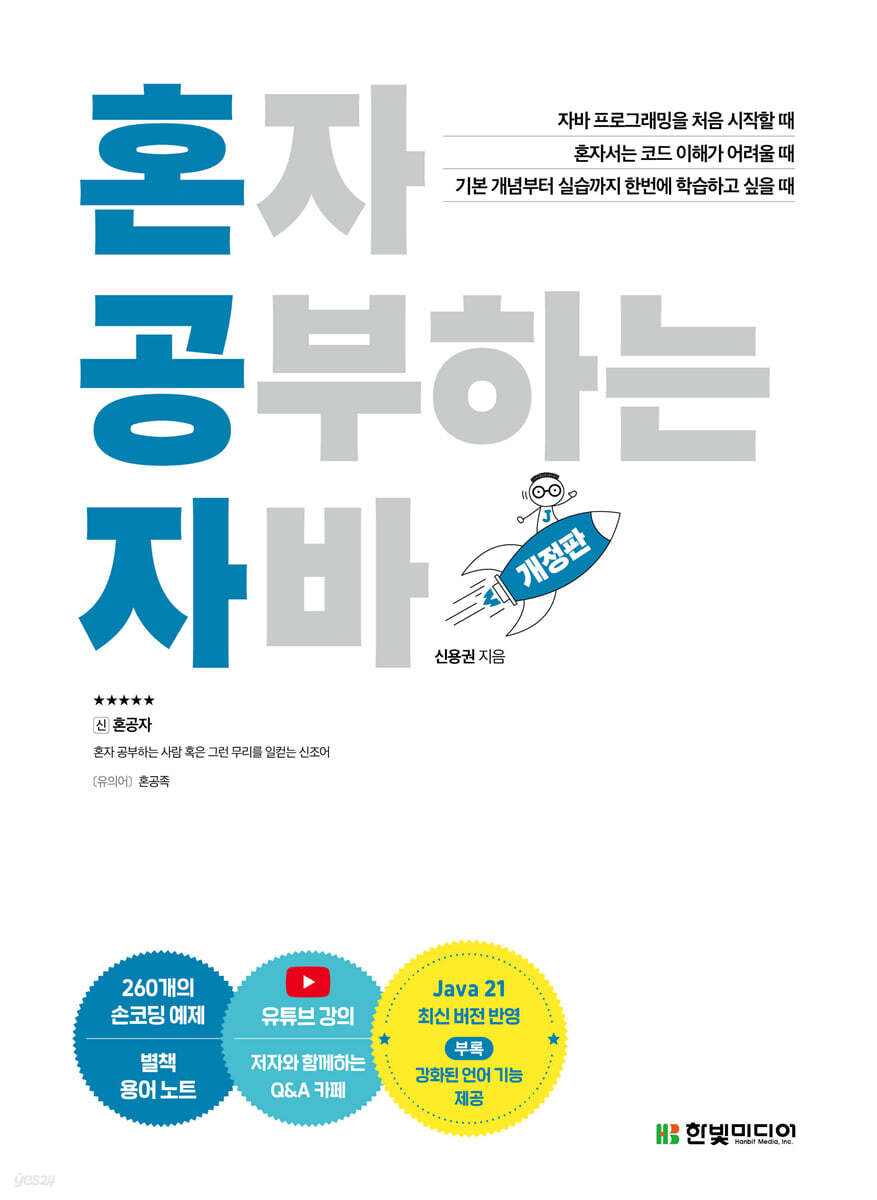
Studying Java on your own
 |
Description
Book Introduction
It's enough to do it alone!
A Java programming tutorial that teaches you how to use one-on-one tutoring (based on the latest Java 21 version)
A personalized beginner's book, "created together," verified by 26 beta readers.
"Study Java on Your Own" returns with even more content! The revised edition covers not only the existing Java 8 & 11 versions, but also the latest version, Java 21.
Enhance your programming skills in a modern development environment with 260 hand-coded examples that showcase the enhanced language features of Java 21! This book will provide a solid foundation for understanding core Java syntax, code flow, and object-oriented concepts.
By the time you open the first page of this book and close the last, you'll feel confident and confident that you can learn Java on your own.
I still completely sympathize with the feeling of a beginner who is new to Java and doesn't even know what they don't know.
We actively reflected the opinions of the '26 beta readers' who experienced 『Study Java on Your Own (Revised Edition)』 first, and organized it into a 'friendly explanation' that points out only the key contents as if a private tutor were teaching, a 'step-by-step learning' structured so that anyone can easily follow, and a level of difficulty, volume, and learning elements suitable for beginners.
The greatest strength of this book is that the beginner's perspective and perspective of many beginners who have 'studied on their own' are reflected throughout the book.
A Java programming tutorial that teaches you how to use one-on-one tutoring (based on the latest Java 21 version)
A personalized beginner's book, "created together," verified by 26 beta readers.
"Study Java on Your Own" returns with even more content! The revised edition covers not only the existing Java 8 & 11 versions, but also the latest version, Java 21.
Enhance your programming skills in a modern development environment with 260 hand-coded examples that showcase the enhanced language features of Java 21! This book will provide a solid foundation for understanding core Java syntax, code flow, and object-oriented concepts.
By the time you open the first page of this book and close the last, you'll feel confident and confident that you can learn Java on your own.
I still completely sympathize with the feeling of a beginner who is new to Java and doesn't even know what they don't know.
We actively reflected the opinions of the '26 beta readers' who experienced 『Study Java on Your Own (Revised Edition)』 first, and organized it into a 'friendly explanation' that points out only the key contents as if a private tutor were teaching, a 'step-by-step learning' structured so that anyone can easily follow, and a level of difficulty, volume, and learning elements suitable for beginners.
The greatest strength of this book is that the beginner's perspective and perspective of many beginners who have 'studied on their own' are reflected throughout the book.
- You can preview some of the book's contents.
Preview
index
Chapter 01 Getting Started with Java
01-1 Programming Languages and Java
Introduction to Java
Install Java Development Tools
Setting environment variables
Key points concluded with 6 keywords
Verification problem
01-2 Setting up the Eclipse development environment
Install Eclipse
Workspace
Perspective and View
Key points concluded with four keywords
Verification problem
01-3 Java Program Development Course
Bytecode files and the Java Virtual Machine
From project creation to execution
Compile and run from the command line
Program source analysis
Using comments
Executable statement and semicolon (;)
Learn more Use the provided source files
Key points concluded with 6 keywords
Verification problem
Chapter 02 Variables and Types
02-1 Variable
Variable declaration
Save value
Using variables
Variable usage scope
Key points concluded with four keywords
Verification problem
02-2 Basic Type
Integer type
Real number type
Logical type
Key points concluded with 5 keywords
Verification problem
02-3 Type Conversion
Automatic type conversion
Forced type conversion
Automatic type conversion in integer operations
Automatic type conversion in floating-point operations
+ Automatic string type conversion in operations
Force type conversion of string to primitive type
Key points concluded with 5 keywords
Verification problem
02-4 Variables and System Input/Output
Outputting variable values to the monitor
Store the input from the keyboard in a variable
Key points concluded with 5 keywords
Verification problem
Chapter 03 Variables and Data Entry
03-1 Operators and expressions
Types of operators
Direction and priority of operations
Key points concluded with four keywords
Key points summarized in a table
Verification problem
03-2 Types of operators
unary operators
Binary operator
ternary operator
Key points concluded with 5 keywords
Verification problem
Chapter 04 Conditional Statements and Loops
04-1 Conditional statements: if statement, switch statement
if statement
if-else statement
if-else if-else statement
switch statement
Key points concluded with four keywords
Key points summarized in a picture
Verification problem
04-2 Loops: for loop, while loop, do-while loop
for loop
while loop
do-while statement
break statement
continue statement
Key points concluded with 5 keywords
Verification problem
Chapter 05 Reference Type
05-1 Reference Types and Reference Variables
Primitive types and reference types
Memory usage area
==, != operations of reference variables
null and NullPointerException
String type
Key points concluded with 6 keywords
Verification problem
05-2 Array
What is an array?
Array declaration
Create an array
Array length
Command line input
multidimensional array
Array of references to objects
Array copy
Enhanced for loop
Key points concluded with 7 keywords
Verification problem
05-3 Enumeration Type
Enumeration type declaration
Enumerated type variable
Key points concluded with four keywords
Verification problem
Chapter 06 Class
06-1 Object-Oriented Programming
Object interaction
Relationships between objects
Objects and Classes
Class declaration
Object creation and class variables
Members of a class
Key points concluded with 6 keywords
Verification problem
06-2 Field
Field declaration
Field usage
Key points to conclude with two keywords
Verification problem
06-3 Constructor
Default constructor
Constructor declaration
Field initialization
Constructor overloading
Calling another constructor: this()
Key points concluded with 6 keywords
Verification problem
06-4 Method
Method declaration
return statement
Method call
Method overloading
Key points concluded with 6 keywords
Verification problem
06-5 Instance members and static members
Instance members and this
Static members and static
singleton
final fields and constants
Key points concluded with 7 keywords
Verification problem
06-6 Packages and Access Modifiers
Package declaration
Access modifier
Restricting class access
Restricting constructor access
Restricting access to fields and methods
Getter and Setter methods
Key points concluded with four keywords
Verification problem
Chapter 07 Inheritance
07-1 Inheritance
Class inheritance
Call parent constructor
Method override
final classes and final methods
Learn more about protected access modifiers
Key points concluded with four keywords
Verification problem
07-2 Type Conversion and Polymorphism
Automatic type conversion
Polymorphism of fields
Polymorphism of parameters
Forced type conversion
Check object type
Key points concluded with 5 keywords
Verification problem
07-3 Abstract Class
Uses of abstract classes
Abstract class declaration
Abstract methods and overriding
Key points to conclude with two keywords
Verification problem
Chapter 08 Interface
08-1 Interface
Interface declaration
Interface implementation
Using the interface
Key points concluded with 5 keywords
Verification problem
08-2 Type Conversion and Polymorphism
Automatic type conversion
Polymorphism of fields
Polymorphism of parameters
Forced type conversion
Check object type
Learn more about interface inheritance
Key points concluded with 5 keywords
Verification problem
Chapter 09 Pointers
09-1 Introduction to Nested Classes and Nested Interfaces
Nested classes
Restricting access to nested classes
nested interfaces
Key points concluded with four keywords
Verification problem
09-2 Anonymous Objects
Creating anonymous child objects
Creating anonymous implementation objects
Using local variables in anonymous objects
Key points to conclude with two keywords
Verification problem
Chapter 10 Exception Handling
10-1 Exception Class
Exceptions and Exception Classes
Execution exception
Key points concluded with four keywords
Verification problem
10-2 Exception Handling
Exception handling code
Handling code according to exception type
Passing the Exception
Key points concluded with four keywords
Verification problem
Chapter 11 Basic API Classes
11-1 java.lang package
Java API Documentation
How to read class pages in the API documentation
Object class
System class
Class class
String class
Wrapper class
Math class
Key points concluded with 6 keywords
Verification problem
11-2 java.util package
Date class
Calendar class
Key points to conclude with two keywords
Verification problem
Chapter 12 Threads
12-1 Multi-thread
Thread
Main thread
Creating and executing worker threads
Synchronization method
Key points concluded with 5 keywords
Verification problem
12-2 Thread Control
Thread status
Thread state control
Learn more about Daemon Threads
Key points concluded with four keywords
Verification problem
Chapter 13 Collection Framework
13-1 Collection Framework
List collection
Set Collection
Map Collection
Key points concluded with four keywords
Verification problem
13-2 LIFO and FIFO Collections
Stack
Queue
Key points concluded with four keywords
Verification problem
Chapter 14 Input/Output Streams
14-1 Input/Output Streams
Types of input/output streams
Byte Output Stream: OutputStream
Byte input stream: InputStream
Character output stream: Writer
Character input stream: Reader
Key points concluded with 5 keywords
Verification problem
14-2 Auxiliary stream
Connecting an auxiliary stream
Character conversion auxiliary stream
Performance-enhancing auxiliary stream
Basic type input/output auxiliary streams
Printer auxiliary stream
Object input/output auxiliary streams
Key points concluded with 5 keywords
Verification problem
14-3 Input/Output Related APIs
System.in field
System.out fields
Scanner class
File class
Key points concluded with four keywords
Verification problem
Appendix A: Enhanced Language Features in Modern Java
Confirmation problem answer
Search
01-1 Programming Languages and Java
Introduction to Java
Install Java Development Tools
Setting environment variables
Key points concluded with 6 keywords
Verification problem
01-2 Setting up the Eclipse development environment
Install Eclipse
Workspace
Perspective and View
Key points concluded with four keywords
Verification problem
01-3 Java Program Development Course
Bytecode files and the Java Virtual Machine
From project creation to execution
Compile and run from the command line
Program source analysis
Using comments
Executable statement and semicolon (;)
Learn more Use the provided source files
Key points concluded with 6 keywords
Verification problem
Chapter 02 Variables and Types
02-1 Variable
Variable declaration
Save value
Using variables
Variable usage scope
Key points concluded with four keywords
Verification problem
02-2 Basic Type
Integer type
Real number type
Logical type
Key points concluded with 5 keywords
Verification problem
02-3 Type Conversion
Automatic type conversion
Forced type conversion
Automatic type conversion in integer operations
Automatic type conversion in floating-point operations
+ Automatic string type conversion in operations
Force type conversion of string to primitive type
Key points concluded with 5 keywords
Verification problem
02-4 Variables and System Input/Output
Outputting variable values to the monitor
Store the input from the keyboard in a variable
Key points concluded with 5 keywords
Verification problem
Chapter 03 Variables and Data Entry
03-1 Operators and expressions
Types of operators
Direction and priority of operations
Key points concluded with four keywords
Key points summarized in a table
Verification problem
03-2 Types of operators
unary operators
Binary operator
ternary operator
Key points concluded with 5 keywords
Verification problem
Chapter 04 Conditional Statements and Loops
04-1 Conditional statements: if statement, switch statement
if statement
if-else statement
if-else if-else statement
switch statement
Key points concluded with four keywords
Key points summarized in a picture
Verification problem
04-2 Loops: for loop, while loop, do-while loop
for loop
while loop
do-while statement
break statement
continue statement
Key points concluded with 5 keywords
Verification problem
Chapter 05 Reference Type
05-1 Reference Types and Reference Variables
Primitive types and reference types
Memory usage area
==, != operations of reference variables
null and NullPointerException
String type
Key points concluded with 6 keywords
Verification problem
05-2 Array
What is an array?
Array declaration
Create an array
Array length
Command line input
multidimensional array
Array of references to objects
Array copy
Enhanced for loop
Key points concluded with 7 keywords
Verification problem
05-3 Enumeration Type
Enumeration type declaration
Enumerated type variable
Key points concluded with four keywords
Verification problem
Chapter 06 Class
06-1 Object-Oriented Programming
Object interaction
Relationships between objects
Objects and Classes
Class declaration
Object creation and class variables
Members of a class
Key points concluded with 6 keywords
Verification problem
06-2 Field
Field declaration
Field usage
Key points to conclude with two keywords
Verification problem
06-3 Constructor
Default constructor
Constructor declaration
Field initialization
Constructor overloading
Calling another constructor: this()
Key points concluded with 6 keywords
Verification problem
06-4 Method
Method declaration
return statement
Method call
Method overloading
Key points concluded with 6 keywords
Verification problem
06-5 Instance members and static members
Instance members and this
Static members and static
singleton
final fields and constants
Key points concluded with 7 keywords
Verification problem
06-6 Packages and Access Modifiers
Package declaration
Access modifier
Restricting class access
Restricting constructor access
Restricting access to fields and methods
Getter and Setter methods
Key points concluded with four keywords
Verification problem
Chapter 07 Inheritance
07-1 Inheritance
Class inheritance
Call parent constructor
Method override
final classes and final methods
Learn more about protected access modifiers
Key points concluded with four keywords
Verification problem
07-2 Type Conversion and Polymorphism
Automatic type conversion
Polymorphism of fields
Polymorphism of parameters
Forced type conversion
Check object type
Key points concluded with 5 keywords
Verification problem
07-3 Abstract Class
Uses of abstract classes
Abstract class declaration
Abstract methods and overriding
Key points to conclude with two keywords
Verification problem
Chapter 08 Interface
08-1 Interface
Interface declaration
Interface implementation
Using the interface
Key points concluded with 5 keywords
Verification problem
08-2 Type Conversion and Polymorphism
Automatic type conversion
Polymorphism of fields
Polymorphism of parameters
Forced type conversion
Check object type
Learn more about interface inheritance
Key points concluded with 5 keywords
Verification problem
Chapter 09 Pointers
09-1 Introduction to Nested Classes and Nested Interfaces
Nested classes
Restricting access to nested classes
nested interfaces
Key points concluded with four keywords
Verification problem
09-2 Anonymous Objects
Creating anonymous child objects
Creating anonymous implementation objects
Using local variables in anonymous objects
Key points to conclude with two keywords
Verification problem
Chapter 10 Exception Handling
10-1 Exception Class
Exceptions and Exception Classes
Execution exception
Key points concluded with four keywords
Verification problem
10-2 Exception Handling
Exception handling code
Handling code according to exception type
Passing the Exception
Key points concluded with four keywords
Verification problem
Chapter 11 Basic API Classes
11-1 java.lang package
Java API Documentation
How to read class pages in the API documentation
Object class
System class
Class class
String class
Wrapper class
Math class
Key points concluded with 6 keywords
Verification problem
11-2 java.util package
Date class
Calendar class
Key points to conclude with two keywords
Verification problem
Chapter 12 Threads
12-1 Multi-thread
Thread
Main thread
Creating and executing worker threads
Synchronization method
Key points concluded with 5 keywords
Verification problem
12-2 Thread Control
Thread status
Thread state control
Learn more about Daemon Threads
Key points concluded with four keywords
Verification problem
Chapter 13 Collection Framework
13-1 Collection Framework
List collection
Set Collection
Map Collection
Key points concluded with four keywords
Verification problem
13-2 LIFO and FIFO Collections
Stack
Queue
Key points concluded with four keywords
Verification problem
Chapter 14 Input/Output Streams
14-1 Input/Output Streams
Types of input/output streams
Byte Output Stream: OutputStream
Byte input stream: InputStream
Character output stream: Writer
Character input stream: Reader
Key points concluded with 5 keywords
Verification problem
14-2 Auxiliary stream
Connecting an auxiliary stream
Character conversion auxiliary stream
Performance-enhancing auxiliary stream
Basic type input/output auxiliary streams
Printer auxiliary stream
Object input/output auxiliary streams
Key points concluded with 5 keywords
Verification problem
14-3 Input/Output Related APIs
System.in field
System.out fields
Scanner class
File class
Key points concluded with four keywords
Verification problem
Appendix A: Enhanced Language Features in Modern Java
Confirmation problem answer
Search
Detailed image

Publisher's Review
When you first start programming in Java,
When it is difficult to understand the code on your own,
The best book to learn Java properly!
》 One, a solid learning design that systematically repeats following the '7-step structure tailored for beginners'!
This book is structured to help you naturally memorize the core contents of Java by learning them repeatedly in seven stages.
After briefly reviewing the representative concepts of each topic in each section through [Key Keywords] and [Before You Begin], we will begin learning and practicing the core concepts of Java in earnest.
In the conclusion, we will review what we have learned through [Key Points] and [Confirmation Questions].
If you follow the curriculum that allows you to study on your own, even someone who is learning programming for the first time will be able to complete the course without difficulty!
》 Second, learn the core grammar easily with 'eye coding'! Get a real sense of the situation with 260 hands-on 'hand coding' exercises!
The book contains 260 carefully selected practical examples so that you can read and understand the core grammar and theory with ease, and gain a hands-on understanding of Java programming through hands-on practice.
By doing the repetitive learning and coding practice that beginners need most, you can make the code in the book 'your own code'!
》 Third, video lectures and learning sites to support 'Honkong' that will give you strength!
For beginners who still find it difficult to learn from books alone, we also provide videos of lectures directly from the author.
We also provide a learning site so that you can ask the author questions at any time while studying.
The author personally answers each question, and you can also get technical information related to Java.
Additionally, we run a self-study group for those who want to study alone but lack confidence.
With the Honkong Study Group, you can complete the course without giving up.
- Learning site: https://hongong.hanbit.co.kr
- Ask the author: https://cafe.naver.com/thisisjava
》 Net, [Terminology Note] provided that can be viewed easily anytime, anywhere!
We provide a [Terminology Note] that organizes only the key concepts and terms that you must remember.
The reason why people who are new to programming find it difficult is because of the unfamiliar terminology.
However, it is not difficult, but rather confusing due to unfamiliarity, so whenever you have trouble remembering a term or concept, feel free to open the [Terminology Note].
In addition to the terms presented, you can also enjoy the process of completing your own glossary by adding new terms.
Who is 『Study Java on Your Own (Revised Edition)』 for?
》 Majors who have taken undergraduate courses but still lack understanding of Java
》 Job seekers who want to get a job or change jobs as developers without any knowledge of Java programming
》 Junior developers who use Java in their work but have difficulties due to lack of understanding of the language
》 Anyone interested in Java programming
A word from a beta reader who read 『Study Java on Your Own (Revised Edition)』 first!
》 If you follow the flow of this book, you will find yourself becoming familiar with Java before you know it! _Kim Ga-eun
》 This is a great book to start learning Java programming, with easy explanations, clear organization, hands-on guidance for complete understanding, and practical tips.
_Kim Sam-young
》 The advantage is that you can build basic knowledge by solving 〈Hand-Coding by Yourself〉 and 〈Confirmation Problems〉.
_Oh Du-young
》 I had a prejudice that programming languages are difficult to learn on your own, but I thought that I would be able to learn Java from A to Z through this book.
》 The “Key Points” and “Confirmation Questions” included in each chapter are of great help to readers in understanding and acquiring the content.
_Yoon Myeong-sik
》 When explaining concepts or terms, we use appropriate expressions and diagrams to help you understand them easily, as if drawing a picture in your head.
_Seungtae Ahn
》 Guides you through learning the basics and core of Java on your own.
_Lim Seung-min
》 When learning a new language, the grammar is bound to be confusing and unfamiliar, but through “Hand-on Coding”, I was able to become familiar with the grammar by learning it step by step.
_Kim Hyun-jin
When it is difficult to understand the code on your own,
The best book to learn Java properly!
》 One, a solid learning design that systematically repeats following the '7-step structure tailored for beginners'!
This book is structured to help you naturally memorize the core contents of Java by learning them repeatedly in seven stages.
After briefly reviewing the representative concepts of each topic in each section through [Key Keywords] and [Before You Begin], we will begin learning and practicing the core concepts of Java in earnest.
In the conclusion, we will review what we have learned through [Key Points] and [Confirmation Questions].
If you follow the curriculum that allows you to study on your own, even someone who is learning programming for the first time will be able to complete the course without difficulty!
》 Second, learn the core grammar easily with 'eye coding'! Get a real sense of the situation with 260 hands-on 'hand coding' exercises!
The book contains 260 carefully selected practical examples so that you can read and understand the core grammar and theory with ease, and gain a hands-on understanding of Java programming through hands-on practice.
By doing the repetitive learning and coding practice that beginners need most, you can make the code in the book 'your own code'!
》 Third, video lectures and learning sites to support 'Honkong' that will give you strength!
For beginners who still find it difficult to learn from books alone, we also provide videos of lectures directly from the author.
We also provide a learning site so that you can ask the author questions at any time while studying.
The author personally answers each question, and you can also get technical information related to Java.
Additionally, we run a self-study group for those who want to study alone but lack confidence.
With the Honkong Study Group, you can complete the course without giving up.
- Learning site: https://hongong.hanbit.co.kr
- Ask the author: https://cafe.naver.com/thisisjava
》 Net, [Terminology Note] provided that can be viewed easily anytime, anywhere!
We provide a [Terminology Note] that organizes only the key concepts and terms that you must remember.
The reason why people who are new to programming find it difficult is because of the unfamiliar terminology.
However, it is not difficult, but rather confusing due to unfamiliarity, so whenever you have trouble remembering a term or concept, feel free to open the [Terminology Note].
In addition to the terms presented, you can also enjoy the process of completing your own glossary by adding new terms.
Who is 『Study Java on Your Own (Revised Edition)』 for?
》 Majors who have taken undergraduate courses but still lack understanding of Java
》 Job seekers who want to get a job or change jobs as developers without any knowledge of Java programming
》 Junior developers who use Java in their work but have difficulties due to lack of understanding of the language
》 Anyone interested in Java programming
A word from a beta reader who read 『Study Java on Your Own (Revised Edition)』 first!
》 If you follow the flow of this book, you will find yourself becoming familiar with Java before you know it! _Kim Ga-eun
》 This is a great book to start learning Java programming, with easy explanations, clear organization, hands-on guidance for complete understanding, and practical tips.
_Kim Sam-young
》 The advantage is that you can build basic knowledge by solving 〈Hand-Coding by Yourself〉 and 〈Confirmation Problems〉.
_Oh Du-young
》 I had a prejudice that programming languages are difficult to learn on your own, but I thought that I would be able to learn Java from A to Z through this book.
》 The “Key Points” and “Confirmation Questions” included in each chapter are of great help to readers in understanding and acquiring the content.
_Yoon Myeong-sik
》 When explaining concepts or terms, we use appropriate expressions and diagrams to help you understand them easily, as if drawing a picture in your head.
_Seungtae Ahn
》 Guides you through learning the basics and core of Java on your own.
_Lim Seung-min
》 When learning a new language, the grammar is bound to be confusing and unfamiliar, but through “Hand-on Coding”, I was able to become familiar with the grammar by learning it step by step.
_Kim Hyun-jin
GOODS SPECIFICS
- Date of issue: February 1, 2024
- Page count, weight, size: 728 pages | 188*257*40mm
- ISBN13: 9791169211901
- ISBN10: 1169211909
You may also like
카테고리
korean


korean

![GQ KOREA Mark (Monthly): December [2025]](http://librairie.coreenne.fr/cdn/shop/files/8ef265dbbfbf186523ed75ba7319009d.jpg?v=1765340328&width=3840)


