

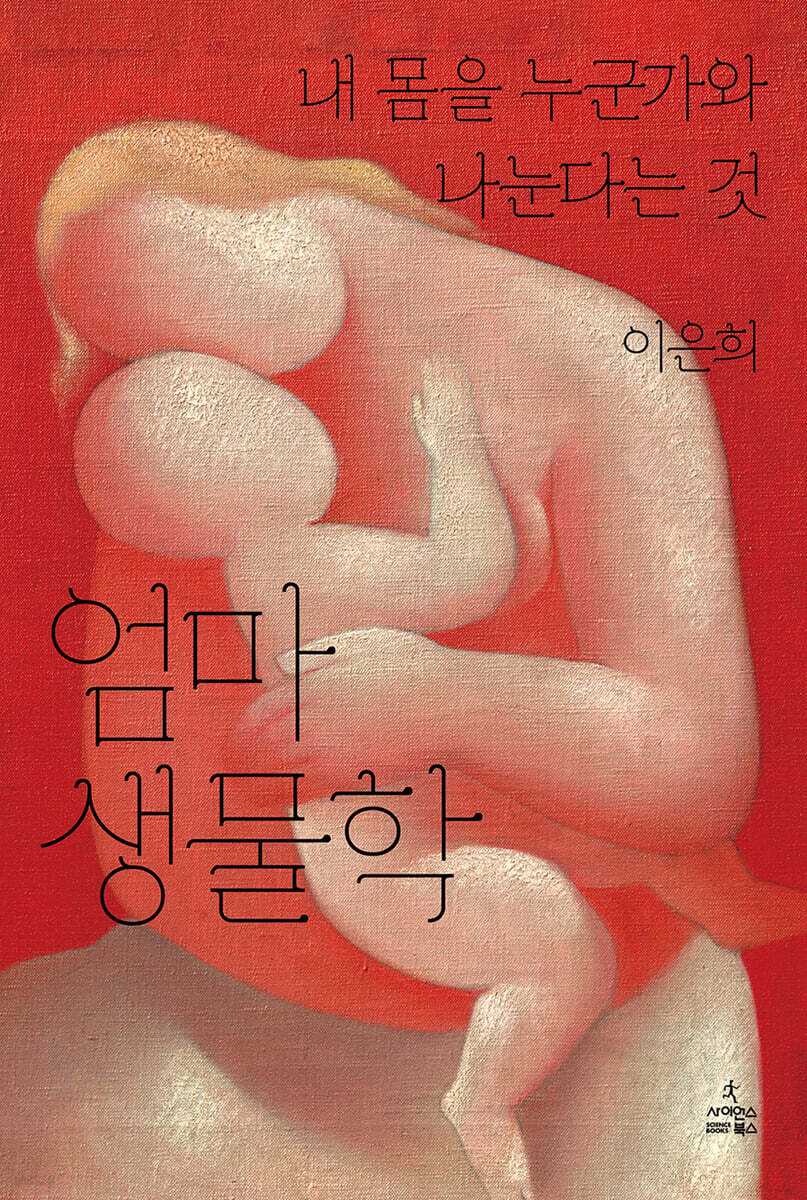
Mom Biology
 |
Description
Book Introduction
What it means to be a mother
What are the biological, ontological, and evolutionary implications?
And beyond that, the wisdom of my sister, mother, and grandmother
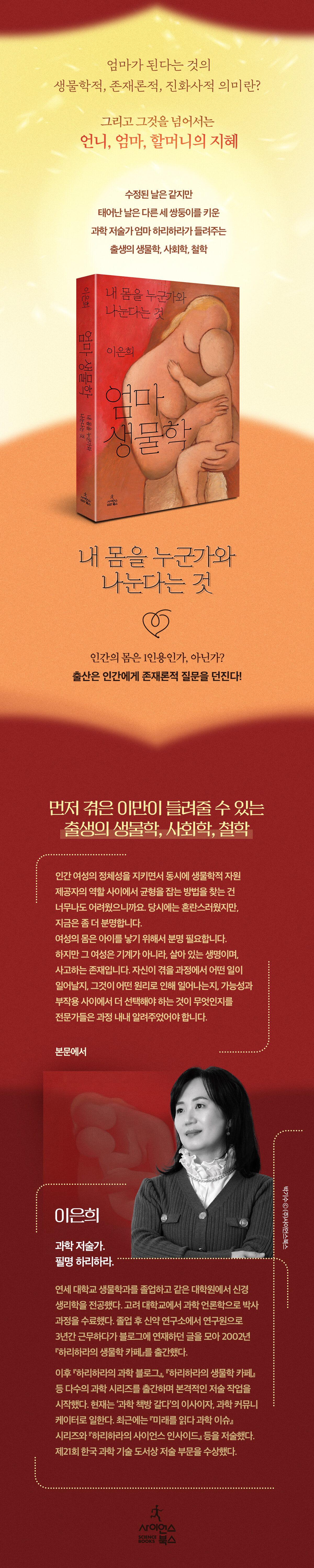
The world of human biology, experienced and learned firsthand by Harihara Lee Eun-hee, Korea's leading biology communicator.
A warm and thoughtful gift from Harihara, a mother, to adults who grew up reading books like Harihara's Biology Cafe and Harihara's Science Blog!
News of the death of Australian James Harrison (1936-2024) broke online on February 17, 2025.
He donated blood 1,173 times throughout his life, and is credited with saving over 2.4 million lives worldwide by donating plasma, a key ingredient in the treatment of a rare disease called hemolytic disease of the newborn.
Hemolytic disease of the newborn is a disease that occurs when the fetus' blood type is Rh- and the mother's blood type is Rh+, causing the mother's blood to attack the fetus, and can kill the fetus or cause a miscarriage.
Before a vaccine made from Harrison's plasma was developed, countless mothers lost their children.
Harrison's passing reminds us that there are unsung heroes who silently sustain our lives, but also that pregnancy is not a simple event to be celebrated or welcomed, but rather a biologically, medically risky, socially, and culturally complex event.
Because it is an astonishing event where a body that was once used by one person is suddenly shared by two or three people.
This time, science communicator and science writer Eunhee Lee's book, "Mom Biology: Sharing My Body with Someone Else," published by Science Books, addresses this very issue head-on: the issue of sharing one's once one-person body with one's child in order to become a mother.
This is a scientific essay that delves into the biological, evolutionary, medical, and philosophical issues of pregnancy and childbirth and their implications.
What are the biological, ontological, and evolutionary implications?
And beyond that, the wisdom of my sister, mother, and grandmother
The world of human biology, experienced and learned firsthand by Harihara Lee Eun-hee, Korea's leading biology communicator.
A warm and thoughtful gift from Harihara, a mother, to adults who grew up reading books like Harihara's Biology Cafe and Harihara's Science Blog!
News of the death of Australian James Harrison (1936-2024) broke online on February 17, 2025.
He donated blood 1,173 times throughout his life, and is credited with saving over 2.4 million lives worldwide by donating plasma, a key ingredient in the treatment of a rare disease called hemolytic disease of the newborn.
Hemolytic disease of the newborn is a disease that occurs when the fetus' blood type is Rh- and the mother's blood type is Rh+, causing the mother's blood to attack the fetus, and can kill the fetus or cause a miscarriage.
Before a vaccine made from Harrison's plasma was developed, countless mothers lost their children.
Harrison's passing reminds us that there are unsung heroes who silently sustain our lives, but also that pregnancy is not a simple event to be celebrated or welcomed, but rather a biologically, medically risky, socially, and culturally complex event.
Because it is an astonishing event where a body that was once used by one person is suddenly shared by two or three people.
This time, science communicator and science writer Eunhee Lee's book, "Mom Biology: Sharing My Body with Someone Else," published by Science Books, addresses this very issue head-on: the issue of sharing one's once one-person body with one's child in order to become a mother.
This is a scientific essay that delves into the biological, evolutionary, medical, and philosophical issues of pregnancy and childbirth and their implications.
- You can preview some of the book's contents.
Preview
index
Opening the story... 7
Part 1: Embrace
1.
Everything you do is natural... 19
2.
Know Your Body's Map... 27
3.
Eggs are not for digging up... 35
4.
Since when do we become human? ··· 43
5.
1 minute and 5 years... 51
6.
Morning sickness... 57
7.
Endometriosis... 65
8.
Endometrial Stimulation... 73
9.
Fetal Anomaly Screening: Screening and Confirmation... 81
10.
A splitting belly, a bent back... 89
11.
When you share your body with someone... 97
12.
The Best Gifts for Kids... 105
13.
Cord blood storage... 113
Part 2 Living
14.
Blood is red... 123
15.
Ovulation concealment... 131
16.
Equality and Fairness of the Body... 139
17.
Centering Burden and Choice... 151
18.
The Nature of Men and Women... 159
19.
Good Hand, Bad Hand, Weird Hand... 167
20.
Abolition of the Australian system and uterine transplants... 175
21.
Child's Words... 181
22.
Menopause: Does Old Age Make You No Longer a Woman? ··· 189
Part 3
23.
Birth Rate and Motherhood... 199
24.
Mammals, defined by their mammary glands... 209
25.
Embrace me warmly... 219
26.
The Birth of the Incubator... 227
27.
From Immunological Tolerance to Social Tolerance... 235
28.
About the Aftereffects... 243
29.
Misconceptions about Refrigerator Moms... 251
30.
Is Home Cooking the Answer? ··· 259
31.
Grandmother Hypothesis... 265
32.
What will happen to me after I die? ··· 271
Closing the story... 277
Notes and References ··· 279
Copyright of the illustration... 295
Search ··· 297
Part 1: Embrace
1.
Everything you do is natural... 19
2.
Know Your Body's Map... 27
3.
Eggs are not for digging up... 35
4.
Since when do we become human? ··· 43
5.
1 minute and 5 years... 51
6.
Morning sickness... 57
7.
Endometriosis... 65
8.
Endometrial Stimulation... 73
9.
Fetal Anomaly Screening: Screening and Confirmation... 81
10.
A splitting belly, a bent back... 89
11.
When you share your body with someone... 97
12.
The Best Gifts for Kids... 105
13.
Cord blood storage... 113
Part 2 Living
14.
Blood is red... 123
15.
Ovulation concealment... 131
16.
Equality and Fairness of the Body... 139
17.
Centering Burden and Choice... 151
18.
The Nature of Men and Women... 159
19.
Good Hand, Bad Hand, Weird Hand... 167
20.
Abolition of the Australian system and uterine transplants... 175
21.
Child's Words... 181
22.
Menopause: Does Old Age Make You No Longer a Woman? ··· 189
Part 3
23.
Birth Rate and Motherhood... 199
24.
Mammals, defined by their mammary glands... 209
25.
Embrace me warmly... 219
26.
The Birth of the Incubator... 227
27.
From Immunological Tolerance to Social Tolerance... 235
28.
About the Aftereffects... 243
29.
Misconceptions about Refrigerator Moms... 251
30.
Is Home Cooking the Answer? ··· 259
31.
Grandmother Hypothesis... 265
32.
What will happen to me after I die? ··· 271
Closing the story... 277
Notes and References ··· 279
Copyright of the illustration... 295
Search ··· 297
Detailed image
Publisher's Review
What it means to be a mother
What are the biological, ontological, and evolutionary implications?
And beyond that, the wisdom of my sister, mother, and grandmother
The world of human biology, experienced and learned firsthand by Harihara Lee Eun-hee, Korea's leading biology communicator.
A message to adults who grew up reading 『Harihara's Biology Cafe』, 『Harihara's Science Blog』, etc.
A warm and thoughtful gift from Mom Harihara!
News of the death of Australian James Harrison (1936-2024) broke online on February 17, 2025.
He donated blood 1,173 times throughout his life, and is credited with saving over 2.4 million lives worldwide by donating plasma, a key ingredient in the treatment of a rare disease called hemolytic disease of the newborn.
Hemolytic disease of the newborn is a disease that occurs when the fetus' blood type is Rh- and the mother's blood type is Rh+, causing the mother's blood to attack the fetus, and can kill the fetus or cause a miscarriage.
Before a vaccine made from Harrison's plasma was developed, countless mothers lost their children.
Harrison's passing reminds us that there are unsung heroes who silently sustain our lives, but also that pregnancy is not a simple event to be celebrated or welcomed, but rather a biologically, medically risky, socially, and culturally complex event.
Because it is an astonishing event where a body that was once used by one person is suddenly shared by two or three people.
This time, science communicator and science writer Eunhee Lee's book, "Mom Biology: Sharing My Body with Someone Else," published by Science Books, addresses this very issue head-on: the issue of sharing one's once one-person body with one's child in order to become a mother.
This is a scientific essay that delves into the biological, evolutionary, medical, and philosophical issues of pregnancy and childbirth and their implications.
There is no one in the world of science readers who does not know the name Eun-hee Lee, who has been active for over 20 years under the pen name 'Harihara' and is known as "a rare science writer who conveys hard and cold science in a warm and friendly way," mainly focusing on biological topics.
Her works include 『Harihara's Biology Cafe』 (Gungri, 2002), which played a significant role in popularizing biology at the turn of the 21st century, 『Harihara's Science 24 Hours』 (Biryongso, 2023), which summarizes scientific issues and controversies that young people and the general public must know, and 『Harihara's Science Battle』 (Biryongso, 2024), and her contributions can be found in various newspapers, broadcasts, and media.
He also serves as a director of Galda Science Bookstore, a science content production group.
In this new book, Eun-hee Lee uses her uniquely lively and comfortable writing style to unravel the science of becoming a mother and living as a mother.
Her other books, which delve into the latest science related to pregnancy and childbirth through extensive research and books, are similar to her other books, but there is one difference.
She uses her own body, that is, what she experienced and felt while pregnant and giving birth as another pillar, and combines it with information from papers and books.
Based on her own experience of giving birth to triplets who were conceived on the same day but born on different days, she scientifically and philosophically explores all the problems that mothers all over the world face in the process of human birth, from ovulation to conception, morning sickness to childbirth, and from the evolution of sexuality to gender conflict.
This book is literally “a place where biology learned from books evolves into biology experienced in the body!”
Raising triplets who were born on the same day but different days
The Biology, Sociology, and Philosophy of Birth from a Science Writer Mom
Turning page after page of the book of life I've experienced, I sought out the universal and commonalities explained by biological theories, while carefully examining whether there were any unique facts and experiences of my own that scientific theories had overlooked. I sought to reflect on and delineate the connections and differences between life and science.
Beyond simply presenting numbers and results, we wanted to make scientific knowledge a part of our lives by placing the people who live with those numbers and results at the center.
So, I hope that you, the readers, will read it with the feeling of adding your own page to the commonalities and uniqueness of the facts and experiences I share.
-In the text
Eun-hee Lee is a mother of three children.
They all had children through in vitro fertilization. Their first child was born from one of the fertilized eggs from their first pregnancy, and a few years later, they conceived twins from one of the fertilized eggs created when they had their first child, making a total of three children.
So, I became the mother of triplets who were conceived on the same day but born on different days.
During this process, I had to undergo all kinds of procedures performed at infertility hospitals, such as in vitro fertilization, ovulation induction, cryopreservation and disposal of surplus fertilized eggs and embryos, and endometrial stimulation. I also had to suffer from various pregnancy complications, from severe morning sickness to rectus abdominis separation, lumbar lordosis, gestational diabetes, and hyperthyroidism.
I meticulously document this unique experience of pregnancy and childbirth, delve into related research papers and writings, and weave a story about living with another life within my body.
This book comforts the anxious hearts of new mothers struggling between the cold maternity hospital delivery system and the indifference of those around them who do not share their pain, criticizes the exploitation of women's bodies in modern society that mines women's eggs and uteruses like mineral resources and treats them as factories producing future workers, and reflects on the social and cultural meaning of pregnancy, childbirth, and parenting. It is divided into 32 chapters, divided into Part 1, "To Embrace," Part 2, "To Live," and Part 3, "To Hold."
Eun-hee Lee emphasizes throughout the book that if we understand that “the pain of childbirth is not some mysterious original sin given by God, but rather a byproduct of the physical characteristics that mammals, living upright on a planet with gravity, evolved through natural selection to keep their fetuses safe until birth,” then “vague fears about pregnancy, childbirth, and parenting will likely decrease and the range of choices and understanding will likely expand.”
This solid scientific perspective, along with her own experiences of pregnancy and birth, analyzed based on this perspective, make this book a warm and thoughtful gift from Harihara to her readers who grew up reading books like Harihara's Biology Cafe and Harihara's Science Blog.
Finding a way to balance the role of provider of biological resources while maintaining the identity of a human woman was incredibly difficult.
It was confusing at the time, but it's a little clearer now.
A woman's body is clearly necessary for giving birth to a child.
But the woman is not a machine, she is a living, thinking being.
Experts should have informed you throughout the process what might happen, how it works, and what choices you have to make between the possibilities and the side effects.
─In the text
Is the human body one-person or not?
Childbirth poses existential questions to humans!
In this book, Eun-hee Lee defines pregnancy as a process of sharing a body that is fundamentally designed for one person with an extra something called a fetus.
This naturally puts a strain on the mother's body, but if the strain can be managed within limits and balanced, the health of both the mother and the fetus can be maintained.
In this book, Eunhee Lee introduces readers to ways to achieve this balance in the many situations they face during pregnancy and childbirth.
And we expand this discussion to consider not only the physiological and medical physical balance, but also the social and cultural issues that pregnancy, childbirth, and childcare bring about.
Of particular interest is Chapter 27, which proposes expanding the scientific concept of "immunological tolerance," which explains how a genetically half-human fetus overcomes its mother's immune rejection response and successfully establishes itself in the womb, into a social tolerance.
If the mother's immune system is not weakened to some extent during pregnancy, it may attack the fetus, which could potentially lead to an abortion.
However, if the mother's immune system is weakened too much, it can harm the mother's health and ultimately the health of the fetus.
So, the mother's immune system initially becomes less sensitive to detecting foreign substances, but once it detects them, it reacts strongly.
This precarious tug-of-war is called immunological tolerance.
This is why pregnant women sometimes show more severe symptoms than non-pregnant women, even if they have the same illness.
Eun-hee Lee argues that if we extend this principle of immunological tolerance—“appropriate tolerance and firm sanctions”—to society, we can expand social diversity.
The immunological tolerance that emerges during pregnancy may seem paradoxical at first glance, but it may also seem like the wisest way to deal with others.
Often, we are wary of strangers and reject or reject others without any particular reason simply because they are different from us.
But what if we applied immunological tolerance to real-world human relationships? We strive to acknowledge and accept the differences and diversity of those who are different from us, but when others commit transgressions that exceed established standards, we respond firmly, maintaining order within ourselves and society.
A balance of appropriate tolerance and firm sanctions—perhaps the secret to human survival—is the subtlety of that balance.
-In the text
In addition, the book expands the discussion to the physical differences between men and women, gender conflict, and issues of equality and fairness, using an episode where a woman asks her husband for a favor because she can't even open a can lid, and proposes a solution to resolve the gender conflict in modern society, where the "Hammurabi-style revenge that says, 'I've suffered this much so far, so you should suffer this much too'" is developing into hatred, based on the principle of sexual selection found in the mating process in nature. It also explores the truth and falsehood of uterine transplants and artificial wombs, which are proposed as a means to break the situation where the burden of pregnancy and childbirth is placed on only one sex, and takes an evolutionary view of the lives of women after menopause or menopause, thereby broadly and interestingly reflecting on the meaning of becoming a mother.
From ovulation to fertilization, from morning sickness to childbirth
From the evolution of sex to gender conflict
A scientific essay covering the science of human birth.
Wouldn't this book, which "organizes and sorts out the countless confusions felt in the process of carrying, giving birth to, and raising a child," be helpful to mothers and their spouses of our time who are now raising their children themselves and are worried about not being able to breastfeed, cook home-cooked meals, store umbilical cord blood, and worry that even the slightest problem with their child is their fault?
This book is the result of my own efforts to weave together scientific and personal perspectives on the changes and characteristics that a human being with a female body experiences as they go through biological reproduction.
I wanted to tie together the inevitable discrepancies that arise when objective knowledge and statistical data learned from books are implemented in each individual's body.
I can't say it was perfect, but personally, I think it wasn't a failure at least because the process of writing the book helped me organize and sort out the countless confusions I felt while carrying, giving birth to, and raising a child.
-In the text
What are the biological, ontological, and evolutionary implications?
And beyond that, the wisdom of my sister, mother, and grandmother
The world of human biology, experienced and learned firsthand by Harihara Lee Eun-hee, Korea's leading biology communicator.
A message to adults who grew up reading 『Harihara's Biology Cafe』, 『Harihara's Science Blog』, etc.
A warm and thoughtful gift from Mom Harihara!
News of the death of Australian James Harrison (1936-2024) broke online on February 17, 2025.
He donated blood 1,173 times throughout his life, and is credited with saving over 2.4 million lives worldwide by donating plasma, a key ingredient in the treatment of a rare disease called hemolytic disease of the newborn.
Hemolytic disease of the newborn is a disease that occurs when the fetus' blood type is Rh- and the mother's blood type is Rh+, causing the mother's blood to attack the fetus, and can kill the fetus or cause a miscarriage.
Before a vaccine made from Harrison's plasma was developed, countless mothers lost their children.
Harrison's passing reminds us that there are unsung heroes who silently sustain our lives, but also that pregnancy is not a simple event to be celebrated or welcomed, but rather a biologically, medically risky, socially, and culturally complex event.
Because it is an astonishing event where a body that was once used by one person is suddenly shared by two or three people.
This time, science communicator and science writer Eunhee Lee's book, "Mom Biology: Sharing My Body with Someone Else," published by Science Books, addresses this very issue head-on: the issue of sharing one's once one-person body with one's child in order to become a mother.
This is a scientific essay that delves into the biological, evolutionary, medical, and philosophical issues of pregnancy and childbirth and their implications.
There is no one in the world of science readers who does not know the name Eun-hee Lee, who has been active for over 20 years under the pen name 'Harihara' and is known as "a rare science writer who conveys hard and cold science in a warm and friendly way," mainly focusing on biological topics.
Her works include 『Harihara's Biology Cafe』 (Gungri, 2002), which played a significant role in popularizing biology at the turn of the 21st century, 『Harihara's Science 24 Hours』 (Biryongso, 2023), which summarizes scientific issues and controversies that young people and the general public must know, and 『Harihara's Science Battle』 (Biryongso, 2024), and her contributions can be found in various newspapers, broadcasts, and media.
He also serves as a director of Galda Science Bookstore, a science content production group.
In this new book, Eun-hee Lee uses her uniquely lively and comfortable writing style to unravel the science of becoming a mother and living as a mother.
Her other books, which delve into the latest science related to pregnancy and childbirth through extensive research and books, are similar to her other books, but there is one difference.
She uses her own body, that is, what she experienced and felt while pregnant and giving birth as another pillar, and combines it with information from papers and books.
Based on her own experience of giving birth to triplets who were conceived on the same day but born on different days, she scientifically and philosophically explores all the problems that mothers all over the world face in the process of human birth, from ovulation to conception, morning sickness to childbirth, and from the evolution of sexuality to gender conflict.
This book is literally “a place where biology learned from books evolves into biology experienced in the body!”
Raising triplets who were born on the same day but different days
The Biology, Sociology, and Philosophy of Birth from a Science Writer Mom
Turning page after page of the book of life I've experienced, I sought out the universal and commonalities explained by biological theories, while carefully examining whether there were any unique facts and experiences of my own that scientific theories had overlooked. I sought to reflect on and delineate the connections and differences between life and science.
Beyond simply presenting numbers and results, we wanted to make scientific knowledge a part of our lives by placing the people who live with those numbers and results at the center.
So, I hope that you, the readers, will read it with the feeling of adding your own page to the commonalities and uniqueness of the facts and experiences I share.
-In the text
Eun-hee Lee is a mother of three children.
They all had children through in vitro fertilization. Their first child was born from one of the fertilized eggs from their first pregnancy, and a few years later, they conceived twins from one of the fertilized eggs created when they had their first child, making a total of three children.
So, I became the mother of triplets who were conceived on the same day but born on different days.
During this process, I had to undergo all kinds of procedures performed at infertility hospitals, such as in vitro fertilization, ovulation induction, cryopreservation and disposal of surplus fertilized eggs and embryos, and endometrial stimulation. I also had to suffer from various pregnancy complications, from severe morning sickness to rectus abdominis separation, lumbar lordosis, gestational diabetes, and hyperthyroidism.
I meticulously document this unique experience of pregnancy and childbirth, delve into related research papers and writings, and weave a story about living with another life within my body.
This book comforts the anxious hearts of new mothers struggling between the cold maternity hospital delivery system and the indifference of those around them who do not share their pain, criticizes the exploitation of women's bodies in modern society that mines women's eggs and uteruses like mineral resources and treats them as factories producing future workers, and reflects on the social and cultural meaning of pregnancy, childbirth, and parenting. It is divided into 32 chapters, divided into Part 1, "To Embrace," Part 2, "To Live," and Part 3, "To Hold."
Eun-hee Lee emphasizes throughout the book that if we understand that “the pain of childbirth is not some mysterious original sin given by God, but rather a byproduct of the physical characteristics that mammals, living upright on a planet with gravity, evolved through natural selection to keep their fetuses safe until birth,” then “vague fears about pregnancy, childbirth, and parenting will likely decrease and the range of choices and understanding will likely expand.”
This solid scientific perspective, along with her own experiences of pregnancy and birth, analyzed based on this perspective, make this book a warm and thoughtful gift from Harihara to her readers who grew up reading books like Harihara's Biology Cafe and Harihara's Science Blog.
Finding a way to balance the role of provider of biological resources while maintaining the identity of a human woman was incredibly difficult.
It was confusing at the time, but it's a little clearer now.
A woman's body is clearly necessary for giving birth to a child.
But the woman is not a machine, she is a living, thinking being.
Experts should have informed you throughout the process what might happen, how it works, and what choices you have to make between the possibilities and the side effects.
─In the text
Is the human body one-person or not?
Childbirth poses existential questions to humans!
In this book, Eun-hee Lee defines pregnancy as a process of sharing a body that is fundamentally designed for one person with an extra something called a fetus.
This naturally puts a strain on the mother's body, but if the strain can be managed within limits and balanced, the health of both the mother and the fetus can be maintained.
In this book, Eunhee Lee introduces readers to ways to achieve this balance in the many situations they face during pregnancy and childbirth.
And we expand this discussion to consider not only the physiological and medical physical balance, but also the social and cultural issues that pregnancy, childbirth, and childcare bring about.
Of particular interest is Chapter 27, which proposes expanding the scientific concept of "immunological tolerance," which explains how a genetically half-human fetus overcomes its mother's immune rejection response and successfully establishes itself in the womb, into a social tolerance.
If the mother's immune system is not weakened to some extent during pregnancy, it may attack the fetus, which could potentially lead to an abortion.
However, if the mother's immune system is weakened too much, it can harm the mother's health and ultimately the health of the fetus.
So, the mother's immune system initially becomes less sensitive to detecting foreign substances, but once it detects them, it reacts strongly.
This precarious tug-of-war is called immunological tolerance.
This is why pregnant women sometimes show more severe symptoms than non-pregnant women, even if they have the same illness.
Eun-hee Lee argues that if we extend this principle of immunological tolerance—“appropriate tolerance and firm sanctions”—to society, we can expand social diversity.
The immunological tolerance that emerges during pregnancy may seem paradoxical at first glance, but it may also seem like the wisest way to deal with others.
Often, we are wary of strangers and reject or reject others without any particular reason simply because they are different from us.
But what if we applied immunological tolerance to real-world human relationships? We strive to acknowledge and accept the differences and diversity of those who are different from us, but when others commit transgressions that exceed established standards, we respond firmly, maintaining order within ourselves and society.
A balance of appropriate tolerance and firm sanctions—perhaps the secret to human survival—is the subtlety of that balance.
-In the text
In addition, the book expands the discussion to the physical differences between men and women, gender conflict, and issues of equality and fairness, using an episode where a woman asks her husband for a favor because she can't even open a can lid, and proposes a solution to resolve the gender conflict in modern society, where the "Hammurabi-style revenge that says, 'I've suffered this much so far, so you should suffer this much too'" is developing into hatred, based on the principle of sexual selection found in the mating process in nature. It also explores the truth and falsehood of uterine transplants and artificial wombs, which are proposed as a means to break the situation where the burden of pregnancy and childbirth is placed on only one sex, and takes an evolutionary view of the lives of women after menopause or menopause, thereby broadly and interestingly reflecting on the meaning of becoming a mother.
From ovulation to fertilization, from morning sickness to childbirth
From the evolution of sex to gender conflict
A scientific essay covering the science of human birth.
Wouldn't this book, which "organizes and sorts out the countless confusions felt in the process of carrying, giving birth to, and raising a child," be helpful to mothers and their spouses of our time who are now raising their children themselves and are worried about not being able to breastfeed, cook home-cooked meals, store umbilical cord blood, and worry that even the slightest problem with their child is their fault?
This book is the result of my own efforts to weave together scientific and personal perspectives on the changes and characteristics that a human being with a female body experiences as they go through biological reproduction.
I wanted to tie together the inevitable discrepancies that arise when objective knowledge and statistical data learned from books are implemented in each individual's body.
I can't say it was perfect, but personally, I think it wasn't a failure at least because the process of writing the book helped me organize and sort out the countless confusions I felt while carrying, giving birth to, and raising a child.
-In the text
GOODS SPECIFICS
- Date of issue: February 28, 2025
- Page count, weight, size: 304 pages | 434g | 148*220*20mm
- ISBN13: 9791194087083
- ISBN10: 1194087086
You may also like
카테고리
korean


korean

![GQ KOREA Mark (Monthly): December [2025]](http://librairie.coreenne.fr/cdn/shop/files/8ef265dbbfbf186523ed75ba7319009d.jpg?v=1765340328&width=3840)


