

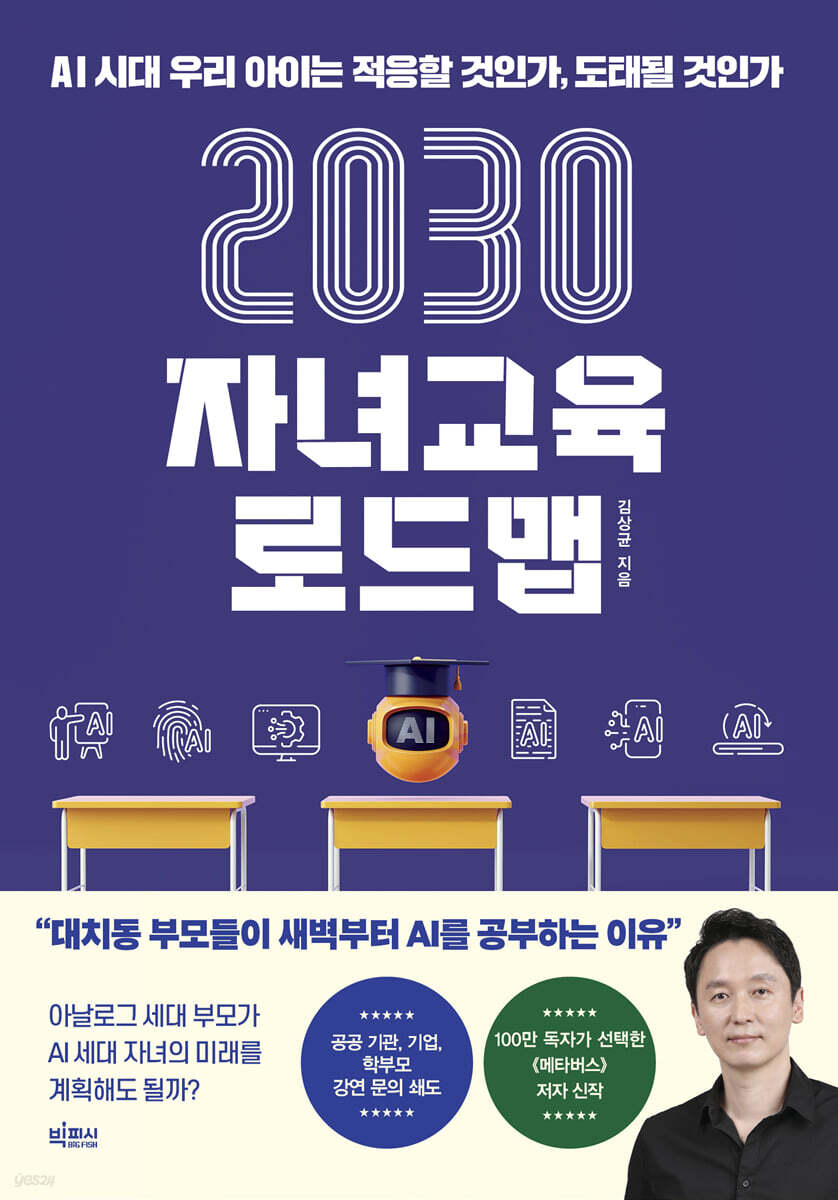
2030 Children's Education Roadmap
 |
Description
Book Introduction
Don't teach your children with the same educational methods from 20 years ago. "The department and job you're aiming for now will mostly disappear in 10 years." * Inquiries about lectures for public institutions, companies, and parents are flooding in. * New work by the author of "Metaverse," chosen by 1 million readers * Includes a checklist of our children's future capabilities Which jobs will survive in the AI era, and which new ones will emerge? What skills will the universities and companies of the future seek? How and what should I teach my children to turn this massive change into opportunities? Can I plan for my child's future in the AI era based on past experiences and knowledge? Professor Kim Sang-gyun, a pioneer in the fields of artificial intelligence, the metaverse, and future education, is asked this question countless times these days. In this age of rapidly changing technology, parents are at a loss as to how to guide their children's college entrance exams and career paths when their own future is uncertain. This book was written to answer these questions. If you want to raise children who can collaborate effectively with AI and maximize their potential amidst the surprising and terrifying technological changes, you'll find the answer in this book, which offers a broad and profound perspective on the future of education. |
- You can preview some of the book's contents.
Preview
index
prolog
Now, a child who only studies well is dangerous.
Chapter 1. How Will Education and Careers Change in the AI Era?
My child's job in 10 years is not available now.
Recruitment requirements becoming more important than a Seoul National University degree
Doctors, accountants, lawyers… the professions most likely to be replaced soonest
What will be the highest-paying job in the AI era?
The change in classroom instruction has begun.
Story.
S Company Recruitment System
Chapter 2.
What is the problem with our education and how can we solve it?
Children who waste time on knowledge that will not be used
The most important qualities for talent that companies consider most important
Children who adapt to the AI era vs. those who are left behind
Don't raise your children using the successful methods of the past.
In an age of disconnection, skills become increasingly important.
Story. A child living with an AI robot
Chapter 3.
What kind of talent will universities and companies be looking for in the future?
A person who enjoys challenges and explores various fields
A person who questions and takes the lead instead of being dragged along
A person with better social skills than intellectual ability
A person who judges and takes responsibility with his own head
A flexible person who can move by pulling out the roots
+ How to develop the five competencies of future talent
+ Our Child's Future Competency Checklist
Story.
A student-led university of the future
Chapter 4.
How will the analog generation raise the AI generation?
To bridge the gap between the two worlds of parents and children
Let's throw away Daechi-dong Mom's schedule.
How to Raise a Child Who Won't Be Fooled by AI
Parents' attitudes that turn great change into opportunities
A parent who studies is the best teacher.
Story.
The role of professors changes
Chapter 5. AI Education: What and How to Teach It?
Why AI Tools Shouldn't Be the Only Thing You Can Teach
Developing your thinking skills through discussions with AI
Children who mistake AI-written text for their own
What it means to create art with AI
The best tool to develop problem-solving skills
Story.
The child who grew up to be a unicorn
Now, a child who only studies well is dangerous.
Chapter 1. How Will Education and Careers Change in the AI Era?
My child's job in 10 years is not available now.
Recruitment requirements becoming more important than a Seoul National University degree
Doctors, accountants, lawyers… the professions most likely to be replaced soonest
What will be the highest-paying job in the AI era?
The change in classroom instruction has begun.
Story.
S Company Recruitment System
Chapter 2.
What is the problem with our education and how can we solve it?
Children who waste time on knowledge that will not be used
The most important qualities for talent that companies consider most important
Children who adapt to the AI era vs. those who are left behind
Don't raise your children using the successful methods of the past.
In an age of disconnection, skills become increasingly important.
Story. A child living with an AI robot
Chapter 3.
What kind of talent will universities and companies be looking for in the future?
A person who enjoys challenges and explores various fields
A person who questions and takes the lead instead of being dragged along
A person with better social skills than intellectual ability
A person who judges and takes responsibility with his own head
A flexible person who can move by pulling out the roots
+ How to develop the five competencies of future talent
+ Our Child's Future Competency Checklist
Story.
A student-led university of the future
Chapter 4.
How will the analog generation raise the AI generation?
To bridge the gap between the two worlds of parents and children
Let's throw away Daechi-dong Mom's schedule.
How to Raise a Child Who Won't Be Fooled by AI
Parents' attitudes that turn great change into opportunities
A parent who studies is the best teacher.
Story.
The role of professors changes
Chapter 5. AI Education: What and How to Teach It?
Why AI Tools Shouldn't Be the Only Thing You Can Teach
Developing your thinking skills through discussions with AI
Children who mistake AI-written text for their own
What it means to create art with AI
The best tool to develop problem-solving skills
Story.
The child who grew up to be a unicorn
Detailed image

Into the book
According to research by the IMF, a whopping 40% of jobs worldwide are threatened by AI.
The report estimates that 60% of jobs in developed countries could be affected by AI.
About half of the jobs will be improved by AI, but the other half will be replaced by AI, leading to lower wages and fewer jobs.
In extreme cases, some argue that some jobs will disappear.
In addition, various numbers threaten us.
They say that not 60%, but 80% of jobs are at risk, or that 14 million, or even 300 million jobs are affected.
First of all, please forget all about these numbers.
Why? Because we only talk about things that disappear.
---“Doctors, accountants, lawyers… Among the professions that will be replaced the fastest”
Although it will take time for digital textbooks to be fully implemented, the winds of change have begun to blow in the educational field.
As teachers increasingly use digital devices in class, students will also need to improve their digital device skills.
This doesn't mean we should use digital devices more.
This means that we need to efficiently utilize paper books, digital devices, and AI tools.
Parents must also be aware of the direction of these changes and how to respond to them, and prepare accordingly.
I don't think classes that utilize AI digital textbooks, AI, and other edutech can be judged as good or bad based solely on the material itself.
What matters is not the technology or the device.
What matters is what we pursue with it, how we create learning that is truly for students, not just superficial glamour.
---From "The Change in Classroom Instruction Has Begun"
When we survey executives, they say that the qualities of a good talent are cooperation and communication skills.
Because cooperation and communication skills are the foundation for achieving good results.
But, unfortunately and fearfully, our children are increasingly losing that ability.
We send flashy messages with our thumbs, use various emoticons and symbols, and even communicate with AI chatbots, but we are becoming people who cannot express our feelings in detail or deeply read the minds of others.
They are growing up in contrast to those who are viewed as talented in society.
---From "The most important qualities for talent that companies consider"
This does not mean, however, that humans do not need to develop the capacity to collect, organize, analyze, and refine vast amounts of knowledge and data.
However, while everyone in an organization, except for a few decision-makers and powerful leaders, is currently focused solely on this task, the situation is already changing. To be able to verify and judge the information refined by AI, we must train ourselves to do the same.
But we must not stop at just such training.
A key competency in our education today is the ability to ask new questions about the knowledge refined by AI.
---From "People who ask questions and lead instead of being dragged along"
When many changes occur in environmental factors, the greatest danger is not the rapidly changing environment itself, but the attitude of individuals who want to live tomorrow with yesterday's habits.
Such individuals will be eliminated from evolution and disappear. Individuals cannot control the rapidly changing environment centered around AI.
Our children should not be like trees rooted in one soil.
You have to be the kind of person who can uproot yourself and move if necessary.
---From "A flexible person who can move by pulling out all the roots"
Recently, we've seen children being taught various AI tools, such as drawing, music creation, and writing. It seems like something we need to do in the AI era, but these tools aren't that difficult to learn, children find them engaging, and the results are surprisingly good.
But here's a point to note: AI tools have far more capabilities and utility than parents might have anticipated or guessed.
It would be great to learn its functions and use them to your advantage, but there are many cases where AI is used in a way that actually undermines one's abilities.
Since you need to know the functions to utilize them, it is of course necessary to go through a process of learning the basic functions, but it is much more important to develop the ability of children to determine what and how to use the functions of AI tools.
---From "Why AI Tools Should Not Be the Only Taught"
The interactive learning that took place in Plato's Academy is being replicated today as interactive learning with AI.
Children actively engage in learning through conversations with AI, which helps them internalize knowledge more effectively than traditional one-way lectures.
If utilized well, the goals and effects of AI-based learning are no different from those of the education of ancient Greek philosophers.
These include improving critical thinking skills, internalizing knowledge, improving communication skills, providing personalized learning experiences, and motivating students to continue learning.
The report estimates that 60% of jobs in developed countries could be affected by AI.
About half of the jobs will be improved by AI, but the other half will be replaced by AI, leading to lower wages and fewer jobs.
In extreme cases, some argue that some jobs will disappear.
In addition, various numbers threaten us.
They say that not 60%, but 80% of jobs are at risk, or that 14 million, or even 300 million jobs are affected.
First of all, please forget all about these numbers.
Why? Because we only talk about things that disappear.
---“Doctors, accountants, lawyers… Among the professions that will be replaced the fastest”
Although it will take time for digital textbooks to be fully implemented, the winds of change have begun to blow in the educational field.
As teachers increasingly use digital devices in class, students will also need to improve their digital device skills.
This doesn't mean we should use digital devices more.
This means that we need to efficiently utilize paper books, digital devices, and AI tools.
Parents must also be aware of the direction of these changes and how to respond to them, and prepare accordingly.
I don't think classes that utilize AI digital textbooks, AI, and other edutech can be judged as good or bad based solely on the material itself.
What matters is not the technology or the device.
What matters is what we pursue with it, how we create learning that is truly for students, not just superficial glamour.
---From "The Change in Classroom Instruction Has Begun"
When we survey executives, they say that the qualities of a good talent are cooperation and communication skills.
Because cooperation and communication skills are the foundation for achieving good results.
But, unfortunately and fearfully, our children are increasingly losing that ability.
We send flashy messages with our thumbs, use various emoticons and symbols, and even communicate with AI chatbots, but we are becoming people who cannot express our feelings in detail or deeply read the minds of others.
They are growing up in contrast to those who are viewed as talented in society.
---From "The most important qualities for talent that companies consider"
This does not mean, however, that humans do not need to develop the capacity to collect, organize, analyze, and refine vast amounts of knowledge and data.
However, while everyone in an organization, except for a few decision-makers and powerful leaders, is currently focused solely on this task, the situation is already changing. To be able to verify and judge the information refined by AI, we must train ourselves to do the same.
But we must not stop at just such training.
A key competency in our education today is the ability to ask new questions about the knowledge refined by AI.
---From "People who ask questions and lead instead of being dragged along"
When many changes occur in environmental factors, the greatest danger is not the rapidly changing environment itself, but the attitude of individuals who want to live tomorrow with yesterday's habits.
Such individuals will be eliminated from evolution and disappear. Individuals cannot control the rapidly changing environment centered around AI.
Our children should not be like trees rooted in one soil.
You have to be the kind of person who can uproot yourself and move if necessary.
---From "A flexible person who can move by pulling out all the roots"
Recently, we've seen children being taught various AI tools, such as drawing, music creation, and writing. It seems like something we need to do in the AI era, but these tools aren't that difficult to learn, children find them engaging, and the results are surprisingly good.
But here's a point to note: AI tools have far more capabilities and utility than parents might have anticipated or guessed.
It would be great to learn its functions and use them to your advantage, but there are many cases where AI is used in a way that actually undermines one's abilities.
Since you need to know the functions to utilize them, it is of course necessary to go through a process of learning the basic functions, but it is much more important to develop the ability of children to determine what and how to use the functions of AI tools.
---From "Why AI Tools Should Not Be the Only Taught"
The interactive learning that took place in Plato's Academy is being replicated today as interactive learning with AI.
Children actively engage in learning through conversations with AI, which helps them internalize knowledge more effectively than traditional one-way lectures.
If utilized well, the goals and effects of AI-based learning are no different from those of the education of ancient Greek philosophers.
These include improving critical thinking skills, internalizing knowledge, improving communication skills, providing personalized learning experiences, and motivating students to continue learning.
---From "Developing Thinking Power through Discussion with AI"
Publisher's Review
Why Daechi-dong parents study AI from dawn
Can parents of the analog generation plan for the future of their AI generation children?
* Inquiries about lectures for public institutions, companies, and parents are flooding in.
* New work by the author of "Metaverse," chosen by 1 million readers
* Includes a checklist of our children's future capabilities
According to research by the IMF, a whopping 40% of jobs worldwide are threatened by AI.
There is also talk that 14 million jobs will disappear in the next five years.
Parents who want their children to have good jobs and stable lives are concerned about how to plan for their children's future in these rapidly changing times.
It is questionable whether we can even consider the future paths of children living in the AI era based on past experiences and knowledge.
What jobs will survive in the future, and what new ones will emerge? What skills will the universities and companies of the future seek? What should I teach my children to help them turn this massive change into an opportunity?
Professor Sang-Kyun Kim, a pioneer in the fields of artificial intelligence, the metaverse, and future education, published "2030 Child Education Roadmap" to address the concerns of parents facing these issues.
As an educator who has always shared students' career concerns, and through collaborations with various companies, the author, who understands the changing industrial landscape and the talent they seek better than anyone else, has included in this book the most pressing concerns he has encountered at the forefront of technology, education, and industry.
If you want to raise children who can collaborate effectively with AI and maximize their potential amidst the surprising and terrifying technological changes, you'll find the answer in this book, which offers a broad and profound perspective on the future of education.
Public institutions, companies, and parents are flooding in with inquiries about lectures!
Answering Parents' Questions About College Entrance Exams and Career Preparation
These days, the author receives many requests to give lectures on education and career paths in the AI era.
There are common questions I always get asked in my lectures to parents and educators, and I've distilled the essence of those questions into the topics of each chapter in this book.
Chapter 1 examines how education and jobs will change in the AI era.
We talk about how the world of work is changing in response to the changing industrial landscape, and what changes are beginning to occur in schools as a result.
Chapter 2 points out the problems of the current education system that is unable to adapt to these changes and suggests the need for fundamental educational innovation.
Chapter 3 examines how the talent desired by universities and companies is changing and proposes five core competencies for future talent.
Chapter 4 covers how parents from the analog generation can communicate with and grow together with their AI generation children.
The final five chapters present concrete ways to implement AI education at home and in schools from the perspectives of thinking, writing, art, and problem-solving.
At the end of each chapter, a short story depicts our daily lives in the near future.
Through this, we can get a glimpse into corporate hiring processes, what a typical home looks like with the proliferation of humanoid robots, and the changing roles of university lectures and professors.
Adapt to the AI Era or Be Left Behind?
A must-read for parents who want to turn huge changes into opportunities!
In early 2023, shortly after ChatGPT was released, parents in Gangnam left their homes at dawn to attend AI lectures.
Now, two years later, savvy parents are using AI to help their children learn.
If there are parents who have been blind to change until now, they can no longer do so.
This is because AI digital textbooks will be introduced starting in 2025.
Despite some controversy, the policy was implemented, and a major transformation in education began both inside and outside of schools.
So what should we do now? The author states, "Children without identity will inevitably be left behind in competition with AI," and recommends exploring children's identities using the GEM method.
Additionally, the "Our Child's Future Competency Checklist" helps you identify your child's strengths and areas for improvement, and provides specific guidance on how to develop the five key competencies needed in the AI era.
At the end of the book, the STAR approach to expanding intelligence with AI is presented, introducing secrets to maximizing a child's capabilities with AI tools.
The capabilities and usability of AI tools exceed our expectations.
Children who utilize this information to their advantage may develop abilities several times greater than their natural intelligence, while those who simply absorb information from AI may become useful limbs for the AI brain. Will we raise children who can adapt to the AI era, or will we raise them to be left behind?
Only parents who are able to read the changing times ahead of others can protect their children's future.
Can parents of the analog generation plan for the future of their AI generation children?
* Inquiries about lectures for public institutions, companies, and parents are flooding in.
* New work by the author of "Metaverse," chosen by 1 million readers
* Includes a checklist of our children's future capabilities
According to research by the IMF, a whopping 40% of jobs worldwide are threatened by AI.
There is also talk that 14 million jobs will disappear in the next five years.
Parents who want their children to have good jobs and stable lives are concerned about how to plan for their children's future in these rapidly changing times.
It is questionable whether we can even consider the future paths of children living in the AI era based on past experiences and knowledge.
What jobs will survive in the future, and what new ones will emerge? What skills will the universities and companies of the future seek? What should I teach my children to help them turn this massive change into an opportunity?
Professor Sang-Kyun Kim, a pioneer in the fields of artificial intelligence, the metaverse, and future education, published "2030 Child Education Roadmap" to address the concerns of parents facing these issues.
As an educator who has always shared students' career concerns, and through collaborations with various companies, the author, who understands the changing industrial landscape and the talent they seek better than anyone else, has included in this book the most pressing concerns he has encountered at the forefront of technology, education, and industry.
If you want to raise children who can collaborate effectively with AI and maximize their potential amidst the surprising and terrifying technological changes, you'll find the answer in this book, which offers a broad and profound perspective on the future of education.
Public institutions, companies, and parents are flooding in with inquiries about lectures!
Answering Parents' Questions About College Entrance Exams and Career Preparation
These days, the author receives many requests to give lectures on education and career paths in the AI era.
There are common questions I always get asked in my lectures to parents and educators, and I've distilled the essence of those questions into the topics of each chapter in this book.
Chapter 1 examines how education and jobs will change in the AI era.
We talk about how the world of work is changing in response to the changing industrial landscape, and what changes are beginning to occur in schools as a result.
Chapter 2 points out the problems of the current education system that is unable to adapt to these changes and suggests the need for fundamental educational innovation.
Chapter 3 examines how the talent desired by universities and companies is changing and proposes five core competencies for future talent.
Chapter 4 covers how parents from the analog generation can communicate with and grow together with their AI generation children.
The final five chapters present concrete ways to implement AI education at home and in schools from the perspectives of thinking, writing, art, and problem-solving.
At the end of each chapter, a short story depicts our daily lives in the near future.
Through this, we can get a glimpse into corporate hiring processes, what a typical home looks like with the proliferation of humanoid robots, and the changing roles of university lectures and professors.
Adapt to the AI Era or Be Left Behind?
A must-read for parents who want to turn huge changes into opportunities!
In early 2023, shortly after ChatGPT was released, parents in Gangnam left their homes at dawn to attend AI lectures.
Now, two years later, savvy parents are using AI to help their children learn.
If there are parents who have been blind to change until now, they can no longer do so.
This is because AI digital textbooks will be introduced starting in 2025.
Despite some controversy, the policy was implemented, and a major transformation in education began both inside and outside of schools.
So what should we do now? The author states, "Children without identity will inevitably be left behind in competition with AI," and recommends exploring children's identities using the GEM method.
Additionally, the "Our Child's Future Competency Checklist" helps you identify your child's strengths and areas for improvement, and provides specific guidance on how to develop the five key competencies needed in the AI era.
At the end of the book, the STAR approach to expanding intelligence with AI is presented, introducing secrets to maximizing a child's capabilities with AI tools.
The capabilities and usability of AI tools exceed our expectations.
Children who utilize this information to their advantage may develop abilities several times greater than their natural intelligence, while those who simply absorb information from AI may become useful limbs for the AI brain. Will we raise children who can adapt to the AI era, or will we raise them to be left behind?
Only parents who are able to read the changing times ahead of others can protect their children's future.
GOODS SPECIFICS
- Date of issue: October 31, 2024
- Page count, weight, size: 306 pages | 516g | 148*210*18mm
- ISBN13: 9791194033424
- ISBN10: 1194033423
You may also like
카테고리
korean


korean

![GQ KOREA Mark (Monthly): December [2025]](http://librairie.coreenne.fr/cdn/shop/files/8ef265dbbfbf186523ed75ba7319009d.jpg?v=1765340328&width=3840)


