

Support structure
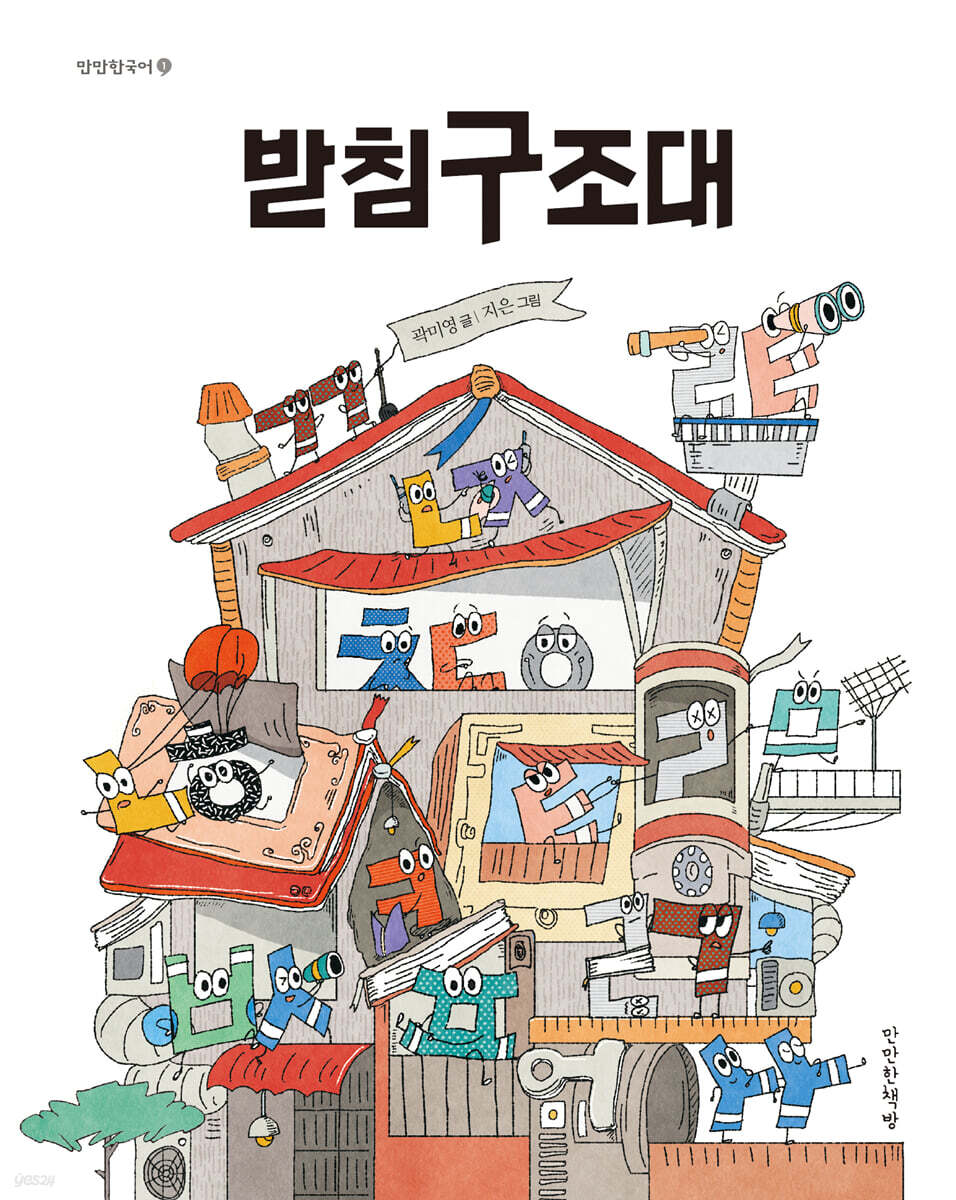 |
Description
Book Introduction
Just one wrong fulcrum, and the world is in shambles.
“Really? How could that happen?”
“Don’t worry.
Friends!!”
Thanks to the amazing performance of the support structure
All the tangled issues are resolved in one go.
The first volume of the "Easy Korean" series, "Consonant Structure," aims to present consonants, which are the most basic consonants in Korean, but can be as boring to children as the multiplication table that must be memorized, in an easy and fun way.
The author's long history of creating children's books, his captivating storylines that capture children's interest, and his understanding of the Korean language all come together to make studying consonants fun and enjoyable.
“Really? How could that happen?”
“Don’t worry.
Friends!!”
Thanks to the amazing performance of the support structure
All the tangled issues are resolved in one go.
The first volume of the "Easy Korean" series, "Consonant Structure," aims to present consonants, which are the most basic consonants in Korean, but can be as boring to children as the multiplication table that must be memorized, in an easy and fun way.
The author's long history of creating children's books, his captivating storylines that capture children's interest, and his understanding of the Korean language all come together to make studying consonants fun and enjoyable.
- You can preview some of the book's contents.
Preview
Detailed image

Publisher's Review
Are you having trouble with the final consonants? No, final consonants are your friends!
An excellent book that helps you learn difficult consonants in an easy and fun way!
"Can I come into the lawn? No, I can't." "The clouds that blocked the sun disappeared, and the world became clear." "It won't become clear if you stay alone."
It gets clean when you wipe it together.' Thanks to who, thanks to the 'support structure'.
『Bottom Structure』 introduces the role of the bottom consonant, one of the unique features of the Korean language, with brilliant ideas, such as situations where the meaning is reversed with a single bottom consonant, or the charm of reversing the content by using a different bottom consonant.
This book explains the final consonants in an easy and fun story format, so it is suitable for children who find studying final consonants boring or difficult, and it is easy to understand.
Giyeok, nieun, digeul, rieul, mieum, bieup, siot, ieung, jieut, chieut, kieut, tieut, pieut, and hieut come together to create a consonant structure, and it is fun to guess which consonant should be added to create the right content depending on the situation, as if solving a quiz.
Rather than a spoon-fed learning method of memorizing and repeating things separately, it is a method of finding and showing the appropriate fulcrum within the story structure.
When Mrs. Kangaroo, who has a sore back and legs from holding her baby kangaroo, runs to her and tells her to sit on a chair, 'Chi-chit' ends up hurting her buttocks. As the child watches the mother kangaroo, he understands that the word 'sit' requires 'Ji-chit' and not 'Chi-chit'.
The part where 'Chi-jit', who is depressed about being useless, is told to 'shoo away' the birds for the sake of the rice plants that are screaming that the birds are pecking at them, reminds us of the clever way 'Chi-jit' is used.
From the names and shapes of basic letters to overlapping
The amazing world of supports revealed by the support structure!
Could the shapes of consonants ever be this systematic and beautiful? The appeal of this book begins with the self-introductions of the members of the consonant structure team.
The author's amazing insight into consonant shapes is highlighted in the introduction, such as when Giyeok (ㄱ) bows to the ground, it becomes Siot (ㅅ), when Nieun (ㄴ) puts a book on it, it becomes Digeut (ㄷ), and when Mi-eum (ㅁ) pricks up its ears, it becomes Bi-eup (ㅂ).
Additionally, with each episode featuring the rescue team, new and attractive animal friends appear, ensuring that the meaning and content of the words are clearly expressed through pictures.
Another strength of this book is that it is structured so that children can naturally understand and acquire single and double consonants through the thirteen episodes introduced in the book.
Rather than memorizing the final consonants, it is like building a mobile, where children learn the final consonants by adding or subtracting them in a playful way, such as “막다+ㄹ=clear, 달다+ㅁ=similar, 할요-ㅎ=sillyo,읽요-ㄹ=ripe.”
In this way, through the 『Bottom Structure』, children's curiosity about bottom consonants can be fostered, and as their vocabulary grows, a solid foundation for studying bottom consonants can be laid.
Don't memorize it! Don't get a headache!
With 『Easy Korean』, you can enjoy learning the 'taste of the Korean language' just by reading along!
You say Korean is easier than math or English? Korean is our native language, so we speak and write it naturally from a young age, so it might seem easier than other subjects. However, the truth is, there are many things we don't know and use well.
However, it is not easy to memorize all the grammar rules one by one.
『Easy Korean』 helps you learn the unique grammatical characteristics of the Korean language through fun situations, thereby helping you enjoy the taste of the Korean language.
Rather than memorizing each and every one of the various consonants, it shows at a glance how the situation changes if one consonant is wrong, and therefore how important it is to use consonants correctly.
『Manman Korean』 will continue to be a project that allows readers to enjoy the flavor of the Korean language by simply reading along with the final consonants, spacing, and punctuation marks, allowing them to grasp the flavor of the Korean language at a glance.
An excellent book that helps you learn difficult consonants in an easy and fun way!
"Can I come into the lawn? No, I can't." "The clouds that blocked the sun disappeared, and the world became clear." "It won't become clear if you stay alone."
It gets clean when you wipe it together.' Thanks to who, thanks to the 'support structure'.
『Bottom Structure』 introduces the role of the bottom consonant, one of the unique features of the Korean language, with brilliant ideas, such as situations where the meaning is reversed with a single bottom consonant, or the charm of reversing the content by using a different bottom consonant.
This book explains the final consonants in an easy and fun story format, so it is suitable for children who find studying final consonants boring or difficult, and it is easy to understand.
Giyeok, nieun, digeul, rieul, mieum, bieup, siot, ieung, jieut, chieut, kieut, tieut, pieut, and hieut come together to create a consonant structure, and it is fun to guess which consonant should be added to create the right content depending on the situation, as if solving a quiz.
Rather than a spoon-fed learning method of memorizing and repeating things separately, it is a method of finding and showing the appropriate fulcrum within the story structure.
When Mrs. Kangaroo, who has a sore back and legs from holding her baby kangaroo, runs to her and tells her to sit on a chair, 'Chi-chit' ends up hurting her buttocks. As the child watches the mother kangaroo, he understands that the word 'sit' requires 'Ji-chit' and not 'Chi-chit'.
The part where 'Chi-jit', who is depressed about being useless, is told to 'shoo away' the birds for the sake of the rice plants that are screaming that the birds are pecking at them, reminds us of the clever way 'Chi-jit' is used.
From the names and shapes of basic letters to overlapping
The amazing world of supports revealed by the support structure!
Could the shapes of consonants ever be this systematic and beautiful? The appeal of this book begins with the self-introductions of the members of the consonant structure team.
The author's amazing insight into consonant shapes is highlighted in the introduction, such as when Giyeok (ㄱ) bows to the ground, it becomes Siot (ㅅ), when Nieun (ㄴ) puts a book on it, it becomes Digeut (ㄷ), and when Mi-eum (ㅁ) pricks up its ears, it becomes Bi-eup (ㅂ).
Additionally, with each episode featuring the rescue team, new and attractive animal friends appear, ensuring that the meaning and content of the words are clearly expressed through pictures.
Another strength of this book is that it is structured so that children can naturally understand and acquire single and double consonants through the thirteen episodes introduced in the book.
Rather than memorizing the final consonants, it is like building a mobile, where children learn the final consonants by adding or subtracting them in a playful way, such as “막다+ㄹ=clear, 달다+ㅁ=similar, 할요-ㅎ=sillyo,읽요-ㄹ=ripe.”
In this way, through the 『Bottom Structure』, children's curiosity about bottom consonants can be fostered, and as their vocabulary grows, a solid foundation for studying bottom consonants can be laid.
Don't memorize it! Don't get a headache!
With 『Easy Korean』, you can enjoy learning the 'taste of the Korean language' just by reading along!
You say Korean is easier than math or English? Korean is our native language, so we speak and write it naturally from a young age, so it might seem easier than other subjects. However, the truth is, there are many things we don't know and use well.
However, it is not easy to memorize all the grammar rules one by one.
『Easy Korean』 helps you learn the unique grammatical characteristics of the Korean language through fun situations, thereby helping you enjoy the taste of the Korean language.
Rather than memorizing each and every one of the various consonants, it shows at a glance how the situation changes if one consonant is wrong, and therefore how important it is to use consonants correctly.
『Manman Korean』 will continue to be a project that allows readers to enjoy the flavor of the Korean language by simply reading along with the final consonants, spacing, and punctuation marks, allowing them to grasp the flavor of the Korean language at a glance.
GOODS SPECIFICS
- Date of issue: January 20, 2023
- Format: Hardcover book binding method guide
- Page count, weight, size: 76 pages | 404g | 193*242*11mm
- ISBN13: 9791189499525
- ISBN10: 1189499525
- KC Certification: Certification Type: Conformity Confirmation
You may also like
카테고리
korean


korean

![GQ KOREA Mark (Monthly): December [2025]](http://librairie.coreenne.fr/cdn/shop/files/8ef265dbbfbf186523ed75ba7319009d.jpg?v=1765340328&width=3840)


