

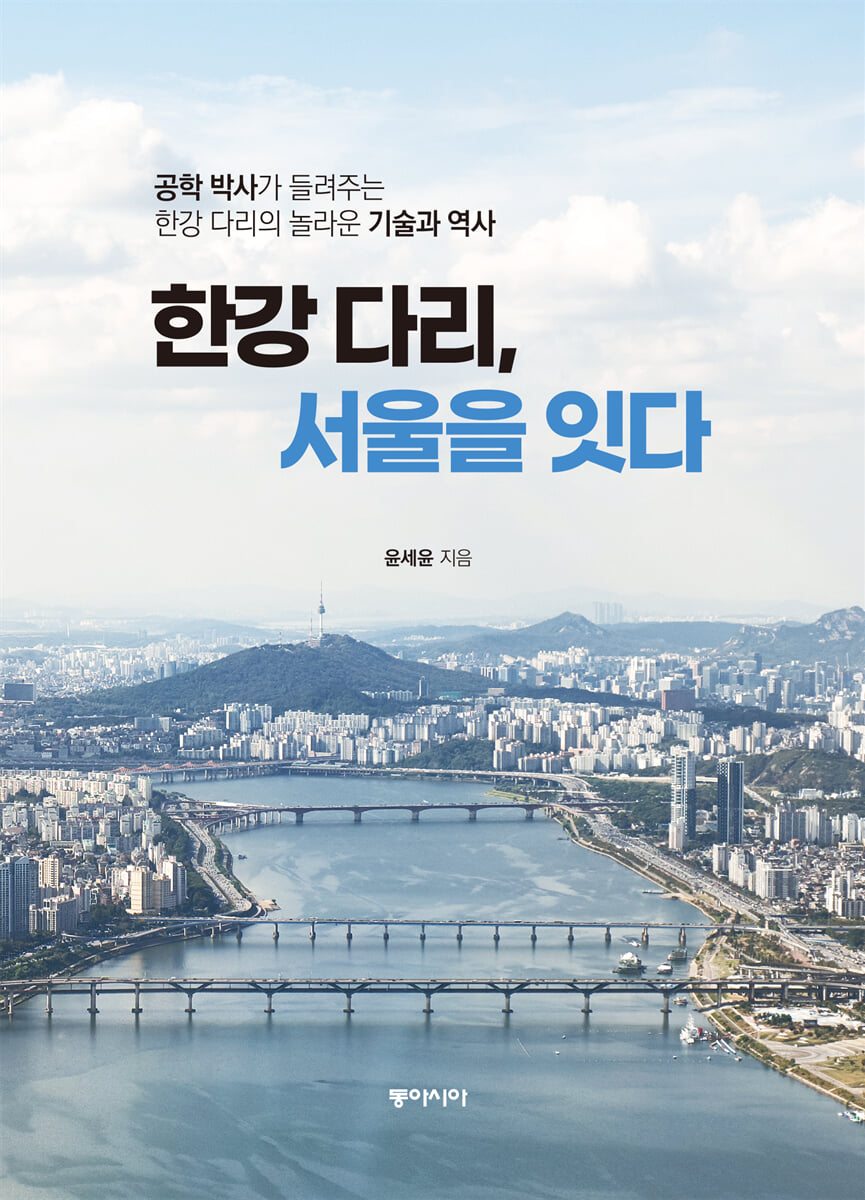
Han River Bridges Connect Seoul
 |
Description
Book Introduction
The Han River's Past and Present: Eight Bridges that Run Through History
Banpo Bridge and Jamsu Bridge are the first two-story bridges in Korea.
However, the two bridges did not open at the same time, and the Jamsu Bridge opened six years before the upper Banpo Bridge.
When it first opened, the name of the submarine bridge was 'Anbo Bridge'.
Why was it given this name? Because at the time of its construction, it was built to allow vehicles to quickly pass through, allowing the US ground forces stationed in Yongsan to move in case of emergency.
Although it is a submerged bridge, it has now become a cultural space representing Seoul for the citizens of Seoul.
In particular, the annual Car-Free Jamsu Bridge Ttukbuk Ttukbuk Festival is one of the representative cultural events that can be enjoyed along the Han River.
The Moonlight Rainbow Fountain, a representative attraction of Banpo Bridge, was listed in the Guinness Book of World Records in 2008 as the world's longest bridge fountain, and in 2014, it was introduced as the world's most spectacular fountain by CNN in the United States.
If we recall the 'Anbo Bridge' that was there when the Banpo Bridge was first built, it can be said that it was a truly dramatic change.
This phase change between bridges and space is rooted in our country's historical background.
It is as if the flow of modern and contemporary Korean history is being absorbed into it.
In addition, the author examines the Han River and its bridges through various questions and stories.
At this time, it does not stop at looking into the structure and 'present' of the Han River bridge, but also looks back at the appearance of the Han River before development, the development process, and its background, and comprehensively covers the history and culture of our country, Seoul, the metropolitan area, and the Han River.
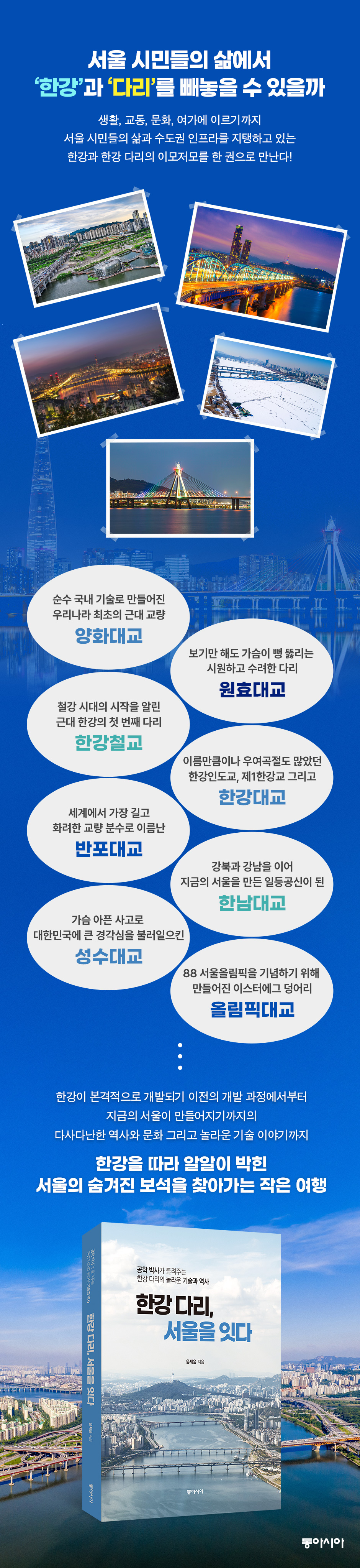
The story of the Han River and its bridges unfolds around eight bridges, including the Hangang Railroad Bridge, the first modern bridge built over the Han River; the Hangang Bridge, the first bridge built for pedestrians; the Yanghwa Bridge, the first bridge built entirely with Korean technology; and the Hannam Bridge, which connected Gangbuk and Gangnam and contributed to establishing the scope and identity of modern Seoul.
This is a dense volume that fully reflects the author's love and interest in bridges, having majored in civil engineering and bridges and consistently published related papers.
Banpo Bridge and Jamsu Bridge are the first two-story bridges in Korea.
However, the two bridges did not open at the same time, and the Jamsu Bridge opened six years before the upper Banpo Bridge.
When it first opened, the name of the submarine bridge was 'Anbo Bridge'.
Why was it given this name? Because at the time of its construction, it was built to allow vehicles to quickly pass through, allowing the US ground forces stationed in Yongsan to move in case of emergency.
Although it is a submerged bridge, it has now become a cultural space representing Seoul for the citizens of Seoul.
In particular, the annual Car-Free Jamsu Bridge Ttukbuk Ttukbuk Festival is one of the representative cultural events that can be enjoyed along the Han River.
The Moonlight Rainbow Fountain, a representative attraction of Banpo Bridge, was listed in the Guinness Book of World Records in 2008 as the world's longest bridge fountain, and in 2014, it was introduced as the world's most spectacular fountain by CNN in the United States.
If we recall the 'Anbo Bridge' that was there when the Banpo Bridge was first built, it can be said that it was a truly dramatic change.
This phase change between bridges and space is rooted in our country's historical background.
It is as if the flow of modern and contemporary Korean history is being absorbed into it.
In addition, the author examines the Han River and its bridges through various questions and stories.
At this time, it does not stop at looking into the structure and 'present' of the Han River bridge, but also looks back at the appearance of the Han River before development, the development process, and its background, and comprehensively covers the history and culture of our country, Seoul, the metropolitan area, and the Han River.
The story of the Han River and its bridges unfolds around eight bridges, including the Hangang Railroad Bridge, the first modern bridge built over the Han River; the Hangang Bridge, the first bridge built for pedestrians; the Yanghwa Bridge, the first bridge built entirely with Korean technology; and the Hannam Bridge, which connected Gangbuk and Gangnam and contributed to establishing the scope and identity of modern Seoul.
This is a dense volume that fully reflects the author's love and interest in bridges, having majored in civil engineering and bridges and consistently published related papers.
- You can preview some of the book's contents.
Preview
index
prolog
1.
Yanghwa Bridge
When I ask where he is, my father always says Yanghwa Bridge / Yanghwajin and Jeoldusan, the Korean version of Golgotha Hill / Yanghwajin Jeoldusan Martyrs' Museum and Mapo Saebit Cultural Forest / Seonyudo Park and Seonyu Bridge / The first Han River bridge built with purely Korean technology / Steel plate girder bridge / Buckling phenomenon that can be found in everyday life
2.
Wonhyo Bridge
Where the 'Monster' Hides in the Movie / Where Did the Name Wonhyo Bridge Come From? / What if Ahn Jung-geun Hadn't Shot Ito Hirobumi / In Search of Ahn Jung-geun's Family Tomb / Beauty Hidden in Simplicity / The Concrete That Created the Beauty of Wonhyo Bridge / Modern Concrete Made for an Unbreakable Lighthouse / Technological Advances in Concrete Beams
3.
Han River Bridge
Hangang Bridge Built on Sand / Sayukshin Historical Park and Hangang Bridge / The Age of Steel: The Story of Steel That Built Hangang Bridge / Steel: Changing the History of Northeast Asia / The Truss Structure of Hangang Bridge / Hangang Bridge and the Eiffel Tower Share the Same Structure
4.
Han River Bridge
When does the Han River freeze over? / How did people cross the Han River in the past? / Hangang Pedestrian Bridge, the First Hangang Bridge, and Hangang Grand Bridge / A visit to Yongyangbong Reservoir Park and Nodeul Island / The arch structure of Hangang Grand Bridge / How was a bridge built underwater?
5.
Banpo Bridge
Submerged Bridge and Banpo Bridge / A Field Trip to Banpo Hangang Park / Banpo Public Housing: The Beginning of National Equity / Why Are Seoul Apartment Prices So High? / The Torsionally Resistant Box Girder of Banpo Bridge and the Independence Gate Overpass / Finite Element Analysis: Easily Analyzing Materials Mechanics
6.
Hannam Bridge
I can live without my wife, but not without boots / Soyang River Dam and the 1984 Seoul Flood / A Field Trip to Soyang River Dam and Soyang Lake / What's the Difference Between the Hoover Dam and Soyang River Dam in the U.S. / How Can We Know About a 200-Year Flood?
7.
Seongsu Bridge
The painful memory of the collapse of Seongsu Bridge / The absence of 'maintenance' rather than simple 'poor construction' / In search of the memorial stone hidden in Seoul Forest Park at the northern end of Seongsu Bridge / The cantilever and hinge structure that made the middle part of the bridge prone to falling / Stable and unstable structures
8.
Olympic Bridge
A bridge with various hidden Easter eggs / Gwangnaru Hangang Park with a view of the Olympic Bridge / Cable-stayed bridges are even more fun when you know more / What's the difference between a cable-stayed bridge and a suspension bridge?
Epilogue
References
Image source
1.
Yanghwa Bridge
When I ask where he is, my father always says Yanghwa Bridge / Yanghwajin and Jeoldusan, the Korean version of Golgotha Hill / Yanghwajin Jeoldusan Martyrs' Museum and Mapo Saebit Cultural Forest / Seonyudo Park and Seonyu Bridge / The first Han River bridge built with purely Korean technology / Steel plate girder bridge / Buckling phenomenon that can be found in everyday life
2.
Wonhyo Bridge
Where the 'Monster' Hides in the Movie / Where Did the Name Wonhyo Bridge Come From? / What if Ahn Jung-geun Hadn't Shot Ito Hirobumi / In Search of Ahn Jung-geun's Family Tomb / Beauty Hidden in Simplicity / The Concrete That Created the Beauty of Wonhyo Bridge / Modern Concrete Made for an Unbreakable Lighthouse / Technological Advances in Concrete Beams
3.
Han River Bridge
Hangang Bridge Built on Sand / Sayukshin Historical Park and Hangang Bridge / The Age of Steel: The Story of Steel That Built Hangang Bridge / Steel: Changing the History of Northeast Asia / The Truss Structure of Hangang Bridge / Hangang Bridge and the Eiffel Tower Share the Same Structure
4.
Han River Bridge
When does the Han River freeze over? / How did people cross the Han River in the past? / Hangang Pedestrian Bridge, the First Hangang Bridge, and Hangang Grand Bridge / A visit to Yongyangbong Reservoir Park and Nodeul Island / The arch structure of Hangang Grand Bridge / How was a bridge built underwater?
5.
Banpo Bridge
Submerged Bridge and Banpo Bridge / A Field Trip to Banpo Hangang Park / Banpo Public Housing: The Beginning of National Equity / Why Are Seoul Apartment Prices So High? / The Torsionally Resistant Box Girder of Banpo Bridge and the Independence Gate Overpass / Finite Element Analysis: Easily Analyzing Materials Mechanics
6.
Hannam Bridge
I can live without my wife, but not without boots / Soyang River Dam and the 1984 Seoul Flood / A Field Trip to Soyang River Dam and Soyang Lake / What's the Difference Between the Hoover Dam and Soyang River Dam in the U.S. / How Can We Know About a 200-Year Flood?
7.
Seongsu Bridge
The painful memory of the collapse of Seongsu Bridge / The absence of 'maintenance' rather than simple 'poor construction' / In search of the memorial stone hidden in Seoul Forest Park at the northern end of Seongsu Bridge / The cantilever and hinge structure that made the middle part of the bridge prone to falling / Stable and unstable structures
8.
Olympic Bridge
A bridge with various hidden Easter eggs / Gwangnaru Hangang Park with a view of the Olympic Bridge / Cable-stayed bridges are even more fun when you know more / What's the difference between a cable-stayed bridge and a suspension bridge?
Epilogue
References
Image source
Detailed image
Into the book
“Speaking of the Han River, isn’t it amazing?” This happened when I was on a business trip to Singapore.
These words, spoken to me by a local driver, became the beginning of this book.
The driver, who had visited Korea before, said he was impressed by the unusually large river flowing through the middle of the city.
The thing I remember most from my visit to Korea was the great Han River and the many bridges across it.
Yes, that's right.
As he said, the Han River is amazing and special.
The great river that runs through the center of Seoul, and the numerous bridges spanning it, I never noticed anything special about them because they were always there.
--- From the "Prologue"
Because of this original purpose of connecting the western part of Seoul and the western part of the metropolitan area, it is still convenient and faster to cross the Yanghwa Bridge when taking the Gyeongin Expressway to Seoul and wanting to cross the Han River.
In Giant's song, there is a lyric that says, "Whenever I ask my father where the taxi driver is, he always says Yanghwa Bridge."
It is said that Giant lived in Gangseo-gu during his school days, and if his father drove a taxi in the western part of Seoul, which was close to his house, it would be natural that he would often pick up passengers traveling between Seoul and Incheon, including Bucheon and Bupyeong.
You must have often crossed Yanghwa Bridge to use the Gyeongin Expressway.
As the song lyrics remind us of the spatial significance of Yangwha Bridge, I think this bridge has become an important part of the lives of people in Seoul and the western part of the metropolitan area.
--- 「1.
From "Yangwha Bridge"
Originally, the Seoul Metropolitan Government had planned to build Wonhyo Bridge as a 'steel plate girder bridge' due to its low construction cost and previous construction experience.
However, there was public criticism that 'the bridges on the Han River are focusing only on practicality and missing aesthetic importance' and a social demand that 'a beautiful bridge on the Han River should be built', and the Seoul Metropolitan Government accepted these demands and changed the plan to use a new structure and construction method.
The beautiful aesthetics of the Wonhyo Bridge, built in this way, are also very significant as a symbol of moving beyond the period when only the functional aspects of the previous Han River bridges were emphasized.
--- 「2.
From "Wonhyo Bridge"
As our country's economy developed and the volume of goods transported began to increase, and when the Gyeongbu Expressway was built, the volume of train transport also increased rapidly.
The first and second railway bridges were temporarily restored and left unused, but the superstructures of the bridges were replaced with trusses of a completely different shape and opened in 1969.
The trusses of the first and second railroad bridges that we can see on the Han River today were restored at this time.
The fourth bridge, built last to accommodate the increased traffic, opened in 1994, six years after the 1988 Seoul Olympics.
The year the 4th railroad bridge opened was a year of major events in the transportation and construction sectors. There were simultaneous strikes on the railroad and subway, the collapse of the Seongsu Bridge in October, and the establishment of the Seoul Metropolitan Rapid Transit Corporation to build additional subway lines 5 to 8 in Seoul.
Looking at this, the Han River Bridge is a symbolic bridge on the Han River that has undergone changes along with every turbulent period in our society.
--- 「3.
From "Han River Bridge"
The Roman arch aqueduct was an innovative structure designed to solve the city's water supply problem.
The Romans built aqueducts to bring water from distant sources to the city, thus meeting the city's diverse water needs.
The arch aqueduct of Segovia, built in 80 BC, used arch technology that was difficult to imagine at the time.
Because of its sophistication and grandeur, it was also called the 'Devil's Bridge' because it was not built by people of the time.
In Roman structures, the arch structure applied to bricks is generally an upper arch structure in which the load is applied directly on the bricks forming the arch, but as seen above, the Han River Bridge is an under arch structure in which the vertical member connecting the arch and the deck acts as an intermediate link to transfer the load above the vehicle load.
--- 「4.
From "Han River Bridge"
The lower part of Banpo Bridge, Jamsu Bridge, was completed in 1976, six years before the upper part, Banpo Bridge (completed in 1982).
When it was first built, it was called 'Anbo Bridge' rather than 'Submersible Bridge'.
This is because it was originally built for military purposes.
After the Korean War, the US military units stationed in Yongsan planned and built a low bridge that could be crossed quickly by vehicles in place of the Han River Bridge during wartime.
--- 「5.
From "Banpo Bridge"
In fact, before the modern era, only the Gangbuk region, and even some areas within the four gates, were classified as part of the city wall, so the boundaries of Seoul as we think of them today were created not so long ago.
And the main player that promoted the development of Gangnam and created today's Seoul, encompassing Gangbuk and Gangnam, is the Hannam Bridge, which I will introduce now.
--- 「6.
From "Hannam Bridge"
South Korea's bridge construction technology has made remarkable progress over the past several decades.
After a period of initial dependence on foreign technology, we have now reached a level where we can freely design and construct cable-stayed and suspension bridges.
Domestic engineers have secured world-class technological prowess through complex structural analysis, advanced material development, and innovative construction methods.
This has been proven by the successful completion of large-scale bridge projects such as the Ulsan Bridge and Incheon Bridge.
--- 「8.
From "Olympic Bridge"
While writing the book, I often had questions.
I wondered if it was right for me, a non-bridge construction expert, to write a book like this. But then I realized.
This was a story that someone had to tell, and I felt that as a civil engineering major, I had to take on the role.
The bridges of the Han River connect Seoul's past and present, and carry our dreams for the future.
I hope this book will not simply provide information about bridges, but will also provide an opportunity to think about the development, safety, and future of our society.
These words, spoken to me by a local driver, became the beginning of this book.
The driver, who had visited Korea before, said he was impressed by the unusually large river flowing through the middle of the city.
The thing I remember most from my visit to Korea was the great Han River and the many bridges across it.
Yes, that's right.
As he said, the Han River is amazing and special.
The great river that runs through the center of Seoul, and the numerous bridges spanning it, I never noticed anything special about them because they were always there.
--- From the "Prologue"
Because of this original purpose of connecting the western part of Seoul and the western part of the metropolitan area, it is still convenient and faster to cross the Yanghwa Bridge when taking the Gyeongin Expressway to Seoul and wanting to cross the Han River.
In Giant's song, there is a lyric that says, "Whenever I ask my father where the taxi driver is, he always says Yanghwa Bridge."
It is said that Giant lived in Gangseo-gu during his school days, and if his father drove a taxi in the western part of Seoul, which was close to his house, it would be natural that he would often pick up passengers traveling between Seoul and Incheon, including Bucheon and Bupyeong.
You must have often crossed Yanghwa Bridge to use the Gyeongin Expressway.
As the song lyrics remind us of the spatial significance of Yangwha Bridge, I think this bridge has become an important part of the lives of people in Seoul and the western part of the metropolitan area.
--- 「1.
From "Yangwha Bridge"
Originally, the Seoul Metropolitan Government had planned to build Wonhyo Bridge as a 'steel plate girder bridge' due to its low construction cost and previous construction experience.
However, there was public criticism that 'the bridges on the Han River are focusing only on practicality and missing aesthetic importance' and a social demand that 'a beautiful bridge on the Han River should be built', and the Seoul Metropolitan Government accepted these demands and changed the plan to use a new structure and construction method.
The beautiful aesthetics of the Wonhyo Bridge, built in this way, are also very significant as a symbol of moving beyond the period when only the functional aspects of the previous Han River bridges were emphasized.
--- 「2.
From "Wonhyo Bridge"
As our country's economy developed and the volume of goods transported began to increase, and when the Gyeongbu Expressway was built, the volume of train transport also increased rapidly.
The first and second railway bridges were temporarily restored and left unused, but the superstructures of the bridges were replaced with trusses of a completely different shape and opened in 1969.
The trusses of the first and second railroad bridges that we can see on the Han River today were restored at this time.
The fourth bridge, built last to accommodate the increased traffic, opened in 1994, six years after the 1988 Seoul Olympics.
The year the 4th railroad bridge opened was a year of major events in the transportation and construction sectors. There were simultaneous strikes on the railroad and subway, the collapse of the Seongsu Bridge in October, and the establishment of the Seoul Metropolitan Rapid Transit Corporation to build additional subway lines 5 to 8 in Seoul.
Looking at this, the Han River Bridge is a symbolic bridge on the Han River that has undergone changes along with every turbulent period in our society.
--- 「3.
From "Han River Bridge"
The Roman arch aqueduct was an innovative structure designed to solve the city's water supply problem.
The Romans built aqueducts to bring water from distant sources to the city, thus meeting the city's diverse water needs.
The arch aqueduct of Segovia, built in 80 BC, used arch technology that was difficult to imagine at the time.
Because of its sophistication and grandeur, it was also called the 'Devil's Bridge' because it was not built by people of the time.
In Roman structures, the arch structure applied to bricks is generally an upper arch structure in which the load is applied directly on the bricks forming the arch, but as seen above, the Han River Bridge is an under arch structure in which the vertical member connecting the arch and the deck acts as an intermediate link to transfer the load above the vehicle load.
--- 「4.
From "Han River Bridge"
The lower part of Banpo Bridge, Jamsu Bridge, was completed in 1976, six years before the upper part, Banpo Bridge (completed in 1982).
When it was first built, it was called 'Anbo Bridge' rather than 'Submersible Bridge'.
This is because it was originally built for military purposes.
After the Korean War, the US military units stationed in Yongsan planned and built a low bridge that could be crossed quickly by vehicles in place of the Han River Bridge during wartime.
--- 「5.
From "Banpo Bridge"
In fact, before the modern era, only the Gangbuk region, and even some areas within the four gates, were classified as part of the city wall, so the boundaries of Seoul as we think of them today were created not so long ago.
And the main player that promoted the development of Gangnam and created today's Seoul, encompassing Gangbuk and Gangnam, is the Hannam Bridge, which I will introduce now.
--- 「6.
From "Hannam Bridge"
South Korea's bridge construction technology has made remarkable progress over the past several decades.
After a period of initial dependence on foreign technology, we have now reached a level where we can freely design and construct cable-stayed and suspension bridges.
Domestic engineers have secured world-class technological prowess through complex structural analysis, advanced material development, and innovative construction methods.
This has been proven by the successful completion of large-scale bridge projects such as the Ulsan Bridge and Incheon Bridge.
--- 「8.
From "Olympic Bridge"
While writing the book, I often had questions.
I wondered if it was right for me, a non-bridge construction expert, to write a book like this. But then I realized.
This was a story that someone had to tell, and I felt that as a civil engineering major, I had to take on the role.
The bridges of the Han River connect Seoul's past and present, and carry our dreams for the future.
I hope this book will not simply provide information about bridges, but will also provide an opportunity to think about the development, safety, and future of our society.
--- From "Epilogue"
Publisher's Review
The Seine River divides left and right, but the Han River connects north and south.
From a boundary separating the city from the outside world to becoming a part of the city
The history of the Han River and the Han River bridges that created today's Seoul
Anyone who lives in the Seoul metropolitan area of South Korea likely has at least one personal memory of the Han River.
Considering that more than 50% of Korea's population will reside in the metropolitan area as of 2025, we can vaguely imagine the extent of the influence the Han River has on Koreans.
This is not just a story for today.
As we always learn in history class, the Han River basin has been extremely important to the Korean Peninsula, and numerous dramas have unfolded around the Han River.
It would be unbelievable to say that this great river, 500 km long and over 1 km wide, has had no presence in history.
In fact, it is not at all unusual for a river to flow through the middle of a city.
As the saying goes, “A mountain meets a river,” it is only natural for people to gather near water and build cities.
But such general theories are completely blown away when faced with the great waters of the Han River.
First of all, rivers that often flow through other cities are not this large.
The Seine River in Paris, a famous river we are all familiar with, is only about 100 to 200 meters wide, and the Thames River in London is about 265 meters wide when measured from the location of London Bridge.
Cases like Seoul and the Han River are extremely rare worldwide.
When a river flows through the middle of a city, it is usually a small river like the Seine or the Thames, and when a large river like the Han River flows through a city, it usually flows along the outskirts rather than the center of the city, acting as a boundary between the city and the outside world.
So how did the Han River, and Seoul itself, come to be in its current form? While the current "Seoul" may seem natural to younger generations, it wasn't that long ago that Seoul took its current form.
Even if you just look at the traces of the 'Four Great Gates' that exist in the Gangbuk downtown area, you can see that even going back to the early days of the Republic of Korea, let alone the Joseon Dynasty, Seoul was a small city that was only half the size of its current size, and the Han River, like other large rivers in other countries, played a role in dividing Seoul from the outside world.
However, after the modern era, the need for the expansion of the capital city of Seoul arose, and with the advancement of bridge technology, the Han River, which had previously served as a barrier to transportation, began to function as a passage connecting Gangnam and Gangbuk.
Yes, that's right.
The space we recognize as 'Seoul' today is an extremely modern and changeable concept.
The author, who specializes in civil engineering and bridges, begins this book by praising the special space of Seoul and the Han River.
Starting from a long time ago, before the Han River was called the "Han River," it slowly traces the history of the Han River and the bridges built on it, like flowing water.
Even though it is called 'the history of the Han River Bridges', as is often the case with history, the history of the Han River Bridges is not just the story of the Han River Bridges.
Prior to the construction of bridges during the Japanese colonial period, there was competition between Japan and the United States over railroad construction rights, the development of steel needed to build steel bridges and its impact on Asian history, the aftermath of the Korean War and air raids on bridges, and even the heartbreaking collapse of Seongsu Bridge and Soyang River Dam, and the great flood in Seoul. Many major events in modern and contemporary history have occurred around the Han River and its bridges.
All of this is the history of the Han River Bridge, and at the same time, the history of the Han River and the history of Seoul.
The author, with a sensitive tone that belies his background in science and engineering, explores the history of the Han River and delivers a captivating account of the technology and history surrounding the Han River and its bridges.
Discover Seoul's hidden gems, nestled along the Han River.
The ins and outs of the Han River and its bridges that we didn't know about
Seoul Future Heritage is a project being carried out by the Seoul Metropolitan Government to discover and preserve valuable tangible and intangible assets to pass on Seoul's history to future generations.
The subjects are Seoul's modern and contemporary cultural heritages that are not separately registered as cultural properties but for which citizens hold special memories, and which can be said to be truly hidden gems of Seoul.
Of course, there are also hidden gems along the Han River that flows through Seoul.
These include Banpo Bridge, Jamsu Bridge, Yanghwa Bridge, Wonhyo Bridge, Hangang Bridge, and Hannam Bridge.
In this book, the author doesn't just convey the meaningful stories of these hidden gems and other bridges along the Han River in a textbook-like manner. Instead, he actually visits the sites and conveys the various aspects of the Han River bridges we encounter today.
The book is structured in a direction from the lower reaches of the Han River to the upper reaches, from Yanghwa Bridge to Olympic Bridge, and introduces great places for outings, such as Han River Park and historical sites around the bridge.
The author is a bridge expert who has studied civil engineering and bridges for many years, but this book is based on that specialized knowledge, but is written in a way that most people can easily read.
Through the author's guidance, we are able to glimpse the hidden side of the Han River that we never knew about before, and we are surprised to see that the Han River has so many different faces.
You will also come to realize that much of the lives of Seoul citizens today are built on the miraculous balance created by the Han River and its bridges.
This book is recommended to all citizens who enjoy going on outings to the Han River Park near their home on weekends and holidays, and who want to learn more about the place where we live now.
From a boundary separating the city from the outside world to becoming a part of the city
The history of the Han River and the Han River bridges that created today's Seoul
Anyone who lives in the Seoul metropolitan area of South Korea likely has at least one personal memory of the Han River.
Considering that more than 50% of Korea's population will reside in the metropolitan area as of 2025, we can vaguely imagine the extent of the influence the Han River has on Koreans.
This is not just a story for today.
As we always learn in history class, the Han River basin has been extremely important to the Korean Peninsula, and numerous dramas have unfolded around the Han River.
It would be unbelievable to say that this great river, 500 km long and over 1 km wide, has had no presence in history.
In fact, it is not at all unusual for a river to flow through the middle of a city.
As the saying goes, “A mountain meets a river,” it is only natural for people to gather near water and build cities.
But such general theories are completely blown away when faced with the great waters of the Han River.
First of all, rivers that often flow through other cities are not this large.
The Seine River in Paris, a famous river we are all familiar with, is only about 100 to 200 meters wide, and the Thames River in London is about 265 meters wide when measured from the location of London Bridge.
Cases like Seoul and the Han River are extremely rare worldwide.
When a river flows through the middle of a city, it is usually a small river like the Seine or the Thames, and when a large river like the Han River flows through a city, it usually flows along the outskirts rather than the center of the city, acting as a boundary between the city and the outside world.
So how did the Han River, and Seoul itself, come to be in its current form? While the current "Seoul" may seem natural to younger generations, it wasn't that long ago that Seoul took its current form.
Even if you just look at the traces of the 'Four Great Gates' that exist in the Gangbuk downtown area, you can see that even going back to the early days of the Republic of Korea, let alone the Joseon Dynasty, Seoul was a small city that was only half the size of its current size, and the Han River, like other large rivers in other countries, played a role in dividing Seoul from the outside world.
However, after the modern era, the need for the expansion of the capital city of Seoul arose, and with the advancement of bridge technology, the Han River, which had previously served as a barrier to transportation, began to function as a passage connecting Gangnam and Gangbuk.
Yes, that's right.
The space we recognize as 'Seoul' today is an extremely modern and changeable concept.
The author, who specializes in civil engineering and bridges, begins this book by praising the special space of Seoul and the Han River.
Starting from a long time ago, before the Han River was called the "Han River," it slowly traces the history of the Han River and the bridges built on it, like flowing water.
Even though it is called 'the history of the Han River Bridges', as is often the case with history, the history of the Han River Bridges is not just the story of the Han River Bridges.
Prior to the construction of bridges during the Japanese colonial period, there was competition between Japan and the United States over railroad construction rights, the development of steel needed to build steel bridges and its impact on Asian history, the aftermath of the Korean War and air raids on bridges, and even the heartbreaking collapse of Seongsu Bridge and Soyang River Dam, and the great flood in Seoul. Many major events in modern and contemporary history have occurred around the Han River and its bridges.
All of this is the history of the Han River Bridge, and at the same time, the history of the Han River and the history of Seoul.
The author, with a sensitive tone that belies his background in science and engineering, explores the history of the Han River and delivers a captivating account of the technology and history surrounding the Han River and its bridges.
Discover Seoul's hidden gems, nestled along the Han River.
The ins and outs of the Han River and its bridges that we didn't know about
Seoul Future Heritage is a project being carried out by the Seoul Metropolitan Government to discover and preserve valuable tangible and intangible assets to pass on Seoul's history to future generations.
The subjects are Seoul's modern and contemporary cultural heritages that are not separately registered as cultural properties but for which citizens hold special memories, and which can be said to be truly hidden gems of Seoul.
Of course, there are also hidden gems along the Han River that flows through Seoul.
These include Banpo Bridge, Jamsu Bridge, Yanghwa Bridge, Wonhyo Bridge, Hangang Bridge, and Hannam Bridge.
In this book, the author doesn't just convey the meaningful stories of these hidden gems and other bridges along the Han River in a textbook-like manner. Instead, he actually visits the sites and conveys the various aspects of the Han River bridges we encounter today.
The book is structured in a direction from the lower reaches of the Han River to the upper reaches, from Yanghwa Bridge to Olympic Bridge, and introduces great places for outings, such as Han River Park and historical sites around the bridge.
The author is a bridge expert who has studied civil engineering and bridges for many years, but this book is based on that specialized knowledge, but is written in a way that most people can easily read.
Through the author's guidance, we are able to glimpse the hidden side of the Han River that we never knew about before, and we are surprised to see that the Han River has so many different faces.
You will also come to realize that much of the lives of Seoul citizens today are built on the miraculous balance created by the Han River and its bridges.
This book is recommended to all citizens who enjoy going on outings to the Han River Park near their home on weekends and holidays, and who want to learn more about the place where we live now.
GOODS SPECIFICS
- Date of issue: February 14, 2025
- Page count, weight, size: 312 pages | 145*200*15mm
- ISBN13: 9788962626452
You may also like
카테고리
korean


korean

![ELLE 엘르 스페셜 에디션 A형 : 12월 [2025]](http://librairie.coreenne.fr/cdn/shop/files/b8e27a3de6c9538896439686c6b0e8fb.jpg?v=1766436872&width=3840)


