

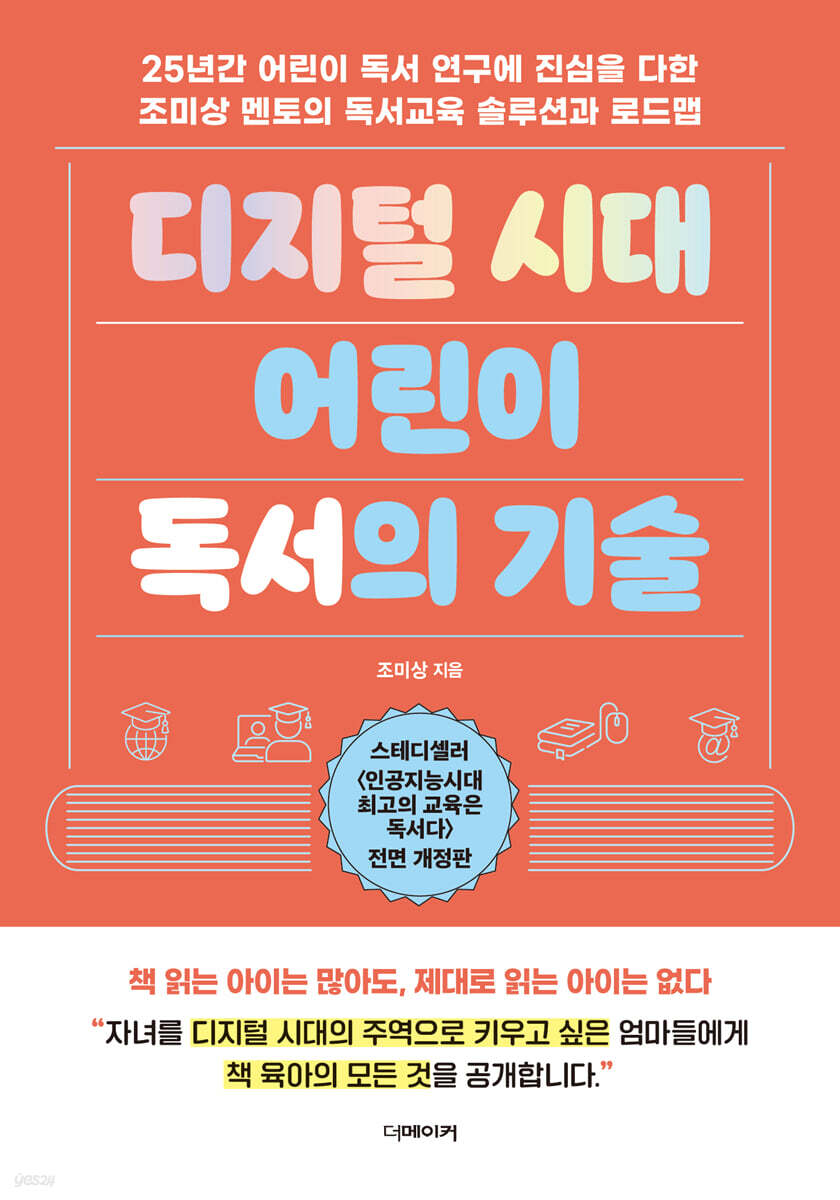
Children's Reading Skills in the Digital Age
 |
Description
Book Introduction
It has been greatly loved since its publication.
"In the Age of AI, the Best Education is Reading" Fully Revised Edition Released!
A completely revised edition of "In the Age of Artificial Intelligence, Reading is the Best Education," which has received sympathy and support from many readers since its publication in 2018, has been published.
The author actively reflected changes in the educational and reading environments and made revisions and additions.
In particular, the 'Reading Roadmap from Infants to Elementary School' is covered in detail in one part, allowing for reading guidance while drawing a big picture.
Why do we keep emphasizing reading again and again?
Why, even in the digital age, does a child's competitiveness depend on reading?
The reason why the educational field emphasizes collaboration, communication, critical thinking, and creativity over memorization, accuracy, and speed is because the type of talent society demands is changing as the world changes.
So how can we cultivate these abilities? The author explains that "books are a representative creative work that connects and edits knowledge and information, putting them into practice through storytelling." Therefore, books naturally cultivate "the ability to connect knowledge, apply it, and create."
That's why the author says, "Even in the digital age, our children's competitiveness depends on reading."
25 years of sincere dedication to children's reading research
Mentor Jo Mi-sang's Reading Education Solutions and Roadmap
This book is a reading education solution for children in the digital age, written by an author who has been researching children's reading for 25 years.
In particular, the author emphasizes that “reading is something that must be learned and practiced.”
Based on this, it contains everything about reading guidance, including “reading guidance points and methods by growth stage and genre, reading techniques that double the fun and efficiency, and the role of parents in raising children to be lifelong readers.”
This book will serve as a practical guide for parents who want to raise their children to be competitive readers.
"In the Age of AI, the Best Education is Reading" Fully Revised Edition Released!
A completely revised edition of "In the Age of Artificial Intelligence, Reading is the Best Education," which has received sympathy and support from many readers since its publication in 2018, has been published.
The author actively reflected changes in the educational and reading environments and made revisions and additions.
In particular, the 'Reading Roadmap from Infants to Elementary School' is covered in detail in one part, allowing for reading guidance while drawing a big picture.
Why do we keep emphasizing reading again and again?
Why, even in the digital age, does a child's competitiveness depend on reading?
The reason why the educational field emphasizes collaboration, communication, critical thinking, and creativity over memorization, accuracy, and speed is because the type of talent society demands is changing as the world changes.
So how can we cultivate these abilities? The author explains that "books are a representative creative work that connects and edits knowledge and information, putting them into practice through storytelling." Therefore, books naturally cultivate "the ability to connect knowledge, apply it, and create."
That's why the author says, "Even in the digital age, our children's competitiveness depends on reading."
25 years of sincere dedication to children's reading research
Mentor Jo Mi-sang's Reading Education Solutions and Roadmap
This book is a reading education solution for children in the digital age, written by an author who has been researching children's reading for 25 years.
In particular, the author emphasizes that “reading is something that must be learned and practiced.”
Based on this, it contains everything about reading guidance, including “reading guidance points and methods by growth stage and genre, reading techniques that double the fun and efficiency, and the role of parents in raising children to be lifelong readers.”
This book will serve as a practical guide for parents who want to raise their children to be competitive readers.
- You can preview some of the book's contents.
Preview
index
Entering
Instead of just being passionate about education, we need to have an educational philosophy.
PART 1: How Should Reading Change in the Digital Age?
1.
A world that wants creators, not knowledge consumers.
2.
What skills are needed in a digital society?
3.
Only children who read, think, and express themselves will survive.
4.
Why Reading is the Real Competitive Edge of the Future
5.
Pay attention to 'how' to read rather than 'what'
TIP1: 5 Reasons Why Reading is a Powerful Survival Strategy in the Age of AI
PART 2 You must also learn to read
1.
Children who have never learned to read
2.
Why should parents read books to their children?
3.
Successful Reading, Failure Reading
4.
When reading, the beginning and the end are important.
5.
The wrong reading activities can make children hate books.
6.
Reading also requires training.
7.
The way to read a book varies depending on the genre.
TIP2: 7 Reasons Why Your Child Fails at Reading
PART 3 Reading points vary depending on the child's stage of development.
: From Toddlers to Elementary School, a Roadmap to Successful Reading
1.
Stage 1 (0 to 24 months): A period of becoming familiar with books.
2.
Stage 2 (24 to 48 months): The time to encounter stories
3.
Stage 3 (50 months or older, 5 to 6 years old): A period of intellectual curiosity
4.
Stage 4 (ages 7-9): Intensive reading vs. rejection of books
5.
Stage 5 (ages 10-13): A crossroads period, whether to become a lifelong reader or not.
PART 4 There are different ways to read books by genre.
1.
Reading picture books where the pictures are more important than the text
2.
Reading creative fairy tales that foster imagination and creativity
3.
Reading traditional and classic fairy tales that set the standard for life
4.
Reading knowledge picture books that influence the first impression of studying
5.
Reading math and science fairy tales to train logical thinking skills
6.
Reading history and biographical books that provide a compass for life
7.
Reading classics that lead you into a sea of deep thought
8.
Reading textbooks, which are the basis of studying
PART 5: 8 Reading Skills for Children
1.
Read slowly and thoughtfully
2.
Repeated reading
3.
Read with questions
4.
Split and read separately
5.
Reading in a strange, different way
6.
If I were you, I would read
7.
Reading by topic
8.
Reading digital images
TIP3: 7 Reading Strategies to Engage Your Child
PART 6 The Reading Revolution Starts with Moms
1.
You can't talk about studying without reading.
2.
Lifelong reading is lifelong competitiveness.
3.
Mom is your first mentor! Your best reading partner!
TIP4: 5 Things Moms Must Do to Raise Their Children Lifelong Readers
Instead of just being passionate about education, we need to have an educational philosophy.
PART 1: How Should Reading Change in the Digital Age?
1.
A world that wants creators, not knowledge consumers.
2.
What skills are needed in a digital society?
3.
Only children who read, think, and express themselves will survive.
4.
Why Reading is the Real Competitive Edge of the Future
5.
Pay attention to 'how' to read rather than 'what'
TIP1: 5 Reasons Why Reading is a Powerful Survival Strategy in the Age of AI
PART 2 You must also learn to read
1.
Children who have never learned to read
2.
Why should parents read books to their children?
3.
Successful Reading, Failure Reading
4.
When reading, the beginning and the end are important.
5.
The wrong reading activities can make children hate books.
6.
Reading also requires training.
7.
The way to read a book varies depending on the genre.
TIP2: 7 Reasons Why Your Child Fails at Reading
PART 3 Reading points vary depending on the child's stage of development.
: From Toddlers to Elementary School, a Roadmap to Successful Reading
1.
Stage 1 (0 to 24 months): A period of becoming familiar with books.
2.
Stage 2 (24 to 48 months): The time to encounter stories
3.
Stage 3 (50 months or older, 5 to 6 years old): A period of intellectual curiosity
4.
Stage 4 (ages 7-9): Intensive reading vs. rejection of books
5.
Stage 5 (ages 10-13): A crossroads period, whether to become a lifelong reader or not.
PART 4 There are different ways to read books by genre.
1.
Reading picture books where the pictures are more important than the text
2.
Reading creative fairy tales that foster imagination and creativity
3.
Reading traditional and classic fairy tales that set the standard for life
4.
Reading knowledge picture books that influence the first impression of studying
5.
Reading math and science fairy tales to train logical thinking skills
6.
Reading history and biographical books that provide a compass for life
7.
Reading classics that lead you into a sea of deep thought
8.
Reading textbooks, which are the basis of studying
PART 5: 8 Reading Skills for Children
1.
Read slowly and thoughtfully
2.
Repeated reading
3.
Read with questions
4.
Split and read separately
5.
Reading in a strange, different way
6.
If I were you, I would read
7.
Reading by topic
8.
Reading digital images
TIP3: 7 Reading Strategies to Engage Your Child
PART 6 The Reading Revolution Starts with Moms
1.
You can't talk about studying without reading.
2.
Lifelong reading is lifelong competitiveness.
3.
Mom is your first mentor! Your best reading partner!
TIP4: 5 Things Moms Must Do to Raise Their Children Lifelong Readers
Detailed image

Into the book
Unlike machines, humans think, imagine, share, communicate, and create new things through critical thinking.
Machines only do the work that humans have assigned them.
It is humans who program the machines to move.
Isn't the ability to create something new the only competitive edge humans can possess in this age of science and technology? So, what can foster these uniquely human capabilities—the ability to think, imagine, collaborate, and communicate differently, the critical thinking that examines validity, and the creativity to recreate existing content by leveraging existing knowledge? The answer is reading.
--- p.9
In this book, I want to look at the meaning of reading from a different perspective than that of the previous generation of parents.
Reading must now go beyond simply acquiring knowledge or information and become a tool for developing new world capabilities.
--- p.9
In Chapter 1, we will look at a changing world and reexamine the meaning of reading, a competitive edge in a changing world.
In Chapter 2, we will understand that reading is impossible without learning, and we will examine what we need to prepare to learn reading properly.
In Chapter 3, we will understand that reading points differ depending on the stage of development and draw a reading roadmap from toddlers to elementary school students.
In Chapter 4, we will examine the different reading goals and methods for each genre and the need for genre-specific reading coaching.
Chapter 5 covers various reading techniques that can enhance the enjoyment of reading.
Chapter 6 discusses how reading is the only way to become a competitive child, and how a lifelong reader requires a partner.
--- p.10
In “What Only Readers Can Get,” Kazuhiro Fujihara said, “In the 21st century, a class society will emerge, divided into those who read books and those who don’t.”
This means that reading is a competitive edge that guarantees survival in the new world.
--- p.41
Books are a representative creative work that connects and edits knowledge and information and puts them into practice through storytelling.
Therefore, if you continue to read books, you will naturally develop the ability to connect knowledge, put it into practice, and create.
--- p.43
Let's take a look at what we can gain from reading books.
First of all, vocabulary, which affects thinking ability, increases.
Additionally, your thinking skills develop because you have to constantly think to understand the text.
Not only that, but understanding the characters in the book develops emotions, and the imagination to predict and infer develops.
Critical thinking skills develop by examining the validity of content, and creativity develops by looking at it from a new perspective.
--- p.82
The 'reading zone' is 'a state in which the reader leaves reality behind, enters the book, and feels the characters' emotions and situations as if they were his own.'
How could a child who has experienced even one 'Reading Zone' not read a book?
--- p.98
What happens if there are no adults or books to satisfy a child's curiosity at this point? The child will no longer cultivate curiosity, and future learning will become a chore.
--- p.113
Reading is a thinking activity that connects the author's thoughts with the reader's thoughts and develops new ideas.
By repeating these reading activities, you can develop your own unique ideas, which is the competitive edge you need in the 21st century, coexisting with artificial intelligence.
--- p.185
Reading that thinks is reading that asks questions.
The more questions a child asks while reading, the more his or her thinking capacity expands.
--- p.198
The true purpose of reading is not to simply accept the author's thoughts, but to combine the author's thoughts with the reader's thoughts and move on to another thought.
--- p.209
Ultimately, studying is about developing the ability to read text, understand it, think about it, and solve problems.
Furthermore, it is about creating the power to create texts yourself.
Machines only do the work that humans have assigned them.
It is humans who program the machines to move.
Isn't the ability to create something new the only competitive edge humans can possess in this age of science and technology? So, what can foster these uniquely human capabilities—the ability to think, imagine, collaborate, and communicate differently, the critical thinking that examines validity, and the creativity to recreate existing content by leveraging existing knowledge? The answer is reading.
--- p.9
In this book, I want to look at the meaning of reading from a different perspective than that of the previous generation of parents.
Reading must now go beyond simply acquiring knowledge or information and become a tool for developing new world capabilities.
--- p.9
In Chapter 1, we will look at a changing world and reexamine the meaning of reading, a competitive edge in a changing world.
In Chapter 2, we will understand that reading is impossible without learning, and we will examine what we need to prepare to learn reading properly.
In Chapter 3, we will understand that reading points differ depending on the stage of development and draw a reading roadmap from toddlers to elementary school students.
In Chapter 4, we will examine the different reading goals and methods for each genre and the need for genre-specific reading coaching.
Chapter 5 covers various reading techniques that can enhance the enjoyment of reading.
Chapter 6 discusses how reading is the only way to become a competitive child, and how a lifelong reader requires a partner.
--- p.10
In “What Only Readers Can Get,” Kazuhiro Fujihara said, “In the 21st century, a class society will emerge, divided into those who read books and those who don’t.”
This means that reading is a competitive edge that guarantees survival in the new world.
--- p.41
Books are a representative creative work that connects and edits knowledge and information and puts them into practice through storytelling.
Therefore, if you continue to read books, you will naturally develop the ability to connect knowledge, put it into practice, and create.
--- p.43
Let's take a look at what we can gain from reading books.
First of all, vocabulary, which affects thinking ability, increases.
Additionally, your thinking skills develop because you have to constantly think to understand the text.
Not only that, but understanding the characters in the book develops emotions, and the imagination to predict and infer develops.
Critical thinking skills develop by examining the validity of content, and creativity develops by looking at it from a new perspective.
--- p.82
The 'reading zone' is 'a state in which the reader leaves reality behind, enters the book, and feels the characters' emotions and situations as if they were his own.'
How could a child who has experienced even one 'Reading Zone' not read a book?
--- p.98
What happens if there are no adults or books to satisfy a child's curiosity at this point? The child will no longer cultivate curiosity, and future learning will become a chore.
--- p.113
Reading is a thinking activity that connects the author's thoughts with the reader's thoughts and develops new ideas.
By repeating these reading activities, you can develop your own unique ideas, which is the competitive edge you need in the 21st century, coexisting with artificial intelligence.
--- p.185
Reading that thinks is reading that asks questions.
The more questions a child asks while reading, the more his or her thinking capacity expands.
--- p.198
The true purpose of reading is not to simply accept the author's thoughts, but to combine the author's thoughts with the reader's thoughts and move on to another thought.
--- p.209
Ultimately, studying is about developing the ability to read text, understand it, think about it, and solve problems.
Furthermore, it is about creating the power to create texts yourself.
--- p.240
Publisher's Review
It has been greatly loved since its publication.
"In the Age of AI, the Best Education is Reading" Fully Revised Edition Released!
An upgraded version with a complete revision, additional writing, and a new title and design!!
This book is a completely revised edition of "In the Age of Artificial Intelligence, Reading is the Best Education," which has received sympathy and support from many readers since its publication in 2018.
The author actively reflected changes in the educational and reading environments and made revisions and additions.
In particular, the 'Reading Roadmap from Infants to Elementary School' is covered in detail in one part, allowing for reading guidance while drawing a big picture.
This is an upgraded version with a complete revision, additional writing, and a new title and design.
Why do we keep emphasizing reading again and again?
Why, even in the digital age, does a child's competitiveness depend on reading?
In the past, one could be competitive simply by acquiring knowledge or faithfully following established manuals.
However, as the world becomes more complex and artificial intelligence emerges, simple memorization skills are gradually losing value.
Today, we live in an era where problem-solving skills, the ability to creatively solve problems by utilizing diverse knowledge, are essential.
This is why in educational settings, collaboration skills, communication skills, critical thinking skills, and creativity are emphasized instead of memorization, accuracy, and speed.
So, how can we develop these abilities? The author answers this question as follows:
"So, how can we cultivate these uniquely human capabilities—the ability to think, imagine, collaborate, and communicate differently, the critical thinking that examines validity, and the creativity to recreate new content using existing materials? Reading is the answer."
Books are “a representative creative work that connects and edits knowledge and information and puts it into practice through storytelling,” and thus, they explain that through books, “the ability to connect knowledge, the ability to put it into practice, and the ability to create” are naturally cultivated.
That is why the author says, “Even in the age of artificial intelligence, our children’s competitiveness depends on reading.”
25 years of sincere dedication to children's reading research
Mentor Jo Mi-sang's Reading Education Solutions and Roadmap
This book is a reading education solution for children in the digital age, written by an author who has been researching children's reading for 25 years.
In particular, the author emphasizes that “reading is something that must be learned and practiced.”
Based on this, it contains everything about reading guidance, including “reading guidance points and methods by growth stage and genre, reading techniques that double the fun and efficiency, and the role of parents in raising children to be lifelong readers.”
Chapter 1 looks at the changing world and reexamines the meaning of reading, which is a competitive edge in this changing world.
Chapter 2 explores the understanding that reading cannot be done without learning, and examines what preparations are needed to properly learn to read.
Chapter 3 explains that reading points differ depending on the stage of growth, and draws a reading roadmap from infants to elementary school students.
Chapter 4 examines the need for genre-specific reading coaching, recognizing that reading goals and methods differ by genre.
Chapter 5 covers various reading techniques that can enhance the enjoyment of reading.
Chapter 6 discusses that the only way to become a competitive child is through reading, and that to become a lifelong reader, you need a partner.
This book will serve as a practical guide for parents who want to raise their children to be competitive readers.
Recommendation
Can a child develop a reading habit simply by buying books? Reading needs to be learned.
-Kim Bo-seom, Director of Leadin, author of "Reading is Everything for Elementary School Students"
This book persuasively demonstrates why reading is the best form of education and study.
-Teacher Park Jin-young
This book teaches reading skills that cultivate the power of thinking and the power to change oneself.
-Dr. Kim Seon-seok
If you're curious about key strategies that will help your child grow into a lifelong reader, this book is a must-read.
-writing***
We all know that reading is good, but we're often at a loss as to how to guide reading. This book provides easy-to-understand guidance that gets to the core.
-lo***
It reminds us once again that reading is an essential education for our children, no matter how the world changes.
-cl***
The ultimate guidebook for parents who want to raise their children to be competitive readers!
-ty***
It contains everything about reading guidance, including why reading is important, when is a good time to let your child read on their own, how to get them interested in books, how to read by genre and stage of development, and what mothers should do to raise their children to be readers.
-angel***
"In the Age of AI, the Best Education is Reading" Fully Revised Edition Released!
An upgraded version with a complete revision, additional writing, and a new title and design!!
This book is a completely revised edition of "In the Age of Artificial Intelligence, Reading is the Best Education," which has received sympathy and support from many readers since its publication in 2018.
The author actively reflected changes in the educational and reading environments and made revisions and additions.
In particular, the 'Reading Roadmap from Infants to Elementary School' is covered in detail in one part, allowing for reading guidance while drawing a big picture.
This is an upgraded version with a complete revision, additional writing, and a new title and design.
Why do we keep emphasizing reading again and again?
Why, even in the digital age, does a child's competitiveness depend on reading?
In the past, one could be competitive simply by acquiring knowledge or faithfully following established manuals.
However, as the world becomes more complex and artificial intelligence emerges, simple memorization skills are gradually losing value.
Today, we live in an era where problem-solving skills, the ability to creatively solve problems by utilizing diverse knowledge, are essential.
This is why in educational settings, collaboration skills, communication skills, critical thinking skills, and creativity are emphasized instead of memorization, accuracy, and speed.
So, how can we develop these abilities? The author answers this question as follows:
"So, how can we cultivate these uniquely human capabilities—the ability to think, imagine, collaborate, and communicate differently, the critical thinking that examines validity, and the creativity to recreate new content using existing materials? Reading is the answer."
Books are “a representative creative work that connects and edits knowledge and information and puts it into practice through storytelling,” and thus, they explain that through books, “the ability to connect knowledge, the ability to put it into practice, and the ability to create” are naturally cultivated.
That is why the author says, “Even in the age of artificial intelligence, our children’s competitiveness depends on reading.”
25 years of sincere dedication to children's reading research
Mentor Jo Mi-sang's Reading Education Solutions and Roadmap
This book is a reading education solution for children in the digital age, written by an author who has been researching children's reading for 25 years.
In particular, the author emphasizes that “reading is something that must be learned and practiced.”
Based on this, it contains everything about reading guidance, including “reading guidance points and methods by growth stage and genre, reading techniques that double the fun and efficiency, and the role of parents in raising children to be lifelong readers.”
Chapter 1 looks at the changing world and reexamines the meaning of reading, which is a competitive edge in this changing world.
Chapter 2 explores the understanding that reading cannot be done without learning, and examines what preparations are needed to properly learn to read.
Chapter 3 explains that reading points differ depending on the stage of growth, and draws a reading roadmap from infants to elementary school students.
Chapter 4 examines the need for genre-specific reading coaching, recognizing that reading goals and methods differ by genre.
Chapter 5 covers various reading techniques that can enhance the enjoyment of reading.
Chapter 6 discusses that the only way to become a competitive child is through reading, and that to become a lifelong reader, you need a partner.
This book will serve as a practical guide for parents who want to raise their children to be competitive readers.
Recommendation
Can a child develop a reading habit simply by buying books? Reading needs to be learned.
-Kim Bo-seom, Director of Leadin, author of "Reading is Everything for Elementary School Students"
This book persuasively demonstrates why reading is the best form of education and study.
-Teacher Park Jin-young
This book teaches reading skills that cultivate the power of thinking and the power to change oneself.
-Dr. Kim Seon-seok
If you're curious about key strategies that will help your child grow into a lifelong reader, this book is a must-read.
-writing***
We all know that reading is good, but we're often at a loss as to how to guide reading. This book provides easy-to-understand guidance that gets to the core.
-lo***
It reminds us once again that reading is an essential education for our children, no matter how the world changes.
-cl***
The ultimate guidebook for parents who want to raise their children to be competitive readers!
-ty***
It contains everything about reading guidance, including why reading is important, when is a good time to let your child read on their own, how to get them interested in books, how to read by genre and stage of development, and what mothers should do to raise their children to be readers.
-angel***
GOODS SPECIFICS
- Date of issue: July 15, 2024
- Page count, weight, size: 264 pages | 426g | 147*210*20mm
- ISBN13: 9791187809531
- ISBN10: 1187809535
You may also like
카테고리
korean


korean

![ELLE 엘르 스페셜 에디션 A형 : 12월 [2025]](http://librairie.coreenne.fr/cdn/shop/files/b8e27a3de6c9538896439686c6b0e8fb.jpg?v=1766436872&width=3840)


