

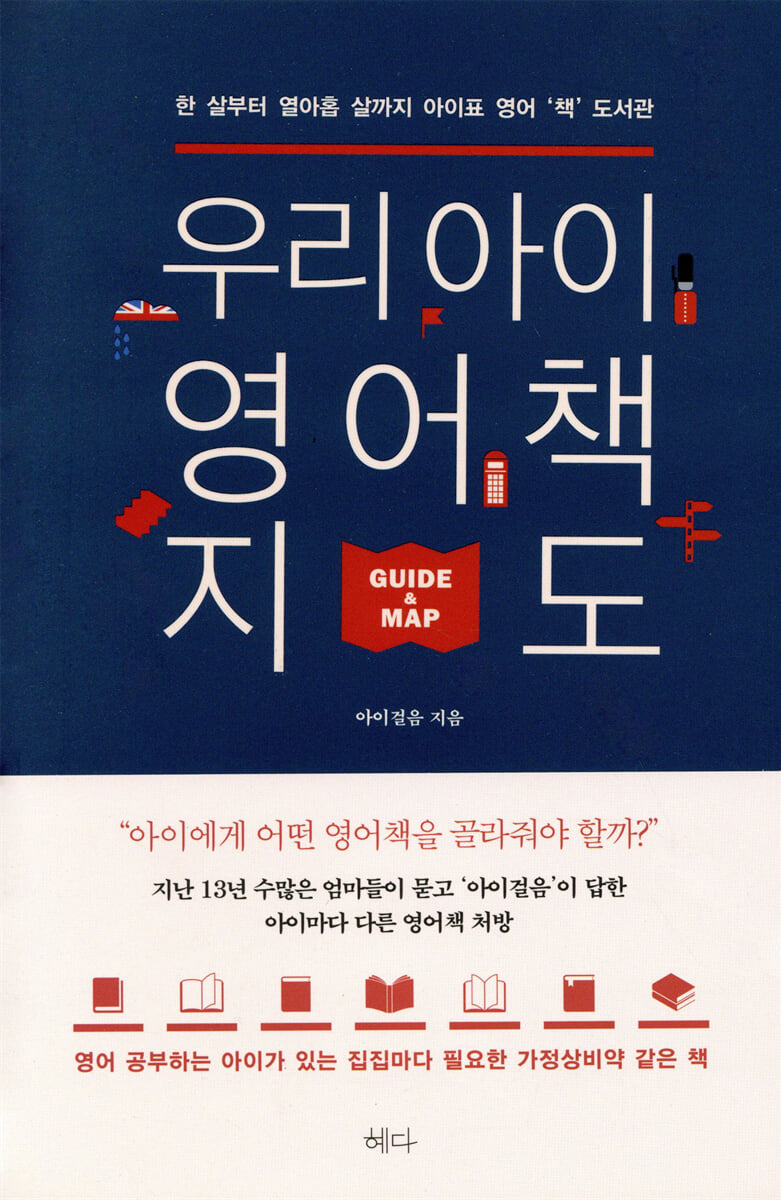
English book guidance for our children
 |
Description
Book Introduction
There are English books that children like!
How do we choose English books for our children that will change their future?
To become a discerning mother who can choose English books that suit your child's level and taste
To become a child who enjoys and is excited about reading English books
I am not a child who was briefly called an English prodigy when I was young.
To grow into a future talent who can freely utilize English content throughout their lives
A dream map to finding books your child will like among the countless English book information.
Over the past 13 years, mothers have asked and 'Aiguleum' has answered, prescribing different English books for each child.
A must-have book for every household with a child learning English.
When our children don't like the English books that everyone else says are fun, or when our children don't want to read the recommended books that we tell them to read, mothers often worry.
We feel a sense of duty and responsibility to get our children to read those books, so we try to get them to read by following recommended book lists and information on popular books, but even so, there is no guarantee that the child will become good at English.
This is because the must-read list, which is like an answer sheet, does not reflect our children's tastes and curiosities.
The important thing is that it should be a book that your child enjoys and enjoys, not a book that someone else's child has read.
Reading English books with your child or on your own can be sustained for a long time when it feels like play rather than studying, rather than a book that your mother studied hard and carefully selected.
So, the beginning of a child's English study is for the mother to properly understand the child's thoughts, mind, tastes, and emotions.
This book serves as a guide to finding books that your child will truly enjoy among the numerous English book information available.
The goal is not to learn English faster than others, but to be able to freely utilize English content throughout one's life.
The book contains comprehensive information on all English books and other English-related content that children can read from the time they first encounter English until they can use it to some extent.
This is not a simple list of recommended books, but contains essential information that mothers who choose books for their children or children who know how to choose books on their own really want to know, such as the content and level of each book, reader tendencies, format and style, message delivered, and book reviews.
This is a must-have book for every household with a child learning English.
How do we choose English books for our children that will change their future?
To become a discerning mother who can choose English books that suit your child's level and taste
To become a child who enjoys and is excited about reading English books
I am not a child who was briefly called an English prodigy when I was young.
To grow into a future talent who can freely utilize English content throughout their lives
A dream map to finding books your child will like among the countless English book information.
Over the past 13 years, mothers have asked and 'Aiguleum' has answered, prescribing different English books for each child.
A must-have book for every household with a child learning English.
When our children don't like the English books that everyone else says are fun, or when our children don't want to read the recommended books that we tell them to read, mothers often worry.
We feel a sense of duty and responsibility to get our children to read those books, so we try to get them to read by following recommended book lists and information on popular books, but even so, there is no guarantee that the child will become good at English.
This is because the must-read list, which is like an answer sheet, does not reflect our children's tastes and curiosities.
The important thing is that it should be a book that your child enjoys and enjoys, not a book that someone else's child has read.
Reading English books with your child or on your own can be sustained for a long time when it feels like play rather than studying, rather than a book that your mother studied hard and carefully selected.
So, the beginning of a child's English study is for the mother to properly understand the child's thoughts, mind, tastes, and emotions.
This book serves as a guide to finding books that your child will truly enjoy among the numerous English book information available.
The goal is not to learn English faster than others, but to be able to freely utilize English content throughout one's life.
The book contains comprehensive information on all English books and other English-related content that children can read from the time they first encounter English until they can use it to some extent.
This is not a simple list of recommended books, but contains essential information that mothers who choose books for their children or children who know how to choose books on their own really want to know, such as the content and level of each book, reader tendencies, format and style, message delivered, and book reviews.
This is a must-have book for every household with a child learning English.
- You can preview some of the book's contents.
Preview
index
prolog
7p A map and compass that guides children into the world of English books that are perfect for them.
INTRO
16p English books for children from one to nineteen years old
Chapter 1: Ai-Pyo English Picture Book Map
31p 01 Picture books by age
40p 02 Infants and toddlers (0-18 months)
49p 03 Toddler (18-36 months)
63p 04 Preschoolers (ages 3 and up)
76p 05 Preschoolers (ages 4 and up)
86p 06 Kinder (5 years old)
98p 07 1st grade (6 years old)
104p +INFO.
Eric Carle, a leading picture book author
Chapter 2: Latitude and longitude of the English map, reading level
113p 01 Understanding Reading Levels
140p 02 Using Reading Level
Chapter 3: Aipyo English Leaders Book Map
133p 01 Leaders Book Definition and Types
140p 02 When you think of Leaders Book, you think of Dr. Seuss Award-winning authors and books.
158p 03 Leaders Book Representative Author Dr. Seuss
165p 04 A good picture book for reading practice
176p 05 Leader's Book Selection Guide ① Choosing by Age_ Kindergarten (5 years old)
180p 06 Leader's Book Selection Guide ② Choosing by Age_ 1st and 2nd grade and above
188p 07 Leader's Book Selection Guide ③ Choosing by Genre
195p 08 Leader's Book Selection Guide ④ Choosing by Gender
207p 09 Leader's Book Selection Guide ⑤ Choosing by Reading Level
Chapter 4: Aipyo English Chapter Book Map
215p 01 From Leaders Book to Chapter Book
218p 02 Early Chapter Book
222p 03 Early Chapter Book Selection Guide ① Choosing by Genre
232p 04 Early Chapter Book Selection Guide ② Choosing by Gender
234p 05 Early Chapter Book Selection Guide ③ Choosing by Reading Level
236p 06 Chapter Book
241p 07 Chapter Book Selection Guide ① Choose by Genre
266p 08 Chapter Book Selection Guide ② Choose by Grade and Gender
270p 09 Chapter Book Selection Guide ③ Choosing by Reading Level
Chapter 5: Aipyo English Graphic Novel Map
275p 01 The Usefulness of Graphic Novels
278p 02 Graphic Novel
292p 03 Graphic novel with original novel
297p +INFO.
It's not a graphic novel, but it's a book with a lot of illustrations.
Chapter 6: Ai-Pyo English Novel Book Map
305p 01 Novels by Age
308p 02 Elementary School Novel
327p +INFO.
Roald Dahl, the representative of elementary school novels
332p 03 Middle School Novel
341p 04 Newbery Medal, a children's literature award
359p 05 High School Novel
370p 06 Classics
Chapter 7: Ai-Pyo English Nonfiction Book Map
383p 01 Reading nonfiction books
386p 02 History and People
397p 03 Science
420p 04 Math
431p 05 Worksheets and Dictionaries
442p 06 Current Affairs
448p 07 Online Education Site
Chapter 8: Finding Your Taste and Dreams on the English Map
457p 01 Children's Picture Book Preferences
461p COMPASS A book for children who love animals
470p COMPASS A book for kids who love dinosaurs
474p COMPASS: A book for kids who love princesses, fairies, and ballerinas.
484p COMPASS A book for kids who love rides
493p COMPASS Alphabet Book
502p COMPASS Classic Traditional Fairy Tale Picture Book
514p COMPASS: A book for kids who love travel and maps
520p COMPASS Art Picture Book
523p COMPASS: A Book About the Human Body, Bones, and the Fetus
526p 02 Children's Novel Book Preferences
527p COMPASS Age-Specific Myths
533p COMPASS Bible by Age
537p COMPASS Age-Specific Fantasy
549p COMPASS Age-Specific Mystery
556p COMPASS Age-Specific Dystopia
559p COMPASS SF by Age
562p 03 Child's interests, occupations, and dreams
567p COMPASS Human Rights? Environment & Human Rights Activists? Environmental Activists
572p COMPASS Journalism & Journalists
575p COMPASS Science & Scientists
579p COMPASS Computer Science & Computer Engineers
582p COMPASS Space & Astronauts
584p COMPASS Art & Painters
588p COMPASS Fashion & Fashion Designer
590p COMPASS Architecture & Architects
595p COMPASS Food & Chef
600p +INFO.
How to buy English books
602p EPILOGUE
604p INDEX Find English books in the book
7p A map and compass that guides children into the world of English books that are perfect for them.
INTRO
16p English books for children from one to nineteen years old
Chapter 1: Ai-Pyo English Picture Book Map
31p 01 Picture books by age
40p 02 Infants and toddlers (0-18 months)
49p 03 Toddler (18-36 months)
63p 04 Preschoolers (ages 3 and up)
76p 05 Preschoolers (ages 4 and up)
86p 06 Kinder (5 years old)
98p 07 1st grade (6 years old)
104p +INFO.
Eric Carle, a leading picture book author
Chapter 2: Latitude and longitude of the English map, reading level
113p 01 Understanding Reading Levels
140p 02 Using Reading Level
Chapter 3: Aipyo English Leaders Book Map
133p 01 Leaders Book Definition and Types
140p 02 When you think of Leaders Book, you think of Dr. Seuss Award-winning authors and books.
158p 03 Leaders Book Representative Author Dr. Seuss
165p 04 A good picture book for reading practice
176p 05 Leader's Book Selection Guide ① Choosing by Age_ Kindergarten (5 years old)
180p 06 Leader's Book Selection Guide ② Choosing by Age_ 1st and 2nd grade and above
188p 07 Leader's Book Selection Guide ③ Choosing by Genre
195p 08 Leader's Book Selection Guide ④ Choosing by Gender
207p 09 Leader's Book Selection Guide ⑤ Choosing by Reading Level
Chapter 4: Aipyo English Chapter Book Map
215p 01 From Leaders Book to Chapter Book
218p 02 Early Chapter Book
222p 03 Early Chapter Book Selection Guide ① Choosing by Genre
232p 04 Early Chapter Book Selection Guide ② Choosing by Gender
234p 05 Early Chapter Book Selection Guide ③ Choosing by Reading Level
236p 06 Chapter Book
241p 07 Chapter Book Selection Guide ① Choose by Genre
266p 08 Chapter Book Selection Guide ② Choose by Grade and Gender
270p 09 Chapter Book Selection Guide ③ Choosing by Reading Level
Chapter 5: Aipyo English Graphic Novel Map
275p 01 The Usefulness of Graphic Novels
278p 02 Graphic Novel
292p 03 Graphic novel with original novel
297p +INFO.
It's not a graphic novel, but it's a book with a lot of illustrations.
Chapter 6: Ai-Pyo English Novel Book Map
305p 01 Novels by Age
308p 02 Elementary School Novel
327p +INFO.
Roald Dahl, the representative of elementary school novels
332p 03 Middle School Novel
341p 04 Newbery Medal, a children's literature award
359p 05 High School Novel
370p 06 Classics
Chapter 7: Ai-Pyo English Nonfiction Book Map
383p 01 Reading nonfiction books
386p 02 History and People
397p 03 Science
420p 04 Math
431p 05 Worksheets and Dictionaries
442p 06 Current Affairs
448p 07 Online Education Site
Chapter 8: Finding Your Taste and Dreams on the English Map
457p 01 Children's Picture Book Preferences
461p COMPASS A book for children who love animals
470p COMPASS A book for kids who love dinosaurs
474p COMPASS: A book for kids who love princesses, fairies, and ballerinas.
484p COMPASS A book for kids who love rides
493p COMPASS Alphabet Book
502p COMPASS Classic Traditional Fairy Tale Picture Book
514p COMPASS: A book for kids who love travel and maps
520p COMPASS Art Picture Book
523p COMPASS: A Book About the Human Body, Bones, and the Fetus
526p 02 Children's Novel Book Preferences
527p COMPASS Age-Specific Myths
533p COMPASS Bible by Age
537p COMPASS Age-Specific Fantasy
549p COMPASS Age-Specific Mystery
556p COMPASS Age-Specific Dystopia
559p COMPASS SF by Age
562p 03 Child's interests, occupations, and dreams
567p COMPASS Human Rights? Environment & Human Rights Activists? Environmental Activists
572p COMPASS Journalism & Journalists
575p COMPASS Science & Scientists
579p COMPASS Computer Science & Computer Engineers
582p COMPASS Space & Astronauts
584p COMPASS Art & Painters
588p COMPASS Fashion & Fashion Designer
590p COMPASS Architecture & Architects
595p COMPASS Food & Chef
600p +INFO.
How to buy English books
602p EPILOGUE
604p INDEX Find English books in the book
Detailed image

Into the book
There are so many good English books.
Even if you just read the must-read lists recommended by various organizations and the latest bestsellers that keep coming out, 24 hours wouldn't be enough.
The bigger problem is that there is no guarantee that our children will like the books that others say are good.
A skill that a mother needs is the ability to find books that her child will enjoy reading.
If you want your child to continue to enjoy reading, you need to keep finding lots of books, not just one or two.
How can we develop this kind of discernment? It's not something you can develop overnight.
Although mothers think they know their children well, it takes time and effort to figure out their children's book tastes.
If a book that was a hit in another household is a failure in ours, we shouldn't be disappointed; we should rejoice that it's a valuable discovery about our child's tastes.
--- From "What a mother needs is an eye for choosing books that her child will enjoy reading"
Learning English doesn't happen overnight.
It takes at least 10 years.
‘Doing a little bit every day consistently’ is what leads to success in learning a foreign language.
The power that makes this simple but difficult to put into practice possible is ‘fun.’
Kids have to have fun to work hard, keep going, and finish.
If you want your child to enjoy reading English books, all you have to do is find books that they enjoy reading.
--- From "A Mother's Attitude Toward Her Child's English Study"
It is a waste to fill a child's heart and mind with things that do not excite him.
Wouldn't it be better to fill a child's limited time, mind, and thoughts with exciting things? When information or memories are imbued with emotion, they remain long-lasting and influence the child's life.
As time passes, the books you read may be forgotten, but the happy experience of reading them will stay with your child for a lifetime.
--- From "Don't read anything that doesn't make your heart flutter"
You can read it at a level similar to reading Korean.
The longer you stay in that age group, the better.
If you start before age 4, read as many books as possible that are appropriate for that age group rather than rushing to the next age group.
--- From "If you start reading original texts early"
You may have already encountered foreign authors' books in Korean picture books.
Skip the baby books and browse the covers of toddler books for ages 18-36 months.
If your child likes an author, read another book by that author in English.
If the book is part of a series, please read other books in the same series.
Since a series usually has more than 10 volumes, it can naturally lead to reading a lot of English books.
The stories in toddler books are simple, so you don't have to read too much.
You've probably already experienced being immersed in a story by reading a Korean book, so move on to a children's English book with a strong story.
You just need to find a book for preschoolers aged 3-4.
It's okay to read just a few books, but if your child develops a favorite author or series, read them thoroughly.
If you start at age 6 or 7, look at some of the books for 3-year-olds, then read mainly books for 4-year-olds and older, and then move on to books for older age groups.
--- From "When starting to read English books after the age of 5"
You can start by reading English picture books or leaders' books.
Before reading a book, you need to have some level of listening skills to accelerate your reading.
If your child is already familiar with the sounds of English through English songs, videos, or audiobooks, read books at a level they enjoy.
Some children may prefer picture books, while others may prefer leaders' books because they have seen enough Korean picture books.
There is also a way to read the Leader's Book to some extent and then return to the picture book.
This is because the vocabulary level in picture books is often higher than that of leaders' books.
--- From "When to start reading English books in 1st or 2nd grade"
There are many cases where you are exposed to English at school, academy, or at home.
If you can read books at a simple level, start reading with Leader's Books.
Start with a low level of Leader's Book and gradually work your way up, increasing the difficulty of the words and the level of sentences.
After reading a certain amount of Leaders' Books, it's a good idea to read picture books at the preschool and kindergarten level, but some children refuse to read picture books, saying that they are only for young children.
If so, read the Leader's Book thoroughly and then move on to the chapter book.
--- From "When starting to read English books in 3rd or 4th grade"
The reason we have children read English books from a young age is so that they can read English freely as adults.
You shouldn't think of Harry Potter, which is at a fifth grade level, as the ultimate goal of reading English books.
Harry Potter does not represent the entire English content.
As your child grows, his or her English reading level should also improve.
The English section of the CSAT is at the American middle school level.
English academies often stop at the level of American middle school students, but if you plan to use English for the rest of your life and read English books, you should aim to read original texts at the level of a native-speaking college student.
--- From "The Real Reason We Start Children Learning English Early"
The period when I pay the most attention to reading level is when I read mainly leaders' books and chapter books.
However, children at this age feel burdened by reading books when they encounter difficult words that are beyond their reading level.
So, it is important to understand your child's reading level and choose books that fit that range.
--- From "When to be concerned about your child's reading level"
Many mothers worry about when to move from leaders' books to early chapter books, from early chapter books to chapter books, and from AR 2-point chapter books to AR 3-point chapter books. There is no standard for how many books to read to move to the next level.
It depends on the child's language ability, native language skills, learning ability, motivation to learn English, and concentration.
Some children are good at reading Korean and can easily move on to English books.
We shouldn't expect that our child will be able to read as much as that child.
After each person has reached their appropriate amount, they should naturally move on to the next step.
--- From "How long does it take to raise your reading level"
As much as reading level, something that mothers should be concerned about is the length of the book.
When a child says, "English books are difficult," he or she may mean that the vocabulary is difficult or that the book is long.
Children who are sensitive to the difficulty of words can choose books that take AR into consideration.
If your child has difficulty reading long books, you should look at the word count per book.
Even if it's the same 70 pages, the number of words in the book varies depending on the presence or absence of illustrations, font size, line spacing, etc.
If the text is large or there are many pictures, it doesn't feel like there is a lot of space even if there are many pages.
--- From "The Relationship Between the Number of Words and the Number of Pages per Volume"
Reading level is just one criterion for choosing the right book for your child.
When a child finds a book they like, they'll stick with it, even if it's difficult. Just because a child who reads books with AR scores of 3 or 4 reads Harry Potter doesn't mean they'll reach AR scores of 5 or 6. To be considered at that level, they need to be able to read other books with AR scores of 5 or 6 as well.
After reading Harry Potter, some children go back to reading books with AR scores of 3 or 4.
--- From "When You Shouldn't Be Overly Obsessed with Your Reading Level"
If your child starts reading English books early, it's better in the long run to have them read more books appropriate for their age group rather than focusing on raising their reading level.
If you raise the reading age too early, they will think that books for their age are not suitable for them, and if they do not match their emotional age, they will often stop at some point.
--- From "Advice for Children Who Have a Higher Reading Level Than Their Peers"
As children grow, they develop interests.
It actually makes mom more comfortable when her child starts to prefer certain things.
Because now you have a guideline for what to choose.
If you pick another book by your favorite author or another book with your favorite characters, animals, or objects, you're more likely to like that book.
A mother's role is to help her child's interests and reading become enjoyable.
Create an environment where your child can express himself freely.
Don't belittle the little things your child does, but always admire them with loving eyes.
A child's perspective determines which book to read.
Enjoy the time by cheering on your child as he or she walks, choosing the direction and path.
A child with a strong supporter will follow his heart with confidence.
--- From "Children's Tastes and Reading"
The books that children read while following their future hopes or career interests accumulate as time for them to explore the world.
I hope that not every book my child reads is related to grades or college entrance exams.
Allow your child to freely experience the diversity of the world.
--- From "Children's Dreams and Reading"
Some children can answer the question, "What do you want to be when you grow up?", but many find it difficult to answer.
If your child is still young, you can just wait.
As you grow up and your interests diversify, this is a problem that will be solved on its own.
However, if your child doesn't know many occupations or hasn't thought about them before and can't answer, you and your child can explore them together.
--- From "Children's Future Careers and Reading"
This book was written with the hope that it will serve as a guide to finding books that your child will like among the vast amount of English book information.
There are several ways to get from Seoul to Busan.
If your goal is to get there quickly, you can take the high-speed train.
You can either stop by a large city along the way and play, or you can take a regular train or express bus.
You can also drive there yourself.
You can stop by Daejeon or Daegu along the way, or go to Gwangju or Yeosu and then pass through Jirisan.
The world has changed so that it is no longer about how quickly you arrived, but about what you saw, felt, learned along the way, and what is unique about you.
--- From "The most personal is the most creative"
Finding books your child likes is surprisingly simple.
The child can choose.
Don't hand over to your child something that your mother studied hard and thought hard about.
It would be good to choose with your child and pass the initiative to them as they grow up.
I hope this book will become a book that you can read with your child.
Even if you just read the must-read lists recommended by various organizations and the latest bestsellers that keep coming out, 24 hours wouldn't be enough.
The bigger problem is that there is no guarantee that our children will like the books that others say are good.
A skill that a mother needs is the ability to find books that her child will enjoy reading.
If you want your child to continue to enjoy reading, you need to keep finding lots of books, not just one or two.
How can we develop this kind of discernment? It's not something you can develop overnight.
Although mothers think they know their children well, it takes time and effort to figure out their children's book tastes.
If a book that was a hit in another household is a failure in ours, we shouldn't be disappointed; we should rejoice that it's a valuable discovery about our child's tastes.
--- From "What a mother needs is an eye for choosing books that her child will enjoy reading"
Learning English doesn't happen overnight.
It takes at least 10 years.
‘Doing a little bit every day consistently’ is what leads to success in learning a foreign language.
The power that makes this simple but difficult to put into practice possible is ‘fun.’
Kids have to have fun to work hard, keep going, and finish.
If you want your child to enjoy reading English books, all you have to do is find books that they enjoy reading.
--- From "A Mother's Attitude Toward Her Child's English Study"
It is a waste to fill a child's heart and mind with things that do not excite him.
Wouldn't it be better to fill a child's limited time, mind, and thoughts with exciting things? When information or memories are imbued with emotion, they remain long-lasting and influence the child's life.
As time passes, the books you read may be forgotten, but the happy experience of reading them will stay with your child for a lifetime.
--- From "Don't read anything that doesn't make your heart flutter"
You can read it at a level similar to reading Korean.
The longer you stay in that age group, the better.
If you start before age 4, read as many books as possible that are appropriate for that age group rather than rushing to the next age group.
--- From "If you start reading original texts early"
You may have already encountered foreign authors' books in Korean picture books.
Skip the baby books and browse the covers of toddler books for ages 18-36 months.
If your child likes an author, read another book by that author in English.
If the book is part of a series, please read other books in the same series.
Since a series usually has more than 10 volumes, it can naturally lead to reading a lot of English books.
The stories in toddler books are simple, so you don't have to read too much.
You've probably already experienced being immersed in a story by reading a Korean book, so move on to a children's English book with a strong story.
You just need to find a book for preschoolers aged 3-4.
It's okay to read just a few books, but if your child develops a favorite author or series, read them thoroughly.
If you start at age 6 or 7, look at some of the books for 3-year-olds, then read mainly books for 4-year-olds and older, and then move on to books for older age groups.
--- From "When starting to read English books after the age of 5"
You can start by reading English picture books or leaders' books.
Before reading a book, you need to have some level of listening skills to accelerate your reading.
If your child is already familiar with the sounds of English through English songs, videos, or audiobooks, read books at a level they enjoy.
Some children may prefer picture books, while others may prefer leaders' books because they have seen enough Korean picture books.
There is also a way to read the Leader's Book to some extent and then return to the picture book.
This is because the vocabulary level in picture books is often higher than that of leaders' books.
--- From "When to start reading English books in 1st or 2nd grade"
There are many cases where you are exposed to English at school, academy, or at home.
If you can read books at a simple level, start reading with Leader's Books.
Start with a low level of Leader's Book and gradually work your way up, increasing the difficulty of the words and the level of sentences.
After reading a certain amount of Leaders' Books, it's a good idea to read picture books at the preschool and kindergarten level, but some children refuse to read picture books, saying that they are only for young children.
If so, read the Leader's Book thoroughly and then move on to the chapter book.
--- From "When starting to read English books in 3rd or 4th grade"
The reason we have children read English books from a young age is so that they can read English freely as adults.
You shouldn't think of Harry Potter, which is at a fifth grade level, as the ultimate goal of reading English books.
Harry Potter does not represent the entire English content.
As your child grows, his or her English reading level should also improve.
The English section of the CSAT is at the American middle school level.
English academies often stop at the level of American middle school students, but if you plan to use English for the rest of your life and read English books, you should aim to read original texts at the level of a native-speaking college student.
--- From "The Real Reason We Start Children Learning English Early"
The period when I pay the most attention to reading level is when I read mainly leaders' books and chapter books.
However, children at this age feel burdened by reading books when they encounter difficult words that are beyond their reading level.
So, it is important to understand your child's reading level and choose books that fit that range.
--- From "When to be concerned about your child's reading level"
Many mothers worry about when to move from leaders' books to early chapter books, from early chapter books to chapter books, and from AR 2-point chapter books to AR 3-point chapter books. There is no standard for how many books to read to move to the next level.
It depends on the child's language ability, native language skills, learning ability, motivation to learn English, and concentration.
Some children are good at reading Korean and can easily move on to English books.
We shouldn't expect that our child will be able to read as much as that child.
After each person has reached their appropriate amount, they should naturally move on to the next step.
--- From "How long does it take to raise your reading level"
As much as reading level, something that mothers should be concerned about is the length of the book.
When a child says, "English books are difficult," he or she may mean that the vocabulary is difficult or that the book is long.
Children who are sensitive to the difficulty of words can choose books that take AR into consideration.
If your child has difficulty reading long books, you should look at the word count per book.
Even if it's the same 70 pages, the number of words in the book varies depending on the presence or absence of illustrations, font size, line spacing, etc.
If the text is large or there are many pictures, it doesn't feel like there is a lot of space even if there are many pages.
--- From "The Relationship Between the Number of Words and the Number of Pages per Volume"
Reading level is just one criterion for choosing the right book for your child.
When a child finds a book they like, they'll stick with it, even if it's difficult. Just because a child who reads books with AR scores of 3 or 4 reads Harry Potter doesn't mean they'll reach AR scores of 5 or 6. To be considered at that level, they need to be able to read other books with AR scores of 5 or 6 as well.
After reading Harry Potter, some children go back to reading books with AR scores of 3 or 4.
--- From "When You Shouldn't Be Overly Obsessed with Your Reading Level"
If your child starts reading English books early, it's better in the long run to have them read more books appropriate for their age group rather than focusing on raising their reading level.
If you raise the reading age too early, they will think that books for their age are not suitable for them, and if they do not match their emotional age, they will often stop at some point.
--- From "Advice for Children Who Have a Higher Reading Level Than Their Peers"
As children grow, they develop interests.
It actually makes mom more comfortable when her child starts to prefer certain things.
Because now you have a guideline for what to choose.
If you pick another book by your favorite author or another book with your favorite characters, animals, or objects, you're more likely to like that book.
A mother's role is to help her child's interests and reading become enjoyable.
Create an environment where your child can express himself freely.
Don't belittle the little things your child does, but always admire them with loving eyes.
A child's perspective determines which book to read.
Enjoy the time by cheering on your child as he or she walks, choosing the direction and path.
A child with a strong supporter will follow his heart with confidence.
--- From "Children's Tastes and Reading"
The books that children read while following their future hopes or career interests accumulate as time for them to explore the world.
I hope that not every book my child reads is related to grades or college entrance exams.
Allow your child to freely experience the diversity of the world.
--- From "Children's Dreams and Reading"
Some children can answer the question, "What do you want to be when you grow up?", but many find it difficult to answer.
If your child is still young, you can just wait.
As you grow up and your interests diversify, this is a problem that will be solved on its own.
However, if your child doesn't know many occupations or hasn't thought about them before and can't answer, you and your child can explore them together.
--- From "Children's Future Careers and Reading"
This book was written with the hope that it will serve as a guide to finding books that your child will like among the vast amount of English book information.
There are several ways to get from Seoul to Busan.
If your goal is to get there quickly, you can take the high-speed train.
You can either stop by a large city along the way and play, or you can take a regular train or express bus.
You can also drive there yourself.
You can stop by Daejeon or Daegu along the way, or go to Gwangju or Yeosu and then pass through Jirisan.
The world has changed so that it is no longer about how quickly you arrived, but about what you saw, felt, learned along the way, and what is unique about you.
--- From "The most personal is the most creative"
Finding books your child likes is surprisingly simple.
The child can choose.
Don't hand over to your child something that your mother studied hard and thought hard about.
It would be good to choose with your child and pass the initiative to them as they grow up.
I hope this book will become a book that you can read with your child.
--- From "How to Find Books Your Child Likes"
Publisher's Review
About English study for children that feels like a heavy burden
Mothers' worries are solved!
· I want to read the original book, but which book should I start with?
· I finished Phoenix and started reading English books. Which books should I read?
· I hate Magic Tree House. What book should I read?
· Do I need to read a lot of the original text to read Harry Potter?
· What should I do if my boy hates books with girls as the main characters?
· I don't want to read non-fiction. What should I do?
· My child started reading original books late and has poor reading skills. What kind of books should I read if he or she dislikes chapter books because they are too childish?
· I've already read all the Caldecott Award-winning picture books in Korean. Do I need to read them again in their original language?
· It's difficult to choose an English book that your child will like with only a list of covers and titles.
· Popular books from 10 to 20 years ago are well known, but information on recent books is difficult to obtain.
· Information on books for young children is easy to find, but information on books for elementary, middle, and high school students is relatively rare.
This blog contains questions about children's English education shared with numerous mothers over the past 13 years, along with Aistep's prescriptions for these questions.
You will feel like your worries about studying English, which you were so curious about but had no one to ask, have been completely resolved.
A mother's correct attitude toward her child's English study
You can develop an eye for choosing the perfect book for your child!
If a mother thinks that the most important thing for her child to learn English is a list of good books, she is very mistaken.
The important thing is ‘the right book for our child.’
Anyone can find a good list of books with a little effort, but if you don't know your child well enough to know which books he or she likes, there's a high chance that he or she won't read them even if you buy them books.
This book helps you find books your child will like among a list of many good books.
Rather than a simple list of recommended books, it contains essential information that any mother who chooses books should know, such as the main content and level of each book, the message it conveys, reader tendencies, format and style, and post-publication reviews.
This is a book that allows you to choose different books for each child by focusing only on your child's thoughts and tastes, without using other children as a standard.
English books for all ages from one to nineteen, of course.
Plus, comprehensive English content information!
The book contains information on numerous English books that can be selected according to the child's growth rate and level from one to nineteen years old.
We introduce English books of all genres, including picture books suitable for infants and toddlers, early elementary school students, and when mothers read to their children, as well as reader books and chapter books for reading practice when children begin to read English, and graphic novels, novels, classics, and the Bible that children can read from the upper grades of elementary school to high school students, where they can choose the books they want.
In addition, it provides detailed information on related content that can help children study English, such as workbooks, learning sites, dictionaries, current affairs, and online education sites, as well as information on books that can be selected based on the child's tastes, dreams, and career interests, to help each child choose a good English book that is unique to them.
Mothers' worries are solved!
· I want to read the original book, but which book should I start with?
· I finished Phoenix and started reading English books. Which books should I read?
· I hate Magic Tree House. What book should I read?
· Do I need to read a lot of the original text to read Harry Potter?
· What should I do if my boy hates books with girls as the main characters?
· I don't want to read non-fiction. What should I do?
· My child started reading original books late and has poor reading skills. What kind of books should I read if he or she dislikes chapter books because they are too childish?
· I've already read all the Caldecott Award-winning picture books in Korean. Do I need to read them again in their original language?
· It's difficult to choose an English book that your child will like with only a list of covers and titles.
· Popular books from 10 to 20 years ago are well known, but information on recent books is difficult to obtain.
· Information on books for young children is easy to find, but information on books for elementary, middle, and high school students is relatively rare.
This blog contains questions about children's English education shared with numerous mothers over the past 13 years, along with Aistep's prescriptions for these questions.
You will feel like your worries about studying English, which you were so curious about but had no one to ask, have been completely resolved.
A mother's correct attitude toward her child's English study
You can develop an eye for choosing the perfect book for your child!
If a mother thinks that the most important thing for her child to learn English is a list of good books, she is very mistaken.
The important thing is ‘the right book for our child.’
Anyone can find a good list of books with a little effort, but if you don't know your child well enough to know which books he or she likes, there's a high chance that he or she won't read them even if you buy them books.
This book helps you find books your child will like among a list of many good books.
Rather than a simple list of recommended books, it contains essential information that any mother who chooses books should know, such as the main content and level of each book, the message it conveys, reader tendencies, format and style, and post-publication reviews.
This is a book that allows you to choose different books for each child by focusing only on your child's thoughts and tastes, without using other children as a standard.
English books for all ages from one to nineteen, of course.
Plus, comprehensive English content information!
The book contains information on numerous English books that can be selected according to the child's growth rate and level from one to nineteen years old.
We introduce English books of all genres, including picture books suitable for infants and toddlers, early elementary school students, and when mothers read to their children, as well as reader books and chapter books for reading practice when children begin to read English, and graphic novels, novels, classics, and the Bible that children can read from the upper grades of elementary school to high school students, where they can choose the books they want.
In addition, it provides detailed information on related content that can help children study English, such as workbooks, learning sites, dictionaries, current affairs, and online education sites, as well as information on books that can be selected based on the child's tastes, dreams, and career interests, to help each child choose a good English book that is unique to them.
GOODS SPECIFICS
- Date of issue: August 25, 2021
- Page count, weight, size: 640 pages | 958g | 153*224*40mm
- ISBN13: 9791191183078
- ISBN10: 1191183076
You may also like
카테고리
korean


korean

![GQ KOREA Mark (Monthly): December [2025]](http://librairie.coreenne.fr/cdn/shop/files/8ef265dbbfbf186523ed75ba7319009d.jpg?v=1765340328&width=3840)


