

How can you not love science?
 |
Description
Book Introduction
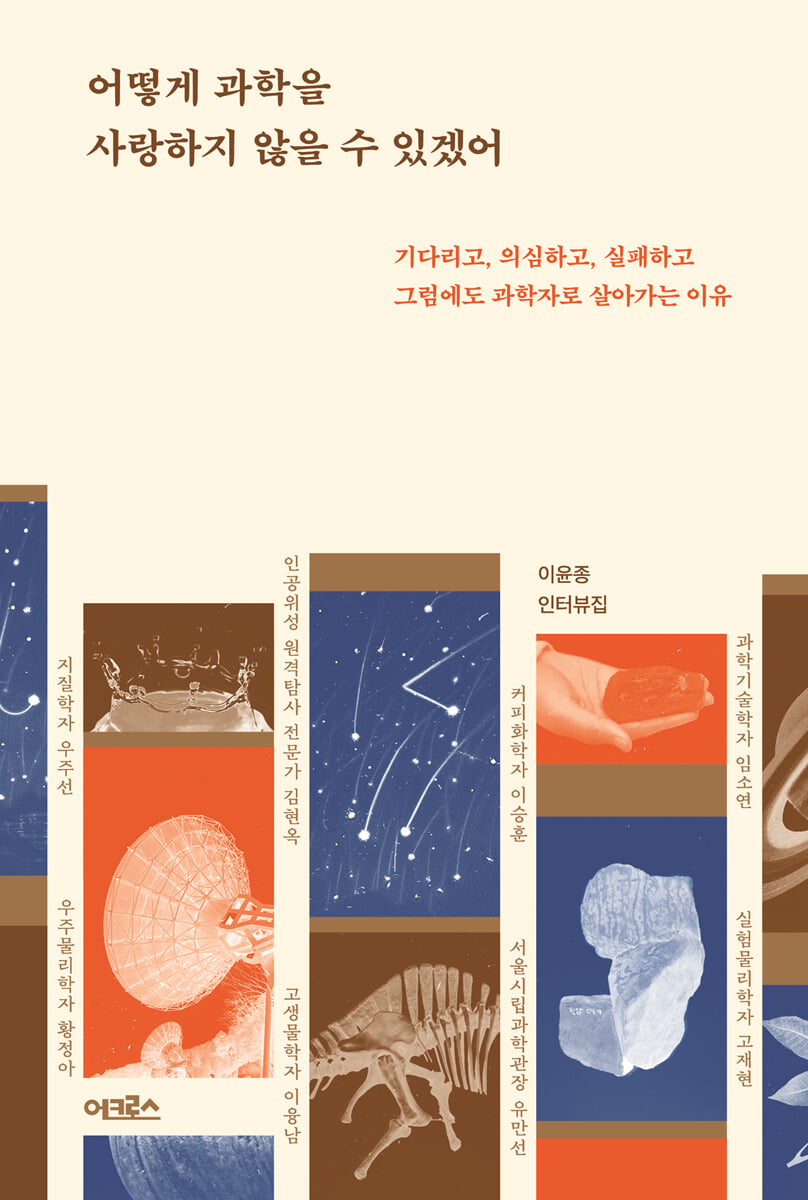
This is a collection of interviews with eight scientists at the forefront of the Korean scientific community, including geologists, paleontologists, and astrophysicists, revealing their scientific passions.
For them, science is not just a branch of learning, but a lifelong pursuit, an object of love, and a tool for understanding the world and themselves.
What led them to choose the path of science? Why do they live as scientists, despite the cycle of waiting, doubting, and failing?
As a broadcast writer with 23 years of experience, writer Lee Yoon-jong has made various attempts to connect science and books. He decides to leave the studio and visit contemporary scientists to ask them questions directly.
What is your first memory of science, and how has what you learned through science impacted your life?
If we were to extract the biggest commonality from their stories of struggling in their respective fields, it would be the confession, "How can one not love science?"
In these confessions, we will encounter a larger world connected to us that only science can reveal.
For them, science is not just a branch of learning, but a lifelong pursuit, an object of love, and a tool for understanding the world and themselves.
What led them to choose the path of science? Why do they live as scientists, despite the cycle of waiting, doubting, and failing?
As a broadcast writer with 23 years of experience, writer Lee Yoon-jong has made various attempts to connect science and books. He decides to leave the studio and visit contemporary scientists to ask them questions directly.
What is your first memory of science, and how has what you learned through science impacted your life?
If we were to extract the biggest commonality from their stories of struggling in their respective fields, it would be the confession, "How can one not love science?"
In these confessions, we will encounter a larger world connected to us that only science can reveal.
- You can preview some of the book's contents.
Preview
index
Prologue: Visiting the Scientist's Study
Facing a page from the history book called Earth
Geologist spacecraft
The power to move forward without bending against gravity
Astrophysicist Hwang Jeong-ah
In response to the question, “What kind of science is that?”
Coffee chemist Lee Seung-hoon
Seeing ourselves from the perspective of the cosmos
Experimental physicist Ko Jae-hyun
We are still living in the age of dinosaurs.
Paleontologist Lee Yong-nam
You have to keep a reasonable distance before you can see it
Kim Hyeon-ok, satellite remote sensing expert
Engineering the Science Museum
ㆍMan-seon Yoo, Director of Seoul Metropolitan Science Museum
Technology that loves science
ㆍScience and technology scholar Lim So-yeon
Facing a page from the history book called Earth
Geologist spacecraft
The power to move forward without bending against gravity
Astrophysicist Hwang Jeong-ah
In response to the question, “What kind of science is that?”
Coffee chemist Lee Seung-hoon
Seeing ourselves from the perspective of the cosmos
Experimental physicist Ko Jae-hyun
We are still living in the age of dinosaurs.
Paleontologist Lee Yong-nam
You have to keep a reasonable distance before you can see it
Kim Hyeon-ok, satellite remote sensing expert
Engineering the Science Museum
ㆍMan-seon Yoo, Director of Seoul Metropolitan Science Museum
Technology that loves science
ㆍScience and technology scholar Lim So-yeon
Detailed image

Into the book
Even changes that occur slowly, by a few millimeters per year, can have enormous effects over time.
But what if there were not 100 million years, but 500 million years, or even significantly longer? Anything could happen, even life that never existed before.
Life couldn't have just appeared suddenly and haphazardly at some point 3.8 billion years ago. There was a huge amount of time between 4.6 billion and 3.8 billion years ago.
What started out as a coincidence, after countless experiments and failures, resulted in the creation of life. The condition that can turn coincidence into inevitability is time.
That time is being dealt with in geology.
--- From "Facing a Page in the History Book Called Earth"
It's stupid to study engineering without science.
It is a delusion to pursue science without engineering.
What and how must go together.
Science is responsible for what, and engineering is responsible for how.
The two of you going separately? It's a disaster.
What and why should come first, and how should follow.
But in our country, we abnormally only go for how first.
People often say research and development, R&D (Research and Development).
It's a concept that only exists in our country.
Scientists are not only required to conduct research and write papers; they are also required to develop and produce products and explain how they generate economic benefits.
What this means is that it's nearly impossible to get research funding to understand the space environment, to find out why auroras occur, or to figure out how old the universe is.
I only care about how I get there.
--- From "The Power to Move Forward Without Breaking Against Gravity"
If there is a response like, “What kind of science is that? I could do that too,” I welcome it.
Because you can say, “Yes, this is science too, so you can do science too.”
While research that leads to the Nobel Prize or the intellectual advancement of humanity is great, I also want to convey the message that science can be put into practice in everyday life.
--- From "In the face of the question, 'What kind of science is that?'"
The light particles that make up sunlight are born in the center of the sun where nuclear fusion occurs due to the enormous pressure and temperature, and it takes hundreds of thousands of years for them to rise to the sun's surface.
The light we see is light that has spent a long time in the sun and has traveled to Earth for 8 minutes.
There's a chance that it'll go to the moon, Jupiter, or somewhere else, but a very small fraction of those particles will reach the Earth's surface and land on tiny leaves, triggering photosynthesis.
We eat the leaves and get the energy we need to survive, so even just one leaf connects us to the universe.
--- From "Looking at Ourselves from the Perspective of the Cosmos"
Most of us live our whole lives thinking, "I was born to do this, so I'm just going to live," earning money, spending it, and fighting with other people.
However, I think that there is a difference between dying knowing why I was born as a life form on this planet called Earth in this vast solar system and what process I went through to become a being called me here today and dying without knowing.
Knowing the longevity of life and my roots, which have continued from the past through evolution, is like understanding my own existence.
So, for me, fossils became something worth risking my life for.
--- From "We Are Still Living in the Age of Dinosaurs"
Satellite remote sensing takes us beyond cities and countries to look beyond the map and into the vast expanse of space we call Earth.
Plus, one of the nice things about satellites is that they look at the same places over and over again at regular intervals.
Just like when a baby is born, we make a growth album and look at it and say, “Your feet were this big when you were born, and that’s when you first walked,” remote sensing is the same.
Each photo provides a wealth of information, but photos taken repeatedly over a long period of time have layers of stories built up through the overlapping spaces and times behind them.
--- From "You have to keep an appropriate distance to start seeing"
Engineering is about solving the inconveniences of human life and creating something that is actually needed.
The interesting thing is that, because it is not as clear-cut as an established scientific theory, we have to constantly compromise with reality and find solutions.
In reality, there is no such thing as a perfectly straight line as assumed in physics or mathematical theories.
No matter how great an idea is, in the physical world we live in, errors occur, people's psychology is reflected, and mistakes are bound to occur.
Engineers have to adjust problems one by one, come up with additional ideas, and demonstrate craftsmanship along the way.
--- From "Engineering the Science Museum"
Science isn't perfect.
Scientists are filling in the gaps and imperfections with their labor.
While pulling out my hair, and sometimes even urging the graduate students.
Science didn't come from the brilliant minds of genius scientists.
If there is such a thing as objectivity in science, distinct from the knowledge of the humanities and social sciences, it comes from the power of materials and tools in nature, and from daily labor. This is something I have come to realize through studying science and technology studies, which demonstrates the field.
It was an experience that brought back the objectivity of science that had once been thrown away.
But what if there were not 100 million years, but 500 million years, or even significantly longer? Anything could happen, even life that never existed before.
Life couldn't have just appeared suddenly and haphazardly at some point 3.8 billion years ago. There was a huge amount of time between 4.6 billion and 3.8 billion years ago.
What started out as a coincidence, after countless experiments and failures, resulted in the creation of life. The condition that can turn coincidence into inevitability is time.
That time is being dealt with in geology.
--- From "Facing a Page in the History Book Called Earth"
It's stupid to study engineering without science.
It is a delusion to pursue science without engineering.
What and how must go together.
Science is responsible for what, and engineering is responsible for how.
The two of you going separately? It's a disaster.
What and why should come first, and how should follow.
But in our country, we abnormally only go for how first.
People often say research and development, R&D (Research and Development).
It's a concept that only exists in our country.
Scientists are not only required to conduct research and write papers; they are also required to develop and produce products and explain how they generate economic benefits.
What this means is that it's nearly impossible to get research funding to understand the space environment, to find out why auroras occur, or to figure out how old the universe is.
I only care about how I get there.
--- From "The Power to Move Forward Without Breaking Against Gravity"
If there is a response like, “What kind of science is that? I could do that too,” I welcome it.
Because you can say, “Yes, this is science too, so you can do science too.”
While research that leads to the Nobel Prize or the intellectual advancement of humanity is great, I also want to convey the message that science can be put into practice in everyday life.
--- From "In the face of the question, 'What kind of science is that?'"
The light particles that make up sunlight are born in the center of the sun where nuclear fusion occurs due to the enormous pressure and temperature, and it takes hundreds of thousands of years for them to rise to the sun's surface.
The light we see is light that has spent a long time in the sun and has traveled to Earth for 8 minutes.
There's a chance that it'll go to the moon, Jupiter, or somewhere else, but a very small fraction of those particles will reach the Earth's surface and land on tiny leaves, triggering photosynthesis.
We eat the leaves and get the energy we need to survive, so even just one leaf connects us to the universe.
--- From "Looking at Ourselves from the Perspective of the Cosmos"
Most of us live our whole lives thinking, "I was born to do this, so I'm just going to live," earning money, spending it, and fighting with other people.
However, I think that there is a difference between dying knowing why I was born as a life form on this planet called Earth in this vast solar system and what process I went through to become a being called me here today and dying without knowing.
Knowing the longevity of life and my roots, which have continued from the past through evolution, is like understanding my own existence.
So, for me, fossils became something worth risking my life for.
--- From "We Are Still Living in the Age of Dinosaurs"
Satellite remote sensing takes us beyond cities and countries to look beyond the map and into the vast expanse of space we call Earth.
Plus, one of the nice things about satellites is that they look at the same places over and over again at regular intervals.
Just like when a baby is born, we make a growth album and look at it and say, “Your feet were this big when you were born, and that’s when you first walked,” remote sensing is the same.
Each photo provides a wealth of information, but photos taken repeatedly over a long period of time have layers of stories built up through the overlapping spaces and times behind them.
--- From "You have to keep an appropriate distance to start seeing"
Engineering is about solving the inconveniences of human life and creating something that is actually needed.
The interesting thing is that, because it is not as clear-cut as an established scientific theory, we have to constantly compromise with reality and find solutions.
In reality, there is no such thing as a perfectly straight line as assumed in physics or mathematical theories.
No matter how great an idea is, in the physical world we live in, errors occur, people's psychology is reflected, and mistakes are bound to occur.
Engineers have to adjust problems one by one, come up with additional ideas, and demonstrate craftsmanship along the way.
--- From "Engineering the Science Museum"
Science isn't perfect.
Scientists are filling in the gaps and imperfections with their labor.
While pulling out my hair, and sometimes even urging the graduate students.
Science didn't come from the brilliant minds of genius scientists.
If there is such a thing as objectivity in science, distinct from the knowledge of the humanities and social sciences, it comes from the power of materials and tools in nature, and from daily labor. This is something I have come to realize through studying science and technology studies, which demonstrates the field.
It was an experience that brought back the objectivity of science that had once been thrown away.
--- From "Technology that Loves Science"
Publisher's Review
The spirit of continuing even in the most difficult moments
The attitude of wandering widely but never losing one's way and finding one's own answers
The joys and sorrows of science that enable them to live as scientists, and the 'scientific heart'
A paleontologist who roams the dusty desert in search of traces of dinosaurs that went extinct tens of millions of years ago; an astrophysicist who imagines space not as a romantic symbol but as a specific place to reach; a technologist who subjects his own body to experimentation and becomes part of the scientific field.
For them, science is not just a branch of learning, but a lifelong pursuit, an object of love, and a tool for understanding the world and themselves.
What made them choose the path of becoming scientists?
As a broadcast writer with 23 years of experience, writer Lee Yoon-jong has made various attempts to connect science and books. He decides to leave the studio and visit contemporary scientists to ask them questions directly.
What is your first memory of science, and how has what you learned through science impacted your life?
If we were to extract the biggest commonality from their stories of struggling in their respective fields, it would be the confession, "How can one not love science?"
In those confessions, we will encounter a larger world connected to us that only science can reveal.
A liberal arts student who thought, 'How could I possibly like something like science?'
Visit the libraries of scientists who fell in love with science.
A liberal arts student who said goodbye to science forever after completing the regular curriculum.
The author, who thought that physics was all about pushing and pulling boxes and biology was all about dissecting frogs, one day encountered science from a completely different perspective.
I don't remember exactly what my first book was, but it was a science book that I thought was boring and difficult and best to stay away from, when I came across a sentence that I could only describe as 'this is poetry.'
Another scene that caught his eye in the science book was the image of scientists who looked like 'beautiful thoraxes'.
The gaze that looks beyond the boundaries of time and space, the incredible absorption and tenacity, these characteristics felt like an aura that only someone who is crazy about the object of their life could exude.
While working as a writer for the radio program “Yoon Go-eun’s EBS Book Cafe,” I had the opportunity to plan a segment called “Scientist’s Study” and invite scientists to the studio.
But scientists have always been tight-lipped.
What I really wanted to hear were the intimate stories beyond the simple, entertaining episodes that could be told on TV.
Things like confessions of love for someone I love who still dreams of dinosaurs, or tears shed while listening to a presentation by a scholar who has gone down the same path as me.
What is it that motivates us to live as scientists, despite the cycle of waiting, doubting, and failing?
Everyone who has their own questions becomes a scientist.
How Science Becomes a Tool for Understanding the World and Myself
The eight scientists featured in this book all have different fields of expertise and research methods.
But none of them are passionate about science just because it is their job.
At every crossroads in life, set your own questions to hold onto and do your best to find the answers.
If we view the Earth as a history book, there are geologist spaceships exploring what stories each scene might tell; astrophysicist Hwang Jeong-ah taking a step closer to space against the force of gravity; coffee chemist Lee Seung-hoon scientifically analyzing the boundless world of coffee that no one has ventured into; experimental physicist Ko Jae-hyeon studying areas that cannot be directly touched or seen through light; dinosaur doctor paleontologist Lee Yong-nam restoring the time of life buried underground; satellite remote sensing expert Kim Hyeon-ok reading the lives of Earthlings through the eyes of satellites; Yoo Man-seon, director of the Seoul Science Museum, who wants to convey to people the moments of science that they can experience rather than just see; and science and technology scholar Lim So-yeon who takes science and technology out of textbooks and papers and presents it in a living, breathing way.
The stories of these eight scientists remind us that life can be enriched when we discover the questions we need to answer in our own lives.
For example, paleontologist Lee Yong-nam says, “There is a difference between dying knowing why I was born as a life form on a planet called Earth in this vast solar system and the process through which I came to be here today, and dying without knowing.”
Experimental physicist Ko Jae-hyun also emphasizes that “in order to find the philosophical meaning of life, we need to look at ourselves in a larger context beyond the dimensions of daily life, family, society, nation, and the Earth.”
This objective view of life from a cosmic perspective, and the curiosity to know the larger world connected to us, gives us a new experience that allows us to see the world differently than before.
Meanwhile, Man-seon Yoo, the only engineer in this book, tells the story of the Wright brothers, who succeeded in making objects levitate without a complete understanding of scientific theory, and says, “If we become too immersed in the deductive method of moving from what we already know to the next step, it is difficult to come up with new inventions or innovations.”
His story about the need to jump into something you desperately want or that just seems fun, or the story of astrophysicist Hwang Jeong-ah, who asserts, “People don’t move without curiosity,” offer a glimpse into how the bold attitude of scientists forging their own path can help solve problems.
Their open-minded approach to science and adventurous spirit toward truth encourage readers to be a little more courageous in the pursuit of what they love.
It's good to love science at least once in your life.
A scientific prescription for those who want to escape a life of helplessness.
There are so many external events in the world that frustrate and leave us feeling helpless.
Before it, we often lose our bearings, wonder if we can try again, and feel overwhelmed by the weight of life.
What attitude should we adopt to live a wiser life?
Perhaps we can find hints in science and the stories of scientists.
Scientists don't talk about it, but rather show through their own lives that sometimes you have to be wrong to find new answers, that even dreams that feel absurd have to be dreamed to find a next step, and that sincerity makes so many things possible.
Their expressions radiate the passion and energy of those who do what they love.
If you are someone who wants to find a way out of a helpless life, I hope you can be infected with their healthy passion.
The attitude of wandering widely but never losing one's way and finding one's own answers
The joys and sorrows of science that enable them to live as scientists, and the 'scientific heart'
A paleontologist who roams the dusty desert in search of traces of dinosaurs that went extinct tens of millions of years ago; an astrophysicist who imagines space not as a romantic symbol but as a specific place to reach; a technologist who subjects his own body to experimentation and becomes part of the scientific field.
For them, science is not just a branch of learning, but a lifelong pursuit, an object of love, and a tool for understanding the world and themselves.
What made them choose the path of becoming scientists?
As a broadcast writer with 23 years of experience, writer Lee Yoon-jong has made various attempts to connect science and books. He decides to leave the studio and visit contemporary scientists to ask them questions directly.
What is your first memory of science, and how has what you learned through science impacted your life?
If we were to extract the biggest commonality from their stories of struggling in their respective fields, it would be the confession, "How can one not love science?"
In those confessions, we will encounter a larger world connected to us that only science can reveal.
A liberal arts student who thought, 'How could I possibly like something like science?'
Visit the libraries of scientists who fell in love with science.
A liberal arts student who said goodbye to science forever after completing the regular curriculum.
The author, who thought that physics was all about pushing and pulling boxes and biology was all about dissecting frogs, one day encountered science from a completely different perspective.
I don't remember exactly what my first book was, but it was a science book that I thought was boring and difficult and best to stay away from, when I came across a sentence that I could only describe as 'this is poetry.'
Another scene that caught his eye in the science book was the image of scientists who looked like 'beautiful thoraxes'.
The gaze that looks beyond the boundaries of time and space, the incredible absorption and tenacity, these characteristics felt like an aura that only someone who is crazy about the object of their life could exude.
While working as a writer for the radio program “Yoon Go-eun’s EBS Book Cafe,” I had the opportunity to plan a segment called “Scientist’s Study” and invite scientists to the studio.
But scientists have always been tight-lipped.
What I really wanted to hear were the intimate stories beyond the simple, entertaining episodes that could be told on TV.
Things like confessions of love for someone I love who still dreams of dinosaurs, or tears shed while listening to a presentation by a scholar who has gone down the same path as me.
What is it that motivates us to live as scientists, despite the cycle of waiting, doubting, and failing?
Everyone who has their own questions becomes a scientist.
How Science Becomes a Tool for Understanding the World and Myself
The eight scientists featured in this book all have different fields of expertise and research methods.
But none of them are passionate about science just because it is their job.
At every crossroads in life, set your own questions to hold onto and do your best to find the answers.
If we view the Earth as a history book, there are geologist spaceships exploring what stories each scene might tell; astrophysicist Hwang Jeong-ah taking a step closer to space against the force of gravity; coffee chemist Lee Seung-hoon scientifically analyzing the boundless world of coffee that no one has ventured into; experimental physicist Ko Jae-hyeon studying areas that cannot be directly touched or seen through light; dinosaur doctor paleontologist Lee Yong-nam restoring the time of life buried underground; satellite remote sensing expert Kim Hyeon-ok reading the lives of Earthlings through the eyes of satellites; Yoo Man-seon, director of the Seoul Science Museum, who wants to convey to people the moments of science that they can experience rather than just see; and science and technology scholar Lim So-yeon who takes science and technology out of textbooks and papers and presents it in a living, breathing way.
The stories of these eight scientists remind us that life can be enriched when we discover the questions we need to answer in our own lives.
For example, paleontologist Lee Yong-nam says, “There is a difference between dying knowing why I was born as a life form on a planet called Earth in this vast solar system and the process through which I came to be here today, and dying without knowing.”
Experimental physicist Ko Jae-hyun also emphasizes that “in order to find the philosophical meaning of life, we need to look at ourselves in a larger context beyond the dimensions of daily life, family, society, nation, and the Earth.”
This objective view of life from a cosmic perspective, and the curiosity to know the larger world connected to us, gives us a new experience that allows us to see the world differently than before.
Meanwhile, Man-seon Yoo, the only engineer in this book, tells the story of the Wright brothers, who succeeded in making objects levitate without a complete understanding of scientific theory, and says, “If we become too immersed in the deductive method of moving from what we already know to the next step, it is difficult to come up with new inventions or innovations.”
His story about the need to jump into something you desperately want or that just seems fun, or the story of astrophysicist Hwang Jeong-ah, who asserts, “People don’t move without curiosity,” offer a glimpse into how the bold attitude of scientists forging their own path can help solve problems.
Their open-minded approach to science and adventurous spirit toward truth encourage readers to be a little more courageous in the pursuit of what they love.
It's good to love science at least once in your life.
A scientific prescription for those who want to escape a life of helplessness.
There are so many external events in the world that frustrate and leave us feeling helpless.
Before it, we often lose our bearings, wonder if we can try again, and feel overwhelmed by the weight of life.
What attitude should we adopt to live a wiser life?
Perhaps we can find hints in science and the stories of scientists.
Scientists don't talk about it, but rather show through their own lives that sometimes you have to be wrong to find new answers, that even dreams that feel absurd have to be dreamed to find a next step, and that sincerity makes so many things possible.
Their expressions radiate the passion and energy of those who do what they love.
If you are someone who wants to find a way out of a helpless life, I hope you can be infected with their healthy passion.
GOODS SPECIFICS
- Date of issue: January 13, 2025
- Page count, weight, size: 280 pages | 304g | 128*190*18mm
- ISBN13: 9791167741851
You may also like
카테고리
korean


korean

![GQ KOREA Mark (Monthly): December [2025]](http://librairie.coreenne.fr/cdn/shop/files/8ef265dbbfbf186523ed75ba7319009d.jpg?v=1765340328&width=3840)


