

Biotech Express
 |
Description
Book Introduction
Fighting against cancer and tuberculosis, the greatest enemies of mankind
A Journey into the World of Biotechnology
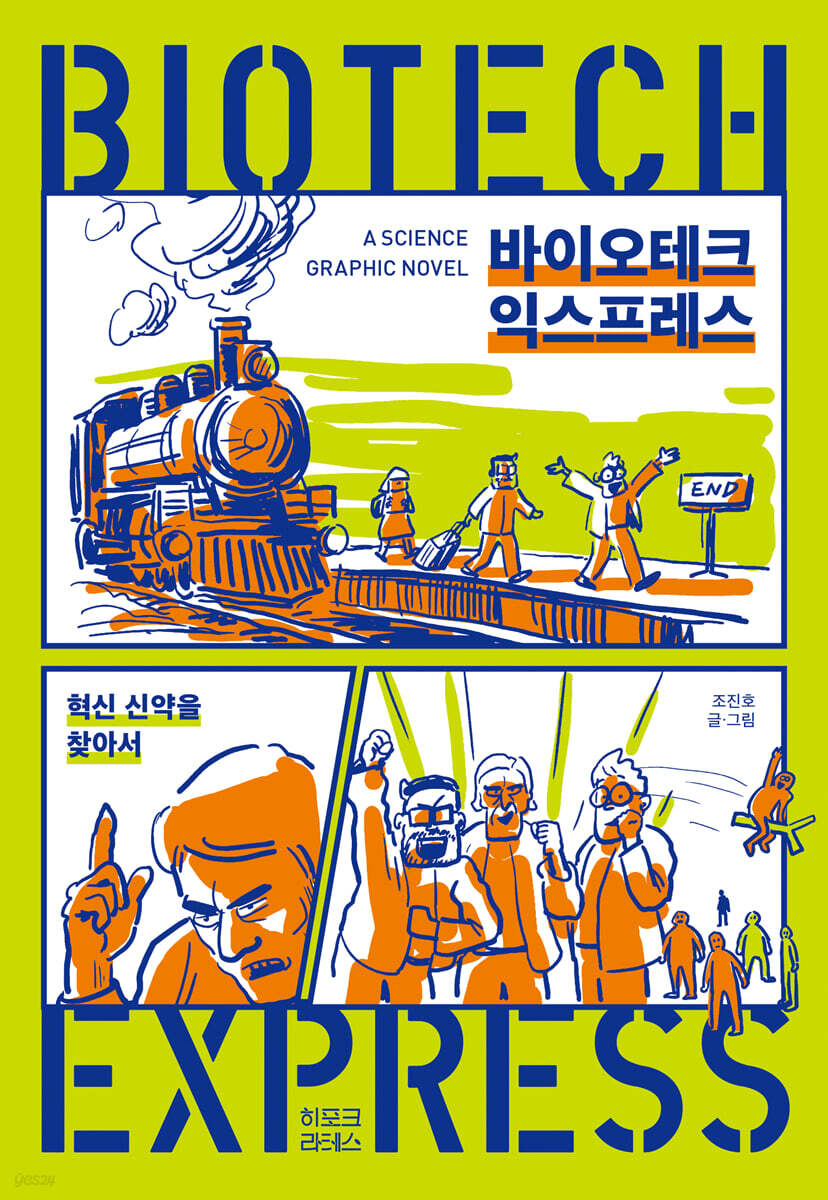
The 'Express' series, which opened a new horizon for Korean science books with graphic novels that combine rich scientific knowledge with friendly illustrations, has returned with a new work, 'Biotech Express', which deals with new drug development.
In this book, author Jin-ho Cho introduces anticancer and tuberculosis treatments currently being developed by domestic biotech companies and guides us on our journey into 'biotechnology.'
The author's storytelling and drawings, which are often described as first or best whenever they are introduced in the media, become even more exciting and dynamic.
The process of developing new drugs introduced in the book is not simply listed, but vividly unfolds, from the causes of cancer to the history of anticancer treatment and the scientific principles of new drugs.
Along the way, readers will be able to explore a diverse range of biotechnology knowledge across disciplines such as immunology, physiology, cell biology, and molecular biology.
Unlike previous works that traced scientific knowledge based on tradition and history, 『Biotech Express』 is more unique in that it deals with the current and ongoing scientific field that is constantly being updated.
As you follow the author's vivid descriptions of the new drug research and development process, you will naturally arrive at the heart of modern pharmaceutical science and biotech innovation, battling humanity's greatest enemy: cancer.
For readers who want to witness the scientific advancements taking place at the forefront of biotechnology and the advancement of life-saving biotechnology, Biotech Express will be the ultimate guide.
A Journey into the World of Biotechnology
The 'Express' series, which opened a new horizon for Korean science books with graphic novels that combine rich scientific knowledge with friendly illustrations, has returned with a new work, 'Biotech Express', which deals with new drug development.
In this book, author Jin-ho Cho introduces anticancer and tuberculosis treatments currently being developed by domestic biotech companies and guides us on our journey into 'biotechnology.'
The author's storytelling and drawings, which are often described as first or best whenever they are introduced in the media, become even more exciting and dynamic.
The process of developing new drugs introduced in the book is not simply listed, but vividly unfolds, from the causes of cancer to the history of anticancer treatment and the scientific principles of new drugs.
Along the way, readers will be able to explore a diverse range of biotechnology knowledge across disciplines such as immunology, physiology, cell biology, and molecular biology.
Unlike previous works that traced scientific knowledge based on tradition and history, 『Biotech Express』 is more unique in that it deals with the current and ongoing scientific field that is constantly being updated.
As you follow the author's vivid descriptions of the new drug research and development process, you will naturally arrive at the heart of modern pharmaceutical science and biotech innovation, battling humanity's greatest enemy: cancer.
For readers who want to witness the scientific advancements taking place at the forefront of biotechnology and the advancement of life-saving biotechnology, Biotech Express will be the ultimate guide.
- You can preview some of the book's contents.
Preview
index
Recommendationㆍ004
Prologue - The World of Biotechnologyㆍ010
Chapter 1: A New Paradigm: Adrixetinib, an Immunotherapy Agent_Q702ㆍ014
Chapter 2: Blocking DNA Repair: How to Drive Cancer Cells to Suicide_CDK7 Inhibitors, Q901ㆍ150
Chapter 3: Clues to Treating Blood Cancers and Autoimmune Diseases: Proteasome Inhibitorsㆍ290
Chapter 4: Tuberculosis Hasn't Disappeared: Towards the Birth of an Innovative New Drug_Telacebecㆍ340
Epilogue ─ Science in Progressㆍ470
Prologue - The World of Biotechnologyㆍ010
Chapter 1: A New Paradigm: Adrixetinib, an Immunotherapy Agent_Q702ㆍ014
Chapter 2: Blocking DNA Repair: How to Drive Cancer Cells to Suicide_CDK7 Inhibitors, Q901ㆍ150
Chapter 3: Clues to Treating Blood Cancers and Autoimmune Diseases: Proteasome Inhibitorsㆍ290
Chapter 4: Tuberculosis Hasn't Disappeared: Towards the Birth of an Innovative New Drug_Telacebecㆍ340
Epilogue ─ Science in Progressㆍ470
Detailed image
.jpg)
Into the book
Ironically, cancer is associated with longer lifespan.
You could almost say that the easiest way to get cancer is just to get older.
As you live longer, your risk of developing cancer naturally increases.
This is because cancer is a disease that develops as genetic errors accumulate.
A person repeats countless copies of their genome during their lifetime.
Most errors occur during this replication process.
Living longer means replicating your genome more, so it's only natural that your disease rates would increase.
You probably have a perception that immune cells are good beings who do their best for the body, their world.
But not only immune cells, but even the molecules inside the body… they just carry out their tasks mechanically, without thinking.
Like a machine part.
The cancer cells in question… the mushy cancer cells that have undergone mesodermal metastasis change their name tag to that of normal cells.
“The name tag of cancer cells changes.” This means that cancer cells that have undergone mesodermal metastasis have problems synthesizing MHC type 1, that is, they have problems presenting antigens as cancer cells.
As we have seen, dendritic cells activate T cells in the lymph nodes, and the activated T cells rush to the battlefield, but... the T cells cannot recognize the cancer cells that have a problem presenting the antigen that says, "I am cancer."
--- From "Chapter 1: A New Paradigm, Immuno-Oncology"
The cell cycle process is very elaborate.
Rather than simply proceeding with a single on/off, there was a system that stopped at a certain point and started again at a certain point.
But we find that certain molecules are crucial to this process.
What if we could control these molecules? That would be the moment when the idea for a new anticancer drug was born.
Scientists began testing the potential of anticancer drugs using the cell cycle, and the development of targeted anticancer drugs began.
The process of developing targeted anticancer drugs demonstrates the beauty of science.
A single study can open the door to new research or take us to unexpected new crossroads.
When scientists discovered the existence of CDKs that regulate the cell cycle, they immediately realized that this was a clue to the development of anticancer drugs.
First, we developed a drug that inhibits all CDKs and began experiments to see if it was effective… As expected, CDK inhibitors were highly toxic, affecting not only cancer cells but also normal cells.
--- From "Chapter 2: Blocking DNA Repair: How to Drive Cancer Cells to Suicide"
First-generation anticancer drugs, chemotherapy drugs, which are primarily used in cancer treatment, have prominent side effects.
The mechanism of action itself was not much different from dropping bombs on a large scale to catch terrorist groups hiding among civilians.
Second-generation anticancer drugs, called targeted anticancer drugs, were ambitiously developed to target specific mutations in cancer cells, but they also revealed limitations.
It turns out that the effect is limited.
Because mutations do not appear in all cancer patients, the effects varied greatly among individuals.
Additionally, it often became useless because cancer cells repeatedly developed other mutations.
Third-generation anticancer drugs, immunotherapy, appear to be free from the side effects of chemotherapy and the mutations that are a weakness of targeted anticancer drugs.
However, since this is a drug that has just begun to be studied, the response rate is said to be only about 10%.
It's a very unsatisfactory situation.
--- From "Chapter 3: Clues to Treating Blood Cancer and Autoimmune Diseases"
Each pharmaceutical creation process has its own unique story.
Some medicines follow a typical scientific formula.
Development proceeds with goals set based on theoretical background, and through experiments and verification, it is completed as an actual drug.
It is also common to see cases where the typical sequence is not followed.
So, the original goal is lost and a strange medicine is created.
A representative example is Viagra.
Sildenafil, the raw material for Viagra, was originally a drug to treat angina.
But while observing the side effects, an interesting phenomenon that everyone knows clearly emerged.
In 1998, the pharmaceutical company Pfizer released it to the world under the somewhat profane brand name Viagra, a combination of vigar (energy) and Niagara (Niagara Falls), and it earned a whopping $1 billion in just two years after its launch.
"Unfortunately, it is the latter.
It's multidrug-resistant tuberculosis.
What this means is that the standard treatments up to now were useless from the start.
From now on, we will apply a different treatment method.
Several antibiotics, including six types of injections, are administered for ~24 months~ exactly 24 months.
The cure rate is significantly lower than that of common tuberculosis.
It's not 'better', it's 'lower'.
The cure rate is “
“The tuberculosis treatment drug Telacevec has a special meaning for us.
They solved a difficult problem, tuberculosis, that even global pharmaceutical companies would find difficult to tackle, and created an ideal story that pursued the public interest while simultaneously reaping corporate profits.
As a biotech company, we are the first in the world to develop a new antibiotic that works by inhibiting the cytochrome bc1 complex.
We have developed a truly innovative new drug.
In Korea~"
You could almost say that the easiest way to get cancer is just to get older.
As you live longer, your risk of developing cancer naturally increases.
This is because cancer is a disease that develops as genetic errors accumulate.
A person repeats countless copies of their genome during their lifetime.
Most errors occur during this replication process.
Living longer means replicating your genome more, so it's only natural that your disease rates would increase.
You probably have a perception that immune cells are good beings who do their best for the body, their world.
But not only immune cells, but even the molecules inside the body… they just carry out their tasks mechanically, without thinking.
Like a machine part.
The cancer cells in question… the mushy cancer cells that have undergone mesodermal metastasis change their name tag to that of normal cells.
“The name tag of cancer cells changes.” This means that cancer cells that have undergone mesodermal metastasis have problems synthesizing MHC type 1, that is, they have problems presenting antigens as cancer cells.
As we have seen, dendritic cells activate T cells in the lymph nodes, and the activated T cells rush to the battlefield, but... the T cells cannot recognize the cancer cells that have a problem presenting the antigen that says, "I am cancer."
--- From "Chapter 1: A New Paradigm, Immuno-Oncology"
The cell cycle process is very elaborate.
Rather than simply proceeding with a single on/off, there was a system that stopped at a certain point and started again at a certain point.
But we find that certain molecules are crucial to this process.
What if we could control these molecules? That would be the moment when the idea for a new anticancer drug was born.
Scientists began testing the potential of anticancer drugs using the cell cycle, and the development of targeted anticancer drugs began.
The process of developing targeted anticancer drugs demonstrates the beauty of science.
A single study can open the door to new research or take us to unexpected new crossroads.
When scientists discovered the existence of CDKs that regulate the cell cycle, they immediately realized that this was a clue to the development of anticancer drugs.
First, we developed a drug that inhibits all CDKs and began experiments to see if it was effective… As expected, CDK inhibitors were highly toxic, affecting not only cancer cells but also normal cells.
--- From "Chapter 2: Blocking DNA Repair: How to Drive Cancer Cells to Suicide"
First-generation anticancer drugs, chemotherapy drugs, which are primarily used in cancer treatment, have prominent side effects.
The mechanism of action itself was not much different from dropping bombs on a large scale to catch terrorist groups hiding among civilians.
Second-generation anticancer drugs, called targeted anticancer drugs, were ambitiously developed to target specific mutations in cancer cells, but they also revealed limitations.
It turns out that the effect is limited.
Because mutations do not appear in all cancer patients, the effects varied greatly among individuals.
Additionally, it often became useless because cancer cells repeatedly developed other mutations.
Third-generation anticancer drugs, immunotherapy, appear to be free from the side effects of chemotherapy and the mutations that are a weakness of targeted anticancer drugs.
However, since this is a drug that has just begun to be studied, the response rate is said to be only about 10%.
It's a very unsatisfactory situation.
--- From "Chapter 3: Clues to Treating Blood Cancer and Autoimmune Diseases"
Each pharmaceutical creation process has its own unique story.
Some medicines follow a typical scientific formula.
Development proceeds with goals set based on theoretical background, and through experiments and verification, it is completed as an actual drug.
It is also common to see cases where the typical sequence is not followed.
So, the original goal is lost and a strange medicine is created.
A representative example is Viagra.
Sildenafil, the raw material for Viagra, was originally a drug to treat angina.
But while observing the side effects, an interesting phenomenon that everyone knows clearly emerged.
In 1998, the pharmaceutical company Pfizer released it to the world under the somewhat profane brand name Viagra, a combination of vigar (energy) and Niagara (Niagara Falls), and it earned a whopping $1 billion in just two years after its launch.
"Unfortunately, it is the latter.
It's multidrug-resistant tuberculosis.
What this means is that the standard treatments up to now were useless from the start.
From now on, we will apply a different treatment method.
Several antibiotics, including six types of injections, are administered for ~24 months~ exactly 24 months.
The cure rate is significantly lower than that of common tuberculosis.
It's not 'better', it's 'lower'.
The cure rate is “
“The tuberculosis treatment drug Telacevec has a special meaning for us.
They solved a difficult problem, tuberculosis, that even global pharmaceutical companies would find difficult to tackle, and created an ideal story that pursued the public interest while simultaneously reaping corporate profits.
As a biotech company, we are the first in the world to develop a new antibiotic that works by inhibiting the cytochrome bc1 complex.
We have developed a truly innovative new drug.
In Korea~"
--- From Chapter 4, “Tuberculosis Has Not Disappeared: Towards the Birth of an Innovative New Drug”
Publisher's Review
This time it's biotech!
A new work in science cartoonist Jo Jin-ho's 'Express' series
Graphic novel "Biotech Express"
“Cancer’s elaborate strategy to subdue humans
A fierce battle unfolds between modern medicine and him.”
Korea's first science cartoonist, Jin-ho Jo, has returned with a new work after three years.
The author's journey, which uses illustrations to explain difficult and complex scientific knowledge in an easy and fun way, is in the field of 'biotechnology', which develops pharmaceuticals such as anticancer drugs.
"Biotech Express: In Search of Innovative New Drugs" continues the tradition of the "Express" series, which opened up new horizons for science books, while also offering another layer of enjoyment in reading science through its lighthearted and humorous presentation.
The Express series began in 2012.
The first book, "Gravity Express," was recognized for its rich scientific knowledge and popular value, and was selected as the Best General Education Book by the Ministry of Culture, Sports and Tourism in 2013, and as the Science Book of the Year by the Asia-Pacific Center for Theoretical Physics (APCTP) in 2013. It also won the General Education category of the 54th Korea Publishing Culture Award.
Since then, the 'Express' series has established itself as the best science graphic novel series in Korea, with the publication of 'Genome Express', 'Atom Express', and 'Evolution Express', which deal with genes, atoms, and evolution, respectively.
『Biotech Express』 covers the development process of anticancer and tuberculosis treatments by a domestic biotech company.
The process of developing new drugs introduced in the book is not simply listed, but vividly unfolds, from the causes of cancer to the history of anticancer treatment and the scientific principles of new drugs.
Along the way, readers will be able to explore a diverse range of biotechnology knowledge across disciplines such as immunology, physiology, cell biology, and molecular biology.
Unlike previous works that traced scientific knowledge based on tradition and history, this book is more unique in that it deals with the ever-evolving field of science.
As you follow the author's vivid descriptions of the new drug research and development process, you will naturally arrive at the heart of modern pharmaceutical science and biotech innovation, battling humanity's greatest enemy: cancer.
For readers who want to witness the scientific advancements taking place at the forefront of biotechnology and the advancement of life-saving biotechnology, Biotech Express will be the ultimate guide.
In a world so tiny, in nanometer units
A fierce war unfolds
In keeping with the groundbreaking advancements in biotechnology, Biotech Express is filled with lighthearted, dynamic illustrations and descriptions that are less solemn.
To illustrate the battle between pathogens, the immune system, cancer, and anticancer drugs that occurs in our bodies, the author enters the tiny world of nanometers (nm) and vividly depicts the war between cells and molecules.
The battle that takes place inside our bodies is “in reality nothing more than a mindless, rapid movement and collision of small molecules chemically and physically.”
But in the comic imagination, our body's cells, molecules, and pathogens are reborn as heroes and villains.
In the biotech battlefield presented by Biotech Express, the villains are undoubtedly cancer cells, cancer tissue, and tuberculosis bacteria.
Natural killer cells, dendritic cells, cytotoxic T cells, CDK inhibitors, and proteasome inhibitors, which fight against powerful pathogens, are the heroes of our body that resist pathogens.
The author faithfully follows biotechnology knowledge while realistically depicting their actions as fierce battles.
And the scientific facts of cancer and biotechnology become living knowledge, not theoretical facts, through vibrant characters.
As the prologue states, with just “a curiosity about new intellectual worlds,” we can now comfortably and interestingly witness the life phenomena and battles that occur within our bodies every moment through this book.
Once aboard the 'Biotech Express,' the dramatic characters, each with their own unique personality, will instantly guide readers to the forefront of biotechnology.
New anticancer drugs and
The Advance of Biotechnology
Unlike other diseases for which treatments are being developed over time, why does cancer still pose a threat to humanity? While a complete cure still exists, anti-cancer strategies are constantly evolving.
『Biotech Express』 introduces anticancer drugs being developed in Korea and explains in detail which anticancer drugs have been developed so far and how they work.
Anticancer drugs were developed in the order of first-generation chemotherapy, second-generation targeted anticancer drugs, and third-generation immunotherapy drugs, gradually evolving toward targeting and attacking only cancer cells.
The new anticancer drugs introduced in the book are targeted anticancer drugs and immune anticancer drugs.
In the process of examining the various new drugs being developed domestically to overcome the limitations of existing drugs, one can also accurately understand the mechanisms of anticancer drugs currently used in the medical field, such as Ibrance, Keytruda, and antibody-drug conjugates.
This single book provides a glimpse into the history of cancer and the development of related biotechnology.
The book is composed of four chapters, each of which explores a new drug currently under development.
Chapter 1, 'New Paradigm, Immuno-Oncology', covers 'Adrixetinib', a type of immuno-oncology drug that inhibits the immune checkpoint AXL of cancer cells and the MER and CSF1R receptors of macrophages to destroy cancer cells that evade the body's immune response.
Chapter 2, 'Blocking DNA Repair: How to Drive Cancer Cells to Suicide', introduces 'CDK7 Inhibitors', drugs that inhibit cyclin-dependent kinase 7, or CDK7, which regulates the cell cycle to prevent cancer cell division.
Chapter 3, "Clues to Treating Blood Cancers and Autoimmune Diseases," examines how the proteasome, which removes useless proteins in our body, can cause cancer and offers a vision for new "proteasome inhibitors" that could be applied to various diseases.
In Chapter 4, "Tuberculosis Has Not Disappeared: Towards the Birth of an Innovative New Drug," we explore Telacebec, an innovative new drug developed through extensive research.
Tuberculosis has not disappeared,
In search of innovative new drugs
A groundbreaking new drug is a drug that uses a completely new mechanism of action to treat a specific disease.
As it is a completely new drug, its value is also high.
Telacevec, developed by a domestic company, is a tuberculosis treatment drug recognized as an innovative new drug.
It has already obtained priority review rights (PRV) for new drugs through a technology transfer agreement with the TB Alliance, an international organization dedicated to the development of tuberculosis treatments.
How did a Korean company develop such an innovative new drug in the field of new drug development, which requires massive capital and human resources? The development of Telacevec is steeped in dramatic elements, including the dynamism of biotechnology and remarkable scientific discoveries.
Let's follow the exciting storytelling and thrilling scenes from the current state of tuberculosis, which still causes serious damage to humanity, to the limitations of existing tuberculosis treatments, and to the moment of Telasevec's discovery.
A new work in science cartoonist Jo Jin-ho's 'Express' series
Graphic novel "Biotech Express"
“Cancer’s elaborate strategy to subdue humans
A fierce battle unfolds between modern medicine and him.”
Korea's first science cartoonist, Jin-ho Jo, has returned with a new work after three years.
The author's journey, which uses illustrations to explain difficult and complex scientific knowledge in an easy and fun way, is in the field of 'biotechnology', which develops pharmaceuticals such as anticancer drugs.
"Biotech Express: In Search of Innovative New Drugs" continues the tradition of the "Express" series, which opened up new horizons for science books, while also offering another layer of enjoyment in reading science through its lighthearted and humorous presentation.
The Express series began in 2012.
The first book, "Gravity Express," was recognized for its rich scientific knowledge and popular value, and was selected as the Best General Education Book by the Ministry of Culture, Sports and Tourism in 2013, and as the Science Book of the Year by the Asia-Pacific Center for Theoretical Physics (APCTP) in 2013. It also won the General Education category of the 54th Korea Publishing Culture Award.
Since then, the 'Express' series has established itself as the best science graphic novel series in Korea, with the publication of 'Genome Express', 'Atom Express', and 'Evolution Express', which deal with genes, atoms, and evolution, respectively.
『Biotech Express』 covers the development process of anticancer and tuberculosis treatments by a domestic biotech company.
The process of developing new drugs introduced in the book is not simply listed, but vividly unfolds, from the causes of cancer to the history of anticancer treatment and the scientific principles of new drugs.
Along the way, readers will be able to explore a diverse range of biotechnology knowledge across disciplines such as immunology, physiology, cell biology, and molecular biology.
Unlike previous works that traced scientific knowledge based on tradition and history, this book is more unique in that it deals with the ever-evolving field of science.
As you follow the author's vivid descriptions of the new drug research and development process, you will naturally arrive at the heart of modern pharmaceutical science and biotech innovation, battling humanity's greatest enemy: cancer.
For readers who want to witness the scientific advancements taking place at the forefront of biotechnology and the advancement of life-saving biotechnology, Biotech Express will be the ultimate guide.
In a world so tiny, in nanometer units
A fierce war unfolds
In keeping with the groundbreaking advancements in biotechnology, Biotech Express is filled with lighthearted, dynamic illustrations and descriptions that are less solemn.
To illustrate the battle between pathogens, the immune system, cancer, and anticancer drugs that occurs in our bodies, the author enters the tiny world of nanometers (nm) and vividly depicts the war between cells and molecules.
The battle that takes place inside our bodies is “in reality nothing more than a mindless, rapid movement and collision of small molecules chemically and physically.”
But in the comic imagination, our body's cells, molecules, and pathogens are reborn as heroes and villains.
In the biotech battlefield presented by Biotech Express, the villains are undoubtedly cancer cells, cancer tissue, and tuberculosis bacteria.
Natural killer cells, dendritic cells, cytotoxic T cells, CDK inhibitors, and proteasome inhibitors, which fight against powerful pathogens, are the heroes of our body that resist pathogens.
The author faithfully follows biotechnology knowledge while realistically depicting their actions as fierce battles.
And the scientific facts of cancer and biotechnology become living knowledge, not theoretical facts, through vibrant characters.
As the prologue states, with just “a curiosity about new intellectual worlds,” we can now comfortably and interestingly witness the life phenomena and battles that occur within our bodies every moment through this book.
Once aboard the 'Biotech Express,' the dramatic characters, each with their own unique personality, will instantly guide readers to the forefront of biotechnology.
New anticancer drugs and
The Advance of Biotechnology
Unlike other diseases for which treatments are being developed over time, why does cancer still pose a threat to humanity? While a complete cure still exists, anti-cancer strategies are constantly evolving.
『Biotech Express』 introduces anticancer drugs being developed in Korea and explains in detail which anticancer drugs have been developed so far and how they work.
Anticancer drugs were developed in the order of first-generation chemotherapy, second-generation targeted anticancer drugs, and third-generation immunotherapy drugs, gradually evolving toward targeting and attacking only cancer cells.
The new anticancer drugs introduced in the book are targeted anticancer drugs and immune anticancer drugs.
In the process of examining the various new drugs being developed domestically to overcome the limitations of existing drugs, one can also accurately understand the mechanisms of anticancer drugs currently used in the medical field, such as Ibrance, Keytruda, and antibody-drug conjugates.
This single book provides a glimpse into the history of cancer and the development of related biotechnology.
The book is composed of four chapters, each of which explores a new drug currently under development.
Chapter 1, 'New Paradigm, Immuno-Oncology', covers 'Adrixetinib', a type of immuno-oncology drug that inhibits the immune checkpoint AXL of cancer cells and the MER and CSF1R receptors of macrophages to destroy cancer cells that evade the body's immune response.
Chapter 2, 'Blocking DNA Repair: How to Drive Cancer Cells to Suicide', introduces 'CDK7 Inhibitors', drugs that inhibit cyclin-dependent kinase 7, or CDK7, which regulates the cell cycle to prevent cancer cell division.
Chapter 3, "Clues to Treating Blood Cancers and Autoimmune Diseases," examines how the proteasome, which removes useless proteins in our body, can cause cancer and offers a vision for new "proteasome inhibitors" that could be applied to various diseases.
In Chapter 4, "Tuberculosis Has Not Disappeared: Towards the Birth of an Innovative New Drug," we explore Telacebec, an innovative new drug developed through extensive research.
Tuberculosis has not disappeared,
In search of innovative new drugs
A groundbreaking new drug is a drug that uses a completely new mechanism of action to treat a specific disease.
As it is a completely new drug, its value is also high.
Telacevec, developed by a domestic company, is a tuberculosis treatment drug recognized as an innovative new drug.
It has already obtained priority review rights (PRV) for new drugs through a technology transfer agreement with the TB Alliance, an international organization dedicated to the development of tuberculosis treatments.
How did a Korean company develop such an innovative new drug in the field of new drug development, which requires massive capital and human resources? The development of Telacevec is steeped in dramatic elements, including the dynamism of biotechnology and remarkable scientific discoveries.
Let's follow the exciting storytelling and thrilling scenes from the current state of tuberculosis, which still causes serious damage to humanity, to the limitations of existing tuberculosis treatments, and to the moment of Telasevec's discovery.
GOODS SPECIFICS
- Date of issue: December 24, 2024
- Page count, weight, size: 472 pages | 766g | 145*210*30mm
- ISBN13: 9791193690055
You may also like
카테고리
korean


korean

![GQ KOREA Mark (Monthly): December [2025]](http://librairie.coreenne.fr/cdn/shop/files/8ef265dbbfbf186523ed75ba7319009d.jpg?v=1765340328&width=3840)


