

AI prompts and music education
 |
Description
Book Introduction
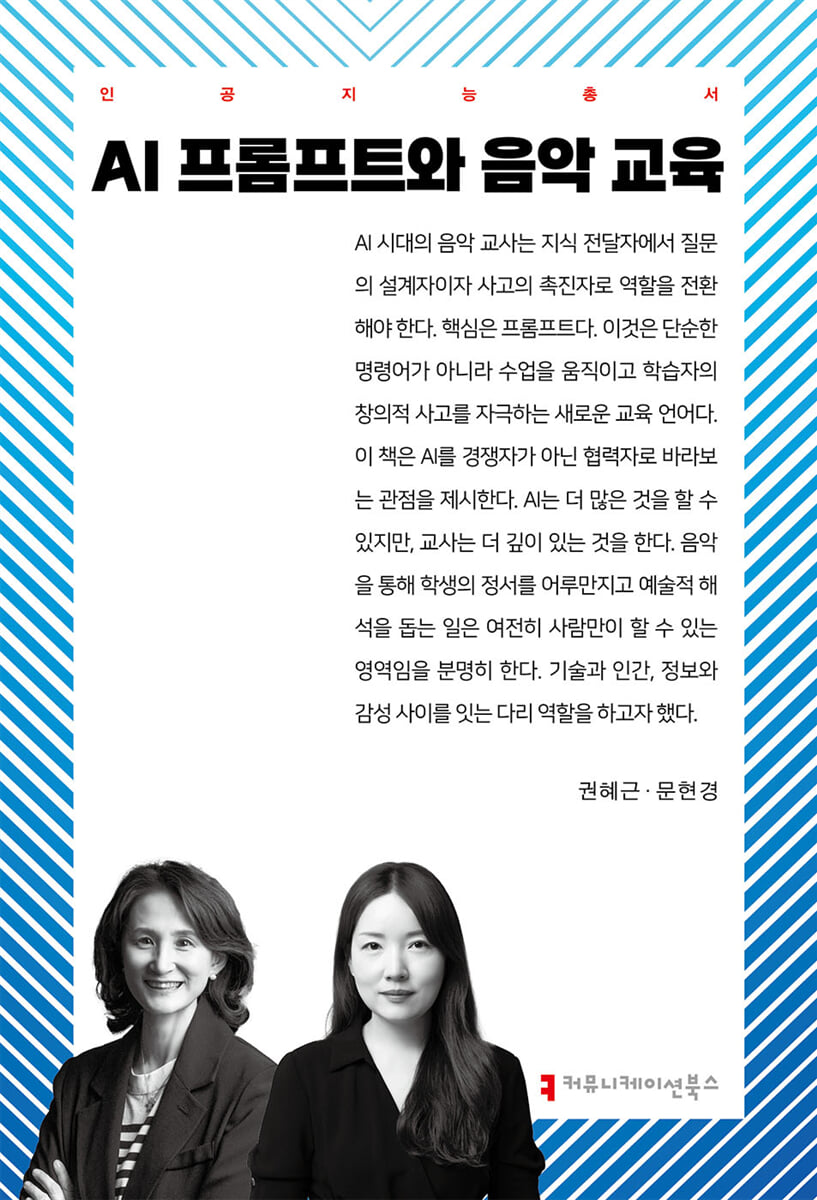
In the era of generative AI, the key to teaching is not "what to teach," but "what questions to ask."
This book applies prompts to performance, appreciation, and creation, establishing teachers as designers and students as creators.
We provide templates and activity plans, and foster expressiveness and metacognition through the AI-teacher division of labor principle.
Artificial Intelligence Encyclopedia.
You can find the artificial intelligence knowledge you need at aiseries.oopy.io.
This book applies prompts to performance, appreciation, and creation, establishing teachers as designers and students as creators.
We provide templates and activity plans, and foster expressiveness and metacognition through the AI-teacher division of labor principle.
Artificial Intelligence Encyclopedia.
You can find the artificial intelligence knowledge you need at aiseries.oopy.io.
- You can preview some of the book's contents.
Preview
index
AI prompts and music education
01 Generative AI Comes to Music Class
02 What is a prompt?
03 Performance Lessons and Prompts
04 Appreciation Lessons and Prompts
05 Creative Writing Lessons and Prompts
06 Student-created prompts
07 Teacher-created prompts
08 Prompt Templates for Use in Class
09 Guide to AI Tools for Music Classes
10 The Future of Music Teachers with AI
01 Generative AI Comes to Music Class
02 What is a prompt?
03 Performance Lessons and Prompts
04 Appreciation Lessons and Prompts
05 Creative Writing Lessons and Prompts
06 Student-created prompts
07 Teacher-created prompts
08 Prompt Templates for Use in Class
09 Guide to AI Tools for Music Classes
10 The Future of Music Teachers with AI
Into the book
Teaching prompts in education today isn't just about learning how to use AI, it's about teaching students how to think.
The entire process of students creating their own questions and engaging in conversations with AI to find better answers becomes a crucial practical education that fosters the core competencies of 21st-century learners.
This ability is not simply the skill of asking questions, but also includes the ability to request information, how to request it, evaluate the results, and apply them again.
--- From "01_“Generative AI Comes to Music Class”"
The teacher's questions, or prompts, serve as tools to help students clearly set performance goals, reflect on their own performance, and stimulate the thinking necessary to coordinate sounds in an ensemble.
Prompts, when used appropriately in music lessons, enable self-directed, thought-based music learning beyond simply mastering the technical aspects of playing.
This plays an important role in promoting students' musical autonomy and creativity.
--- From “03_“Performance Lessons and Prompts””
Activities where students design their own prompts represent a fundamentally different approach from traditional teacher-led instruction.
This is because it is a process in which students decide what to explore based on their own curiosity and interests, rather than learning according to questions prepared in advance by the teacher.
At this point, students begin to think about what they want to know and how to structure their questions to get the answers they want.
--- From “06_“Student-created prompts””
It can also be a useful tool in instrumental, choir, and ensemble classes.
It can be used to establish a practice plan that suits the students' level and goals during performance practice, or to suggest effective practice methods.
Especially in instrumental lessons where individual practice is crucial, you can get a personalized learning plan by making specific requests such as, “Please create a four-week piano practice plan for beginners” or “The F chord on the guitar is too difficult for me. Please provide a three-step practice method for it.”
The entire process of students creating their own questions and engaging in conversations with AI to find better answers becomes a crucial practical education that fosters the core competencies of 21st-century learners.
This ability is not simply the skill of asking questions, but also includes the ability to request information, how to request it, evaluate the results, and apply them again.
--- From "01_“Generative AI Comes to Music Class”"
The teacher's questions, or prompts, serve as tools to help students clearly set performance goals, reflect on their own performance, and stimulate the thinking necessary to coordinate sounds in an ensemble.
Prompts, when used appropriately in music lessons, enable self-directed, thought-based music learning beyond simply mastering the technical aspects of playing.
This plays an important role in promoting students' musical autonomy and creativity.
--- From “03_“Performance Lessons and Prompts””
Activities where students design their own prompts represent a fundamentally different approach from traditional teacher-led instruction.
This is because it is a process in which students decide what to explore based on their own curiosity and interests, rather than learning according to questions prepared in advance by the teacher.
At this point, students begin to think about what they want to know and how to structure their questions to get the answers they want.
--- From “06_“Student-created prompts””
It can also be a useful tool in instrumental, choir, and ensemble classes.
It can be used to establish a practice plan that suits the students' level and goals during performance practice, or to suggest effective practice methods.
Especially in instrumental lessons where individual practice is crucial, you can get a personalized learning plan by making specific requests such as, “Please create a four-week piano practice plan for beginners” or “The F chord on the guitar is too difficult for me. Please provide a three-step practice method for it.”
--- From “09_“Guide to AI Tools for Music Classes””
Publisher's Review
Questions Change the Song: AI Prompts and Revolutionizing Music Lessons
We redefine lesson design with generative AI using a new educational language called 'prompt.'
Prompts are not commands, but rather the structure of the lesson and the design of thinking, and the quality of questions asked before performing, appreciating, and creating changes the depth of learning.
Teachers transform from knowledge transmitters to question designers and thought facilitators, and students grow into self-directed creators who collaborate with AI.
Because the same model can produce different results depending on context, tone, and structure, this book presents prompt literacy as a core competency and provides ready-to-use activity plans along with templates, lesson scripts, and assessment rubrics.
We establish a division of labor principle where AI handles repetitive tasks and teachers handle interpretation, empathy, and ethics. We demonstrate the enhancement of expressive power and the growth of metacognition through classroom examples.
The final chapter envisions future music teachers with the proposition that “AI learns quickly, and teachers understand deeply.”
We redefine lesson design with generative AI using a new educational language called 'prompt.'
Prompts are not commands, but rather the structure of the lesson and the design of thinking, and the quality of questions asked before performing, appreciating, and creating changes the depth of learning.
Teachers transform from knowledge transmitters to question designers and thought facilitators, and students grow into self-directed creators who collaborate with AI.
Because the same model can produce different results depending on context, tone, and structure, this book presents prompt literacy as a core competency and provides ready-to-use activity plans along with templates, lesson scripts, and assessment rubrics.
We establish a division of labor principle where AI handles repetitive tasks and teachers handle interpretation, empathy, and ethics. We demonstrate the enhancement of expressive power and the growth of metacognition through classroom examples.
The final chapter envisions future music teachers with the proposition that “AI learns quickly, and teachers understand deeply.”
GOODS SPECIFICS
- Date of issue: October 23, 2025
- Page count, weight, size: 120 pages | 128*188*7mm
- ISBN13: 9791143010124
You may also like
카테고리
korean


korean

![GQ KOREA Mark (Monthly): December [2025]](http://librairie.coreenne.fr/cdn/shop/files/8ef265dbbfbf186523ed75ba7319009d.jpg?v=1765340328&width=3840)


