

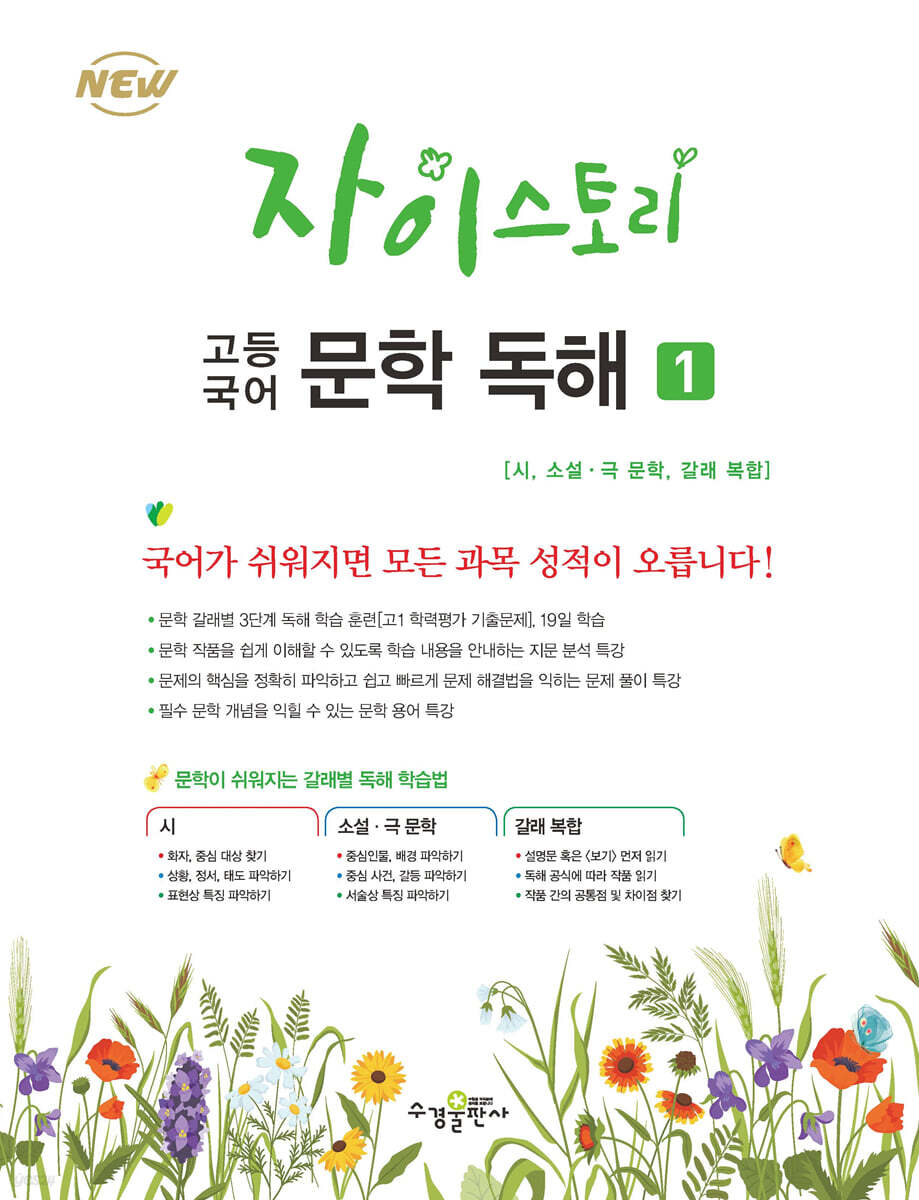
Zaistory High School Korean Literature Reading 1
 |
Description
Book Introduction
Why should I study literary reading?
How should I start reading literature?
Literature is an art form that expresses human emotions through language, and it refers to poetry, novels, dramatic literature, and essays that we commonly know.
By reading literary works, we come to understand ourselves and other human beings, and by encountering various aspects of the world, we develop into more mature individuals.
To truly understand a literary work, we must be able to read it and accurately grasp what it is trying to convey to us.
Literary works such as poetry, novels, plays, and essays each have different characteristics.
In 'poetry', you have to figure out who is saying what, in 'novels' and 'dramatic literature', you have to figure out what is happening to whom, and in 'essays', you have to figure out the central subject and the writer's thoughts and attitudes about it.
What if you understand the content but don't understand what a "speaker" or "narrator" is? When taking the test, you won't understand the question's meaning and won't be able to grasp the examiner's intent.
Therefore, it is important to learn exactly what terms like 'speaker', 'narrator', 'metaphor', and 'personification' mean.
If you learn the concepts of literary terms like these, you can truly read literature.
How should I start reading literature?
Literature is an art form that expresses human emotions through language, and it refers to poetry, novels, dramatic literature, and essays that we commonly know.
By reading literary works, we come to understand ourselves and other human beings, and by encountering various aspects of the world, we develop into more mature individuals.
To truly understand a literary work, we must be able to read it and accurately grasp what it is trying to convey to us.
Literary works such as poetry, novels, plays, and essays each have different characteristics.
In 'poetry', you have to figure out who is saying what, in 'novels' and 'dramatic literature', you have to figure out what is happening to whom, and in 'essays', you have to figure out the central subject and the writer's thoughts and attitudes about it.
What if you understand the content but don't understand what a "speaker" or "narrator" is? When taking the test, you won't understand the question's meaning and won't be able to grasp the examiner's intent.
Therefore, it is important to learn exactly what terms like 'speaker', 'narrator', 'metaphor', and 'personification' mean.
If you learn the concepts of literary terms like these, you can truly read literature.
- You can preview some of the book's contents.
Preview
index
Ⅰ City
[Modern Poetry]
Day 01 On the Old-fashioned Veranda with a Four-Legged Wrong Side (Kim Young-rang) 12
Warm Egg (Jeong Jin-gyu)
+ Fingerprint Analysis Special Lecture 13
+ Problem Solving Special Lecture 16
Seongho area (Kim Gwang-gyun) 20
Standing on the ridge of a rice paddy (Lee Seong-seon)
Day 02 Christmas (Kim Jong-gil) 22
The Secret of the Number (Han Yong-un)
Green Joy - In the Spring Forest (Jeong Hyeon-jong) 24
May (Kim Young-rang)
+ Special Lecture on Literary Terminology 26
Day 03 Spring Snow (Jung Ji-yong) 27
First Love (Go Jae-jong)
Fountain (Kim Chun-soo) 29
gap, space (Bok Hyo-geun)
+ Special Lecture on Literary Terminology 31
[Classical Poetry]
Day 04 Yuliyugok (Kim Gwang-wook) 32
Barley Threshing (Jeong Yak-yong)
+ Fingerprint Analysis Special Lecture 33
+ Problem Solving Special Lecture 35
A Visit (Yoon Seon-do) 38
Day 05 Jemangmaega (Wolmyeongsa Temple) 40
A capital city of five hundred years ~ (Giljae)
Fisherman's Tale (Yoon Seon-do) 41
Chodangchunsugok (Nam Seok-ha)
+ Special Lecture on Literary Terminology 43
Day 06 Hunmin-ga (Jeongcheol) 44
Double-track harmony record (author unknown)
Samiingok (Jeongcheol) 46
+ Special Lecture on Literary Terminology 48
Ⅱ Novel and Drama Literature
[Modern Novel]
Day 07 Namchon Beyond the Mountain (Lee Mun-gu) 52
+ Fingerprint Analysis Special Lecture 54
+ Problem Solving Special Lecture 57
A Dignified Life (Kim Ae-ran) 62
Day 08 Bokdeokbang (Lee Tae-jun) 65
You Left with Eight Hats (Park Wan-seo) 68
+ Special Lecture on Literary Terminology 71
[Classic Novel]
Day 09 The Tale of Heungbu and Nolbu (Author Unknown) 72
+ Fingerprint Analysis Special Lecture 74
+ Problem Solving Special Lecture 76
The Battle of Togong (Author Unknown) 79
Day 10: Chunhyangjeon (Author Unknown) 82
Taewonji (author unknown) 85
+ Special Lecture on Literary Terminology 88
[Drama Literature]
Day 11 Sugar Cubes (adapted by Lee Hwan-gyeong and others) 89
+ Fingerprint Analysis Special Lecture 91
+ Problem Solving Special Lecture 93
The Horse (original work by Kim Dong-ri, adapted by Hong Yun-jeong and Dong Hee-sun) 95
Day 12: The Jewel and the Woman (Lee Kang-baek) 97
Your Majesty (Shin Myeong-sun) 99
+ Special Lecture on Literary Terminology 102
[Modern Novels + Classic Novels]
Day 13: The Traveler of Seonhak-dong (Lee Cheong-jun) 103
Before Maintenance (Author Unknown) 106
+ Special Lecture on Literary Terminology 109
Ⅲ branch complex
Day 14: A Comprehensive History of Korean Literature (Jo Dong-il) 112
Chobuga (author unknown)
Road (Kim So-wol)
+ Fingerprint Analysis Special Lecture 113
+ Problem Solving Special Lecture 117
121 Classic Korean Heroic Novels
Lee Daebongjeon (author unknown)
Day 15: Sakjugu Seong (Kim Sowol) 124
You (Lee Seong-bok)
A street with a house full of fruit hanging on the road (Ham Min-bok)
+ Fingerprint Analysis Special Lecture 126
+ Problem Solving Special Lecture 130
Dosan Sibigok (Yi Hwang) 134
Dolls and Humans (Court)
Day 16 Myeonangjeongga (Songsun) 136
Flounder and donkey (Baekseok)
Pyohaega (Lee Bang-ik) 138
Travel (Kim Ki-rim)
+ Special Lecture on Literary Terminology 142
Day 17 Imjinrok (Author Unknown) 143
Myeongryang (Jeon Cheol-hong, Kim Han-min)
Wings or Handcuffs (Yoon Heung-gil) 147
Fireworks (original work by Seonwoo Hwi, adapted by Lee Eun-seong and Yoon Sam-yuk)
+ Special Lecture on Literary Terminology 151
Ⅳ Literature Practice Test
Day 18 1st Mock Exam [15 Questions] 154
Borrowing the intestines - from the cylinder (Shin Kyung-rim)
Someone asked me (Kim Jong-sam)
Ten Years of Management ~ (Song Soon) / Farm Manager (Wi Baek-gyu)
Grafting Theory (Han Baek-gyeom) / Author Unknown (Choi Hyeon-jeon)
Willow House (Han Seung-won)
Day 19 2nd Mock Exam [15 Questions] 162
Goya (Baek Seok) / When You Go to the Winter Mountain (Na Hee-deok)
I went to the rigid pine forest (Kim Yeon-su)
The Tale of the Three Musketeers (author unknown) / Plum Blossom Temple (by Ahn Min-young)
The Fragrant Man (Shin Seok-jeong)
● Special lecture on literary terminology
Ⅰ City
1 Speaker and central object, situation/emotion/attitude 26
2 Rhyme, a method of expressing poetry 31
3 Classical Poetry - Sijo and Gasa, Topic 43
4 images, 48 presentation styles
49 Chinese Idioms from Classical Poetry
Ⅱ Novel and Drama Literature
5 The Three Elements of a Novel and the Three Elements of Novel Composition 71
6 Classic Novels 88
7 Dramatic Literature - Plays and Screenplays 102
8 Conflict, Narrator, and Point of View 109
Ⅲ branch complex
9 Essay 142
10 Novel Structure and Narrative Style 151
[Modern Poetry]
Day 01 On the Old-fashioned Veranda with a Four-Legged Wrong Side (Kim Young-rang) 12
Warm Egg (Jeong Jin-gyu)
+ Fingerprint Analysis Special Lecture 13
+ Problem Solving Special Lecture 16
Seongho area (Kim Gwang-gyun) 20
Standing on the ridge of a rice paddy (Lee Seong-seon)
Day 02 Christmas (Kim Jong-gil) 22
The Secret of the Number (Han Yong-un)
Green Joy - In the Spring Forest (Jeong Hyeon-jong) 24
May (Kim Young-rang)
+ Special Lecture on Literary Terminology 26
Day 03 Spring Snow (Jung Ji-yong) 27
First Love (Go Jae-jong)
Fountain (Kim Chun-soo) 29
gap, space (Bok Hyo-geun)
+ Special Lecture on Literary Terminology 31
[Classical Poetry]
Day 04 Yuliyugok (Kim Gwang-wook) 32
Barley Threshing (Jeong Yak-yong)
+ Fingerprint Analysis Special Lecture 33
+ Problem Solving Special Lecture 35
A Visit (Yoon Seon-do) 38
Day 05 Jemangmaega (Wolmyeongsa Temple) 40
A capital city of five hundred years ~ (Giljae)
Fisherman's Tale (Yoon Seon-do) 41
Chodangchunsugok (Nam Seok-ha)
+ Special Lecture on Literary Terminology 43
Day 06 Hunmin-ga (Jeongcheol) 44
Double-track harmony record (author unknown)
Samiingok (Jeongcheol) 46
+ Special Lecture on Literary Terminology 48
Ⅱ Novel and Drama Literature
[Modern Novel]
Day 07 Namchon Beyond the Mountain (Lee Mun-gu) 52
+ Fingerprint Analysis Special Lecture 54
+ Problem Solving Special Lecture 57
A Dignified Life (Kim Ae-ran) 62
Day 08 Bokdeokbang (Lee Tae-jun) 65
You Left with Eight Hats (Park Wan-seo) 68
+ Special Lecture on Literary Terminology 71
[Classic Novel]
Day 09 The Tale of Heungbu and Nolbu (Author Unknown) 72
+ Fingerprint Analysis Special Lecture 74
+ Problem Solving Special Lecture 76
The Battle of Togong (Author Unknown) 79
Day 10: Chunhyangjeon (Author Unknown) 82
Taewonji (author unknown) 85
+ Special Lecture on Literary Terminology 88
[Drama Literature]
Day 11 Sugar Cubes (adapted by Lee Hwan-gyeong and others) 89
+ Fingerprint Analysis Special Lecture 91
+ Problem Solving Special Lecture 93
The Horse (original work by Kim Dong-ri, adapted by Hong Yun-jeong and Dong Hee-sun) 95
Day 12: The Jewel and the Woman (Lee Kang-baek) 97
Your Majesty (Shin Myeong-sun) 99
+ Special Lecture on Literary Terminology 102
[Modern Novels + Classic Novels]
Day 13: The Traveler of Seonhak-dong (Lee Cheong-jun) 103
Before Maintenance (Author Unknown) 106
+ Special Lecture on Literary Terminology 109
Ⅲ branch complex
Day 14: A Comprehensive History of Korean Literature (Jo Dong-il) 112
Chobuga (author unknown)
Road (Kim So-wol)
+ Fingerprint Analysis Special Lecture 113
+ Problem Solving Special Lecture 117
121 Classic Korean Heroic Novels
Lee Daebongjeon (author unknown)
Day 15: Sakjugu Seong (Kim Sowol) 124
You (Lee Seong-bok)
A street with a house full of fruit hanging on the road (Ham Min-bok)
+ Fingerprint Analysis Special Lecture 126
+ Problem Solving Special Lecture 130
Dosan Sibigok (Yi Hwang) 134
Dolls and Humans (Court)
Day 16 Myeonangjeongga (Songsun) 136
Flounder and donkey (Baekseok)
Pyohaega (Lee Bang-ik) 138
Travel (Kim Ki-rim)
+ Special Lecture on Literary Terminology 142
Day 17 Imjinrok (Author Unknown) 143
Myeongryang (Jeon Cheol-hong, Kim Han-min)
Wings or Handcuffs (Yoon Heung-gil) 147
Fireworks (original work by Seonwoo Hwi, adapted by Lee Eun-seong and Yoon Sam-yuk)
+ Special Lecture on Literary Terminology 151
Ⅳ Literature Practice Test
Day 18 1st Mock Exam [15 Questions] 154
Borrowing the intestines - from the cylinder (Shin Kyung-rim)
Someone asked me (Kim Jong-sam)
Ten Years of Management ~ (Song Soon) / Farm Manager (Wi Baek-gyu)
Grafting Theory (Han Baek-gyeom) / Author Unknown (Choi Hyeon-jeon)
Willow House (Han Seung-won)
Day 19 2nd Mock Exam [15 Questions] 162
Goya (Baek Seok) / When You Go to the Winter Mountain (Na Hee-deok)
I went to the rigid pine forest (Kim Yeon-su)
The Tale of the Three Musketeers (author unknown) / Plum Blossom Temple (by Ahn Min-young)
The Fragrant Man (Shin Seok-jeong)
● Special lecture on literary terminology
Ⅰ City
1 Speaker and central object, situation/emotion/attitude 26
2 Rhyme, a method of expressing poetry 31
3 Classical Poetry - Sijo and Gasa, Topic 43
4 images, 48 presentation styles
49 Chinese Idioms from Classical Poetry
Ⅱ Novel and Drama Literature
5 The Three Elements of a Novel and the Three Elements of Novel Composition 71
6 Classic Novels 88
7 Dramatic Literature - Plays and Screenplays 102
8 Conflict, Narrator, and Point of View 109
Ⅲ branch complex
9 Essay 142
10 Novel Structure and Narrative Style 151
Detailed image
Publisher's Review
[Problem] Features
1.
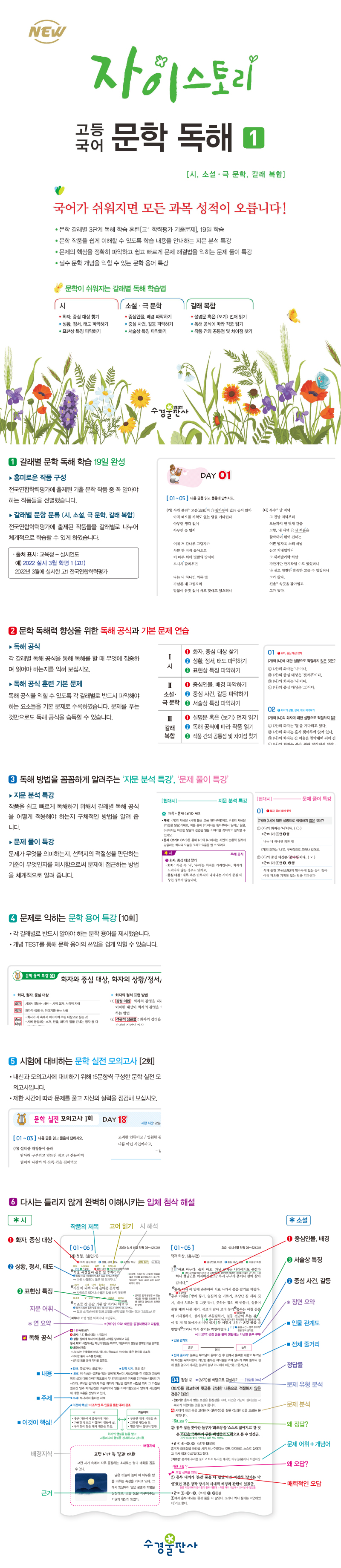
Complete the Literature Reading Course by Category in 19 Days
▶ Interesting composition of the work
We have selected the must-know literary works from among those tested on the National Academic Achievement Test.
▶ Classification of questions by genre [Poetry, novels, dramatic literature, combination of genres]
We have divided the works included in the National Academic Achievement Test into categories to enable systematic study.
2.
Reading formulas and basic problem practice to improve literary reading comprehension
▶ Reading formula
Learn what to focus on when reading through reading formulas for each branch.
▶ Basic Reading Comprehension Training Problems
To help you learn the reading formula, we've included essential elements for each branch as basic problems.
You can learn reading comprehension formulas just by solving problems.
3.
'Special lectures on text analysis' and 'Special lectures on problem solving' that thoroughly teach reading comprehension techniques.
▶ Special lecture on fingerprint analysis
We provide specific methods for applying the reading formula for each branch to read the work easily and quickly.
▶ Problem-solving special lecture
It systematically explains how to approach a problem by presenting what the problem means and the criteria for judging the appropriateness of the options.
4.
Special Lecture on Literary Terminology through Problems [10th Session]
· We have presented literary terms that you must know for each branch.
· You can easily learn the use of literary terms through concept tests.
5.
Literature Practice Test for Exam Preparation [2nd]
· This is a literature mock exam consisting of 15 questions each to prepare for internal and mock exams.
· Solve problems within the time limit and test your skills.
[Commentary] Features
1.
The commentary includes the entire work and the full text of the question, and the explanations for the multiple choice answers are provided to help you understand at a glance why the answer is correct or incorrect.
2.
We have provided verification information tailored to the characteristics of each branch, allowing you to quickly and accurately understand the content of the work.
3.
The content and theme are presented in a way that allows you to understand the content of the work at a glance by presenting the core.
4.
By asking 'Why is it correct?' and 'Why is it wrong?', we provide the basis for the correct and incorrect answers, thereby increasing understanding of the problem.
5.
'Problem Analysis' allows you to see at a glance what the problem means.
6.
We have included various materials related to the work through background knowledge to help you learn and think more deeply.
If Korean becomes easier, your grades in all subjects will go up!
Complete the Literature Reading Course by Category in 19 Days
Ⅰ City
① Finding the speaker and the central object
② Understanding the situation, emotions, and attitudes
③ Understanding the characteristics of expression
Ⅱ Novel and Drama Literature
① Understanding the central character and background
② Identifying the central event and conflict
③ Identifying descriptive characteristics
Ⅲ branch complex
① Read the description or the example first
② Read the work according to the reading formula
③ Finding commonalities and differences between works
· Special Lecture on Fingerprint Analysis: Learning How to Read Fingerprints
· Special lecture on problem solving: Learn how to approach problems.
· Special lecture on literary terminology through problems
· Literature practice tests to prepare for the exam
· 3D editing and commentary to ensure perfect understanding so you never make mistakes again
1.
Complete the Literature Reading Course by Category in 19 Days
▶ Interesting composition of the work
We have selected the must-know literary works from among those tested on the National Academic Achievement Test.
▶ Classification of questions by genre [Poetry, novels, dramatic literature, combination of genres]
We have divided the works included in the National Academic Achievement Test into categories to enable systematic study.
2.
Reading formulas and basic problem practice to improve literary reading comprehension
▶ Reading formula
Learn what to focus on when reading through reading formulas for each branch.
▶ Basic Reading Comprehension Training Problems
To help you learn the reading formula, we've included essential elements for each branch as basic problems.
You can learn reading comprehension formulas just by solving problems.
3.
'Special lectures on text analysis' and 'Special lectures on problem solving' that thoroughly teach reading comprehension techniques.
▶ Special lecture on fingerprint analysis
We provide specific methods for applying the reading formula for each branch to read the work easily and quickly.
▶ Problem-solving special lecture
It systematically explains how to approach a problem by presenting what the problem means and the criteria for judging the appropriateness of the options.
4.
Special Lecture on Literary Terminology through Problems [10th Session]
· We have presented literary terms that you must know for each branch.
· You can easily learn the use of literary terms through concept tests.
5.
Literature Practice Test for Exam Preparation [2nd]
· This is a literature mock exam consisting of 15 questions each to prepare for internal and mock exams.
· Solve problems within the time limit and test your skills.
[Commentary] Features
1.
The commentary includes the entire work and the full text of the question, and the explanations for the multiple choice answers are provided to help you understand at a glance why the answer is correct or incorrect.
2.
We have provided verification information tailored to the characteristics of each branch, allowing you to quickly and accurately understand the content of the work.
3.
The content and theme are presented in a way that allows you to understand the content of the work at a glance by presenting the core.
4.
By asking 'Why is it correct?' and 'Why is it wrong?', we provide the basis for the correct and incorrect answers, thereby increasing understanding of the problem.
5.
'Problem Analysis' allows you to see at a glance what the problem means.
6.
We have included various materials related to the work through background knowledge to help you learn and think more deeply.
If Korean becomes easier, your grades in all subjects will go up!
Complete the Literature Reading Course by Category in 19 Days
Ⅰ City
① Finding the speaker and the central object
② Understanding the situation, emotions, and attitudes
③ Understanding the characteristics of expression
Ⅱ Novel and Drama Literature
① Understanding the central character and background
② Identifying the central event and conflict
③ Identifying descriptive characteristics
Ⅲ branch complex
① Read the description or the example first
② Read the work according to the reading formula
③ Finding commonalities and differences between works
· Special Lecture on Fingerprint Analysis: Learning How to Read Fingerprints
· Special lecture on problem solving: Learn how to approach problems.
· Special lecture on literary terminology through problems
· Literature practice tests to prepare for the exam
· 3D editing and commentary to ensure perfect understanding so you never make mistakes again
GOODS SPECIFICS
- Publication date: July 10, 2022
- Page count, weight, size: 368 pages | 215*280*30mm
- ISBN13: 9791162403921
- ISBN10: 1162403926
- KC Certification: Certification Type: Conformity Confirmation
You may also like
카테고리
korean


korean

![ELLE 엘르 스페셜 에디션 A형 : 12월 [2025]](http://librairie.coreenne.fr/cdn/shop/files/b8e27a3de6c9538896439686c6b0e8fb.jpg?v=1766436872&width=3840)


