

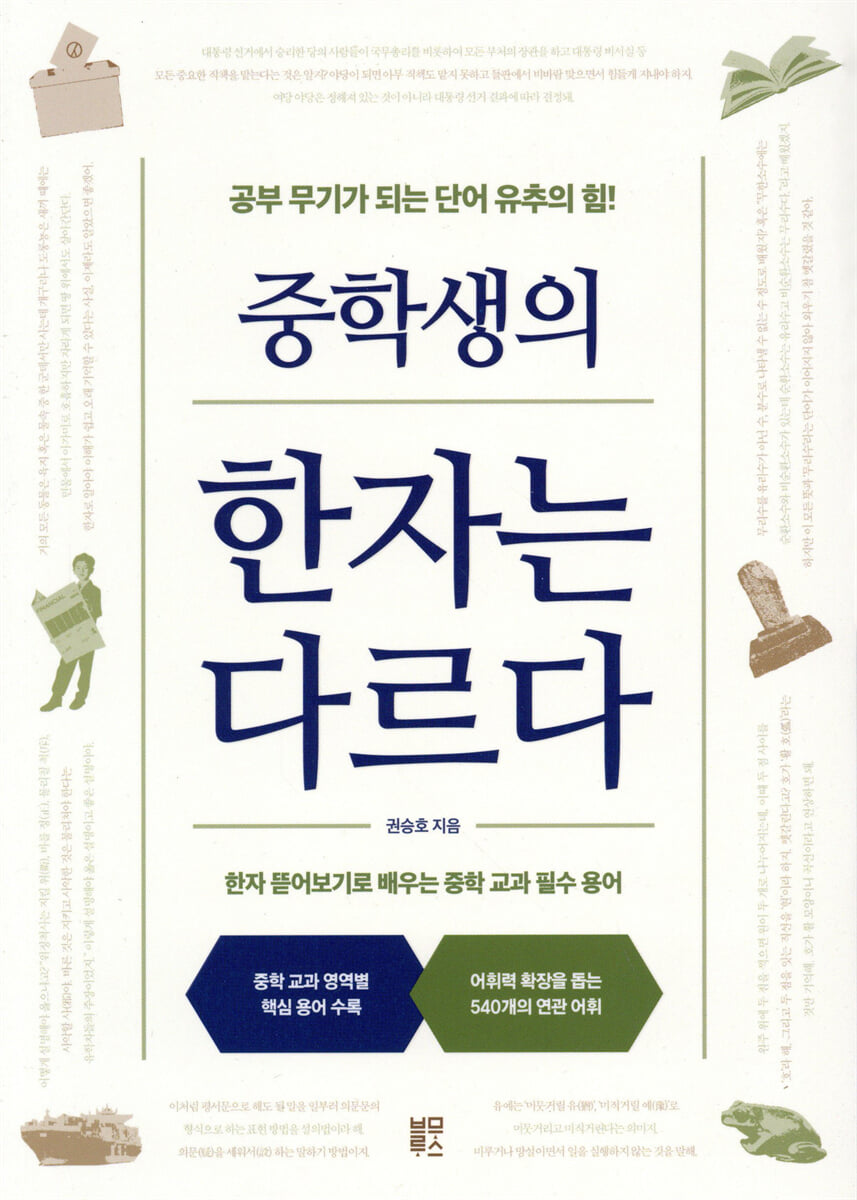
Middle school students' Chinese characters are different
 |
Description
Book Introduction
Middle school students who are really good at studying
When you encounter difficult vocabulary
Let's start by looking at the Chinese characters.
Let's open the social studies textbook that you first encounter when you first enter middle school.
The very first chapter contains an explanation of 'maps'.
Let's take a look together. 'A map is a representation of the entire or part of the Earth's surface, reduced to a certain ratio and represented on a flat surface using established symbols.' I can't understand what that means right away.
If you get stuck from the very beginning of learning a concept, you will lose confidence and interest.
But what about this explanation? 'A map is a picture of the land, with the characters for land (地) and picture (圖).
It's a pictorial depiction of the shape of the earth. By dissecting the Chinese characters, you can easily and simply understand concepts you previously struggled with! This is the power of Chinese characters.
When you study conceptual words in Chinese characters, concepts that felt abstract will come to mind.
The reason why studying concepts became difficult after entering middle school is not because I am stupid or because the concepts are too difficult.
Because the way you study the concept is wrong.
Let's change the method.
Instead of just memorizing them, take some time to look at the Chinese characters.
You might be wondering, "I'm so busy, why am I studying Chinese characters?" That's why "Middle School Students' Chinese Characters Are Different" was published.
We selected 90 concepts that frequently appear in textbooks, analyzed the Chinese characters, and explained their meanings and usage, making it easy to intuitively understand and memorize.
Synonyms, antonyms, and homonyms of important concepts are also included to help you expand your concepts.
Not only does it allow for additional study of Chinese characters by providing a wealth of vocabulary related to important Chinese characters used in concept words, but it also provides a complete learning effect through quizzes linked to the curriculum.
If you invest just 10 minutes a day and read one chapter at a time, you will soon have 178 frequently appearing Chinese characters and 540 essential vocabulary words from the textbook engraved in your head.
If you keep these things firmly in your head, you won't be afraid of any concepts that come up.
Because even if you come across a word you see for the first time, you can easily guess its meaning.
Knowing Chinese characters lowers the barrier to entry for studying and boosts your confidence on exams.
The Chinese characters you learn through this book will be of great help not only in middle school but also in high school.
When you encounter difficult vocabulary
Let's start by looking at the Chinese characters.
Let's open the social studies textbook that you first encounter when you first enter middle school.
The very first chapter contains an explanation of 'maps'.
Let's take a look together. 'A map is a representation of the entire or part of the Earth's surface, reduced to a certain ratio and represented on a flat surface using established symbols.' I can't understand what that means right away.
If you get stuck from the very beginning of learning a concept, you will lose confidence and interest.
But what about this explanation? 'A map is a picture of the land, with the characters for land (地) and picture (圖).
It's a pictorial depiction of the shape of the earth. By dissecting the Chinese characters, you can easily and simply understand concepts you previously struggled with! This is the power of Chinese characters.
When you study conceptual words in Chinese characters, concepts that felt abstract will come to mind.
The reason why studying concepts became difficult after entering middle school is not because I am stupid or because the concepts are too difficult.
Because the way you study the concept is wrong.
Let's change the method.
Instead of just memorizing them, take some time to look at the Chinese characters.
You might be wondering, "I'm so busy, why am I studying Chinese characters?" That's why "Middle School Students' Chinese Characters Are Different" was published.
We selected 90 concepts that frequently appear in textbooks, analyzed the Chinese characters, and explained their meanings and usage, making it easy to intuitively understand and memorize.
Synonyms, antonyms, and homonyms of important concepts are also included to help you expand your concepts.
Not only does it allow for additional study of Chinese characters by providing a wealth of vocabulary related to important Chinese characters used in concept words, but it also provides a complete learning effect through quizzes linked to the curriculum.
If you invest just 10 minutes a day and read one chapter at a time, you will soon have 178 frequently appearing Chinese characters and 540 essential vocabulary words from the textbook engraved in your head.
If you keep these things firmly in your head, you won't be afraid of any concepts that come up.
Because even if you come across a word you see for the first time, you can easily guess its meaning.
Knowing Chinese characters lowers the barrier to entry for studying and boosts your confidence on exams.
The Chinese characters you learn through this book will be of great help not only in middle school but also in high school.
- You can preview some of the book's contents.
Preview
index
Introduction
Korean
The method of explanation
metaphor
Written language
city
novel
interval
rounded vowels
Consonant assimilation
vocabulary
phonetic contraction
Omniscient
essay
drama
milk body
induction
Auxiliary verb
relative
Paralinguistic
math
fountain
unknown
decimal
surd
acute angle
vertical
set
isosceles triangle
parallelogram
probability
Pi
Greatest common divisor
constant term
Factorization
equation
function
statistics
relative frequency
society
Ruling party and opposition party
basic industries
public opinion
economy
Depreciation
Selection
trade
Eligibility for election
Current expenses
toadyism
Absence of work
rule of law
Principle of national self-determination
subtropical
Appeal
Monopoly
feudalism
suspended sentence
science
survival of the fittest
constant acceleration
fig
Use and disuse theory
amphibia
universal gravitation
Visible light
static electricity
inertia
antibiotics
Pharmacological research
arteriosclerosis
eutrophication
tropical cyclone
Japanese food
basin
semiconductor
reclaimed land
National History
Wijeongcheoksa
Sangpyeongchang
human wave tactics
Jeong Gye-bi
Grapevine
Realism
Imperialization
Change of name
Shiilyabangseongdaegok
Tangpyeong policy
Daedong Law
Donghak Peasant Revolution
Gabo Reform
Prehistoric times
Hongik Ingan
Treaty of Peace
Slave inspection method
powerful families
Correct answer
Chinese characters appearing in 'Chinese Character Analysis'
Korean
The method of explanation
metaphor
Written language
city
novel
interval
rounded vowels
Consonant assimilation
vocabulary
phonetic contraction
Omniscient
essay
drama
milk body
induction
Auxiliary verb
relative
Paralinguistic
math
fountain
unknown
decimal
surd
acute angle
vertical
set
isosceles triangle
parallelogram
probability
Pi
Greatest common divisor
constant term
Factorization
equation
function
statistics
relative frequency
society
Ruling party and opposition party
basic industries
public opinion
economy
Depreciation
Selection
trade
Eligibility for election
Current expenses
toadyism
Absence of work
rule of law
Principle of national self-determination
subtropical
Appeal
Monopoly
feudalism
suspended sentence
science
survival of the fittest
constant acceleration
fig
Use and disuse theory
amphibia
universal gravitation
Visible light
static electricity
inertia
antibiotics
Pharmacological research
arteriosclerosis
eutrophication
tropical cyclone
Japanese food
basin
semiconductor
reclaimed land
National History
Wijeongcheoksa
Sangpyeongchang
human wave tactics
Jeong Gye-bi
Grapevine
Realism
Imperialization
Change of name
Shiilyabangseongdaegok
Tangpyeong policy
Daedong Law
Donghak Peasant Revolution
Gabo Reform
Prehistoric times
Hongik Ingan
Treaty of Peace
Slave inspection method
powerful families
Correct answer
Chinese characters appearing in 'Chinese Character Analysis'
Detailed image

Into the book
I hope that as you read this book, you will find yourself muttering, “Why didn’t I think of this sooner?”
And I hope you can realize that studying can be fun too.
It should be made clear that you do not need to know how to write Chinese characters.
This is because I am worried that I will give up on studying Chinese characters if I try too hard to acquire the ability to write, and because writing ability is not important.
---From "Introductory Remarks"
Root, stem, ending.
Confusing? Confusing? But it's easy if you understand it in Chinese characters.
'어' is '어(語)'.
And 'root (根)', 'stem (幹)', and 'tail (尾)'.
Here, 'root' means fundamental.
This is the most crucial part.
The stem is the root and the body above the root.
The tail is not attached to the end of the body.
Let's remember this order.
---From "Sentence Stem"
You can understand that numbers like 0.1 or 0.34 are prime numbers, but you can't understand that numbers like 29 or 31 are prime numbers? Right.
I was confused when I was in middle school too.
Numbers greater than 0 and less than 1 are called prime numbers, using the character 'small'.
Then why are numbers like 29 or 31, which are greater than 1, called prime numbers? In this case, they are the prime numbers of the 'base prime'.
A positive integer greater than 1 that is divisible only by 1 and itself.
---Among the "small numbers"
The dictionary definition of 'the right to be elected is the right to run for election and be elected' is a difficult explanation to understand and memorize.
However, if you follow the Chinese characters and explain it as 'the right to be elected is the right to be elected, the right to be elected and be put up for election, that is, the right to run as a candidate, the right to run for office', it is easy to remember and becomes a near-perfect explanation.
---From "Right to be elected"
If you look at the Chinese characters for visible light, they are 'possible (可)', 'to see (視)', 'light (光)', and 'line (線)'.
A thorn is not a sharp, needle-like growth on the stem or leaf of a plant, nor is it a fish bone.
You can see that it is named visible light because it is the normal light that can be seen by the human eye.
A ray is a geometric line that represents the path that light travels.
In other words, light is not actually a line, but the straight path that light travels is likened to a line.
---From "Visible Light"
During the Goryeo and Joseon Dynasties, there was a price control agency. Was it called Uichang, Sangpyeongchang, or Hye-minguk? Confused? You knew it but forgot? It's easy if you just know that "pyeong" (平) means "level."
Sangpyeongchang means ‘always (常)’, ‘flat (平)’, and ‘warehouse (倉)’.
A warehouse that always keeps the prices of goods flat.
Now you know for sure and you won't be confused, right? This is it.
Here's why you should study using Chinese characters.
And I hope you can realize that studying can be fun too.
It should be made clear that you do not need to know how to write Chinese characters.
This is because I am worried that I will give up on studying Chinese characters if I try too hard to acquire the ability to write, and because writing ability is not important.
---From "Introductory Remarks"
Root, stem, ending.
Confusing? Confusing? But it's easy if you understand it in Chinese characters.
'어' is '어(語)'.
And 'root (根)', 'stem (幹)', and 'tail (尾)'.
Here, 'root' means fundamental.
This is the most crucial part.
The stem is the root and the body above the root.
The tail is not attached to the end of the body.
Let's remember this order.
---From "Sentence Stem"
You can understand that numbers like 0.1 or 0.34 are prime numbers, but you can't understand that numbers like 29 or 31 are prime numbers? Right.
I was confused when I was in middle school too.
Numbers greater than 0 and less than 1 are called prime numbers, using the character 'small'.
Then why are numbers like 29 or 31, which are greater than 1, called prime numbers? In this case, they are the prime numbers of the 'base prime'.
A positive integer greater than 1 that is divisible only by 1 and itself.
---Among the "small numbers"
The dictionary definition of 'the right to be elected is the right to run for election and be elected' is a difficult explanation to understand and memorize.
However, if you follow the Chinese characters and explain it as 'the right to be elected is the right to be elected, the right to be elected and be put up for election, that is, the right to run as a candidate, the right to run for office', it is easy to remember and becomes a near-perfect explanation.
---From "Right to be elected"
If you look at the Chinese characters for visible light, they are 'possible (可)', 'to see (視)', 'light (光)', and 'line (線)'.
A thorn is not a sharp, needle-like growth on the stem or leaf of a plant, nor is it a fish bone.
You can see that it is named visible light because it is the normal light that can be seen by the human eye.
A ray is a geometric line that represents the path that light travels.
In other words, light is not actually a line, but the straight path that light travels is likened to a line.
---From "Visible Light"
During the Goryeo and Joseon Dynasties, there was a price control agency. Was it called Uichang, Sangpyeongchang, or Hye-minguk? Confused? You knew it but forgot? It's easy if you just know that "pyeong" (平) means "level."
Sangpyeongchang means ‘always (常)’, ‘flat (平)’, and ‘warehouse (倉)’.
A warehouse that always keeps the prices of goods flat.
Now you know for sure and you won't be confused, right? This is it.
Here's why you should study using Chinese characters.
---From "Sangpyeongchang"
Publisher's Review
Middle school studies become easier!
In Korean language, math, social studies, science, and Korean history textbooks
Complete mastery of core Chinese characters and related vocabulary
There is a common opinion among teachers of each subject, from Korean, English, social studies, and science.
"Why do students these days have such limited vocabulary?" If you ask middle school students the meaning of concepts in textbooks, many of them won't be able to answer.
I read the text in the textbook, but I just read it without understanding the meaning.
So, when you study, you are bound to get lost and find studying boring.
Lack of vocabulary cannot be solved by studying blindly.
If you know that most of the vocabulary in textbooks is Chinese characters, the answer is clear.
To know the exact meaning of a word, you need to know it in Chinese characters.
Because you need to know Chinese characters to understand the content quickly, accurately, and remember it for a long time.
What textbooks and search sites don't tell you
The fun of learning the 'true meaning' of a concept
This book selects important Chinese characters that appear in Korean, math, social studies, science, and Korean history, explains the concepts using their Chinese character meanings, and adds necessary explanations to make it easy to understand and memorize.
What if you read the simple definitions of concepts in textbooks? You'll just say, "Oh, I see," and then forget about it five minutes later.
On the other hand, this book helps you intuitively understand the meaning through Chinese characters.
It provides rich information on the true meaning, deeper meaning, origin, and even homonyms, antonyms, and synonyms.
Any study will be remembered if you know the context and story.
Therefore, unlike information found through searches, the information obtained through this book will not evaporate from your mind but will remain in your mind for a long time.
This book has a section called ‘Examining Chinese Characters’.
By looking at the six concepts that appear in the textbook vocabulary at once, you will naturally learn how to guess the principles of how Chinese characters are formed and their meanings.
Once you learn the patterns that make up Chinese characters, you will gain the ability to guess the meaning of words you see for the first time.
So, instead of panicking when you encounter a concept you've never seen before on a test, you can calmly solve the problem by looking at the Chinese characters, guessing their meaning, and then calmly solving the problem.
As your knowledge grows, you will feel it for yourself.
The fun of studying Chinese characters
There is something that students who learned from author Seungho Kwon have in common.
“Teacher, learning Chinese characters has made studying more fun.
“Why didn’t I study like this before?” Studying Chinese characters can be fun, different from the boring and dull studying you have to do.
Fun here is the fun of learning Chinese characters and the intellectual joy of reading related knowledge.
In particular, this book includes easy-to-solve problems at each section, and the thrill of getting the correct answer to a problem is also quite enjoyable.
Which study method is better: boring or exciting? The answer is clear.
Just 10 minutes a day, invest in studying Chinese characters by reading this book.
It's not difficult.
If you read it with a light heart and just exclaim, “Aha! So that’s it,” that’s enough.
Even with a little money and effort, you can expect your grades to improve across all subjects.
For middle school students struggling to master concepts, what better "cost-effective" study method could there be? This is why middle school students' Chinese character learning needs to be different.
In Korean language, math, social studies, science, and Korean history textbooks
Complete mastery of core Chinese characters and related vocabulary
There is a common opinion among teachers of each subject, from Korean, English, social studies, and science.
"Why do students these days have such limited vocabulary?" If you ask middle school students the meaning of concepts in textbooks, many of them won't be able to answer.
I read the text in the textbook, but I just read it without understanding the meaning.
So, when you study, you are bound to get lost and find studying boring.
Lack of vocabulary cannot be solved by studying blindly.
If you know that most of the vocabulary in textbooks is Chinese characters, the answer is clear.
To know the exact meaning of a word, you need to know it in Chinese characters.
Because you need to know Chinese characters to understand the content quickly, accurately, and remember it for a long time.
What textbooks and search sites don't tell you
The fun of learning the 'true meaning' of a concept
This book selects important Chinese characters that appear in Korean, math, social studies, science, and Korean history, explains the concepts using their Chinese character meanings, and adds necessary explanations to make it easy to understand and memorize.
What if you read the simple definitions of concepts in textbooks? You'll just say, "Oh, I see," and then forget about it five minutes later.
On the other hand, this book helps you intuitively understand the meaning through Chinese characters.
It provides rich information on the true meaning, deeper meaning, origin, and even homonyms, antonyms, and synonyms.
Any study will be remembered if you know the context and story.
Therefore, unlike information found through searches, the information obtained through this book will not evaporate from your mind but will remain in your mind for a long time.
This book has a section called ‘Examining Chinese Characters’.
By looking at the six concepts that appear in the textbook vocabulary at once, you will naturally learn how to guess the principles of how Chinese characters are formed and their meanings.
Once you learn the patterns that make up Chinese characters, you will gain the ability to guess the meaning of words you see for the first time.
So, instead of panicking when you encounter a concept you've never seen before on a test, you can calmly solve the problem by looking at the Chinese characters, guessing their meaning, and then calmly solving the problem.
As your knowledge grows, you will feel it for yourself.
The fun of studying Chinese characters
There is something that students who learned from author Seungho Kwon have in common.
“Teacher, learning Chinese characters has made studying more fun.
“Why didn’t I study like this before?” Studying Chinese characters can be fun, different from the boring and dull studying you have to do.
Fun here is the fun of learning Chinese characters and the intellectual joy of reading related knowledge.
In particular, this book includes easy-to-solve problems at each section, and the thrill of getting the correct answer to a problem is also quite enjoyable.
Which study method is better: boring or exciting? The answer is clear.
Just 10 minutes a day, invest in studying Chinese characters by reading this book.
It's not difficult.
If you read it with a light heart and just exclaim, “Aha! So that’s it,” that’s enough.
Even with a little money and effort, you can expect your grades to improve across all subjects.
For middle school students struggling to master concepts, what better "cost-effective" study method could there be? This is why middle school students' Chinese character learning needs to be different.
GOODS SPECIFICS
- Date of issue: May 25, 2023
- Page count, weight, size: 208 pages | 308g | 150*210*14mm
- ISBN13: 9791191426878
- ISBN10: 1191426874
You may also like
카테고리
korean


korean

![GQ KOREA Mark (Monthly): December [2025]](http://librairie.coreenne.fr/cdn/shop/files/8ef265dbbfbf186523ed75ba7319009d.jpg?v=1765340328&width=3840)


