

Questioning breeds intelligence, and faith breeds spirituality.
 |
Description
Book Introduction
Ten Years After "From Intellect to Spirituality"
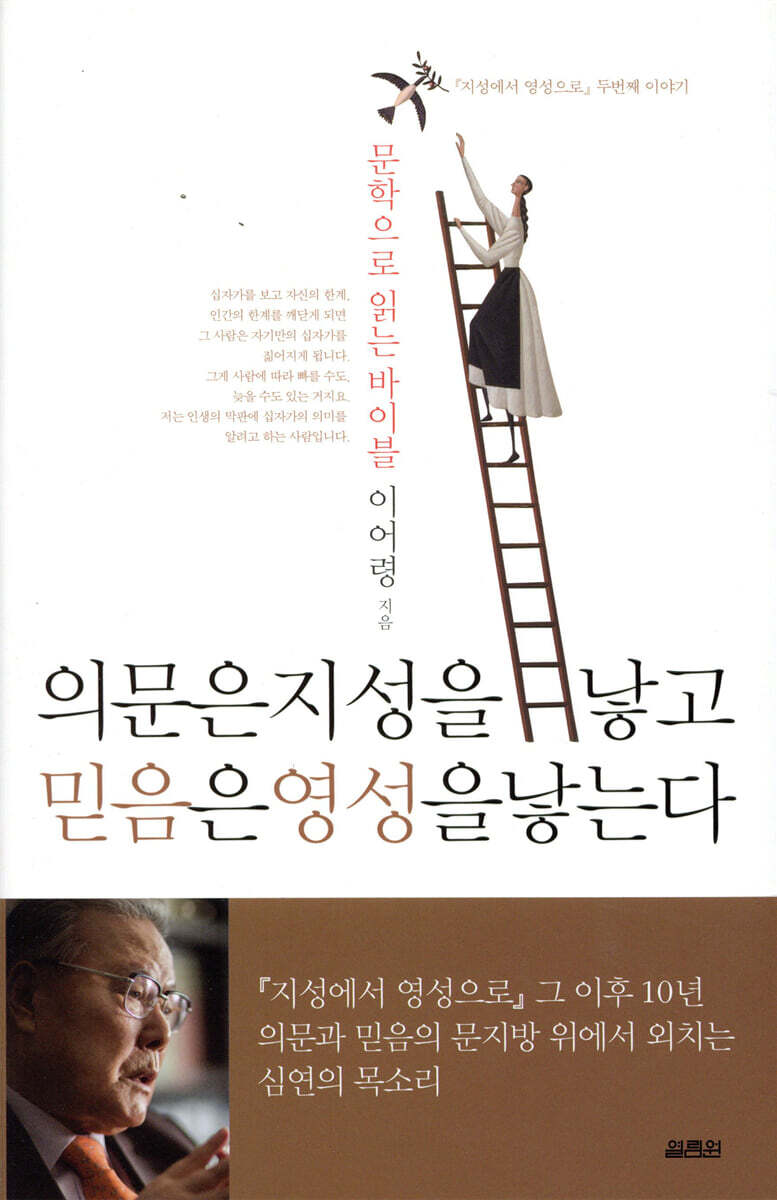
"Questions Give Birth to Intelligence, and Faith Gives Birth to Spirituality" is a book written by Lee Eo-ryeong, an intellectual of the time who met God through baptism in 2007, and in which he honestly asks and answers questions about God's words in the Bible.
As a professor of literature and a semiotician with curiosity, the author generously pours his extensive intellect into suggesting a rereading of the Bible.
This book, filled with rich stories and thoughts about the Bible, will help both believers and non-believers approach God's Word more intimately.
This book, previously published under the title “You Can’t Live by Bread Alone,” is being republished to commemorate the 10th anniversary of the author’s baptism.
I hope this book will be a loving companion on your journey toward God, and a small well that can nourish the minds and hearts of many readers.
By following the author's rich knowledge and friendly guidance, even those who have typically found the Bible difficult to approach will come to deeply understand what it is about the Bible, the Word of God, that has moved people and comforted their hearts for so long.
In a world where “no matter how much you eat, you’re still hungry, and no matter how much you drink, you’re still thirsty,” the author cries out that only the Word of God can fill our hungry souls, and that we need the bread of life, the food of the soul, that we can eat without dying.
The author selects symbolic keywords from the Bible and explains the historical context and circumstances in which it was written, helping readers encounter the Bible from a different perspective than before.
This passion of his may also be another expression of his will to approach God.
Perhaps that's why the biblical anecdotes the author introduces resonate deeply with the unavoidable anxieties of humankind.
As readers follow the text, they will find themselves quietly asking themselves, "What kind of path of love and suffering did Jesus walk, when we are still human and cannot help but be human?" and what attitude we, as Christians, should have toward life.
"Questions Give Birth to Intelligence, and Faith Gives Birth to Spirituality" is a book written by Lee Eo-ryeong, an intellectual of the time who met God through baptism in 2007, and in which he honestly asks and answers questions about God's words in the Bible.
As a professor of literature and a semiotician with curiosity, the author generously pours his extensive intellect into suggesting a rereading of the Bible.
This book, filled with rich stories and thoughts about the Bible, will help both believers and non-believers approach God's Word more intimately.
This book, previously published under the title “You Can’t Live by Bread Alone,” is being republished to commemorate the 10th anniversary of the author’s baptism.
I hope this book will be a loving companion on your journey toward God, and a small well that can nourish the minds and hearts of many readers.
By following the author's rich knowledge and friendly guidance, even those who have typically found the Bible difficult to approach will come to deeply understand what it is about the Bible, the Word of God, that has moved people and comforted their hearts for so long.
In a world where “no matter how much you eat, you’re still hungry, and no matter how much you drink, you’re still thirsty,” the author cries out that only the Word of God can fill our hungry souls, and that we need the bread of life, the food of the soul, that we can eat without dying.
The author selects symbolic keywords from the Bible and explains the historical context and circumstances in which it was written, helping readers encounter the Bible from a different perspective than before.
This passion of his may also be another expression of his will to approach God.
Perhaps that's why the biblical anecdotes the author introduces resonate deeply with the unavoidable anxieties of humankind.
As readers follow the text, they will find themselves quietly asking themselves, "What kind of path of love and suffering did Jesus walk, when we are still human and cannot help but be human?" and what attitude we, as Christians, should have toward life.
- You can preview some of the book's contents.
Preview
Publisher's Review
You have tears
Among the various keywords that appear in the book, let's first talk about tears.
The author quotes Goethe's line, "He who has not eaten his bread with tears does not know the meaning of life," and points out that the tears in Wilhelm Meister's Apprentice do not refer to the pain or sorrow of worldly life, but rather to the tragedy that occurs in the relationship between humans and God in relation to original sin, that is, tears shed in recognition of human limitations and fate.
Jesus, who came in human form, cries three times in the Bible.
Once, he saw the death of Lazarus, once he looked back at Jerusalem, which he had tried to embrace with love, and once lastly before he died on the cross.
The author says that our souls can be cleansed through the tears of love that Jesus shed for humanity.
Only humans grieve and cry for others.
It may be the power of love that Jesus gave us.
Jesus said, “Tear your heart, not your garments” (Joel 2:13).
The author says:
If you can suddenly look back on yourself and shed tears while walking down the street, sleeping, or eating, that is repentance. These are the tears that wet the bread we eat and the sweat we must shed to obtain food.
But in our time, no one wants to taste any of the three tears Jesus shed.
Because a heart that sheds tears is too painful no matter what.
The world always shows a new world only when we overcome things that are so painful that they are almost fatal.
Jesus shed tears and blood for us and then rose again.
(…) So don’t wipe away the tears that are flowing now.
Just leave it until it dries.
Tears are not shameful, they are something to be proud of.
If you have tears, it means you have a soul, it means you have love, it means you love someone and miss them deeply, and it means you regret it. Tears shed for others, not for yourself, are as beautiful as a rainbow that appears after the rain.
_“Bread with Tears,” pp. 71-72
What we seek, wait, and look for in the wilderness of life
Another famous verse from the Bible that the author introduces is, “It is easier for a camel to go through the eye of a needle than for a rich man to enter the kingdom of God” (Matthew 19:24).
Regarding this controversial passage, the author traces the origin of the word and introduces a hypothesis.
Some people claim that in Aramaic, camel is 'gamla' and rope is 'gamta', and the pronunciation and spelling of these two words are so similar that rope was incorrectly translated as camel.
It's not that it's not true, but if you change the word to rope, it makes more sense.
However, in the society at that time, camels were also symbols of 'bigness', so it is not wrong to use the word 'camel'.
But more than these arguments, the author wants to convey a more important story to the readers.
Camels always carry heavy loads on their backs, but most of the time, it's not their own load, but someone else's.
In other words, the camel is a metaphor for a person who has everything he wants, and here the author introduces an interesting story about camels from Mongolia, leaving a calm aftertaste.
Originally, camels had horns, which were so beautiful that other animals envied them.
Then one day, a deer came and said, “Please lend me those antlers.”
The kind-hearted camel lent his horn out of kindness.
But no matter how long I waited, the horn wouldn't come back.
So, the camel is still looking at the horizon as if waiting for something, wondering when the deer will come.
Like the camels who were compared to the rich, we too, laden with things, wait for something in the barren desert of life.
(…) We are so busy carrying on our backs the vain things of this world that we cannot see God or the truth.
We are like camels, vaguely waiting for something with sad eyes.
That would be the heart towards religion, the heart towards spirituality.
If we consider whether what we are seeking is merely a burden, we will understand what we are searching for, waiting for, and looking forward to in the wilderness of life.
_The Camel and the Eye of the Needle, pp. 175-176
Intelligence is the ladder to enlightenment.
In addition, the author presents a new perspective on reading and interpreting the Bible through the prism of representative keywords that frequently appear in the Bible, such as bread, birds and flowers, father, prodigal son, sheep, house, carpenter, connection, grapes, swallows, doves, ravens, eagles, staffs, desert and wilderness, Jesus, and the cross.
By freely analyzing the cultural symbols and images implied by the icons in the Bible, we prove that the Bible is not only a pious and noble story, but also a magnificent text that is as moving and entertaining as a work of literature.
As we encounter the rich sacrament of poetics hidden between the lines of the Bible, we will nod in agreement with the author's wit that if we remove the letter "n" from theology, we get poetry.
This is the ladder to enlightenment that Lee Eo-ryeong's intellect presents to the reader, and it can be said to be a step that leads us to spirituality.
Preface to the Revised Edition
To those who still stand on the threshold
I said I am a well digger, not a drinker.
I have to say the same thing this time too.
Whether it's literature or religion, I dig a well with intellectual curiosity and imagination.
Until the water comes out.
When water starts to flow out of the well I dug, I quickly move the land to another place and dig a new well.
This is how countless books were born.
Each of these books is a thirst for life and truth.
Such books have never quenched my thirst.
It's like an empty bucket.
The gourd is empty, so we look for water again.
This book, published under the title 'You Can't Live by Bread Alone', is also just another well I dug to quench my thirst as a Christian.
After writing that book, I left.
My attention has already wandered far from the words of "You Can't Live by Bread Alone."
The Bible tells the story of Lot's wife who was turned into a pillar of salt because she looked back at the burning city of Sodom.
I have never looked back on the books I have written.
In severe cases, they do not try to correct typos or incorrect facts.
No matter how much one regrets and reflects on the life one has lived, it is not something that can be corrected as if by proofreading or publishing a revised edition.
But this time, something truly exceptional happened to me.
This is a revised edition of the already published book, “You Can’t Live on Bread Alone.”
The reason for the name change is simple.
In the Korean Bible, 'bread' is mostly translated as 'tteok'.
In the text, there was a detailed discussion about whether it was rice cake or bread.
However, using this as the title of the book has led to many misunderstandings.
This has caused great confusion, especially for devout Christians who know that “one cannot live by bread alone.”
There is another reason.
From an orthodox theological perspective, there are many interpretations that are close to errors, and some of them could be seen as heretical.
Because I read the Bible, the best-selling and long-selling book of all time, not from the perspective of a religious person or a fixed religious viewpoint, but as a literary work, that is, from the perspective of a literary critic, there are many differences from religious interpretations.
So, I chose the subtitle, "Reading the Bible through Literature," and the title, "Questions give birth to intelligence, and faith gives birth to spirituality," which is a confession of my heart that still wanders between the threshold of doubt and faith.
I have published this revised edition with the hope that it will be read by many people, especially intellectuals, who, like me, are still standing on the threshold, because I feel deeply that spirituality is not achieved by abandoning intellect.
In particular, I had forgotten about the Open Center's CEO, Jeong Jung-mo, Editor-in-Chief, Lee Eun-ah, and Editor Yoo Seong-won, but they earnestly requested that this year be the 10th anniversary of my baptism at the Japan Love Sonata event, and that there should be some kind of signage, even if it wasn't a commemorative event.
10 years? They say even rivers and mountains change, but how much have I changed?
It gave me an opportunity to reread old books as if they were new, and to reread books I wrote as if they were written by others.
I drank the water from the well I dug.
Summer 2017
Lee Eo-ryeong
Among the various keywords that appear in the book, let's first talk about tears.
The author quotes Goethe's line, "He who has not eaten his bread with tears does not know the meaning of life," and points out that the tears in Wilhelm Meister's Apprentice do not refer to the pain or sorrow of worldly life, but rather to the tragedy that occurs in the relationship between humans and God in relation to original sin, that is, tears shed in recognition of human limitations and fate.
Jesus, who came in human form, cries three times in the Bible.
Once, he saw the death of Lazarus, once he looked back at Jerusalem, which he had tried to embrace with love, and once lastly before he died on the cross.
The author says that our souls can be cleansed through the tears of love that Jesus shed for humanity.
Only humans grieve and cry for others.
It may be the power of love that Jesus gave us.
Jesus said, “Tear your heart, not your garments” (Joel 2:13).
The author says:
If you can suddenly look back on yourself and shed tears while walking down the street, sleeping, or eating, that is repentance. These are the tears that wet the bread we eat and the sweat we must shed to obtain food.
But in our time, no one wants to taste any of the three tears Jesus shed.
Because a heart that sheds tears is too painful no matter what.
The world always shows a new world only when we overcome things that are so painful that they are almost fatal.
Jesus shed tears and blood for us and then rose again.
(…) So don’t wipe away the tears that are flowing now.
Just leave it until it dries.
Tears are not shameful, they are something to be proud of.
If you have tears, it means you have a soul, it means you have love, it means you love someone and miss them deeply, and it means you regret it. Tears shed for others, not for yourself, are as beautiful as a rainbow that appears after the rain.
_“Bread with Tears,” pp. 71-72
What we seek, wait, and look for in the wilderness of life
Another famous verse from the Bible that the author introduces is, “It is easier for a camel to go through the eye of a needle than for a rich man to enter the kingdom of God” (Matthew 19:24).
Regarding this controversial passage, the author traces the origin of the word and introduces a hypothesis.
Some people claim that in Aramaic, camel is 'gamla' and rope is 'gamta', and the pronunciation and spelling of these two words are so similar that rope was incorrectly translated as camel.
It's not that it's not true, but if you change the word to rope, it makes more sense.
However, in the society at that time, camels were also symbols of 'bigness', so it is not wrong to use the word 'camel'.
But more than these arguments, the author wants to convey a more important story to the readers.
Camels always carry heavy loads on their backs, but most of the time, it's not their own load, but someone else's.
In other words, the camel is a metaphor for a person who has everything he wants, and here the author introduces an interesting story about camels from Mongolia, leaving a calm aftertaste.
Originally, camels had horns, which were so beautiful that other animals envied them.
Then one day, a deer came and said, “Please lend me those antlers.”
The kind-hearted camel lent his horn out of kindness.
But no matter how long I waited, the horn wouldn't come back.
So, the camel is still looking at the horizon as if waiting for something, wondering when the deer will come.
Like the camels who were compared to the rich, we too, laden with things, wait for something in the barren desert of life.
(…) We are so busy carrying on our backs the vain things of this world that we cannot see God or the truth.
We are like camels, vaguely waiting for something with sad eyes.
That would be the heart towards religion, the heart towards spirituality.
If we consider whether what we are seeking is merely a burden, we will understand what we are searching for, waiting for, and looking forward to in the wilderness of life.
_The Camel and the Eye of the Needle, pp. 175-176
Intelligence is the ladder to enlightenment.
In addition, the author presents a new perspective on reading and interpreting the Bible through the prism of representative keywords that frequently appear in the Bible, such as bread, birds and flowers, father, prodigal son, sheep, house, carpenter, connection, grapes, swallows, doves, ravens, eagles, staffs, desert and wilderness, Jesus, and the cross.
By freely analyzing the cultural symbols and images implied by the icons in the Bible, we prove that the Bible is not only a pious and noble story, but also a magnificent text that is as moving and entertaining as a work of literature.
As we encounter the rich sacrament of poetics hidden between the lines of the Bible, we will nod in agreement with the author's wit that if we remove the letter "n" from theology, we get poetry.
This is the ladder to enlightenment that Lee Eo-ryeong's intellect presents to the reader, and it can be said to be a step that leads us to spirituality.
Preface to the Revised Edition
To those who still stand on the threshold
I said I am a well digger, not a drinker.
I have to say the same thing this time too.
Whether it's literature or religion, I dig a well with intellectual curiosity and imagination.
Until the water comes out.
When water starts to flow out of the well I dug, I quickly move the land to another place and dig a new well.
This is how countless books were born.
Each of these books is a thirst for life and truth.
Such books have never quenched my thirst.
It's like an empty bucket.
The gourd is empty, so we look for water again.
This book, published under the title 'You Can't Live by Bread Alone', is also just another well I dug to quench my thirst as a Christian.
After writing that book, I left.
My attention has already wandered far from the words of "You Can't Live by Bread Alone."
The Bible tells the story of Lot's wife who was turned into a pillar of salt because she looked back at the burning city of Sodom.
I have never looked back on the books I have written.
In severe cases, they do not try to correct typos or incorrect facts.
No matter how much one regrets and reflects on the life one has lived, it is not something that can be corrected as if by proofreading or publishing a revised edition.
But this time, something truly exceptional happened to me.
This is a revised edition of the already published book, “You Can’t Live on Bread Alone.”
The reason for the name change is simple.
In the Korean Bible, 'bread' is mostly translated as 'tteok'.
In the text, there was a detailed discussion about whether it was rice cake or bread.
However, using this as the title of the book has led to many misunderstandings.
This has caused great confusion, especially for devout Christians who know that “one cannot live by bread alone.”
There is another reason.
From an orthodox theological perspective, there are many interpretations that are close to errors, and some of them could be seen as heretical.
Because I read the Bible, the best-selling and long-selling book of all time, not from the perspective of a religious person or a fixed religious viewpoint, but as a literary work, that is, from the perspective of a literary critic, there are many differences from religious interpretations.
So, I chose the subtitle, "Reading the Bible through Literature," and the title, "Questions give birth to intelligence, and faith gives birth to spirituality," which is a confession of my heart that still wanders between the threshold of doubt and faith.
I have published this revised edition with the hope that it will be read by many people, especially intellectuals, who, like me, are still standing on the threshold, because I feel deeply that spirituality is not achieved by abandoning intellect.
In particular, I had forgotten about the Open Center's CEO, Jeong Jung-mo, Editor-in-Chief, Lee Eun-ah, and Editor Yoo Seong-won, but they earnestly requested that this year be the 10th anniversary of my baptism at the Japan Love Sonata event, and that there should be some kind of signage, even if it wasn't a commemorative event.
10 years? They say even rivers and mountains change, but how much have I changed?
It gave me an opportunity to reread old books as if they were new, and to reread books I wrote as if they were written by others.
I drank the water from the well I dug.
Summer 2017
Lee Eo-ryeong
GOODS SPECIFICS
- Date of publication: August 25, 2017
- Format: Hardcover book binding method guide
- Page count, weight, size: 396 pages | 808g | 153*234*28mm
- ISBN13: 9791188047093
- ISBN10: 1188047094
You may also like
카테고리
korean


korean

![GQ KOREA Mark (Monthly): December [2025]](http://librairie.coreenne.fr/cdn/shop/files/8ef265dbbfbf186523ed75ba7319009d.jpg?v=1765340328&width=3840)


