

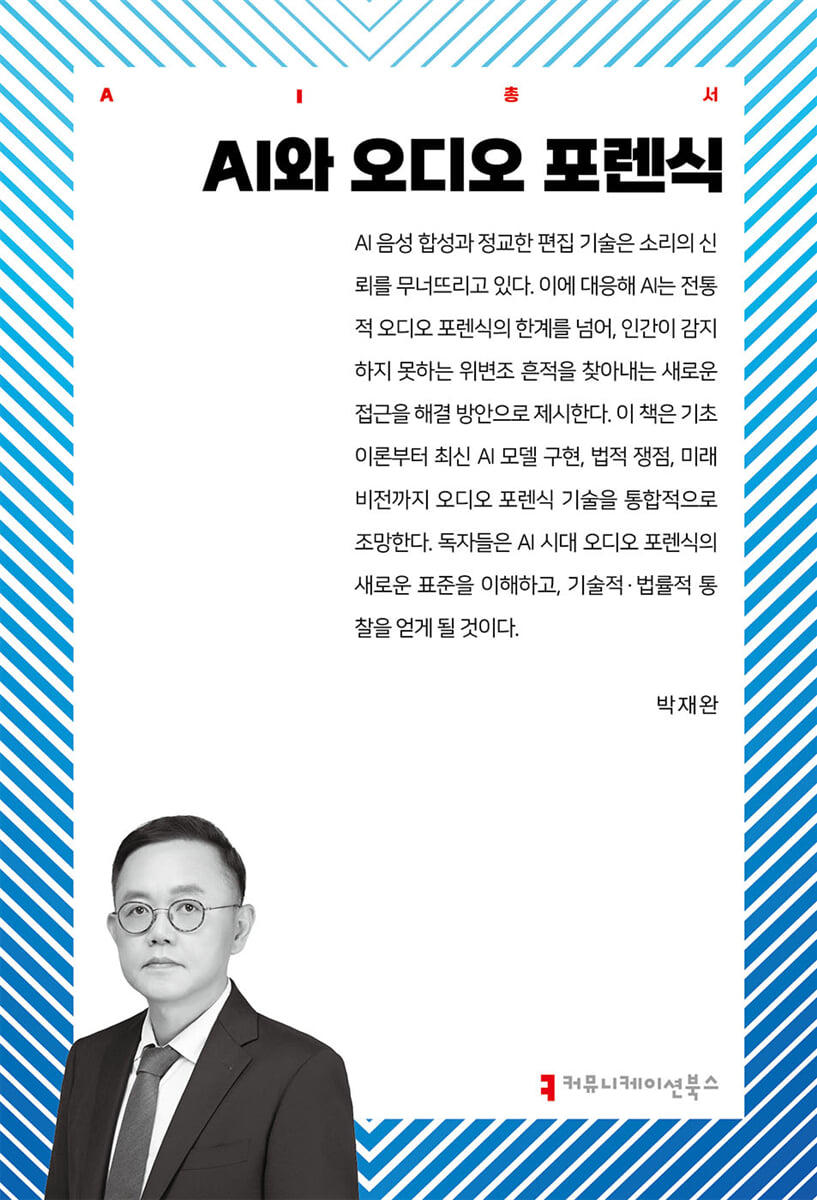
AI and Audio Forensics
 |
Description
Book Introduction
It covers the science of detecting voice forgery and uncovering the truth using artificial intelligence.
Technology that detects manipulated sounds becomes the new foundation for a trustworthy society. AI Encyclopedia.
You can find the artificial intelligence knowledge you need at aiseries.oopy.io.
Technology that detects manipulated sounds becomes the new foundation for a trustworthy society. AI Encyclopedia.
You can find the artificial intelligence knowledge you need at aiseries.oopy.io.
- You can preview some of the book's contents.
Preview
index
Hearing the Voice of Truth in the AI Age
01 Possibility of tampering with audio files
02 Understanding digital audio formats, file structure, and metadata
03 Traditional techniques for detecting digital audio tampering
04 Types of Digital Audio Counterfeiting and Detection Procedures
05 AI-based audio forgery detection technology
06 Building and Processing Datasets for Audio Forensics
07 AI Model for Audio Forensics
08 The Role of Audio Files and AI as Legal Evidence
09 Limitations and Ethical Issues of AI Audio Forensics Technology
10 The Future of AI Audio Forensics
01 Possibility of tampering with audio files
02 Understanding digital audio formats, file structure, and metadata
03 Traditional techniques for detecting digital audio tampering
04 Types of Digital Audio Counterfeiting and Detection Procedures
05 AI-based audio forgery detection technology
06 Building and Processing Datasets for Audio Forensics
07 AI Model for Audio Forensics
08 The Role of Audio Files and AI as Legal Evidence
09 Limitations and Ethical Issues of AI Audio Forensics Technology
10 The Future of AI Audio Forensics
Into the book
It is a digital record containing the entire creation process.
The file itself retains information such as creation time and method.
However, these editing processes and stored information can also provide important clues for forensic experts to find traces of falsification.
For example, if you splice together recordings from different points in time, the background noise will change slightly, and if you increase the volume excessively, clipping, where the top or bottom of the waveform is cut off, may occur.
Also, re-encoding may introduce regular noise patterns during the recompression process.
--- From “01_“Possibility of Forgery of Audio Files””
Our ears hear the content of the sound, but experts see the shape of the sound.
To do this, we need to visualize the inaudible digital audio files.
In other words, the process of analyzing invisible sounds by creating graphs or maps is called acoustic signal analysis.
Acoustic signal analysis mainly uses three methods: waveform, spectrum, and spectrogram.
These analyses aim to observe discontinuities, outliers (values that deviate significantly from the overall data pattern or distribution), and changes in noise patterns that appear in the edit interval.
--- From “03_“Traditional Techniques for Detecting Digital Audio Forgery””
Due to the lack of audio editing datasets, audio editing detection remains a domain for experts.
As audio forgery becomes more sophisticated, detection becomes more about looking for minor mistakes made by the forger.
Moreover, if AI-powered audio editing features like Photoshop are added to the software, traces of editing will be hidden even more.
To develop an AI model for audio editing detection, it is necessary to build a suitable dataset based on novel feature extraction and algorithm development that goes beyond conventional boundary region detection.
--- From “06_“Building and Processing Datasets for Audio Forensics””
The most striking example of why audio forensics technology is needed is the exploitation of deepfake voice technology.
This is becoming a real threat, causing social unrest and real-world harm. Voice phishing is becoming more sophisticated due to rapid advancements in AI voice synthesis technology.
Voice phishing, which uses deepfake voices to replicate the voices of children, family members, or acquaintances and demand money, is already a reality and is causing significant damage.
The amount of damage from voice phishing in 2024 doubled to 854.5 billion won in just one year, a 99% increase compared to the same period last year.
The file itself retains information such as creation time and method.
However, these editing processes and stored information can also provide important clues for forensic experts to find traces of falsification.
For example, if you splice together recordings from different points in time, the background noise will change slightly, and if you increase the volume excessively, clipping, where the top or bottom of the waveform is cut off, may occur.
Also, re-encoding may introduce regular noise patterns during the recompression process.
--- From “01_“Possibility of Forgery of Audio Files””
Our ears hear the content of the sound, but experts see the shape of the sound.
To do this, we need to visualize the inaudible digital audio files.
In other words, the process of analyzing invisible sounds by creating graphs or maps is called acoustic signal analysis.
Acoustic signal analysis mainly uses three methods: waveform, spectrum, and spectrogram.
These analyses aim to observe discontinuities, outliers (values that deviate significantly from the overall data pattern or distribution), and changes in noise patterns that appear in the edit interval.
--- From “03_“Traditional Techniques for Detecting Digital Audio Forgery””
Due to the lack of audio editing datasets, audio editing detection remains a domain for experts.
As audio forgery becomes more sophisticated, detection becomes more about looking for minor mistakes made by the forger.
Moreover, if AI-powered audio editing features like Photoshop are added to the software, traces of editing will be hidden even more.
To develop an AI model for audio editing detection, it is necessary to build a suitable dataset based on novel feature extraction and algorithm development that goes beyond conventional boundary region detection.
--- From “06_“Building and Processing Datasets for Audio Forensics””
The most striking example of why audio forensics technology is needed is the exploitation of deepfake voice technology.
This is becoming a real threat, causing social unrest and real-world harm. Voice phishing is becoming more sophisticated due to rapid advancements in AI voice synthesis technology.
Voice phishing, which uses deepfake voices to replicate the voices of children, family members, or acquaintances and demand money, is already a reality and is causing significant damage.
The amount of damage from voice phishing in 2024 doubled to 854.5 billion won in just one year, a 99% increase compared to the same period last year.
--- From "09_“Limitations and Ethical Issues of AI Audio Forensics Technology”"
Publisher's Review
AI Audio Truth Verification Technology
We explore how artificial intelligence can scientifically determine the 'truth of sound.'
In a world where smartphone recordings serve as evidence, AI is blurring the line between truth and fiction with deepfake voices and sophisticated editing.
Fake voices undermine trust in real-world cases, from financial fraud to election manipulation, and threaten the credibility of auditory evidence.
This book builds AI-based detection technology to set a new standard in audio forensics amidst this chaos.
Going beyond the limitations of traditional techniques such as metadata analysis, waveform detection, and noise pattern tracking, AI models detect subtle acoustic traces to detect forgery.
This book presents the "science of truth verification," covering the principles of audio manipulation detection, dataset construction, AI model implementation, and legal and ethical standards. It offers the insight that if AI is the tool that enables manipulation, then AI must also be the tool that verifies truth.
We explore how artificial intelligence can scientifically determine the 'truth of sound.'
In a world where smartphone recordings serve as evidence, AI is blurring the line between truth and fiction with deepfake voices and sophisticated editing.
Fake voices undermine trust in real-world cases, from financial fraud to election manipulation, and threaten the credibility of auditory evidence.
This book builds AI-based detection technology to set a new standard in audio forensics amidst this chaos.
Going beyond the limitations of traditional techniques such as metadata analysis, waveform detection, and noise pattern tracking, AI models detect subtle acoustic traces to detect forgery.
This book presents the "science of truth verification," covering the principles of audio manipulation detection, dataset construction, AI model implementation, and legal and ethical standards. It offers the insight that if AI is the tool that enables manipulation, then AI must also be the tool that verifies truth.
GOODS SPECIFICS
- Date of issue: November 17, 2025
- Page count, weight, size: 162 pages | 128*188*7mm
- ISBN13: 9791143014931
You may also like
카테고리
korean


korean

![GQ KOREA Mark (Monthly): December [2025]](http://librairie.coreenne.fr/cdn/shop/files/8ef265dbbfbf186523ed75ba7319009d.jpg?v=1765340328&width=3840)


