

The story of wine that changed world history
 |
Description
Book Introduction
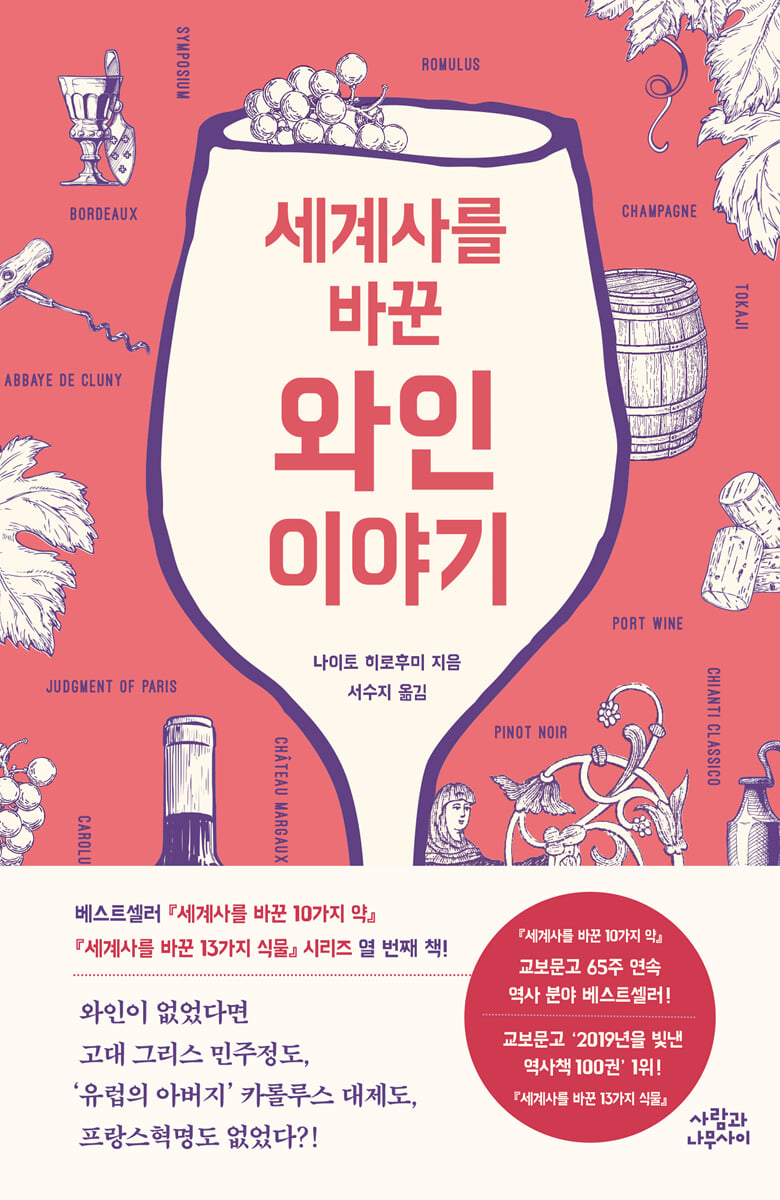
Wine, the "drink of the gods," intertwined with human desire, changed the course of world history.
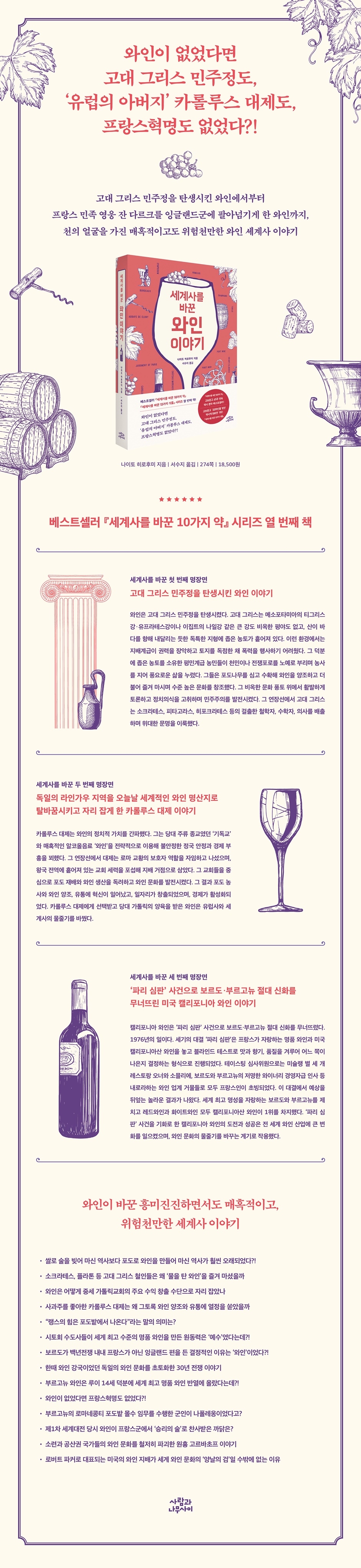
Wine gave birth to ancient Greek democracy.
Ancient Greece differed from Mesopotamia or Egypt in terms of the shape and topography of the land.
In this region, there are no large rivers such as the Tigris, Euphrates, or Nile, nor fertile plains, and narrow farmlands are scattered across a unique terrain where mountains seem to run down to the sea.
In this environment, it was difficult for the ruling class to exercise violence while monopolizing all power and land.
Thanks to this, commoners who owned small farmlands enjoyed a life of abundance by farming with the help of commoners and prisoners of war as slaves.
They planted vines, harvested them, brewed wine, enjoyed it, and created a high-quality culture.
In that fertile cultural climate, we actively debated, promoted political awareness, and developed democracy.
In that vein, ancient Greece created a great civilization by producing outstanding philosophers, mathematicians, and doctors such as Socrates, Pythagoras, and Hippocrates.
Charlemagne recognized the political value of wine.
He grew into a superpower, but strategically used Christianity, the mainstream religion, and the alluring alcoholic beverage wine to stabilize his unstable kingdom.
In this extension, the Great Emperor took on the role of protector of the Pope of Rome and united the church forces scattered throughout the kingdom to make it a base of rule.
They encouraged grape cultivation and wine production around these churches and developed a wine culture.
As a result, innovations in grape farming, winemaking, and distribution occurred, jobs were created, and the economy was revitalized.
Wine, chosen by Charlemagne and nurtured by the Catholics of the time, changed the course of European and world history.
This book is full of exciting stories about wine that clashed with human desires, caused chemical reactions, and changed the course of world history, such as 'Why Christianity in the ancient Roman Empire had to suffer a fatal blow from wine', 'Why Catholic monks in medieval Europe had to pour all their passion and effort into winemaking', 'Why Muhammad, who once loved wine, suddenly strictly prohibited wine and tried to eradicate wine culture', 'The story of the Burgundian army that captured the national hero Joan of Arc and handed it over to the English army because of wine', and 'The story of Gorbachev, the mastermind who completely destroyed the wine culture of the Soviet Union and communist countries'.
Wine gave birth to ancient Greek democracy.
Ancient Greece differed from Mesopotamia or Egypt in terms of the shape and topography of the land.
In this region, there are no large rivers such as the Tigris, Euphrates, or Nile, nor fertile plains, and narrow farmlands are scattered across a unique terrain where mountains seem to run down to the sea.
In this environment, it was difficult for the ruling class to exercise violence while monopolizing all power and land.
Thanks to this, commoners who owned small farmlands enjoyed a life of abundance by farming with the help of commoners and prisoners of war as slaves.
They planted vines, harvested them, brewed wine, enjoyed it, and created a high-quality culture.
In that fertile cultural climate, we actively debated, promoted political awareness, and developed democracy.
In that vein, ancient Greece created a great civilization by producing outstanding philosophers, mathematicians, and doctors such as Socrates, Pythagoras, and Hippocrates.
Charlemagne recognized the political value of wine.
He grew into a superpower, but strategically used Christianity, the mainstream religion, and the alluring alcoholic beverage wine to stabilize his unstable kingdom.
In this extension, the Great Emperor took on the role of protector of the Pope of Rome and united the church forces scattered throughout the kingdom to make it a base of rule.
They encouraged grape cultivation and wine production around these churches and developed a wine culture.
As a result, innovations in grape farming, winemaking, and distribution occurred, jobs were created, and the economy was revitalized.
Wine, chosen by Charlemagne and nurtured by the Catholics of the time, changed the course of European and world history.
This book is full of exciting stories about wine that clashed with human desires, caused chemical reactions, and changed the course of world history, such as 'Why Christianity in the ancient Roman Empire had to suffer a fatal blow from wine', 'Why Catholic monks in medieval Europe had to pour all their passion and effort into winemaking', 'Why Muhammad, who once loved wine, suddenly strictly prohibited wine and tried to eradicate wine culture', 'The story of the Burgundian army that captured the national hero Joan of Arc and handed it over to the English army because of wine', and 'The story of Gorbachev, the mastermind who completely destroyed the wine culture of the Soviet Union and communist countries'.
- You can preview some of the book's contents.
Preview
index
Editor's Preface: The story of how wine, the "drink of the gods," collided with human desires, creating a chemical reaction that changed world history.
① World History of Wine
Wine, the alcoholic beverage that fueled ancient Greek democracy
Is the history of making and drinking wine from grapes much older than the history of brewing and drinking alcohol from rice? | The significant reason why wine was used as a drink and tool symbolizing Judaism and Christianity | Why did ancient Greek philosophers such as Socrates and Plato enjoy drinking 'watered-down wine'? | Wine, the surprising alcoholic beverage that drove the democracy of ancient Greek city-states such as Athens | Why did Romulus, the founder of Rome, have to strictly prohibit wine? | The Romans learned how to store wine in oak barrels from the Gauls during their conquest of Gaul. | Was the process of Rome's territorial expansion also the process of expanding its wine culture? | Why did Catholic monks have to devote so much effort to winemaking? | Christianity in the Roman Empire, fatally hit by wine
② World History of Wine
Charlemagne of the Frankish Kingdom, who cleverly utilized wine in politics
The Great Migration and numerous wars that devastated the wine cultures of Germany and the Italian Peninsula | The secret reason why wine became the main means of generating income and strengthening the economy of the Catholic Church in the Middle Ages | Why did Charlemagne, the hegemon of Europe, devote all his energy to winemaking? | The two main characters who transformed Johannisberg in Germany's Rheingau into a famous wine region: Charlemagne and the Benedictine monks | The ultimate reason why Charlemagne, who loved cider, had no choice but to devote himself to grape cultivation and winemaking | The meaning of the saying, "The power of Rheims comes from its vineyards" | The Benedictine Abbey of Cluny, which used wine as a weapon to control the feudal lords of Burgundy and even exerted influence on the Vatican | The irony of history: the wine made by Cistercian monks, who advocated for being "poor natural men," became the origin of expensive and luxurious Burgundy wines | Was the driving force behind the creation of world-class luxury wines by Cistercian monks 'Jesus'?! | The Eberbach Abbey, under the patronage of the Holy Roman Emperor, transformed Germany into the world's largest wine-producing region. | Why did Muhammad, who once loved wine, suddenly impose a strict ban on it and try to eradicate wine culture?
③ World History of Wine
King John of England, who laid the foundation for Bordeaux, a famous wine region
The ironic history of how the incompetent King John of England laid the foundation for Bordeaux, a world-renowned wine region | The 'Bordeaux Privilege' granted by English kings for hundreds of years turned Bordeaux into a prestigious wine region | The butterfly effect of the Avignon Papacy caused by Philip IV put Bordeaux wine on a stronger foundation | The famous Burgundy wine that even captured the taste buds of a Bordeaux-born Pope | The desperate reason why the Burgundian monarchs hated the Gamay grape so much and tried to eradicate it | Why did Bordeaux side with England, not France, throughout the Hundred Years' War? | The decisive reason the Burgundian army captured Joan of Arc and handed her over to the English was 'wine'?! | The reason why grape farming and the wine industry flourished in 15th-century Western Europe was 'Jesus'?!
④ World History of Wine
The Thirty Years' War devastated the vineyards of Germany, a wine powerhouse.
The Thirty Years' War devastated Germany's vineyards, once a leading wine powerhouse. | How did Riesling signal the revival of German wine? | Haut-Brion, a Bordeaux wine known as "black wine," was born from fierce competition with chocolate and coffee, which were hugely popular at the time. | The Dutch, who transformed the once-gravelly, barren Médoc region into a world-renowned wine region. | Burgundy wine, now one of the world's finest, thanks to its special relationship with the Bourbon dynasty, including Louis XIV. | If it weren't for the British in the late 17th century, the Champagne market wouldn't exist as it is today. | Dom Pérignon, the synonym for Champagne. | Champagne, which instantly captivated the monarchs of emerging powers with its "low barrier to entry" and "thrilling stimulation." | The story of the battle of pride between the Duke of Conti and the Marquise de Pompadour over the Romanée-Conti vineyards. | Port, a Bordeaux substitute born amidst the fierce conflict between England and France. | Did the Muslim Ottoman Empire actually strictly prohibit wine? | If the Ottoman Empire had not invaded Hungary, the famous Hungarian wine Tokaj would not have been born?! | Tokaj wine once played a major role in leading the Hungarian army to victory in the war against the Habsburgs | The wine entrance tax that changed the paradigm of the French wine world in the 18th century
⑤ World History of Wine
The wine tax that sparked the French Revolution
Wine led the French Revolution?! | The soldier who carried out the mission to confiscate the Romanee-Conti vineyards in Burgundy was Napoleon? | Did Napoleon really love Chambertin? | Was Champagne Napoleon's favorite drink? | Talleyrand, the brilliant diplomat who saved France from a desperate crisis with the finest champagne as a weapon | Austrian Chancellor Metternich, the man who raised German wine to the level of world-class luxury.
⑥ World History of Wine
Napoleon III, who elevated French wine to the world's best
Author Victor Hugo's proposal to abolish the wine entrance tax passes parliament | Napoleon III's Bordeaux and Médoc wine classification system, far ahead of its time | Burgundy wines that failed to fully demonstrate their capabilities at the Paris World's Fair | The railroad construction project that completely changed the French wine landscape | Why did Italian wine, the origin of European wine, stagnate until the early 19th century? | Barolo wine from the Piedmont region, praised as the "king of wines, wine of kings" | Bettino Ricasoli, the prime minister of unified Italy who transformed the humble Chianti into the prestigious Chianti Classico | Europe intoxicated by Champagne during its golden age from the late 19th to early 20th centuries.
⑦ World History of Wine
California wines that shattered the myth of Bordeaux and Burgundy.
Wine, praised as the "drink of victory" by the French army during World War I, what was its impact in World War II? | Gorbachev, the man responsible for the complete destruction of wine culture in the Soviet Union and other communist countries | Wealthy American consumers who completely transformed global wine culture after World War II | The "Judgment of Paris," a historic event that shattered the "myth of absolute Bordeaux and Burgundy" with California wine | The United States, a rising wine powerhouse challenging the stronghold of premium Bordeaux and Burgundy wines with "varietal wines" | Why the American wine dominance, represented by Robert Parker, is a double-edged sword for global wine culture | The project to individualize Burgundy wines that began in the 1970s | Why the presence of Italian wine has grown since the late 1970s | Why the Plaza Accord was a decisive moment for the Japanese to become aware of luxury French wines | Japan's powerful influence on global wine culture with manga such as "The Sommelier" and "Drops of God" | The fascinating reason why Japan became the country that loved Beaujolais Nouveau the most | Where is the world of wine headed in the 21st century?
References
① World History of Wine
Wine, the alcoholic beverage that fueled ancient Greek democracy
Is the history of making and drinking wine from grapes much older than the history of brewing and drinking alcohol from rice? | The significant reason why wine was used as a drink and tool symbolizing Judaism and Christianity | Why did ancient Greek philosophers such as Socrates and Plato enjoy drinking 'watered-down wine'? | Wine, the surprising alcoholic beverage that drove the democracy of ancient Greek city-states such as Athens | Why did Romulus, the founder of Rome, have to strictly prohibit wine? | The Romans learned how to store wine in oak barrels from the Gauls during their conquest of Gaul. | Was the process of Rome's territorial expansion also the process of expanding its wine culture? | Why did Catholic monks have to devote so much effort to winemaking? | Christianity in the Roman Empire, fatally hit by wine
② World History of Wine
Charlemagne of the Frankish Kingdom, who cleverly utilized wine in politics
The Great Migration and numerous wars that devastated the wine cultures of Germany and the Italian Peninsula | The secret reason why wine became the main means of generating income and strengthening the economy of the Catholic Church in the Middle Ages | Why did Charlemagne, the hegemon of Europe, devote all his energy to winemaking? | The two main characters who transformed Johannisberg in Germany's Rheingau into a famous wine region: Charlemagne and the Benedictine monks | The ultimate reason why Charlemagne, who loved cider, had no choice but to devote himself to grape cultivation and winemaking | The meaning of the saying, "The power of Rheims comes from its vineyards" | The Benedictine Abbey of Cluny, which used wine as a weapon to control the feudal lords of Burgundy and even exerted influence on the Vatican | The irony of history: the wine made by Cistercian monks, who advocated for being "poor natural men," became the origin of expensive and luxurious Burgundy wines | Was the driving force behind the creation of world-class luxury wines by Cistercian monks 'Jesus'?! | The Eberbach Abbey, under the patronage of the Holy Roman Emperor, transformed Germany into the world's largest wine-producing region. | Why did Muhammad, who once loved wine, suddenly impose a strict ban on it and try to eradicate wine culture?
③ World History of Wine
King John of England, who laid the foundation for Bordeaux, a famous wine region
The ironic history of how the incompetent King John of England laid the foundation for Bordeaux, a world-renowned wine region | The 'Bordeaux Privilege' granted by English kings for hundreds of years turned Bordeaux into a prestigious wine region | The butterfly effect of the Avignon Papacy caused by Philip IV put Bordeaux wine on a stronger foundation | The famous Burgundy wine that even captured the taste buds of a Bordeaux-born Pope | The desperate reason why the Burgundian monarchs hated the Gamay grape so much and tried to eradicate it | Why did Bordeaux side with England, not France, throughout the Hundred Years' War? | The decisive reason the Burgundian army captured Joan of Arc and handed her over to the English was 'wine'?! | The reason why grape farming and the wine industry flourished in 15th-century Western Europe was 'Jesus'?!
④ World History of Wine
The Thirty Years' War devastated the vineyards of Germany, a wine powerhouse.
The Thirty Years' War devastated Germany's vineyards, once a leading wine powerhouse. | How did Riesling signal the revival of German wine? | Haut-Brion, a Bordeaux wine known as "black wine," was born from fierce competition with chocolate and coffee, which were hugely popular at the time. | The Dutch, who transformed the once-gravelly, barren Médoc region into a world-renowned wine region. | Burgundy wine, now one of the world's finest, thanks to its special relationship with the Bourbon dynasty, including Louis XIV. | If it weren't for the British in the late 17th century, the Champagne market wouldn't exist as it is today. | Dom Pérignon, the synonym for Champagne. | Champagne, which instantly captivated the monarchs of emerging powers with its "low barrier to entry" and "thrilling stimulation." | The story of the battle of pride between the Duke of Conti and the Marquise de Pompadour over the Romanée-Conti vineyards. | Port, a Bordeaux substitute born amidst the fierce conflict between England and France. | Did the Muslim Ottoman Empire actually strictly prohibit wine? | If the Ottoman Empire had not invaded Hungary, the famous Hungarian wine Tokaj would not have been born?! | Tokaj wine once played a major role in leading the Hungarian army to victory in the war against the Habsburgs | The wine entrance tax that changed the paradigm of the French wine world in the 18th century
⑤ World History of Wine
The wine tax that sparked the French Revolution
Wine led the French Revolution?! | The soldier who carried out the mission to confiscate the Romanee-Conti vineyards in Burgundy was Napoleon? | Did Napoleon really love Chambertin? | Was Champagne Napoleon's favorite drink? | Talleyrand, the brilliant diplomat who saved France from a desperate crisis with the finest champagne as a weapon | Austrian Chancellor Metternich, the man who raised German wine to the level of world-class luxury.
⑥ World History of Wine
Napoleon III, who elevated French wine to the world's best
Author Victor Hugo's proposal to abolish the wine entrance tax passes parliament | Napoleon III's Bordeaux and Médoc wine classification system, far ahead of its time | Burgundy wines that failed to fully demonstrate their capabilities at the Paris World's Fair | The railroad construction project that completely changed the French wine landscape | Why did Italian wine, the origin of European wine, stagnate until the early 19th century? | Barolo wine from the Piedmont region, praised as the "king of wines, wine of kings" | Bettino Ricasoli, the prime minister of unified Italy who transformed the humble Chianti into the prestigious Chianti Classico | Europe intoxicated by Champagne during its golden age from the late 19th to early 20th centuries.
⑦ World History of Wine
California wines that shattered the myth of Bordeaux and Burgundy.
Wine, praised as the "drink of victory" by the French army during World War I, what was its impact in World War II? | Gorbachev, the man responsible for the complete destruction of wine culture in the Soviet Union and other communist countries | Wealthy American consumers who completely transformed global wine culture after World War II | The "Judgment of Paris," a historic event that shattered the "myth of absolute Bordeaux and Burgundy" with California wine | The United States, a rising wine powerhouse challenging the stronghold of premium Bordeaux and Burgundy wines with "varietal wines" | Why the American wine dominance, represented by Robert Parker, is a double-edged sword for global wine culture | The project to individualize Burgundy wines that began in the 1970s | Why the presence of Italian wine has grown since the late 1970s | Why the Plaza Accord was a decisive moment for the Japanese to become aware of luxury French wines | Japan's powerful influence on global wine culture with manga such as "The Sommelier" and "Drops of God" | The fascinating reason why Japan became the country that loved Beaujolais Nouveau the most | Where is the world of wine headed in the 21st century?
References
Detailed image
Into the book
In ancient Greece, wine was not a drink reserved only for the ruling class, such as kings and nobles.
Commoners could also freely drink wine and enjoy wine culture.
Suddenly, a question arises.
'How did the ancient Greeks, regardless of social status, enjoy wine and develop a sophisticated wine culture?' Geography, namely the unique topography of ancient Greece, was a major factor.
Ancient Greece was significantly different from Mesopotamia or Egypt in terms of its geographical conditions.
This region not only lacked major rivers like the Tigris and Euphrates of ancient Mesopotamia or the Nile of Egypt, but also had few fertile plains.
Instead, the unique terrain of mountains running down to the sea, with narrow plains scattered here and there like the black dots of Dalmatia, made it difficult for the ruling class, such as kings and nobles, to monopolize the land and exercise violence while holding all power in their hands.
For this reason, in ancient Greece, the common class of farmers who owned narrow plains enjoyed a life of abundance by farming and enslaving the common people and prisoners of war.
It was the people of this wealthy peasant class who planted and harvested grapes, brewed wine, enjoyed it, and created and developed a wine culture.
Democracy developed in the ancient Greek polis, especially in Athens.
Because the geographic characteristics of the city made it difficult for an absolute monarch to exist, Athens was able to create an unprecedentedly great civilization, producing outstanding philosophers, mathematicians, and doctors such as Socrates, Plato, Pythagoras, and Hippocrates.
These great scholars of ancient Greece all loved wine.
In fact, it is said that the great philosophers Socrates and Plato loved and enjoyed drinking wine as much as anyone else.
Hippocrates, the 'father of medicine', also famous for the Hippocratic Oath, used wine as a medicine, categorizing it for various purposes such as reducing fever, disinfecting, diuresis, and recovering from fatigue.
--- From "Why did ancient Greek philosophers such as Socrates and Plato enjoy drinking 'wine mixed with water'?"
In addition, the Canaanite wedding feast story had a great influence on later wine production and manufacturing.
As we will see in more detail later, the ones who put the most effort into improving the quality of wine during the European Middle Ages were the Cistercians, a Catholic monastic order based in Burgundy, France.
Consider the example of Jesus at a Canaanite wedding feast, where he transformed water into wine so exquisite that all the guests were amazed.
If Jesus performed miracles and produced high-quality wine, then all who follow Jesus' will should also produce high-quality wine.
Therefore, those who believe in Jesus as the Son of God and follow him have no choice but to follow Jesus' example and make every effort to brew good wine.
In fact, this spirit later took root in the Cistercian monasteries, and the monks devoted all their energy, time, knowledge, and experience to improving the quality of their wine.
It is no exaggeration to say that the great vineyards of Burgundy, one of the world's greatest wine-producing regions today, were developed as an extension of the religious fervor of the Cistercian monasteries.
--- From "Why did Catholic monks have to devote so much effort to winemaking?"
Charlemagne, the defender of Christianity and the hegemon of Europe at the time, devoted all his efforts to winemaking within his kingdom while actively engaged in conquests.
He granted land to churches established throughout his kingdom and encouraged winemaking.
Charlemagne personally supervised and managed the winery, even giving detailed instructions on how to make wine.
They also banned the practice of crushing grapes by foot to extract the juice.
At the time, there were no grape presses, so many farmers did not follow this order. Therefore, his order could not be considered an unrealistic measure that was too ahead of its time.
However, his order was a groundbreaking measure that introduced the 'concept of hygiene' into winemaking and enabled wine to be reborn as a sacred drink.
He also banned the practice of storing wine in leather bottles for hygiene reasons.
Charlemagne also got involved in wine distribution.
He authorized wine producers to sell their wine directly to tourists.
Additionally, as part of measures to revitalize the wine industry, a regulation was established requiring wine producers to display tree branches as signs so that tourists can easily see that they are wine shops.
The Heurige tavern in Vienna, Austria, still hangs a pine branch above its sign to attract customers, indicating that it sells wine.
--- From "Why did Charlemagne, the European hegemon, devote all his efforts to wine brewing and distribution?"
Muslims destroyed the Sassanid Persian Empire (226-651), suppressed the Byzantine Empire, and established a vast Islamic empire.
But in the process, wine began to disappear from the Arabic-speaking world.
One question here is: did Muhammad initially dislike and harbor hostility toward wine? The answer is no.
According to scholars, Muhammad also tolerated wine in the early days of establishing the Islamic world.
But why did he go beyond hating and antagonizing wine to trying to eradicate it? Islam and Christianity share so many similarities that it wouldn't be an exaggeration to call them "brother religions."
This is because Islam was formed by absorbing the teachings of Judaism and Christianity.
Just as Christianity loved and valued wine, there was a time when Muhammad, the founder of Islam, also loved and valued wine.
The Islamic holy book, the Quran, contains a verse that says, “Among the fruits are the palm tree and the grapevine; from these we obtain drink and our daily bread; and in them are signs for the wise.”
Moreover, Muhammad actually socialized freely with believers and often had drinks with them.
Then one day, Muhammad's thoughts changed dramatically after experiencing an incident at a drinking party.
A drunken believer from Mecca and a believer from Medina (Yasrab) got into a fist fight in front of Muhammad.
Witnessing a friendly drinking party turn into chaos in an instant opened Muhammad's eyes to the potential harm of wine.
After that, Muhammad strictly forbade wine, saying, “Gambling, addiction, idolatry, and archery betting are blasphemous inventions of the devil, so forbid them.”
--- From "Why did Muhammad, who once loved wine, suddenly strictly prohibit wine and try to eradicate wine culture?"
Within England, King John suffered the humiliation of being forced to sign the Magna Carta by the nobles and citizens of London, who had endured it for as long as they could.
Historically, the Magna Carta became the foundation of British constitutional politics and world democracy, but for John, it was a humiliating event as it was a sign of his incompetence as a king.
The proverb, “A leaky bowl leaks outside too,” fortunately did not apply from the king’s perspective.
Because he bought large quantities of Gascony wine from France, the Bordeaux intermediary trade prospered day by day.
Thanks to King John's policies, Bordeaux's economy prospered, but ironically, he was losing territory within France to the French.
During his reign, the English territories in France were taken away one by one like dominoes by King Philip II of France, and as a result, only some territories, including Bordeaux in the Duchy of Aquitaine, remained.
To make matters worse, the Kingdom of Castile on the Iberian Peninsula attacked Bordeaux.
However, even in this desperate situation, Bordeaux pledged allegiance to King John of England and fought against the invasion of the Kingdom of Castile.
--- From "The ironic history of how the incompetent King John of England laid the foundation for Bordeaux, a world-renowned wine region"
The Duchy of Burgundy felt threatened by the rapid growth of Champagne.
The Burgundians were not pleased with the growing fame of Rheims and its surroundings.
It was already unpleasant that all the people's attention was focused on Rheims, but coincidentally, at that time, Charles VII was being crowned in Rheims, so all the attention of France was focused on him.
Even if the coronation of Charles VII was unavoidable, Joan of Arc must have been resentful of the situation that had led to this.
From the perspective of the Duchy of Burgundy, the liberation of Orléans by Joan of Arc was also uncomfortable and unsatisfactory.
Today, most of the vineyards in Orléans have disappeared, but in the Middle Ages, it was another famous wine region that competed fiercely with Burgundy.
Therefore, Joan of Arc's actions would have been seen as an attempt to enhance the reputation and strengthen the position of a powerful competitor to Burgundy wine.
Before Joan of Arc came along, Burgundy dominated wine sales.
However, when the situation at the time, which was going well, reached a point where it could be overturned in an instant due to Joan of Arc, it can be assumed that the Burgundian army handed Joan of Arc over to the English army as spoils of war, charging her with treason.
However, contrary to the intentions of the Duchy of Burgundy, the quality of wine in the Champagne region improved day by day, eventually growing to a level that threatened Burgundy wine.
Because of this, Burgundy's worries deepened.
--- From "The decisive reason the Burgundian army captured Joan of Arc and handed her over to the English army was because of 'wine'?!"
The Dutch who arrived in Bordeaux wanted to secure large quantities of relatively inexpensive wine.
It was out of this necessity that they began reclaiming the swamps of the Médoc region today.
The Dutch, who originally lived in low-lying areas frequently flooded by the sea, possessed the best technology to successfully reclaim the Médoc region.
Thanks to the Dutch's successful land reclamation projects, grape cultivation began in earnest in the Médoc region.
However, at first, the construction of mansions for nobles and merchants came before the cultivation of grapes.
The nobles and merchants of the Bordeaux region built their villas on the newly created land through reclamation projects.
A chateau is a grand mansion so large and majestic that it puts most castles built at that time to shame.
They created fields around their mansions and grew grapes to make wine for themselves and their families.
Of course, he put all his effort into producing a wine that was even a little bit more delicious, since it would end up in his mouth.
At the time, no one could have imagined that the gravelly soil of the Médoc region would become a 'golden land' producing some of the world's finest grapes and wines.
This land, with gravel depths reaching 3 meters, was truly blessed with excellent drainage and the gravel stored heat, acting as an insulator.
The Médoc region has made its mark on world wine history by producing top-quality wines, almost in direct contrast to the Dutch desire for inexpensive wines.
--- From "The Dutch, the protagonists who transformed the barren, gravelly Médoc region into a world-renowned wine region"
The 'Judgment of Paris', the showdown of the century, was held in the form of a blind taste test between France's famous wines and Californian wines, and then judges scored them to determine which was superior.
For reference, the English word for Paris and the name of the Trojan War hero 'Paris' in Greek mythology are spelled the same, so it was nicknamed 'The Judgement of Paris' as a pun.
In this competition, French red wines such as Château Mouton Rothschild and Château Haut-Brion from Bordeaux were served.
A prestigious Burgundy winery presented a white wine.
All the tasting judges were French.
They were all big names in the wine industry, including owners of three-star Michelin restaurants, sommeliers, and managers of renowned wineries in Bordeaux and Burgundy.
Interestingly, this match produced a surprising result that completely defied expectations.
California wines took first place in both red and white wines, beating out Bordeaux and Burgundy, which are renowned for their world-class reputations.
In other words, French judges who were well-versed in French wine gave higher scores to an unknown California wine that had little presence at the time than to their country's famous brand wines.
The triumph of California wine was also a triumph of the wine craze that was sweeping the United States at the time.
In the 1960s, when wine fever was heating up in the United States, wine lovers who were not satisfied with French wine alone began to grow grapes, establish wineries, and brew wine themselves.
Commoners could also freely drink wine and enjoy wine culture.
Suddenly, a question arises.
'How did the ancient Greeks, regardless of social status, enjoy wine and develop a sophisticated wine culture?' Geography, namely the unique topography of ancient Greece, was a major factor.
Ancient Greece was significantly different from Mesopotamia or Egypt in terms of its geographical conditions.
This region not only lacked major rivers like the Tigris and Euphrates of ancient Mesopotamia or the Nile of Egypt, but also had few fertile plains.
Instead, the unique terrain of mountains running down to the sea, with narrow plains scattered here and there like the black dots of Dalmatia, made it difficult for the ruling class, such as kings and nobles, to monopolize the land and exercise violence while holding all power in their hands.
For this reason, in ancient Greece, the common class of farmers who owned narrow plains enjoyed a life of abundance by farming and enslaving the common people and prisoners of war.
It was the people of this wealthy peasant class who planted and harvested grapes, brewed wine, enjoyed it, and created and developed a wine culture.
Democracy developed in the ancient Greek polis, especially in Athens.
Because the geographic characteristics of the city made it difficult for an absolute monarch to exist, Athens was able to create an unprecedentedly great civilization, producing outstanding philosophers, mathematicians, and doctors such as Socrates, Plato, Pythagoras, and Hippocrates.
These great scholars of ancient Greece all loved wine.
In fact, it is said that the great philosophers Socrates and Plato loved and enjoyed drinking wine as much as anyone else.
Hippocrates, the 'father of medicine', also famous for the Hippocratic Oath, used wine as a medicine, categorizing it for various purposes such as reducing fever, disinfecting, diuresis, and recovering from fatigue.
--- From "Why did ancient Greek philosophers such as Socrates and Plato enjoy drinking 'wine mixed with water'?"
In addition, the Canaanite wedding feast story had a great influence on later wine production and manufacturing.
As we will see in more detail later, the ones who put the most effort into improving the quality of wine during the European Middle Ages were the Cistercians, a Catholic monastic order based in Burgundy, France.
Consider the example of Jesus at a Canaanite wedding feast, where he transformed water into wine so exquisite that all the guests were amazed.
If Jesus performed miracles and produced high-quality wine, then all who follow Jesus' will should also produce high-quality wine.
Therefore, those who believe in Jesus as the Son of God and follow him have no choice but to follow Jesus' example and make every effort to brew good wine.
In fact, this spirit later took root in the Cistercian monasteries, and the monks devoted all their energy, time, knowledge, and experience to improving the quality of their wine.
It is no exaggeration to say that the great vineyards of Burgundy, one of the world's greatest wine-producing regions today, were developed as an extension of the religious fervor of the Cistercian monasteries.
--- From "Why did Catholic monks have to devote so much effort to winemaking?"
Charlemagne, the defender of Christianity and the hegemon of Europe at the time, devoted all his efforts to winemaking within his kingdom while actively engaged in conquests.
He granted land to churches established throughout his kingdom and encouraged winemaking.
Charlemagne personally supervised and managed the winery, even giving detailed instructions on how to make wine.
They also banned the practice of crushing grapes by foot to extract the juice.
At the time, there were no grape presses, so many farmers did not follow this order. Therefore, his order could not be considered an unrealistic measure that was too ahead of its time.
However, his order was a groundbreaking measure that introduced the 'concept of hygiene' into winemaking and enabled wine to be reborn as a sacred drink.
He also banned the practice of storing wine in leather bottles for hygiene reasons.
Charlemagne also got involved in wine distribution.
He authorized wine producers to sell their wine directly to tourists.
Additionally, as part of measures to revitalize the wine industry, a regulation was established requiring wine producers to display tree branches as signs so that tourists can easily see that they are wine shops.
The Heurige tavern in Vienna, Austria, still hangs a pine branch above its sign to attract customers, indicating that it sells wine.
--- From "Why did Charlemagne, the European hegemon, devote all his efforts to wine brewing and distribution?"
Muslims destroyed the Sassanid Persian Empire (226-651), suppressed the Byzantine Empire, and established a vast Islamic empire.
But in the process, wine began to disappear from the Arabic-speaking world.
One question here is: did Muhammad initially dislike and harbor hostility toward wine? The answer is no.
According to scholars, Muhammad also tolerated wine in the early days of establishing the Islamic world.
But why did he go beyond hating and antagonizing wine to trying to eradicate it? Islam and Christianity share so many similarities that it wouldn't be an exaggeration to call them "brother religions."
This is because Islam was formed by absorbing the teachings of Judaism and Christianity.
Just as Christianity loved and valued wine, there was a time when Muhammad, the founder of Islam, also loved and valued wine.
The Islamic holy book, the Quran, contains a verse that says, “Among the fruits are the palm tree and the grapevine; from these we obtain drink and our daily bread; and in them are signs for the wise.”
Moreover, Muhammad actually socialized freely with believers and often had drinks with them.
Then one day, Muhammad's thoughts changed dramatically after experiencing an incident at a drinking party.
A drunken believer from Mecca and a believer from Medina (Yasrab) got into a fist fight in front of Muhammad.
Witnessing a friendly drinking party turn into chaos in an instant opened Muhammad's eyes to the potential harm of wine.
After that, Muhammad strictly forbade wine, saying, “Gambling, addiction, idolatry, and archery betting are blasphemous inventions of the devil, so forbid them.”
--- From "Why did Muhammad, who once loved wine, suddenly strictly prohibit wine and try to eradicate wine culture?"
Within England, King John suffered the humiliation of being forced to sign the Magna Carta by the nobles and citizens of London, who had endured it for as long as they could.
Historically, the Magna Carta became the foundation of British constitutional politics and world democracy, but for John, it was a humiliating event as it was a sign of his incompetence as a king.
The proverb, “A leaky bowl leaks outside too,” fortunately did not apply from the king’s perspective.
Because he bought large quantities of Gascony wine from France, the Bordeaux intermediary trade prospered day by day.
Thanks to King John's policies, Bordeaux's economy prospered, but ironically, he was losing territory within France to the French.
During his reign, the English territories in France were taken away one by one like dominoes by King Philip II of France, and as a result, only some territories, including Bordeaux in the Duchy of Aquitaine, remained.
To make matters worse, the Kingdom of Castile on the Iberian Peninsula attacked Bordeaux.
However, even in this desperate situation, Bordeaux pledged allegiance to King John of England and fought against the invasion of the Kingdom of Castile.
--- From "The ironic history of how the incompetent King John of England laid the foundation for Bordeaux, a world-renowned wine region"
The Duchy of Burgundy felt threatened by the rapid growth of Champagne.
The Burgundians were not pleased with the growing fame of Rheims and its surroundings.
It was already unpleasant that all the people's attention was focused on Rheims, but coincidentally, at that time, Charles VII was being crowned in Rheims, so all the attention of France was focused on him.
Even if the coronation of Charles VII was unavoidable, Joan of Arc must have been resentful of the situation that had led to this.
From the perspective of the Duchy of Burgundy, the liberation of Orléans by Joan of Arc was also uncomfortable and unsatisfactory.
Today, most of the vineyards in Orléans have disappeared, but in the Middle Ages, it was another famous wine region that competed fiercely with Burgundy.
Therefore, Joan of Arc's actions would have been seen as an attempt to enhance the reputation and strengthen the position of a powerful competitor to Burgundy wine.
Before Joan of Arc came along, Burgundy dominated wine sales.
However, when the situation at the time, which was going well, reached a point where it could be overturned in an instant due to Joan of Arc, it can be assumed that the Burgundian army handed Joan of Arc over to the English army as spoils of war, charging her with treason.
However, contrary to the intentions of the Duchy of Burgundy, the quality of wine in the Champagne region improved day by day, eventually growing to a level that threatened Burgundy wine.
Because of this, Burgundy's worries deepened.
--- From "The decisive reason the Burgundian army captured Joan of Arc and handed her over to the English army was because of 'wine'?!"
The Dutch who arrived in Bordeaux wanted to secure large quantities of relatively inexpensive wine.
It was out of this necessity that they began reclaiming the swamps of the Médoc region today.
The Dutch, who originally lived in low-lying areas frequently flooded by the sea, possessed the best technology to successfully reclaim the Médoc region.
Thanks to the Dutch's successful land reclamation projects, grape cultivation began in earnest in the Médoc region.
However, at first, the construction of mansions for nobles and merchants came before the cultivation of grapes.
The nobles and merchants of the Bordeaux region built their villas on the newly created land through reclamation projects.
A chateau is a grand mansion so large and majestic that it puts most castles built at that time to shame.
They created fields around their mansions and grew grapes to make wine for themselves and their families.
Of course, he put all his effort into producing a wine that was even a little bit more delicious, since it would end up in his mouth.
At the time, no one could have imagined that the gravelly soil of the Médoc region would become a 'golden land' producing some of the world's finest grapes and wines.
This land, with gravel depths reaching 3 meters, was truly blessed with excellent drainage and the gravel stored heat, acting as an insulator.
The Médoc region has made its mark on world wine history by producing top-quality wines, almost in direct contrast to the Dutch desire for inexpensive wines.
--- From "The Dutch, the protagonists who transformed the barren, gravelly Médoc region into a world-renowned wine region"
The 'Judgment of Paris', the showdown of the century, was held in the form of a blind taste test between France's famous wines and Californian wines, and then judges scored them to determine which was superior.
For reference, the English word for Paris and the name of the Trojan War hero 'Paris' in Greek mythology are spelled the same, so it was nicknamed 'The Judgement of Paris' as a pun.
In this competition, French red wines such as Château Mouton Rothschild and Château Haut-Brion from Bordeaux were served.
A prestigious Burgundy winery presented a white wine.
All the tasting judges were French.
They were all big names in the wine industry, including owners of three-star Michelin restaurants, sommeliers, and managers of renowned wineries in Bordeaux and Burgundy.
Interestingly, this match produced a surprising result that completely defied expectations.
California wines took first place in both red and white wines, beating out Bordeaux and Burgundy, which are renowned for their world-class reputations.
In other words, French judges who were well-versed in French wine gave higher scores to an unknown California wine that had little presence at the time than to their country's famous brand wines.
The triumph of California wine was also a triumph of the wine craze that was sweeping the United States at the time.
In the 1960s, when wine fever was heating up in the United States, wine lovers who were not satisfied with French wine alone began to grow grapes, establish wineries, and brew wine themselves.
--- From "The Judgment of Paris: A Historical Event That Destroyed the 'Bordeaux-Burgundy Absolute Myth' by California Wine"
Publisher's Review
From wine, which gave birth to ancient Greek democracy, to national heroes
Even the wine that sold Joan of Arc to the English army
A fascinating and dangerous creature with a thousand faces
The Story of the World of Wine
The first famous scene that changed world history: The story of wine that gave birth to ancient Greek democracy.
If you say, 'Wine gave birth to ancient Greek democracy,' many people will wonder, 'Is that really true?'
But this is an obvious fact.
Let's look at the context in which this is so.
The inextricable connection between ancient Greek democracy and wine can be traced back to geography, the unique topography of the country(ies).
Ancient Greece was distinctly different from Mesopotamia or Egypt in terms of its land shape and topography.
In other words, this region had neither large rivers like the Tigris, Euphrates, or Nile, nor fertile plains. Instead, it had a unique terrain where mountains seemed to run down to the sea, with only sparsely scattered narrow farmlands that were too small to be called plains.
In this environment, it was difficult for the ruling class, such as kings and nobles, to exercise violence while monopolizing all power and land.
In this context, the common-class farmers of ancient Greece were able to enjoy a life of abundance by owning small plots of farmland and enslaving the common people and prisoners of war to farm.
And these affluent common peasants planted vineyards on their land, harvested them, brewed wine, and enjoyed drinking it together, creating a high-level culture. They also developed democracy through active debate and political awareness based on this fertile cultural climate.
Athens, representing the ancient Greek world, produced outstanding philosophers, mathematicians, and doctors such as Socrates, Plato, Pythagoras, and Hippocrates, and established a great civilization.
This is the first scene in the story of how wine changed world history.
ㆍThe second famous scene that changed world history─The Rheingau region of Germany is today a world-class
The story of Charlemagne, who transformed and established the region into a renowned wine region.
Today, Germany is known as a country of beer, not wine.
However, for hundreds of years, Germany had been a wine powerhouse on par with France and Italy until the Thirty Years' War in the first half of the 17th century (1618-1648, to be exact) devastated vineyards across Germany.
Despite these tremendous ups and downs, Germany still boasts the Rheingau, one of the world's greatest wine regions.
How did the Rheingau establish itself as a world-renowned wine region? It's a testament to the keen insight and foresight of Charlemagne, the great monarch known as the "Father of Europe."
It is said that the Rheingau, one of the world's most renowned wine regions today, had almost no vineyards until the time of Charlemagne.
One day, the Grand Duke, who was staying in Ingelheim on the banks of the Rhine River, was gazing at the foot of Mount Johannisberg in the Rheingau on the other side of the river.
At that moment, an unusual sight caught his eye.
It was early spring at the time, and I noticed that the foothills of Rheingau Johannisberg were getting more sunlight than other places and the snow was melting unusually quickly.
The emperor immediately recognized that the area was suitable for grape cultivation and wine production and ordered that vineyards be planted.
Although historical records vary slightly, it is difficult to deny that the Rheingau has become a world-renowned wine region thanks to the insight and efforts of Charlemagne.
Charlemagne, the Frankish monarch who is praised as the 'Father of Europe', holds a high position not only in world history but also in the history of wine.
Not only did he keenly perceive the political significance and value of wine, but he also devoted all his efforts to winemaking within his kingdom, in parallel with his active conquests.
The Great, also known as the 'Defender of Christianity', granted land to churches throughout the kingdom and encouraged winemaking.
Charlemagne's love of wine did not stop there.
He thoroughly managed and supervised the winery, even providing detailed instructions on how to make wine.
He also got involved in distribution, including allowing wine producers to sell their wine directly to tourists.
In that vein, he enacted laws and established regulations to promote grape farming and winemaking.
Why did Charlemagne devote so much energy to grape cultivation, winemaking, and distribution? During his reign, he grew a vast empire, but he strategically leveraged wine, along with Christianity, to stabilize a deeply unstable political situation.
He cleverly combined Christianity, the dominant religion in Europe at the time, with the fascinating alcoholic beverage wine.
In this context, he assumed the role of protector of the Pope of Rome and united the church forces scattered throughout the kingdom into a stronghold of domination.
He encouraged grape cultivation and wine production around those churches and made a breakthrough in the wine industry.
During this process, vineyard development began in earnest, and innovations occurred in grape farming, winemaking, and distribution.
As a result, many jobs were created and the economy was revitalized.
Charlemagne also sought a secondary effect through his policy of revitalizing the wine industry through the use of the church.
It was a task to transform the rough and unruly Germanic people into a gentler people by adapting them to grape farming and wine production.
Charlemagne viewed wine not as a mere commodity, but as a vital commodity closely linked to the survival and prosperity of his entire kingdom, the "blood" that flowed through the arteries of the economy. He laid the solid foundation for today's splendid European wine world.
This is the second famous scene in world history that wine changed.
ㆍThe third famous scene that changed world history─Recognized as the world's best wine producing region
The story of the three main characters who created the Bordeaux myth
How did the myth of Bordeaux, recognized as one of the world's greatest wine regions alongside Burgundy and Champagne, come about? Over centuries of history, three parties have shaped and developed the Bordeaux wine myth.
The first subjects are several English kings, including King John, who is considered one of the worst monarchs in English history.
Henry II of England, through his marriage to Eleanor of d'Aquitaine, was fortunate to have the Duchy of Aquitaine in southwestern France, encompassing the Bordeaux region, as his territory.
The relationship between Bordeaux and the English royal family became even stronger during the reign of Richard I, son of Henry II and widely known as the 'Lionhearted King', and his younger brother, King John.
He had a bad reputation because he committed many misdeeds during his reign, including losing a significant portion of English territory in France to King Philip II of France.
But from Bordeaux's point of view, at least, the adage "a leaky bucket leaks outside" did not apply to King John.
King John not only prospered Bordeaux's transit trade by purchasing large quantities of Gascon wine from the Duchy of Aquitaine, but also prospered the Bordeaux economy thanks to his special wine policy.
The friendly cooperative relationship between Bordeaux and England continued steadily, and Bordeaux wines laid the foundation for emerging as a new powerhouse in the global market.
Bordeaux maintained a honeymoon with England and dreamed of a bright future, a dream realized by the 'Bordeaux Privilege', a benefit granted to Bordeaux by several English kings since King John in return for loyalty and devotion.
Bordeaux wines enjoyed enormous tax benefits under the 'Bordeaux Privilege', but the tax exemption wasn't the only benefit.
This is because the 'Bordeaux privilege' came with a clause guaranteeing that Bordeaux wines would be released before those from other regions.
This gave wines produced in the Bordeaux region a strong competitive edge.
This scene became an important turning point in establishing Bordeaux as a world-renowned wine producing region in the distant future.
The second group that gave birth to the Bordeaux wine myth were the Dutch, who in the 16th century contributed greatly to transforming the Médoc region, which was a swampy area with few vineyards and mostly submerged by the sea, into an attractive vineyard.
The Netherlands, which won independence after a war of independence against the tyranny of Spain, the most powerful country at the time, established the East India Company to pursue maritime expansion, and in the process discovered the attractive commodity of wine.
It was in this context that they, who possessed the best reclamation technology of their time, moved to the Bordeaux region of France and promoted the reclamation project in the Médoc region.
That is, the purpose was to secure large quantities of wine at low prices to sell to people in Europe and other countries across the sea.
The third person who gave birth to Bordeaux wine was Napoleon III.
He can be considered a man with 'two faces': one is that of an 'incompetent dictator', and the other is that of an 'excellent marketing expert' who raised French wine, especially Bordeaux wine, to the ranks of the best in the world.
He hosted the Paris World's Fair, transforming the city into the splendid and attractive city it is today.
It was 1858.
It was a stage to showcase the highly developed French industry of the time to the world and to increase product awareness and sales of French agricultural products.
At that time, Bordeaux wine was selected as one of the products to be exhibited at the Paris World's Fair, and to promote sales, Napoleon III implemented the 'Médoc Region Classification System'.
Thanks to the hard work and dedication of many people over hundreds of years, Bordeaux has established itself as one of the world's leading wine producing regions, alongside Burgundy and Champagne.
These are the third famous scenes in world history that wine changed.
The Fourth Famous Scene That Changed World History: The "Judgment of Paris" Incident, Bordeaux and Burgundy
The Story of California Wine That Shattered Absolute Myths
California wines in the US shattered the myth of Bordeaux and Burgundy absolutes with the 'Judgment of Paris'.
Entering the 1960s, the United States emerged as the world's largest wine consumer and took steps to become a leading wine producer.
Then, the 'Paris Judgment' occurred, forcing everyone to recognize the United States as a wine powerhouse on par with France.
It was 1976.
The 'Paris Judgment' was the match of the century.
This was conducted in the form of a blind taste test between France's famous wines and Californian wines to determine which one was better by comparing taste, aroma, and quality.
In this competition, French red wines such as Château Mouton Rothschild and Château Haut-Brion from Bordeaux were served.
A prestigious Burgundy winery presented a white wine.
All the tasting judges were French.
They were big names in the wine industry, including owners of three-star Michelin restaurants, sommeliers, and managers of renowned wineries in Bordeaux and Burgundy.
Interestingly, this match produced an unexpected result.
California wines took first place in both red and white wines, beating out Bordeaux and Burgundy, which are renowned for their world-class reputations.
Surprisingly, the French judges, who were well-versed in French wines, gave higher scores to the then-unknown California wine than to the prestigious brand wines of their own country.
California wine has strengthened its position with producers such as the genius winemaker Robert Mondavi at the forefront.
The changes and innovations they brought about dealt a fatal blow to French wine, which had been complacent and neglected efforts to develop itself, relying solely on its high recognition and reputation.
Along with this, a tectonic shift occurred in the global wine industry.
The challenge and success of California wine, sparked by the 'Paris Judgment' incident, brought about a major change in the global wine industry and served as a catalyst for changing the course of wine culture.
This can be said to be the fourth famous scene that changed the history of wine.
ㆍThe tenth book in the bestselling series, “10 Medicines That Changed World History” and “13 Plants That Changed World History”!
Wine, the "drink of the gods," intertwined with human desire, changed the course of world history.
Kyobo Bookstore's bestseller in the history category for 65 consecutive weeks (『10 Medicines That Changed World History』), No. 1 in Kyobo Bookstore's '100 History Books that Shined in 2019' (『13 Plants That Changed World History』), 2021 Education Office Student Education and Culture Center Recommended Book (『37 Stories of Fish That Changed World History』), Happy Morning Reading Recommended Book (『10 Medicines That Changed World History』『13 Plants That Changed World History』『37 Stories of Fish That Changed World History』『10 Infectious Diseases That Changed World History』『Stories of Chemistry That Changed World History - From the Birth of the Universe to the Industrial Revolution』), School Library Journal Recommended Book (『13 Plants That Changed World History』『37 Stories of Fish That Changed World History』), Book Morning Book for Kyobo Bookstore CEO (『13 Plants That Changed World History』『37 Stories of Fish That Changed World History』『10 Infectious Diseases That Changed World History』『Stories of Coffee That Changed World History』『 A series that has 'changed world history' and has been consistently sold as a bestseller and steady seller in major online and offline bookstores, including 'Chemistry Story - From the Birth of the Universe to the Industrial Revolution', and has been recognized for its content and value.
The tenth book in this series has been published by People and Trees Publishing.
“The Story of Wine That Changed World History” is that book.
『The Story of Wine That Changed World History』 asks questions like, 'The history of brewing and drinking wine from grapes is much older than the history of brewing and drinking alcohol from rice?!', 'Why did wine become a beverage that symbolizes Judaism and Christianity?', 'Why did ancient Greek philosophers such as Socrates and Plato enjoy drinking wine mixed with water?', 'Why did Romulus, the founder of Rome, have to strictly prohibit wine?', 'Why did Catholic monks devote so much effort to winemaking?', 'Wine dealt a fatal blow to Christianity in the ancient Roman Empire?!', 'What does it mean that “the power of Rheims comes from the vineyards”?', 'The driving force behind the Cistercian monks creating the world’s best wine was Jesus?!', 'Why did Muhammad, who once loved wine, suddenly strictly prohibit wine and try to eradicate wine culture?', 'The decisive reason the Burgundian army captured Joan of Arc and handed her over to the English army was because of ‘wine’?!', It is full of interesting and informative stories about wine, such as, 'It is said that Burgundy wine rose to the ranks of the world's best luxury wines thanks to Louis XIV?!' and 'Why did the Marquise de Pompadour have to engage in a battle of pride with the Duke of Conti over the Romanee-Conti vineyards?'
This book is also full of exciting wine stories that changed the course of world history, such as 'the story of Tokaji wine, which once played a great role in leading the Hungarian army to victory in the war against the Habsburg army', 'the story of the wine entrance tax that changed the paradigm of the 18th century French wine world', 'the story of Austrian Chancellor Metternich, who raised German wine to the level of world-class luxury goods', 'the story of Gorbachev, the mastermind who completely destroyed the wine culture of the Soviet Union and communist countries', 'the story of wealthy American consumers who completely changed the wine culture after World War II', and 'the story of Robert Parker, the unparalleled wine critic who solidified America's wine dominance by boldly introducing a scoring system'.
As you slowly savor a glass of wine and read this book, you will be captivated by the fascinating story of human history, where wine, the "drink of the gods," collided with human desires, creating a chemical reaction that changed the course of the waters.
Even the wine that sold Joan of Arc to the English army
A fascinating and dangerous creature with a thousand faces
The Story of the World of Wine
The first famous scene that changed world history: The story of wine that gave birth to ancient Greek democracy.
If you say, 'Wine gave birth to ancient Greek democracy,' many people will wonder, 'Is that really true?'
But this is an obvious fact.
Let's look at the context in which this is so.
The inextricable connection between ancient Greek democracy and wine can be traced back to geography, the unique topography of the country(ies).
Ancient Greece was distinctly different from Mesopotamia or Egypt in terms of its land shape and topography.
In other words, this region had neither large rivers like the Tigris, Euphrates, or Nile, nor fertile plains. Instead, it had a unique terrain where mountains seemed to run down to the sea, with only sparsely scattered narrow farmlands that were too small to be called plains.
In this environment, it was difficult for the ruling class, such as kings and nobles, to exercise violence while monopolizing all power and land.
In this context, the common-class farmers of ancient Greece were able to enjoy a life of abundance by owning small plots of farmland and enslaving the common people and prisoners of war to farm.
And these affluent common peasants planted vineyards on their land, harvested them, brewed wine, and enjoyed drinking it together, creating a high-level culture. They also developed democracy through active debate and political awareness based on this fertile cultural climate.
Athens, representing the ancient Greek world, produced outstanding philosophers, mathematicians, and doctors such as Socrates, Plato, Pythagoras, and Hippocrates, and established a great civilization.
This is the first scene in the story of how wine changed world history.
ㆍThe second famous scene that changed world history─The Rheingau region of Germany is today a world-class
The story of Charlemagne, who transformed and established the region into a renowned wine region.
Today, Germany is known as a country of beer, not wine.
However, for hundreds of years, Germany had been a wine powerhouse on par with France and Italy until the Thirty Years' War in the first half of the 17th century (1618-1648, to be exact) devastated vineyards across Germany.
Despite these tremendous ups and downs, Germany still boasts the Rheingau, one of the world's greatest wine regions.
How did the Rheingau establish itself as a world-renowned wine region? It's a testament to the keen insight and foresight of Charlemagne, the great monarch known as the "Father of Europe."
It is said that the Rheingau, one of the world's most renowned wine regions today, had almost no vineyards until the time of Charlemagne.
One day, the Grand Duke, who was staying in Ingelheim on the banks of the Rhine River, was gazing at the foot of Mount Johannisberg in the Rheingau on the other side of the river.
At that moment, an unusual sight caught his eye.
It was early spring at the time, and I noticed that the foothills of Rheingau Johannisberg were getting more sunlight than other places and the snow was melting unusually quickly.
The emperor immediately recognized that the area was suitable for grape cultivation and wine production and ordered that vineyards be planted.
Although historical records vary slightly, it is difficult to deny that the Rheingau has become a world-renowned wine region thanks to the insight and efforts of Charlemagne.
Charlemagne, the Frankish monarch who is praised as the 'Father of Europe', holds a high position not only in world history but also in the history of wine.
Not only did he keenly perceive the political significance and value of wine, but he also devoted all his efforts to winemaking within his kingdom, in parallel with his active conquests.
The Great, also known as the 'Defender of Christianity', granted land to churches throughout the kingdom and encouraged winemaking.
Charlemagne's love of wine did not stop there.
He thoroughly managed and supervised the winery, even providing detailed instructions on how to make wine.
He also got involved in distribution, including allowing wine producers to sell their wine directly to tourists.
In that vein, he enacted laws and established regulations to promote grape farming and winemaking.
Why did Charlemagne devote so much energy to grape cultivation, winemaking, and distribution? During his reign, he grew a vast empire, but he strategically leveraged wine, along with Christianity, to stabilize a deeply unstable political situation.
He cleverly combined Christianity, the dominant religion in Europe at the time, with the fascinating alcoholic beverage wine.
In this context, he assumed the role of protector of the Pope of Rome and united the church forces scattered throughout the kingdom into a stronghold of domination.
He encouraged grape cultivation and wine production around those churches and made a breakthrough in the wine industry.
During this process, vineyard development began in earnest, and innovations occurred in grape farming, winemaking, and distribution.
As a result, many jobs were created and the economy was revitalized.
Charlemagne also sought a secondary effect through his policy of revitalizing the wine industry through the use of the church.
It was a task to transform the rough and unruly Germanic people into a gentler people by adapting them to grape farming and wine production.
Charlemagne viewed wine not as a mere commodity, but as a vital commodity closely linked to the survival and prosperity of his entire kingdom, the "blood" that flowed through the arteries of the economy. He laid the solid foundation for today's splendid European wine world.
This is the second famous scene in world history that wine changed.
ㆍThe third famous scene that changed world history─Recognized as the world's best wine producing region
The story of the three main characters who created the Bordeaux myth
How did the myth of Bordeaux, recognized as one of the world's greatest wine regions alongside Burgundy and Champagne, come about? Over centuries of history, three parties have shaped and developed the Bordeaux wine myth.
The first subjects are several English kings, including King John, who is considered one of the worst monarchs in English history.
Henry II of England, through his marriage to Eleanor of d'Aquitaine, was fortunate to have the Duchy of Aquitaine in southwestern France, encompassing the Bordeaux region, as his territory.
The relationship between Bordeaux and the English royal family became even stronger during the reign of Richard I, son of Henry II and widely known as the 'Lionhearted King', and his younger brother, King John.
He had a bad reputation because he committed many misdeeds during his reign, including losing a significant portion of English territory in France to King Philip II of France.
But from Bordeaux's point of view, at least, the adage "a leaky bucket leaks outside" did not apply to King John.
King John not only prospered Bordeaux's transit trade by purchasing large quantities of Gascon wine from the Duchy of Aquitaine, but also prospered the Bordeaux economy thanks to his special wine policy.
The friendly cooperative relationship between Bordeaux and England continued steadily, and Bordeaux wines laid the foundation for emerging as a new powerhouse in the global market.
Bordeaux maintained a honeymoon with England and dreamed of a bright future, a dream realized by the 'Bordeaux Privilege', a benefit granted to Bordeaux by several English kings since King John in return for loyalty and devotion.
Bordeaux wines enjoyed enormous tax benefits under the 'Bordeaux Privilege', but the tax exemption wasn't the only benefit.
This is because the 'Bordeaux privilege' came with a clause guaranteeing that Bordeaux wines would be released before those from other regions.
This gave wines produced in the Bordeaux region a strong competitive edge.
This scene became an important turning point in establishing Bordeaux as a world-renowned wine producing region in the distant future.
The second group that gave birth to the Bordeaux wine myth were the Dutch, who in the 16th century contributed greatly to transforming the Médoc region, which was a swampy area with few vineyards and mostly submerged by the sea, into an attractive vineyard.
The Netherlands, which won independence after a war of independence against the tyranny of Spain, the most powerful country at the time, established the East India Company to pursue maritime expansion, and in the process discovered the attractive commodity of wine.
It was in this context that they, who possessed the best reclamation technology of their time, moved to the Bordeaux region of France and promoted the reclamation project in the Médoc region.
That is, the purpose was to secure large quantities of wine at low prices to sell to people in Europe and other countries across the sea.
The third person who gave birth to Bordeaux wine was Napoleon III.
He can be considered a man with 'two faces': one is that of an 'incompetent dictator', and the other is that of an 'excellent marketing expert' who raised French wine, especially Bordeaux wine, to the ranks of the best in the world.
He hosted the Paris World's Fair, transforming the city into the splendid and attractive city it is today.
It was 1858.
It was a stage to showcase the highly developed French industry of the time to the world and to increase product awareness and sales of French agricultural products.
At that time, Bordeaux wine was selected as one of the products to be exhibited at the Paris World's Fair, and to promote sales, Napoleon III implemented the 'Médoc Region Classification System'.
Thanks to the hard work and dedication of many people over hundreds of years, Bordeaux has established itself as one of the world's leading wine producing regions, alongside Burgundy and Champagne.
These are the third famous scenes in world history that wine changed.
The Fourth Famous Scene That Changed World History: The "Judgment of Paris" Incident, Bordeaux and Burgundy
The Story of California Wine That Shattered Absolute Myths
California wines in the US shattered the myth of Bordeaux and Burgundy absolutes with the 'Judgment of Paris'.
Entering the 1960s, the United States emerged as the world's largest wine consumer and took steps to become a leading wine producer.
Then, the 'Paris Judgment' occurred, forcing everyone to recognize the United States as a wine powerhouse on par with France.
It was 1976.
The 'Paris Judgment' was the match of the century.
This was conducted in the form of a blind taste test between France's famous wines and Californian wines to determine which one was better by comparing taste, aroma, and quality.
In this competition, French red wines such as Château Mouton Rothschild and Château Haut-Brion from Bordeaux were served.
A prestigious Burgundy winery presented a white wine.
All the tasting judges were French.
They were big names in the wine industry, including owners of three-star Michelin restaurants, sommeliers, and managers of renowned wineries in Bordeaux and Burgundy.
Interestingly, this match produced an unexpected result.
California wines took first place in both red and white wines, beating out Bordeaux and Burgundy, which are renowned for their world-class reputations.
Surprisingly, the French judges, who were well-versed in French wines, gave higher scores to the then-unknown California wine than to the prestigious brand wines of their own country.
California wine has strengthened its position with producers such as the genius winemaker Robert Mondavi at the forefront.
The changes and innovations they brought about dealt a fatal blow to French wine, which had been complacent and neglected efforts to develop itself, relying solely on its high recognition and reputation.
Along with this, a tectonic shift occurred in the global wine industry.
The challenge and success of California wine, sparked by the 'Paris Judgment' incident, brought about a major change in the global wine industry and served as a catalyst for changing the course of wine culture.
This can be said to be the fourth famous scene that changed the history of wine.
ㆍThe tenth book in the bestselling series, “10 Medicines That Changed World History” and “13 Plants That Changed World History”!
Wine, the "drink of the gods," intertwined with human desire, changed the course of world history.
Kyobo Bookstore's bestseller in the history category for 65 consecutive weeks (『10 Medicines That Changed World History』), No. 1 in Kyobo Bookstore's '100 History Books that Shined in 2019' (『13 Plants That Changed World History』), 2021 Education Office Student Education and Culture Center Recommended Book (『37 Stories of Fish That Changed World History』), Happy Morning Reading Recommended Book (『10 Medicines That Changed World History』『13 Plants That Changed World History』『37 Stories of Fish That Changed World History』『10 Infectious Diseases That Changed World History』『Stories of Chemistry That Changed World History - From the Birth of the Universe to the Industrial Revolution』), School Library Journal Recommended Book (『13 Plants That Changed World History』『37 Stories of Fish That Changed World History』), Book Morning Book for Kyobo Bookstore CEO (『13 Plants That Changed World History』『37 Stories of Fish That Changed World History』『10 Infectious Diseases That Changed World History』『Stories of Coffee That Changed World History』『 A series that has 'changed world history' and has been consistently sold as a bestseller and steady seller in major online and offline bookstores, including 'Chemistry Story - From the Birth of the Universe to the Industrial Revolution', and has been recognized for its content and value.
The tenth book in this series has been published by People and Trees Publishing.
“The Story of Wine That Changed World History” is that book.
『The Story of Wine That Changed World History』 asks questions like, 'The history of brewing and drinking wine from grapes is much older than the history of brewing and drinking alcohol from rice?!', 'Why did wine become a beverage that symbolizes Judaism and Christianity?', 'Why did ancient Greek philosophers such as Socrates and Plato enjoy drinking wine mixed with water?', 'Why did Romulus, the founder of Rome, have to strictly prohibit wine?', 'Why did Catholic monks devote so much effort to winemaking?', 'Wine dealt a fatal blow to Christianity in the ancient Roman Empire?!', 'What does it mean that “the power of Rheims comes from the vineyards”?', 'The driving force behind the Cistercian monks creating the world’s best wine was Jesus?!', 'Why did Muhammad, who once loved wine, suddenly strictly prohibit wine and try to eradicate wine culture?', 'The decisive reason the Burgundian army captured Joan of Arc and handed her over to the English army was because of ‘wine’?!', It is full of interesting and informative stories about wine, such as, 'It is said that Burgundy wine rose to the ranks of the world's best luxury wines thanks to Louis XIV?!' and 'Why did the Marquise de Pompadour have to engage in a battle of pride with the Duke of Conti over the Romanee-Conti vineyards?'
This book is also full of exciting wine stories that changed the course of world history, such as 'the story of Tokaji wine, which once played a great role in leading the Hungarian army to victory in the war against the Habsburg army', 'the story of the wine entrance tax that changed the paradigm of the 18th century French wine world', 'the story of Austrian Chancellor Metternich, who raised German wine to the level of world-class luxury goods', 'the story of Gorbachev, the mastermind who completely destroyed the wine culture of the Soviet Union and communist countries', 'the story of wealthy American consumers who completely changed the wine culture after World War II', and 'the story of Robert Parker, the unparalleled wine critic who solidified America's wine dominance by boldly introducing a scoring system'.
As you slowly savor a glass of wine and read this book, you will be captivated by the fascinating story of human history, where wine, the "drink of the gods," collided with human desires, creating a chemical reaction that changed the course of the waters.
GOODS SPECIFICS
- Date of issue: June 17, 2025
- Page count, weight, size: 274 pages | 454g | 141*215*22mm
- ISBN13: 9791194096153
- ISBN10: 1194096158
You may also like
카테고리
korean


korean

![GQ KOREA Mark (Monthly): December [2025]](http://librairie.coreenne.fr/cdn/shop/files/8ef265dbbfbf186523ed75ba7319009d.jpg?v=1765340328&width=3840)


