

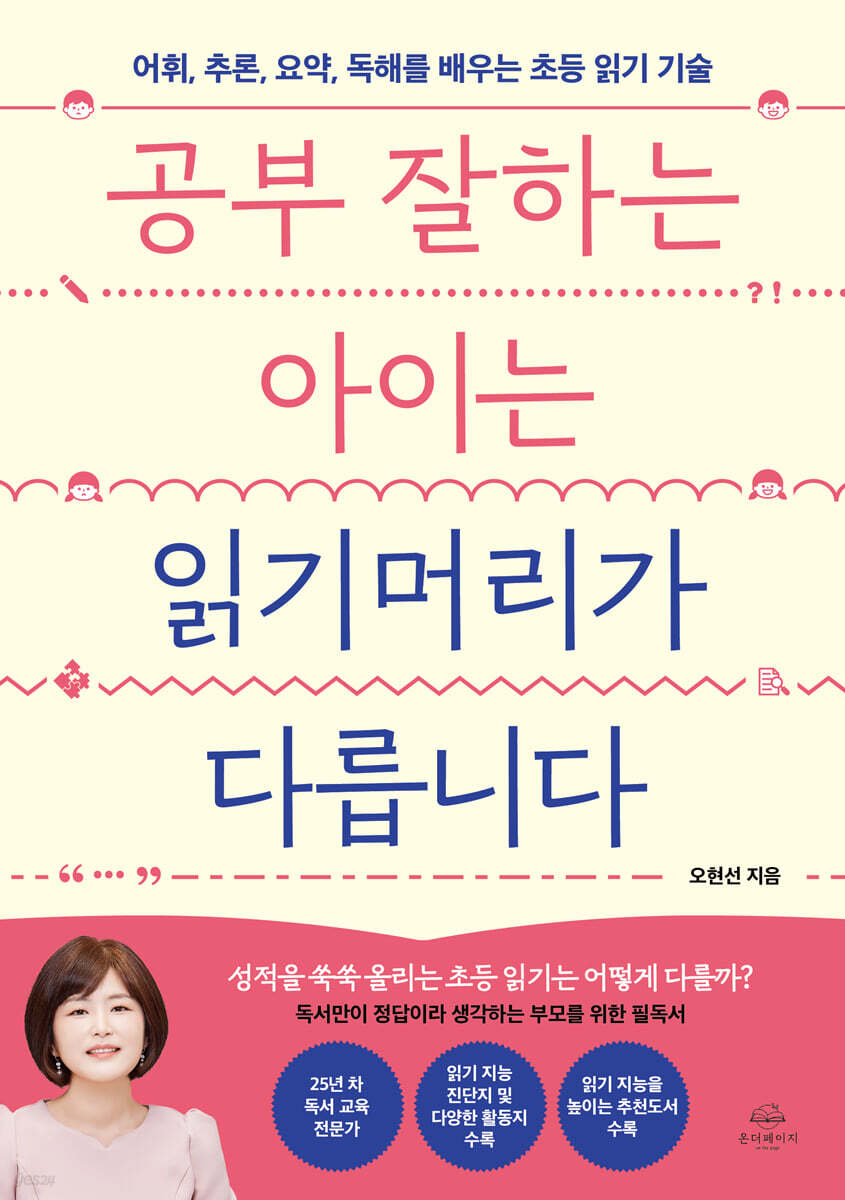
Children who are good at studying have different reading skills.
 |
Description
Book Introduction
Children who read well also study well!
Seize the golden time for reading intelligence, which determines middle and high school grades!
A new book has been published by author Oh Hyeon-seon, who has been dedicated to reading education for 25 years while meeting children in the reading education field.
The author, who has experienced life-changing changes through reading and writing and has dedicated a long time to researching, developing, and teaching reading methods, emphasizes in this book that proper reading is more important than the act of reading, and introduces reading education strategies for each child type and reading medium.
The author says that each child has different reading abilities due to differences in their innate 'reading intelligence'.
Reading intelligence is a concept introduced by the author for reading education. It refers to the ability to read well, or more specifically, the ability to understand unfamiliar texts. Reading intelligence varies from child to child.
So, even if they read the same book, each child's level of understanding is different, and not all children who like books are good readers.
Many parents say they understand the importance of reading, but the reality is that they focus more on English and math studies because they don't have time.
In order to accurately understand textbooks and various learning materials, one must first develop reading intelligence to read and understand properly, but this is overlooked.
Moreover, they do not recognize that each child has a different innate reading intelligence and simply force their children to read only the recommended books for their grade level.
What's more important than 'what' you read is how 'immersed' you are in it.
The author emphasizes that immersive reading is the essence of improving reading intelligence and that it can only be done at home, and that if a child does not develop reading intelligence in elementary school, he or she will have difficulty achieving academically and growing into a confident member of society.
I hope that you will master the various reading education strategies for each child type and medium introduced in this book so that you do not miss the golden time for your child's reading intelligence.
Seize the golden time for reading intelligence, which determines middle and high school grades!
A new book has been published by author Oh Hyeon-seon, who has been dedicated to reading education for 25 years while meeting children in the reading education field.
The author, who has experienced life-changing changes through reading and writing and has dedicated a long time to researching, developing, and teaching reading methods, emphasizes in this book that proper reading is more important than the act of reading, and introduces reading education strategies for each child type and reading medium.
The author says that each child has different reading abilities due to differences in their innate 'reading intelligence'.
Reading intelligence is a concept introduced by the author for reading education. It refers to the ability to read well, or more specifically, the ability to understand unfamiliar texts. Reading intelligence varies from child to child.
So, even if they read the same book, each child's level of understanding is different, and not all children who like books are good readers.
Many parents say they understand the importance of reading, but the reality is that they focus more on English and math studies because they don't have time.
In order to accurately understand textbooks and various learning materials, one must first develop reading intelligence to read and understand properly, but this is overlooked.
Moreover, they do not recognize that each child has a different innate reading intelligence and simply force their children to read only the recommended books for their grade level.
What's more important than 'what' you read is how 'immersed' you are in it.
The author emphasizes that immersive reading is the essence of improving reading intelligence and that it can only be done at home, and that if a child does not develop reading intelligence in elementary school, he or she will have difficulty achieving academically and growing into a confident member of society.
I hope that you will master the various reading education strategies for each child type and medium introduced in this book so that you do not miss the golden time for your child's reading intelligence.
- You can preview some of the book's contents.
Preview
index
Introduction_Please raise your child to be a good reader.
PART 1.
Now is the time to develop reading intelligence
There's a difference between liking books and being a good reader.
What is reading intelligence and why is it needed?
Reading, the center of controversy: Is it really necessary?
Will increasing reading intelligence improve grades?
Byulpyeon_Simple Reading Intelligence Assessment by Grade
PART 2.
Reading skills to increase reading intelligence
Hidden points for improving vocabulary
Elementary Vocabulary Improvement Strategies
How to read non-fiction?
How to read literary texts?
Everyday conversation techniques to develop reasoning skills
How to Develop Reasoning Skills Through Narrative Writing
How to Develop Reasoning Skills with Proverbs
How to Develop Reasoning Skills Using Idioms
Completing the development of reasoning skills: reading poetry
Separate Page_Non-literature and Literature Reading Intelligence Activities
PART 3.
Reading Strategies to Increase Reading Intelligence
Immersive reading is crucial for improving reading comprehension.
A systematic approach to improving reading skills
Four Types of Reading Instruction
Must-reads for Reading Intelligence
How to Read Storybooks to Increase Reading Intelligence
How to Read Science Books to Increase Reading Intelligence
How to Read History Books to Increase Reading Intelligence
Byulmyeon_Field-specific Reading Intelligence Book Paper
PART 4.
There are so many different things to read, how should we read them?
How should I read comic books?
How to read educational comics?
How to read a graphic novel?
Why should I read the newspaper?
How to Read a Newspaper Effectively
Reading textbooks to maximize learning effectiveness
How can we help with reading Korean textbooks?
How can we help students read social studies and science textbooks?
Should I 'read' the paper Korean dictionary too?
Fun Korean Dictionary Play with Children
How to Use Children's Magazines in Various Ways
Byulmyeon_Newspaper Article Reading Activity
Concluding remarks: Reading intelligence determines our children's future.
PART 1.
Now is the time to develop reading intelligence
There's a difference between liking books and being a good reader.
What is reading intelligence and why is it needed?
Reading, the center of controversy: Is it really necessary?
Will increasing reading intelligence improve grades?
Byulpyeon_Simple Reading Intelligence Assessment by Grade
PART 2.
Reading skills to increase reading intelligence
Hidden points for improving vocabulary
Elementary Vocabulary Improvement Strategies
How to read non-fiction?
How to read literary texts?
Everyday conversation techniques to develop reasoning skills
How to Develop Reasoning Skills Through Narrative Writing
How to Develop Reasoning Skills with Proverbs
How to Develop Reasoning Skills Using Idioms
Completing the development of reasoning skills: reading poetry
Separate Page_Non-literature and Literature Reading Intelligence Activities
PART 3.
Reading Strategies to Increase Reading Intelligence
Immersive reading is crucial for improving reading comprehension.
A systematic approach to improving reading skills
Four Types of Reading Instruction
Must-reads for Reading Intelligence
How to Read Storybooks to Increase Reading Intelligence
How to Read Science Books to Increase Reading Intelligence
How to Read History Books to Increase Reading Intelligence
Byulmyeon_Field-specific Reading Intelligence Book Paper
PART 4.
There are so many different things to read, how should we read them?
How should I read comic books?
How to read educational comics?
How to read a graphic novel?
Why should I read the newspaper?
How to Read a Newspaper Effectively
Reading textbooks to maximize learning effectiveness
How can we help with reading Korean textbooks?
How can we help students read social studies and science textbooks?
Should I 'read' the paper Korean dictionary too?
Fun Korean Dictionary Play with Children
How to Use Children's Magazines in Various Ways
Byulmyeon_Newspaper Article Reading Activity
Concluding remarks: Reading intelligence determines our children's future.
Detailed image

Into the book
The book begins by explaining that enjoying reading and being a good reader are two different concepts.
Here, we've included tips for improving your child's reading skills, effective reading methods, and ways to develop reasoning skills, which are increasingly considered a crisis these days.
We also provide detailed guidance on reading a variety of media to help you find your way beyond books.
--- p.7
Now, do you understand why "enjoying reading" and "being a good reader" don't align? There's no need to feel a vague sense of relief, thinking, "I enjoy reading, so I'll figure it out somehow," or a vague sense of anxiety, thinking, "What if I don't like books?"
In other words, to raise a child to be a good reader, it is important to carefully observe the current situation, think about how to help, and put it into practice.
--- p.22
Let me emphasize again that vocabulary is the core of reading intelligence, so you should pay close attention to improving your vocabulary.
Reading is a basic way to increase vocabulary, but it is inefficient because it requires reading a lot of books over a long period of time.
However, if you help them acquire words naturally in their daily lives in the way introduced above, their reading intelligence and sentence structure will improve, and their perspective on the world will broaden.
--- p.78
Adults often unconsciously give the right answer because they feel they have to teach the child.
You can't give your child every choice, but you can give them the opportunity to think for themselves.
Sometimes what adults believe is right may be wrong.
When you want to give an answer, pause and turn it into a question.
This process will improve your child's reasoning skills.
--- p.101
A list of recommended books can be very helpful if used well.
I also recommend the book in the hope that many parents will 'use it'.
However, relying solely on recommended reading lists is dangerous.
You can never raise a child to be a reader this way.
Looking only for recommended books means you're focusing on "What books would my child be interested in?" rather than "What books would be good reading for my child?"
--- p.172
But immersion is an absolute prerequisite for reading.
Reading only certain types of books means that those books resonate with your child's needs, which in turn leads to immersive reading habits.
The type of books a child has read is very likely to be immersive as soon as they open the book because the child is familiar with the grammar.
So, we should rather recommend biased reading.
--- p.174
When choosing a book to read with your children or a recommended book, look for and read recent articles related to the book's content.
Because it is a recent issue, children generally show interest, and then their understanding increases as they read the book.
This is a way to kill two birds with one stone: it expands your reading horizons and improves your ability to understand articles better, i.e., your reading intelligence.
--- p.273
If we explain the Korean dictionary from the perspective of 'reading material', as mentioned earlier, the Korean dictionary is a medium that increases understanding of the Korean language.
It is also a medium that helps you learn the words themselves.
Words are broadly divided into everyday words that enhance daily expressiveness and learning words necessary for learning.
However, both of these are included in the elementary Korean dictionary available on the market, so it also has the character of an encyclopedia.
In other words, the Korean dictionary helps not only to develop vocabulary, which is an element of reading intelligence, but also to deepen learning.
--- p.305
If you lack reading intelligence, you will have difficulty with not only English and math, but also Korean.
Many parents say they don't have time to focus on reading education, but the truth is, the opposite is true.
In other words, as the child's reading intelligence is low and learning efficiency is gradually decreasing, study time becomes even shorter.
Here, we've included tips for improving your child's reading skills, effective reading methods, and ways to develop reasoning skills, which are increasingly considered a crisis these days.
We also provide detailed guidance on reading a variety of media to help you find your way beyond books.
--- p.7
Now, do you understand why "enjoying reading" and "being a good reader" don't align? There's no need to feel a vague sense of relief, thinking, "I enjoy reading, so I'll figure it out somehow," or a vague sense of anxiety, thinking, "What if I don't like books?"
In other words, to raise a child to be a good reader, it is important to carefully observe the current situation, think about how to help, and put it into practice.
--- p.22
Let me emphasize again that vocabulary is the core of reading intelligence, so you should pay close attention to improving your vocabulary.
Reading is a basic way to increase vocabulary, but it is inefficient because it requires reading a lot of books over a long period of time.
However, if you help them acquire words naturally in their daily lives in the way introduced above, their reading intelligence and sentence structure will improve, and their perspective on the world will broaden.
--- p.78
Adults often unconsciously give the right answer because they feel they have to teach the child.
You can't give your child every choice, but you can give them the opportunity to think for themselves.
Sometimes what adults believe is right may be wrong.
When you want to give an answer, pause and turn it into a question.
This process will improve your child's reasoning skills.
--- p.101
A list of recommended books can be very helpful if used well.
I also recommend the book in the hope that many parents will 'use it'.
However, relying solely on recommended reading lists is dangerous.
You can never raise a child to be a reader this way.
Looking only for recommended books means you're focusing on "What books would my child be interested in?" rather than "What books would be good reading for my child?"
--- p.172
But immersion is an absolute prerequisite for reading.
Reading only certain types of books means that those books resonate with your child's needs, which in turn leads to immersive reading habits.
The type of books a child has read is very likely to be immersive as soon as they open the book because the child is familiar with the grammar.
So, we should rather recommend biased reading.
--- p.174
When choosing a book to read with your children or a recommended book, look for and read recent articles related to the book's content.
Because it is a recent issue, children generally show interest, and then their understanding increases as they read the book.
This is a way to kill two birds with one stone: it expands your reading horizons and improves your ability to understand articles better, i.e., your reading intelligence.
--- p.273
If we explain the Korean dictionary from the perspective of 'reading material', as mentioned earlier, the Korean dictionary is a medium that increases understanding of the Korean language.
It is also a medium that helps you learn the words themselves.
Words are broadly divided into everyday words that enhance daily expressiveness and learning words necessary for learning.
However, both of these are included in the elementary Korean dictionary available on the market, so it also has the character of an encyclopedia.
In other words, the Korean dictionary helps not only to develop vocabulary, which is an element of reading intelligence, but also to deepen learning.
--- p.305
If you lack reading intelligence, you will have difficulty with not only English and math, but also Korean.
Many parents say they don't have time to focus on reading education, but the truth is, the opposite is true.
In other words, as the child's reading intelligence is low and learning efficiency is gradually decreasing, study time becomes even shorter.
--- p.335
Publisher's Review
In addition to media-specific reading strategies that develop reading intelligence,
Reading intelligence diagnostic sheet, reading intelligence activity sheet and recommended books,
And even fun ways to encourage immersive reading at home!
Even if you don't read a lot of books or send them to reading academies,
Raising a child who is good at reading anything
Mr. Oh Hyeon-seon, a reading education expert with 25 years of experience
Customized Reading Skills Strategy Revealed
This book is about elementary reading skills for each child type and reading medium, developing vocabulary, inference, summarization, and reading comprehension skills.
Because reading is a core ability to understand and analyze information and the foundation for learning and problem solving, this book introduces specific reading education methods that foster reading intelligence, or the ability to read properly.
Since each child has a different innate reading intelligence, the author divided the children into (1) types who enjoy reading but are not good at reading, (2) types who do not enjoy reading but are good at reading, (3) types who do not enjoy reading and are not good at reading, and (4) types who enjoy reading and are good at reading. After examining the characteristics of each child, the author made it possible to evaluate the reading intelligence of our children before reading education using the 'Reading Intelligence Diagnostic Sheet' attached in Part 1.
For reference, children of types (1) and (3) have lower reading intelligence than children of types (2) and (4).
Next, we introduce the overall reading skills that develop reading intelligence, starting with increasing vocabulary, reading literary and non-literary texts, and improving reasoning ability through reading lifelong conversations, stories, proverbs, idioms, and poetry.
This is because these reading skills are the basics for reading a variety of texts well.
Once you have mastered the reading skills, you should apply them to your reading.
Reading intelligence grows within the 'reading ability' of handling books, selecting them, and reading them according to purpose.
Therefore, a variety of reading activities are essential to improving reading intelligence.
The author categorized the books into storybooks, science books, and history books and organized recommended books by grade level.
What you must never forget at this time is that immersive reading must come first.
This is because, no matter how many books a child reads, it is difficult to improve reading intelligence unless the child's intellectual and emotional needs are fundamentally stimulated and the experience to read properly is provided.
When many parents think of 'reading,' they usually think of literary or non-literary books published in single volumes, but the author says that various reading materials such as comic books, newspapers, textbooks, Korean dictionaries, and children's magazines are also good tools to help improve reading intelligence, and also introduces reading strategies for each medium.
Although comic books in particular are controversial, exposure to a variety of reading materials actually helps students develop into 'good readers', so I explained a reading strategy centered on educational comics and graphic novels.
The Korean dictionary is not simply a means of looking up unfamiliar words; it also introduces a variety of reading and writing activities that utilize the dictionary, demonstrating that any reading medium can help develop a child's reading intelligence in a way appropriate to that medium.
Lastly, as briefly mentioned earlier, in order to provide customized reading education for each child's reading type, we have included not only a grade-specific reading intelligence diagnostic sheet, but also reading intelligence activity sheets for each field to develop reading intelligence, newspaper article reading activity sheets, and recommended books to improve reading intelligence, so that the contents introduced in the book can be directly applied at home.
Children who read well do well in everything.
Reading intelligence is related not only to academic performance, but also to the ability to make sound judgments in daily life, as well as to subjectivity and dignity.
This is why it is important for parents to accurately understand each child's innate language intelligence and provide reading education using the right strategies.
I hope that this book, which contains the know-how of a reading education expert with 25 years of experience, will help you provide customized reading education just for your child.
Reading intelligence diagnostic sheet, reading intelligence activity sheet and recommended books,
And even fun ways to encourage immersive reading at home!
Even if you don't read a lot of books or send them to reading academies,
Raising a child who is good at reading anything
Mr. Oh Hyeon-seon, a reading education expert with 25 years of experience
Customized Reading Skills Strategy Revealed
This book is about elementary reading skills for each child type and reading medium, developing vocabulary, inference, summarization, and reading comprehension skills.
Because reading is a core ability to understand and analyze information and the foundation for learning and problem solving, this book introduces specific reading education methods that foster reading intelligence, or the ability to read properly.
Since each child has a different innate reading intelligence, the author divided the children into (1) types who enjoy reading but are not good at reading, (2) types who do not enjoy reading but are good at reading, (3) types who do not enjoy reading and are not good at reading, and (4) types who enjoy reading and are good at reading. After examining the characteristics of each child, the author made it possible to evaluate the reading intelligence of our children before reading education using the 'Reading Intelligence Diagnostic Sheet' attached in Part 1.
For reference, children of types (1) and (3) have lower reading intelligence than children of types (2) and (4).
Next, we introduce the overall reading skills that develop reading intelligence, starting with increasing vocabulary, reading literary and non-literary texts, and improving reasoning ability through reading lifelong conversations, stories, proverbs, idioms, and poetry.
This is because these reading skills are the basics for reading a variety of texts well.
Once you have mastered the reading skills, you should apply them to your reading.
Reading intelligence grows within the 'reading ability' of handling books, selecting them, and reading them according to purpose.
Therefore, a variety of reading activities are essential to improving reading intelligence.
The author categorized the books into storybooks, science books, and history books and organized recommended books by grade level.
What you must never forget at this time is that immersive reading must come first.
This is because, no matter how many books a child reads, it is difficult to improve reading intelligence unless the child's intellectual and emotional needs are fundamentally stimulated and the experience to read properly is provided.
When many parents think of 'reading,' they usually think of literary or non-literary books published in single volumes, but the author says that various reading materials such as comic books, newspapers, textbooks, Korean dictionaries, and children's magazines are also good tools to help improve reading intelligence, and also introduces reading strategies for each medium.
Although comic books in particular are controversial, exposure to a variety of reading materials actually helps students develop into 'good readers', so I explained a reading strategy centered on educational comics and graphic novels.
The Korean dictionary is not simply a means of looking up unfamiliar words; it also introduces a variety of reading and writing activities that utilize the dictionary, demonstrating that any reading medium can help develop a child's reading intelligence in a way appropriate to that medium.
Lastly, as briefly mentioned earlier, in order to provide customized reading education for each child's reading type, we have included not only a grade-specific reading intelligence diagnostic sheet, but also reading intelligence activity sheets for each field to develop reading intelligence, newspaper article reading activity sheets, and recommended books to improve reading intelligence, so that the contents introduced in the book can be directly applied at home.
Children who read well do well in everything.
Reading intelligence is related not only to academic performance, but also to the ability to make sound judgments in daily life, as well as to subjectivity and dignity.
This is why it is important for parents to accurately understand each child's innate language intelligence and provide reading education using the right strategies.
I hope that this book, which contains the know-how of a reading education expert with 25 years of experience, will help you provide customized reading education just for your child.
GOODS SPECIFICS
- Date of issue: April 30, 2025
- Page count, weight, size: 336 pages | 538g | 148*210*30mm
- ISBN13: 9791194508137
- ISBN10: 1194508138
You may also like
카테고리
korean


korean

![GQ KOREA Mark (Monthly): December [2025]](http://librairie.coreenne.fr/cdn/shop/files/8ef265dbbfbf186523ed75ba7319009d.jpg?v=1765340328&width=3840)


