

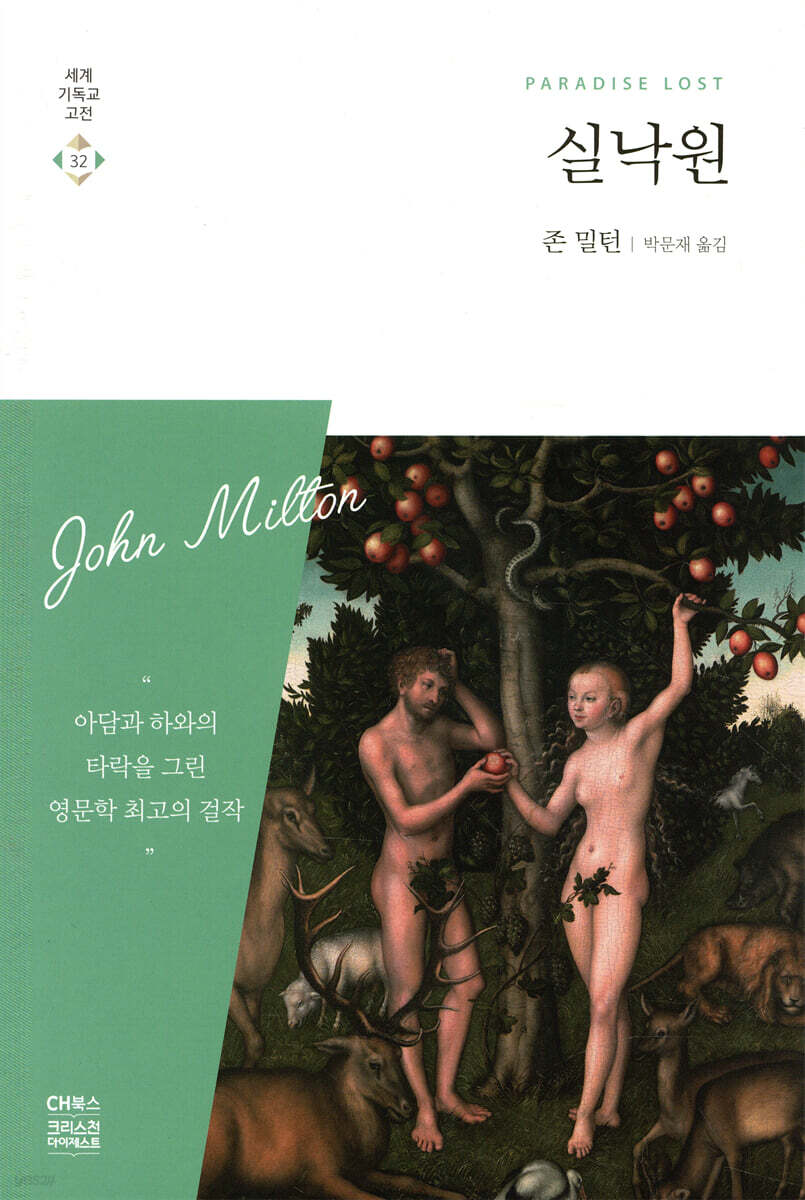
Paradise Lost
 |
Description
Book Introduction
The greatest masterpiece of English literature depicting the fall of Adam and Eve!
The only collection in Korea featuring 58 famous paintings by Gustave Doré and William Blake.
Homer wrote the Iliad for the Greeks, Virgil wrote the Aeneid for the Romans, and Milton wrote Paradise Lost for humanity.
Paradise Lost is the work that placed Milton among the great poets comparable to Shakespeare.
This book, which embodies the essence of the Puritan spirit, is based on the account recorded in Genesis 3 of the Christian Old Testament.
The first part briefly explains how Satan, who was an angel, rebelled against God and was banished from heaven.
And it shows the process of Satan and his minions preparing revenge against God.
The remainder of the story is filled with the events of Eve's disobedience to God due to Satan's temptation and her expulsion from Paradise along with her husband, Adam.
As a Christian humanist, Milton synthesized the intellectual and cultural history of the West up to his time.
Milton combined the monotheistic beliefs of Judaism and Christianity, Platonic idealism, Homeric mythology, and Italian humanities to create Paradise Lost, a comprehensive work about the universe and humanity.
Milton, one of the most learned of English writers, filled this book with allusions to the Bible, Greek and Roman mythology, and history.
CH Books has added a touch of appreciation to this book for its readers.
By including 50 famous paintings by Gustave Doré, the most famous French illustrator of the mid-19th century, and 8 prints by William Blake, a genius painter, readers can enjoy both literary works and works of art at the same time.
Milton, with his own pen, deeply, richly, and very excitingly captured the contents of the Bible in Paradise Lost.
Milton's reimagined story will resonate deeply with readers, leaving them deeply moved and providing them with an opportunity to reflect on themselves.
(This is the new 32nd volume of the "World Christian Classics" series, "Paradise Lost," which replaces the out-of-print "Pensees." CH Books has translated the epic poem into prose for easier understanding and includes detailed commentary.)
The only collection in Korea featuring 58 famous paintings by Gustave Doré and William Blake.
Homer wrote the Iliad for the Greeks, Virgil wrote the Aeneid for the Romans, and Milton wrote Paradise Lost for humanity.
Paradise Lost is the work that placed Milton among the great poets comparable to Shakespeare.
This book, which embodies the essence of the Puritan spirit, is based on the account recorded in Genesis 3 of the Christian Old Testament.
The first part briefly explains how Satan, who was an angel, rebelled against God and was banished from heaven.
And it shows the process of Satan and his minions preparing revenge against God.
The remainder of the story is filled with the events of Eve's disobedience to God due to Satan's temptation and her expulsion from Paradise along with her husband, Adam.
As a Christian humanist, Milton synthesized the intellectual and cultural history of the West up to his time.
Milton combined the monotheistic beliefs of Judaism and Christianity, Platonic idealism, Homeric mythology, and Italian humanities to create Paradise Lost, a comprehensive work about the universe and humanity.
Milton, one of the most learned of English writers, filled this book with allusions to the Bible, Greek and Roman mythology, and history.
CH Books has added a touch of appreciation to this book for its readers.
By including 50 famous paintings by Gustave Doré, the most famous French illustrator of the mid-19th century, and 8 prints by William Blake, a genius painter, readers can enjoy both literary works and works of art at the same time.
Milton, with his own pen, deeply, richly, and very excitingly captured the contents of the Bible in Paradise Lost.
Milton's reimagined story will resonate deeply with readers, leaving them deeply moved and providing them with an opportunity to reflect on themselves.
(This is the new 32nd volume of the "World Christian Classics" series, "Paradise Lost," which replaces the out-of-print "Pensees." CH Books has translated the epic poem into prose for easier understanding and includes detailed commentary.)
- You can preview some of the book's contents.
Preview
index
On the Form of This Epic - John Milton
Volume 1
Volume 2
Volume 3
Volume 4
Volume 5
Volume 6
Volume 7
Volume 8
Volume 9
Volume 10
Volume 11
Volume 12
Park Moon-jae, who was released
John Milton Chronology
Volume 1
Volume 2
Volume 3
Volume 4
Volume 5
Volume 6
Volume 7
Volume 8
Volume 9
Volume 10
Volume 11
Volume 12
Park Moon-jae, who was released
John Milton Chronology
Into the book
God has drawn a line so far out, and made the universe so vast, with the heavens spread out in the vast space, to show forth the greatness and majesty of the Creator, so that man may know that in this structure, which is too vast for him to possess alone, he lives only in the small part which God has appointed for him, and that the rest of the universe is used for purposes best known to Him.
--- p.317
He knows that on the day you eat of the fruit of this tree, your eyes, which now seem to see very clearly but in fact can only see dimly, will be perfectly opened, and you will see everything clearly, and you will be like gods, knowing good and evil.
Just as I was a beast and became human, so at least on the inside, it is only natural that you were human and then became gods.
Moreover, if you die, you will shed even your human form and truly become gods. Isn't a death that will never bring you any worse consequences—a death that is both terrifying and desirable? --- p.376
… So, please eat this fruit so that the two of us can share in love, in destiny, and in joy.
If you do not eat this fruit, we will be separated and forced to live in different worlds, and even if I wanted to give up my divinity for you, it would be too late, and fate would not allow it.
--- p.384
When I first created man, I bestowed upon him two good gifts: happiness and immortality. However, man sinned and lost happiness, and immortality only served to prolong his suffering and sorrow until the death I had pronounced upon him came.
Therefore, death will now be the final remedy for mankind, and those who have been refined through the harsh tribulations and trials of their lives in this world and have been purified through faith and acts of faith will be resurrected as righteous people in the next life and live a second life in the new heaven and new earth that will be given to them.
--- p.317
He knows that on the day you eat of the fruit of this tree, your eyes, which now seem to see very clearly but in fact can only see dimly, will be perfectly opened, and you will see everything clearly, and you will be like gods, knowing good and evil.
Just as I was a beast and became human, so at least on the inside, it is only natural that you were human and then became gods.
Moreover, if you die, you will shed even your human form and truly become gods. Isn't a death that will never bring you any worse consequences—a death that is both terrifying and desirable? --- p.376
… So, please eat this fruit so that the two of us can share in love, in destiny, and in joy.
If you do not eat this fruit, we will be separated and forced to live in different worlds, and even if I wanted to give up my divinity for you, it would be too late, and fate would not allow it.
--- p.384
When I first created man, I bestowed upon him two good gifts: happiness and immortality. However, man sinned and lost happiness, and immortality only served to prolong his suffering and sorrow until the death I had pronounced upon him came.
Therefore, death will now be the final remedy for mankind, and those who have been refined through the harsh tribulations and trials of their lives in this world and have been purified through faith and acts of faith will be resurrected as righteous people in the next life and live a second life in the new heaven and new earth that will be given to them.
--- p.354
Publisher's Review
The emergence of a great poet following Shakespeare
Milton was born in 1608 in London, the son of a wealthy notary.
Raised in a Protestant family, he originally intended to become a priest.
However, he gave up that dream due to his resentment towards the religious policies of Charles I and chose instead the path of a religious poet.
The reason Milton chose the path of a poet was because he thought there was no difference between becoming a priest and serving God in the church and becoming a poet and praising God.
For him, poetry was a means of praising God and informing the public of the righteousness of God's ways.
Above all, his extraordinary passion for literature gave him great ambition as a poet.
So, during his time at Cambridge University, Milton confirmed his natural talent as a poet by writing poems such as “On the Morning of Christ’s Nativity,” “On the Death of a Child,” “The Merry Man,” and “The Thinker.”
From his school days, Milton wanted to write a heroic epic poem in English like Homer or Virgil.
He wanted to write a great work like the Iliad or the Aeneid.
However, he abandoned the idea of writing an English epic poem, such as a medieval romance or the Arthurian legend, and decided to write an epic poem based on the Bible, dealing with the problems of human depravity and evil.
The work that resulted was Paradise Lost.
This work announces to the world the emergence of a great poet who would succeed Shakespeare.
Paradise Lost, the greatest Christian epic
Milton, who lived in a turbulent era, became the secretary of foreign languages for the republican government under Cromwell after Charles I was executed by guillotine in 1649.
He defended the legitimacy of the republic and lost his sight in 1652 due to his arduous work.
To make matters worse, in 1660 the republic was defeated and the monarchy was restored.
Milton finds himself in the unfortunate position of having his property confiscated and his personal safety threatened due to political retaliation.
But miraculously, he escaped execution.
Lost his sight and fortune, he was struggling in poverty, but with the help of his daughter, he wrote Paradise Lost.
It is estimated that Milton began conceiving Paradise Lost in the late 1650s.
It was not until 1663, ten years later, that the manuscript was completed.
However, publication was delayed due to the plague (1665) and the Great Fire of London (1666).
It was not until April of the following year, 1667, that the first edition was published by the publisher Samuel Symonds.
The material that can serve as the basis for Paradise Lost is extremely extensive.
However, its foundation can be said to be the story of the fall of Adam and Eve in Genesis 1-2 and the prophetic record of the battle in heaven in Revelation 12.
Paradise Lost contains numerous biblical passages and references to Greek and Roman classics and other sources of thought.
So, they say that the content is so difficult for the general reader to read, it is not easy to access, and it is not relatable.
Nevertheless, Paradise Lost achieved great fame.
The reason is that it adds a deep flavor of the classics to the monochromatic light that is often easy to fall into when dealing with biblical subjects.
And it is in the light of classical tradition that the grand questions of human destiny and God's way are illuminated with boundless imagination.
Had it rejected classical traditions in composition and style, it might have resulted in a plain and monotonous work, but it would have been difficult to leave it as an immortal classic.
Paradise Lost is all the more remarkable because it avoids monotony and instead combines the two origins of human culture, Hellenism and Hebraism, to create a brilliant light.
A combination of Western classical knowledge and Christian thought
Paradise Lost is an attempt to reinterpret and revive the entire cultural tradition of the West.
In this book, Milton combines the monotheistic beliefs of Judaism and Christianity, Platonic idealism, Homeric mythology, and Italian humanities to create a comprehensive narrative about the universe and humanity.
In addition, he combined Lucretius's cosmology, Ptolemy's geocentric cosmology, and Copernicus's heliocentric cosmology with the cosmology found in the Bible and used it as the basic framework for Paradise Lost.
Based on this worldview, it centers on two seemingly similar yet different events: Satan's 'rebellion' in heaven and the 'fall' of mankind in the Garden of Eden.
By linking the two incidents under the theme of 'rebellion', we can see the entire world beyond the universe we live in, encompassing heaven, hell, and the realm of chaos.
For Milton, the world of Paradise Lost was not simply a world of religion or mythology divorced from reality, but reality itself.
This is in line with the way religions and myths capture real human experiences and express truth through various religious and mythical symbols and metaphors.
In this way, in the epic poem called Paradise Lost, the truth expressed through religion and mythology is resurrected as a vivid reality through Jehovah God, Satan, the fallen angels, and Adam and Eve.
Features of CH Books' Paradise Lost
CH Books is making it easier and more enjoyable for more readers to read Paradise Lost.
It includes 50 famous paintings by Gustave Doré and 8 prints by William Blake.
It is the only book in Korea that includes all 58 famous paintings related to Paradise Lost.
Doré was the most prominent French painter, illustrator, and sculptor of the mid-19th century, whom Vincent van Gogh aspired to emulate.
The famous painting he painted, Paradise Lost, is outstanding in its imagination and descriptive power.
The black and white contrast and detailed depiction through light create an incredibly vivid feeling, as if you were seeing the actual scene.
Moreover, the scale and grandeur of each point adds dramatic emotion to this masterpiece and further immerses readers into the work.
Blake, a genius as an artist, is famous for his illustrations for Paradise Lost.
Blake's works included in this book are as unique as his genius.
His works, drawn with bizarre shapes and eccentric imagination, offer a different kind of enjoyment from Doré's works.
In this way, 58 famous paintings will add to the enjoyment of readers who can appreciate both literary works and works of art at the same time.
Additionally, Paradise Lost contains countless references to content and words from the Bible and Greco-Roman mythology.
Because of this, it is difficult for general readers to fully understand the contents of this book without knowledge of theology, mythology, and history.
Therefore, CH Books has added detailed footnotes and detailed commentary to help readers understand difficult passages based on the Bible and Greco-Roman mythology.
Let's discover the essence of Christian literature through Milton's Paradise Lost, recognized as the greatest Christian epic and a masterpiece in the history of English literature.
#Introducing the World Christian Classics Series
I believe that in order to cultivate spiritual maturity and true faith in Christians, many valuable Christian classics should be published and passed down to future generations for a long time.
The Christian classics of the world are an eternal treasure for all Christians, and nothing is more precious for the growth of faith and the salvation of the soul.
With this in mind, we plan to publish the "World Christian Classics" series, collecting only the most outstanding religious writings and works of lasting value written across the globe over a period of over two thousand years.
Milton was born in 1608 in London, the son of a wealthy notary.
Raised in a Protestant family, he originally intended to become a priest.
However, he gave up that dream due to his resentment towards the religious policies of Charles I and chose instead the path of a religious poet.
The reason Milton chose the path of a poet was because he thought there was no difference between becoming a priest and serving God in the church and becoming a poet and praising God.
For him, poetry was a means of praising God and informing the public of the righteousness of God's ways.
Above all, his extraordinary passion for literature gave him great ambition as a poet.
So, during his time at Cambridge University, Milton confirmed his natural talent as a poet by writing poems such as “On the Morning of Christ’s Nativity,” “On the Death of a Child,” “The Merry Man,” and “The Thinker.”
From his school days, Milton wanted to write a heroic epic poem in English like Homer or Virgil.
He wanted to write a great work like the Iliad or the Aeneid.
However, he abandoned the idea of writing an English epic poem, such as a medieval romance or the Arthurian legend, and decided to write an epic poem based on the Bible, dealing with the problems of human depravity and evil.
The work that resulted was Paradise Lost.
This work announces to the world the emergence of a great poet who would succeed Shakespeare.
Paradise Lost, the greatest Christian epic
Milton, who lived in a turbulent era, became the secretary of foreign languages for the republican government under Cromwell after Charles I was executed by guillotine in 1649.
He defended the legitimacy of the republic and lost his sight in 1652 due to his arduous work.
To make matters worse, in 1660 the republic was defeated and the monarchy was restored.
Milton finds himself in the unfortunate position of having his property confiscated and his personal safety threatened due to political retaliation.
But miraculously, he escaped execution.
Lost his sight and fortune, he was struggling in poverty, but with the help of his daughter, he wrote Paradise Lost.
It is estimated that Milton began conceiving Paradise Lost in the late 1650s.
It was not until 1663, ten years later, that the manuscript was completed.
However, publication was delayed due to the plague (1665) and the Great Fire of London (1666).
It was not until April of the following year, 1667, that the first edition was published by the publisher Samuel Symonds.
The material that can serve as the basis for Paradise Lost is extremely extensive.
However, its foundation can be said to be the story of the fall of Adam and Eve in Genesis 1-2 and the prophetic record of the battle in heaven in Revelation 12.
Paradise Lost contains numerous biblical passages and references to Greek and Roman classics and other sources of thought.
So, they say that the content is so difficult for the general reader to read, it is not easy to access, and it is not relatable.
Nevertheless, Paradise Lost achieved great fame.
The reason is that it adds a deep flavor of the classics to the monochromatic light that is often easy to fall into when dealing with biblical subjects.
And it is in the light of classical tradition that the grand questions of human destiny and God's way are illuminated with boundless imagination.
Had it rejected classical traditions in composition and style, it might have resulted in a plain and monotonous work, but it would have been difficult to leave it as an immortal classic.
Paradise Lost is all the more remarkable because it avoids monotony and instead combines the two origins of human culture, Hellenism and Hebraism, to create a brilliant light.
A combination of Western classical knowledge and Christian thought
Paradise Lost is an attempt to reinterpret and revive the entire cultural tradition of the West.
In this book, Milton combines the monotheistic beliefs of Judaism and Christianity, Platonic idealism, Homeric mythology, and Italian humanities to create a comprehensive narrative about the universe and humanity.
In addition, he combined Lucretius's cosmology, Ptolemy's geocentric cosmology, and Copernicus's heliocentric cosmology with the cosmology found in the Bible and used it as the basic framework for Paradise Lost.
Based on this worldview, it centers on two seemingly similar yet different events: Satan's 'rebellion' in heaven and the 'fall' of mankind in the Garden of Eden.
By linking the two incidents under the theme of 'rebellion', we can see the entire world beyond the universe we live in, encompassing heaven, hell, and the realm of chaos.
For Milton, the world of Paradise Lost was not simply a world of religion or mythology divorced from reality, but reality itself.
This is in line with the way religions and myths capture real human experiences and express truth through various religious and mythical symbols and metaphors.
In this way, in the epic poem called Paradise Lost, the truth expressed through religion and mythology is resurrected as a vivid reality through Jehovah God, Satan, the fallen angels, and Adam and Eve.
Features of CH Books' Paradise Lost
CH Books is making it easier and more enjoyable for more readers to read Paradise Lost.
It includes 50 famous paintings by Gustave Doré and 8 prints by William Blake.
It is the only book in Korea that includes all 58 famous paintings related to Paradise Lost.
Doré was the most prominent French painter, illustrator, and sculptor of the mid-19th century, whom Vincent van Gogh aspired to emulate.
The famous painting he painted, Paradise Lost, is outstanding in its imagination and descriptive power.
The black and white contrast and detailed depiction through light create an incredibly vivid feeling, as if you were seeing the actual scene.
Moreover, the scale and grandeur of each point adds dramatic emotion to this masterpiece and further immerses readers into the work.
Blake, a genius as an artist, is famous for his illustrations for Paradise Lost.
Blake's works included in this book are as unique as his genius.
His works, drawn with bizarre shapes and eccentric imagination, offer a different kind of enjoyment from Doré's works.
In this way, 58 famous paintings will add to the enjoyment of readers who can appreciate both literary works and works of art at the same time.
Additionally, Paradise Lost contains countless references to content and words from the Bible and Greco-Roman mythology.
Because of this, it is difficult for general readers to fully understand the contents of this book without knowledge of theology, mythology, and history.
Therefore, CH Books has added detailed footnotes and detailed commentary to help readers understand difficult passages based on the Bible and Greco-Roman mythology.
Let's discover the essence of Christian literature through Milton's Paradise Lost, recognized as the greatest Christian epic and a masterpiece in the history of English literature.
#Introducing the World Christian Classics Series
I believe that in order to cultivate spiritual maturity and true faith in Christians, many valuable Christian classics should be published and passed down to future generations for a long time.
The Christian classics of the world are an eternal treasure for all Christians, and nothing is more precious for the growth of faith and the salvation of the soul.
With this in mind, we plan to publish the "World Christian Classics" series, collecting only the most outstanding religious writings and works of lasting value written across the globe over a period of over two thousand years.
GOODS SPECIFICS
- Date of issue: April 19, 2019
- Page count, weight, size: 544 pages | 694g | 150*225*35mm
- ISBN13: 9788944785320
- ISBN10: 8944785325
You may also like
카테고리
korean


korean

![ELLE 엘르 스페셜 에디션 A형 : 12월 [2025]](http://librairie.coreenne.fr/cdn/shop/files/b8e27a3de6c9538896439686c6b0e8fb.jpg?v=1766436872&width=3840)


