

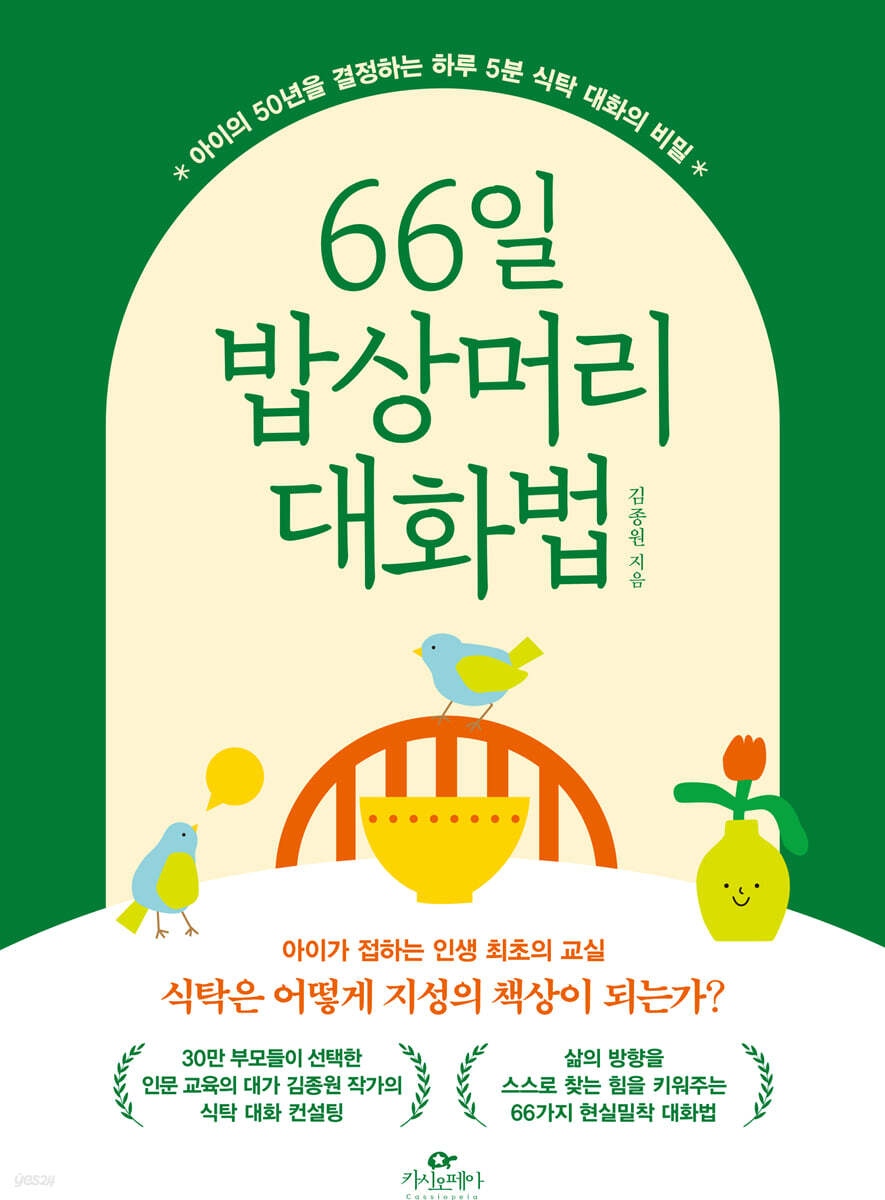
66-Day Dinner Table Conversation Method
 |
Description
Book Introduction
"My life was decided by a five-minute conversation at the dinner table."
The first classroom a child encounters in life
How does a dining table become a desk for intellect?
* Table conversation consulting by author Kim Jong-won, a master of humanities education chosen by 300,000 parents
* 66 realistic conversation techniques that will help you develop the power to find your own direction in life.
Kim Jong-won, a humanities education expert who has written over 80 books over the past 20 years and has been deeply contemplating the humanities and child education, focuses on 'Conversations at the Table.'
Regardless of the era, parents want to impart love and a philosophy that will guide their children during mealtimes.
"66-Day Table Conversation Method" is a book for parents who know the importance of mealtimes but are worried about what to say and how to say it.
Unlike other places, conversations at the dinner table have these advantages.
First, we can have a conversation while looking at each other.
Second, you can talk about a variety of topics.
Third, new knowledge can stimulate children's thinking.
Fourth, you can find out what your child is thinking these days.
Fifth, you can teach and learn attitudes toward life.
The author says he completed this book by reflecting on his entire life.
Just as the intellectuals who led the times unanimously say that conversations around the dinner table determine one's life, he too learned about life and the world from the five minutes or so of conversations that took place at the dinner table each day.
It reinterprets dinner table conversations with a unique perspective and contains 66 conversation techniques that can be applied directly to everyday life for modern parents.
First, we introduced 'Conversations that are good to have during mealtimes', then 'Conversations that teach you how to wisely build and maintain relationships', and in Chapter 3, 'Conversations that convey love and strengthen family bonds'.
Chapter 4 introduces 'Conversations that teach rules and order,' Chapter 5 introduces 'Conversations that expand thinking and develop children into great intellectuals,' and the last Chapter 6 introduces 'Conversations that develop self-directedness,' allowing children to transform themselves into the most wonderful beings through conversations that take place at the dinner table for 66 days.
With this book, let's take the first step toward 66 days of conversation, starting today at the dinner table, for 5 minutes a day.
The destinations of our children and families in 5, 10, and 20 years will be very different.
The first classroom a child encounters in life
How does a dining table become a desk for intellect?
* Table conversation consulting by author Kim Jong-won, a master of humanities education chosen by 300,000 parents
* 66 realistic conversation techniques that will help you develop the power to find your own direction in life.
Kim Jong-won, a humanities education expert who has written over 80 books over the past 20 years and has been deeply contemplating the humanities and child education, focuses on 'Conversations at the Table.'
Regardless of the era, parents want to impart love and a philosophy that will guide their children during mealtimes.
"66-Day Table Conversation Method" is a book for parents who know the importance of mealtimes but are worried about what to say and how to say it.
Unlike other places, conversations at the dinner table have these advantages.
First, we can have a conversation while looking at each other.
Second, you can talk about a variety of topics.
Third, new knowledge can stimulate children's thinking.
Fourth, you can find out what your child is thinking these days.
Fifth, you can teach and learn attitudes toward life.
The author says he completed this book by reflecting on his entire life.
Just as the intellectuals who led the times unanimously say that conversations around the dinner table determine one's life, he too learned about life and the world from the five minutes or so of conversations that took place at the dinner table each day.
It reinterprets dinner table conversations with a unique perspective and contains 66 conversation techniques that can be applied directly to everyday life for modern parents.
First, we introduced 'Conversations that are good to have during mealtimes', then 'Conversations that teach you how to wisely build and maintain relationships', and in Chapter 3, 'Conversations that convey love and strengthen family bonds'.
Chapter 4 introduces 'Conversations that teach rules and order,' Chapter 5 introduces 'Conversations that expand thinking and develop children into great intellectuals,' and the last Chapter 6 introduces 'Conversations that develop self-directedness,' allowing children to transform themselves into the most wonderful beings through conversations that take place at the dinner table for 66 days.
With this book, let's take the first step toward 66 days of conversation, starting today at the dinner table, for 5 minutes a day.
The destinations of our children and families in 5, 10, and 20 years will be very different.
- You can preview some of the book's contents.
Preview
index
prolog
How does a 'dining table' become a 'desk of intellect' that nurtures a child's life?
Chapter 1: 11 Great Mealtime Conversations
7 Questions That Will Strengthen Your Inner Self When Made Into Dinner Conversation
How to Break Your Child's Habit of Eating While Looking at Their Smartphone
One word to change a child who enjoys bad food or has a big appetite
Good sayings to say at mealtime to foster a child's spirit of challenge
A saying that changes a child's bad behavior when said at mealtime
5 Changes to Change Your Child's Drooling
The Language of Possibility to Cure Your Child's Picky Eating
Rather than eating like this, it's better to order a game.
How to Get Your Child to Read Books and Not Play Games on YouTube
All of a child's education begins with brushing his teeth.
Stability at the table determines the stability of a child's life.
Tabletop Tips: 6 Tailored Tabletop Conversation Tips for Parents Who Suck at Conversation: Consideration and Dignity
Chapter 2: 11 Conversations on How to Build and Maintain Relationships Wisely
The 3 Worst Things to Say to a Child Coming Home After an Argument with a Friend
A Miraculous Word to Raise a Child Who Speaks and Acts Well
8 Ways to Boost Your Child's Emotional Intelligence
Words to change a selfish child who only thinks about himself
6 Open Questions to Open Your Child's Closed Mind
Thinking Words to Develop Your Child's Empathy
Assertive language destroys a child's ability to empathize.
Words to help a child who has lost self-esteem in relationships with friends
How to escape the negative influences that arise in relationships surrounding children
The impact of saying, "You ended up like this because you made the wrong friends" on a child's life
A great phrase to say to a child about to enter elementary school.
Tabletop Tips: 6 Tailored Tabletop Conversation Tips for Parents Who Struggle with Conversation: Exploration and Observation
Chapter 3: 11 Conversations to Express Love and Strengthen Family Bonds
The moment parents' emotions become mixed into their conversations, their relationship with their children also becomes distant.
Words of love that make the hearts of parents and children more beautiful every day
20 Things Your Dad Says to Make Your Day Happier
8 Rules of Speech to Calm Down Siblings Who Always Fight
Attachment conversation techniques for children who have become quiet
A Word of Love That Will Change Your Relationship with Your Teenager
Adding words from parents who change their disobedient children
Why do I feel sorry for my child every day?
10 Words of Happiness and Joy to Create a Home Filled with Good Fortune Where Everything Goes Well
5-Step Dialogue to Heal Your Child's Wounds
A beautiful family where parents and children respect each other is a different story.
Tabletop Tips: 6 Tailored Tabletop Conversation Tips for Parents Who Struggle with Conversation: Intelligence and Character
Chapter 4: Conversations on Rules and Order, Day 11
173 Truths to Change a Child Who Lies
A refreshing phrase to describe a child who is not ready for school and is sluggish.
Words to calm a distracted and unfocused child
Words of Praise to Change a Child Who Behaves Badly and Speaks Badly
How to Make Homework a Celebration for a Child Who Procrastinates
How to Change a Complaining and Whining Child Without Yelling
Children who don't know 'this' end up seriously lost after puberty.
3 Rules of Speech to Develop Morality and Self-Control in Children
How to Wisely Discipline Your Child to Develop Inner Strength and Responsibility
8 Calm Talk Techniques to Build Your Child's Attention and Self-Regulation
6 Basic Words That Determine the Level and Depth of a Child's Life
Tabletop Tips: 6 Tailored Tabletop Conversation Tips for Parents Who Have a Hard Time Conversing: Self-Control
Chapter 5: 11 Days of Conversation to Expand Your Mindset and Develop Great Intellectuals
A 3-Step Method for Raising a Quibbler into a Philosopher
Verb-type questions that awaken all of a child's talents and potential
Telling a child they are wrong makes them think less
Words that positively change a child's attitude toward math
Why it's bad to tell a child who's worked hard, "You've got all your spelling mistakes!"
A 3-Step Intellectual Conversation Method for Turning News into Knowledge for Children
How to awaken the thinking of a child who answers "I don't know!" no matter what you ask
The Power of the Six Study Attitudes of Perfect Scorers
"Will you just bring me any book?" The incredible impact this one word can have on a child's life.
12 Parental Habits That Boost Your Child's Literacy
A child who seems to have learned well grows up hearing things like this.
Tabletop TIP: 6 Customized Tabletop Conversation Tips for Parents Who Struggle with Conversation: Literacy
Chapter 6: 11 Days of Conversations to Develop Self-Initiative
Why Saying "My child is naturally silent" is the worst thing a child can do.
Two Ways to Raise a Child Who Will Always Find His Own Way
Words that change a weak and passive child into an active one
Four Questions to Ask Your Child to Escape All Addictions, from Gaming to YouTube, and Raise Them to Independence
The tragedy of scolding a child in front of others
10 Phrases to Raise Unwavering Children in the Face of Any Challenge
Words that make you follow the rules you set for yourself
The language of self-focus to raise independent children who are confident in their own lives.
The Power of Self-Expression That Raised BTS's RM and the Great Author Tolstoy
After the age of five, a child's life becomes more solid when he or she recognizes the subject "I".
Words that help children achieve complete independence both internally and externally.
Tabletop Tips: 6 Customized Tabletop Conversation Techniques for Parents Who Have Difficulty Conversing
Epilogue
A happy individual comes first, not a happy family.
How does a 'dining table' become a 'desk of intellect' that nurtures a child's life?
Chapter 1: 11 Great Mealtime Conversations
7 Questions That Will Strengthen Your Inner Self When Made Into Dinner Conversation
How to Break Your Child's Habit of Eating While Looking at Their Smartphone
One word to change a child who enjoys bad food or has a big appetite
Good sayings to say at mealtime to foster a child's spirit of challenge
A saying that changes a child's bad behavior when said at mealtime
5 Changes to Change Your Child's Drooling
The Language of Possibility to Cure Your Child's Picky Eating
Rather than eating like this, it's better to order a game.
How to Get Your Child to Read Books and Not Play Games on YouTube
All of a child's education begins with brushing his teeth.
Stability at the table determines the stability of a child's life.
Tabletop Tips: 6 Tailored Tabletop Conversation Tips for Parents Who Suck at Conversation: Consideration and Dignity
Chapter 2: 11 Conversations on How to Build and Maintain Relationships Wisely
The 3 Worst Things to Say to a Child Coming Home After an Argument with a Friend
A Miraculous Word to Raise a Child Who Speaks and Acts Well
8 Ways to Boost Your Child's Emotional Intelligence
Words to change a selfish child who only thinks about himself
6 Open Questions to Open Your Child's Closed Mind
Thinking Words to Develop Your Child's Empathy
Assertive language destroys a child's ability to empathize.
Words to help a child who has lost self-esteem in relationships with friends
How to escape the negative influences that arise in relationships surrounding children
The impact of saying, "You ended up like this because you made the wrong friends" on a child's life
A great phrase to say to a child about to enter elementary school.
Tabletop Tips: 6 Tailored Tabletop Conversation Tips for Parents Who Struggle with Conversation: Exploration and Observation
Chapter 3: 11 Conversations to Express Love and Strengthen Family Bonds
The moment parents' emotions become mixed into their conversations, their relationship with their children also becomes distant.
Words of love that make the hearts of parents and children more beautiful every day
20 Things Your Dad Says to Make Your Day Happier
8 Rules of Speech to Calm Down Siblings Who Always Fight
Attachment conversation techniques for children who have become quiet
A Word of Love That Will Change Your Relationship with Your Teenager
Adding words from parents who change their disobedient children
Why do I feel sorry for my child every day?
10 Words of Happiness and Joy to Create a Home Filled with Good Fortune Where Everything Goes Well
5-Step Dialogue to Heal Your Child's Wounds
A beautiful family where parents and children respect each other is a different story.
Tabletop Tips: 6 Tailored Tabletop Conversation Tips for Parents Who Struggle with Conversation: Intelligence and Character
Chapter 4: Conversations on Rules and Order, Day 11
173 Truths to Change a Child Who Lies
A refreshing phrase to describe a child who is not ready for school and is sluggish.
Words to calm a distracted and unfocused child
Words of Praise to Change a Child Who Behaves Badly and Speaks Badly
How to Make Homework a Celebration for a Child Who Procrastinates
How to Change a Complaining and Whining Child Without Yelling
Children who don't know 'this' end up seriously lost after puberty.
3 Rules of Speech to Develop Morality and Self-Control in Children
How to Wisely Discipline Your Child to Develop Inner Strength and Responsibility
8 Calm Talk Techniques to Build Your Child's Attention and Self-Regulation
6 Basic Words That Determine the Level and Depth of a Child's Life
Tabletop Tips: 6 Tailored Tabletop Conversation Tips for Parents Who Have a Hard Time Conversing: Self-Control
Chapter 5: 11 Days of Conversation to Expand Your Mindset and Develop Great Intellectuals
A 3-Step Method for Raising a Quibbler into a Philosopher
Verb-type questions that awaken all of a child's talents and potential
Telling a child they are wrong makes them think less
Words that positively change a child's attitude toward math
Why it's bad to tell a child who's worked hard, "You've got all your spelling mistakes!"
A 3-Step Intellectual Conversation Method for Turning News into Knowledge for Children
How to awaken the thinking of a child who answers "I don't know!" no matter what you ask
The Power of the Six Study Attitudes of Perfect Scorers
"Will you just bring me any book?" The incredible impact this one word can have on a child's life.
12 Parental Habits That Boost Your Child's Literacy
A child who seems to have learned well grows up hearing things like this.
Tabletop TIP: 6 Customized Tabletop Conversation Tips for Parents Who Struggle with Conversation: Literacy
Chapter 6: 11 Days of Conversations to Develop Self-Initiative
Why Saying "My child is naturally silent" is the worst thing a child can do.
Two Ways to Raise a Child Who Will Always Find His Own Way
Words that change a weak and passive child into an active one
Four Questions to Ask Your Child to Escape All Addictions, from Gaming to YouTube, and Raise Them to Independence
The tragedy of scolding a child in front of others
10 Phrases to Raise Unwavering Children in the Face of Any Challenge
Words that make you follow the rules you set for yourself
The language of self-focus to raise independent children who are confident in their own lives.
The Power of Self-Expression That Raised BTS's RM and the Great Author Tolstoy
After the age of five, a child's life becomes more solid when he or she recognizes the subject "I".
Words that help children achieve complete independence both internally and externally.
Tabletop Tips: 6 Customized Tabletop Conversation Techniques for Parents Who Have Difficulty Conversing
Epilogue
A happy individual comes first, not a happy family.
Detailed image

Into the book
For a long time, dinner table conversations have been a routine that has been preserved in the history of prestigious families.
But I don't know exactly what topic they talked about.
Of course, all kinds of cool topics like history and philosophy are important, but even more important than that is sharing interest in each other, our hearts, and stories from our daily lives.
Because that is the very history of my family and the dense material that makes up my life philosophy.
---p.21 From "7 Questions That Can Strengthen Your Inner Self When Made a Topic of Dinner Table Conversation"
Reading any book during meal times is also not a good idea.
No matter how necessary it is for studying, reading books and solving problems until it's time to eat is worse than playing games during that time.
Remember, the wisest way to start a meal is to look at the person you are eating with.
This way, the child can feel the process and flow.
This is why conversation at the dinner table is so important.
For children who are preoccupied with other things during meals or who eat quickly, teach them the joy of slowing down and sharing thoughts with those around them.
---p.50 From "It's better to make them play games than to eat like this"
Parents who find all the bad things in their friends are a prime example of how they can ruin a good child.
Even if it hurts now, you can promise hope in the future only if you think that the problem lies with your child.
If you have a serious illness and you cry out that your cough is due to bad air and blame only the air, what will be the result?
A parent's words are like a pencil.
I think that if I make a mistake, I can erase it with an eraser at any time.
You can erase pencil marks with an eraser, but paper remembers.
What did the pencil write to itself?
The same goes for parents.
You may think you've erased it cleanly, but the kids remember.
What your parents said to you.
I remember all the words and feelings that were conveyed.
---p.110 From “The impact of saying, ‘You ended up like this because you made the wrong friends’ on a child’s life”
As parents, we can't always make rational decisions.
Every day, we are swayed by various emotions, and our standards and principles fluctuate like waves.
But what is clear is that it can be changed and modified later.
“Then who will heal the wounded hearts of parents?” you might ask.
The parents' difficult feelings actually heal the wounds in their children's hearts, and they naturally get better.
Because as parents help their children solve difficult problems, they themselves find wise answers.
So, if you have hurt your child's feelings, remember that it is important to heal quickly through conversation.
---p.162 From “5-Step Dialogue Method to Heal the Wounds Left in a Child’s Heart”
It is important to make children who are just repeating their own arguments stop and think.
It allows you to simultaneously keep in mind your own thoughts and the situations of others, and find the appropriate point at which to respond flexibly.
This will help you stop crying like crazy, getting angry, hitting others, and calming down your excited emotions.
Attention and self-regulation play a very important role in intellectual development even as adults.
Because it is very important to maintain emotional calm both at home and at work.
So, it's a good idea to say the words I mentioned earlier often.
This is because attention and self-control are ultimately products of faith and hope, which are the result of a combination of ‘belief in oneself’ and ‘hope for tomorrow.’
---p.214 From “8 Calm Conversation Methods to Develop Children’s Attention and Self-Regulation”
A parent's words are a very delicate intellectual tool that sculpts a child's life.
The important thing here is not to sculpt the child solely based on the parents' desires, but to sculpt the child into the most beautiful form that suits his or her personality.
If you help them like that at first, they will eventually reach a stage where they can sculpt themselves on their own.
Then now you can truly live worry-free days.
---p.264 From “The Amazing Impact of One Word, ‘Will You Bring Me Any Book?’ on a Child’s Life”
For a child to reach the level of following rules because they believe they are right, they need to have an attitude of empathy and understanding towards their parents and those around them.
The reason children cannot think for themselves and decide and judge which rules are worth following is not because they lack the ability to do so, but because they lack the ability to empathize and understand.
When children understand the hearts of their parents and those around them, only then will they be able to awaken their own thoughts and live a different life than before.
But I don't know exactly what topic they talked about.
Of course, all kinds of cool topics like history and philosophy are important, but even more important than that is sharing interest in each other, our hearts, and stories from our daily lives.
Because that is the very history of my family and the dense material that makes up my life philosophy.
---p.21 From "7 Questions That Can Strengthen Your Inner Self When Made a Topic of Dinner Table Conversation"
Reading any book during meal times is also not a good idea.
No matter how necessary it is for studying, reading books and solving problems until it's time to eat is worse than playing games during that time.
Remember, the wisest way to start a meal is to look at the person you are eating with.
This way, the child can feel the process and flow.
This is why conversation at the dinner table is so important.
For children who are preoccupied with other things during meals or who eat quickly, teach them the joy of slowing down and sharing thoughts with those around them.
---p.50 From "It's better to make them play games than to eat like this"
Parents who find all the bad things in their friends are a prime example of how they can ruin a good child.
Even if it hurts now, you can promise hope in the future only if you think that the problem lies with your child.
If you have a serious illness and you cry out that your cough is due to bad air and blame only the air, what will be the result?
A parent's words are like a pencil.
I think that if I make a mistake, I can erase it with an eraser at any time.
You can erase pencil marks with an eraser, but paper remembers.
What did the pencil write to itself?
The same goes for parents.
You may think you've erased it cleanly, but the kids remember.
What your parents said to you.
I remember all the words and feelings that were conveyed.
---p.110 From “The impact of saying, ‘You ended up like this because you made the wrong friends’ on a child’s life”
As parents, we can't always make rational decisions.
Every day, we are swayed by various emotions, and our standards and principles fluctuate like waves.
But what is clear is that it can be changed and modified later.
“Then who will heal the wounded hearts of parents?” you might ask.
The parents' difficult feelings actually heal the wounds in their children's hearts, and they naturally get better.
Because as parents help their children solve difficult problems, they themselves find wise answers.
So, if you have hurt your child's feelings, remember that it is important to heal quickly through conversation.
---p.162 From “5-Step Dialogue Method to Heal the Wounds Left in a Child’s Heart”
It is important to make children who are just repeating their own arguments stop and think.
It allows you to simultaneously keep in mind your own thoughts and the situations of others, and find the appropriate point at which to respond flexibly.
This will help you stop crying like crazy, getting angry, hitting others, and calming down your excited emotions.
Attention and self-regulation play a very important role in intellectual development even as adults.
Because it is very important to maintain emotional calm both at home and at work.
So, it's a good idea to say the words I mentioned earlier often.
This is because attention and self-control are ultimately products of faith and hope, which are the result of a combination of ‘belief in oneself’ and ‘hope for tomorrow.’
---p.214 From “8 Calm Conversation Methods to Develop Children’s Attention and Self-Regulation”
A parent's words are a very delicate intellectual tool that sculpts a child's life.
The important thing here is not to sculpt the child solely based on the parents' desires, but to sculpt the child into the most beautiful form that suits his or her personality.
If you help them like that at first, they will eventually reach a stage where they can sculpt themselves on their own.
Then now you can truly live worry-free days.
---p.264 From “The Amazing Impact of One Word, ‘Will You Bring Me Any Book?’ on a Child’s Life”
For a child to reach the level of following rules because they believe they are right, they need to have an attitude of empathy and understanding towards their parents and those around them.
The reason children cannot think for themselves and decide and judge which rules are worth following is not because they lack the ability to do so, but because they lack the ability to empathize and understand.
When children understand the hearts of their parents and those around them, only then will they be able to awaken their own thoughts and live a different life than before.
---p.309 From “Words that make you follow the rules you set for yourself”
Publisher's Review
“The dining table is a crucial conversation space that affects a child’s life!”
The master of humanities education chosen by 300,000 parents
Kim Jong-won's Table Conversation Consulting
Any parent interested in their children's education has probably heard of 'table conversation' at least once.
The amount of vocabulary a child learns at the dinner table is more than ten times that of when he or she reads a book.
Children who eat family meals more often have better academic performance and are significantly less likely to become delinquent than those who don't, and making family meals a habit in childhood can strengthen the bond between parents and children throughout adolescence and into adulthood.
The importance of table manners has been proven by numerous studies.
But given its importance, how much do we really know about how to best utilize family mealtimes? This book focuses on this.
"66-Day Table Conversation Method" is a book for parents who know the importance of mealtimes but are worried about what to say and how to say it.
The author, who has written over 80 books over the past 20 years and has deeply contemplated the humanities and child education, says that he reflected on his entire life to write this book and that it captures the essence of the philosophy of humanities education.
Just as the intellectuals who led the times unanimously say that conversations around the dinner table determine one's life, he too learned about life and the world from the five minutes or so of conversations that took place at the dinner table each day.
It reinterprets dinner table conversations with a unique perspective and contains 66 conversation techniques that can be applied directly to everyday life for modern parents.
“I know that conversation at the dinner table is important,
“What should I say and how should I say it?”
Academics, social skills, self-directedness, thinking skills, lifestyle habits, and even family bonds
66 Dinner Table Conversations That Will Shape Your Child's Future!
Conversations at the dinner table have these distinct advantages.
First, we can have a conversation while looking at each other.
Second, you can talk about a variety of topics.
Third, new knowledge can stimulate children's thinking.
Fourth, you can find out what your child is thinking these days.
Fifth, you can teach and learn attitudes toward life.
But reality is not easy.
In most homes where children are raised, the mealtime is a battlefield.
We rush children who won't eat, yell at children who procrastinate to hurry up, and waste what may be the only precious time of the day we have to talk to our children.
If this situation continues, when the child reaches puberty, he or she will avoid family meals.
Even if parents somehow manage to sit down with their children at the dinner table, they often don't know how to utilize this time, so they focus on things like whether their children have finished their homework or why their test scores are so low. As a result, the children end up cutting off communication with their parents.
The author says that the first thing that must be done for the family dinner to be effective is to make the child feel comfortable and secure at the family table.
Of course, the most important thing here is the parents' 'words'.
A conversation about the humanities begins only when parents' words make children feel loved and when children consider the dining table where they sit with their parents as the most comfortable place in the world for conversation.
As mentioned earlier, at the mealtime, children are exposed to more vocabulary than anywhere else.
When family members, including parents, talk freely about all the events of the day, children encounter unpredictable emotions and vocabulary.
And when a child tries to convey his or her day's events and thoughts to his or her family with all the thoughts he or she has, we can bring out the maximum potential of the child's capacity.
The most important thing is that mealtimes are not about unilaterally relaying parents' words to their children, but about drawing out the children's words and thoughts.
When a child opens up and faces their parents like that, the dinner table becomes the most important place in the world for conversation and love.
The author, who concisely and accurately conveys how to develop children's potential through humanistic knowledge and serves as a strong mentor to parents, presents six key words in this book to optimize dinner table conversations.
First, Chapter 1 introduces 'Conversations that are good to have during mealtimes,' followed by 'Conversations that teach you how to wisely build and maintain relationships,' and Chapter 3 introduces 'Conversations that convey love and strengthen family bonds.'
Chapter 4 is about 'Conversations that teach rules and order', Chapter 5 is about 'Conversations that expand thinking and help children grow into great intellectuals', and the last Chapter 6 is about 'Conversations that help children develop self-directedness', allowing children to infinitely develop their potential and transform themselves into the most wonderful beings through conversations that take place at the dinner table for 66 days.
“The best food in the world is the words of parents.
“A good mealtime ends with a good conversation.”
If you just change your words a little at the dinner table for 5 minutes a day, your child will change beyond recognition!
World leaders like Barack Obama, Mark Zuckerberg, Professor Yu-Ryung KAIST, and even singer Lee Juck all agree that “family mealtimes have shaped my life.”
It is not grand discourses or difficult intellectual games, but short but sincere conversations with our parents that become the most useful and powerful weapons for navigating the world.
Parents also need to ease their burden during mealtimes with their children.
When you try to cram too much into a child, the child feels burdened.
At the dinner table, it is important to speak clearly to the child and accurately draw out the child's thoughts.
Let's let go of greed and burdens and focus on the 66 deep and essential conversation techniques presented in this book.
Communicating with children is a concern for all parents.
No matter how hard you try, your sincerity doesn't seem to come across and your relationship with your child seems to be going astray.
The recent private education craze is taking away even the time to talk with your children.
But is there anything more important in raising children than "words"? How to treat a child, how to help them, how to guide and teach them—all concerns ultimately come down to words.
And the place where these words have the greatest power is at the dinner table.
Parents who don't want to waste a single second of love with their children, parents who want to give their children the strength to live life above all else, parents who want to remain friends with their children as they grow into teenagers and adults, let's start now at the dinner table.
If we take the first step toward a 66-day conversation of just 5 minutes a day, the destination of our children and families in 5, 10, and 20 years will be very different.
The master of humanities education chosen by 300,000 parents
Kim Jong-won's Table Conversation Consulting
Any parent interested in their children's education has probably heard of 'table conversation' at least once.
The amount of vocabulary a child learns at the dinner table is more than ten times that of when he or she reads a book.
Children who eat family meals more often have better academic performance and are significantly less likely to become delinquent than those who don't, and making family meals a habit in childhood can strengthen the bond between parents and children throughout adolescence and into adulthood.
The importance of table manners has been proven by numerous studies.
But given its importance, how much do we really know about how to best utilize family mealtimes? This book focuses on this.
"66-Day Table Conversation Method" is a book for parents who know the importance of mealtimes but are worried about what to say and how to say it.
The author, who has written over 80 books over the past 20 years and has deeply contemplated the humanities and child education, says that he reflected on his entire life to write this book and that it captures the essence of the philosophy of humanities education.
Just as the intellectuals who led the times unanimously say that conversations around the dinner table determine one's life, he too learned about life and the world from the five minutes or so of conversations that took place at the dinner table each day.
It reinterprets dinner table conversations with a unique perspective and contains 66 conversation techniques that can be applied directly to everyday life for modern parents.
“I know that conversation at the dinner table is important,
“What should I say and how should I say it?”
Academics, social skills, self-directedness, thinking skills, lifestyle habits, and even family bonds
66 Dinner Table Conversations That Will Shape Your Child's Future!
Conversations at the dinner table have these distinct advantages.
First, we can have a conversation while looking at each other.
Second, you can talk about a variety of topics.
Third, new knowledge can stimulate children's thinking.
Fourth, you can find out what your child is thinking these days.
Fifth, you can teach and learn attitudes toward life.
But reality is not easy.
In most homes where children are raised, the mealtime is a battlefield.
We rush children who won't eat, yell at children who procrastinate to hurry up, and waste what may be the only precious time of the day we have to talk to our children.
If this situation continues, when the child reaches puberty, he or she will avoid family meals.
Even if parents somehow manage to sit down with their children at the dinner table, they often don't know how to utilize this time, so they focus on things like whether their children have finished their homework or why their test scores are so low. As a result, the children end up cutting off communication with their parents.
The author says that the first thing that must be done for the family dinner to be effective is to make the child feel comfortable and secure at the family table.
Of course, the most important thing here is the parents' 'words'.
A conversation about the humanities begins only when parents' words make children feel loved and when children consider the dining table where they sit with their parents as the most comfortable place in the world for conversation.
As mentioned earlier, at the mealtime, children are exposed to more vocabulary than anywhere else.
When family members, including parents, talk freely about all the events of the day, children encounter unpredictable emotions and vocabulary.
And when a child tries to convey his or her day's events and thoughts to his or her family with all the thoughts he or she has, we can bring out the maximum potential of the child's capacity.
The most important thing is that mealtimes are not about unilaterally relaying parents' words to their children, but about drawing out the children's words and thoughts.
When a child opens up and faces their parents like that, the dinner table becomes the most important place in the world for conversation and love.
The author, who concisely and accurately conveys how to develop children's potential through humanistic knowledge and serves as a strong mentor to parents, presents six key words in this book to optimize dinner table conversations.
First, Chapter 1 introduces 'Conversations that are good to have during mealtimes,' followed by 'Conversations that teach you how to wisely build and maintain relationships,' and Chapter 3 introduces 'Conversations that convey love and strengthen family bonds.'
Chapter 4 is about 'Conversations that teach rules and order', Chapter 5 is about 'Conversations that expand thinking and help children grow into great intellectuals', and the last Chapter 6 is about 'Conversations that help children develop self-directedness', allowing children to infinitely develop their potential and transform themselves into the most wonderful beings through conversations that take place at the dinner table for 66 days.
“The best food in the world is the words of parents.
“A good mealtime ends with a good conversation.”
If you just change your words a little at the dinner table for 5 minutes a day, your child will change beyond recognition!
World leaders like Barack Obama, Mark Zuckerberg, Professor Yu-Ryung KAIST, and even singer Lee Juck all agree that “family mealtimes have shaped my life.”
It is not grand discourses or difficult intellectual games, but short but sincere conversations with our parents that become the most useful and powerful weapons for navigating the world.
Parents also need to ease their burden during mealtimes with their children.
When you try to cram too much into a child, the child feels burdened.
At the dinner table, it is important to speak clearly to the child and accurately draw out the child's thoughts.
Let's let go of greed and burdens and focus on the 66 deep and essential conversation techniques presented in this book.
Communicating with children is a concern for all parents.
No matter how hard you try, your sincerity doesn't seem to come across and your relationship with your child seems to be going astray.
The recent private education craze is taking away even the time to talk with your children.
But is there anything more important in raising children than "words"? How to treat a child, how to help them, how to guide and teach them—all concerns ultimately come down to words.
And the place where these words have the greatest power is at the dinner table.
Parents who don't want to waste a single second of love with their children, parents who want to give their children the strength to live life above all else, parents who want to remain friends with their children as they grow into teenagers and adults, let's start now at the dinner table.
If we take the first step toward a 66-day conversation of just 5 minutes a day, the destination of our children and families in 5, 10, and 20 years will be very different.
GOODS SPECIFICS
- Date of issue: May 26, 2023
- Page count, weight, size: 336 pages | 437g | 148*210*30mm
- ISBN13: 9791168271173
- ISBN10: 1168271177
You may also like
카테고리
korean


korean

![GQ KOREA Mark (Monthly): December [2025]](http://librairie.coreenne.fr/cdn/shop/files/8ef265dbbfbf186523ed75ba7319009d.jpg?v=1765340328&width=3840)


