

Christian Emotions Class
 |
Description
Book Introduction
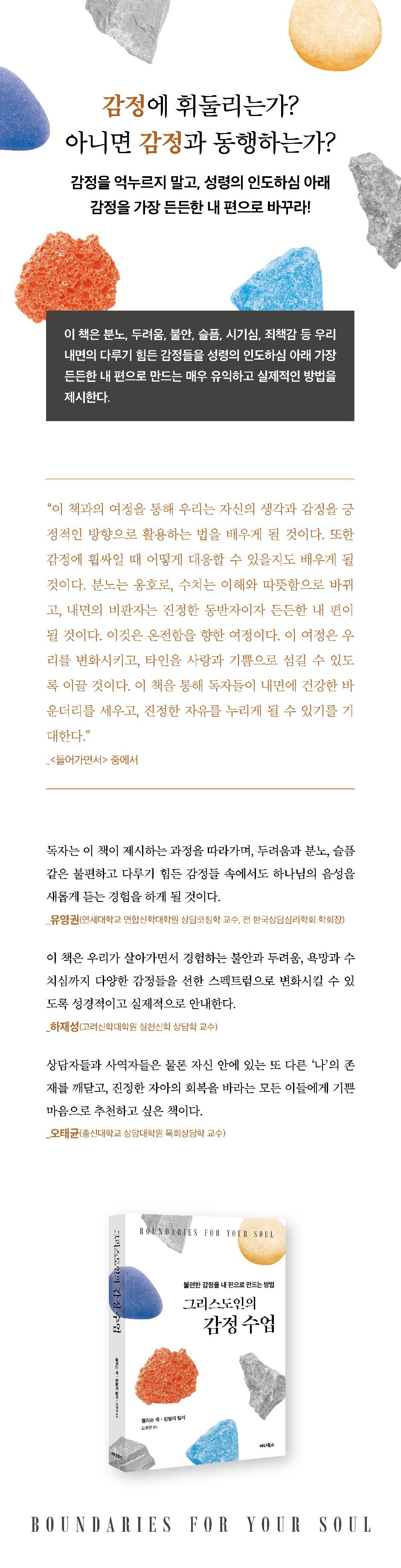
Are you swayed by emotions?
Or does it go along with emotions?
Do not suppress your emotions, but follow the guidance of the Holy Spirit.
Turn your emotions into your strongest ally!
This book presents a very helpful and practical way to turn difficult and uncomfortable emotions within us, such as anger, fear, anxiety, sadness, jealousy, and guilt, into our strongest allies under the guidance of the Holy Spirit.
Or does it go along with emotions?
Do not suppress your emotions, but follow the guidance of the Holy Spirit.
Turn your emotions into your strongest ally!
This book presents a very helpful and practical way to turn difficult and uncomfortable emotions within us, such as anger, fear, anxiety, sadness, jealousy, and guilt, into our strongest allies under the guidance of the Holy Spirit.
- You can preview some of the book's contents.
Preview
index
Recommendation 5
Entering 19
Part 1: A New Look at Our Souls
Chapter 1: Why Do Our Souls Need Boundaries? 31
Chapter 2: The True Self Guided by the Holy Spirit 53
Chapter 3: The Three Parts Within Me 71
Part 2: "You-Turn": Five Steps to Taking Care of Your Inner Self
Chapter 4, Step 1 - Focus 89
Chapter 5, Step 2 - Getting to Know Each Other 105
Chapter 6, Step 3 - Inviting 129
Chapter 7, Step 4 - Letting Go 155
Chapter 8, Step 5 - Integration 183
Part 3: Working with Uncomfortable Emotions: Setting Boundaries
Chapter 9: Anger 207
Chapter 10: Fear and Anxiety 225
Chapter 11: Sorrow 245
Chapter 12: Jealousy and Desire 263
Chapter 13: Guilt and Shame 281
Chapter 14: Other People's Uncomfortable Feelings 301
Acknowledgements
supplement
Map of the Soul 323
Five-Step Practice Guide 325
Glossary 329
Note 345
Entering 19
Part 1: A New Look at Our Souls
Chapter 1: Why Do Our Souls Need Boundaries? 31
Chapter 2: The True Self Guided by the Holy Spirit 53
Chapter 3: The Three Parts Within Me 71
Part 2: "You-Turn": Five Steps to Taking Care of Your Inner Self
Chapter 4, Step 1 - Focus 89
Chapter 5, Step 2 - Getting to Know Each Other 105
Chapter 6, Step 3 - Inviting 129
Chapter 7, Step 4 - Letting Go 155
Chapter 8, Step 5 - Integration 183
Part 3: Working with Uncomfortable Emotions: Setting Boundaries
Chapter 9: Anger 207
Chapter 10: Fear and Anxiety 225
Chapter 11: Sorrow 245
Chapter 12: Jealousy and Desire 263
Chapter 13: Guilt and Shame 281
Chapter 14: Other People's Uncomfortable Feelings 301
Acknowledgements
supplement
Map of the Soul 323
Five-Step Practice Guide 325
Glossary 329
Note 345
Detailed image
Into the book
“Ironically, our instinctive way of dealing with painful emotions often makes the problem worse.
The better the intentions of a person, the more likely he or she is to suppress or deny the feelings he or she dislikes.
The most common response to unwanted impulses is, "I need to get over this" or "I need to stop thinking about this."
However, in our experience as counselors and authors, this approach is often ineffective.
This book offers a different path toward the same goal.
It is a way of walking slowly rather than going faster, an approach that says, “Come now, let us reason together” (Isaiah 1:18).
This leads us to understand the painful parts of our souls and, furthermore, to become intimate with them.”
--- p.23
“The Christian’s Emotional Class” is the first book to deeply apply the concept of boundaries to inner thoughts and feelings.
The theory I found most useful in exploring this topic was the Internal Family Systems (IFS) model.
…This book not only presents an approach that integrates the concept of boundaries and the IFS model, but also interprets it from a Christian perspective.
It is clear why we, the authors, developed a Christian approach to IFS.
Ultimately, the best way to care for the parts of our soul that are overwhelming is to invite the Holy Spirit to be with them.”
--- pp.24-25
What is a boundary? A boundary is a boundary or limit that determines who I am, what I choose and do, and how far I will accept my own actions or those of others.
Our spirit, mind, heart, will, and body all have their own boundaries.
“Understanding these limitations allows a nation to respect not only the uniqueness of its own existence, but also the uniqueness of others.”
--- p.36
“The true self guided by the Holy Spirit is our true self, living according to the guidance of God who dwells within our souls.
This concept, which we, the authors, call the "Spirit-led Self," has been explored by many psychologists and spiritual leaders.
For example, the beloved author Henri Nouwen described that place deep within the soul as a place where the mind becomes clear, vision becomes clear, scattered thoughts and desires gather together, and truth can be abided in.”
--- p.61
“Like an out-of-control bus, problems arise when various parts of our soul begin to vie for control.
In fact, most emotional problems are a complex intertwining of deep-rooted inner parts that have taken over the soul.
In times like these, we no longer live under calm and clear leadership.
Instead, you lose your perspective, become confused, and become overwhelmed to the point where you find it difficult to cope with everything.
Change begins with the realization, 'I was just handing the steering wheel over to my kids!'
We have within us the power to take charge of and direct our thoughts and emotions, which are difficult to control.
“That power comes from none other than the true self, guided by the Holy Spirit.”
--- p.65
“This concept of becoming friendly with your inner enemy may be the exact opposite of how we have been taught to deal with emotions.
But criticizing and rejecting any part of ourselves doesn't make things better.
Rather, a more effective way is to become familiar with the part of me that makes me most uncomfortable, and only then can change occur.”
--- p.115
“Most of us live under the thumb of powerful inner guardians who blur our perception of reality.
Managers, in particular, make us believe that we are self-sufficient and deserve to be rewarded.
When these protective parts obscure our true selves, guided by the Holy Spirit, we begin to think of ourselves as the center of the world and lose sight of God.
“Many of these areas do not want Jesus to come near them because it means giving up control.”
--- p.148
“As we met each week, I got a glimpse of what Jesus meant when he reversed the concepts of the strong and the weak.
When we all come together, powerful spiritual power is revealed.
This truth applies equally to our inner selves.
What would happen if we brought together the strong protectors and the vulnerable exiles within us, and listened to each other's stories? We would experience a remarkable moment, when the protectors would gain a humble perspective, and the exiles would shine with a light they never imagined.
“The more we embrace our strengths and our vulnerabilities, the closer we get to true wholeness.”
--- p.200
“If you are grieving a loss, create space in your life to mourn.
It is no coincidence that about a third of the Psalms are composed of laments.
Sighing is not an expression of lack of faith, but rather an expression of holding on to faith to the end.
So let's make this promise to ourselves:
Whenever I feel pain, I will carefully examine the part of me that is sad and invite Jesus to be there.
This connection is more precious than anything else right now.
Because that sad part will lead to a new experience of God's kindness.
“Blessed are those who mourn, for they will be comforted” (Matthew 5:4).
--- p.263
“Desire sometimes feels painful and dangerous.
Because accepting it means becoming a vulnerable being exposed to loss and regret.
So we tend to shy away from desire and instead lean on envy.
But desire can also be the driving force that leads us to a richer life.
Without desire, who would want to get out of bed in the morning? If I want to live a full life, I must open my heart to the desires within me and gently bring them before God.”
--- p.279
In her TED Talk “The Power of Vulnerability,” Brene Brown argues that people who live fully are those who have the courage to reveal their imperfections to others and to themselves.
They willingly choose to let go of expectations of who they should be and be who they are.”
The better the intentions of a person, the more likely he or she is to suppress or deny the feelings he or she dislikes.
The most common response to unwanted impulses is, "I need to get over this" or "I need to stop thinking about this."
However, in our experience as counselors and authors, this approach is often ineffective.
This book offers a different path toward the same goal.
It is a way of walking slowly rather than going faster, an approach that says, “Come now, let us reason together” (Isaiah 1:18).
This leads us to understand the painful parts of our souls and, furthermore, to become intimate with them.”
--- p.23
“The Christian’s Emotional Class” is the first book to deeply apply the concept of boundaries to inner thoughts and feelings.
The theory I found most useful in exploring this topic was the Internal Family Systems (IFS) model.
…This book not only presents an approach that integrates the concept of boundaries and the IFS model, but also interprets it from a Christian perspective.
It is clear why we, the authors, developed a Christian approach to IFS.
Ultimately, the best way to care for the parts of our soul that are overwhelming is to invite the Holy Spirit to be with them.”
--- pp.24-25
What is a boundary? A boundary is a boundary or limit that determines who I am, what I choose and do, and how far I will accept my own actions or those of others.
Our spirit, mind, heart, will, and body all have their own boundaries.
“Understanding these limitations allows a nation to respect not only the uniqueness of its own existence, but also the uniqueness of others.”
--- p.36
“The true self guided by the Holy Spirit is our true self, living according to the guidance of God who dwells within our souls.
This concept, which we, the authors, call the "Spirit-led Self," has been explored by many psychologists and spiritual leaders.
For example, the beloved author Henri Nouwen described that place deep within the soul as a place where the mind becomes clear, vision becomes clear, scattered thoughts and desires gather together, and truth can be abided in.”
--- p.61
“Like an out-of-control bus, problems arise when various parts of our soul begin to vie for control.
In fact, most emotional problems are a complex intertwining of deep-rooted inner parts that have taken over the soul.
In times like these, we no longer live under calm and clear leadership.
Instead, you lose your perspective, become confused, and become overwhelmed to the point where you find it difficult to cope with everything.
Change begins with the realization, 'I was just handing the steering wheel over to my kids!'
We have within us the power to take charge of and direct our thoughts and emotions, which are difficult to control.
“That power comes from none other than the true self, guided by the Holy Spirit.”
--- p.65
“This concept of becoming friendly with your inner enemy may be the exact opposite of how we have been taught to deal with emotions.
But criticizing and rejecting any part of ourselves doesn't make things better.
Rather, a more effective way is to become familiar with the part of me that makes me most uncomfortable, and only then can change occur.”
--- p.115
“Most of us live under the thumb of powerful inner guardians who blur our perception of reality.
Managers, in particular, make us believe that we are self-sufficient and deserve to be rewarded.
When these protective parts obscure our true selves, guided by the Holy Spirit, we begin to think of ourselves as the center of the world and lose sight of God.
“Many of these areas do not want Jesus to come near them because it means giving up control.”
--- p.148
“As we met each week, I got a glimpse of what Jesus meant when he reversed the concepts of the strong and the weak.
When we all come together, powerful spiritual power is revealed.
This truth applies equally to our inner selves.
What would happen if we brought together the strong protectors and the vulnerable exiles within us, and listened to each other's stories? We would experience a remarkable moment, when the protectors would gain a humble perspective, and the exiles would shine with a light they never imagined.
“The more we embrace our strengths and our vulnerabilities, the closer we get to true wholeness.”
--- p.200
“If you are grieving a loss, create space in your life to mourn.
It is no coincidence that about a third of the Psalms are composed of laments.
Sighing is not an expression of lack of faith, but rather an expression of holding on to faith to the end.
So let's make this promise to ourselves:
Whenever I feel pain, I will carefully examine the part of me that is sad and invite Jesus to be there.
This connection is more precious than anything else right now.
Because that sad part will lead to a new experience of God's kindness.
“Blessed are those who mourn, for they will be comforted” (Matthew 5:4).
--- p.263
“Desire sometimes feels painful and dangerous.
Because accepting it means becoming a vulnerable being exposed to loss and regret.
So we tend to shy away from desire and instead lean on envy.
But desire can also be the driving force that leads us to a richer life.
Without desire, who would want to get out of bed in the morning? If I want to live a full life, I must open my heart to the desires within me and gently bring them before God.”
--- p.279
In her TED Talk “The Power of Vulnerability,” Brene Brown argues that people who live fully are those who have the courage to reveal their imperfections to others and to themselves.
They willingly choose to let go of expectations of who they should be and be who they are.”
--- p.300
Publisher's Review
“Emotions like anger, anxiety, fear, and shame are not enemies trying to harm and destroy us, but rather a part of our inner self that seeks to protect and defend us!”
All the emotions we feel, whether positive or negative, are gifts from God.
But sometimes we are overwhelmed by certain emotions and break down.
Yes, that's right.
We often find ourselves overwhelmed and tossed around by emotions like anger, fear, anxiety, jealousy, sadness, and guilt, which can leave us feeling devastated, straining our relationships with others, especially our loved ones, and even distancing us from our intimate fellowship with God.
So we antagonize these emotions and expend a lot of energy trying to suppress or eliminate them.
But this book tells us that those uncomfortable, difficult emotions are not actually our enemies to be suppressed or eliminated, but rather parts of our soul (our "inner family") that need attention and care.
Furthermore, it presents an innovative way to make those emotions into my strongest allies and companions, supporting and helping me grow under the guidance of the Holy Spirit.
The trick is to set appropriate boundaries for our inner emotions, just as we need to set appropriate boundaries to have healthy relationships with people outside of ourselves.
That is, we must ensure that our emotions are not too close to us (we become overwhelmed or swayed by them) or too far away (we suppress them and ignore them), but rather are handled within appropriate boundaries in the Holy Spirit.
To this end, the authors based their model on the IFS (Internal Family Systems) which deeply integrates the Bible and psychology.
It presents five steps called 'You-Turn'.
They are ① Focus, ② Befriend, ③ Invite, ④ Unburden, and ⑤ Integrate.
This process is not just theory; it is a practical exercise that can be applied to emotions that make us uncomfortable, such as anger, fear, anxiety, sadness, shame, and jealousy.
This book offers practical and spiritually profound answers to Christians seeking to hold on to their crumbling hearts, those struggling with emotional struggles in relationships and ministry, and counselors and pastors alike.
I hope that through this book, we can cultivate a new relationship with the uncomfortable emotions within us, so that we can no longer be swayed by emotions, but rather grow into people of God overflowing with love and truth.
This book consists of the following contents:
Part 1 explains why our souls need boundaries, the concept of the true self guided by the Holy Spirit, and the three main parts of the inner self: the manager, the firefighter, and the exile.
Part 2 introduces the five-step process of 'U-turning' (focus, become friendly, invite, let go, and integrate), and suggests ways to care for and recover from the inner confusion.
Part 3 guides you through how to apply the five-step "U-Turn" process outlined above to difficult emotions like anger, fear, anxiety, and sadness, as well as to the difficult emotions of others.
From 'Entering'
We need to pay attention to our inner issues such as anger, guilt, and unforgiveness.
Otherwise, these emotions can overwhelm us and cause unnecessary hurt to others.
When you are sick inside, it becomes difficult to do good to others.
Ironically, our instinctive way of dealing with painful emotions often makes the problem worse.
The better the intentions of a person, the more likely he or she is to suppress or deny the feelings he or she dislikes.
The most common response to unwanted impulses is, "I need to get over this" or "I need to stop thinking about this."
However, in our experience as counselors and authors, this approach is often ineffective.
This book offers a different path toward the same goal.
It is a way of walking slowly rather than going faster, an approach that says, “Come now, let us reason together” (Isaiah 1:18).
This leads us to understand the painful parts of our souls and, furthermore, to become intimate with them.
<syncopation>
What we are sure of is this:
“We accept unwanted thoughts and emotions as parts of our soul.
This way, we can understand how they are connected to each other and to our true self, which is guided by the Holy Spirit.
Just as we can live a peaceful life by establishing healthy boundaries with others, we can also establish beneficial boundaries with the various parts of our soul.
So let's think of these different parts of the soul as our inner family.
Let us picture our true selves, guided by the Holy Spirit, guiding them with courage and love, as wise and compassionate parents do.”
All the emotions we feel, whether positive or negative, are gifts from God.
But sometimes we are overwhelmed by certain emotions and break down.
Yes, that's right.
We often find ourselves overwhelmed and tossed around by emotions like anger, fear, anxiety, jealousy, sadness, and guilt, which can leave us feeling devastated, straining our relationships with others, especially our loved ones, and even distancing us from our intimate fellowship with God.
So we antagonize these emotions and expend a lot of energy trying to suppress or eliminate them.
But this book tells us that those uncomfortable, difficult emotions are not actually our enemies to be suppressed or eliminated, but rather parts of our soul (our "inner family") that need attention and care.
Furthermore, it presents an innovative way to make those emotions into my strongest allies and companions, supporting and helping me grow under the guidance of the Holy Spirit.
The trick is to set appropriate boundaries for our inner emotions, just as we need to set appropriate boundaries to have healthy relationships with people outside of ourselves.
That is, we must ensure that our emotions are not too close to us (we become overwhelmed or swayed by them) or too far away (we suppress them and ignore them), but rather are handled within appropriate boundaries in the Holy Spirit.
To this end, the authors based their model on the IFS (Internal Family Systems) which deeply integrates the Bible and psychology.
It presents five steps called 'You-Turn'.
They are ① Focus, ② Befriend, ③ Invite, ④ Unburden, and ⑤ Integrate.
This process is not just theory; it is a practical exercise that can be applied to emotions that make us uncomfortable, such as anger, fear, anxiety, sadness, shame, and jealousy.
This book offers practical and spiritually profound answers to Christians seeking to hold on to their crumbling hearts, those struggling with emotional struggles in relationships and ministry, and counselors and pastors alike.
I hope that through this book, we can cultivate a new relationship with the uncomfortable emotions within us, so that we can no longer be swayed by emotions, but rather grow into people of God overflowing with love and truth.
This book consists of the following contents:
Part 1 explains why our souls need boundaries, the concept of the true self guided by the Holy Spirit, and the three main parts of the inner self: the manager, the firefighter, and the exile.
Part 2 introduces the five-step process of 'U-turning' (focus, become friendly, invite, let go, and integrate), and suggests ways to care for and recover from the inner confusion.
Part 3 guides you through how to apply the five-step "U-Turn" process outlined above to difficult emotions like anger, fear, anxiety, and sadness, as well as to the difficult emotions of others.
From 'Entering'
We need to pay attention to our inner issues such as anger, guilt, and unforgiveness.
Otherwise, these emotions can overwhelm us and cause unnecessary hurt to others.
When you are sick inside, it becomes difficult to do good to others.
Ironically, our instinctive way of dealing with painful emotions often makes the problem worse.
The better the intentions of a person, the more likely he or she is to suppress or deny the feelings he or she dislikes.
The most common response to unwanted impulses is, "I need to get over this" or "I need to stop thinking about this."
However, in our experience as counselors and authors, this approach is often ineffective.
This book offers a different path toward the same goal.
It is a way of walking slowly rather than going faster, an approach that says, “Come now, let us reason together” (Isaiah 1:18).
This leads us to understand the painful parts of our souls and, furthermore, to become intimate with them.
<syncopation>
What we are sure of is this:
“We accept unwanted thoughts and emotions as parts of our soul.
This way, we can understand how they are connected to each other and to our true self, which is guided by the Holy Spirit.
Just as we can live a peaceful life by establishing healthy boundaries with others, we can also establish beneficial boundaries with the various parts of our soul.
So let's think of these different parts of the soul as our inner family.
Let us picture our true selves, guided by the Holy Spirit, guiding them with courage and love, as wise and compassionate parents do.”
GOODS SPECIFICS
- Date of issue: November 3, 2025
- Page count, weight, size: 352 pages | 138*211*30mm
- ISBN13: 9791199079984
- ISBN10: 1199079987
You may also like
카테고리
korean


korean

![GQ KOREA Mark (Monthly): December [2025]](http://librairie.coreenne.fr/cdn/shop/files/8ef265dbbfbf186523ed75ba7319009d.jpg?v=1765340328&width=3840)


