

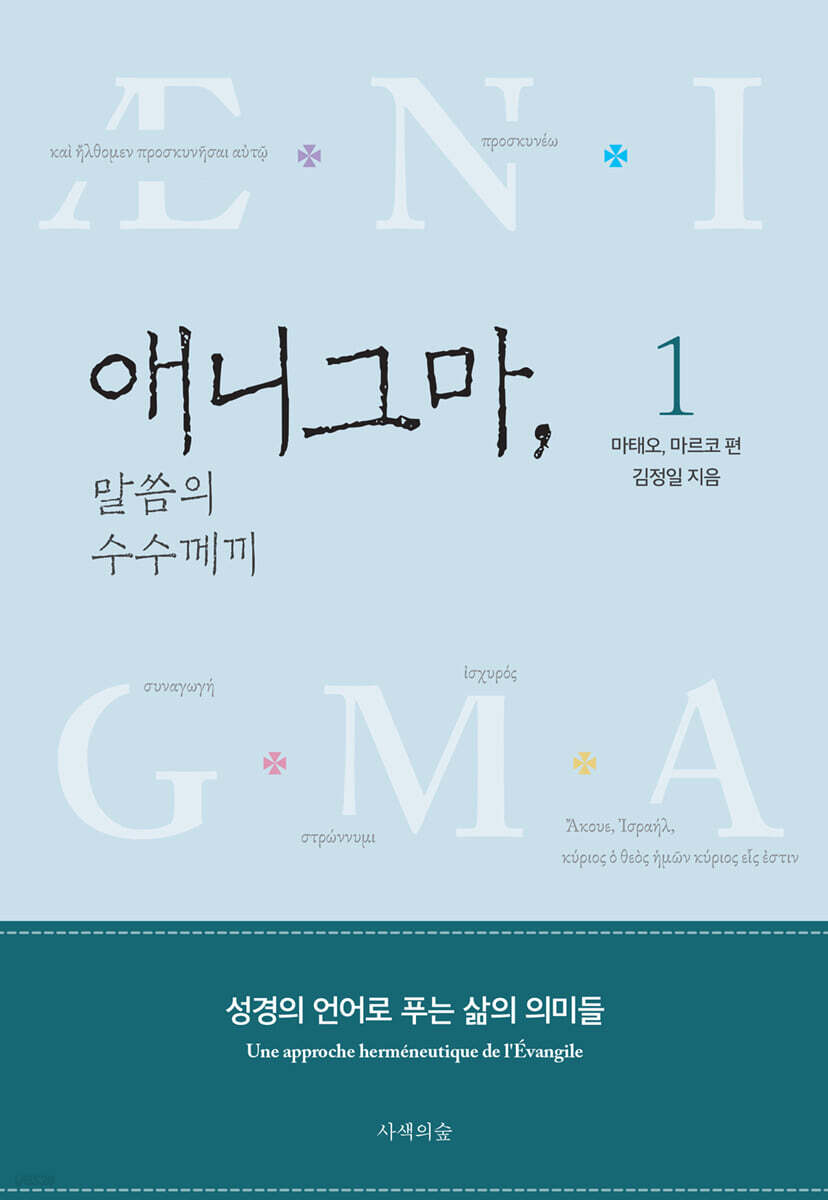
Enigma, the Riddle of the Word 1
 |
Description
Book Introduction
The Bible contains the word of God, but its meaning is so profound and profound that it leaves room for incomprehension every time I read it.
This book confronts this enigmatic margin of meaning and hermeneutically unravels the profound dimensions of the words contained within.
To this end, the author presents the original Greek texts that are key to 50 episodes selected from the Gospels of Matthew and Mark.
And by examining the historical context of the word and its connection within the text, we also think about the true meaning revealed in the text while crossing the humanities terrain such as philosophy, history, and literature.
Rather than providing a definitive answer, this book shows the journey of such interpretation.
We can see the open cycle of words and life constantly interacting, the "hermeneutics of grace," unfolding through the author's delicate and warm language.
By participating in this process, you will experience a new experience where you will be able to think for yourself and ask questions that fit your life.
Blending deep theological insight with thoughtful reflection, this book will be a valuable companion for any reader seeking a fresh understanding of the Bible.
This book confronts this enigmatic margin of meaning and hermeneutically unravels the profound dimensions of the words contained within.
To this end, the author presents the original Greek texts that are key to 50 episodes selected from the Gospels of Matthew and Mark.
And by examining the historical context of the word and its connection within the text, we also think about the true meaning revealed in the text while crossing the humanities terrain such as philosophy, history, and literature.
Rather than providing a definitive answer, this book shows the journey of such interpretation.
We can see the open cycle of words and life constantly interacting, the "hermeneutics of grace," unfolding through the author's delicate and warm language.
By participating in this process, you will experience a new experience where you will be able to think for yourself and ask questions that fit your life.
Blending deep theological insight with thoughtful reflection, this book will be a valuable companion for any reader seeking a fresh understanding of the Bible.
- You can preview some of the book's contents.
Preview
index
Part 1: Stars and Treasures
01 · About the reception
02 · About the Stars
03 · On Worship (1)
04 · About locusts and wild honey
05 · About the wilderness
06 · About people sitting and walking
07 · About Happiness
08 · On Light and Salt
09 · Concerning God's Justice
10 · About the True Worker
11 · On Endurance
12 · On Martyrdom
13 · About Life
14 · About waiting
15 · Concerning the Sower
16 · About Treasures
17 · On having courage
Part 2: Useless Bell
01 · About asking for help
02 · About establishing a church
03 · About stumbling blocks
04 · About change
05 · About Tying
06 · On Gathering and Gathering
07 · About the last person to arrive
08 · About What the Lord Needs
09 · About the Wicked Tenants
10 · About Equipping
11 · About serving
12 · On Being Awake (1)
13 · About the Useless Bell
14 · Concerning the least
15 · About this
16 · Concerning Worship (2)
17 · Regarding dispatch
Part 3 Shema, Israel
01 · About greater abilities
02 · About unclean spirits
03 · About holding hands
04 · About being afraid
05 · About what happens
06 · About resting
07 · On preserving tradition
08 · About Ephphatha
09 · About Satan
10 · About relationships
11 · On selling what you have
12 · Shema, Concerning Israel
13 · Concerning the offering of the poor widow
14 · Concerning the Spirit of God
15 · On Being Awake (2)
16 · Concerning the Eschatological Election
01 · About the reception
02 · About the Stars
03 · On Worship (1)
04 · About locusts and wild honey
05 · About the wilderness
06 · About people sitting and walking
07 · About Happiness
08 · On Light and Salt
09 · Concerning God's Justice
10 · About the True Worker
11 · On Endurance
12 · On Martyrdom
13 · About Life
14 · About waiting
15 · Concerning the Sower
16 · About Treasures
17 · On having courage
Part 2: Useless Bell
01 · About asking for help
02 · About establishing a church
03 · About stumbling blocks
04 · About change
05 · About Tying
06 · On Gathering and Gathering
07 · About the last person to arrive
08 · About What the Lord Needs
09 · About the Wicked Tenants
10 · About Equipping
11 · About serving
12 · On Being Awake (1)
13 · About the Useless Bell
14 · Concerning the least
15 · About this
16 · Concerning Worship (2)
17 · Regarding dispatch
Part 3 Shema, Israel
01 · About greater abilities
02 · About unclean spirits
03 · About holding hands
04 · About being afraid
05 · About what happens
06 · About resting
07 · On preserving tradition
08 · About Ephphatha
09 · About Satan
10 · About relationships
11 · On selling what you have
12 · Shema, Concerning Israel
13 · Concerning the offering of the poor widow
14 · Concerning the Spirit of God
15 · On Being Awake (2)
16 · Concerning the Eschatological Election
Detailed image

Into the book
‘Accepting’ does not mean accepting the other into the subject called ‘I’, but rather the subject called ‘I’ completely enters into the other.
The angel of the Lord's words to Joseph telling him not to be afraid and to take Mary as his wife were like telling him to go deep into the power of the Holy Spirit that made Mary pregnant.
It also means to completely entrust my existence to God Emmanuel, move toward the other person, and ultimately become one with him.
--- p.24
When the scribes and Pharisees began to argue about how to keep the law without paying attention to its spirit, Jesus compared them to salt that had lost its flavor.
This also means that they are foolish.
The law was given by God to care for life and to care for humanity, but it requires flexibility to be applied appropriately in each era.
However, if we try to mechanically follow the provisions of the law, we will end up being foolish and forgetting the original meaning.
When Jesus said that they had lost their taste (moraino), he was trying to awaken the foolishness of such legalists.
--- p.69
The Gospel message about the treasure hidden in the field makes us reflect on how we live and preserve things and life.
It is I who make things treasures, and it is I who make this world a good and wonderful storehouse in itself.
The person who sold everything he had to buy the field where the treasure was hidden had a true heart that truly recognized the value of things and cherished them.
Therefore, the human mind is the source that allows treasures to shine as treasures.
It is a special wisdom, love and spirituality that allows us to see the true meaning of things.
A person who has discovered a treasure or a pearl has discovered the true meaning hidden in the world, in things, in people and events.
If I could discover the true meaning hidden within the world, I would not regret selling everything I have.
--- p.120
The Bible says that the owner of this vineyard is like the kingdom of heaven (Matthew 20:1).
A country where everyone can care for and protect their lives, a country where we do not turn a blind eye to the pain and despair of our neighbors but share in them and live together—this is the kingdom of heaven.
The workers who worked all day had reason to complain.
Because I did more work, but the pay was the same.
They put forward 'equal pay for equal work' as the standard of fairness.
It's mechanical fairness.
But the kingdom of heaven has different standards.
Everyone should be given a chance, and any chance should be rewarded with a minimum standard of living.
Because that country is not a world of competition where acorns measure their height, but a country where everyone cares for one another, protects the dignity of life, and enjoys the fullness of existence together.
--- p.175
The Greek word used in the Gospel of Matthew to mean 'least' is 'elakistos (?λ?χιστο?)'.
This is the superlative form of the adjective 'micros (μικρ??)', which means small in size or volume.
'Micros' refers to physical dwarfism, such as small stature and light weight, as in the case of Zacchaeus (cf. Luke 19:3).
Or it could refer to someone younger or of lower status and rank, as seen in Jesus' words warning against looking down on children or the little ones (cf. Matthew 18:10).
'Elachistos' means the smallest and most insignificant, so it is used to refer to insignificant events, trivial objects, or insignificant people that are not easily noticed.
In other words, it is used for objects and people with little or no presence.
--- p.215
'Talita Kum!' is a word that awakens all those who have not yet realized the Lord and are trapped in darkness, telling them to wake up now, "like shaking the dawn" (cf. Psalm 108:2-3).
'Talita Kum' is a call to abandon the old life and live a new life.
'Egeiro' means to rise from spiritual death and live a new life of resurrection.
The miracle of raising Jairus' daughter, the synagogue leader, is clearly a demonstration of the Lord's power to raise even the dead, but symbolically, it is a teaching that awakens our sleeping souls and bodies.
Jesus also raised the dead son of a widow in the town of Nain with the same words: “Young man, I tell you,
“Get up (to Aegei).” (Luke 7:14)
--- p.271
Of course, what she put into the offering box was money, but the reason the Gospel of Mark specifically calls it "bios" is probably because it wanted to convey a truth that goes beyond the level of money.
Her bios is the very form of her life.
He gave his unique life, which he had maintained until now, to God.
Surrendering our lives to God does not mean surrendering our lives, but rather faithfully accepting that God is Lord of the world and of our lives.
It is a confession and resolution to live with the character and attitude of trusting in God, relying on God, and humbly following God, and to continue to live that way in the future.
It was this faithful attitude toward life that she dedicated to God.
The angel of the Lord's words to Joseph telling him not to be afraid and to take Mary as his wife were like telling him to go deep into the power of the Holy Spirit that made Mary pregnant.
It also means to completely entrust my existence to God Emmanuel, move toward the other person, and ultimately become one with him.
--- p.24
When the scribes and Pharisees began to argue about how to keep the law without paying attention to its spirit, Jesus compared them to salt that had lost its flavor.
This also means that they are foolish.
The law was given by God to care for life and to care for humanity, but it requires flexibility to be applied appropriately in each era.
However, if we try to mechanically follow the provisions of the law, we will end up being foolish and forgetting the original meaning.
When Jesus said that they had lost their taste (moraino), he was trying to awaken the foolishness of such legalists.
--- p.69
The Gospel message about the treasure hidden in the field makes us reflect on how we live and preserve things and life.
It is I who make things treasures, and it is I who make this world a good and wonderful storehouse in itself.
The person who sold everything he had to buy the field where the treasure was hidden had a true heart that truly recognized the value of things and cherished them.
Therefore, the human mind is the source that allows treasures to shine as treasures.
It is a special wisdom, love and spirituality that allows us to see the true meaning of things.
A person who has discovered a treasure or a pearl has discovered the true meaning hidden in the world, in things, in people and events.
If I could discover the true meaning hidden within the world, I would not regret selling everything I have.
--- p.120
The Bible says that the owner of this vineyard is like the kingdom of heaven (Matthew 20:1).
A country where everyone can care for and protect their lives, a country where we do not turn a blind eye to the pain and despair of our neighbors but share in them and live together—this is the kingdom of heaven.
The workers who worked all day had reason to complain.
Because I did more work, but the pay was the same.
They put forward 'equal pay for equal work' as the standard of fairness.
It's mechanical fairness.
But the kingdom of heaven has different standards.
Everyone should be given a chance, and any chance should be rewarded with a minimum standard of living.
Because that country is not a world of competition where acorns measure their height, but a country where everyone cares for one another, protects the dignity of life, and enjoys the fullness of existence together.
--- p.175
The Greek word used in the Gospel of Matthew to mean 'least' is 'elakistos (?λ?χιστο?)'.
This is the superlative form of the adjective 'micros (μικρ??)', which means small in size or volume.
'Micros' refers to physical dwarfism, such as small stature and light weight, as in the case of Zacchaeus (cf. Luke 19:3).
Or it could refer to someone younger or of lower status and rank, as seen in Jesus' words warning against looking down on children or the little ones (cf. Matthew 18:10).
'Elachistos' means the smallest and most insignificant, so it is used to refer to insignificant events, trivial objects, or insignificant people that are not easily noticed.
In other words, it is used for objects and people with little or no presence.
--- p.215
'Talita Kum!' is a word that awakens all those who have not yet realized the Lord and are trapped in darkness, telling them to wake up now, "like shaking the dawn" (cf. Psalm 108:2-3).
'Talita Kum' is a call to abandon the old life and live a new life.
'Egeiro' means to rise from spiritual death and live a new life of resurrection.
The miracle of raising Jairus' daughter, the synagogue leader, is clearly a demonstration of the Lord's power to raise even the dead, but symbolically, it is a teaching that awakens our sleeping souls and bodies.
Jesus also raised the dead son of a widow in the town of Nain with the same words: “Young man, I tell you,
“Get up (to Aegei).” (Luke 7:14)
--- p.271
Of course, what she put into the offering box was money, but the reason the Gospel of Mark specifically calls it "bios" is probably because it wanted to convey a truth that goes beyond the level of money.
Her bios is the very form of her life.
He gave his unique life, which he had maintained until now, to God.
Surrendering our lives to God does not mean surrendering our lives, but rather faithfully accepting that God is Lord of the world and of our lives.
It is a confession and resolution to live with the character and attitude of trusting in God, relying on God, and humbly following God, and to continue to live that way in the future.
It was this faithful attitude toward life that she dedicated to God.
--- p.322
Publisher's Review
Using hermeneutics to interpret the hidden meaning in the language of the Gospels.
The margins of the mysterious words
The depth of the Bible beyond understanding
The Bible is the scripture of Christianity.
Christians encounter God's word in the Bible and find the path they should take in life.
The words of the Bible are a grace that guides those who seek their path within it, and they are also the foundation for establishing life.
For this reason, understanding the Bible correctly has always been an important issue.
However, the biblical text is often ambiguous and confusing rather than clear.
It may have a different meaning every time you read it, and sometimes you may not be able to figure out the meaning no matter how many times you read it.
Because although it is written in human language, it contains the inspiration of God that transcends language.
Unlike any other text produced by humans, the Bible contains a high, deep, and sacred dimension of divine mystery that is difficult for human intellect alone to fully comprehend.
No matter what interpretation is offered, there is still room for unexplained meaning in the Bible.
The enigmatic, distant space of meaning is the source that reveals the profound dimension of the Word.
Divine truth contained in a single word
A hermeneutical attempt to solve the riddle of the Word
"Enigma, the Riddle of the Word" is an attempt to engage with the riddle behind interpretation and contemplate the deeper truth of the word.
The riddle of the Word, or 'enigma,' is an obstacle that blocks understanding the Word, but at the same time it is also a clue and guide that leads into a deeper dimension of the Word.
That is precisely why the author placed Enigma at the center of biblical interpretation.
The author takes as his starting point the concept of 'knowledge ignorance (docta ignorantia)' as described by Nicholas of Cusa.
Human beings can never fully possess the essence of God's mystery.
But that is why humans always seek deeper understanding, and by going back and forth between what they already know and what they still do not know, they gradually get closer to the truth.
This endless journey of conjecture and interpretation is called the "hermeneutic circle," and it is through this hermeneutic method that the author unravels the riddle of the Word.
What the author particularly paid attention to was the original Greek text of the Bible.
By selecting key words from various episodes of the Gospel and carefully examining their roots, historical context, and biblical connections, the author vividly and richly unfolds the semantic structure contained in the text.
For example, the “star” (Aster) that guided the Magi is both a star that decorates the night sky and a symbol of the divine unfolding of truth, and their act of “worshiping” (proskuneo) the baby Jesus is an act of absolute love and obedience toward God, as well as an event of grace in which the Lord first served humanity.
He also rebuked his beloved disciple Peter as a “stumbling block” (skandalon) in warm language to show the paradoxical nature of human existence, in which sin and temptation begin as obstacles, but also grow and are refined through such falls.
In this way, the author, through his unique hermeneutics, clearly demonstrates that even the smallest word in the Bible contains divine meaning and profound grace.
Reading the Bible as a Journey of Questions
Hermeneutics of Grace and Endless Speculation
However, this book does not provide complete answers.
For the author, theology is a journey of sharing questions.
The author's interest is not in mere theory, but in our lives unfolding on this earth.
Reading and understanding the Bible also interacts with real life.
Because as we live, we gain clues to interpreting the Word, and as we read the Bible, we gain clues to life.
The author calls this cycle and process of interpretation of words and life "the hermeneutics of grace," a journey that progresses through constant questioning and never ends.
So, instead of providing answers, this book poses open questions.
The goal is to make readers think for themselves about how the horizons presented in the text can be applied to their own lives.
As we follow the author's profound theological insights and warm, nuanced meditations, we find ourselves standing in the very place where we must respond to the invitations and questions posed by the biblical text.
So the remaining story is up to the reader.
The most valuable experience this book seeks to share is a reflective attitude of questioning, thinking, and questioning again to reflect on one's place in life.
The Gospel Still Calls Us
A companion for meditation that connects words and life
"Enigma: The Enigma of the Word" is a rare interpretation of the Gospels that combines theological depth with meditative kindness.
This first volume, to be published first, covers 50 selected episodes from the Gospels of Matthew and Mark.
It conveys beautiful meditations centered around key words in the text in simple, concise, yet warm language.
* For all those who want to read the Bible more deeply
* For general readers who want to explore linguistic, philosophical, and theological topics
* To all Christians who wish to live their faith through practical meditation
* To pastors and theological researchers who prepare meditations to share with believers in the pastoral field
This book will be a useful companion.
The margins of the mysterious words
The depth of the Bible beyond understanding
The Bible is the scripture of Christianity.
Christians encounter God's word in the Bible and find the path they should take in life.
The words of the Bible are a grace that guides those who seek their path within it, and they are also the foundation for establishing life.
For this reason, understanding the Bible correctly has always been an important issue.
However, the biblical text is often ambiguous and confusing rather than clear.
It may have a different meaning every time you read it, and sometimes you may not be able to figure out the meaning no matter how many times you read it.
Because although it is written in human language, it contains the inspiration of God that transcends language.
Unlike any other text produced by humans, the Bible contains a high, deep, and sacred dimension of divine mystery that is difficult for human intellect alone to fully comprehend.
No matter what interpretation is offered, there is still room for unexplained meaning in the Bible.
The enigmatic, distant space of meaning is the source that reveals the profound dimension of the Word.
Divine truth contained in a single word
A hermeneutical attempt to solve the riddle of the Word
"Enigma, the Riddle of the Word" is an attempt to engage with the riddle behind interpretation and contemplate the deeper truth of the word.
The riddle of the Word, or 'enigma,' is an obstacle that blocks understanding the Word, but at the same time it is also a clue and guide that leads into a deeper dimension of the Word.
That is precisely why the author placed Enigma at the center of biblical interpretation.
The author takes as his starting point the concept of 'knowledge ignorance (docta ignorantia)' as described by Nicholas of Cusa.
Human beings can never fully possess the essence of God's mystery.
But that is why humans always seek deeper understanding, and by going back and forth between what they already know and what they still do not know, they gradually get closer to the truth.
This endless journey of conjecture and interpretation is called the "hermeneutic circle," and it is through this hermeneutic method that the author unravels the riddle of the Word.
What the author particularly paid attention to was the original Greek text of the Bible.
By selecting key words from various episodes of the Gospel and carefully examining their roots, historical context, and biblical connections, the author vividly and richly unfolds the semantic structure contained in the text.
For example, the “star” (Aster) that guided the Magi is both a star that decorates the night sky and a symbol of the divine unfolding of truth, and their act of “worshiping” (proskuneo) the baby Jesus is an act of absolute love and obedience toward God, as well as an event of grace in which the Lord first served humanity.
He also rebuked his beloved disciple Peter as a “stumbling block” (skandalon) in warm language to show the paradoxical nature of human existence, in which sin and temptation begin as obstacles, but also grow and are refined through such falls.
In this way, the author, through his unique hermeneutics, clearly demonstrates that even the smallest word in the Bible contains divine meaning and profound grace.
Reading the Bible as a Journey of Questions
Hermeneutics of Grace and Endless Speculation
However, this book does not provide complete answers.
For the author, theology is a journey of sharing questions.
The author's interest is not in mere theory, but in our lives unfolding on this earth.
Reading and understanding the Bible also interacts with real life.
Because as we live, we gain clues to interpreting the Word, and as we read the Bible, we gain clues to life.
The author calls this cycle and process of interpretation of words and life "the hermeneutics of grace," a journey that progresses through constant questioning and never ends.
So, instead of providing answers, this book poses open questions.
The goal is to make readers think for themselves about how the horizons presented in the text can be applied to their own lives.
As we follow the author's profound theological insights and warm, nuanced meditations, we find ourselves standing in the very place where we must respond to the invitations and questions posed by the biblical text.
So the remaining story is up to the reader.
The most valuable experience this book seeks to share is a reflective attitude of questioning, thinking, and questioning again to reflect on one's place in life.
The Gospel Still Calls Us
A companion for meditation that connects words and life
"Enigma: The Enigma of the Word" is a rare interpretation of the Gospels that combines theological depth with meditative kindness.
This first volume, to be published first, covers 50 selected episodes from the Gospels of Matthew and Mark.
It conveys beautiful meditations centered around key words in the text in simple, concise, yet warm language.
* For all those who want to read the Bible more deeply
* For general readers who want to explore linguistic, philosophical, and theological topics
* To all Christians who wish to live their faith through practical meditation
* To pastors and theological researchers who prepare meditations to share with believers in the pastoral field
This book will be a useful companion.
GOODS SPECIFICS
- Date of issue: June 22, 2025
- Page count, weight, size: 344 pages | 145*210*30mm
- ISBN13: 9791197329661
- ISBN10: 1197329668
You may also like
카테고리
korean


korean

![GQ KOREA Mark (Monthly): December [2025]](http://librairie.coreenne.fr/cdn/shop/files/8ef265dbbfbf186523ed75ba7319009d.jpg?v=1765340328&width=3840)


