

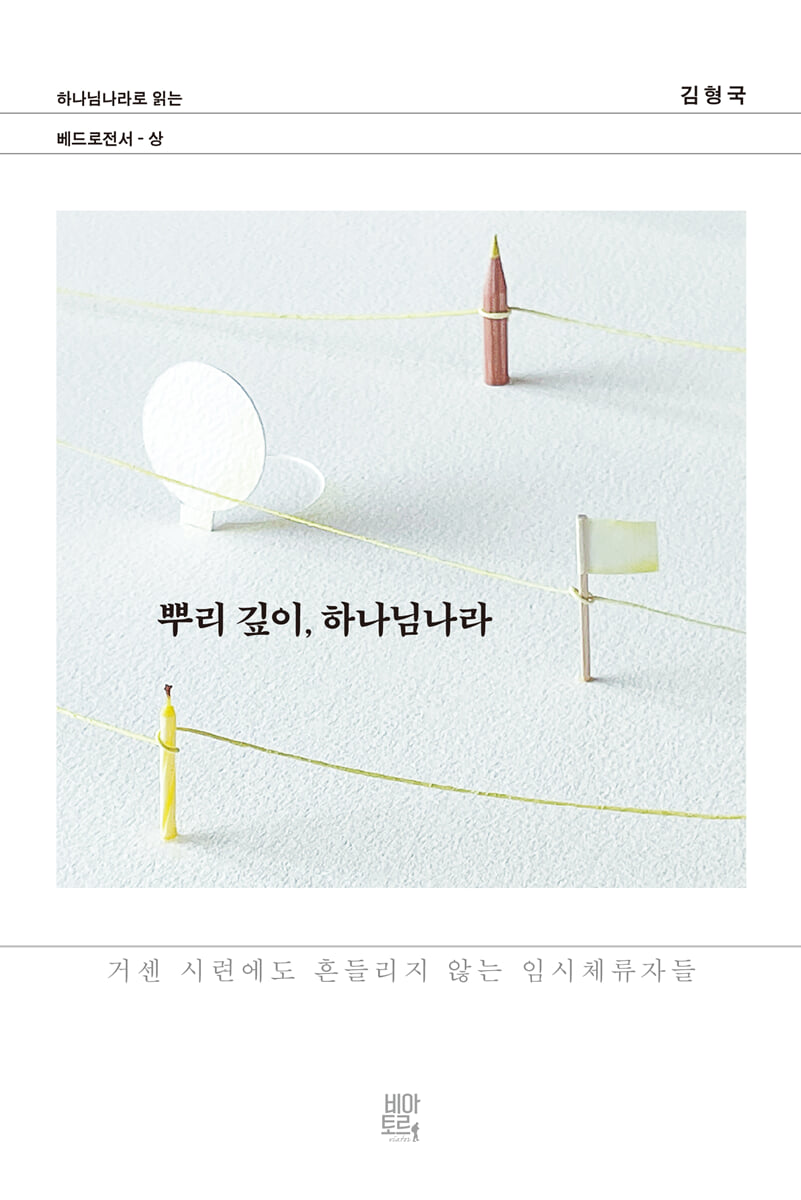
Deeply Rooted, Kingdom of God
 |
Description
Book Introduction
Who do Christians say they are?
Is it an identity that you have acquired through life, rather than something you learned or heard?
The Apostle Peter's message to the scattered Christians: "The True Nature of a Christian"
The Apostle Peter, while encouraging and strengthening the early Christians scattered throughout Asia Minor, gives a detailed introduction to 'Christians' as people who are like this.
It emphasizes how deep-rooted and solid the Christian faith they have established is.
He encourages us to pass through this period of 'temporary sojourn' by placing our hope in the kingdom of God, which seems so insignificant compared to the power and promise of the Roman Empire.
What was the force that sustained them and enabled them to live as Christians amidst adverse circumstances? "Deep Roots, the Kingdom of God" unravels the essence of that faith, line by line from the Apostle Peter's letters.
Who a Christian considers himself to be is not as simple as it may seem.
If you vaguely define your identity based on what you heard or learned from others, you may end up in a difficult situation.
We know better than anyone else that we are not actually that kind of person.
To us, the Apostle Peter speaks firmly.
Do you know how great the gift we, God's chosen people and temporary residents, have been given? How could we remain silent when this happens to us?
To modern eyes, Rome has long since vanished, and the seemingly insignificant kingdom of God still stands as a large, green tree where anyone in the world can nest.
Yet, perhaps we are still more attracted to the ideas of worldly architects than to God's divine house.
So the affection and confidence that the Apostle Peter expressed in his letter still resonates among us today.
『Deep Roots, Kingdom of God』, which covers the first half of 1 Peter, is the third book in the 'Reading the Bible through the Kingdom of God' series, following 『Disaster Again, Kingdom of God Again』 and 『Kingdom of God in the City』.
A book covering the latter part of 1 Peter is also scheduled to be published soon.
Is it an identity that you have acquired through life, rather than something you learned or heard?
The Apostle Peter's message to the scattered Christians: "The True Nature of a Christian"
The Apostle Peter, while encouraging and strengthening the early Christians scattered throughout Asia Minor, gives a detailed introduction to 'Christians' as people who are like this.
It emphasizes how deep-rooted and solid the Christian faith they have established is.
He encourages us to pass through this period of 'temporary sojourn' by placing our hope in the kingdom of God, which seems so insignificant compared to the power and promise of the Roman Empire.
What was the force that sustained them and enabled them to live as Christians amidst adverse circumstances? "Deep Roots, the Kingdom of God" unravels the essence of that faith, line by line from the Apostle Peter's letters.
Who a Christian considers himself to be is not as simple as it may seem.
If you vaguely define your identity based on what you heard or learned from others, you may end up in a difficult situation.
We know better than anyone else that we are not actually that kind of person.
To us, the Apostle Peter speaks firmly.
Do you know how great the gift we, God's chosen people and temporary residents, have been given? How could we remain silent when this happens to us?
To modern eyes, Rome has long since vanished, and the seemingly insignificant kingdom of God still stands as a large, green tree where anyone in the world can nest.
Yet, perhaps we are still more attracted to the ideas of worldly architects than to God's divine house.
So the affection and confidence that the Apostle Peter expressed in his letter still resonates among us today.
『Deep Roots, Kingdom of God』, which covers the first half of 1 Peter, is the third book in the 'Reading the Bible through the Kingdom of God' series, following 『Disaster Again, Kingdom of God Again』 and 『Kingdom of God in the City』.
A book covering the latter part of 1 Peter is also scheduled to be published soon.
- You can preview some of the book's contents.
Preview
index
Prologue: Taking root in another world
1.
Dual Identity 1:1-2
First identity
Second identity
2.
Last Days 1:3-7
Unanswered questions
Rebirth
Five gifts
3.
The Emotion of a Lifetime 1:8-12
What comes after being born again
The historical consciousness of a reborn person
Be reborn as a worshiper
4.
A New Dream 1:13-16
The grace of “therefore”
New expectations, hopes
New pursuit, holiness
5.
New Life 1:17-2:3
New perspective, awe
New relationship, love
New energy source, truth
6.
New Home 2:4-10
Two worlds
Priestly Nation Plan
Today's misunderstandings and the original excitement
supplement
Bible.
1 Peter KHKV
celebration.
A song of hope for the kingdom of God
contemplation.
Six Encounters: Reading Together and Sharing Our Lives
1.
Dual Identity 1:1-2
First identity
Second identity
2.
Last Days 1:3-7
Unanswered questions
Rebirth
Five gifts
3.
The Emotion of a Lifetime 1:8-12
What comes after being born again
The historical consciousness of a reborn person
Be reborn as a worshiper
4.
A New Dream 1:13-16
The grace of “therefore”
New expectations, hopes
New pursuit, holiness
5.
New Life 1:17-2:3
New perspective, awe
New relationship, love
New energy source, truth
6.
New Home 2:4-10
Two worlds
Priestly Nation Plan
Today's misunderstandings and the original excitement
supplement
Bible.
1 Peter KHKV
celebration.
A song of hope for the kingdom of God
contemplation.
Six Encounters: Reading Together and Sharing Our Lives
Into the book
Of all the books in the New Testament, 1 Peter is the most outstanding in its treatment of Christian identity.
The Apostle Peter wrote this letter to Christians scattered throughout Asia Minor in the early 60s AD.
The recipients lived in neighborhoods and environments that challenged their identities.
So this letter serves as an excellent guide for modern Christians who are living through many difficulties and crises today.
--- p.22
Temporary residents know very well that they do not belong to the country of residence.
However, we live while respecting the culture and laws of the place we reside.
However, people with a clear sense of self-identity are neither brainwashed nor subservient to the values and lifestyles of the place they reside.
Although there are times when you have to follow the standards of your place of residence, that doesn't change your identity.
--- p.45
Christians, the 'temporary residents' who live scattered throughout the world, are people who have obtained a completely different status through rebirth.
That is why the Apostle Peter called them “the elect” in the opening greeting of his letter.
Based on the fact that we have received amazing salvation, the Apostle Peter teaches us how to live as temporary residents.
--- p.74
God's salvation, how great is this gift we have received.
This is why Christians, who are merely temporary residents, can live with pride and dignity.
The salvation we have received is something God planned long ago to restore a broken and wounded world, something prophets researched and foresaw and foretold, something countless people risked their lives to spread, and something angels still watch with anticipation.
That salvation is a reality that is being realized within us.
The saints of the early church also enjoyed salvation and waited for the second coming of Jesus Christ. Even though they could not see Him in person, they loved Him, believed in Him, and rejoiced in Him.
--- p.111
It is important to properly understand the truth.
When you correctly understand the truth, you will have dreams based on it, and you will live to achieve those dreams.
But if you don't understand the truth properly, you will dream dreams based on what you believe to be the real truth, and you will live your life accordingly.
Many Christians say they believe in God, but they do not truly understand God's truth and consider something else to be absolutely important in life.
Therefore, before we change our lives, it is important to check whether we have a dream worth pursuing and whether we possess the foundation for achieving that dream—the true truth.
--- p.149~150
The expression “period” indicates that the period of living as a temporary resident is a time in one’s life.
It suggests that when the “temporary resident period” ends, “another period” will come.
The world constantly forces a closed worldview without God, saying that this world is all there is and that what comes after is unknown and does not exist.
So, we are encouraged to build our own fortresses with things that keep us safe and prosperous.
But we who have met God have come to know that this world is a temporary place to stay, and that our life is a “season” spent in this world.
The perspective that this world is not everything, that our lives are merely a “season” of temporary sojourn, is growing deeper.
This is the Christian life.
--- p.177
Most people lived in the town where they were born and heard rumors about the cities founded by Rome.
You must have been amazed by the imperial power displayed through such cities.
The few who actually had the opportunity to visit Rome would have had an even more shocking experience.
Even the villages they lived in, and the cities they were proud of, would have seemed shabby compared to the scale and grand architecture of Rome.
But the Apostle Peter declares:
That the vast world you see before your eyes is not everything.
Rather, it declares that God is building a 'spiritual house' centered on Jesus, the living stone, though it is invisible to the eyes.
--- p.211
The houses built by the world's architects are destined to collapse, and rise and fall are unavoidable.
And the people who live in that house's way also walk the path of rise and fall along with that house.
If you can astutely grasp the values and methods pursued by the world's architects and apply them effectively, you may be able to enjoy the wealth and glory this world promises.
But only a very few can live like that, and even they will be “ashamed” of their lives when this world “falls.”
Some people have realized that the world we live in has many problems.
However, it is difficult to find an alternative that can compete with or replace the mainstream of the world, so people usually follow the trend.
Rarely, there are people who become “small world architects” and build their own house of life with their own values that are different from those of the world’s architects.
But that road is not easy either.
Because it is very difficult for one individual or a small group of people to overcome the influence of the 'architects of the larger world'.
--- p.217~218
The Messianic community established by God naturally grows both qualitatively and quantitatively.
The same goes for the individuals within it.
Those who were once swayed by the world begin to live completely differently when they connect with Jesus, the living stone, and when they belong to a community that encourages such a life, their growth accelerates even more.
Those who have experienced change naturally spread that change to those around them and those they love.
People around you come into the light one by one, and they in turn lead those around them into the light.
In fact, the history of Christianity, spanning over two thousand years, is a story of people coming to the light, over and over again.
They could not cover up the light they had experienced (Matthew 5:15), and so the mission of the kingdom of priests reached to the ends of the earth.
The Apostle Peter wrote this letter to Christians scattered throughout Asia Minor in the early 60s AD.
The recipients lived in neighborhoods and environments that challenged their identities.
So this letter serves as an excellent guide for modern Christians who are living through many difficulties and crises today.
--- p.22
Temporary residents know very well that they do not belong to the country of residence.
However, we live while respecting the culture and laws of the place we reside.
However, people with a clear sense of self-identity are neither brainwashed nor subservient to the values and lifestyles of the place they reside.
Although there are times when you have to follow the standards of your place of residence, that doesn't change your identity.
--- p.45
Christians, the 'temporary residents' who live scattered throughout the world, are people who have obtained a completely different status through rebirth.
That is why the Apostle Peter called them “the elect” in the opening greeting of his letter.
Based on the fact that we have received amazing salvation, the Apostle Peter teaches us how to live as temporary residents.
--- p.74
God's salvation, how great is this gift we have received.
This is why Christians, who are merely temporary residents, can live with pride and dignity.
The salvation we have received is something God planned long ago to restore a broken and wounded world, something prophets researched and foresaw and foretold, something countless people risked their lives to spread, and something angels still watch with anticipation.
That salvation is a reality that is being realized within us.
The saints of the early church also enjoyed salvation and waited for the second coming of Jesus Christ. Even though they could not see Him in person, they loved Him, believed in Him, and rejoiced in Him.
--- p.111
It is important to properly understand the truth.
When you correctly understand the truth, you will have dreams based on it, and you will live to achieve those dreams.
But if you don't understand the truth properly, you will dream dreams based on what you believe to be the real truth, and you will live your life accordingly.
Many Christians say they believe in God, but they do not truly understand God's truth and consider something else to be absolutely important in life.
Therefore, before we change our lives, it is important to check whether we have a dream worth pursuing and whether we possess the foundation for achieving that dream—the true truth.
--- p.149~150
The expression “period” indicates that the period of living as a temporary resident is a time in one’s life.
It suggests that when the “temporary resident period” ends, “another period” will come.
The world constantly forces a closed worldview without God, saying that this world is all there is and that what comes after is unknown and does not exist.
So, we are encouraged to build our own fortresses with things that keep us safe and prosperous.
But we who have met God have come to know that this world is a temporary place to stay, and that our life is a “season” spent in this world.
The perspective that this world is not everything, that our lives are merely a “season” of temporary sojourn, is growing deeper.
This is the Christian life.
--- p.177
Most people lived in the town where they were born and heard rumors about the cities founded by Rome.
You must have been amazed by the imperial power displayed through such cities.
The few who actually had the opportunity to visit Rome would have had an even more shocking experience.
Even the villages they lived in, and the cities they were proud of, would have seemed shabby compared to the scale and grand architecture of Rome.
But the Apostle Peter declares:
That the vast world you see before your eyes is not everything.
Rather, it declares that God is building a 'spiritual house' centered on Jesus, the living stone, though it is invisible to the eyes.
--- p.211
The houses built by the world's architects are destined to collapse, and rise and fall are unavoidable.
And the people who live in that house's way also walk the path of rise and fall along with that house.
If you can astutely grasp the values and methods pursued by the world's architects and apply them effectively, you may be able to enjoy the wealth and glory this world promises.
But only a very few can live like that, and even they will be “ashamed” of their lives when this world “falls.”
Some people have realized that the world we live in has many problems.
However, it is difficult to find an alternative that can compete with or replace the mainstream of the world, so people usually follow the trend.
Rarely, there are people who become “small world architects” and build their own house of life with their own values that are different from those of the world’s architects.
But that road is not easy either.
Because it is very difficult for one individual or a small group of people to overcome the influence of the 'architects of the larger world'.
--- p.217~218
The Messianic community established by God naturally grows both qualitatively and quantitatively.
The same goes for the individuals within it.
Those who were once swayed by the world begin to live completely differently when they connect with Jesus, the living stone, and when they belong to a community that encourages such a life, their growth accelerates even more.
Those who have experienced change naturally spread that change to those around them and those they love.
People around you come into the light one by one, and they in turn lead those around them into the light.
In fact, the history of Christianity, spanning over two thousand years, is a story of people coming to the light, over and over again.
They could not cover up the light they had experienced (Matthew 5:15), and so the mission of the kingdom of priests reached to the ends of the earth.
--- p.230
Publisher's Review
To Christians who are not growing as Christians
I recommend the Kingdom of God
『Deep Roots, Kingdom of God』 focuses on the identity of Christians.
If the previous work, 『The Kingdom of God in the City』, focused on the birth of an entirely new community, the disasters that the community would face, and the end of the world, 『Disaster Again, Kingdom of God Again』, this book, which examines 1 Peter, focuses on who we will live as in this place now.
Modern society is, of course, much more complex and multifaceted than it was in the time when the Apostle Peter lived.
So, the question of what kind of person a Christian should be has become difficult and ambiguous.
Yet the reason why the Apostle Peter's message is still valid is because of its vitality.
"In fact, the history of Christianity, spanning over two thousand years, is a story of people coming to the light, over and over again.
They could not cover up the light they had experienced (Matthew 5:15), and so the mission of the kingdom of priests reached the ends of the earth. (p. 230) For over two thousand years, the Apostle Peter has been proving that his story was not wrong.
The problem is identity
However, the Apostle Peter does not go straight into “You must live like this or like that,” but first explains at some length, “You are such and such people.”
Nowadays, people put a lot of effort into emphasizing content that is close to the 'theory'.
〈Deep Roots, Kingdom of God〉 deals with this first half.
The keyword that runs through the first half is temporary residents.
Of course, the Apostle Peter first emphasizes the identity of “one who has been chosen by God.”
But, the key point is that the status of those people is that of temporary residents.
It is a truly impossible 'lifestyle' for a man of God to hang himself here as if he were going to live here forever.
But why do we so often see this kind of discord around us? This is where the first half of 1 Peter shines.
“If you don’t understand the truth properly, you will dream dreams based on what you believe to be the real truth and live your life accordingly.
Many Christians say they believe in God, but they do not truly understand God's truth and consider something else to be absolutely important in life.
For example, because many Christians believe in money instead of God as the truth, their lives are not much different from those of worldly people who pursue and are governed by money. (pp. 149-150) The reason why people don't dramatically change their behavior or transform their life trajectory after becoming Christians is because the foundation of their lives and actions hasn't changed.
The Apostle Peter hits the nail on the head on that point.
So, we first let the Christians scattered throughout Asia Minor know who we are.
The author presents the Apostle Peter's loving explanation in a clear and concise manner through five gifts and five commandments.
The bigger problem is the kingdom of God
But can modern Christians claim to be unaware of such truths? Perhaps they simply wave them off, having heard it so many times.
The author does not miss that point and distinguishes from the outset between “given identity” and “established identity.”
"The Apostle Peter begins his letter with excitement and emotion, having formed an 'established identity' through the winding path of life, in the real world.
His identity was not based solely on intellectual agreement or determination, but was forged throughout his life through a holistic communion with Jesus Christ. (p. 26) Because the given identity is “based solely on intellectual agreement or determination,” it amounts to a faith that borrows something from others as one’s own.
It is extremely unlikely that a new lifestyle will be created that way.
So, is there a bridge to an established identity? Surprisingly, that bridge lies in the "Kingdom of God," the core of this series.
“God did not choose us simply to save us individually, but chose us with God’s community in mind.
And even that community was chosen with the salvation of the world in mind.
If Christianity loses this context, it could end up degenerating into a greedy religion, pursuing only its own salvation and happiness. (p. 29) Could it be that the reason many Korean Christians remain stuck in what others say or what they've learned, failing to delve deeper, is because they're fixated on personal salvation and happiness?
Conversely, because we are only concerned with our own personal salvation and happiness, we become satisfied with our 'given identity' and remain stuck in that place.
As a result, God's truth does not function properly.
『Deep Roots, Kingdom of God』 leads us to that point.
Now the choice is yours.
Whether to move beyond the line to an 'established identity' or to stay as is.
The spirituality of the temporary resident presents a great challenge to modern Christians who desire security.
But who knows, which is safer?
Whether it lasts longer.
I recommend the Kingdom of God
『Deep Roots, Kingdom of God』 focuses on the identity of Christians.
If the previous work, 『The Kingdom of God in the City』, focused on the birth of an entirely new community, the disasters that the community would face, and the end of the world, 『Disaster Again, Kingdom of God Again』, this book, which examines 1 Peter, focuses on who we will live as in this place now.
Modern society is, of course, much more complex and multifaceted than it was in the time when the Apostle Peter lived.
So, the question of what kind of person a Christian should be has become difficult and ambiguous.
Yet the reason why the Apostle Peter's message is still valid is because of its vitality.
"In fact, the history of Christianity, spanning over two thousand years, is a story of people coming to the light, over and over again.
They could not cover up the light they had experienced (Matthew 5:15), and so the mission of the kingdom of priests reached the ends of the earth. (p. 230) For over two thousand years, the Apostle Peter has been proving that his story was not wrong.
The problem is identity
However, the Apostle Peter does not go straight into “You must live like this or like that,” but first explains at some length, “You are such and such people.”
Nowadays, people put a lot of effort into emphasizing content that is close to the 'theory'.
〈Deep Roots, Kingdom of God〉 deals with this first half.
The keyword that runs through the first half is temporary residents.
Of course, the Apostle Peter first emphasizes the identity of “one who has been chosen by God.”
But, the key point is that the status of those people is that of temporary residents.
It is a truly impossible 'lifestyle' for a man of God to hang himself here as if he were going to live here forever.
But why do we so often see this kind of discord around us? This is where the first half of 1 Peter shines.
“If you don’t understand the truth properly, you will dream dreams based on what you believe to be the real truth and live your life accordingly.
Many Christians say they believe in God, but they do not truly understand God's truth and consider something else to be absolutely important in life.
For example, because many Christians believe in money instead of God as the truth, their lives are not much different from those of worldly people who pursue and are governed by money. (pp. 149-150) The reason why people don't dramatically change their behavior or transform their life trajectory after becoming Christians is because the foundation of their lives and actions hasn't changed.
The Apostle Peter hits the nail on the head on that point.
So, we first let the Christians scattered throughout Asia Minor know who we are.
The author presents the Apostle Peter's loving explanation in a clear and concise manner through five gifts and five commandments.
The bigger problem is the kingdom of God
But can modern Christians claim to be unaware of such truths? Perhaps they simply wave them off, having heard it so many times.
The author does not miss that point and distinguishes from the outset between “given identity” and “established identity.”
"The Apostle Peter begins his letter with excitement and emotion, having formed an 'established identity' through the winding path of life, in the real world.
His identity was not based solely on intellectual agreement or determination, but was forged throughout his life through a holistic communion with Jesus Christ. (p. 26) Because the given identity is “based solely on intellectual agreement or determination,” it amounts to a faith that borrows something from others as one’s own.
It is extremely unlikely that a new lifestyle will be created that way.
So, is there a bridge to an established identity? Surprisingly, that bridge lies in the "Kingdom of God," the core of this series.
“God did not choose us simply to save us individually, but chose us with God’s community in mind.
And even that community was chosen with the salvation of the world in mind.
If Christianity loses this context, it could end up degenerating into a greedy religion, pursuing only its own salvation and happiness. (p. 29) Could it be that the reason many Korean Christians remain stuck in what others say or what they've learned, failing to delve deeper, is because they're fixated on personal salvation and happiness?
Conversely, because we are only concerned with our own personal salvation and happiness, we become satisfied with our 'given identity' and remain stuck in that place.
As a result, God's truth does not function properly.
『Deep Roots, Kingdom of God』 leads us to that point.
Now the choice is yours.
Whether to move beyond the line to an 'established identity' or to stay as is.
The spirituality of the temporary resident presents a great challenge to modern Christians who desire security.
But who knows, which is safer?
Whether it lasts longer.
GOODS SPECIFICS
- Date of issue: June 19, 2025
- Page count, weight, size: 264 pages | 140*210*20mm
- ISBN13: 9791194216193
- ISBN10: 1194216196
You may also like
카테고리
korean


korean

![ELLE 엘르 스페셜 에디션 A형 : 12월 [2025]](http://librairie.coreenne.fr/cdn/shop/files/b8e27a3de6c9538896439686c6b0e8fb.jpg?v=1766436872&width=3840)


