

Beginner's Guide to Polyhedral Origami
 |
Description
Book Introduction
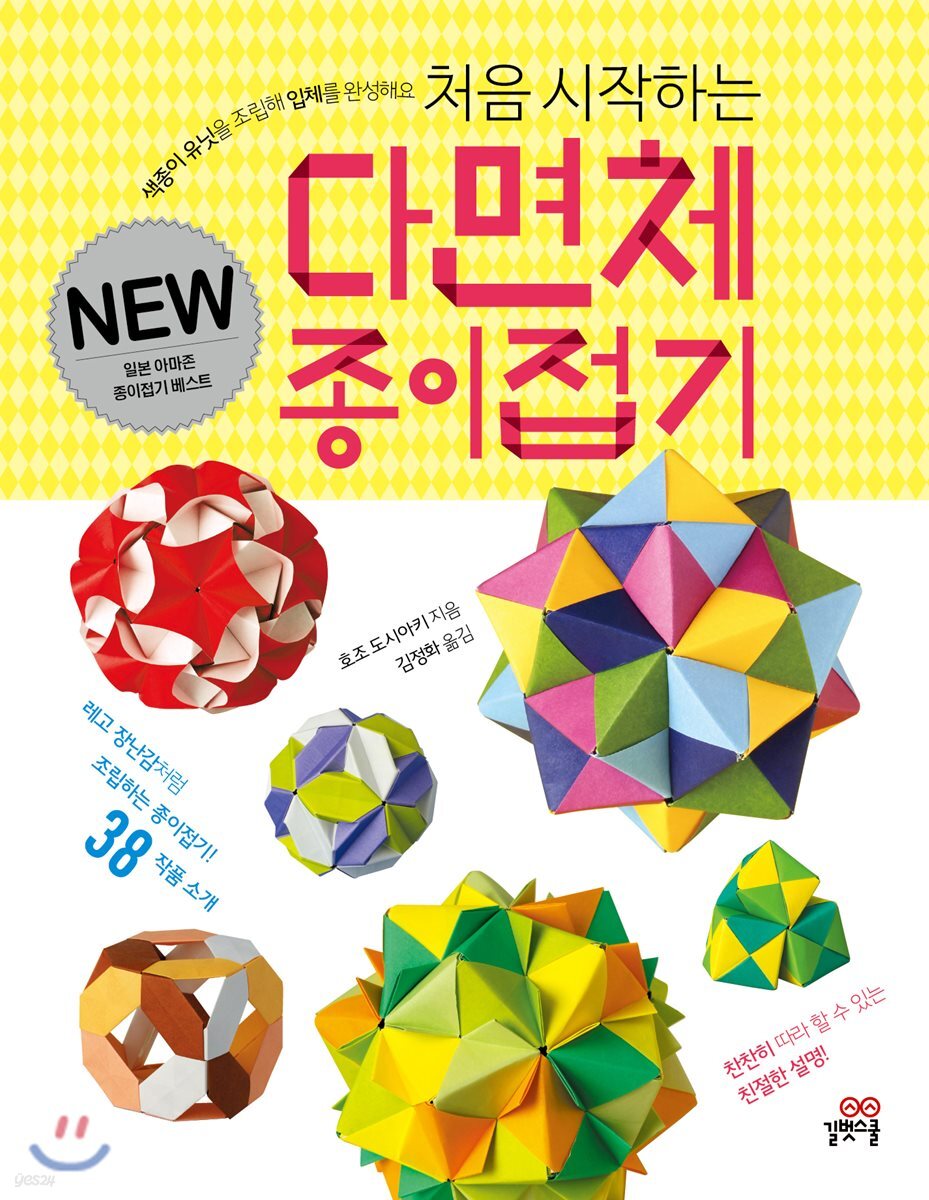
'Polyhedral origami' is an origami method that completes a polyhedral three-dimensional figure based on the structure of a cube.
Unlike regular origami, which is completed by folding just one piece of colored paper, multiple pieces of paper are folded into units in advance and then assembled individually to create a single piece.
It's like assembling paper Legos.
This origami method may seem a little difficult at first, but once you start, it is very interesting and fascinating, so there are many people around the world who enjoy this origami.
Introduced in English-speaking countries as 'module origami' and 'unit origami', it was brought into Japan and became widely known as 'polyhedral origami' in connection with learning shapes in mathematics, and was also introduced to Korea.
This is a great activity for stimulating and developing the brain as you have to fold multiple sheets, which requires a lot of fingertip movement, and you also have to imagine the shape of the shape and assemble it one by one.
Once you complete a piece of work, you feel a great sense of accomplishment knowing that you have created such a great piece.
It is also a very educational origami activity in many ways, as it helps children understand complex shapes such as squares and hexagons, and stimulates their curiosity and motivation to learn about mathematics.
Anyone can create a polyhedron that magically completes itself! Let's try it together!
Unlike regular origami, which is completed by folding just one piece of colored paper, multiple pieces of paper are folded into units in advance and then assembled individually to create a single piece.
It's like assembling paper Legos.
This origami method may seem a little difficult at first, but once you start, it is very interesting and fascinating, so there are many people around the world who enjoy this origami.
Introduced in English-speaking countries as 'module origami' and 'unit origami', it was brought into Japan and became widely known as 'polyhedral origami' in connection with learning shapes in mathematics, and was also introduced to Korea.
This is a great activity for stimulating and developing the brain as you have to fold multiple sheets, which requires a lot of fingertip movement, and you also have to imagine the shape of the shape and assemble it one by one.
Once you complete a piece of work, you feel a great sense of accomplishment knowing that you have created such a great piece.
It is also a very educational origami activity in many ways, as it helps children understand complex shapes such as squares and hexagons, and stimulates their curiosity and motivation to learn about mathematics.
Anyone can create a polyhedron that magically completes itself! Let's try it together!
- You can preview some of the book's contents.
Preview
index
Welcome to the world of polyhedral origami! 2
What is polyhedral origami? 4
10 Basic Origami and Symbol Reading Lessons
How to Fold and Assemble 12
Paper size / Paper color and material 13
Learn the basics
How to fold the basic unit 20
How to assemble the basic unit 22
How to Read Assembly Symbols 23
Chapter 1: Folding and Assembling the Basic Unit
1) Assemble 2 basic units 14, 24
2) Assemble 3 basic units 15, 25
3) Assemble 12 basic units (3 colors) 16, 26
4) Assemble 12 basic units (4 colors) 16, 28
5) Assemble 30 basic units (3 colors) 18, 30
6) Assemble 30 basic units (5 colors) 18, 34
Additional polyhedrons made from the basic units of Chapter 2
7) Assemble 6 basic units 40, 45
8) Assemble 18 basic units 41, 46
9) Assemble 36 basic units 42, 48
10) Assemble 48 basic units 43, 51
11) Assemble 90 basic units 44, 54
Chapter 3: Polyhedrons of various shapes and colors
12) Fold 1 58, 64 with back side visible
13) Fold 2 59, 65 with back side visible
14) Fold 3 60, 66 with back side visible
15) Fold 4 62, 67 with back side visible
16) Fold 5 63, 68 with back side visible
17) Fold with decoration 1 70, 74
18) Fold with decoration 2 71, 75
19) Fold with decoration 3 72, 76
20) Fold with decoration 4 73, 77
21) Fold 1 of the same color (6 colors) 78, 80
22) Fold 2 of the same color (10 colors) 78, 84
23) Fold 3 of the same color 79, 86
A magical polyhedron with four holes
24) Apply and fold 1 88, 92
25) Apply and fold 2 89, 94
26) Apply and fold 3 90, 95
27) Fold with hole 1 96, 97
28) Fold with hole 2 100, 104
29) Fold with hole 3 101, 107
30) Fold with hole 4 102, 108
31) Fold with hole 5 102,110
32) Fold by transforming 103, 111
Chapter 5: Boxes and Polyhedra Using Boxes
33) Folding a square box 112, 118
34) Folding a rectangular box 113, 120
35) Folding a rectangular box 114, 122
36) Folding using box application 1 115, 124
37) Folding using box application 2 116, 125
38) Folding using box application 3 117, 126
Learn more about polyhedral origami
Create a work of art by adding mountains to basic polyhedrons 38
Repetitive folding activities develop the brain 69
Let's try to make a more beautiful and cool polyhedral origami 127
What is polyhedral origami? 4
10 Basic Origami and Symbol Reading Lessons
How to Fold and Assemble 12
Paper size / Paper color and material 13
Learn the basics
How to fold the basic unit 20
How to assemble the basic unit 22
How to Read Assembly Symbols 23
Chapter 1: Folding and Assembling the Basic Unit
1) Assemble 2 basic units 14, 24
2) Assemble 3 basic units 15, 25
3) Assemble 12 basic units (3 colors) 16, 26
4) Assemble 12 basic units (4 colors) 16, 28
5) Assemble 30 basic units (3 colors) 18, 30
6) Assemble 30 basic units (5 colors) 18, 34
Additional polyhedrons made from the basic units of Chapter 2
7) Assemble 6 basic units 40, 45
8) Assemble 18 basic units 41, 46
9) Assemble 36 basic units 42, 48
10) Assemble 48 basic units 43, 51
11) Assemble 90 basic units 44, 54
Chapter 3: Polyhedrons of various shapes and colors
12) Fold 1 58, 64 with back side visible
13) Fold 2 59, 65 with back side visible
14) Fold 3 60, 66 with back side visible
15) Fold 4 62, 67 with back side visible
16) Fold 5 63, 68 with back side visible
17) Fold with decoration 1 70, 74
18) Fold with decoration 2 71, 75
19) Fold with decoration 3 72, 76
20) Fold with decoration 4 73, 77
21) Fold 1 of the same color (6 colors) 78, 80
22) Fold 2 of the same color (10 colors) 78, 84
23) Fold 3 of the same color 79, 86
A magical polyhedron with four holes
24) Apply and fold 1 88, 92
25) Apply and fold 2 89, 94
26) Apply and fold 3 90, 95
27) Fold with hole 1 96, 97
28) Fold with hole 2 100, 104
29) Fold with hole 3 101, 107
30) Fold with hole 4 102, 108
31) Fold with hole 5 102,110
32) Fold by transforming 103, 111
Chapter 5: Boxes and Polyhedra Using Boxes
33) Folding a square box 112, 118
34) Folding a rectangular box 113, 120
35) Folding a rectangular box 114, 122
36) Folding using box application 1 115, 124
37) Folding using box application 2 116, 125
38) Folding using box application 3 117, 126
Learn more about polyhedral origami
Create a work of art by adding mountains to basic polyhedrons 38
Repetitive folding activities develop the brain 69
Let's try to make a more beautiful and cool polyhedral origami 127
Detailed image
.jpg)
Publisher's Review
If you are confident in basic folding, try polyhedron origami!
If you are someone who has mastered or can perfectly fold basic origami such as flowers, cars, and animals and would like to try something new, try polyhedron origami.
It's a little more difficult than basic flat origami, but you can create new and wonderful pieces that you've never seen before.
It's perfect for friends who are confident with basic origami to move on to more advanced origami.
Unlike basic folding on a flat surface, the work is completed in three dimensions much more beautifully, and because you have to exert a high level of concentration throughout the folding process, the sense of accomplishment when you complete one is also great.
It's so brain stimulating that your head will feel dizzy when you finish it!
The polyhedrons in this book are completed by assembling a minimum of 3 units and up to 90 units.
Unlike regular origami, which involves folding a single sheet of paper, you must first fold multiple pieces of paper into units to complete a three-dimensional object.
Because they use their fingertips a lot while making multiple units, it's great for training fine motor skills and helping elementary school students develop perseverance.
Also, when assembling, you have to carefully consider not only the number of units, but also the color and shape of the units.
This is a task that requires a lot of brain power, so after completing one, your brain feels so stimulated that it feels like your head is spinning.
While making it, my concentration level is higher than ever.
You need to be able to quickly complete an accurate polyhedron without losing concentration.
Polyhedron origami is a great activity for brain development and concentration.
Origami that fosters interest in mathematics and a sense of geometry
The origami method introduced in this book was initially introduced in English-speaking countries as 'module origami' or 'unit origami', but was further developed into 'polyhedral origami' when it was introduced to Japan and linked to the study of mathematical shapes.
In fact, polyhedral origami is based on the basic shapes of regular polyhedrons, such as the tetrahedron, cube, etc.
The work is completed by placing the vertices on the triangular faces of each shape like mountains.
In this way, by doing polyhedral origami, you will not only become familiar with the structure of shapes, but also become interested in and understand mathematical concepts such as vertices, surfaces, and lines.
Decorate your special day or your room with the work you've created.
The completed polyhedron is so amazing and cool that most people who see it for the first time are very curious about how it was made.
Make a good polyhedron origami and show off your skills to your friends and family.
Even though the assembly method for this origami is the same, you can create an endless variety of works by using different paper colors.
You will also naturally learn how to arrange and combine colors.
Connect the pieces you like with thread and use them to decorate your room.
Wouldn't it be nice to decorate a tree or the surrounding area on special days like Christmas?
If you are someone who has mastered or can perfectly fold basic origami such as flowers, cars, and animals and would like to try something new, try polyhedron origami.
It's a little more difficult than basic flat origami, but you can create new and wonderful pieces that you've never seen before.
It's perfect for friends who are confident with basic origami to move on to more advanced origami.
Unlike basic folding on a flat surface, the work is completed in three dimensions much more beautifully, and because you have to exert a high level of concentration throughout the folding process, the sense of accomplishment when you complete one is also great.
It's so brain stimulating that your head will feel dizzy when you finish it!
The polyhedrons in this book are completed by assembling a minimum of 3 units and up to 90 units.
Unlike regular origami, which involves folding a single sheet of paper, you must first fold multiple pieces of paper into units to complete a three-dimensional object.
Because they use their fingertips a lot while making multiple units, it's great for training fine motor skills and helping elementary school students develop perseverance.
Also, when assembling, you have to carefully consider not only the number of units, but also the color and shape of the units.
This is a task that requires a lot of brain power, so after completing one, your brain feels so stimulated that it feels like your head is spinning.
While making it, my concentration level is higher than ever.
You need to be able to quickly complete an accurate polyhedron without losing concentration.
Polyhedron origami is a great activity for brain development and concentration.
Origami that fosters interest in mathematics and a sense of geometry
The origami method introduced in this book was initially introduced in English-speaking countries as 'module origami' or 'unit origami', but was further developed into 'polyhedral origami' when it was introduced to Japan and linked to the study of mathematical shapes.
In fact, polyhedral origami is based on the basic shapes of regular polyhedrons, such as the tetrahedron, cube, etc.
The work is completed by placing the vertices on the triangular faces of each shape like mountains.
In this way, by doing polyhedral origami, you will not only become familiar with the structure of shapes, but also become interested in and understand mathematical concepts such as vertices, surfaces, and lines.
Decorate your special day or your room with the work you've created.
The completed polyhedron is so amazing and cool that most people who see it for the first time are very curious about how it was made.
Make a good polyhedron origami and show off your skills to your friends and family.
Even though the assembly method for this origami is the same, you can create an endless variety of works by using different paper colors.
You will also naturally learn how to arrange and combine colors.
Connect the pieces you like with thread and use them to decorate your room.
Wouldn't it be nice to decorate a tree or the surrounding area on special days like Christmas?
GOODS SPECIFICS
- Publication date: November 23, 2017
- Page count, weight, size: 128 pages | 324g | 190*245*20mm
- ISBN13: 9788962227468
- ISBN10: 8962227460
- KC Certification: Certification Type: Conformity Confirmation
You may also like
카테고리
korean


korean

![GQ KOREA Mark (Monthly): December [2025]](http://librairie.coreenne.fr/cdn/shop/files/8ef265dbbfbf186523ed75ba7319009d.jpg?v=1765340328&width=3840)


