

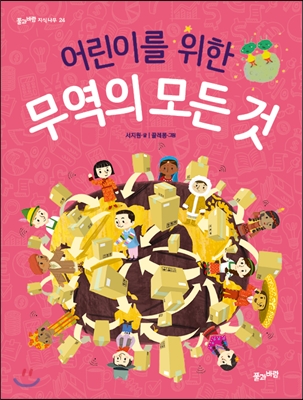
All About Trade for Kids
 |
Description
Book Introduction
Do you feel it, everyone? The world is getting closer, and borders are losing their meaning day by day.
We are now living in the 'age of globalization'.
It's a world where we can't live without Saudi Arabian oil or Brazilian coffee.
Our country imports more than 90% of wheat flour, the main ingredient in bread and pastries, and purchases various tropical fruits, such as bananas, from Southeast Asia and New Zealand.
Many of the things we eat and use are foreign products, so our daily lives are connected to the world, and furthermore, to farmers and workers in many countries.
Therefore, what we must know is the ‘world economy’ and ‘trade flow.’
If we are to compete with foreign companies in the global market going forward, we must pay attention to economic issues.
≪Everything About Trade for Kids≫ contains very basic information about trade.
The economy is a very important field that is inseparable from our lives, but it is a field that is not easily accessible to both children and adults.
So, this book connects economics to things that frequently happen around us, allowing children to naturally encounter economics and trade.
Just by knowing the contents of this book, you will be able to grasp the overall flow and understand trade in general.
We are now living in the 'age of globalization'.
It's a world where we can't live without Saudi Arabian oil or Brazilian coffee.
Our country imports more than 90% of wheat flour, the main ingredient in bread and pastries, and purchases various tropical fruits, such as bananas, from Southeast Asia and New Zealand.
Many of the things we eat and use are foreign products, so our daily lives are connected to the world, and furthermore, to farmers and workers in many countries.
Therefore, what we must know is the ‘world economy’ and ‘trade flow.’
If we are to compete with foreign companies in the global market going forward, we must pay attention to economic issues.
≪Everything About Trade for Kids≫ contains very basic information about trade.
The economy is a very important field that is inseparable from our lives, but it is a field that is not easily accessible to both children and adults.
So, this book connects economics to things that frequently happen around us, allowing children to naturally encounter economics and trade.
Just by knowing the contents of this book, you will be able to grasp the overall flow and understand trade in general.
- You can preview some of the book's contents.
Preview
index
1.
What is trade?
2.
Characteristics of our country's trade
3.
Trade Stories Throughout History
4.
The Future of Trade in Our Country in the Age of Globalization
5.
What is fair trade?
Trade-related common sense quiz
Trade-related word definitions
What is trade?
2.
Characteristics of our country's trade
3.
Trade Stories Throughout History
4.
The Future of Trade in Our Country in the Age of Globalization
5.
What is fair trade?
Trade-related common sense quiz
Trade-related word definitions
Detailed image
Into the book
Problems and solutions for our country's trade
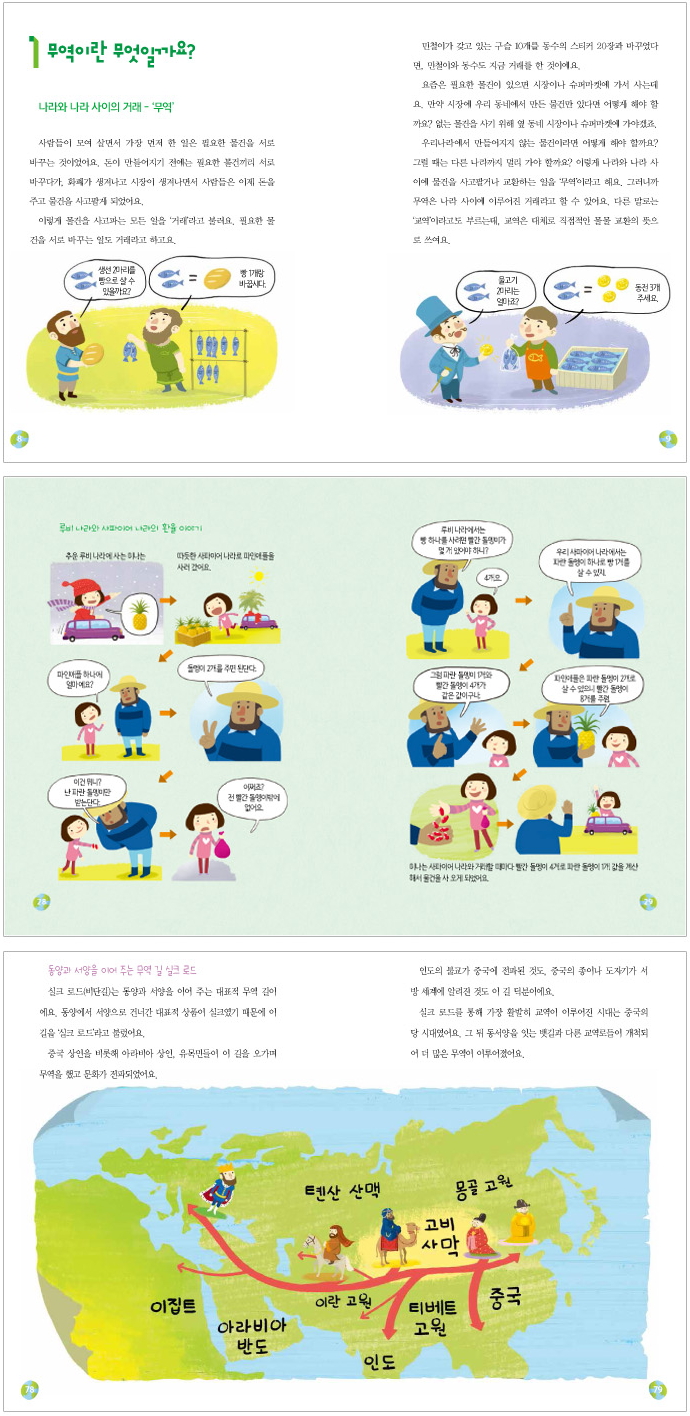
The recent intensifying trade competition with China can also be considered a challenge for our country's trade.
As of 2013, there were 65 items in which our country ranked first in global exports.
Among them, China ranks second in 20 items.
In particular, China is closely following our country in 14 items, including memory semiconductors, with a 5% gap.
With a population of approximately 1.3 billion, China is a valuable market and trading competitor for us.
China has a large population and low labor costs.
If we have no choice but to hand over labor-intensive industrial items to China, we should expand our Korean export business to more core and technology-intensive industrial items.
The Good and Bad of FTAs
FTAs are not good for all industries.
Industries that are not yet competitive may disappear altogether.
To reduce these problems, rather than eliminating tariffs completely from the beginning, we are lowering them in stages.
For example, our country's competitiveness in agriculture and livestock is weak.
In countries like the US and Australia, farms are large and well-mechanized, so mass production is possible.
It could be imported at a much cheaper price than our country's products.
This is why agricultural and livestock farmers protest whenever talk of FTA agreements with foreign countries comes up.
(……)
When we decide to import agricultural and livestock products from foreign countries, we have been gradually lowering tariffs over a long period of time.
It's to make farmers more competitive.
We could cultivate special crops that cannot be mass-produced, or develop new products through variety development, thereby creating our own unique agricultural and fishery product market.
The recent intensifying trade competition with China can also be considered a challenge for our country's trade.
As of 2013, there were 65 items in which our country ranked first in global exports.
Among them, China ranks second in 20 items.
In particular, China is closely following our country in 14 items, including memory semiconductors, with a 5% gap.
With a population of approximately 1.3 billion, China is a valuable market and trading competitor for us.
China has a large population and low labor costs.
If we have no choice but to hand over labor-intensive industrial items to China, we should expand our Korean export business to more core and technology-intensive industrial items.
The Good and Bad of FTAs
FTAs are not good for all industries.
Industries that are not yet competitive may disappear altogether.
To reduce these problems, rather than eliminating tariffs completely from the beginning, we are lowering them in stages.
For example, our country's competitiveness in agriculture and livestock is weak.
In countries like the US and Australia, farms are large and well-mechanized, so mass production is possible.
It could be imported at a much cheaper price than our country's products.
This is why agricultural and livestock farmers protest whenever talk of FTA agreements with foreign countries comes up.
(……)
When we decide to import agricultural and livestock products from foreign countries, we have been gradually lowering tariffs over a long period of time.
It's to make farmers more competitive.
We could cultivate special crops that cannot be mass-produced, or develop new products through variety development, thereby creating our own unique agricultural and fishery product market.
--- From the text
Publisher's Review
* A trading story that children can easily learn!
All activities of making, buying, and selling things necessary for life are called 'economy'.
Children are also engaged in economic activities every day, buying necessary school supplies and enjoying delicious snacks.
Moreover, many of the items used by children, such as bags, erasers, and pencils, are foreign products.
As such, the economy and trade are so essential to our lives that we've explained the principles of trade through real-life stories so that anyone can learn them easily and enjoyably.
A variety of illustrations, cartoons, and stories help you understand the once-stiff trade terms and principles, such as exports, imports, and exchange rates, in a fun way.
I hope that through this book, children will become more interested in the economy and become great people who will contribute to the health and strength of our country's economy in the future.
* The power of trade that shakes the world!
With the globalization of trade, the entire world has become a single market.
The fact that we can drive cars using oil and that we, who live in temperate climates, can easily eat bananas is all thanks to trade.
Because each country has different resources and natural environments, as well as different technologies and capital, trade is essential for growth and development.
We've designed this book to help you clearly understand these important trade principles and connect them to how they impact our lives.
By exploring trade stories through various case studies, we can gain a three-dimensional understanding of the diverse relationships between the society and economy in which we live.
* A look at the history of our country's trade!
When did Korea begin trading? Goguryeo, a leading iron producer, sold iron to China, the Xianbei, and the Khitan, and bought other goods like horses, porcelain, and glass.
During the Goryeo Dynasty, when trade was active, Chinese merchants, as well as Japanese and Arabian merchants, traveled and traded through Byeokrando.
Currently, our country is an export powerhouse, ranking 7th in the world in terms of exports.
From the Three Kingdoms period to the present day.
The flow of our country's trade history is explained in an easy and fun way for children to understand.
We will show you a glimpse of the very important Korean history related to trade.
By looking at the various products that have varied from era to era, including Korea's representative exports and imports throughout history, we can learn about the industries in which Korea was competitive at that time.
Come see and enjoy our outstanding technologies and products, proudly showcased to the world! We've broadened children's understanding by explaining trade through stories of history, culture, and everyday life.
It also covers economic terms that appear in textbooks, so it will be very helpful for studying the subject and building background knowledge.
* A beautiful book for children living together with the world!
As globalization accelerates, the world is becoming increasingly polarized.
Rich countries are getting richer and poor countries are getting poorer.
Because trade is being conducted unfairly.
Especially poor people in developing countries, including Africa, are starving because they are not paid for their hard work.
There are many cases where even children are used as slaves to lower the purchase price.
Through the chocolate and soccer balls children encounter in their daily lives, they are naturally led to explore the truth about trade and the global economy by observing the sacrifices and suffering of countless workers and farmers in developing countries.
Understanding fair trade and the market economy will be the first step for children to learn how to 'live together.'
I hope that children will feel and empathize for themselves and think about cooperation and living together rather than competition.
All activities of making, buying, and selling things necessary for life are called 'economy'.
Children are also engaged in economic activities every day, buying necessary school supplies and enjoying delicious snacks.
Moreover, many of the items used by children, such as bags, erasers, and pencils, are foreign products.
As such, the economy and trade are so essential to our lives that we've explained the principles of trade through real-life stories so that anyone can learn them easily and enjoyably.
A variety of illustrations, cartoons, and stories help you understand the once-stiff trade terms and principles, such as exports, imports, and exchange rates, in a fun way.
I hope that through this book, children will become more interested in the economy and become great people who will contribute to the health and strength of our country's economy in the future.
* The power of trade that shakes the world!
With the globalization of trade, the entire world has become a single market.
The fact that we can drive cars using oil and that we, who live in temperate climates, can easily eat bananas is all thanks to trade.
Because each country has different resources and natural environments, as well as different technologies and capital, trade is essential for growth and development.
We've designed this book to help you clearly understand these important trade principles and connect them to how they impact our lives.
By exploring trade stories through various case studies, we can gain a three-dimensional understanding of the diverse relationships between the society and economy in which we live.
* A look at the history of our country's trade!
When did Korea begin trading? Goguryeo, a leading iron producer, sold iron to China, the Xianbei, and the Khitan, and bought other goods like horses, porcelain, and glass.
During the Goryeo Dynasty, when trade was active, Chinese merchants, as well as Japanese and Arabian merchants, traveled and traded through Byeokrando.
Currently, our country is an export powerhouse, ranking 7th in the world in terms of exports.
From the Three Kingdoms period to the present day.
The flow of our country's trade history is explained in an easy and fun way for children to understand.
We will show you a glimpse of the very important Korean history related to trade.
By looking at the various products that have varied from era to era, including Korea's representative exports and imports throughout history, we can learn about the industries in which Korea was competitive at that time.
Come see and enjoy our outstanding technologies and products, proudly showcased to the world! We've broadened children's understanding by explaining trade through stories of history, culture, and everyday life.
It also covers economic terms that appear in textbooks, so it will be very helpful for studying the subject and building background knowledge.
* A beautiful book for children living together with the world!
As globalization accelerates, the world is becoming increasingly polarized.
Rich countries are getting richer and poor countries are getting poorer.
Because trade is being conducted unfairly.
Especially poor people in developing countries, including Africa, are starving because they are not paid for their hard work.
There are many cases where even children are used as slaves to lower the purchase price.
Through the chocolate and soccer balls children encounter in their daily lives, they are naturally led to explore the truth about trade and the global economy by observing the sacrifices and suffering of countless workers and farmers in developing countries.
Understanding fair trade and the market economy will be the first step for children to learn how to 'live together.'
I hope that children will feel and empathize for themselves and think about cooperation and living together rather than competition.
GOODS SPECIFICS
- Date of issue: April 9, 2015
- Page count, weight, size: 148 pages | 371g | 185*245*8mm
- ISBN13: 9788983895981
- ISBN10: 8983895985
You may also like
카테고리
korean


korean

![GQ KOREA Mark (Monthly): December [2025]](http://librairie.coreenne.fr/cdn/shop/files/8ef265dbbfbf186523ed75ba7319009d.jpg?v=1765340328&width=3840)


