

Is this really an apology?
 |
Description
Book Introduction
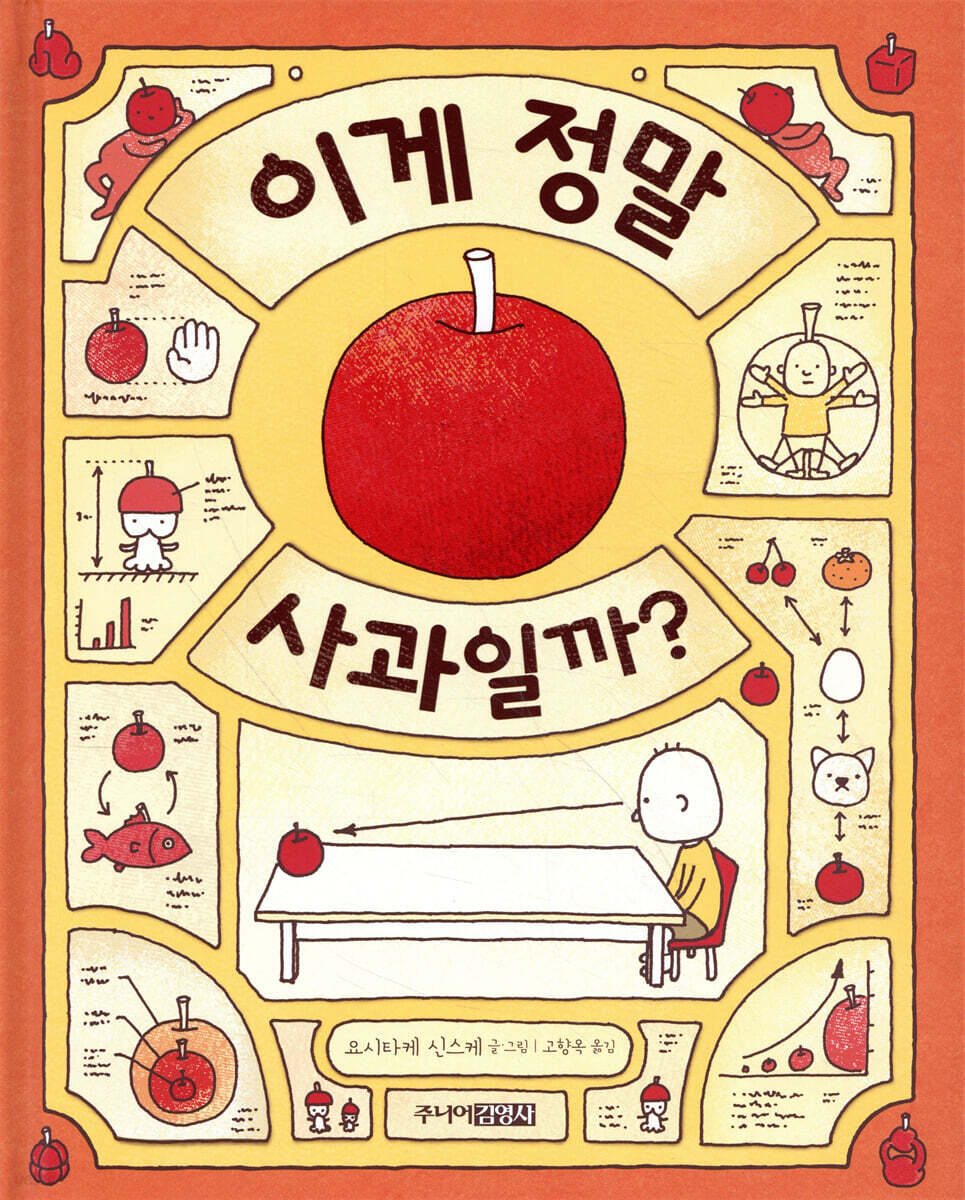
A boy sees a red apple on his desk, and his curiosity is piqued. He lets his imagination run wild, wondering, "Is this an apple? Or maybe it's not an apple?" This book is a delightful picture book that teaches the power of thought, allowing children to imagine and reason freely, breaking free from stereotypes about the object called an "apple," and encouraging creative thinking. "Is This Really an Apple?" Watch the Video *Click* |
- You can preview some of the book's contents.
Preview
Detailed image

Into the book
One day I came home and… … .
There was an apple on the table.
Hey, what's that?
But that might not be an apology.
Could it be a large cherry? Maybe it's grape-flavored jelly inside.
Or, no matter how much you cut it, the skin might keep coming out.
Could the invisible back be a tangerine?
Don't apples have feelings too?
When you're sad, you might turn white.
If you sprinkle mayonnaise on it, it might become runny.
(omitted)
When you receive praise, you become shiny and bright
When you're scared, you get wrinkled
If you get angry, you might become stiff.
If I spin it around and around, won't I get dizzy and lose my balance?
If you touch here, 'hehehe'
You might get tickled.
There was an apple on the table.
Hey, what's that?
But that might not be an apology.
Could it be a large cherry? Maybe it's grape-flavored jelly inside.
Or, no matter how much you cut it, the skin might keep coming out.
Could the invisible back be a tangerine?
Don't apples have feelings too?
When you're sad, you might turn white.
If you sprinkle mayonnaise on it, it might become runny.
(omitted)
When you receive praise, you become shiny and bright
When you're scared, you get wrinkled
If you get angry, you might become stiff.
If I spin it around and around, won't I get dizzy and lose my balance?
If you touch here, 'hehehe'
You might get tickled.
---text
Publisher's Review
Japanese Awards
1st place in the 6th MOE Picture Book Awards
2nd place in the 4th Libro Picture Book Awards
3rd place in the children's book category at the 2nd Shizuoka Bookstore Awards
Winner of the 61st Sankei Children's Publishing Culture Award Art Award
A world of imagination you've never seen before! All you need is an apple!
"Is This Really an Apple?" is, in a word, a brilliant book.
It shows all the thoughts, doubts, fantasies, imaginations and even fantasies that can be made using apples as a subject.
Although it is certainly not the first time the boy protagonist has seen an apple, he suddenly begins to suspect that the object on the table that appears to be an apple might not be an apple at all.
At first, you start to imagine something different from the apple's red color, taste, and round shape.
Then we move on to the idea that the size can change.
Sometimes I wonder if the apple would look like a person's face and want to wear a wig or a hat, and sometimes I wonder if the apple might come from a small star in the universe.
Imagine the apple changing shape and wonder if it might be due to emotions that humans or animals have.
They even give names to their siblings, thinking that apples might be people.
Then, as he began to wonder how this apple ended up on his desk, his thoughts began to spiral into absurd directions.
The boy, who was curious about how far his relationship with the apple would go, began to think that the apple might one day leave him and go somewhere else.
So, I feel sad to say goodbye, so I think I'll take a bite.
Apples are a common fruit, but you might find that they have a taste, aroma, and texture you've never experienced before, and they might stretch like gum or deflate like a balloon.
Or, just like Snow White fell down after eating the poisoned apple, you might even start to think that you too might become strangely transformed after eating it.
As I think about that, my stomach starts growling.
At that sound, the boy's imagination calms down.
And then I think, 'Should I just eat it?'
Let's break free from stereotypes and explore from different angles, and the world becomes more enjoyable!
The topic of a recent documentary on EBS is 'Slow Reading'.
It introduces a method of developing thinking power by reading a book slowly, and suggests that you develop your 'thinking power' by reading a book slowly, using all your senses.
It's very similar to the approach shown in this book, Is This Really an Apple?
In this book, the story unfolds with just one object: an apple.
It literally starts with an apple and ends with an apple story until the last chapter.
What message did the author want to convey through this book? The author may have begun "Imagination of Apples" not only to convey the message, "Imagination is truly a joy!" but also to encourage us to reconsider our stereotypes and preconceptions.
For that to happen, curiosity must be a prerequisite.
Curiosity is the beginning of all thinking, and the ability to think differently from others is a great joy and the beginning of creativity, a skill required in the 21st century.
If you start practicing imaginative thinking with your child today, following the author's instructions, they will not only find it enjoyable in itself, but they may even enjoy reading, imagining, and thinking differently more than passively receiving information through TV, games, or other entertainment.
Any child who can explore one thing for a long time will be able to happily succeed in the field he or she wants, regardless of grades.
I hope that this book will be widely read in schools, kindergartens, and academies, stimulating children's innovative thinking and providing them with enjoyable moments when read together with their parents.
** Visit the author's Facebook page (https://ja-jp.facebook.com/ringokamoshirena) to see how this popular book has been used in Japan.
Even before publication, the author created a Facebook page and posted a production diary and Q&A with the author, explaining how the author, who had never published a picture book before, came to create a picture book, to increase interest.
1st place in the 6th MOE Picture Book Awards
2nd place in the 4th Libro Picture Book Awards
3rd place in the children's book category at the 2nd Shizuoka Bookstore Awards
Winner of the 61st Sankei Children's Publishing Culture Award Art Award
A world of imagination you've never seen before! All you need is an apple!
"Is This Really an Apple?" is, in a word, a brilliant book.
It shows all the thoughts, doubts, fantasies, imaginations and even fantasies that can be made using apples as a subject.
Although it is certainly not the first time the boy protagonist has seen an apple, he suddenly begins to suspect that the object on the table that appears to be an apple might not be an apple at all.
At first, you start to imagine something different from the apple's red color, taste, and round shape.
Then we move on to the idea that the size can change.
Sometimes I wonder if the apple would look like a person's face and want to wear a wig or a hat, and sometimes I wonder if the apple might come from a small star in the universe.
Imagine the apple changing shape and wonder if it might be due to emotions that humans or animals have.
They even give names to their siblings, thinking that apples might be people.
Then, as he began to wonder how this apple ended up on his desk, his thoughts began to spiral into absurd directions.
The boy, who was curious about how far his relationship with the apple would go, began to think that the apple might one day leave him and go somewhere else.
So, I feel sad to say goodbye, so I think I'll take a bite.
Apples are a common fruit, but you might find that they have a taste, aroma, and texture you've never experienced before, and they might stretch like gum or deflate like a balloon.
Or, just like Snow White fell down after eating the poisoned apple, you might even start to think that you too might become strangely transformed after eating it.
As I think about that, my stomach starts growling.
At that sound, the boy's imagination calms down.
And then I think, 'Should I just eat it?'
Let's break free from stereotypes and explore from different angles, and the world becomes more enjoyable!
The topic of a recent documentary on EBS is 'Slow Reading'.
It introduces a method of developing thinking power by reading a book slowly, and suggests that you develop your 'thinking power' by reading a book slowly, using all your senses.
It's very similar to the approach shown in this book, Is This Really an Apple?
In this book, the story unfolds with just one object: an apple.
It literally starts with an apple and ends with an apple story until the last chapter.
What message did the author want to convey through this book? The author may have begun "Imagination of Apples" not only to convey the message, "Imagination is truly a joy!" but also to encourage us to reconsider our stereotypes and preconceptions.
For that to happen, curiosity must be a prerequisite.
Curiosity is the beginning of all thinking, and the ability to think differently from others is a great joy and the beginning of creativity, a skill required in the 21st century.
If you start practicing imaginative thinking with your child today, following the author's instructions, they will not only find it enjoyable in itself, but they may even enjoy reading, imagining, and thinking differently more than passively receiving information through TV, games, or other entertainment.
Any child who can explore one thing for a long time will be able to happily succeed in the field he or she wants, regardless of grades.
I hope that this book will be widely read in schools, kindergartens, and academies, stimulating children's innovative thinking and providing them with enjoyable moments when read together with their parents.
** Visit the author's Facebook page (https://ja-jp.facebook.com/ringokamoshirena) to see how this popular book has been used in Japan.
Even before publication, the author created a Facebook page and posted a production diary and Q&A with the author, explaining how the author, who had never published a picture book before, came to create a picture book, to increase interest.
GOODS SPECIFICS
- Date of publication: October 20, 2014
- Format: Hardcover book binding method guide
- Page count, weight, size: 32 pages | 333g | 205*257*8mm
- ISBN13: 9788934968726
- ISBN10: 8934968729
You may also like
카테고리
korean


korean

![GQ KOREA Mark (Monthly): December [2025]](http://librairie.coreenne.fr/cdn/shop/files/8ef265dbbfbf186523ed75ba7319009d.jpg?v=1765340328&width=3840)


