

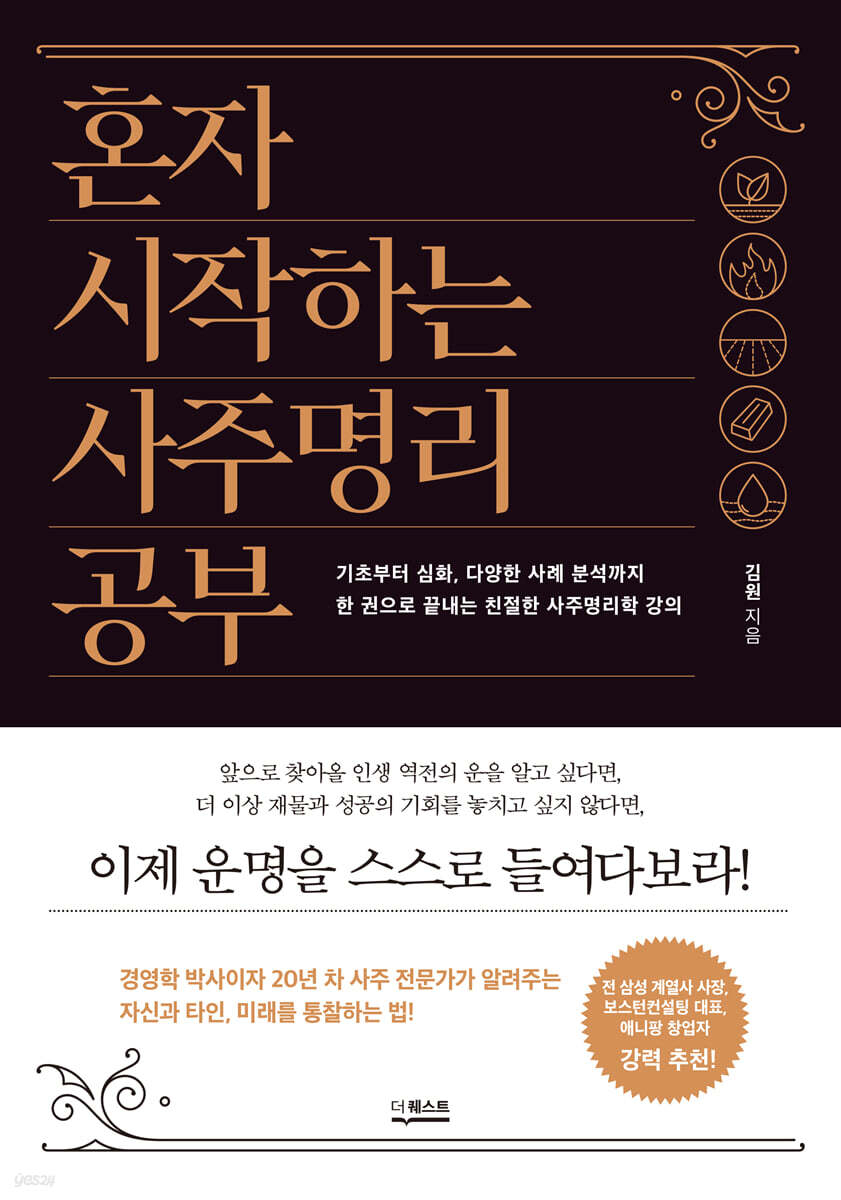
Studying Saju fortune telling on your own
 |
Description
Book Introduction
“I look at my fortune myself!”
From the basic concepts of fortune telling to advanced theories and various examples of fortune telling interpretation.
Studying the four pillars of destiny that can be applied immediately after reading
A faithful study guide to fortune telling for those seeking to delve into their own life path! It's an open secret that politicians, businesspeople, and celebrities consult fortune tellers whenever they have important matters to discuss.
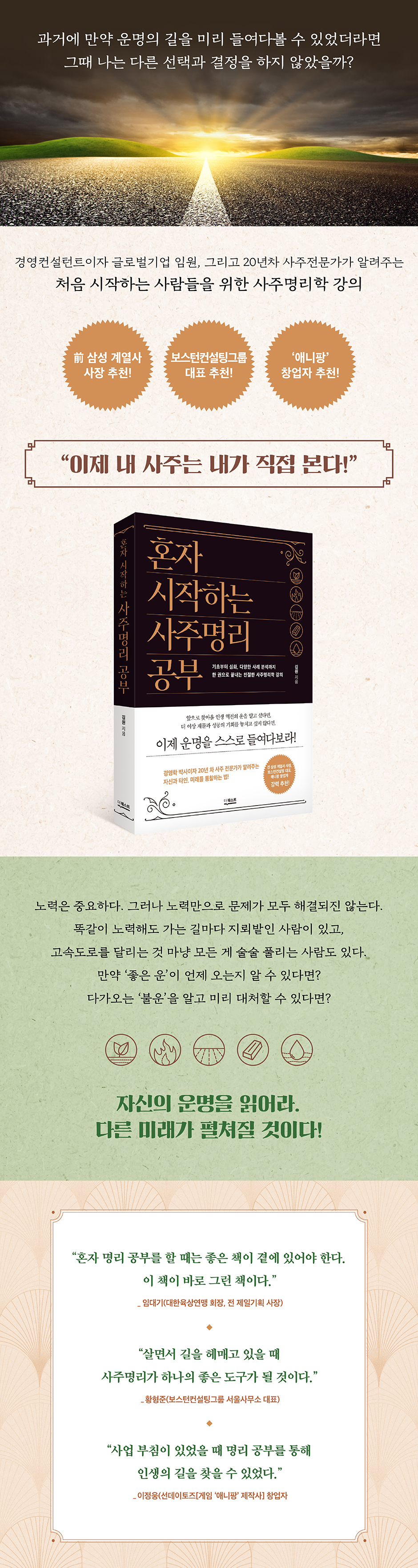
As the saying goes, “Luck is seven, skill is three,” effort is important in life, but not everything will turn out well with effort alone.
What if I could tell when good luck was coming my way? And when bad luck was coming my way? I could embrace good luck, avoid bad, and live a more peaceful life.
This book is a friendly study guide for those who want to know the path of their destiny in advance, those who want to use a method other than general analysis tools when making important life choices, and those who want to prepare for the future by analyzing the fortunes of family members or acquaintances.
This is an introductory book on fortune telling for beginners, covering everything from basic concepts to fundamental theories and interpretations through various real-life examples.
From the basic concepts of fortune telling to advanced theories and various examples of fortune telling interpretation.
Studying the four pillars of destiny that can be applied immediately after reading
A faithful study guide to fortune telling for those seeking to delve into their own life path! It's an open secret that politicians, businesspeople, and celebrities consult fortune tellers whenever they have important matters to discuss.
As the saying goes, “Luck is seven, skill is three,” effort is important in life, but not everything will turn out well with effort alone.
What if I could tell when good luck was coming my way? And when bad luck was coming my way? I could embrace good luck, avoid bad, and live a more peaceful life.
This book is a friendly study guide for those who want to know the path of their destiny in advance, those who want to use a method other than general analysis tools when making important life choices, and those who want to prepare for the future by analyzing the fortunes of family members or acquaintances.
This is an introductory book on fortune telling for beginners, covering everything from basic concepts to fundamental theories and interpretations through various real-life examples.
- You can preview some of the book's contents.
Preview
index
Introduction_ A tool for understanding myself and the world, Sajumyeongri
Four Pillars of Destiny Study Roadmap
Lecture 1.
The basics of Sajumyeongri
01.
What is Sajumyeongri?
02.
What to study
[Principles and order of writing the Great Fortune]
03.
Ten Stems and Twelve Earthly Branches
[History of Saju Myungri]
Lecture 2.
Basic Theory 1
01.
Yin-Yang and the Five Elements
02.
Ten Stems
03.
twelve zodiac signs
[Yin-Yang and the Five Elements and Seasons]
04.
Jijanggan
[What is the difference between the four pillars of destiny and the Book of Changes?]
Lecture 3.
Basic Theory 2
01.
Overview of the theory of conflict
02.
Heavenly Stem Combination and Heavenly Stem Clash
03.
Supporters and supporters
[The Horse and the Peach Blossom]
04.
The relationship between Chung and Jijang
Lecture 4.
Basic Theory 3
01.
Overview of the Ten Gods
02.
Equal relationship with me, cowardice
03.
Relationships and character that help me
04.
Relationships that involve helping others, boring
05.
Relationships I control, Jaeseong
06.
The relationship that controls me, inertia
[New Fortune Telling and New Drug Fortune Telling]
[Glossary]
Lesson 5.
Real-world case study solution
01.
Before interpreting the case
02.
Good luck at work
Will I get a promotion at the end of the year? | Am I destined to be a career soldier? | I changed jobs due to conflict at work | Can I succeed even without luck in promotion or wealth? | Is there a separate fortune for a high salary? | Can I get promoted without luck in government? | If you're worried about changing jobs frequently
[The difference between the Heavenly Stems and Earthly Branches in Hapchung]
[Theory of the Battle of Nations]
03.
Business luck
The fortune of becoming a CEO from a company employee | The fortune of only giving good things to a partner | Is there a time when heaven helps you succeed? | The key to success is knowing how to stop | The fortune that made becoming a popular YouTuber possible
[Twelve Zodiac Signs]
04.
Love and marriage luck
A man who dates a lot but never marries | The sudden death of a spouse | Can you become a wealthy daughter-in-law without inertia? | Was the divorce rate in your fortune? | How can you get married?
[Shin Sal-ron]
05.
Other cases
Why I Need Luck to Help Me No Matter How Well I'm Doing | Suddenly Diagnosed with Cancer | Embroiled in Office Conflict
[Public network]
Lesson 6.
Real-world case study practice
01.
Which fortune should I start with?
Male in his 30s | Male in his 40s | Female in her 50s | Male in his 60s
Going Out_Learning Life Wisdom from Four Pillars of Destiny
Appendix 1.
Frequently Asked Questions About Sajoo
Appendix 2.
After studying the basics, here are some books to read together.
Four Pillars of Destiny Study Roadmap
Lecture 1.
The basics of Sajumyeongri
01.
What is Sajumyeongri?
02.
What to study
[Principles and order of writing the Great Fortune]
03.
Ten Stems and Twelve Earthly Branches
[History of Saju Myungri]
Lecture 2.
Basic Theory 1
01.
Yin-Yang and the Five Elements
02.
Ten Stems
03.
twelve zodiac signs
[Yin-Yang and the Five Elements and Seasons]
04.
Jijanggan
[What is the difference between the four pillars of destiny and the Book of Changes?]
Lecture 3.
Basic Theory 2
01.
Overview of the theory of conflict
02.
Heavenly Stem Combination and Heavenly Stem Clash
03.
Supporters and supporters
[The Horse and the Peach Blossom]
04.
The relationship between Chung and Jijang
Lecture 4.
Basic Theory 3
01.
Overview of the Ten Gods
02.
Equal relationship with me, cowardice
03.
Relationships and character that help me
04.
Relationships that involve helping others, boring
05.
Relationships I control, Jaeseong
06.
The relationship that controls me, inertia
[New Fortune Telling and New Drug Fortune Telling]
[Glossary]
Lesson 5.
Real-world case study solution
01.
Before interpreting the case
02.
Good luck at work
Will I get a promotion at the end of the year? | Am I destined to be a career soldier? | I changed jobs due to conflict at work | Can I succeed even without luck in promotion or wealth? | Is there a separate fortune for a high salary? | Can I get promoted without luck in government? | If you're worried about changing jobs frequently
[The difference between the Heavenly Stems and Earthly Branches in Hapchung]
[Theory of the Battle of Nations]
03.
Business luck
The fortune of becoming a CEO from a company employee | The fortune of only giving good things to a partner | Is there a time when heaven helps you succeed? | The key to success is knowing how to stop | The fortune that made becoming a popular YouTuber possible
[Twelve Zodiac Signs]
04.
Love and marriage luck
A man who dates a lot but never marries | The sudden death of a spouse | Can you become a wealthy daughter-in-law without inertia? | Was the divorce rate in your fortune? | How can you get married?
[Shin Sal-ron]
05.
Other cases
Why I Need Luck to Help Me No Matter How Well I'm Doing | Suddenly Diagnosed with Cancer | Embroiled in Office Conflict
[Public network]
Lesson 6.
Real-world case study practice
01.
Which fortune should I start with?
Male in his 30s | Male in his 40s | Female in her 50s | Male in his 60s
Going Out_Learning Life Wisdom from Four Pillars of Destiny
Appendix 1.
Frequently Asked Questions About Sajoo
Appendix 2.
After studying the basics, here are some books to read together.
Detailed image
Into the book
What exactly is the Four Pillars of Destiny? It can be seen as similar to temperament.
We are all born with something, but the way our temperament is expressed changes depending on the environment and situation we encounter.
And that temperament doesn't determine everything about a person, but it does determine 'somewhat'.
Through the Four Pillars of Destiny, you can find out a person's general personality, preferences, areas of expertise, and favorable or unfavorable periods for employment or financial fortune.
It allows us to infer more than 70 to 80 percent of our lives.
Wouldn't knowing just this much be enough of a compass for life?
---「Lecture 1.
From “The Basics of Four Pillars of Destiny”
Gap (甲) means a large, sturdy, tall pine tree.
Eul (乙) represents soft plants such as grass, small trees, and lotus flowers.
Bing (丙) is the sun that provides energy and warmth to all things.
Jeong (丁) is a small fire such as a spark, candle, or torch, but sometimes it becomes a furnace, so it is all fire on earth.
Mu (戊) is a large, unmanaged natural area such as a field, wilderness, grassland, or desert.
Gi (己) is a soil area that can be managed by humans, such as a garden or vegetable patch.
Gyeong (庚) is a round metal that can be a raw stone like a rock on a mountain or a source of water from which a waterfall begins.
Shin (辛) represents processed and refined metals such as jewels or sharp iron.
Im (壬) means large water such as the sea or river.
Gye (癸) means clear, small water such as a valley, spring water, or drizzle.
Here, rather than simply explaining the characteristics of Gap, we will try to explain the meaning applied to the eight characters of the four pillars of destiny as much as possible in each theory.
This is because, from the basic explanation, you need to learn how the theory is applied in practice so that you can apply it when interpreting actual fortune telling.
Even if it's a bit slow, it's ultimately the fast way to go.
---「Lecture 2.
From “Basic Theory 1”
The relationship between the ten gods, including the comparison, is not only established between the heavenly stems, but also between the heavenly stems and the earthly branches.
For example, In (寅) is a comparison to Gap (甲), and Myo (卯) is a comparison to Eul (乙).
For Sa (巳), Byeong (丙) is a comparison, and for Oh (午), Jeong (丁) is a comparison.
The same applies to other celestial stems and earthly branches.
If my yin and yang are the same and the five elements are the same, then they are all comparable.
Since the yin and yang and the five elements are all the same, it means a relationship of giving and receiving help from each other, such as brothers, friends, and colleagues.
But that's the basic meaning, not always.
When I'm weak, my colleagues can be helpful, but when I don't need their help, it can be a burdensome relationship.
Sometimes, life's story is that the people closest to us can take away what's precious to us.
---「Lecture 4.
From “Basic Theory 3”
All cases that will follow are those I personally consulted with.
Since I have over 20 years of work experience, I often get asked business-related questions.
So, let's start with your job and business luck.
Since wealth is something that everyone is interested in, it is reflected in work and business luck.
Each case focuses on one or two of the most prominent life characteristics or core concerns of a particular period.
This is because those who request actual consultations often ask about specific topics at a specific time, but also because the earlier you start studying, the more practice you need to identify the characteristic points of the horoscope.
Before going into the case, let's briefly summarize the order in which the four pillars are analyzed.
First, identify the five elements that are necessary for the four pillars of destiny and the five elements that the four pillars of destiny are reluctant to accept.
Second, the fortune of the 10-year period, the great fortune, and the fortune of the 1-year period, the three fortunes, are analyzed by looking at how much of the five elements that the country needs and the five elements that the country dislikes.
Third, we look at which of the Ten Gods (Sipshin) a good or bad situation is related to and find the cause and alternative to the trouble we are facing.
---「Lecture 5.
From “Solution to Real-World Cases”
This is the fortune and fortune of a man in his 40s.
It is a day of Gi (己) born in the hour of Sin (申時) in the month of Ja (子), and can be said to be the farmland of a winter afternoon.
The innate cold requires warmth to thaw the frozen ground.
There is one each of Bi-Gyeon, Gyeop-Jae, and Pyeon-In to help with the daily, but overall it is a bit weak.
(…) It is not yet certain as it is a future event, but it is unlikely that the protagonist will use his fortune for business, and it seems that he will work in a company with strong business potential, such as business development or sales.
Since the new medicine fortune, which has the organizational fortune Jeong-gwan and the stable financial fortune Jeong-jae on either side of the daily stem, has gained strength at a certain time, I think it is more appropriate to receive a high salary through active activities within the organization.
This is in consideration of the tendency of the country itself to value the calm and stability that the daily life has.
We are all born with something, but the way our temperament is expressed changes depending on the environment and situation we encounter.
And that temperament doesn't determine everything about a person, but it does determine 'somewhat'.
Through the Four Pillars of Destiny, you can find out a person's general personality, preferences, areas of expertise, and favorable or unfavorable periods for employment or financial fortune.
It allows us to infer more than 70 to 80 percent of our lives.
Wouldn't knowing just this much be enough of a compass for life?
---「Lecture 1.
From “The Basics of Four Pillars of Destiny”
Gap (甲) means a large, sturdy, tall pine tree.
Eul (乙) represents soft plants such as grass, small trees, and lotus flowers.
Bing (丙) is the sun that provides energy and warmth to all things.
Jeong (丁) is a small fire such as a spark, candle, or torch, but sometimes it becomes a furnace, so it is all fire on earth.
Mu (戊) is a large, unmanaged natural area such as a field, wilderness, grassland, or desert.
Gi (己) is a soil area that can be managed by humans, such as a garden or vegetable patch.
Gyeong (庚) is a round metal that can be a raw stone like a rock on a mountain or a source of water from which a waterfall begins.
Shin (辛) represents processed and refined metals such as jewels or sharp iron.
Im (壬) means large water such as the sea or river.
Gye (癸) means clear, small water such as a valley, spring water, or drizzle.
Here, rather than simply explaining the characteristics of Gap, we will try to explain the meaning applied to the eight characters of the four pillars of destiny as much as possible in each theory.
This is because, from the basic explanation, you need to learn how the theory is applied in practice so that you can apply it when interpreting actual fortune telling.
Even if it's a bit slow, it's ultimately the fast way to go.
---「Lecture 2.
From “Basic Theory 1”
The relationship between the ten gods, including the comparison, is not only established between the heavenly stems, but also between the heavenly stems and the earthly branches.
For example, In (寅) is a comparison to Gap (甲), and Myo (卯) is a comparison to Eul (乙).
For Sa (巳), Byeong (丙) is a comparison, and for Oh (午), Jeong (丁) is a comparison.
The same applies to other celestial stems and earthly branches.
If my yin and yang are the same and the five elements are the same, then they are all comparable.
Since the yin and yang and the five elements are all the same, it means a relationship of giving and receiving help from each other, such as brothers, friends, and colleagues.
But that's the basic meaning, not always.
When I'm weak, my colleagues can be helpful, but when I don't need their help, it can be a burdensome relationship.
Sometimes, life's story is that the people closest to us can take away what's precious to us.
---「Lecture 4.
From “Basic Theory 3”
All cases that will follow are those I personally consulted with.
Since I have over 20 years of work experience, I often get asked business-related questions.
So, let's start with your job and business luck.
Since wealth is something that everyone is interested in, it is reflected in work and business luck.
Each case focuses on one or two of the most prominent life characteristics or core concerns of a particular period.
This is because those who request actual consultations often ask about specific topics at a specific time, but also because the earlier you start studying, the more practice you need to identify the characteristic points of the horoscope.
Before going into the case, let's briefly summarize the order in which the four pillars are analyzed.
First, identify the five elements that are necessary for the four pillars of destiny and the five elements that the four pillars of destiny are reluctant to accept.
Second, the fortune of the 10-year period, the great fortune, and the fortune of the 1-year period, the three fortunes, are analyzed by looking at how much of the five elements that the country needs and the five elements that the country dislikes.
Third, we look at which of the Ten Gods (Sipshin) a good or bad situation is related to and find the cause and alternative to the trouble we are facing.
---「Lecture 5.
From “Solution to Real-World Cases”
This is the fortune and fortune of a man in his 40s.
It is a day of Gi (己) born in the hour of Sin (申時) in the month of Ja (子), and can be said to be the farmland of a winter afternoon.
The innate cold requires warmth to thaw the frozen ground.
There is one each of Bi-Gyeon, Gyeop-Jae, and Pyeon-In to help with the daily, but overall it is a bit weak.
(…) It is not yet certain as it is a future event, but it is unlikely that the protagonist will use his fortune for business, and it seems that he will work in a company with strong business potential, such as business development or sales.
Since the new medicine fortune, which has the organizational fortune Jeong-gwan and the stable financial fortune Jeong-jae on either side of the daily stem, has gained strength at a certain time, I think it is more appropriate to receive a high salary through active activities within the organization.
This is in consideration of the tendency of the country itself to value the calm and stability that the daily life has.
---「Lecture 6.
From “Practical Case Studies”
From “Practical Case Studies”
Publisher's Review
Let's look at our own fortunes!
A study book on fortune telling by a doctor of business administration and a fortune teller with 20 years of experience!
Even in this age of heated debate about new IT technologies and cutting-edge science, many people still seek out fortune tellers to ask about the future.
Why? Because the world has become so complex and uncertain, we want to know our fate in advance and prepare for it in some way.
But what if, even after meeting a fortune teller and hearing "what kind of fortune will come at what age," you find it difficult to apply it to your daily life? What if, despite hearing the advice of a virtuous person, your life doesn't change? What if you want one more tool to help you make choices and make decisions before making important life decisions? There's only one way.
It is a study to look into one's own destiny.
《Start Studying Sajoo Myeongri on Your Own》 is a friendly Sajoo Myeongri study book suitable for the new era.
There were many cases where existing books were written by people without work experience or contained content that was not suitable for the era of gender equality.
This book is an introductory book on fortune telling suitable for modern times, written by an author who holds a Ph.D. in business administration and has been working for over 20 years.
The author, currently a senior executive at a global company, has been studying and consulting on fortune telling since he first encountered it in his early 30s. He has also provided customized career fortune telling lectures for executives at large corporations and startup managers.
There have been many requests from people who want to use their own fortune telling to make important decisions and judgments, so I decided to write a fortune telling book that can be studied on one's own.
From the basic theory of fortune telling to actual cases of fortune telling
A one-volume introduction to fortune telling
You know your life, or the lives of your family or acquaintances, better than any fortune teller you meet for the first time.
If you can understand your own environment, situation, personality, and strengths and weaknesses, and use the tool called 'Saju' to predict the future, you will be able to make good use of good luck and prepare for bad luck.
However, many people who want to study fortune telling find it difficult to even try because of the burden of Chinese characters and the monotonous explanations.
This book is designed with the author's own special study roadmap to help alleviate that burden and allow you to immediately apply it while studying.
Studying the four pillars of destiny is for ‘utilization’, so it should not stop at knowing the theory, but you should be able to see and interpret actual cases.
In every explanation, the author goes beyond simply introducing the theory, but expands the reader's thinking by showing examples of its application.
This book consists of a roadmap with five steps.
In step 1, you will learn the meaning and basic terminology of Saju Myungri.
In the second stage, the meaning and interrelationship of yin and yang and the five elements are studied, and in the third stage, the relationship between the ten stems and twelve earthly branches is studied.
If you get to step 3, you will have learned all the basic theories.
From now on, we must study and interpret by looking into the actual country of origin.
In step 4, we review the theoretical study contents by focusing on each topic, such as job luck, business luck, and marriage luck.
In step 5, we look into the four pillars of our family and friends and think about the major events in their lives, such as their tastes, abilities, health, relationships, wealth, and fame, and try to figure out how we can confirm them in their four pillars.
Additionally, the appendix includes 'Frequently Asked Questions When Learning Sajoo' and 'Books That Are Better to Read After Studying the Basics' to help readers study Sajoo more deeply.
Even if it is the same fortune, it can be interpreted in various ways depending on the circumstances and situation.
By reading your own destiny, you can find the path of fortune that suits you!
If you could read your own destiny, you would be able to make wise decisions that suit you, rather than seeking out fortune tellers at every important decision-making moment.
As an individual called 'I', I know myself best, yet I don't know myself very well. If I had one more tool to understand myself while living in the world, that too would be a strong force in my life.
If you want to know the flow of your destiny and deal with it before it's too late, if you want to know and prepare in advance about money, work, love/marriage, and if you don't want to be stressed out by interpersonal relationships anymore, start studying Sajumyeongri right now.
A study book on fortune telling by a doctor of business administration and a fortune teller with 20 years of experience!
Even in this age of heated debate about new IT technologies and cutting-edge science, many people still seek out fortune tellers to ask about the future.
Why? Because the world has become so complex and uncertain, we want to know our fate in advance and prepare for it in some way.
But what if, even after meeting a fortune teller and hearing "what kind of fortune will come at what age," you find it difficult to apply it to your daily life? What if, despite hearing the advice of a virtuous person, your life doesn't change? What if you want one more tool to help you make choices and make decisions before making important life decisions? There's only one way.
It is a study to look into one's own destiny.
《Start Studying Sajoo Myeongri on Your Own》 is a friendly Sajoo Myeongri study book suitable for the new era.
There were many cases where existing books were written by people without work experience or contained content that was not suitable for the era of gender equality.
This book is an introductory book on fortune telling suitable for modern times, written by an author who holds a Ph.D. in business administration and has been working for over 20 years.
The author, currently a senior executive at a global company, has been studying and consulting on fortune telling since he first encountered it in his early 30s. He has also provided customized career fortune telling lectures for executives at large corporations and startup managers.
There have been many requests from people who want to use their own fortune telling to make important decisions and judgments, so I decided to write a fortune telling book that can be studied on one's own.
From the basic theory of fortune telling to actual cases of fortune telling
A one-volume introduction to fortune telling
You know your life, or the lives of your family or acquaintances, better than any fortune teller you meet for the first time.
If you can understand your own environment, situation, personality, and strengths and weaknesses, and use the tool called 'Saju' to predict the future, you will be able to make good use of good luck and prepare for bad luck.
However, many people who want to study fortune telling find it difficult to even try because of the burden of Chinese characters and the monotonous explanations.
This book is designed with the author's own special study roadmap to help alleviate that burden and allow you to immediately apply it while studying.
Studying the four pillars of destiny is for ‘utilization’, so it should not stop at knowing the theory, but you should be able to see and interpret actual cases.
In every explanation, the author goes beyond simply introducing the theory, but expands the reader's thinking by showing examples of its application.
This book consists of a roadmap with five steps.
In step 1, you will learn the meaning and basic terminology of Saju Myungri.
In the second stage, the meaning and interrelationship of yin and yang and the five elements are studied, and in the third stage, the relationship between the ten stems and twelve earthly branches is studied.
If you get to step 3, you will have learned all the basic theories.
From now on, we must study and interpret by looking into the actual country of origin.
In step 4, we review the theoretical study contents by focusing on each topic, such as job luck, business luck, and marriage luck.
In step 5, we look into the four pillars of our family and friends and think about the major events in their lives, such as their tastes, abilities, health, relationships, wealth, and fame, and try to figure out how we can confirm them in their four pillars.
Additionally, the appendix includes 'Frequently Asked Questions When Learning Sajoo' and 'Books That Are Better to Read After Studying the Basics' to help readers study Sajoo more deeply.
Even if it is the same fortune, it can be interpreted in various ways depending on the circumstances and situation.
By reading your own destiny, you can find the path of fortune that suits you!
If you could read your own destiny, you would be able to make wise decisions that suit you, rather than seeking out fortune tellers at every important decision-making moment.
As an individual called 'I', I know myself best, yet I don't know myself very well. If I had one more tool to understand myself while living in the world, that too would be a strong force in my life.
If you want to know the flow of your destiny and deal with it before it's too late, if you want to know and prepare in advance about money, work, love/marriage, and if you don't want to be stressed out by interpersonal relationships anymore, start studying Sajumyeongri right now.
GOODS SPECIFICS
- Publication date: July 29, 2022
- Page count, weight, size: 364 pages | 754g | 165*235*21mm
- ISBN13: 9791140700561
- ISBN10: 1140700561
You may also like
카테고리
korean


korean

![GQ KOREA Mark (Monthly): December [2025]](http://librairie.coreenne.fr/cdn/shop/files/8ef265dbbfbf186523ed75ba7319009d.jpg?v=1765340328&width=3840)


