

A walk through the plants with Dad
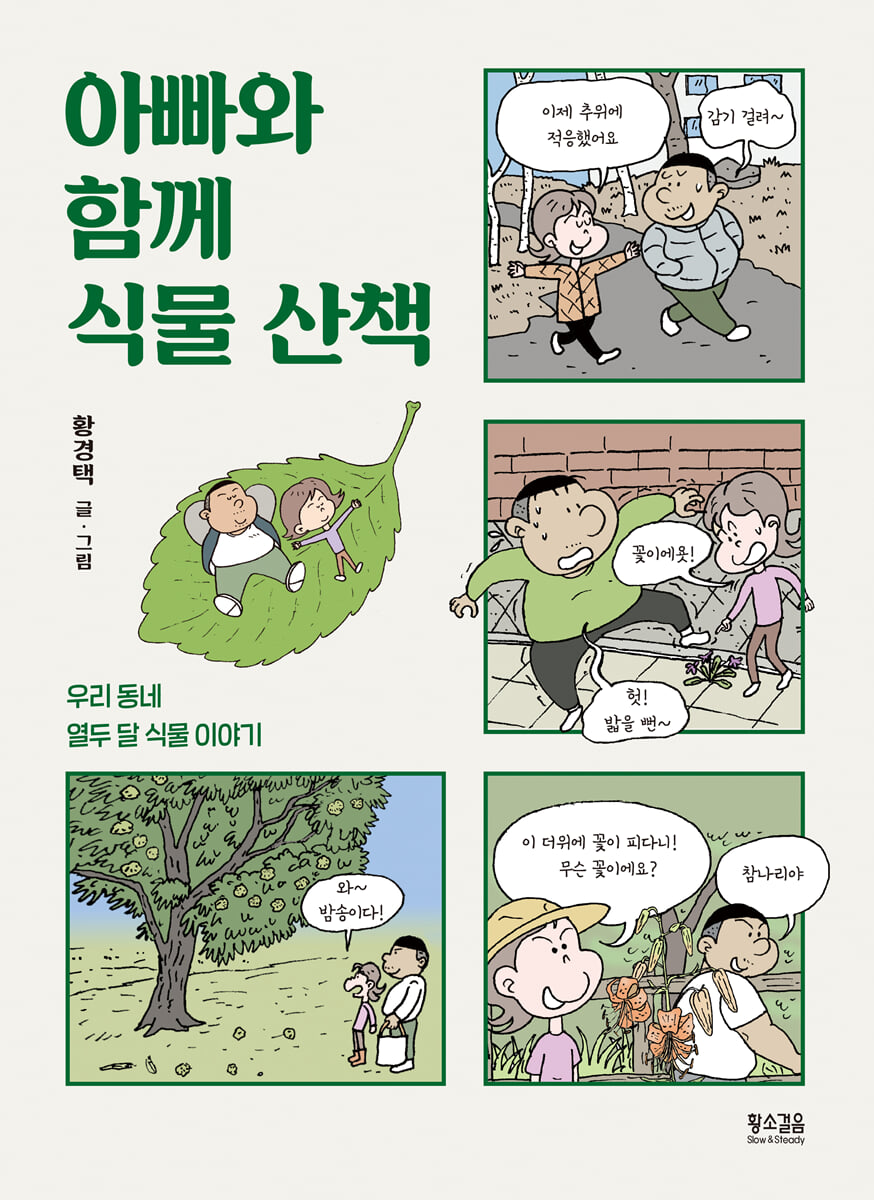 |
Description
Book Introduction
Our neighborhood plant friends we meet twelve months a year
Humans can live the healthiest and happiest lives when they live in harmony with nature.
Because humans are also a part of nature.
However, as urban civilization develops, 60 percent of the world's population and 92 percent of Koreans live in cities.
We should not be distant from nature, but we have become accustomed to city life and feel uncomfortable with nature.
What should I do?
If you think about it, there is a lot of nature around us.
That's very close too.
When I leave my house, I see various wild flowers blooming between the sidewalk blocks, cherry trees standing at the bus stop, and when I look out the bus window, the trees flowing like a river.
There are small parks in every neighborhood, and if you venture a little out of the city, the mountains will welcome you.
Nature can be found everywhere, even in the city.
Just get closer to nature and spend more time with it.
The reason we can't do that is because we don't know what value nature has, how to become close to it, and what stories nature contains.
Nature changes its appearance with the seasons.
So, you need to watch it steadily for a year, not just when it blooms, to see its true form.
Rather than trying to observe every plant, it's better to take an interest in the plants you're likely to encounter on your way to school or on a walk around the neighborhood.
This book introduces the trees and grasses I encounter throughout the twelve months of the year while walking around the neighborhood with my father.
To make it fun and accessible, one side features comics, while the other side features plant stories and detailed illustrations.
I hope that through this book, you will realize that nature is closer to us than we think, that each of us has our own way of living and our own story, and that we can learn the wisdom of life from it.
Humans can live the healthiest and happiest lives when they live in harmony with nature.
Because humans are also a part of nature.
However, as urban civilization develops, 60 percent of the world's population and 92 percent of Koreans live in cities.
We should not be distant from nature, but we have become accustomed to city life and feel uncomfortable with nature.
What should I do?
If you think about it, there is a lot of nature around us.
That's very close too.
When I leave my house, I see various wild flowers blooming between the sidewalk blocks, cherry trees standing at the bus stop, and when I look out the bus window, the trees flowing like a river.
There are small parks in every neighborhood, and if you venture a little out of the city, the mountains will welcome you.
Nature can be found everywhere, even in the city.
Just get closer to nature and spend more time with it.
The reason we can't do that is because we don't know what value nature has, how to become close to it, and what stories nature contains.
Nature changes its appearance with the seasons.
So, you need to watch it steadily for a year, not just when it blooms, to see its true form.
Rather than trying to observe every plant, it's better to take an interest in the plants you're likely to encounter on your way to school or on a walk around the neighborhood.
This book introduces the trees and grasses I encounter throughout the twelve months of the year while walking around the neighborhood with my father.
To make it fun and accessible, one side features comics, while the other side features plant stories and detailed illustrations.
I hope that through this book, you will realize that nature is closer to us than we think, that each of us has our own way of living and our own story, and that we can learn the wisdom of life from it.
- You can preview some of the book's contents.
Preview
index
Preface 4
january
Winter snow preparing for the new year
evergreen pine tree
Generous red bean tree
Birch trees shine even brighter in midwinter
winged arrow tree
february
Wintering porcupine
camellia flowers blooming in winter
A good leather tree that is useless
The flower that calls spring, the forsythia
March
The giant dog testicle plant, which you will never forget once you hear it
Plum tree with fragrant flowers
True azalea
Forsythia, which everyone knows but few know
april
Magnolia flowers bloom before the leaves
Cherry blossom viewing
Small but wise violet
Dandelion blooms everywhere
fragrant peony
May
Poplar tree with flowers that resemble rice
The lovable wisteria
The acacia tree that greened our mountains
The bamboo tree that fills the forest with fragrance
I thought it was a flower, but it wasn't a flower, a mountain ash tree
June
Mulberry, the successor to Eastern and Western civilizations
A common but surprising sight
Thank you and kind rabbit grass
The dogtooth violet adapts well anywhere
July
The rhododendrons soar high into the midsummer sky
The crape myrtle tree that blooms red flowers for 100 days
Dogweed to beat the heat
The original lily, the chamnidium
August
Acorn weevils that lay eggs in acorns
Thank you cotton
Poison-making snail
A seven-leafed tree whose fruit ripens in midsummer
Impatiens that attract ants
September
Cosmos with stars
A night to remember our ancestors
The defendant's rose of Sharon
A mosquito that moves by attaching itself to an animal's body
october
The ginkgo tree that lived with dinosaurs
Live a thousand years, die a thousand years, pay attention
Maple trees because their leaves are beautiful
Chrysanthemum, a symbol of autumn
November
The largest-leaved paulownia tree
Zelkova tree protecting the village
Sweet-smelling cinnamon tree
The zelkova tree welcoming winter
december
Metasequoia, recently discovered
The interesting bark of the Chinese juniper tree
The willow tree that brushed its teeth
Useful kudzu
january
Winter snow preparing for the new year
evergreen pine tree
Generous red bean tree
Birch trees shine even brighter in midwinter
winged arrow tree
february
Wintering porcupine
camellia flowers blooming in winter
A good leather tree that is useless
The flower that calls spring, the forsythia
March
The giant dog testicle plant, which you will never forget once you hear it
Plum tree with fragrant flowers
True azalea
Forsythia, which everyone knows but few know
april
Magnolia flowers bloom before the leaves
Cherry blossom viewing
Small but wise violet
Dandelion blooms everywhere
fragrant peony
May
Poplar tree with flowers that resemble rice
The lovable wisteria
The acacia tree that greened our mountains
The bamboo tree that fills the forest with fragrance
I thought it was a flower, but it wasn't a flower, a mountain ash tree
June
Mulberry, the successor to Eastern and Western civilizations
A common but surprising sight
Thank you and kind rabbit grass
The dogtooth violet adapts well anywhere
July
The rhododendrons soar high into the midsummer sky
The crape myrtle tree that blooms red flowers for 100 days
Dogweed to beat the heat
The original lily, the chamnidium
August
Acorn weevils that lay eggs in acorns
Thank you cotton
Poison-making snail
A seven-leafed tree whose fruit ripens in midsummer
Impatiens that attract ants
September
Cosmos with stars
A night to remember our ancestors
The defendant's rose of Sharon
A mosquito that moves by attaching itself to an animal's body
october
The ginkgo tree that lived with dinosaurs
Live a thousand years, die a thousand years, pay attention
Maple trees because their leaves are beautiful
Chrysanthemum, a symbol of autumn
November
The largest-leaved paulownia tree
Zelkova tree protecting the village
Sweet-smelling cinnamon tree
The zelkova tree welcoming winter
december
Metasequoia, recently discovered
The interesting bark of the Chinese juniper tree
The willow tree that brushed its teeth
Useful kudzu
Detailed image

Into the book
The English word January is said to have originated from Januarius, meaning 'month of Janus'.
In Roman mythology, Janus is a two-faced god.
The Janus Moon means 'the moon where the past and future overlap.'
--- p.9
The red bean tree bears fruit all winter long.
So it becomes a valuable food source for birds that fly in winter.
The red bean tree gets help from birds to spread and propagate far away.
In the bleak winter, looking at the red berries hanging from the red bean tree, we learn the wisdom of helping birds and preparing for the future.
--- p.15
All life has meaning in itself.
Usefulness is an overly human-centric term that comes from a lack of understanding of ecology.
Even if it seems useless now, nothing in this world exists without a purpose.
We are too.
--- p.27
If you pay attention to even an ordinary forsythia, you will see things you never saw before.
Knowing the name doesn't mean understanding.
As you take a step closer, you will discover many things you didn't know before.
--- p.39
Some people hate vines that climb other trees.
I guess they don't like the sight of trees leaning against other trees instead of standing on their own.
But as we live, there comes a time when we have to help the weak.
On the other hand, there are times when I need help.
Some people think that the maple tree is unilaterally helpful, but that is not the case.
--- p.57
The rabbit grass flowers wither after pollination is complete.
It's a consideration to prevent the bees from making a wasted effort.
This consideration increases the chances of pollination of unwilted clover flowers.
You are benefiting from the kindness you show to the bees.
There's a lot to learn from the rabbit grass, which spreads out in a low posture while helping other plants and being kind to bees, isn't there?
--- p.71
Plants produce poisons to prevent herbivores from eating their leaves or unripe fruits.
The poison can usually be used as medicine when used in appropriate amounts.
The line between medicine and poison is very subtle.
The events and things that happen around us also have good and bad outcomes due to small differences.
No object has just one form.
We need to look at people and things from different perspectives.
--- p.93
While conifers usually produce pine cone-like fruits, yews produce fruits with seeds inside red flesh.
The red flesh is sweet and edible, but the seeds are poisonous.
In Shakespeare's Hamlet, it is written that when Hamlet's uncle killed his father, he used poison extracted from yew seeds.
Poison, if used well, becomes medicine.
The ingredient in the anticancer drug 'Taxol' is extracted from the seeds of the yew tree.
--- p.111
The acorns of the oak tree provide food for the hungry, and are used as materials for building houses, boats, and furniture, and are also used as firewood and charcoal.
It is truly a tree that gives generously.
It gives us a lot, but if we try to get it unconditionally, there will come a time when we will get nothing.
I hope to be with the zelkova tree for a long time.
--- p.125
When the leaves fall, the bare body of the tree is exposed.
It's a good time to observe the kudzu creepers winding their way up other trees.
Many people don't know that kudzu is a tree.
You can tell it's a kudzu tree by looking at its winter buds.
In Roman mythology, Janus is a two-faced god.
The Janus Moon means 'the moon where the past and future overlap.'
--- p.9
The red bean tree bears fruit all winter long.
So it becomes a valuable food source for birds that fly in winter.
The red bean tree gets help from birds to spread and propagate far away.
In the bleak winter, looking at the red berries hanging from the red bean tree, we learn the wisdom of helping birds and preparing for the future.
--- p.15
All life has meaning in itself.
Usefulness is an overly human-centric term that comes from a lack of understanding of ecology.
Even if it seems useless now, nothing in this world exists without a purpose.
We are too.
--- p.27
If you pay attention to even an ordinary forsythia, you will see things you never saw before.
Knowing the name doesn't mean understanding.
As you take a step closer, you will discover many things you didn't know before.
--- p.39
Some people hate vines that climb other trees.
I guess they don't like the sight of trees leaning against other trees instead of standing on their own.
But as we live, there comes a time when we have to help the weak.
On the other hand, there are times when I need help.
Some people think that the maple tree is unilaterally helpful, but that is not the case.
--- p.57
The rabbit grass flowers wither after pollination is complete.
It's a consideration to prevent the bees from making a wasted effort.
This consideration increases the chances of pollination of unwilted clover flowers.
You are benefiting from the kindness you show to the bees.
There's a lot to learn from the rabbit grass, which spreads out in a low posture while helping other plants and being kind to bees, isn't there?
--- p.71
Plants produce poisons to prevent herbivores from eating their leaves or unripe fruits.
The poison can usually be used as medicine when used in appropriate amounts.
The line between medicine and poison is very subtle.
The events and things that happen around us also have good and bad outcomes due to small differences.
No object has just one form.
We need to look at people and things from different perspectives.
--- p.93
While conifers usually produce pine cone-like fruits, yews produce fruits with seeds inside red flesh.
The red flesh is sweet and edible, but the seeds are poisonous.
In Shakespeare's Hamlet, it is written that when Hamlet's uncle killed his father, he used poison extracted from yew seeds.
Poison, if used well, becomes medicine.
The ingredient in the anticancer drug 'Taxol' is extracted from the seeds of the yew tree.
--- p.111
The acorns of the oak tree provide food for the hungry, and are used as materials for building houses, boats, and furniture, and are also used as firewood and charcoal.
It is truly a tree that gives generously.
It gives us a lot, but if we try to get it unconditionally, there will come a time when we will get nothing.
I hope to be with the zelkova tree for a long time.
--- p.125
When the leaves fall, the bare body of the tree is exposed.
It's a good time to observe the kudzu creepers winding their way up other trees.
Many people don't know that kudzu is a tree.
You can tell it's a kudzu tree by looking at its winter buds.
--- p.135
GOODS SPECIFICS
- Date of issue: October 21, 2025
- Page count, weight, size: 136 pages | 188*257*20mm
- ISBN13: 9791174460028
- ISBN10: 1174460024
- KC Certification: Certification Type: Conformity Confirmation
You may also like
카테고리
korean


korean

![GQ KOREA Mark (Monthly): December [2025]](http://librairie.coreenne.fr/cdn/shop/files/8ef265dbbfbf186523ed75ba7319009d.jpg?v=1765340328&width=3840)


