

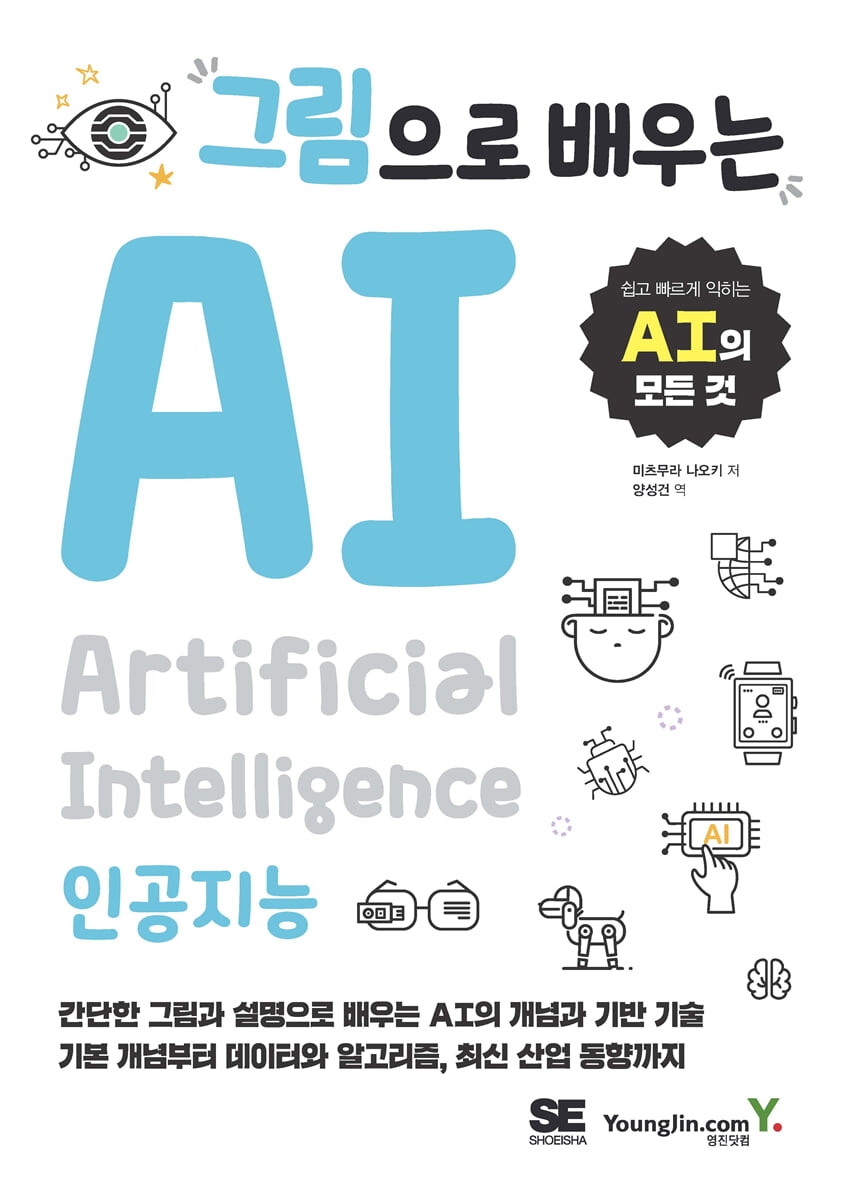
AI Learning Through Pictures
 |
Description
Book Introduction
Everything you need to know about AI: Learn it quickly and easily
With the advent of deep learning and the proliferation of the internet and smartphones, artificial intelligence (AI) has already become a part of our lives.
However, few people truly understand and utilize the structure of AI. Properly learning about AI requires knowledge of information science, statistics, and mathematics, making it a significant barrier to entry for the average person.
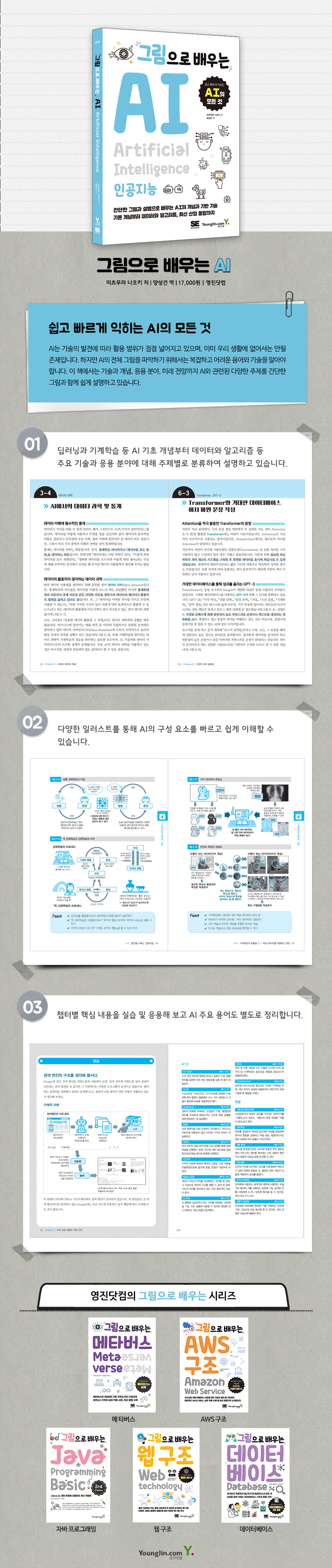
This book omits technical terminology and detailed explanations, focusing on the general structure of AI. It explains each topic—basic concepts, types, structure, and characteristics—on a single page, with illustrations, allowing even those unfamiliar with information science or computer architecture to understand the principles and operations of AI. It covers a wide range of topics related to AI, from basic algorithms to technical aspects like data analysis and deep learning, as well as current applications in industries like self-driving cars, drones, healthcare, fintech, and robotics, as well as future prospects. It is recommended for beginners curious about AI, as well as those working in related industries and engineers.
With the advent of deep learning and the proliferation of the internet and smartphones, artificial intelligence (AI) has already become a part of our lives.
However, few people truly understand and utilize the structure of AI. Properly learning about AI requires knowledge of information science, statistics, and mathematics, making it a significant barrier to entry for the average person.
This book omits technical terminology and detailed explanations, focusing on the general structure of AI. It explains each topic—basic concepts, types, structure, and characteristics—on a single page, with illustrations, allowing even those unfamiliar with information science or computer architecture to understand the principles and operations of AI. It covers a wide range of topics related to AI, from basic algorithms to technical aspects like data analysis and deep learning, as well as current applications in industries like self-driving cars, drones, healthcare, fintech, and robotics, as well as future prospects. It is recommended for beginners curious about AI, as well as those working in related industries and engineers.
- You can preview some of the book's contents.
Preview
index
Chapter 1: The Basics of AI
1-1 What is AI? Defining a Vague Concept
1-2 Rapid development and stagnation of AI
1-3 The First AI Boom: "The Beginning and Potential of AI"
1-4 The Second AI Boom: "How to Handle Data and Knowledge"
1-5 The Third AI Boom: "A Leap Forward in Machine Learning"
1-6 How did connectionism develop?
1-7 How did symbolism develop?
1-8 Relationship between AI technology and products
Chapter 2: Basic Structure of AI and Programs
2-1 Challenges and Solutions for AI
2-2 Types and Overview of Search Algorithms
2-3 Types and Overview of Sorting Algorithms
2-4 Types and Overview of Encryption Algorithms
2-5 Architecture that becomes the blueprint for AI
2-6 The existence of AI that works independently
AI's mindset and decision-making techniques according to the 2-7 Rule
2-8 AI's Thinking Methods and Decision-Making Techniques Tailored to the Goal
Learning AI's Thinking Methods and Decision-Making Techniques from Case Studies 2-9
2-10 Approaches to Thinking Flexiblely
Chapter 3: Data Handling in AI
3-1 Information required by AI
3-2 When handling data, what is easy to handle and what is difficult to handle
3-3 Approaches to conveying knowledge and concepts
3-4 Data Science and Statistics in AI
3-5 Analyze data and find value
3-6 Analysis Methods to Know ① - Finding Relationships in Data
3-7 Analysis Methods to Know ② - Divide the data and then analyze it.
3-8 Theory used to understand the ambiguous world ① - Representation of information~
3-9 Theory used to understand the ambiguous world ② - Predicting the future
3-10 Difficulties in Processing Data Correctly
3-11 Creating AI concepts from knowledge and statistics
Chapter 4: Technologies Related to Machine Learning
4-1 Create a judgment criterion from statistics
4-2 Machine Learning Using Networks
4-3 Most Common Learning Styles
4-4 Learning Styles with High Potential
4-5 Learning styles that adapt to the real world
Reinforcement learning that achieves 4-6 development
4-7 Two theorems illustrating the challenges of machine learning
4-8 Learning methods similar to reinforcement learning
4-9 Improving Machine Learning Efficiency ① - Supplementing Learning Data
4-10 Improving Machine Learning Efficiency ② - Dedicating Learning Models
4-11 Improving Machine Learning Efficiency ③ - Scientific Learning Measures
Chapter 5 Deep Learning
5-1 What is a neural network?
5-2 The Road to Deep Learning
5-3 Deep Learning's Feature Extraction Capability
5-4 Deep neural networks strong in image and speech recognition
5-5 Deep neural networks strong in language processing and time series processing
5-6 Applications of Recurrent Neural Networks
5-7 GANs that complement the shortcomings of deep learning
5-8 Information handled by neural networks
How to represent the meaning of 5-9 words in numbers
5-10 Understanding the Neural Network's Mindset
5-11 Establishing a Deep Learning Environment
5-12 Machine Learning Methods Changed by Deep Learning
Chapter 6: Various AI and Their Applications
6-1 Image Recognition: Evolving from Images to Videos
6-2 AI's Communication Methods
6-3 Transformer and writing sentences that have been changed from a huge database
6-4 Technology required for textualization of speech
6-5 Data analysis combining video, audio, and multiple pieces of information
6-6 Learn human creative techniques
6-7 Learn how to use the human body
6-8 Platformizing AI
6-9 Distributed and Spreading AI
6-10 Execute the given task ① - Perception of autonomous driving
6-11 Execute the given task ② - Judgment and operation of autonomous vehicles
6-12 Game AI that promotes the development and growth of AI
6-13 Strategies that vary depending on the information visible
6-14 Game theory explaining human judgment criteria
6-15 Collaboration between AI and humans in both private and business life
Chapter 7: AI Evolving in Harmony with Other Fields
7-1 Medical AI ① - Assisting the Medical Field
7-2 Medical AI ② - AI Utilization in Difficult Areas
7-3 Medical AI ③ - Organizing the Data Necessary for Growth
7-4 Fintech ① - Automation of Data Analysis
7-5 Fintech ② - Customer Response and Data Management
7-6 Robotics ① - Robots that expand their scope of activity
-7 Robotics ② - Robots working in human society
7-8 Autonomous Vehicle ① - Level 0-3 with Humans Involved
7-9 Autonomous Vehicle ② - Level 4-5: Leaving Everything to the Driver
7-10 Drones and Unmanned Aerial Vehicles, Applications in Military Technology
7-11 Hardware ① - A New Computer That Will Change AI
7-12 Hardware ② - Two Types of Quantum Computers
7-13 RPA ① - Work Efficiency Gaining Attention
7-14 RPA ② - Automation Areas Expanding with AI
Chapter 8: Various Discussions on AI
8-1 Classification of artificial intelligence that must be known as a prerequisite
8-2 AI's Language Understanding ① - Can Intelligence Be Measured Through Speech?
8-3 AI's Language Understanding ② - The Wall Between Understanding Meaning and Reality
8-4 Problem of falling into a state of inability to judge
8-5 AI's Physicality ① - A Body for Approaching Humans
8-6 AI's Physicality ② - Learning sensations without having a body
8-7 Biases in AI Under Human Influence
8-8 AI-powered information control for humans
8-9 The Black Box-like, Incomprehensible Way of Thinking of AI
8-10 AI Ethics ① - The Difficult Structure and Operation of AI
8-11 AI Ethics ② - Who Protects Ethics?
8-12 Monopoly and Openness of AI
Chapter 9: AI of the Future
9-1 AI continues to grow in various forms
9-2 AI Outlook ① ~Singularity and Optimism~
9-3 AI's Prospects ② ~Winter Era and Pessimism~
9-4 The Changing Way Humans Work
9-5 Methods and feasibility of reproducing humans
9-6 Humans Follow AI's Advancement
9-7 The line between humans and AI is blurring, AI, VR, and avatars
9-8 Is AI an intelligent life form?
1-1 What is AI? Defining a Vague Concept
1-2 Rapid development and stagnation of AI
1-3 The First AI Boom: "The Beginning and Potential of AI"
1-4 The Second AI Boom: "How to Handle Data and Knowledge"
1-5 The Third AI Boom: "A Leap Forward in Machine Learning"
1-6 How did connectionism develop?
1-7 How did symbolism develop?
1-8 Relationship between AI technology and products
Chapter 2: Basic Structure of AI and Programs
2-1 Challenges and Solutions for AI
2-2 Types and Overview of Search Algorithms
2-3 Types and Overview of Sorting Algorithms
2-4 Types and Overview of Encryption Algorithms
2-5 Architecture that becomes the blueprint for AI
2-6 The existence of AI that works independently
AI's mindset and decision-making techniques according to the 2-7 Rule
2-8 AI's Thinking Methods and Decision-Making Techniques Tailored to the Goal
Learning AI's Thinking Methods and Decision-Making Techniques from Case Studies 2-9
2-10 Approaches to Thinking Flexiblely
Chapter 3: Data Handling in AI
3-1 Information required by AI
3-2 When handling data, what is easy to handle and what is difficult to handle
3-3 Approaches to conveying knowledge and concepts
3-4 Data Science and Statistics in AI
3-5 Analyze data and find value
3-6 Analysis Methods to Know ① - Finding Relationships in Data
3-7 Analysis Methods to Know ② - Divide the data and then analyze it.
3-8 Theory used to understand the ambiguous world ① - Representation of information~
3-9 Theory used to understand the ambiguous world ② - Predicting the future
3-10 Difficulties in Processing Data Correctly
3-11 Creating AI concepts from knowledge and statistics
Chapter 4: Technologies Related to Machine Learning
4-1 Create a judgment criterion from statistics
4-2 Machine Learning Using Networks
4-3 Most Common Learning Styles
4-4 Learning Styles with High Potential
4-5 Learning styles that adapt to the real world
Reinforcement learning that achieves 4-6 development
4-7 Two theorems illustrating the challenges of machine learning
4-8 Learning methods similar to reinforcement learning
4-9 Improving Machine Learning Efficiency ① - Supplementing Learning Data
4-10 Improving Machine Learning Efficiency ② - Dedicating Learning Models
4-11 Improving Machine Learning Efficiency ③ - Scientific Learning Measures
Chapter 5 Deep Learning
5-1 What is a neural network?
5-2 The Road to Deep Learning
5-3 Deep Learning's Feature Extraction Capability
5-4 Deep neural networks strong in image and speech recognition
5-5 Deep neural networks strong in language processing and time series processing
5-6 Applications of Recurrent Neural Networks
5-7 GANs that complement the shortcomings of deep learning
5-8 Information handled by neural networks
How to represent the meaning of 5-9 words in numbers
5-10 Understanding the Neural Network's Mindset
5-11 Establishing a Deep Learning Environment
5-12 Machine Learning Methods Changed by Deep Learning
Chapter 6: Various AI and Their Applications
6-1 Image Recognition: Evolving from Images to Videos
6-2 AI's Communication Methods
6-3 Transformer and writing sentences that have been changed from a huge database
6-4 Technology required for textualization of speech
6-5 Data analysis combining video, audio, and multiple pieces of information
6-6 Learn human creative techniques
6-7 Learn how to use the human body
6-8 Platformizing AI
6-9 Distributed and Spreading AI
6-10 Execute the given task ① - Perception of autonomous driving
6-11 Execute the given task ② - Judgment and operation of autonomous vehicles
6-12 Game AI that promotes the development and growth of AI
6-13 Strategies that vary depending on the information visible
6-14 Game theory explaining human judgment criteria
6-15 Collaboration between AI and humans in both private and business life
Chapter 7: AI Evolving in Harmony with Other Fields
7-1 Medical AI ① - Assisting the Medical Field
7-2 Medical AI ② - AI Utilization in Difficult Areas
7-3 Medical AI ③ - Organizing the Data Necessary for Growth
7-4 Fintech ① - Automation of Data Analysis
7-5 Fintech ② - Customer Response and Data Management
7-6 Robotics ① - Robots that expand their scope of activity
-7 Robotics ② - Robots working in human society
7-8 Autonomous Vehicle ① - Level 0-3 with Humans Involved
7-9 Autonomous Vehicle ② - Level 4-5: Leaving Everything to the Driver
7-10 Drones and Unmanned Aerial Vehicles, Applications in Military Technology
7-11 Hardware ① - A New Computer That Will Change AI
7-12 Hardware ② - Two Types of Quantum Computers
7-13 RPA ① - Work Efficiency Gaining Attention
7-14 RPA ② - Automation Areas Expanding with AI
Chapter 8: Various Discussions on AI
8-1 Classification of artificial intelligence that must be known as a prerequisite
8-2 AI's Language Understanding ① - Can Intelligence Be Measured Through Speech?
8-3 AI's Language Understanding ② - The Wall Between Understanding Meaning and Reality
8-4 Problem of falling into a state of inability to judge
8-5 AI's Physicality ① - A Body for Approaching Humans
8-6 AI's Physicality ② - Learning sensations without having a body
8-7 Biases in AI Under Human Influence
8-8 AI-powered information control for humans
8-9 The Black Box-like, Incomprehensible Way of Thinking of AI
8-10 AI Ethics ① - The Difficult Structure and Operation of AI
8-11 AI Ethics ② - Who Protects Ethics?
8-12 Monopoly and Openness of AI
Chapter 9: AI of the Future
9-1 AI continues to grow in various forms
9-2 AI Outlook ① ~Singularity and Optimism~
9-3 AI's Prospects ② ~Winter Era and Pessimism~
9-4 The Changing Way Humans Work
9-5 Methods and feasibility of reproducing humans
9-6 Humans Follow AI's Advancement
9-7 The line between humans and AI is blurring, AI, VR, and avatars
9-8 Is AI an intelligent life form?
Detailed image
GOODS SPECIFICS
- Date of issue: October 20, 2023
- Page count, weight, size: 240 pages | 444g | 152*215*16mm
- ISBN13: 9788931469707
- ISBN10: 8931469705
You may also like
카테고리
korean


korean

![GQ KOREA Mark (Monthly): December [2025]](http://librairie.coreenne.fr/cdn/shop/files/8ef265dbbfbf186523ed75ba7319009d.jpg?v=1765340328&width=3840)


