

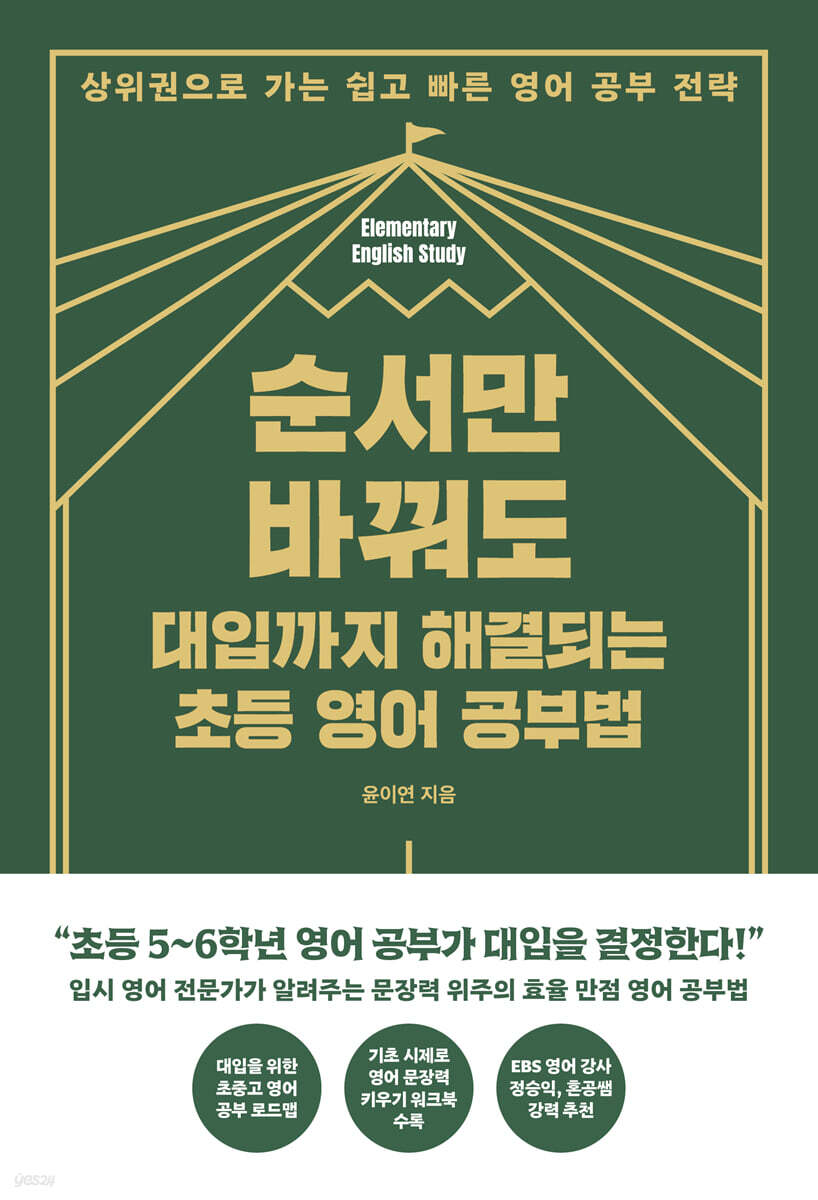
A simple way to study elementary English that will help you get into college.
 |
Description
Book Introduction
“English studies in 5th and 6th grade determine college admissions!”
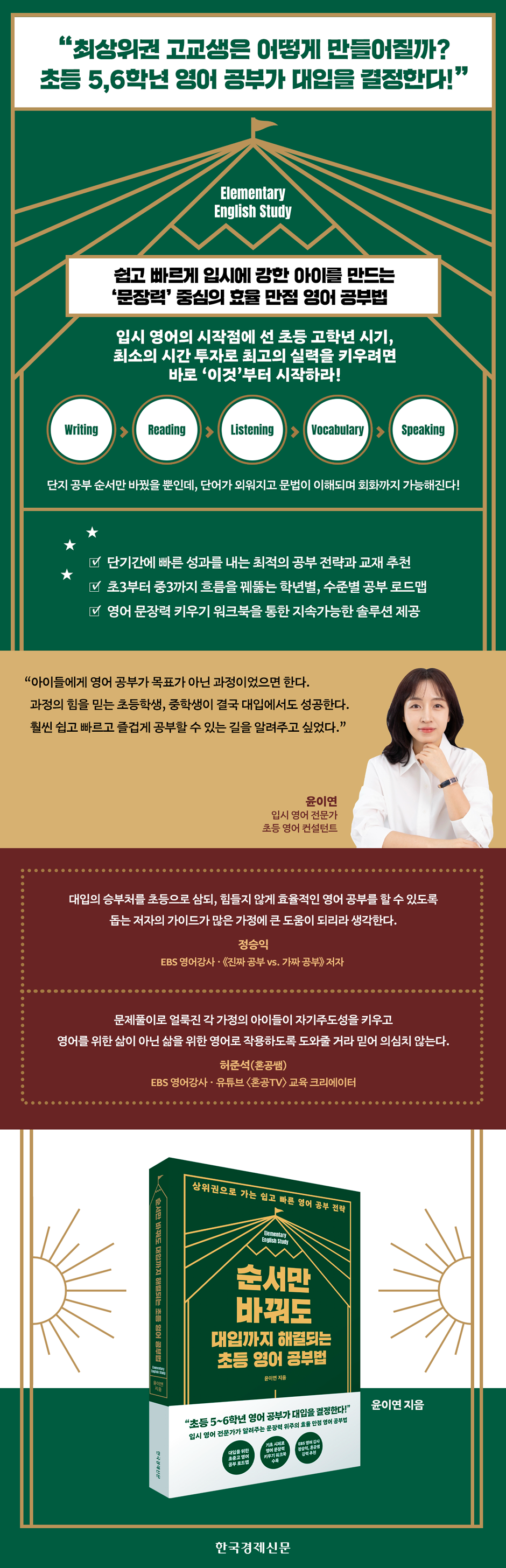
What if there was an English roadmap that would solve your college entrance exam problems just by changing the order in which you study?
The best English study strategy to quickly and easily reach the top ranks.
An English entrance exam expert and elementary English consultant shares an efficient English study method focused on sentence structure.
With three or four academies a day and hours of homework after returning home... Will elementary school students who endure all that time actually achieve good results on the CSAT? With the growing interest in English learning, interest in English kindergartens and language training programs from an early age is also on the rise.
This is because parents expect that learning will be easier if their children have sufficient exposure to English.
However, parents who have exposed their children to conversational English, such as listening and speaking English, when they were young suddenly become anxious and are busy switching to grammar-based English education when their children reach the upper grades of elementary school.
In a reality where conversation-focused English education creates limitations in grammar, and entrance exam-focused English education causes people to give up conversation, isn't there an optimal English study method that allows for both?
This book was written by an English instructor with 10 years of experience teaching English to many students, from high school students to elementary school students, from college entrance exam English to elementary school English. Based on the experience and research gained in the classroom, this book was written to suggest a more efficient way to study English to parents and students who have gone through countless trials and errors in the past.
To avoid forcing children to study English too hard and excessively from a young age, you must first understand what kind of English is helpful for college entrance exams.
It helps students view the college entrance exam race that unfolds over the course of 12 years from a long-term perspective, and it suggests a roadmap that will help them quickly and easily settle into the top ranks, as well as a groundbreaking English study method that focuses on 'sentence skills' that will allow them to kill three birds with one stone: vocabulary, grammar, and even conversation, all in one easy course during elementary school.
What if there was an English roadmap that would solve your college entrance exam problems just by changing the order in which you study?
The best English study strategy to quickly and easily reach the top ranks.
An English entrance exam expert and elementary English consultant shares an efficient English study method focused on sentence structure.
With three or four academies a day and hours of homework after returning home... Will elementary school students who endure all that time actually achieve good results on the CSAT? With the growing interest in English learning, interest in English kindergartens and language training programs from an early age is also on the rise.
This is because parents expect that learning will be easier if their children have sufficient exposure to English.
However, parents who have exposed their children to conversational English, such as listening and speaking English, when they were young suddenly become anxious and are busy switching to grammar-based English education when their children reach the upper grades of elementary school.
In a reality where conversation-focused English education creates limitations in grammar, and entrance exam-focused English education causes people to give up conversation, isn't there an optimal English study method that allows for both?
This book was written by an English instructor with 10 years of experience teaching English to many students, from high school students to elementary school students, from college entrance exam English to elementary school English. Based on the experience and research gained in the classroom, this book was written to suggest a more efficient way to study English to parents and students who have gone through countless trials and errors in the past.
To avoid forcing children to study English too hard and excessively from a young age, you must first understand what kind of English is helpful for college entrance exams.
It helps students view the college entrance exam race that unfolds over the course of 12 years from a long-term perspective, and it suggests a roadmap that will help them quickly and easily settle into the top ranks, as well as a groundbreaking English study method that focuses on 'sentence skills' that will allow them to kill three birds with one stone: vocabulary, grammar, and even conversation, all in one easy course during elementary school.
- You can preview some of the book's contents.
Preview
index
Introductory Remarks: College Admissions Are a Domino Effect! A Long-Term Perspective Is Essential
PART 1.
Elementary education that creates the top 1 percent of high school students
Third and fifth grades: two turning points
Elementary school grades 5 and 6, two years of study determine college admissions.
The secret to being in the top 1 percent isn't your score, it's your attitude.
Managing your college entrance exams means managing your time.
Habits of Top High School Students Who Have Perfected Their Study Methods
Understanding Elementary English for College Entrance Exams
PART 2.
Studying English: Just change the order and you'll see the way forward.
Learn about the level tests at major language schools
Does the level test have an expiration date?
The ability to understand sentences is more important than the level score.
A 10-Minute Test to Determine Your Child's English Skills
An English academy where you get scolded for asking questions in Korean?
Studying English: Change the order to see the path
PART 3.
The key to learning English: sentence structure
This is too easy for our child to see?
Elementary English is enough if you study it three times a week.
Understand sentence structure before memorizing words.
The core of sentence structure: word order and tense
List of recommended English books by sentence comprehension level
Reading English books that will give wings to your writing skills
PART 4.
Expanding sentence structure and vocabulary
Words: Utilizing is more important than memorizing.
Should I start by memorizing the spelling? Or should I start by memorizing the meaning of the word?
Recommended vocabulary list for elementary school students starting in the upper grades
A good vocabulary list for middle and high school students
How to use Naver Internet Dictionary
PART 5.
The flower of writing, writing
5th and 6th grades are the turning point for the CSAT.
Writing a little bit every day, the beginning of writing
The Rise of AI, ChatGPT & DeepL
Speaking & Pronunciation Practice with My Writing
PART 6.
Perfecting your writing skills, grammar
A child who understands sentences does not struggle with grammar.
Essential workbook for checking basic grammar
Intermediate workbook covering all grades
English study by grade level to prepare for middle school grammar
Study the best textbooks to prepare for middle school grades
Tip.
English for the CSAT, prepared from middle school
Study Methods for High School Listening Assessments Starting in Middle School 1st Grade
The order of solutions to high school mock exams starting from the second year of middle school
How to solve mock exam questions by type for the CSAT
PART 7.
Confidence that completes study efficiency
Study confidence developed through metacognition
The power to get elementary school students to study on their own
Elementary school grades 5 and 6 are a period to increase study efficiency.
A child who thinks he or she is good at studying, not a child who is good at studying
Outgoing Words: Education that Breaks Common Sense with Love
Appendix_Workbook 50: Developing English Sentence Skills with Basic Tenses
PART 1.
Elementary education that creates the top 1 percent of high school students
Third and fifth grades: two turning points
Elementary school grades 5 and 6, two years of study determine college admissions.
The secret to being in the top 1 percent isn't your score, it's your attitude.
Managing your college entrance exams means managing your time.
Habits of Top High School Students Who Have Perfected Their Study Methods
Understanding Elementary English for College Entrance Exams
PART 2.
Studying English: Just change the order and you'll see the way forward.
Learn about the level tests at major language schools
Does the level test have an expiration date?
The ability to understand sentences is more important than the level score.
A 10-Minute Test to Determine Your Child's English Skills
An English academy where you get scolded for asking questions in Korean?
Studying English: Change the order to see the path
PART 3.
The key to learning English: sentence structure
This is too easy for our child to see?
Elementary English is enough if you study it three times a week.
Understand sentence structure before memorizing words.
The core of sentence structure: word order and tense
List of recommended English books by sentence comprehension level
Reading English books that will give wings to your writing skills
PART 4.
Expanding sentence structure and vocabulary
Words: Utilizing is more important than memorizing.
Should I start by memorizing the spelling? Or should I start by memorizing the meaning of the word?
Recommended vocabulary list for elementary school students starting in the upper grades
A good vocabulary list for middle and high school students
How to use Naver Internet Dictionary
PART 5.
The flower of writing, writing
5th and 6th grades are the turning point for the CSAT.
Writing a little bit every day, the beginning of writing
The Rise of AI, ChatGPT & DeepL
Speaking & Pronunciation Practice with My Writing
PART 6.
Perfecting your writing skills, grammar
A child who understands sentences does not struggle with grammar.
Essential workbook for checking basic grammar
Intermediate workbook covering all grades
English study by grade level to prepare for middle school grammar
Study the best textbooks to prepare for middle school grades
Tip.
English for the CSAT, prepared from middle school
Study Methods for High School Listening Assessments Starting in Middle School 1st Grade
The order of solutions to high school mock exams starting from the second year of middle school
How to solve mock exam questions by type for the CSAT
PART 7.
Confidence that completes study efficiency
Study confidence developed through metacognition
The power to get elementary school students to study on their own
Elementary school grades 5 and 6 are a period to increase study efficiency.
A child who thinks he or she is good at studying, not a child who is good at studying
Outgoing Words: Education that Breaks Common Sense with Love
Appendix_Workbook 50: Developing English Sentence Skills with Basic Tenses
Detailed image
Into the book
It is bound to be difficult for a child who lacks the foundation of elementary school to understand and memorize the content of the secondary school curriculum, and without this knowledge, they will not be able to apply and deepen the content in the higher education curriculum.
This domino effect starts in the 5th or 6th grade of elementary school and leads to college entrance.
5th and 6th grades are the most important time in a child's academic life.
By studying without excessive homework or demanding tests, children in grades 5 and 6 gain confidence in their studies rather than the aversion to studying that often comes at that age.
It is no exaggeration to say that 5th and 6th graders in elementary school determine college admissions.
This is because one hour of study, used effectively at this time, creates value equivalent to 10 hours of study in high school, or even more.
--- p.20
The most important thing that parents of elementary school students should consider when teaching English is the 'order' of English study.
Let's think about it for a moment.
What if a child who has only learned the alphabet and basic phonics were to attend an academy simply to listen to a native-speaking teacher, or immediately begin reading various English books even if they don't understand them, or begin learning English with grammar workbooks from elementary school, or complete a single-page English writing assignment? Even for a child with exceptional language skills, none of this would be easy.
What if we started right away with basic English sentence writing? If my child began by learning how to construct sentences while understanding the word order of English sentences, even if it meant stumbling through very short sentences, how would the rest of the process be different?
--- p.41~42
Even at the academies that elementary school students attend, they spend more time listening to native English speakers speak fluent English than speaking on their own, and writing in English is almost always done as homework without individual guidance on understanding sentence structure appropriate to their level.
The test-focused nature of elementary English education is a waste of time for elementary school students who don't know sentence structure.
From 3rd grade to 6th grade, which is the golden time for elementary English, many students pass by without knowing the structure of sentences.
Up until the 4th grade, the level test scores are clearly high, but it does not lead to grammar skills, so parents who do not know the standards are frustrated.
So, a vicious cycle repeats itself in which children in the 5th and 6th grades are sent to cram schools in large numbers to prepare for middle school grades.
Above all, it is important during this period to teach children to make sentences on their own from the beginning.
--- p.53~54
If you memorize a lot of words without using them, the words you don't use will eventually disappear from your memory.
Knowing a lot of words is good, but knowing how they are used in sentences will help you remember and apply them longer.
You should learn the order of words by repeatedly making easy sentences, and acquire it by using it, not by memorizing it and taking a test.
In this way, the point that you learn while learning English like Korean is the structure of sentences, or sentence power.
During elementary school, let's put aside the idea of memorizing a lot of words and reading a lot of high-level books.
Elementary English learning should be based not on reading, but on the level at which sentences can be constructed.
Only then can children avoid trial and error or suffering because of English in middle school grades and even in college entrance exam preparation.
--- p.80~81
From the 3rd grade of elementary school at the earliest, or the 5th grade at the latest, you should be studying with a priority on 'writing skills'.
This will speed up the process of transitioning to middle and high school studies.
The reason why it is important to first develop sentence structure in English is that when children begin to memorize vocabulary in earnest in the upper grades, they will not have a hard time and will be able to use dictionaries on their own, which will provide various advantages in the long race of English study leading up to university entrance.
The biggest advantage is that its true value is demonstrated in grammar studies starting in the upper grades.
For children who have already acquired some grammar while building their writing skills, studying middle school grammar starting in the 5th or 6th grade is not unfamiliar.
So, once you understand the part where you learn new English grammar terms in Chinese characters, your understanding of grammar will be several times higher than that of children whose sentence structure is not yet complete.
This domino effect starts in the 5th or 6th grade of elementary school and leads to college entrance.
5th and 6th grades are the most important time in a child's academic life.
By studying without excessive homework or demanding tests, children in grades 5 and 6 gain confidence in their studies rather than the aversion to studying that often comes at that age.
It is no exaggeration to say that 5th and 6th graders in elementary school determine college admissions.
This is because one hour of study, used effectively at this time, creates value equivalent to 10 hours of study in high school, or even more.
--- p.20
The most important thing that parents of elementary school students should consider when teaching English is the 'order' of English study.
Let's think about it for a moment.
What if a child who has only learned the alphabet and basic phonics were to attend an academy simply to listen to a native-speaking teacher, or immediately begin reading various English books even if they don't understand them, or begin learning English with grammar workbooks from elementary school, or complete a single-page English writing assignment? Even for a child with exceptional language skills, none of this would be easy.
What if we started right away with basic English sentence writing? If my child began by learning how to construct sentences while understanding the word order of English sentences, even if it meant stumbling through very short sentences, how would the rest of the process be different?
--- p.41~42
Even at the academies that elementary school students attend, they spend more time listening to native English speakers speak fluent English than speaking on their own, and writing in English is almost always done as homework without individual guidance on understanding sentence structure appropriate to their level.
The test-focused nature of elementary English education is a waste of time for elementary school students who don't know sentence structure.
From 3rd grade to 6th grade, which is the golden time for elementary English, many students pass by without knowing the structure of sentences.
Up until the 4th grade, the level test scores are clearly high, but it does not lead to grammar skills, so parents who do not know the standards are frustrated.
So, a vicious cycle repeats itself in which children in the 5th and 6th grades are sent to cram schools in large numbers to prepare for middle school grades.
Above all, it is important during this period to teach children to make sentences on their own from the beginning.
--- p.53~54
If you memorize a lot of words without using them, the words you don't use will eventually disappear from your memory.
Knowing a lot of words is good, but knowing how they are used in sentences will help you remember and apply them longer.
You should learn the order of words by repeatedly making easy sentences, and acquire it by using it, not by memorizing it and taking a test.
In this way, the point that you learn while learning English like Korean is the structure of sentences, or sentence power.
During elementary school, let's put aside the idea of memorizing a lot of words and reading a lot of high-level books.
Elementary English learning should be based not on reading, but on the level at which sentences can be constructed.
Only then can children avoid trial and error or suffering because of English in middle school grades and even in college entrance exam preparation.
--- p.80~81
From the 3rd grade of elementary school at the earliest, or the 5th grade at the latest, you should be studying with a priority on 'writing skills'.
This will speed up the process of transitioning to middle and high school studies.
The reason why it is important to first develop sentence structure in English is that when children begin to memorize vocabulary in earnest in the upper grades, they will not have a hard time and will be able to use dictionaries on their own, which will provide various advantages in the long race of English study leading up to university entrance.
The biggest advantage is that its true value is demonstrated in grammar studies starting in the upper grades.
For children who have already acquired some grammar while building their writing skills, studying middle school grammar starting in the 5th or 6th grade is not unfamiliar.
So, once you understand the part where you learn new English grammar terms in Chinese characters, your understanding of grammar will be several times higher than that of children whose sentence structure is not yet complete.
--- p.160
Publisher's Review
'What should I do first when studying English for elementary school children?
From conversation? From vocabulary? From grammar?
College entrance is a 12-year domino effect. Studying English in 5th and 6th grades is key!
Elementary school upper grades are the starting point for college entrance exams. Start with 'this' before it's too late!
* Highly recommended by EBS English instructors Seungik Jeong and Junseok Heo *
* Presenting a 12-year roadmap for English study in elementary, middle, and high school for college entrance exams *
* Includes '50 Workbooks to Improve Your English Sentence Skills with Basic Tenses' *
In a country like South Korea, where English education varies greatly, it's difficult to guide your child's studies clearly and without wavering.
However, even though parents cannot do their children's studies for them, they must play the role of a guide who can show them the right path to take.
After all, college entrance is a chain of dominoes that spans 12 years.
If we approach and apply English education from a long-term perspective, with the goal of college admissions in mind, we can guide our children in an efficient and appropriate direction without forcing them to endure excessive amounts of homework and tests from elementary school.
It is no exaggeration to say that English for college entrance exams actually begins in the upper grades of elementary school.
This is because the 5th and 6th grades of elementary school are the optimal time to create new opportunities and opportunities, depending on how you approach English for college entrance exams and how you start.
It is in this context that the author mentions 5th and 6th grade as the most important turning point.
The 5th and 6th grades of elementary school are a time when we must use our time wisely for the next six years.
The author says that, having taught and observed many children from high school to elementary school, it is during this period of upper elementary school that a well-developed mindset toward studying, one's own study habits, and study methods become the first step toward becoming a top-tier high school student.
The fifth and sixth grades of elementary school are the most appropriate time to fill in the gaps in the foundation of the studies you have been doing so far, and it can also be a turning point to find new enjoyment in studying.
If you fail to discover these characteristics and suddenly send your children to cram schools that force them to study for entrance exams or make them memorize a lot of words and struggle with grammar simply because "everyone else is doing it" or "they're anxious," it can have the opposite effect of making them distance themselves from studying in middle and high school.
You should look at college entrance exams with a long-term perspective and use it as a time to build a solid foundation without getting tired.
This is because one hour of English study, which was done efficiently and without burden during elementary school, can have the effect of reducing the amount of study required in high school by 10 hours, or even more.
“How are the top 1 percent of high school students created?”
Without trial and error, from elementary, middle, and high school grades to the college entrance exam
Study tips focused on sentence structure to help children excel in English for college entrance exams.
The keys to elementary English that the author mentions are ‘fun’ and ‘a sense of accomplishment.’
Children should be able to have fun while studying English and feel a sense of pride in their own ability.
Therefore, I boldly suggest that you reconsider and overturn the order in which you have studied English so far.
The author recommends that you change the order of your studies after the Phoenix course and start by making English sentences.
In order for children to feel a sense of accomplishment in English, they must start by practicing making basic sentences step by step, and it is essential that they spend time learning why English sentences are structured this way.
The author says that when building a foundation in English, you should put aside English conversation, vocabulary memorization, and grammar tests, and instead practice writing sentences consisting of three or four words over and over again, making mistakes.
Gradually acquire the English word order first.
Whether it's middle school grammar, high school reading, or English conversation, all of this can be achieved by adding vocabulary, grammar, and pronunciation to a sentence structure that is complete.
Speaking begins to improve when a child can construct sentences on his or her own to some extent, and it is not something that can be achieved by simply placing the child in front of a native speaker.
The same goes for listening.
It sounds like a sentence that you can construct and say on your own.
What about reading? When a child with a certain level of writing skills begins reading original texts, it's like taking flight in English.
What a child who has finished phonics needs most is not a native English teacher, but 'sentence skills'.
If you can develop your writing skills when you first start learning English in earnest in elementary school, you can increase the effectiveness of your English studies.
In fact, since both grammar and vocabulary are included in English sentences, there is no need to study grammar again in the upper grades.
Because you have already learned basic grammar by writing sentences.
Therefore, a child who has been learning English this way since Phoenix can enter middle school with the ability to speak, write, listen, and read.
And these children can advance to high school with all the basic skills they need just by learning the grammar in middle school.
The author says that simply by correcting the order of elementary English studies, you can sufficiently prepare for the college entrance exam, and furthermore, you can easily learn English conversation by attending an academy after entering college.
Parenting Book + Study Guide: A Learning Coaching Book with Practical Solutions
I just changed the order of studying.
Words are memorized, grammar is understood, and writing is possible.
The amazing magic of learning English begins!
Children who have blindly memorized 50 to 100 words a day, no matter how well they read English books, will later on, when they have to read, they will only look for words they know and read them sporadically, which is a stepping stone interpretation.
Therefore, studying vocabulary by just memorizing it without knowing how to use it by putting it in the right place in a sentence is meaningless.
The same goes for grammar.
Children quickly lose interest when they suddenly start learning Chinese grammar terms that are difficult to understand even in Korean, without any understanding of English sentence structure and word order, which are clearly different from ours.
English, which is already becoming increasingly difficult, suddenly becomes a boring study full of unfamiliar terms.
The author explains how to start studying English, which is like a lifelong shackle for Koreans, to make it less difficult, and furthermore, how to achieve high scores in English in middle and high school grades as well as the college entrance exam. He also provides specific study methods to solidify the fundamentals through his own know-how on 'improving writing skills'.
This book goes beyond simply providing a roadmap for learning English, and includes a separate "50 Workbooks for Building English Sentence Skills Using Basic Tenses" that mothers can use with their children in real-life situations.
If you simply follow the book's suggestions, it provides a very practical and sustainable solution that can be easily followed without sending your child to a separate English academy.
By simply changing the order in which you study, you can begin studying English efficiently, memorizing words, understanding grammar, and writing fluently, allowing you to easily settle into the flow of English for the entrance exam.
This book offers a compelling and intelligent approach that will help elementary school students reduce the time they spend struggling with English, maximize its effectiveness, and naturally achieve English proficiency on the College Scholastic Ability Test (CSAT).
For parents who are struggling to decide between practical English and English for college entrance exams, this guide provides realistic advice and detailed, grade-specific study methods to help students from third grade of elementary school to third grade of middle school properly set the direction for their English studies for college entrance.
We also included a TIP section in the middle to provide useful information that will help you prepare for the CSAT even after you enter middle school.
I'm confident that with just this one book, you'll be able to develop a quick and easy English study strategy that will reduce trial and error from elementary school and help you advance straight to a top-tier high school student.
From conversation? From vocabulary? From grammar?
College entrance is a 12-year domino effect. Studying English in 5th and 6th grades is key!
Elementary school upper grades are the starting point for college entrance exams. Start with 'this' before it's too late!
* Highly recommended by EBS English instructors Seungik Jeong and Junseok Heo *
* Presenting a 12-year roadmap for English study in elementary, middle, and high school for college entrance exams *
* Includes '50 Workbooks to Improve Your English Sentence Skills with Basic Tenses' *
In a country like South Korea, where English education varies greatly, it's difficult to guide your child's studies clearly and without wavering.
However, even though parents cannot do their children's studies for them, they must play the role of a guide who can show them the right path to take.
After all, college entrance is a chain of dominoes that spans 12 years.
If we approach and apply English education from a long-term perspective, with the goal of college admissions in mind, we can guide our children in an efficient and appropriate direction without forcing them to endure excessive amounts of homework and tests from elementary school.
It is no exaggeration to say that English for college entrance exams actually begins in the upper grades of elementary school.
This is because the 5th and 6th grades of elementary school are the optimal time to create new opportunities and opportunities, depending on how you approach English for college entrance exams and how you start.
It is in this context that the author mentions 5th and 6th grade as the most important turning point.
The 5th and 6th grades of elementary school are a time when we must use our time wisely for the next six years.
The author says that, having taught and observed many children from high school to elementary school, it is during this period of upper elementary school that a well-developed mindset toward studying, one's own study habits, and study methods become the first step toward becoming a top-tier high school student.
The fifth and sixth grades of elementary school are the most appropriate time to fill in the gaps in the foundation of the studies you have been doing so far, and it can also be a turning point to find new enjoyment in studying.
If you fail to discover these characteristics and suddenly send your children to cram schools that force them to study for entrance exams or make them memorize a lot of words and struggle with grammar simply because "everyone else is doing it" or "they're anxious," it can have the opposite effect of making them distance themselves from studying in middle and high school.
You should look at college entrance exams with a long-term perspective and use it as a time to build a solid foundation without getting tired.
This is because one hour of English study, which was done efficiently and without burden during elementary school, can have the effect of reducing the amount of study required in high school by 10 hours, or even more.
“How are the top 1 percent of high school students created?”
Without trial and error, from elementary, middle, and high school grades to the college entrance exam
Study tips focused on sentence structure to help children excel in English for college entrance exams.
The keys to elementary English that the author mentions are ‘fun’ and ‘a sense of accomplishment.’
Children should be able to have fun while studying English and feel a sense of pride in their own ability.
Therefore, I boldly suggest that you reconsider and overturn the order in which you have studied English so far.
The author recommends that you change the order of your studies after the Phoenix course and start by making English sentences.
In order for children to feel a sense of accomplishment in English, they must start by practicing making basic sentences step by step, and it is essential that they spend time learning why English sentences are structured this way.
The author says that when building a foundation in English, you should put aside English conversation, vocabulary memorization, and grammar tests, and instead practice writing sentences consisting of three or four words over and over again, making mistakes.
Gradually acquire the English word order first.
Whether it's middle school grammar, high school reading, or English conversation, all of this can be achieved by adding vocabulary, grammar, and pronunciation to a sentence structure that is complete.
Speaking begins to improve when a child can construct sentences on his or her own to some extent, and it is not something that can be achieved by simply placing the child in front of a native speaker.
The same goes for listening.
It sounds like a sentence that you can construct and say on your own.
What about reading? When a child with a certain level of writing skills begins reading original texts, it's like taking flight in English.
What a child who has finished phonics needs most is not a native English teacher, but 'sentence skills'.
If you can develop your writing skills when you first start learning English in earnest in elementary school, you can increase the effectiveness of your English studies.
In fact, since both grammar and vocabulary are included in English sentences, there is no need to study grammar again in the upper grades.
Because you have already learned basic grammar by writing sentences.
Therefore, a child who has been learning English this way since Phoenix can enter middle school with the ability to speak, write, listen, and read.
And these children can advance to high school with all the basic skills they need just by learning the grammar in middle school.
The author says that simply by correcting the order of elementary English studies, you can sufficiently prepare for the college entrance exam, and furthermore, you can easily learn English conversation by attending an academy after entering college.
Parenting Book + Study Guide: A Learning Coaching Book with Practical Solutions
I just changed the order of studying.
Words are memorized, grammar is understood, and writing is possible.
The amazing magic of learning English begins!
Children who have blindly memorized 50 to 100 words a day, no matter how well they read English books, will later on, when they have to read, they will only look for words they know and read them sporadically, which is a stepping stone interpretation.
Therefore, studying vocabulary by just memorizing it without knowing how to use it by putting it in the right place in a sentence is meaningless.
The same goes for grammar.
Children quickly lose interest when they suddenly start learning Chinese grammar terms that are difficult to understand even in Korean, without any understanding of English sentence structure and word order, which are clearly different from ours.
English, which is already becoming increasingly difficult, suddenly becomes a boring study full of unfamiliar terms.
The author explains how to start studying English, which is like a lifelong shackle for Koreans, to make it less difficult, and furthermore, how to achieve high scores in English in middle and high school grades as well as the college entrance exam. He also provides specific study methods to solidify the fundamentals through his own know-how on 'improving writing skills'.
This book goes beyond simply providing a roadmap for learning English, and includes a separate "50 Workbooks for Building English Sentence Skills Using Basic Tenses" that mothers can use with their children in real-life situations.
If you simply follow the book's suggestions, it provides a very practical and sustainable solution that can be easily followed without sending your child to a separate English academy.
By simply changing the order in which you study, you can begin studying English efficiently, memorizing words, understanding grammar, and writing fluently, allowing you to easily settle into the flow of English for the entrance exam.
This book offers a compelling and intelligent approach that will help elementary school students reduce the time they spend struggling with English, maximize its effectiveness, and naturally achieve English proficiency on the College Scholastic Ability Test (CSAT).
For parents who are struggling to decide between practical English and English for college entrance exams, this guide provides realistic advice and detailed, grade-specific study methods to help students from third grade of elementary school to third grade of middle school properly set the direction for their English studies for college entrance.
We also included a TIP section in the middle to provide useful information that will help you prepare for the CSAT even after you enter middle school.
I'm confident that with just this one book, you'll be able to develop a quick and easy English study strategy that will reduce trial and error from elementary school and help you advance straight to a top-tier high school student.
GOODS SPECIFICS
- Date of issue: February 15, 2024
- Page count, weight, size: 312 pages | 542g | 152*225*30mm
- ISBN13: 9788947549400
- ISBN10: 8947549401
You may also like
카테고리
korean


korean

![GQ KOREA Mark (Monthly): December [2025]](http://librairie.coreenne.fr/cdn/shop/files/8ef265dbbfbf186523ed75ba7319009d.jpg?v=1765340328&width=3840)


