

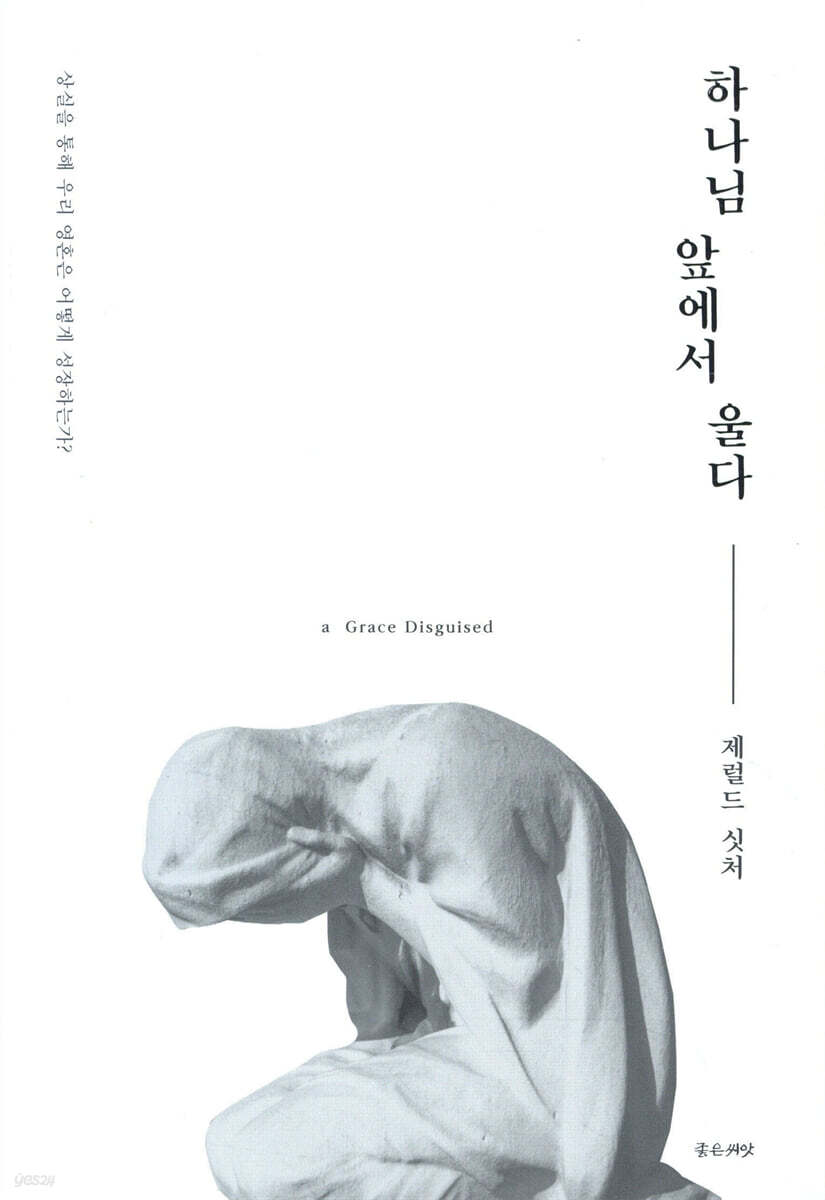
Cry before God
 |
Description
Book Introduction
A gem of a book filled with profound spiritual insight and grace about loss!?
C.
If S. Lewis solved the 'problem of pain' with fierce intellect, Gerald Sitzer poured his whole soul into writing the 'problem of loss'.
Filled with profound spiritual insight and grace about loss, "Weeping Before God" speaks of the tragic experience of loss and the changes it can bring about in our lives.
Instead of offering quick and painless solutions, it shows you the path to a lifelong journey of 'growth'.
Furthermore, it tells us what changes we must bring about in the midst of loss.
C.
If S. Lewis solved the 'problem of pain' with fierce intellect, Gerald Sitzer poured his whole soul into writing the 'problem of loss'.
Filled with profound spiritual insight and grace about loss, "Weeping Before God" speaks of the tragic experience of loss and the changes it can bring about in our lives.
Instead of offering quick and painless solutions, it shows you the path to a lifelong journey of 'growth'.
Furthermore, it tells us what changes we must bring about in the midst of loss.
- You can preview some of the book's contents.
Preview
index
Introduction
1.
The end and the beginning
2.
Can loss be compared?
3.
Go into the darkness
4.
Hear the silent screams of pain
5.
Sailing alone across the vast sea
6.
Breaking away from one's familiar self
7.
Daily life comes to a halt
8.
Loss comes to everyone at any time.
9.
Why not me
10.
Forgive and remember
11.
God is silent
12.
Death is not the final winner
13.
wounded communities
14.
A cloud of witnesses surround us
15.
The future depends on me
1.
The end and the beginning
2.
Can loss be compared?
3.
Go into the darkness
4.
Hear the silent screams of pain
5.
Sailing alone across the vast sea
6.
Breaking away from one's familiar self
7.
Daily life comes to a halt
8.
Loss comes to everyone at any time.
9.
Why not me
10.
Forgive and remember
11.
God is silent
12.
Death is not the final winner
13.
wounded communities
14.
A cloud of witnesses surround us
15.
The future depends on me
Into the book
Whose loss is worse? This question is a flawed one, cleverly missing the point.
Every loss we experience is unique and painful in its own way.
...
What good can come from quantifying loss? What good can result from comparing? The question we should be asking here is not, "Whose is worse?"
The question should be, “What meaning can we find in suffering, and how can we grow through suffering?”
--- p.42 From “The End of Chapter 1, and the Beginning”
It's not true that after experiencing loss we become less happy than before.
Whether we become unhappy when we experience loss is a matter of choice.
It is entirely within our power to choose whether we allow ourselves to be crushed by loss until we are left with nothing but a shell of ourselves, completely subservient to the circumstances.
Loss can make us different, more mature than before.
Even when we walk through the darkness, we can still find light.
Even when we experience death, we can find life.
It's all up to our choice.
--- p.58 From “Chapter 3: Entering the Darkness”
Deep sorrow often causes vanity, pretense, and superficiality to fall from life.
Deep sadness forces us to ask fundamental questions about what is most important in life.
Pain can lead us to a simpler life.
A life that is not confused by non-essential things.
--- p.96 From “Chapter 5: Sailing the Vast Sea Alone”
The problem with the expectation of living in a completely fair world is that in such a world there would be no grace.
Because grace is only grace when it is given to someone who does not deserve it.
--- p.177 From Chapter 9, “Why Not Me”
I, too, have been thinking about heaven often since some time ago.
Life on this earth is real and good.
I have enjoyed the joys of life with those I loved who are no longer on this earth, and I am still enjoying life even now that they are gone.
But life on this earth is not everything.
Sometimes it seems like there is everything, but there is definitely more to it.
There is another life hidden in this land, a reality much greater than the present one.
As philosopher Peter Krieft said, this earth is not the outer reaches of heaven, but heaven's workshop.
It is the womb of heaven.
Every loss we experience is unique and painful in its own way.
...
What good can come from quantifying loss? What good can result from comparing? The question we should be asking here is not, "Whose is worse?"
The question should be, “What meaning can we find in suffering, and how can we grow through suffering?”
--- p.42 From “The End of Chapter 1, and the Beginning”
It's not true that after experiencing loss we become less happy than before.
Whether we become unhappy when we experience loss is a matter of choice.
It is entirely within our power to choose whether we allow ourselves to be crushed by loss until we are left with nothing but a shell of ourselves, completely subservient to the circumstances.
Loss can make us different, more mature than before.
Even when we walk through the darkness, we can still find light.
Even when we experience death, we can find life.
It's all up to our choice.
--- p.58 From “Chapter 3: Entering the Darkness”
Deep sorrow often causes vanity, pretense, and superficiality to fall from life.
Deep sadness forces us to ask fundamental questions about what is most important in life.
Pain can lead us to a simpler life.
A life that is not confused by non-essential things.
--- p.96 From “Chapter 5: Sailing the Vast Sea Alone”
The problem with the expectation of living in a completely fair world is that in such a world there would be no grace.
Because grace is only grace when it is given to someone who does not deserve it.
--- p.177 From Chapter 9, “Why Not Me”
I, too, have been thinking about heaven often since some time ago.
Life on this earth is real and good.
I have enjoyed the joys of life with those I loved who are no longer on this earth, and I am still enjoying life even now that they are gone.
But life on this earth is not everything.
Sometimes it seems like there is everything, but there is definitely more to it.
There is another life hidden in this land, a reality much greater than the present one.
As philosopher Peter Krieft said, this earth is not the outer reaches of heaven, but heaven's workshop.
It is the womb of heaven.
--- p.276 From “Chapter 14: A Cloud of Witnesses Surrounding Us”
Publisher's Review
· “This book touched something deep in my soul.
“It had a profound influence on me, making me think and feel about the issues of life and death in a different way than I had before.” - Richard Maud
“Reading this book helped me prepare for my own sorrows that were to come.
“I hope that someday, when it strikes me, I can remember his book and reread it.” - Louis Smithies
“It had a profound influence on me, making me think and feel about the issues of life and death in a different way than I had before.” - Richard Maud
“Reading this book helped me prepare for my own sorrows that were to come.
“I hope that someday, when it strikes me, I can remember his book and reread it.” - Louis Smithies
GOODS SPECIFICS
- Date of issue: July 25, 2020
- Page count, weight, size: 288 pages | 334g | 130*190*17mm
- ISBN13: 9788958743392
- ISBN10: 8958743395
You may also like
카테고리
korean


korean

![GQ KOREA Mark (Monthly): December [2025]](http://librairie.coreenne.fr/cdn/shop/files/8ef265dbbfbf186523ed75ba7319009d.jpg?v=1765340328&width=3840)


