

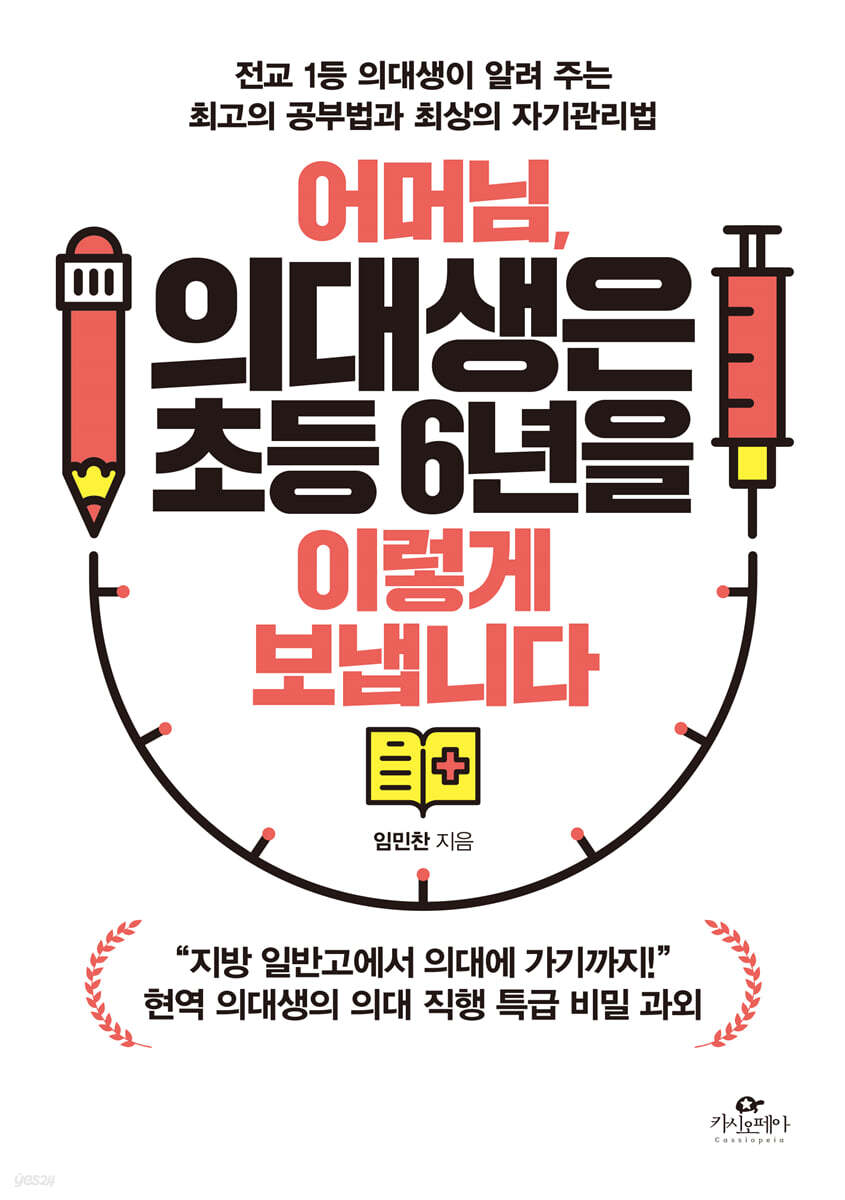
Mom, this is how medical students spend their six years of elementary school.
 |
Description
Book Introduction
From a local high school to medical school! A current medical student's secret private tutoring that will get you straight into medical school. The best study methods and self-management tips from the top medical student in the school. A child who excels in school is different from elementary school! The one and only book for parents who want to raise a child who studies well. What makes a child excel in school? How can we raise a child who excels in school? These are concerns that every parent in Korea has. So who should you ask? A school teacher? A tutor? A mom next door? A private tutor? Perhaps the best option is the advice of a college student who's excelled at studying. This book is written by a top student in the medical school who was known for being a good student since elementary school, and shares the most effective and systematic study methods that he personally found effective. It is a book filled with know-how, self-management secrets, and life guidance know-how that can help you develop lifelong study habits that will last through elementary, middle, and high school. It covers study methods that are good to use in elementary school for each subject (Korean/English/Math), as well as advice on elementary school studies and life in general. It also covers the author's know-how on preparing for school grades and the CSAT for parents of elementary school students who are curious about middle and high school entrance exams and study methods. This is the only essential elementary school study and life guidebook for parents of elementary school students who are beginning to take an interest in their children's education and college entrance exams, and for parents who want to instill lifelong study habits in their children not only during elementary school but also throughout middle, high school, and college. |
- You can preview some of the book's contents.
Preview
index
prolog
Part 1.
Primary study principles for medical students
Studying is more important than staying close.
▶ Three Reasons Why Elementary School Children Disengage from Studying
▶ It's important to give people a choice
▶ It's okay to make mistakes
▶ Three study rules you can learn from elementary school classes
▶ Three Ways to Improve Your Child's Focus
▶ Good things to say to elementary school children who don't know why they need to study
▶ Four characteristics of children who study well
▶ Three Ways to Increase Metacognition
Killing Two Birds: Interest and Habit
▶ What I learned in the classroom after school
▶ For studying science, we recommend the combination of 'experiments + science magazines + science comics'.
▶ Four ways to spark interest in Korean history
▶ Practice writing in your planner for 10 minutes every night
▶ Every Sunday is 'Review Day'
▶ At the end of each semester, a final exam just for my child.
▶ How to Use Learning Coaching to Develop Your Child's Study Habits
Part 2.
Primary School Life Principles for Medical Students
Elementary School Life: Things to Do Before Studying
▶ The six years of elementary school are a time to fill in other elements besides studying.
▶ Please make sure you are close to a bookstore or library.
▶ There are three advantages to doing arts and physical education.
▶ Give them a chance to be proactive
▶ Three tips for gaming problems
▶ Three Ways to Control Your Child's Smartphone Use
▶ Penalties are counterproductive
▶ Three Ways to Build Resilience in Your Child
Tips for Parents on Communicating with Their Children
▶ How should I spend my vacation?
▶ If you record your daily routine, things will change.
▶ Let's open a counseling center just for children.
▶ Two Ways to Help Elementary School Children Who Are Struggling with Friendships
▶ Four great activities to spend time with your child after school
▶ Children do what their parents do, not what their parents tell them to do.
Part 3.
Study methods for elementary school subjects for medical students
Elementary Korean language study tips to improve study skills
▶ In the end, reading is the most important thing
▶ 5-Step Process for Writing Practice
▶ Three reasons why you should correct your bad handwriting
▶ Three reasons why it's good to write
▶ How to Make Your Child Love Korean Language
Practical study methods for elementary math are more important than prior knowledge.
▶ Precedence is not required
▶ Four Ways to Memorize Math Concepts
▶ It is a good idea for your child to study two workbooks independently, separate from the academy.
▶ Descriptive practice is also important in math.
▶ How to Make Your Child Love Math
Elementary English Study Tips for Building Basics
▶ Two Ways to Improve Your English Reading Skills
▶ Three Ways to Improve Your English Writing Skills
▶ Four Tips for Studying Elementary English Vocabulary
▶ How to Make Your Child Love English
Part 4.
Medical Student's Elementary Life Q&A
Principles of studying in middle and high school that you should know and prepare for in advance
▶ Three differences between elementary and middle school
▶ Principle 1.
I constantly think about how to differentiate myself from others.
▶ Principle 2.
On the day of the exam, I focus only on myself.
▶ Principle 3.
My school teacher is the examiner for my final exam.
▶ Principle 4.
Today is the day I'm not the smartest.
Medical students talk about their elementary school life
▶ Q&A ① Three things that helped me when I was in elementary school
▶ Q&A ② Three things I regret not doing in elementary school
▶ Q&A ③ Study methods for each subject that I would like to share with elementary school students
▶ Q&A ④ What I want to say to elementary school students
▶ Q&A ⑤ My own study tips for school grades or the CSAT
▶ Q&A ⑥ What kind of students would benefit from attending medical school?
▶ Q&A ⑦ Something I want to say to elementary school parents
To parents reading this book
▶ There are many things more important than studying during elementary school.
Part 1.
Primary study principles for medical students
Studying is more important than staying close.
▶ Three Reasons Why Elementary School Children Disengage from Studying
▶ It's important to give people a choice
▶ It's okay to make mistakes
▶ Three study rules you can learn from elementary school classes
▶ Three Ways to Improve Your Child's Focus
▶ Good things to say to elementary school children who don't know why they need to study
▶ Four characteristics of children who study well
▶ Three Ways to Increase Metacognition
Killing Two Birds: Interest and Habit
▶ What I learned in the classroom after school
▶ For studying science, we recommend the combination of 'experiments + science magazines + science comics'.
▶ Four ways to spark interest in Korean history
▶ Practice writing in your planner for 10 minutes every night
▶ Every Sunday is 'Review Day'
▶ At the end of each semester, a final exam just for my child.
▶ How to Use Learning Coaching to Develop Your Child's Study Habits
Part 2.
Primary School Life Principles for Medical Students
Elementary School Life: Things to Do Before Studying
▶ The six years of elementary school are a time to fill in other elements besides studying.
▶ Please make sure you are close to a bookstore or library.
▶ There are three advantages to doing arts and physical education.
▶ Give them a chance to be proactive
▶ Three tips for gaming problems
▶ Three Ways to Control Your Child's Smartphone Use
▶ Penalties are counterproductive
▶ Three Ways to Build Resilience in Your Child
Tips for Parents on Communicating with Their Children
▶ How should I spend my vacation?
▶ If you record your daily routine, things will change.
▶ Let's open a counseling center just for children.
▶ Two Ways to Help Elementary School Children Who Are Struggling with Friendships
▶ Four great activities to spend time with your child after school
▶ Children do what their parents do, not what their parents tell them to do.
Part 3.
Study methods for elementary school subjects for medical students
Elementary Korean language study tips to improve study skills
▶ In the end, reading is the most important thing
▶ 5-Step Process for Writing Practice
▶ Three reasons why you should correct your bad handwriting
▶ Three reasons why it's good to write
▶ How to Make Your Child Love Korean Language
Practical study methods for elementary math are more important than prior knowledge.
▶ Precedence is not required
▶ Four Ways to Memorize Math Concepts
▶ It is a good idea for your child to study two workbooks independently, separate from the academy.
▶ Descriptive practice is also important in math.
▶ How to Make Your Child Love Math
Elementary English Study Tips for Building Basics
▶ Two Ways to Improve Your English Reading Skills
▶ Three Ways to Improve Your English Writing Skills
▶ Four Tips for Studying Elementary English Vocabulary
▶ How to Make Your Child Love English
Part 4.
Medical Student's Elementary Life Q&A
Principles of studying in middle and high school that you should know and prepare for in advance
▶ Three differences between elementary and middle school
▶ Principle 1.
I constantly think about how to differentiate myself from others.
▶ Principle 2.
On the day of the exam, I focus only on myself.
▶ Principle 3.
My school teacher is the examiner for my final exam.
▶ Principle 4.
Today is the day I'm not the smartest.
Medical students talk about their elementary school life
▶ Q&A ① Three things that helped me when I was in elementary school
▶ Q&A ② Three things I regret not doing in elementary school
▶ Q&A ③ Study methods for each subject that I would like to share with elementary school students
▶ Q&A ④ What I want to say to elementary school students
▶ Q&A ⑤ My own study tips for school grades or the CSAT
▶ Q&A ⑥ What kind of students would benefit from attending medical school?
▶ Q&A ⑦ Something I want to say to elementary school parents
To parents reading this book
▶ There are many things more important than studying during elementary school.
Detailed image

Into the book
It would be great if children liked to study and did well in their studies as their parents wished.
However, it is not necessary for a child to be closely involved in studies during elementary school.
Not studying hard during this period won't cause any major problems in middle and high school.
However, there are cases where this can be problematic.
This is when an elementary school child becomes distant from studying and develops an aversion to studying.
This is because there is a limit to how hard a child who hated studying in elementary school can suddenly study in middle or high school.
So, during elementary school, it is important to keep children from becoming too close to studying, even if they are not too far away from it.
---From "Three Reasons Why Elementary School Children Disengage from Studying"
The second characteristic is that he studies consistently without any ups and downs.
Doing well on a test once is possible with just a little effort, but consistently getting good grades and showing a good attitude is not easy.
Students who study well and succeed in getting into their desired colleges have this kind of 'consistency.'
Rather than studying a lot some days and not studying at all some days, study consistently and repeatedly every day according to the time you have set for yourself.
To cultivate consistency, it is a good idea to make it a habit to write a study planner.
It is helpful to start writing a planner from elementary school, plan out what you need to study each day, and practice consistently putting it into practice.
---From "Four Characteristics of Children Who Study Well"
So how can we foster an interest in science in elementary school? I recommend a combination of three: experiments, science magazines, and science comics.
I do not recommend reading thick science books in elementary school without going through these three processes.
Because it is important to approach science lightly and be interested in it rather than taking it too seriously.
---From "For studying science, I recommend the combination of 'experiment + science magazine + science comic book'"
One of the common characteristics of students who do well in school during middle and high school is 'sincerity'.
Rather than studying hard some days and not studying other days, I have the consistency and sincerity to complete the amount of work I have to do each day.
If you develop this kind of sincerity as a habit in elementary school, it will be of great help not only in your studies in middle and high school, but also in your daily life.
To this end, I recommend that parents spend 10 minutes each night with their elementary school-age children practicing writing in a planner.
---From "Practice writing a planner for 10 minutes every night"
The second is the fact that 'there are things that can only be done in elementary school.'
The fact that college entrance exams are the result of 12 years of elementary, middle, and high school means that everything you do during those 12 years is reflected in college entrance exams.
The comprehensive student record screening, one of the representative college entrance examinations, is a screening process that reflects the ‘school life record.’
This school record reflects not only grades by subject, but also attitude areas such as leadership and character, as well as secondary abilities such as arts, physical education, and reading.
During middle and high school, ‘grades’ become the most important of these factors.
So, when can we cultivate attitudes like leadership and character, which are crucial elements of a student's college transcript, and secondary skills like arts, physical education, and reading? Right now, in elementary school.
Elementary school is the optimal time to improve your reading level by reading books on various topics, develop your artistic and physical skills through experiences in various fields, gain experience by participating in various competitions, and develop leadership skills by serving as a class officer.
---From "The six years of elementary school are a time to fill in other elements besides studying"
One of the biggest reasons why elementary school children spend more time playing games is because they play a wider variety of games.
I play games on my phone, on my computer, and on various other games, so even if I play each game for 30 minutes, if I play six games, three hours will quickly pass.
So, first of all, I would recommend that you guide your child to play games only on either a cell phone or a computer.
And even if you do one of the two, it is recommended to limit the game types to only one or two.
---From "Three Tips for Game Problems"
When you advance to middle school or high school, you will have to submit many reports and assignments for all subjects, not just Korean.
Performance assessments will also largely consist of writing, and there will be more 'descriptive' tests.
Especially in the case of high school internal exams, writing skills become more important as one of the factors that determines the top grades is how well you solve 'descriptive' problems.
If you don't have a solid foundation in writing, it will be difficult to express what you know in writing.
Even the child's abilities and knowledge may be underestimated.
---From "The 5-Step Process for Practicing Writing"
First of all, the first thing I want to say is that good deeds are not mandatory in elementary school.
These days, math academies often require students to do advanced math, and many students study ahead of others on their own, so some people look at it as strange not to do advanced math in elementary school.
However, in elementary school, even if you don't do the prerequisites, there is no problem at all in keeping up with classes and studying.
So, there is no need to worry about not doing good deeds.
However, ‘review’ and ‘deepening’ are essential.
For the current math curriculum taught in school, it is important to memorize the concepts learned that day and review them by solving problems again.
In fact, in elementary school, deepening is much more important than prior knowledge.
---From "Good deeds are not mandatory"
Even if you send your child to a math academy during elementary school, I recommend that parents help their child work on two workbooks at home independently, separate from the academy's progress.
In my experience, working on two workbooks on my own, separate from the academy's progress, helped me solidify my elementary math skills.
Here, I will tell you how to solve each problem book and what role each problem plays.
---「It is good for children to study two workbooks independently, separately from the academy」
How you study is important, but your attitude toward studying is also important.
Perhaps what makes a top student is the difference in mindset.
I always thought that today was the day I wasn't the smartest while studying for the test.
I have always been humble and tried to learn what I didn't know, and I wasn't afraid of failure in the process.
And on the actual test day, I went into the test with tremendous confidence.
Because the day of the test is when I am the smartest.
Although they are still elementary school children, I hope that their parents will guide them so that they can recognize and study like this in the future.
If you tell your children, "Today is the day I'm not the smartest," they will feel more confident in their studies.
---「Principle 4.
From "Today is the day I'm not the smartest"
The most important thing is to trust your child.
Cherish and value each and every thing your child does and accomplishes, and encourage them.
The sense of accomplishment that comes from accomplishing something on your own will be a major driving force behind your next challenge.
I believe that the best way to be a facilitator is to ask the student's opinion, provide guidance little by little when the student needs it, and provide direction, rather than providing something in advance.
There may be times when you feel confused about whether you should be doing this or not, comparing yourself to other parents' children.
But even in those cases, I think it's appropriate to encourage the child to try it once rather than forcing it.
Even though elementary school students may look young, I think it's a good idea to give them the opportunity to decide for themselves whether or not they need it.
When children make choices like this, they will be able to take initiative and achieve things in the future.
---From "What I Want to Say to Elementary School Parents"
In this book, we introduce to parents of elementary school students good study and learning methods for each subject that their children should use during their elementary school years.
But among the things I've told you, there isn't a single thing that you can say, 'You absolutely must do this,' or 'If you don't do this, you'll be in big trouble.'
During elementary school, it is sufficient to just listen to the school lessons and follow along.
Elementary school is a time to build the basics in order to study properly under better conditions in middle and high school.
Elementary school is a time when there are many things more important than studying.
However, it is not necessary for a child to be closely involved in studies during elementary school.
Not studying hard during this period won't cause any major problems in middle and high school.
However, there are cases where this can be problematic.
This is when an elementary school child becomes distant from studying and develops an aversion to studying.
This is because there is a limit to how hard a child who hated studying in elementary school can suddenly study in middle or high school.
So, during elementary school, it is important to keep children from becoming too close to studying, even if they are not too far away from it.
---From "Three Reasons Why Elementary School Children Disengage from Studying"
The second characteristic is that he studies consistently without any ups and downs.
Doing well on a test once is possible with just a little effort, but consistently getting good grades and showing a good attitude is not easy.
Students who study well and succeed in getting into their desired colleges have this kind of 'consistency.'
Rather than studying a lot some days and not studying at all some days, study consistently and repeatedly every day according to the time you have set for yourself.
To cultivate consistency, it is a good idea to make it a habit to write a study planner.
It is helpful to start writing a planner from elementary school, plan out what you need to study each day, and practice consistently putting it into practice.
---From "Four Characteristics of Children Who Study Well"
So how can we foster an interest in science in elementary school? I recommend a combination of three: experiments, science magazines, and science comics.
I do not recommend reading thick science books in elementary school without going through these three processes.
Because it is important to approach science lightly and be interested in it rather than taking it too seriously.
---From "For studying science, I recommend the combination of 'experiment + science magazine + science comic book'"
One of the common characteristics of students who do well in school during middle and high school is 'sincerity'.
Rather than studying hard some days and not studying other days, I have the consistency and sincerity to complete the amount of work I have to do each day.
If you develop this kind of sincerity as a habit in elementary school, it will be of great help not only in your studies in middle and high school, but also in your daily life.
To this end, I recommend that parents spend 10 minutes each night with their elementary school-age children practicing writing in a planner.
---From "Practice writing a planner for 10 minutes every night"
The second is the fact that 'there are things that can only be done in elementary school.'
The fact that college entrance exams are the result of 12 years of elementary, middle, and high school means that everything you do during those 12 years is reflected in college entrance exams.
The comprehensive student record screening, one of the representative college entrance examinations, is a screening process that reflects the ‘school life record.’
This school record reflects not only grades by subject, but also attitude areas such as leadership and character, as well as secondary abilities such as arts, physical education, and reading.
During middle and high school, ‘grades’ become the most important of these factors.
So, when can we cultivate attitudes like leadership and character, which are crucial elements of a student's college transcript, and secondary skills like arts, physical education, and reading? Right now, in elementary school.
Elementary school is the optimal time to improve your reading level by reading books on various topics, develop your artistic and physical skills through experiences in various fields, gain experience by participating in various competitions, and develop leadership skills by serving as a class officer.
---From "The six years of elementary school are a time to fill in other elements besides studying"
One of the biggest reasons why elementary school children spend more time playing games is because they play a wider variety of games.
I play games on my phone, on my computer, and on various other games, so even if I play each game for 30 minutes, if I play six games, three hours will quickly pass.
So, first of all, I would recommend that you guide your child to play games only on either a cell phone or a computer.
And even if you do one of the two, it is recommended to limit the game types to only one or two.
---From "Three Tips for Game Problems"
When you advance to middle school or high school, you will have to submit many reports and assignments for all subjects, not just Korean.
Performance assessments will also largely consist of writing, and there will be more 'descriptive' tests.
Especially in the case of high school internal exams, writing skills become more important as one of the factors that determines the top grades is how well you solve 'descriptive' problems.
If you don't have a solid foundation in writing, it will be difficult to express what you know in writing.
Even the child's abilities and knowledge may be underestimated.
---From "The 5-Step Process for Practicing Writing"
First of all, the first thing I want to say is that good deeds are not mandatory in elementary school.
These days, math academies often require students to do advanced math, and many students study ahead of others on their own, so some people look at it as strange not to do advanced math in elementary school.
However, in elementary school, even if you don't do the prerequisites, there is no problem at all in keeping up with classes and studying.
So, there is no need to worry about not doing good deeds.
However, ‘review’ and ‘deepening’ are essential.
For the current math curriculum taught in school, it is important to memorize the concepts learned that day and review them by solving problems again.
In fact, in elementary school, deepening is much more important than prior knowledge.
---From "Good deeds are not mandatory"
Even if you send your child to a math academy during elementary school, I recommend that parents help their child work on two workbooks at home independently, separate from the academy's progress.
In my experience, working on two workbooks on my own, separate from the academy's progress, helped me solidify my elementary math skills.
Here, I will tell you how to solve each problem book and what role each problem plays.
---「It is good for children to study two workbooks independently, separately from the academy」
How you study is important, but your attitude toward studying is also important.
Perhaps what makes a top student is the difference in mindset.
I always thought that today was the day I wasn't the smartest while studying for the test.
I have always been humble and tried to learn what I didn't know, and I wasn't afraid of failure in the process.
And on the actual test day, I went into the test with tremendous confidence.
Because the day of the test is when I am the smartest.
Although they are still elementary school children, I hope that their parents will guide them so that they can recognize and study like this in the future.
If you tell your children, "Today is the day I'm not the smartest," they will feel more confident in their studies.
---「Principle 4.
From "Today is the day I'm not the smartest"
The most important thing is to trust your child.
Cherish and value each and every thing your child does and accomplishes, and encourage them.
The sense of accomplishment that comes from accomplishing something on your own will be a major driving force behind your next challenge.
I believe that the best way to be a facilitator is to ask the student's opinion, provide guidance little by little when the student needs it, and provide direction, rather than providing something in advance.
There may be times when you feel confused about whether you should be doing this or not, comparing yourself to other parents' children.
But even in those cases, I think it's appropriate to encourage the child to try it once rather than forcing it.
Even though elementary school students may look young, I think it's a good idea to give them the opportunity to decide for themselves whether or not they need it.
When children make choices like this, they will be able to take initiative and achieve things in the future.
---From "What I Want to Say to Elementary School Parents"
In this book, we introduce to parents of elementary school students good study and learning methods for each subject that their children should use during their elementary school years.
But among the things I've told you, there isn't a single thing that you can say, 'You absolutely must do this,' or 'If you don't do this, you'll be in big trouble.'
During elementary school, it is sufficient to just listen to the school lessons and follow along.
Elementary school is a time to build the basics in order to study properly under better conditions in middle and high school.
Elementary school is a time when there are many things more important than studying.
---From "There are many things more important than studying during elementary school"
Publisher's Review
What do medical students say about the medical school entrance exam fever that has reached elementary school? … “There is no ‘essential’ in elementary school studies!”
The author of "Mother, This is How Medical Students Spend Their Six Years of Elementary School" is a medical student.
After entering medical school, he provided academic counseling to middle and high school students and shared his study and life management know-how through social media and internet platforms, becoming an expert in study methods and entrance exam management.
This was possible because I personally experienced the most competitive medical school entrance exam and knew better than anyone else the concerns and realities of students.
This time, he wrote a book about elementary school life and study methods.
The author says, “There is nothing ‘essential’ in elementary school studies,” hoping that parents of elementary school children will not be swayed by sensational content that says, “You absolutely must do this.”
In this book, which seems to only talk about study methods, the author provides a significant explanation of things that children need to take care of in addition to studying during elementary school.
And, more than anything else, it emphasizes ‘building the basics of studying’ and ‘not losing interest in studying.’
“The most important thing during elementary school is to build a foundation for studying so that children can have a better school life when they advance to middle school, and especially to ensure that they do not lose interest in studying.
There are many things more important than studying.
“It’s about developing hobbies that will be a great help during the six years of middle and high school when you should be focusing on your studies, building good relationships with your parents and friends, and growing as a member of society.”
Is it absolutely necessary to do good deeds? … “In elementary school, ‘review’ and ‘deepening’ are far more important than good deeds.”
With the medical school craze, these days, good deeds are being emphasized from elementary school.
Because we take good deeds for granted, some people look upon those who do not do good deeds as strange.
But is good deeds really necessary? The author says that many middle and high school students he met struggled because they lacked the fundamentals, regardless of whether they had good deeds or not.
In fact, among the 12-year race for college entrance, the '6 years of elementary school' can be said to be a time to prepare for the '6 years of middle and high school' when students must focus on studying in earnest.
In order to focus on studying in earnest in middle and high school, it is important to develop a positive attitude toward studying and develop good habits that will build the basics of studying during elementary school.
The author emphasizes that it is not at all a problem to follow classes and study even if you do not do advance studies in elementary school, and that it is much more important to follow the current situation and do 'review' and 'deep study' than to do advance studies in elementary school.
Leadership, character, arts, physical education, and reading have emerged as important college entrance exam criteria... Elementary school is the only time to fill in the gaps in academics!
Elementary school is the only time when it is important to experience various fields outside of academics, and it is also the only time when one can do so.
The author states that elementary school is the optimal time to develop leadership, character, convergence skills through arts and physical education, and reading skills, which are especially reflected as important evaluation criteria in recent college entrance exams.
So, during elementary school, it is most important to have enough experiences and activities that fill in various elements other than studying.
The author also emphasizes the importance of communication between parents and children during elementary school.
In order for children to study stably during middle and high school, their relationship with their parents is most important.
The book contains a lot of advice that parents who communicate with their children should listen carefully to.
It offers advice on controlling smartphone use and gaming, which are the biggest concerns for parents of elementary school children, as well as various communication tips to address these issues.
Medical students share their vivid stories of elementary school life through interviews... Study tips for cultivating both interest and habit.
What makes this book special is that it offers a wealth of universal and easily accessible study methods that can be applied directly to your child.
In fact, the author did not receive a typical education in a Seoul area school district and was accepted to medical school, but rather achieved acceptance to medical school in a so-called 'provincial' area.
Perhaps that is why the author's advice contains content that can be applied not only to Gangnam school districts or specialized high schools, but also to anyone, regardless of where they live or which school they attend.
Even if your child's goal isn't necessarily to go to medical school, this is helpful information for any parent who wants their child to make the most of their elementary school years to prepare for the six years of middle and high school without trial and error.
You can refer to various examples and know-how to kill two birds with one stone: creating a planner, utilizing the after-school classroom, utilizing study coaching, creating your own final exam just for your child, creating a review day, recommending the best combination for elementary science studies, and how to spark interest in Korean history.
The study method reflects not only the author's own experiences from his elementary school days, but also those of other medical students. In particular, this book includes interviews with medical students in the same department on the topic of 'studying and life in elementary school.'
Medical students share vivid stories about how they spent their elementary school years, what they found helpful in doing in elementary school, what they regret not doing, the study methods for each subject they would like to share with elementary school students, and their own secrets for studying for school grades and the college entrance exam.
It is worth reading and referencing not only to parents but also to students aspiring to medical school.
The author of "Mother, This is How Medical Students Spend Their Six Years of Elementary School" is a medical student.
After entering medical school, he provided academic counseling to middle and high school students and shared his study and life management know-how through social media and internet platforms, becoming an expert in study methods and entrance exam management.
This was possible because I personally experienced the most competitive medical school entrance exam and knew better than anyone else the concerns and realities of students.
This time, he wrote a book about elementary school life and study methods.
The author says, “There is nothing ‘essential’ in elementary school studies,” hoping that parents of elementary school children will not be swayed by sensational content that says, “You absolutely must do this.”
In this book, which seems to only talk about study methods, the author provides a significant explanation of things that children need to take care of in addition to studying during elementary school.
And, more than anything else, it emphasizes ‘building the basics of studying’ and ‘not losing interest in studying.’
“The most important thing during elementary school is to build a foundation for studying so that children can have a better school life when they advance to middle school, and especially to ensure that they do not lose interest in studying.
There are many things more important than studying.
“It’s about developing hobbies that will be a great help during the six years of middle and high school when you should be focusing on your studies, building good relationships with your parents and friends, and growing as a member of society.”
Is it absolutely necessary to do good deeds? … “In elementary school, ‘review’ and ‘deepening’ are far more important than good deeds.”
With the medical school craze, these days, good deeds are being emphasized from elementary school.
Because we take good deeds for granted, some people look upon those who do not do good deeds as strange.
But is good deeds really necessary? The author says that many middle and high school students he met struggled because they lacked the fundamentals, regardless of whether they had good deeds or not.
In fact, among the 12-year race for college entrance, the '6 years of elementary school' can be said to be a time to prepare for the '6 years of middle and high school' when students must focus on studying in earnest.
In order to focus on studying in earnest in middle and high school, it is important to develop a positive attitude toward studying and develop good habits that will build the basics of studying during elementary school.
The author emphasizes that it is not at all a problem to follow classes and study even if you do not do advance studies in elementary school, and that it is much more important to follow the current situation and do 'review' and 'deep study' than to do advance studies in elementary school.
Leadership, character, arts, physical education, and reading have emerged as important college entrance exam criteria... Elementary school is the only time to fill in the gaps in academics!
Elementary school is the only time when it is important to experience various fields outside of academics, and it is also the only time when one can do so.
The author states that elementary school is the optimal time to develop leadership, character, convergence skills through arts and physical education, and reading skills, which are especially reflected as important evaluation criteria in recent college entrance exams.
So, during elementary school, it is most important to have enough experiences and activities that fill in various elements other than studying.
The author also emphasizes the importance of communication between parents and children during elementary school.
In order for children to study stably during middle and high school, their relationship with their parents is most important.
The book contains a lot of advice that parents who communicate with their children should listen carefully to.
It offers advice on controlling smartphone use and gaming, which are the biggest concerns for parents of elementary school children, as well as various communication tips to address these issues.
Medical students share their vivid stories of elementary school life through interviews... Study tips for cultivating both interest and habit.
What makes this book special is that it offers a wealth of universal and easily accessible study methods that can be applied directly to your child.
In fact, the author did not receive a typical education in a Seoul area school district and was accepted to medical school, but rather achieved acceptance to medical school in a so-called 'provincial' area.
Perhaps that is why the author's advice contains content that can be applied not only to Gangnam school districts or specialized high schools, but also to anyone, regardless of where they live or which school they attend.
Even if your child's goal isn't necessarily to go to medical school, this is helpful information for any parent who wants their child to make the most of their elementary school years to prepare for the six years of middle and high school without trial and error.
You can refer to various examples and know-how to kill two birds with one stone: creating a planner, utilizing the after-school classroom, utilizing study coaching, creating your own final exam just for your child, creating a review day, recommending the best combination for elementary science studies, and how to spark interest in Korean history.
The study method reflects not only the author's own experiences from his elementary school days, but also those of other medical students. In particular, this book includes interviews with medical students in the same department on the topic of 'studying and life in elementary school.'
Medical students share vivid stories about how they spent their elementary school years, what they found helpful in doing in elementary school, what they regret not doing, the study methods for each subject they would like to share with elementary school students, and their own secrets for studying for school grades and the college entrance exam.
It is worth reading and referencing not only to parents but also to students aspiring to medical school.
GOODS SPECIFICS
- Date of issue: January 30, 2024
- Page count, weight, size: 256 pages | 364g | 148*210*20mm
- ISBN13: 9791168271678
- ISBN10: 1168271673
You may also like
카테고리
korean


korean

![GQ KOREA Mark (Monthly): December [2025]](http://librairie.coreenne.fr/cdn/shop/files/8ef265dbbfbf186523ed75ba7319009d.jpg?v=1765340328&width=3840)


