

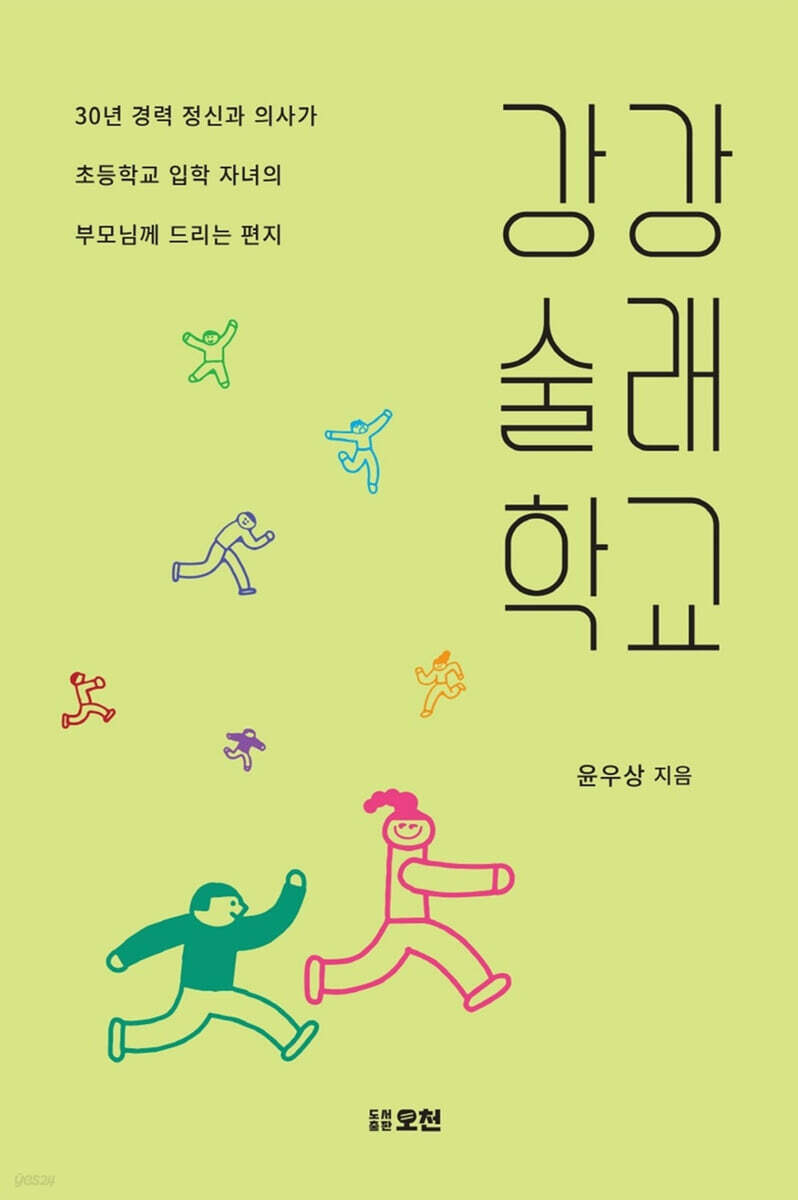
Ganggangsullae School
 |
Description
Book Introduction
A letter from a psychiatrist with 30 years of experience to parents of children entering elementary school.
This is a letter written by the author of 『Mom Psychology Class』 and 『Mom Psychology Class 2』, which have been acclaimed as the 'Bible of Parenting', to parents about what she really wants to tell them.
When their children enter school, parents become more anxious and worried, and try to resolve even the slightest difficulty their children may have.
The more this happens, the less independent the child becomes and the more dependent he or she becomes on his or her parents.
Children are tasked with 'learning' and 'independence', but if parents remain at the level of 'care' and 'anxiety', it can be detrimental to their children.
Parents need a new educational attitude to support their children's growth.
This book tells parents how to view their children as students and how to discipline them.
Additionally, he honestly shares his experience in psychotherapy by discussing what kind of relationship with school and teachers will be helpful for children.
This is a letter written by the author of 『Mom Psychology Class』 and 『Mom Psychology Class 2』, which have been acclaimed as the 'Bible of Parenting', to parents about what she really wants to tell them.
When their children enter school, parents become more anxious and worried, and try to resolve even the slightest difficulty their children may have.
The more this happens, the less independent the child becomes and the more dependent he or she becomes on his or her parents.
Children are tasked with 'learning' and 'independence', but if parents remain at the level of 'care' and 'anxiety', it can be detrimental to their children.
Parents need a new educational attitude to support their children's growth.
This book tells parents how to view their children as students and how to discipline them.
Additionally, he honestly shares his experience in psychotherapy by discussing what kind of relationship with school and teachers will be helpful for children.
- You can preview some of the book's contents.
Preview
index
prolog
Starting the letter
* First letter
My child is perfect
There are two secret codes
Love with colored glasses becomes poisonous.
You have to trust your child's growth rate.
We can't prevent all of a child's handicaps.
The way you look at your child increases their self-esteem.
It's overprotective to try to be nice about behaviors that require discipline.
It is important to develop the habit of seeing children as they are.
* Second letter
I need the strength to not help you
You have to think about what not to do
It is the parent's role to make things difficult for the child.
Selfless children become leaders.
You have to have the mindset to do less.
We need the 'ability not to help'
* Third letter
Discipline is important in school.
Discipline is about creating a healthy superego.
Social discipline can be done in schools.
Emotional wounds are essential experiences for growth.
Life guidance is an essential education in school.
Behavioral therapy is active discipline.
Strict discipline is a 'growth experience'
Growing children show various appearances.
Weakening school discipline is detrimental to us all.
Discipline comes before treatment
You must trust and support your teacher.
* Fourth letter
School is a small society
Experiences of frustration and failure build resilience.
Through the teacher, the child encounters a new world.
If parents distrust their children, they will also distrust their schools.
It's not "educational" for an incident to go to the school violence committee.
The moment the 'law' comes in, relationships and education disappear.
From ‘I protect my child’ to ‘We protect our children’
Don't frame the experience of "growing pains" as "trauma."
* Fifth letter
Empower my child's teacher
Teacher, my heart aches too
The teacher's role is important
Parents' faith becomes the foundation of education.
I hope elementary school becomes the home of children's hearts.
* Sixth letter
Scale up big
Develop invisible abilities in a rapidly changing world.
I wish the first educational philosophy were 'spontaneity'.
The more you touch a child, the less spontaneous they become.
To foster spontaneity, you must trust your child.
Please take a long and broad view of my child's life.
In closing the letter
Epilogue Ganggangsullae School
Starting the letter
* First letter
My child is perfect
There are two secret codes
Love with colored glasses becomes poisonous.
You have to trust your child's growth rate.
We can't prevent all of a child's handicaps.
The way you look at your child increases their self-esteem.
It's overprotective to try to be nice about behaviors that require discipline.
It is important to develop the habit of seeing children as they are.
* Second letter
I need the strength to not help you
You have to think about what not to do
It is the parent's role to make things difficult for the child.
Selfless children become leaders.
You have to have the mindset to do less.
We need the 'ability not to help'
* Third letter
Discipline is important in school.
Discipline is about creating a healthy superego.
Social discipline can be done in schools.
Emotional wounds are essential experiences for growth.
Life guidance is an essential education in school.
Behavioral therapy is active discipline.
Strict discipline is a 'growth experience'
Growing children show various appearances.
Weakening school discipline is detrimental to us all.
Discipline comes before treatment
You must trust and support your teacher.
* Fourth letter
School is a small society
Experiences of frustration and failure build resilience.
Through the teacher, the child encounters a new world.
If parents distrust their children, they will also distrust their schools.
It's not "educational" for an incident to go to the school violence committee.
The moment the 'law' comes in, relationships and education disappear.
From ‘I protect my child’ to ‘We protect our children’
Don't frame the experience of "growing pains" as "trauma."
* Fifth letter
Empower my child's teacher
Teacher, my heart aches too
The teacher's role is important
Parents' faith becomes the foundation of education.
I hope elementary school becomes the home of children's hearts.
* Sixth letter
Scale up big
Develop invisible abilities in a rapidly changing world.
I wish the first educational philosophy were 'spontaneity'.
The more you touch a child, the less spontaneous they become.
To foster spontaneity, you must trust your child.
Please take a long and broad view of my child's life.
In closing the letter
Epilogue Ganggangsullae School
Into the book
What builds a child's self-esteem and makes them confident is how their parents view them.
When parents see their child as they are, their child's self-esteem increases.
When parents see their children as they are, their child's current appearance becomes their individuality, not their inferiority.
Whether a child's unique appearance becomes their individuality is determined by how their parents view them.
---p.38
If you look at parenting books these days, they seem to claim that parents should always be like a 15-degree spring breeze blowing.
Otherwise, you may be afraid that your child's emotions will become seriously ill.
That doesn't make sense.
Parents are the four seasons.
That's natural.
There are spring breezes, but there can also be midsummer storms and winter cold winds.
In those four seasons, flowers bloom fresh.
Can flowers bloom just by the spring breeze? The same goes for children.
---p.72
There has been a rise in the number of students dropping out of school due to uncontrolled behavior problems.
When children who have no experience with discipline in the early grades reach the upper grades, discipline is almost impossible.
When you try to stop their problem behavior, these children rebel, swear, and fight back.
These children often drop out of school due to serious behavioral problems as early as the upper grades, usually middle school.
Many of these students would have developed healthy superegos and gone through school life without any major problems if they had been properly disciplined in the early grades.
---p.90
My child not only protects me, but also protects his teachers, his friends, and other parents.
Teachers and friends are 'on our side'.
Even among those on the same side, there are conflicts and arguments, but we can resolve them healthily within the framework of 'us.'
If you are sending your child to school for the first time with the nervous thought, "I will protect my child," please put it aside and start with a harmonious mindset, thinking, "We will all protect our children."
---p.127
I hope that the word "spontaneity" will be the top priority in your parents' educational philosophy.
Spontaneity is the ability to enjoy your life.
It is the ability to find fun and create meaning in everyday life.
Depending on whether or not the word "spontaneity" exists in the parents' hearts, my child's life will change greatly in 30 years.
I am convinced that the best way to raise children in this day and age is to vividly cultivate the power of spontaneity.
When parents see their child as they are, their child's self-esteem increases.
When parents see their children as they are, their child's current appearance becomes their individuality, not their inferiority.
Whether a child's unique appearance becomes their individuality is determined by how their parents view them.
---p.38
If you look at parenting books these days, they seem to claim that parents should always be like a 15-degree spring breeze blowing.
Otherwise, you may be afraid that your child's emotions will become seriously ill.
That doesn't make sense.
Parents are the four seasons.
That's natural.
There are spring breezes, but there can also be midsummer storms and winter cold winds.
In those four seasons, flowers bloom fresh.
Can flowers bloom just by the spring breeze? The same goes for children.
---p.72
There has been a rise in the number of students dropping out of school due to uncontrolled behavior problems.
When children who have no experience with discipline in the early grades reach the upper grades, discipline is almost impossible.
When you try to stop their problem behavior, these children rebel, swear, and fight back.
These children often drop out of school due to serious behavioral problems as early as the upper grades, usually middle school.
Many of these students would have developed healthy superegos and gone through school life without any major problems if they had been properly disciplined in the early grades.
---p.90
My child not only protects me, but also protects his teachers, his friends, and other parents.
Teachers and friends are 'on our side'.
Even among those on the same side, there are conflicts and arguments, but we can resolve them healthily within the framework of 'us.'
If you are sending your child to school for the first time with the nervous thought, "I will protect my child," please put it aside and start with a harmonious mindset, thinking, "We will all protect our children."
---p.127
I hope that the word "spontaneity" will be the top priority in your parents' educational philosophy.
Spontaneity is the ability to enjoy your life.
It is the ability to find fun and create meaning in everyday life.
Depending on whether or not the word "spontaneity" exists in the parents' hearts, my child's life will change greatly in 30 years.
I am convinced that the best way to raise children in this day and age is to vividly cultivate the power of spontaneity.
---p.166
Publisher's Review
“I hope the children don’t get sick.
I hope my parents don't get sick.
I hope the teacher doesn't get sick.
I hope that our school will become a place where teachers, parents, and children all join hands and dance Ganggangsullae together.”
The author, who has been a psychiatrist for over 30 years, began writing this book out of frustration and sadness after meeting both elementary school teachers and parents who visited his clinic.
The author's best-selling books, "Mom Psychology Class" and "Mom Psychology Class 2: Practical Edition," are referred to as the "Bible of Parenting" among mothers because they help restore the self-esteem of mothers who have been lowered by impatience and anxiety, give them the freedom to see their children as they are, and guide them to enjoy the joy and happiness of living as a mother.
This book also serves as a lighthouse to guide parents with children entering elementary school on what kind of mindset they should have.
This book, which consists of six letters, covers two topics: how I view my child and how I view the school and teachers, regarding what kind of educational attitude I should have as a parent now that my child is a student.
“I have to trust my child’s growth rate.
Each child has their own unique growth schedule.
There are flowers that bloom early and flowers that bloom late.
A flower blooms when you wait, but the more you touch it, the weaker the flower becomes.
“It’s not the average that matters, but the spontaneity and self-reliance that comes from my child.”
In the first letter, written about the anxious mind that becomes more concerned about the child's shortcomings the moment the child enters school, the author talks about two secret codes that influence a child's education: 'Mom's colored glasses' and 'Mom's smell.'
It means to get away from the number game of developmental stages and averages, to see your child as they are, and to shake off the colored glasses, the 'smell of timidity' and the 'smell of anxiety'.
What raises a child's self-esteem and makes them confident is the way parents look at their children.
“The ability that parents need in this day and age is not the ‘ability to help,’ but the ‘ability not to help.’
You need to practice carrying someone's load when you feel like helping.
The more parents help, the weaker their children become.
“It is preventing children from growing into independent human beings.”
The second letter is about the real 'parental power' needed in this era.
When children enter elementary school, there are many things to take care of and do for them.
As we work hard to help our children do better, we end up becoming 'helicopter moms', and later on, we live as manager moms who have to take responsibility for our children's lives until the end, thinking, 'It has to be me.'
As children advance in grade level, there will be more to manage, but the author advises that mothers should be prepared to do less of the work.
"Should a teacher's discipline be considered emotional abuse or a human rights issue? If a teacher fails to provide positive discipline and forces a child to take ADHD medication, that could be 'emotional trauma' and serious 'child abuse.'"
The third letter is about the reality of schools where disciplinary functions are not functioning properly.
School is a place where we learn rules and order, learn social skills, and practice community training. It is a place where we begin to learn to control our desires and to be considerate and respectful of others.
If proper discipline is not provided in the early elementary school years when the superego is not properly developed, problems arise in the formation of the superego, and if problem behaviors are repeated, the child is sent to a counseling center instead of being disciplined in the classroom.
If the problem is not resolved there, the child is sent to a pediatric psychiatric clinic.
As a psychiatrist, I earnestly advise that strict discipline is far more educational and beneficial to the child than medication, given the heartbreaking reality of encountering children in my clinic who could be helped by proper discipline.
“A lot happens at school.
There may be small wounds, but please don't frame the experience of 'growing pains' as 'trauma'."
The fourth letter talks about how to protect not only “my child” but also “our child” by helping the child’s wounds transform into growth in the “safe practice ground” called school.
The author, who has seen many cases in his clinic where minor incidents escalate into a major incident and students who are either the perpetrators or victims suffer from the aftereffects after the school violence committee is held, emphasizes the term 'post traumatic stress growth (PTSG)' instead of 'post traumatic stress disorder (PTSD).
If you accept and overcome trauma after experiencing it, the experience can actually lead to growth.
“The teacher is sick.
My heart aches when I see the children, and my heart aches when I see the parents who are in pain.
“I feel heartbroken by the frustrating education system, I feel heartbroken seeing my fellow teachers struggling, I feel helpless and unable to do anything in this situation, and I feel heartbroken again for blaming myself for not being a proper teacher.”
The fifth letter is about how we should not save our child's life, but rather save the teacher's life.
It is now time for us to protect our teachers so that they can protect our children.
I just want to make sure that the teachers in my child's classroom are confident, enthusiastic, and dedicated to teaching.
I hope that when children grow up, they will remember their school and teachers with pride, longing, and gratitude, and that elementary school will become the home of their hearts.
“My child’s life 30 years from now will be very different depending on whether or not the word ‘spontaneity’ is in the parents’ hearts.
I am convinced that the best way to raise children in this day and age is to vividly cultivate the power of spontaneity.”
The sixth letter discusses how to foster children's spontaneity, which is key to their ability to survive in a rapidly changing world.
“I would tell people to find something that interests them and that they find rewarding.
And we should try to be as helpful to others as possible.” The author explains Elon Musk’s words about the future path of children in this era as ‘spontaneity’, the ability to do interesting and rewarding work on one’s own.
The idea is to reduce the excessive interference of parents' love and to watch over the lives of their children, who are 'bundles of spontaneity', broadly and long-term.
If you listen carefully to these six letters, you will have hope that a school where teachers can teach children with joy, a school where parents can send their children with peace of mind, a school where children can play and learn with their friends, and a Ganggangsullae school that saves children will open.
I hope my parents don't get sick.
I hope the teacher doesn't get sick.
I hope that our school will become a place where teachers, parents, and children all join hands and dance Ganggangsullae together.”
The author, who has been a psychiatrist for over 30 years, began writing this book out of frustration and sadness after meeting both elementary school teachers and parents who visited his clinic.
The author's best-selling books, "Mom Psychology Class" and "Mom Psychology Class 2: Practical Edition," are referred to as the "Bible of Parenting" among mothers because they help restore the self-esteem of mothers who have been lowered by impatience and anxiety, give them the freedom to see their children as they are, and guide them to enjoy the joy and happiness of living as a mother.
This book also serves as a lighthouse to guide parents with children entering elementary school on what kind of mindset they should have.
This book, which consists of six letters, covers two topics: how I view my child and how I view the school and teachers, regarding what kind of educational attitude I should have as a parent now that my child is a student.
“I have to trust my child’s growth rate.
Each child has their own unique growth schedule.
There are flowers that bloom early and flowers that bloom late.
A flower blooms when you wait, but the more you touch it, the weaker the flower becomes.
“It’s not the average that matters, but the spontaneity and self-reliance that comes from my child.”
In the first letter, written about the anxious mind that becomes more concerned about the child's shortcomings the moment the child enters school, the author talks about two secret codes that influence a child's education: 'Mom's colored glasses' and 'Mom's smell.'
It means to get away from the number game of developmental stages and averages, to see your child as they are, and to shake off the colored glasses, the 'smell of timidity' and the 'smell of anxiety'.
What raises a child's self-esteem and makes them confident is the way parents look at their children.
“The ability that parents need in this day and age is not the ‘ability to help,’ but the ‘ability not to help.’
You need to practice carrying someone's load when you feel like helping.
The more parents help, the weaker their children become.
“It is preventing children from growing into independent human beings.”
The second letter is about the real 'parental power' needed in this era.
When children enter elementary school, there are many things to take care of and do for them.
As we work hard to help our children do better, we end up becoming 'helicopter moms', and later on, we live as manager moms who have to take responsibility for our children's lives until the end, thinking, 'It has to be me.'
As children advance in grade level, there will be more to manage, but the author advises that mothers should be prepared to do less of the work.
"Should a teacher's discipline be considered emotional abuse or a human rights issue? If a teacher fails to provide positive discipline and forces a child to take ADHD medication, that could be 'emotional trauma' and serious 'child abuse.'"
The third letter is about the reality of schools where disciplinary functions are not functioning properly.
School is a place where we learn rules and order, learn social skills, and practice community training. It is a place where we begin to learn to control our desires and to be considerate and respectful of others.
If proper discipline is not provided in the early elementary school years when the superego is not properly developed, problems arise in the formation of the superego, and if problem behaviors are repeated, the child is sent to a counseling center instead of being disciplined in the classroom.
If the problem is not resolved there, the child is sent to a pediatric psychiatric clinic.
As a psychiatrist, I earnestly advise that strict discipline is far more educational and beneficial to the child than medication, given the heartbreaking reality of encountering children in my clinic who could be helped by proper discipline.
“A lot happens at school.
There may be small wounds, but please don't frame the experience of 'growing pains' as 'trauma'."
The fourth letter talks about how to protect not only “my child” but also “our child” by helping the child’s wounds transform into growth in the “safe practice ground” called school.
The author, who has seen many cases in his clinic where minor incidents escalate into a major incident and students who are either the perpetrators or victims suffer from the aftereffects after the school violence committee is held, emphasizes the term 'post traumatic stress growth (PTSG)' instead of 'post traumatic stress disorder (PTSD).
If you accept and overcome trauma after experiencing it, the experience can actually lead to growth.
“The teacher is sick.
My heart aches when I see the children, and my heart aches when I see the parents who are in pain.
“I feel heartbroken by the frustrating education system, I feel heartbroken seeing my fellow teachers struggling, I feel helpless and unable to do anything in this situation, and I feel heartbroken again for blaming myself for not being a proper teacher.”
The fifth letter is about how we should not save our child's life, but rather save the teacher's life.
It is now time for us to protect our teachers so that they can protect our children.
I just want to make sure that the teachers in my child's classroom are confident, enthusiastic, and dedicated to teaching.
I hope that when children grow up, they will remember their school and teachers with pride, longing, and gratitude, and that elementary school will become the home of their hearts.
“My child’s life 30 years from now will be very different depending on whether or not the word ‘spontaneity’ is in the parents’ hearts.
I am convinced that the best way to raise children in this day and age is to vividly cultivate the power of spontaneity.”
The sixth letter discusses how to foster children's spontaneity, which is key to their ability to survive in a rapidly changing world.
“I would tell people to find something that interests them and that they find rewarding.
And we should try to be as helpful to others as possible.” The author explains Elon Musk’s words about the future path of children in this era as ‘spontaneity’, the ability to do interesting and rewarding work on one’s own.
The idea is to reduce the excessive interference of parents' love and to watch over the lives of their children, who are 'bundles of spontaneity', broadly and long-term.
If you listen carefully to these six letters, you will have hope that a school where teachers can teach children with joy, a school where parents can send their children with peace of mind, a school where children can play and learn with their friends, and a Ganggangsullae school that saves children will open.
GOODS SPECIFICS
- Date of issue: December 15, 2023
- Page count, weight, size: 180 pages | 289g | 140*200*11mm
- ISBN13: 9791198578907
- ISBN10: 1198578904
You may also like
카테고리
korean


korean

![GQ KOREA Mark (Monthly): December [2025]](http://librairie.coreenne.fr/cdn/shop/files/8ef265dbbfbf186523ed75ba7319009d.jpg?v=1765340328&width=3840)


