

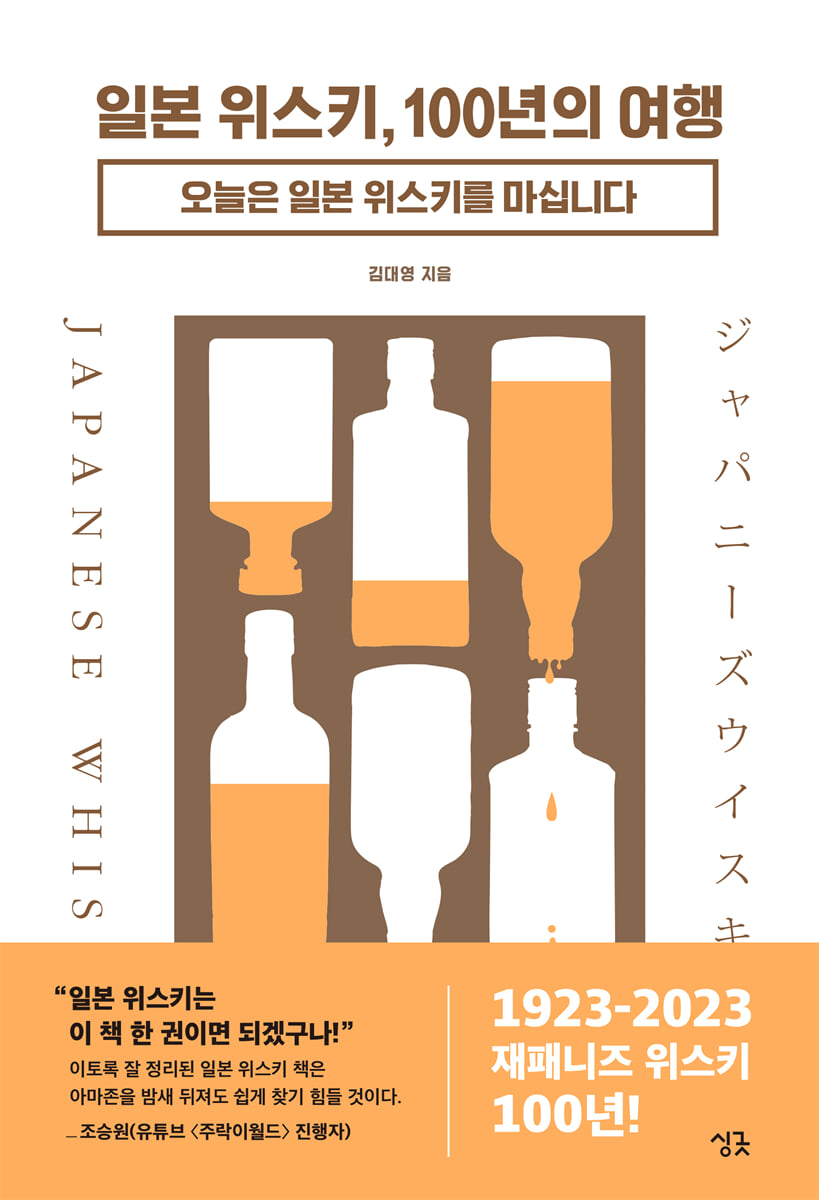
Japanese Whiskey: A 100-Year Journey
 |
Description
Book Introduction
1923-2023, 100 years of Japanese whiskey! From Hokkaido, the northernmost island in Japan, to Okinawa, the southernmost island, Whiskey Lover Kim Dae-young personally visited 22 distilleries and wrote about them. The past, present, and future of Japanese whiskey! Indulge in one of the world's top five whiskies, Japanese whiskey. "You'd be hard-pressed to find a book on Japanese whiskey this well-organized, even if you spent all night searching Amazon." _Jo Seung-won (host of YouTube's "Jurak World") |
- You can preview some of the book's contents.
Preview
index
Recommendation
· Jo Seung-won (host of YouTube's "Jurak World")
Yuichiro Sumiyoshi (Bar LEICHHARDT owner and bartender, whiskey journalist)
introduction
Chapter 1: The Process of Making Japanese Whiskey
How is Japanese whiskey made?
Chapter 2: The Path of Japanese Whiskey Pioneers
1.
The Dawn of Japanese Whiskey
2.
Suntory - Yamazaki, Hakushu, Chita
Ⅰ.
Yamazaki Distillery
Ⅱ.
Hakushu Distillery
Ⅲ.
Chita Distillery
3.
Nikka - Yoichi, Miyagikyo, Kashiwa
Ⅰ.
Yoichi Distillery
Ⅱ.
Miyagikyo Distillery
Ⅲ.
Kashiwa Factory
Chapter 3: Changes in Liquor Tax Law and the Rise and Fall of Japanese Whiskey
: Changes in Japanese liquor tax law
Chapter 4: Whiskey Distilleries During Japan's Rapid Growth Period
1.
Honbo Shuzo - Mars Shinshu, Mars Tsunuki
Ⅰ.
Mars Shinshu Distillery
Ⅱ.
Mars Tsunuki Distillery
2.
Sasanokawa Shuzo - Asaka Distillery
3.
Wakatsuru Shuzo - Saburomaru Distillery
4.
Kirin Distillery - Fuji Gotenba Distillery
Chapter 5: The Beginning of Japanese Craft Whiskey, Chichibu
: Venture Whisky - Chichibu 1st Distillery, Chichibu 2nd Distillery
Ⅰ.
Chichibu First Distillery
Ⅱ.
Chichibu Second Distillery
Chapter 6: The First Japanese Craft Whiskey Boom
1.
Gentenjitsugyo - Akkeshi Distillery
2.
Gomasa Shuzo - Kanosuke Distillery
3.
Gaiaflow Distilling - Gaiaflow Shizuoka Distillery
4.
Nagahama Roman Beer - Nagahama Distillery
Chapter 7: The Second Japanese Craft Whiskey Boom
1.
Niigata Small Distillery - Niigata Kameda Distillery
2.
Hakkaisujo - Niseko Distillery
3.
Shinozaki Shuzo - Shindo Distillery
4.
Yoshida Denzai Industrial Co., Ltd. - Yoshida Denzai Distillery
5.
Kamui Whisky - Kamui Distillery
6.
Karuizawa Distillery - Komoro Distillery
Chapter 8: Companies Supporting the Japanese Whiskey Industry
1.
Miyake Manufacturing
2.
Shimada Wood
3.
T&T Toyama
Chapter 9: 'Japanese Whiskey' Next is 'Japanese Rum'
: Iejima Product Center - Iejima Distillery
Chapter 10: Whiskey Events Across Japan: Japanese Whiskey Events
Acknowledgments | Search
· Jo Seung-won (host of YouTube's "Jurak World")
Yuichiro Sumiyoshi (Bar LEICHHARDT owner and bartender, whiskey journalist)
introduction
Chapter 1: The Process of Making Japanese Whiskey
How is Japanese whiskey made?
Chapter 2: The Path of Japanese Whiskey Pioneers
1.
The Dawn of Japanese Whiskey
2.
Suntory - Yamazaki, Hakushu, Chita
Ⅰ.
Yamazaki Distillery
Ⅱ.
Hakushu Distillery
Ⅲ.
Chita Distillery
3.
Nikka - Yoichi, Miyagikyo, Kashiwa
Ⅰ.
Yoichi Distillery
Ⅱ.
Miyagikyo Distillery
Ⅲ.
Kashiwa Factory
Chapter 3: Changes in Liquor Tax Law and the Rise and Fall of Japanese Whiskey
: Changes in Japanese liquor tax law
Chapter 4: Whiskey Distilleries During Japan's Rapid Growth Period
1.
Honbo Shuzo - Mars Shinshu, Mars Tsunuki
Ⅰ.
Mars Shinshu Distillery
Ⅱ.
Mars Tsunuki Distillery
2.
Sasanokawa Shuzo - Asaka Distillery
3.
Wakatsuru Shuzo - Saburomaru Distillery
4.
Kirin Distillery - Fuji Gotenba Distillery
Chapter 5: The Beginning of Japanese Craft Whiskey, Chichibu
: Venture Whisky - Chichibu 1st Distillery, Chichibu 2nd Distillery
Ⅰ.
Chichibu First Distillery
Ⅱ.
Chichibu Second Distillery
Chapter 6: The First Japanese Craft Whiskey Boom
1.
Gentenjitsugyo - Akkeshi Distillery
2.
Gomasa Shuzo - Kanosuke Distillery
3.
Gaiaflow Distilling - Gaiaflow Shizuoka Distillery
4.
Nagahama Roman Beer - Nagahama Distillery
Chapter 7: The Second Japanese Craft Whiskey Boom
1.
Niigata Small Distillery - Niigata Kameda Distillery
2.
Hakkaisujo - Niseko Distillery
3.
Shinozaki Shuzo - Shindo Distillery
4.
Yoshida Denzai Industrial Co., Ltd. - Yoshida Denzai Distillery
5.
Kamui Whisky - Kamui Distillery
6.
Karuizawa Distillery - Komoro Distillery
Chapter 8: Companies Supporting the Japanese Whiskey Industry
1.
Miyake Manufacturing
2.
Shimada Wood
3.
T&T Toyama
Chapter 9: 'Japanese Whiskey' Next is 'Japanese Rum'
: Iejima Product Center - Iejima Distillery
Chapter 10: Whiskey Events Across Japan: Japanese Whiskey Events
Acknowledgments | Search
Into the book
It was Kakubin who saved Suntory whiskey again.
In 2008, they began promoting the "Kakubin Highball" (abbreviated as Kaku Highball), which is made by mixing Kakubin with carbonated water, and it created a nationwide highball boom.
In Japan, there is a custom of ordering beer first when going to a bar, saying, “First, beer (toriaezu bi-ru)!” However, there are a lot of people who start with a highball, saying, “First, a highball!”
---pp.66-68
In Scotland, there is a culture of exchanging whiskey between distilleries and blending it.
However, since Japan does not have such a culture, if one wants to pursue whisky diversity, one company must make all the whiskies.
---p.91
Tsuru, a limited edition blended whiskey sold only at Yoichi and Miyagikyo Distilleries.
The beautiful bottle design adds elegance when combined with the word 'tsuru', which means 'crane'.
The price of blended whiskey without any aging period is around 14,000 yen.
It may feel a bit expensive, but it's a whiskey that you'll find yourself nodding your head to once you taste it.
---p.139
Currently, Japanese whiskey taxes are set at 37% alcohol content.
It costs 370,000 yen per kiloliter up to 37 degrees, and 10,000 yen per degree is added for each degree above 37 degrees.
To make it easier to understand, based on a bottle of whiskey (700 milliliters), the tax is 280 yen for 40-degree whiskey, 350 yen for 50-degree whiskey, and 420 yen for 60-degree whiskey.
Compared to the 72% liquor tax in Korea, you can see how much the specific tax on whiskey has reduced taxes.
In Korea, even a 10,000 won bottle of whiskey has a tax of 7,200 won.
---p.162
I ordered a glass of Old Overholt Soda.
It was a truly delicious drink, the refreshing carbonation blending with the sweetness of Old Overholt.
I drank it in two gulps and ordered another.
It was the most delicious whiskey and soda drink I've ever had.
---p.197
Through my conversation with President Yamaguchi, I was able to see Japanese whiskey, which had previously been viewed in a rosy light, in a different light.
Will all the young whiskies pouring from the 100 or so Japanese distilleries over the next decade be consumed? Will they be embraced or ignored?
This may be the fate of new distilleries in the future.
---p.208-209
I was so immersed in Akkeshi whiskey that I forgot about the oyster pizza I had ordered.
I was about to eat the next slice after enjoying one, when the bar owner gave me something like a small bottle of oil and told me to sprinkle it on the pizza.
I sprinkled it on the pizza without thinking much about it and the peat aroma started to rise.
Surprisingly, they were sprinkling Akkeshi whiskey on pizza like a sauce.
As I took a bite, the fresh ocean scent of the oysters was enveloped by the cheese, and the peat scent blended with it to create a truly fantastic harmony.
---p.279
The World Whisky Awards, an international whisky competition held annually in London, England.
A Japanese distillery with an unfamiliar name won an award at the 2023 tasting.
In the whiskey spirit category, a product from the Niigata Kameda Distillery won the world's best award.
The main character is 'Niigata Kameda Newport Peated', a whiskey spirit made from peated malt.
“Honestly, I’m happy, but I also feel like we’re just getting started,” said President Hiroyuki Toda.
---p.335
Shindo Distillery has no plans to release whiskey that has not been aged for three years.
There are no plans to rush into releasing a whiskey just because it has been three years.
Shinozaki declared that he had no intention of releasing a whisky that was "just drinkable" into the world.
It may make money right away, but I think it's meaningless if it doesn't taste good in the end.
I thought that the way to go for Shinto whiskey was to try new things while still maintaining the same standards.
---p.371
Newly established craft distilleries import grain whiskey from Scotland and other countries.
Because major Japanese distilleries do not sell grain whiskey.
Blended whiskey from craft distilleries has no choice but to mix in foreign whiskey.
In this situation, if a Japanese distillery that supplies grain whiskey were to emerge, the problem could be solved.
With the idea of 'making Japanese whiskey more like Japanese whiskey', we decided to create a grain whiskey distillery using grains other than malt as the main ingredient.
---pp.374-375
Ian Chang's new home is the Komoro region of Japan.
He joined the Komoro Distillery, founded by Japanese businessman Koji Shimaoka.
Ian Chang was involved in the entire distillery construction project, in addition to his role as Master Blender.
From all the distillery equipment to the maturation room, he incorporated all the whisky experience and knowledge he had honed at Kavalan into the Gomoro Distillery.
In 2008, they began promoting the "Kakubin Highball" (abbreviated as Kaku Highball), which is made by mixing Kakubin with carbonated water, and it created a nationwide highball boom.
In Japan, there is a custom of ordering beer first when going to a bar, saying, “First, beer (toriaezu bi-ru)!” However, there are a lot of people who start with a highball, saying, “First, a highball!”
---pp.66-68
In Scotland, there is a culture of exchanging whiskey between distilleries and blending it.
However, since Japan does not have such a culture, if one wants to pursue whisky diversity, one company must make all the whiskies.
---p.91
Tsuru, a limited edition blended whiskey sold only at Yoichi and Miyagikyo Distilleries.
The beautiful bottle design adds elegance when combined with the word 'tsuru', which means 'crane'.
The price of blended whiskey without any aging period is around 14,000 yen.
It may feel a bit expensive, but it's a whiskey that you'll find yourself nodding your head to once you taste it.
---p.139
Currently, Japanese whiskey taxes are set at 37% alcohol content.
It costs 370,000 yen per kiloliter up to 37 degrees, and 10,000 yen per degree is added for each degree above 37 degrees.
To make it easier to understand, based on a bottle of whiskey (700 milliliters), the tax is 280 yen for 40-degree whiskey, 350 yen for 50-degree whiskey, and 420 yen for 60-degree whiskey.
Compared to the 72% liquor tax in Korea, you can see how much the specific tax on whiskey has reduced taxes.
In Korea, even a 10,000 won bottle of whiskey has a tax of 7,200 won.
---p.162
I ordered a glass of Old Overholt Soda.
It was a truly delicious drink, the refreshing carbonation blending with the sweetness of Old Overholt.
I drank it in two gulps and ordered another.
It was the most delicious whiskey and soda drink I've ever had.
---p.197
Through my conversation with President Yamaguchi, I was able to see Japanese whiskey, which had previously been viewed in a rosy light, in a different light.
Will all the young whiskies pouring from the 100 or so Japanese distilleries over the next decade be consumed? Will they be embraced or ignored?
This may be the fate of new distilleries in the future.
---p.208-209
I was so immersed in Akkeshi whiskey that I forgot about the oyster pizza I had ordered.
I was about to eat the next slice after enjoying one, when the bar owner gave me something like a small bottle of oil and told me to sprinkle it on the pizza.
I sprinkled it on the pizza without thinking much about it and the peat aroma started to rise.
Surprisingly, they were sprinkling Akkeshi whiskey on pizza like a sauce.
As I took a bite, the fresh ocean scent of the oysters was enveloped by the cheese, and the peat scent blended with it to create a truly fantastic harmony.
---p.279
The World Whisky Awards, an international whisky competition held annually in London, England.
A Japanese distillery with an unfamiliar name won an award at the 2023 tasting.
In the whiskey spirit category, a product from the Niigata Kameda Distillery won the world's best award.
The main character is 'Niigata Kameda Newport Peated', a whiskey spirit made from peated malt.
“Honestly, I’m happy, but I also feel like we’re just getting started,” said President Hiroyuki Toda.
---p.335
Shindo Distillery has no plans to release whiskey that has not been aged for three years.
There are no plans to rush into releasing a whiskey just because it has been three years.
Shinozaki declared that he had no intention of releasing a whisky that was "just drinkable" into the world.
It may make money right away, but I think it's meaningless if it doesn't taste good in the end.
I thought that the way to go for Shinto whiskey was to try new things while still maintaining the same standards.
---p.371
Newly established craft distilleries import grain whiskey from Scotland and other countries.
Because major Japanese distilleries do not sell grain whiskey.
Blended whiskey from craft distilleries has no choice but to mix in foreign whiskey.
In this situation, if a Japanese distillery that supplies grain whiskey were to emerge, the problem could be solved.
With the idea of 'making Japanese whiskey more like Japanese whiskey', we decided to create a grain whiskey distillery using grains other than malt as the main ingredient.
---pp.374-375
Ian Chang's new home is the Komoro region of Japan.
He joined the Komoro Distillery, founded by Japanese businessman Koji Shimaoka.
Ian Chang was involved in the entire distillery construction project, in addition to his role as Master Blender.
From all the distillery equipment to the maturation room, he incorporated all the whisky experience and knowledge he had honed at Kavalan into the Gomoro Distillery.
---p.397
Publisher's Review
In 2023, Japanese whiskey history celebrates its 100th anniversary.
Although the image of "Japan is associated with sake" is strong, Japan is one of the "Big 5 whiskey powerhouses" along with Scotland, Ireland, the United States, and Canada. In 2020, whiskey recorded exports of 27.1 billion yen, overtaking sake for the first time in 20 years and regaining its position as Japan's leading alcoholic beverage.
It even ranked second in Japan's total agricultural, forestry, and fishery products and food exports, following scallops, which ranked first.
Although Japanese whiskey is so popular worldwide, no book on it has ever been published in Korea.
Singgut Publishing, the publisher of Korea's first book on bourbon whiskey, has now published Korea's first book on Japanese whiskey, "A 100-Year Journey of Japanese Whiskey - Today, I'm Drinking Japanese Whiskey."
Author Kim Dae-young, a former NHK Seoul bureau reporter, is a whiskey lover who runs the whiskey specialty blog 'Edmond Whiskey' and the Facebook page 'Whiskey Love.'
With a journalistic spirit and a whiskey lover's soul, I personally visited and reported on 22 distilleries, from Hokkaido, the northernmost island in Japan, to Okinawa, the southernmost, from old distilleries to new ones, and compiled them into one book.
The world's leading whiskey-making technology, Japanese talent, and raw materials grown in Japan.
And Japanese whiskey is made with the addition of natural environment.
Japanese whiskey began with Scotch whiskey and Masataka Taketsuru.
This is because the whiskey-making techniques that Masataka Taketsuru, known as the 'father of Japanese whiskey', learned in Scotland over 100 years ago are the beginning.
Not only that, Masataka Taketsuru is also involved in the history of Suntory Whiskey, which started in 1923 and is celebrating its 100th anniversary, Nikka Whiskey, which is celebrating its 90th anniversary in 2024, and Honbo Shuzo Whiskey, which closely follows. In addition, when the first boom in Japanese whiskey was dying down and the industry was in a slump, the story of Taketsuru was depicted in the NHK morning drama “Massan Masan,” which started a new whiskey boom in Japan and spread it to a global boom.
Thus, Japanese whiskey, started by Masataka Taketsuru, has stood tall in the global whiskey market as “Japanese whiskey” by adding the world’s leading manufacturing technology, Japanese talent, raw materials grown in Japan, and Japan’s natural environment, and in 2023, the year of “100 years of Japanese whiskey,” the number of whiskey distilleries in Japan will exceed 100.
As the author states in the preface, “I would like to share with you through this book the story of where the global popularity of Japanese whisky came from,” “what challenges Japanese whisky faces and how to solve them,” the author uses this book to look into the past and present of Japanese whisky as well as to look into the future, based on vivid content from interviews with distilleries and officials who are leading the current Japanese whisky industry along with the 100-year history of Japanese whisky.
Japan, with a 100-year history of whiskey production, has been following in the footsteps of Scotland and the United States.
But it didn't stop at simply following.
From malt grinding to maturation, the entire whiskey production process has been developed to suit the Japanese environment, and in 2019, the world's first 'cast iron still' was developed.
Moreover, it is no longer unusual to see oak casks made from Japanese oak, Mizunara, used in Scottish distilleries or to finish blended whiskies.
(Page 25)
“Life is a journey.
“I hope you enjoy a whiskey journey along the journey of life.”
Whiskey distilleries are broadly categorized into five periods.
① Distilleries of Suntory (Yamazaki, Hakushu, Chita) and Nikka (Yoichi, Miyagikyo) built before the outbreak of World War II ② Whiskey distilleries built after the war (Mars, Asaka, Saburomaru, Fuji Gotenba) ③ Chichibu Distillery, which announced the start of Japanese craft whiskey ④ The first craft whiskey boom created by the success of the Chichibu Distillery (Akkeshi, Kanosuke, Gaia Flow, Nagahama) ⑤ The second craft whiskey boom created by increased whiskey exports (Niigata, Niseko, Shindo, Yoshida Denzai, Kamui, Komoro) We introduce whiskey distilleries that were built in each period.
Not only does it explain the Japanese whiskey-making process and the story of how whiskey was first made in Japan 100 years ago, but it also organizes changes in Japanese liquor tax laws to show the rise and fall of Japanese whiskey at a glance.
In addition, by introducing companies that are driving the development of Japanese whiskey today, such as the whiskey manufacturing equipment manufacturer (Miyake Manufacturing), the oak barrel manufacturer (Shimada Wood), and the Japanese independent whiskey bottling company (T&T Toyama), readers can gain a broader perspective on the 'Japanese whiskey industry.'
Along with this, we also introduce one rum distillery, which is being built in Japan in numbers no less than whiskey distilleries, and finally, we include information on various whiskey events in Japan.
Also, while exploring the distillery, you cannot miss out on the introduction of restaurants and delicacies found near the distillery, and it also introduces unique scenery that can only be seen in Japanese distilleries, such as a shrine shaped like a still built within the distillery, an outdoor foot bath with hot spring water flowing from oak barrels, a still tied with a "shimenawa" which symbolizes the barrier between gods and humans, and an unusual maturation cellar made from an abandoned tunnel, an abandoned school, and even a container, making your "Japanese whiskey tour" even more enjoyable.
'Icharibacho-de-i-chari-bacho-de? de?' (…) This phrase means "once we meet, we are brothers," and can be broadly interpreted as "since all humans are brothers, let's get along well."
Our country has long favored soju, beer, and makgeolli.
There are many siblings of soju and beer around the world, such as whiskey, rum, tequila, agave, gin, calvados, cognac, cider, wine, etc., but they have been neglected.
I hope that from now on, we can all love these drinks and get along well.
All alcohol is brothers, so let's get along! (Page 458)
Although the image of "Japan is associated with sake" is strong, Japan is one of the "Big 5 whiskey powerhouses" along with Scotland, Ireland, the United States, and Canada. In 2020, whiskey recorded exports of 27.1 billion yen, overtaking sake for the first time in 20 years and regaining its position as Japan's leading alcoholic beverage.
It even ranked second in Japan's total agricultural, forestry, and fishery products and food exports, following scallops, which ranked first.
Although Japanese whiskey is so popular worldwide, no book on it has ever been published in Korea.
Singgut Publishing, the publisher of Korea's first book on bourbon whiskey, has now published Korea's first book on Japanese whiskey, "A 100-Year Journey of Japanese Whiskey - Today, I'm Drinking Japanese Whiskey."
Author Kim Dae-young, a former NHK Seoul bureau reporter, is a whiskey lover who runs the whiskey specialty blog 'Edmond Whiskey' and the Facebook page 'Whiskey Love.'
With a journalistic spirit and a whiskey lover's soul, I personally visited and reported on 22 distilleries, from Hokkaido, the northernmost island in Japan, to Okinawa, the southernmost, from old distilleries to new ones, and compiled them into one book.
The world's leading whiskey-making technology, Japanese talent, and raw materials grown in Japan.
And Japanese whiskey is made with the addition of natural environment.
Japanese whiskey began with Scotch whiskey and Masataka Taketsuru.
This is because the whiskey-making techniques that Masataka Taketsuru, known as the 'father of Japanese whiskey', learned in Scotland over 100 years ago are the beginning.
Not only that, Masataka Taketsuru is also involved in the history of Suntory Whiskey, which started in 1923 and is celebrating its 100th anniversary, Nikka Whiskey, which is celebrating its 90th anniversary in 2024, and Honbo Shuzo Whiskey, which closely follows. In addition, when the first boom in Japanese whiskey was dying down and the industry was in a slump, the story of Taketsuru was depicted in the NHK morning drama “Massan Masan,” which started a new whiskey boom in Japan and spread it to a global boom.
Thus, Japanese whiskey, started by Masataka Taketsuru, has stood tall in the global whiskey market as “Japanese whiskey” by adding the world’s leading manufacturing technology, Japanese talent, raw materials grown in Japan, and Japan’s natural environment, and in 2023, the year of “100 years of Japanese whiskey,” the number of whiskey distilleries in Japan will exceed 100.
As the author states in the preface, “I would like to share with you through this book the story of where the global popularity of Japanese whisky came from,” “what challenges Japanese whisky faces and how to solve them,” the author uses this book to look into the past and present of Japanese whisky as well as to look into the future, based on vivid content from interviews with distilleries and officials who are leading the current Japanese whisky industry along with the 100-year history of Japanese whisky.
Japan, with a 100-year history of whiskey production, has been following in the footsteps of Scotland and the United States.
But it didn't stop at simply following.
From malt grinding to maturation, the entire whiskey production process has been developed to suit the Japanese environment, and in 2019, the world's first 'cast iron still' was developed.
Moreover, it is no longer unusual to see oak casks made from Japanese oak, Mizunara, used in Scottish distilleries or to finish blended whiskies.
(Page 25)
“Life is a journey.
“I hope you enjoy a whiskey journey along the journey of life.”
Whiskey distilleries are broadly categorized into five periods.
① Distilleries of Suntory (Yamazaki, Hakushu, Chita) and Nikka (Yoichi, Miyagikyo) built before the outbreak of World War II ② Whiskey distilleries built after the war (Mars, Asaka, Saburomaru, Fuji Gotenba) ③ Chichibu Distillery, which announced the start of Japanese craft whiskey ④ The first craft whiskey boom created by the success of the Chichibu Distillery (Akkeshi, Kanosuke, Gaia Flow, Nagahama) ⑤ The second craft whiskey boom created by increased whiskey exports (Niigata, Niseko, Shindo, Yoshida Denzai, Kamui, Komoro) We introduce whiskey distilleries that were built in each period.
Not only does it explain the Japanese whiskey-making process and the story of how whiskey was first made in Japan 100 years ago, but it also organizes changes in Japanese liquor tax laws to show the rise and fall of Japanese whiskey at a glance.
In addition, by introducing companies that are driving the development of Japanese whiskey today, such as the whiskey manufacturing equipment manufacturer (Miyake Manufacturing), the oak barrel manufacturer (Shimada Wood), and the Japanese independent whiskey bottling company (T&T Toyama), readers can gain a broader perspective on the 'Japanese whiskey industry.'
Along with this, we also introduce one rum distillery, which is being built in Japan in numbers no less than whiskey distilleries, and finally, we include information on various whiskey events in Japan.
Also, while exploring the distillery, you cannot miss out on the introduction of restaurants and delicacies found near the distillery, and it also introduces unique scenery that can only be seen in Japanese distilleries, such as a shrine shaped like a still built within the distillery, an outdoor foot bath with hot spring water flowing from oak barrels, a still tied with a "shimenawa" which symbolizes the barrier between gods and humans, and an unusual maturation cellar made from an abandoned tunnel, an abandoned school, and even a container, making your "Japanese whiskey tour" even more enjoyable.
'Icharibacho-de-i-chari-bacho-de? de?' (…) This phrase means "once we meet, we are brothers," and can be broadly interpreted as "since all humans are brothers, let's get along well."
Our country has long favored soju, beer, and makgeolli.
There are many siblings of soju and beer around the world, such as whiskey, rum, tequila, agave, gin, calvados, cognac, cider, wine, etc., but they have been neglected.
I hope that from now on, we can all love these drinks and get along well.
All alcohol is brothers, so let's get along! (Page 458)
GOODS SPECIFICS
- Date of issue: January 2, 2024
- Format: Hardcover book binding method guide
- Page count, weight, size: 480 pages | 146*217*30mm
- ISBN13: 9791192968896
- ISBN10: 1192968891
You may also like
카테고리
korean


korean

![GQ KOREA Mark (Monthly): December [2025]](http://librairie.coreenne.fr/cdn/shop/files/8ef265dbbfbf186523ed75ba7319009d.jpg?v=1765340328&width=3840)


